


A problem you do not have yet is eating the week, because the future one got the hours and the present one waited. Getting Real, chapter 17, says to make the decision just in time, when the real information is in front of you. Name this week’s problem, park the future one, and set the date you will look again.
Key takeaways
- A problem you do not have yet eats the week when a future system gets the hours and the live job waits.
- Getting Real, by Basecamp, in chapter 17 of the PDF read on 17 November 2026, says not to waste time on problems you do not have yet, and to make the decision just in time, when the real information is in front of you.
- That chapter’s account of Basecamp is that they launched without the ability to bill customers, because the product billed in monthly cycles, so they had a 30-day gap, solved more urgent problems, and tackled billing after launch.
- Chapter 3 of the same PDF says a weapons system, a nuclear control plant, a banking system for millions of customers, or another life or finance-critical system should take additional precautions.
- The four-line note — this week, not yet, the date, and the sentence — is for a solo founder or a new manager. The pages read do not state a publication year. No ISBN was checked.
What a future problem is
A problem you do not have yet is a system for a failure, a scale, or a hire that has not arrived, while the live job waits. You are a solo founder. The client file is still open. You spent Monday on an invoicing tool, Tuesday on permissions for a team you have not hired, and Wednesday on a plan for the week you have a hundred customers. Thursday the client asks where the file is. You are a new manager. One person reports to you. You spent the week writing a performance-review cycle, an escalation ladder, and a rota for an on-call that does not exist. The live delivery is still the thing they asked about on Monday.
The future problem feels responsible. It has a name, a diagram, and a reason it will hurt later. The live problem is smaller and already in the room. The hours went to the one with the diagram. Getting Real’s chapter 17, on page 39 of the PDF read for this page, names that habit in one line: do not waste time on problems you do not have yet. The move underneath it is just in time. You decide when the real information is in front of you, and until then you spend the care on what already requires it.
This page is the case where the problem has not arrived. A build with no appetite is a problem you already chose, with no number of days on it. A week where everything is urgent is a pile of live items. A Monday with no priority is a full list of real work and no cut. You can have a short Monday list and still spend it on a system for a problem that is two years away.
What the chapter says
Chapter 17 of Getting Real says to make the decision just in time, when you have the real information, and to leave the future problem until you must. The book on the title page is Getting Real: The smarter, faster, easier way to build a successful web application, by Basecamp. The copy read on 17 November 2026 is the PDF at basecamp.com/gettingreal/getting-real.pdf. The contents page at basecamp.com/gettingreal, opened the same day, lists chapter 17 as “It’s a Problem When It’s a Problem.” That chapter is page 39 of the PDF. The title page names Basecamp and does not name an individual author. The pages read do not state a publication year. No ISBN was in the file, so none is given.
The chapter opens with three questions, and they are questions, not targets. Do you need to worry about scaling to 100,000 users today if it will take you two years to get there? Do you have to hire eight programmers if you only need three today? Do you need 12 top-of-the-line servers now if you can run on two for a year? Those numbers belong to the questions. They are not a benchmark for your company, and they are not a forecast.
The heading under the questions is “Just Wing It.” The paragraph says people often spend too much time up front trying to solve problems they do not even have yet. Then it gives Basecamp’s own account. They launched Basecamp without the ability to bill customers. The product billed in monthly cycles, so they knew they had a 30-day gap to figure billing out. They used that time to solve more urgent problems and, after launch, tackled billing. They say it worked out fine, and that the gap forced them into a simple solution without unnecessary bells and whistles. That is their account of their product. It is not an instruction to ship a client job without a way to be paid.
The close of the chapter is the line this page uses. Do not sweat it until you actually must. Do not overbuild. If you are slow for a week or two, they say, it is not the end of the world: be honest, and explain to your customers that you are experiencing growing pains. They may not be thrilled. They will appreciate the candor. The bottom line, in their words, is to make decisions just in time, when you have access to the real information you need. In the meanwhile, lavish attention on the things that require immediate care.
Chapter 1, on page 10 of the same PDF, says the book’s emphasis is a web app and that a lot of the ideas apply to non-software work too, including starting a business. That sentence is why a solo founder who is not writing software, and a new manager who is not shipping a web app, can use the order. It is not a study of managers. Chapter 3, on page 12, is the limit, and it has its own section below.
| What is in front of you | What it is | What you do this week |
|---|---|---|
| A live job, a live person, a live file | A problem you have | Put it on the this-week line. Give it the hours. |
| A scale, a hire, or a failure that has not happened | A problem you do not have yet | Name it, park it, and write the date you will look again. |
| The same future problem, and now one real instance of it | It has arrived | Move it to this week. Solve the smallest version the instance supports. |
| A weapons system, a nuclear control plant, a banking system for millions of customers, or another life or finance-critical system | The chapter 3 caveat | Take the additional precautions. Do not wing it. |
The note before you build it
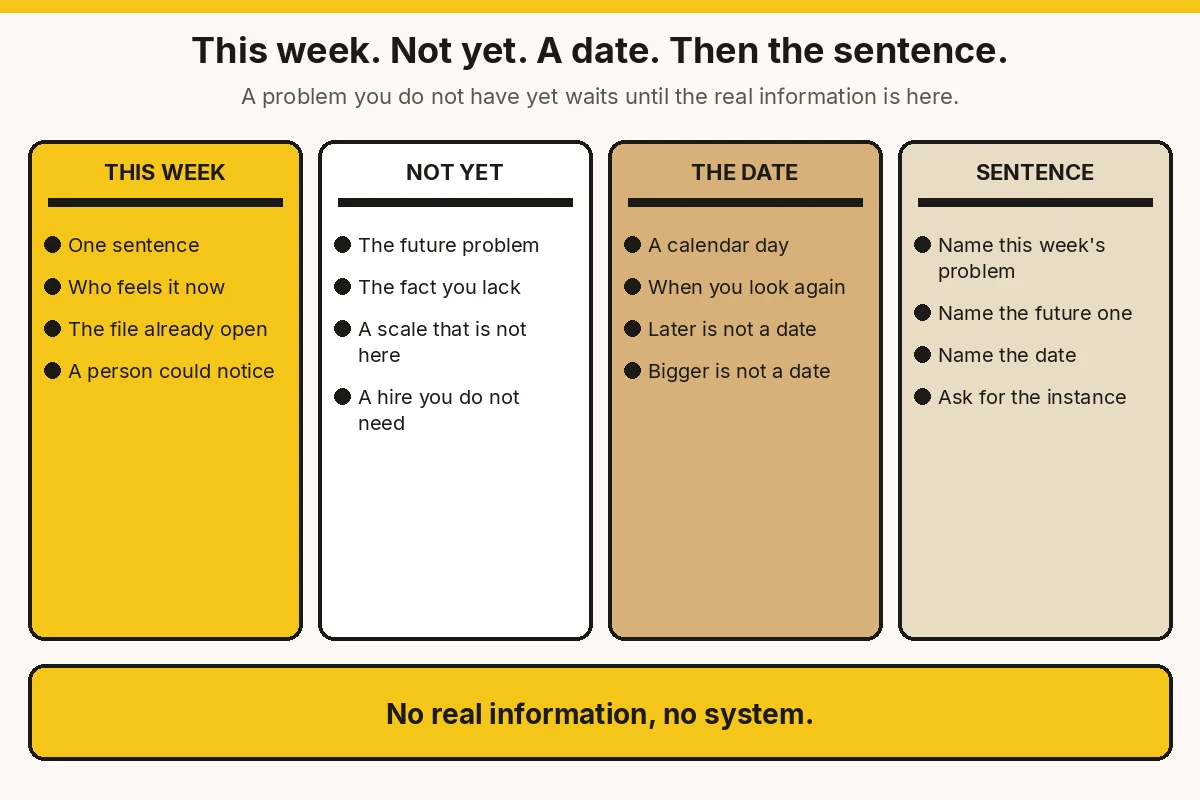
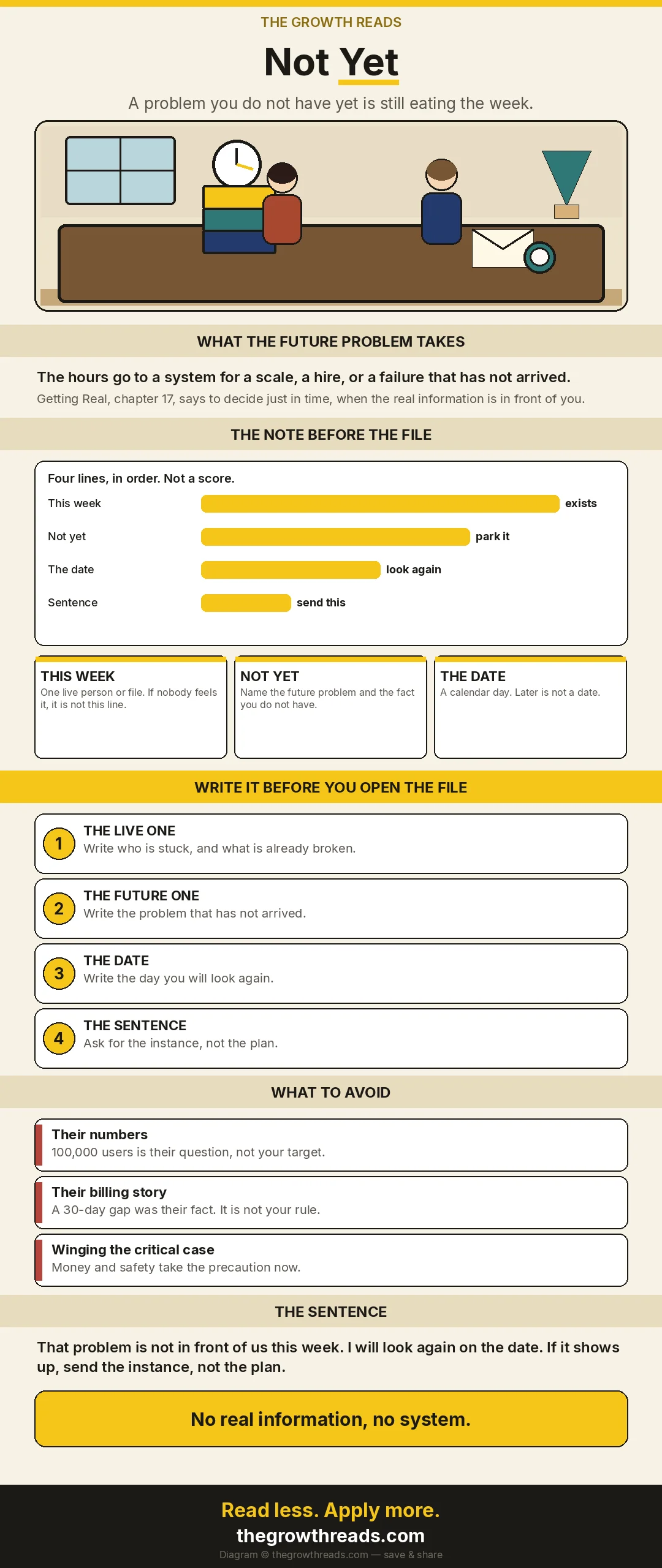
Write four lines before you open a file on a problem that has not arrived. The lines are this page’s application. They are not a form in Getting Real. The chapter gives the order: real information first, the decision second, and the future problem only when you must. The note is how a solo founder or a new manager keeps that order on a Tuesday.
1. This week. One sentence. Who feels it. What is already broken. If you cannot name a person or a file, it is not this line.
2. Not yet. The future problem, in one sentence, and the information you do not have. “A billing system for a product that does not bill yet” is a not-yet line. “The client has not been paid for the file we already delivered” is not.
3. The date. A calendar date you will look at the not-yet line again. “Later” is not a date. “When we are bigger” is not a date.
4. The sentence. What you send when someone asks you to build the future one now. The words are below. If you cannot send them, you have not parked it.
Read the four lines out loud. The this-week line should be something a person could notice if you ignored it for seven days. The not-yet line should be something that would still be true if you did nothing until the date. If both lines describe the same pain, you have one problem, and it belongs on the first line.
The sentence you send
Send the sentence before you open the file on the future problem. Say it to the client, to the person who reports to you, or to yourself. The brackets are the two lines you already wrote.
That problem is not in front of us this week. This week’s problem is [the live one]. I will look at [the future one] on [the date]. If it shows up before then, send me the instance, not the plan.
Three replies follow, and only one of them starts the future work.
- It matches. They accept the date. You do the this-week line. The future file stays closed.
- An instance arrived. They send one real case, not a plan for every case. You move that case onto the this-week line and solve the smallest version the case supports. You still do not design the two-year version.
- They want the plan anyway. You repeat the date. You do not open the file to be agreeable. A plan for a problem you do not have is the thing the chapter tells you to stop spending the week on.
When it is already here
When one real instance is in the room, the problem is no longer a future problem. The chapter’s billing story is this case, told about their own product. They did not have billing on launch day. They did have a fact: the product billed in monthly cycles, so a 30-day gap was real information, not a wish. They used the gap for more urgent problems, then tackled billing, and they say the constraint made the solution simpler. Your gap is not their 30 days. Your product is not Basecamp. The part that transfers is the test. Do you have a real interval, a real instance, or only a worry?
A client who cannot pay an invoice you already sent is an instance. Build the smallest way to take that payment. A client who might someday want net-30 terms, when nobody has asked, is a not-yet line. A server that fell over this morning is an instance. Twelve servers for a traffic level you hope to have in two years is the chapter’s third question, and the answer they want is that you do not buy them today. If the one server you have is slow, their instruction is to be honest about the growing pain, and to add hardware as necessary, not to design the farm first.
The 100,000 users, the eight programmers, and the twelve servers stay inside their questions. Do not paste them into a plan and call them your forecast. If your real number is two customers and one contractor, the this-week line is those two customers. The hire you do not need today goes on the not-yet line with a date.
When you do not wing it
Chapter 3 says the laissez-faire attitude stops at a life or finance-critical system, and you take additional precautions there. The list on page 12 is specific. A weapons system. A nuclear control plant. A banking system for millions of customers. Or some other life or finance-critical system. They say you are going to balk, and that you should take the precautions. They also say it does not have to be all or nothing: you can use some of the ideas and leave the rest.
“Just Wing It” is the heading of chapter 17. It is not a permission slip for the list in chapter 3. A solo founder holding client money, payroll, or medical information is closer to that list than to a chat feature. Park the imaginary scale. Do not park the control that keeps money or safety intact. A new manager can write the four lines for a status ritual nobody needs yet, and still refuse to wing the process that pays people or that handles a safety incident. The book says to use your judgement. This page’s judgement is the same list: if a wrong call is hard to reverse and the harm is to a person or to money you are holding for someone else, the not-yet line does not apply. You take the precaution now, at the size you actually are.
When you are the only pair of hands
Write the four lines to yourself before Sunday night becomes a build. A solo founder does not have a second person to send the sentence to. The ask still arrives. It arrives as a note you wrote to yourself: “we should really have a proper permissions model,” “we should be ready to hire,” “we should not get embarrassed if this gets big.” Those sentences are the future problem wearing your handwriting. Put them on line two. Put the live file on line one. Put a date on line three. Line four is the sentence you will read when you open the laptop and the future problem looks more interesting than the file.
A new manager with one report has the same trap in a smaller room. The report is waiting on a decision about the live job. The document you are tempted to write is a system for the team you expect to have. Send the sentence, with their name in it, and do the live decision the same day. The piece on being the bottleneck is the handoff when work waits on you. This page is the prior cut: some of the work should not be in your hands at all, because the problem has not arrived. A company that still depends on your hours is a capacity cut. Parking a future system gives hours back. It does not, by itself, name the one thing you will stop.
Common mistakes
- Treating their questions as your targets. 100,000 users, eight programmers, and twelve servers are the questions in chapter 17. They are not a plan.
- Copying the billing launch. They launched Basecamp without billing because of a monthly cycle and a 30-day gap they already had. That is their account. It is not a rule that you deliver client work with no way to be paid.
- Parking an instance. One real case moves to the this-week line. A plan for every future case stays parked. The sentence asks for the instance, not the plan.
- Writing “later” instead of a date. The third line is a calendar date. Without it, the future problem returns every Sunday and looks new.
- Winging chapter 3. A life or finance-critical system takes the precautions. The heading “Just Wing It” does not cover that list.
- Calling preparation an appetite. An appetite puts days on a problem you have chosen. This page refuses a problem that has not arrived. Name which one you are in before you open the file.
- Using a nod as the park. A nod is not a restatement of the live job. Parking the future problem does not check the file they are about to bring back. Do the backbrief on the this-week line, and keep the future one closed.
What the source does and does not say
The PDF gives you the just-in-time line, three questions, Basecamp’s billing account, and a caveat for life and finance-critical systems. It does not give you the four-line note or a result for a one-person studio. Chapter 17 was read in full, on page 39. The chapter 1 note on page 10 and the chapter 3 caveat on page 12 were read the same day. The contents page was opened and lists the same chapter title. The rest of the book was not used.
| Source | What was read | What this page uses | What this page does not use |
|---|---|---|---|
| Getting Real, by Basecamp. PDF at basecamp.com/gettingreal/getting-real.pdf. Contents at basecamp.com/gettingreal. | Title page. Chapter 17 in full, PDF page 39. Chapter 1’s note that the ideas apply beyond a web app, including starting a business, PDF page 10. Chapter 3’s caveat on life and finance-critical systems, PDF page 12. The contents list, which names chapter 17 “It’s a Problem When It’s a Problem.” | Do not waste time on problems you do not have yet. The three questions, kept as questions. Their account of launching Basecamp without billing, a monthly cycle, and a 30-day gap. Decide just in time, when the real information is in front of you. Be honest about growing pains. Take additional precautions for the systems chapter 3 names. The transfer to non-software work is their sentence, not a study. | Any publication year, because the pages do not state one. Any ISBN, because the file does not contain one. Their user counts and product claims in other chapters. The instruction to copy “launch without billing.” A promise that a week or two of slowness is fine for every business. The four-line note and the three replies, which are this page’s application. |
They are writing about how they build software at Basecamp. Chapter 1 says many of the ideas can guide other work, including starting a business. That is as far as the transfer goes. The four-line note is our application for a solo founder or a new manager. It is not a measured claim about how often a small team ships, and it is not a finding that future problems are always imaginary. Some of them arrive. The date is how you notice.
Frequently asked questions
What does it mean that you are solving a problem you do not have yet?
A problem you do not have yet is a system for a scale, a hire, or a failure that has not arrived, while a live job waits. A solo founder spends the week on invoicing or on a plan for people who are not here. A new manager writes a review cycle for a team of one. Getting Real, chapter 17, on page 39 of the PDF read on 17 November 2026, says not to waste time on problems you do not have yet. The four lines on this page name this week, the future problem, the date, and the sentence you send.
What does Getting Real say about a problem you do not have yet?
Chapter 17 says people often spend too much time up front on problems they do not even have yet. The bottom line is to make decisions just in time, when you have the real information you need, and to put your care on what needs it now. The chapter asks whether you need to plan for 100,000 users, eight programmers, or twelve servers before those are your facts. Those figures are questions in the book. They are not a target for your company. The title page credits Basecamp. It does not name an individual author, and it does not print a year.
What is a just-in-time decision in this chapter?
A just-in-time decision, in chapter 17’s bottom line, is a decision you make when the real information is in front of you. Until then you do not build the system for the future case. You spend the time on the problem that already requires care. On this page that order becomes four lines: the live problem, the future one, a calendar date, and the sentence you send if someone asks you to build the future one now. The phrase “just in time” is theirs. The four lines are not in the book. If the information is already in the room, the decision is due this week.
What do you write before you build the future system?
Write four lines, in this order. This week: one sentence for the person or the file that is already stuck. Not yet: the future problem, and the information you do not have. The date: a calendar day you will look again, not the word later. The sentence: this week’s problem, the future one, the date, and a request for an instance rather than a plan. If you cannot name the live problem, you are not ready to call the other one future. If you cannot name the date, the future problem will return as if it were new. The file stays closed until an instance arrives.
Did Basecamp launch without billing, and should you copy that?
The chapter says they launched Basecamp without the ability to bill customers. The product billed in monthly cycles, so they had a 30-day gap, used it on more urgent problems, and tackled billing after launch. They say it worked out and kept the solution simple. That is their account of their product. It is not a rule that you deliver client work with no way to be paid. Copy the test, not the anecdote. A real interval you already have is information. A hope that you will sort out payment later, with no interval, is a future problem you should not build your week on.
What if the future problem shows up this week?
One real instance moves the problem onto the this-week line. Solve the smallest version that instance supports. A client who cannot pay an invoice you already sent is an instance. A server that fell over this morning is an instance. A wish for net-30 terms nobody has asked for, or twelve servers for traffic you hope to have in two years, stays on the not-yet line. Ask for the instance, not the plan. The two-year version stays closed even after the small version ships. Their chapter says to increase hardware as necessary, and to be honest if you are slow, not to design the farm first.
When should you refuse to wing it?
Chapter 3, on page 12 of the same PDF, names the limit. A weapons system, a nuclear control plant, a banking system for millions of customers, or another life or finance-critical system should take additional precautions. The heading “Just Wing It” belongs to chapter 17 and does not erase that list. Client money, payroll, and safety sit closer to the caveat than a chat feature does. Park the imaginary scale. Keep the control that protects a person or money you are holding.
Did this page use a print year or an ISBN?
No. The book on the title page is Getting Real, by Basecamp. The text read on 17 November 2026 is the PDF at basecamp.com/gettingreal/getting-real.pdf. Chapter 17 is page 39 of that file. The contents page at basecamp.com/gettingreal was opened the same day. The pages do not state a publication year, so none is given. No ISBN was in the file. Their billing story stays their account of Basecamp. The four-line note and the three replies are our application. They are not a measured claim about how often a one-person shop ships the live job.
Sources
- Basecamp. Getting Real: The smarter, faster, easier way to build a successful web application. Online PDF. Read 17 November 2026 from basecamp.com/gettingreal/getting-real.pdf. The contents page, opened the same day, is basecamp.com/gettingreal. Chapter 17, “It’s a Problem When It’s a Problem,” is page 39 of the PDF and was read in full. Chapter 1’s note on non-software work, including starting a business, is page 10. Chapter 3’s caveat on life and finance-critical systems is page 12. The title page says “by Basecamp” and names no individual author. The pages state no publication year. No ISBN was in the file. The four-line note is not in the book.
Related reading on The Growth Reads
- The build has no appetite — days on a problem you already chose
- Everything is marked urgent — a pile of live items, not a future system
- Monday has no priority — a cut of real work for the week
- You are the bottleneck — work that waits on your decision
- The company still depends on your hours — the capacity cut after you park the future one
- They nodded, and the work came back — the restatement of the live job
- Productivity — the cluster this article sits in
- How we review — what a checked source is, and what an unread chapter is not
How this was checked
Who it is for. A solo founder or a new manager whose week goes to a system for a problem that has not arrived, while the live job waits.
What was read. Getting Real, by Basecamp, online PDF, on 17 November 2026: the title page, chapter 17 in full on page 39, the chapter 1 note on page 10, and the chapter 3 caveat on page 12. The contents page at basecamp.com/gettingreal was opened the same day and lists chapter 17 as “It’s a Problem When It’s a Problem.”
What was not read. The other chapters. No print edition. No ISBN, because the file does not contain one. No publication year, because the pages do not state one. The file’s metadata is not treated as a publication year.
Limit. The four-line note and the three replies are our application. They are not a measured lift in how often the live job ships. Basecamp’s billing story stays inside their account of their product. Their three questions stay questions.
How we work: every article on The Growth Reads is built from books we have read and from primary accounts we can check, and it is date-stamped when those sources change. Read our methodology.