

★★★★☆ 4.6/5 — End the status recital. Their ten minutes, your ten, then one decision and one owner.
Best for: A new manager, or a solo founder with one other person, whose 1:1 only retells finished work.
Reading time: ~5 hrs · This guide: 15 min · Difficulty to apply: The agenda is simple. Protecting the half hour is the hard part.
The Effective Manager in one minute
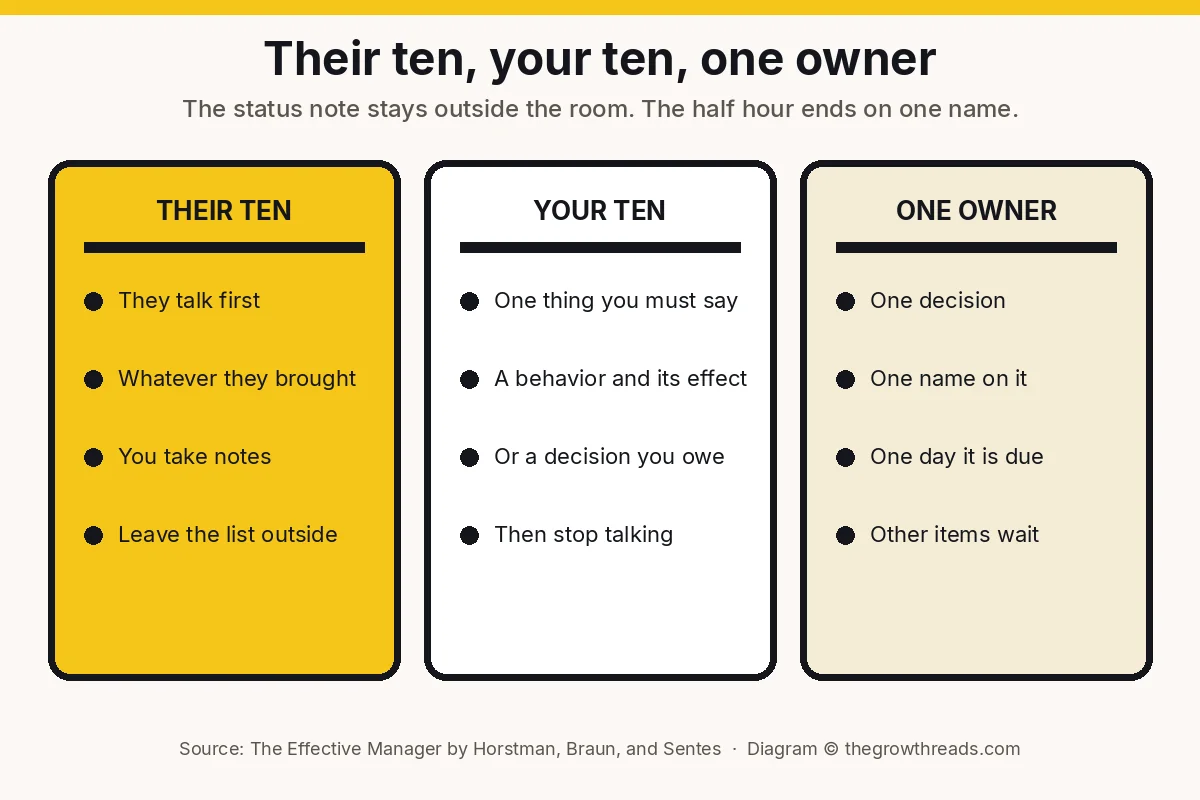
The 1:1 is a status recital when the half hour only retells work that already happened. The Effective Manager, second edition, tells a manager to get results and to know the people who produce them. The meeting that does the knowing is a scheduled one-on-one: weekly, 30 minutes, their issues first, you taking notes. Manager Tools’ own 2005 sheet splits that half hour into ten minutes for them, ten for you, and ten for what comes next. Put the status in a note before you sit down. Before anyone stands up, name one decision and one owner.
That one-owner close is our application. The sheet already asks for a named action by a named day, and what you owe. We allow one name in the room. If you talk first, or you walk the list aloud, the recital is back.
Key takeaways
- Results come first: your first responsibility is to achieve results. Being liked is not the definition.
- Four behaviors, in order: know your people, talk about performance, ask for more, push work down. The one-on-one is first.
- Their issues are primary: scheduled, weekly, 30 minutes, with each direct. Their issues come first. You take notes.
- Three blocks of ten: the 2005 sheet gives them ten, you ten, and development ten. Notes and follow-up are critical.
- The status note stays outside: one project question is allowed. A tour of the list is not. Do not read the note aloud.
- Twelve weeks before feedback: do these meetings only for 12 weeks. Do not rush a verdict.
- Feedback is one behavior, later: ask, behavior, impact, next step. A personality label is not that.
- One decision, one owner: one name, one day. Everything else waits on the follow-up note.
What is The Effective Manager about?
The Effective Manager is a practical book for getting results through other people. In the second edition, Horstman, Braun, and Sentes put four behaviors in order and place a weekly 30-minute one-on-one first, so knowing your people is a meeting rather than a mood.
About the author
Mark Horstman is a co-founder of Manager Tools. The company’s about page says he wrote The Effective Manager, co-wrote this second edition, graduated from West Point, worked in sales and marketing at Procter & Gamble, and hosted the Manager Tools podcast for 17 years. He is now a board member and still writes. Kate Braun, director of emerging markets, co-wrote the second edition. The same page says she is a Tulane engineering graduate who used the firm’s principles as a missile-defence engineer and still presents the training. The book’s third byline is Sarah Sentes. The about page credits Sarah Horstman, managing partner, as a co-author of that edition. We are not adding a biography past those two pages. Explore all Kate Braun book summaries →
Key concepts at a glance
| Concept | What it means | Use it when |
|---|---|---|
| Results | Hit the objective. Being liked does not replace it. | The half hour felt friendly and nothing was decided. |
| One-on-one | Weekly, 30 minutes, their issues first, you taking notes. | The 1:1 is a status recital. |
| Three tens | Theirs, then yours, then what comes next. | You are writing the agenda you will send. |
| Status note | What moved, what is stuck, what they need. Do not read it aloud. | They open a laptop and start the tour. |
| Twelve weeks | Meetings only, before you add feedback. | You want a personality verdict in week one. |
| One behavior | Ask, behavior, impact, next step. Not a label. | Your ten minutes need one thing. |
| One owner | One decision, one name, one day. | You are both about to “keep an eye on it.” |
Results come before a pleasant meeting
A status recital feels like management because everyone spoke. The opening chapter does not accept that. Horstman, Braun, and Sentes tell you to ask anyone who claims to know how to manage: how do you measure it? Conference answers such as liked, smart, or caring are called good efforts, and still wrong. Their test is a manager with all of those traits who missed every objective for three years. You would not call that good. The line they put next is the one to keep: “Your first responsibility as a manager is to achieve results.”
Chapter 2 points back at “results and retention.” A note signed HSB says the impatient reader can skip ahead to the one-on-one chapter. They do not recommend it. The four behaviors in the contents, and on Wiley’s page, are the bridge: know your people, talk about performance, ask for more, and push work down. A status recital fails the first behavior and the first responsibility together. You heard the list. You did not get a result, and you did not learn the person. A solo founder’s “organization” is small. The missed objective is still real: the thing the client is waiting on, or the thing the first hire was supposed to finish.
TGR Note. The morning piece is The 1:1 Is a Status Recital. Same sheet, same edition, same agenda. If you are still the bottleneck, read The Great CEO Within before you fill the half hour with your own tasks.
The half hour has three blocks
Chapter 4 is “Get to Know Your People—One on Ones.” The preview opens with a line you can check: “The most important behavior a manager can engage in is getting to know her people.” They say no other behavior they compared builds trust faster, and that the time comes back in fewer interruptions, whether you have two directs or 15. The public preview stops mid-sentence on that guarantee. We will not finish it.
The headings under that chapter are the structure we are willing to state. Scheduled. Weekly. 30 minutes. With each direct. The direct’s issues are primary. The manager takes notes. The contents also name pushback, including “It’s micromanaging” and “I’m too busy.” We did not read the replies, and we will not invent them.
The three tens live on a different page we did read. Manager Tools’ 2005 sheet, “The Basics of Effective One-on-Ones,” says the meeting is regularly scheduled, rarely missed, and focused on the team member. Weekly for most, every other week for some. Thirty minutes: 10 for them, 10 for you, 10 for development. Notes and follow-up are critical. Not in public. The form has three blocks: what you heard, what you prepared, and the future plus the follow-up. Chapter 6 of the book confirms the half hour in prose. It does not, in the preview we saw, reprint the three tens. So the split stays on the sheet, and the weekly meeting with their issues first stays on the 2023 contents.
Their ten minutes are whatever they brought. The sheet allows “Would you update me on Project X?” as one question, not as the agenda. Your ten minutes are the one thing you must say. The last ten are where they are headed. The status stays in a note you already read.
TGR Note. Andy Grove’s High Output Management and The Making of a Manager both say the one-on-one is not a status report. Use them for the wider argument. Use this agenda if the meeting is tomorrow.
Start them, and do not rush the feedback
Chapter 6 is the part a new manager can do on a Thursday. The preview says one-on-ones will become the core of your managerial behaviors, then it numbers the start:
- Choose times from your calendar.
- Send out an email invitation.
- Allow for possible changes and questions as you get started.
- Brief your team on the meetings.
- Do these meetings only, for 12 weeks.
Offer 1.5 times as many half-hour slots as you have directs, rounding up if the count is odd. Six people means nine slots. Let them choose. Do not throw the calendar open. The authors say they tried that, and it ruined the week. The invitation below is ours. The book does not print the email.
Our one-on-one is 30 minutes, weekly. You have the first ten minutes, for whatever you want to raise. I take the next ten. The last ten is what comes next. We will end with one decision and one owner. Before we meet, send three lines: what moved, what is stuck, and what you need from me. I will read them. We will not read them aloud.
A solo founder with one person skips the menu and books the one half hour. The book assumes directs. The same first-speaker rule fits a first hire or a contractor. It does not fit a client call.
Do the meetings only, for 12 weeks. The contents say “Don’t Rush to Get Feedback!” That wait is how you avoid turning week one into a personality comment. A later chapter covers remote one-on-ones. We read the heading, not a script, so we will not invent one. Keep the same half hour and the same first speaker. A chat thread is not the meeting.
TGR Note. Questions, once the half hour exists, are The Coaching Habit. The hard sentence, later, is Radical Candor. Do not cancel the one-on-one to start either book. The 12 weeks are the point.
Your ten minutes end on one owner
The feedback chapter calls performance talk the second behavior toward results and retention. The preview says almost nobody was trained for it, and that their model is meant to take about 15 seconds. That is their claim. We did not read “A Note About Data,” so we are not calling it a study.
The step names are headings: ask, describe the behavior, describe the impact, encourage the next behavior. Your ten minutes can hold one of those. They cannot hold a speech about who the person is. “You are not strategic” is a label. A missed number the client sent back is a behavior and an effect. Then stop. In the first weeks, use a question, not a verdict.
The close is where this review is stricter than the form. The sheet can hold several follow-ups. Two of its questions are the ending: “So, you’re going to do X by Tuesday, right?” and “Is there anything I need to do, and if so by when?” Say one decision, one name, one day. If it is theirs, their name. If only you can unblock it, your name. Not both, and not neither. “We’ll both keep an eye on it” is how the item returns next week. Other follow-ups go in the note. They do not each get a speech.
So you are going to [the decision] by [day]. You own it. I will [the one thing I owe] by [day], or I owe nothing on this one. Everything else goes on the follow-up note.
Then stop. Another sentence about “the rest of the list” puts the recital back. Take notes. The sheet says follow-up is critical, because memory keeps the loudest status and drops the owner.
Who is The Effective Manager best for — and who should read something else first?
Read this if you manage at least one person and the meeting has become a status recital. That is a new manager with a small team, or a solo founder whose first hire already spends the weekly slot restating the task list. You leave with an agenda: their ten, your ten, one decision, one owner.
Read something else first if nobody reports to you yet. Do not invent a meeting with yourself. If the pain is price and scope, this agenda will not write the boundary sentence. If you can already run the half hour and you freeze on the hard sentence, read Radical Candor. If you want questions instead of three blocks, read The Coaching Habit. If the week is an urgent pile and there is no person across the table yet, read Making Work Visible.
Questions to reflect on
- Who spoke first, and was it finished work?
- Is the status in a note, or on a screen you walk together?
- What is the one decision, and whose name is on it?
- Is your ten minutes a behavior, or a label?
- If you skipped the meeting, what replaced it, and did that name an owner?
🔥 Ready to end the status recital?
Give them the first ten minutes, take the next ten, and leave with one decision and one owner.
How to apply The Effective Manager (7-day plan)
- Day 1 — Book 30 minutes. Several directs: offer about 1.5 times as many slots as people, and let them choose. One person: book the one slot. Rarely miss it.
- Day 2 — Send the invitation. Three blocks, three-line note, one decision and one owner at the end. You will read the note. You will not read it aloud.
- Day 3 — They talk first. About ten minutes. Take notes. One project question is allowed. A tour of the list is not.
- Day 4 — Your ten minutes are one thing. Week one: a question or one assignment. Later: one behavior and its effect, then stop.
- Day 5 — Close out loud. One decision, one name, one day. Every other follow-up goes in the note.
- Day 6 — Protect the next meeting. Write the single thing you will check. If a chat thread replaced the meeting, put the meeting back.
- Day 7 — Add nothing. No new tool and no personality label. The only test is whether they spoke first and one name left with the decision.
Frequently asked questions
What do you do when the 1:1 is a status recital?
The 1:1 is a status recital when the half hour only retells work that already happened. Ask for that report in a three-line note, and do not read the note aloud. Give them the first ten minutes, take the next ten, and keep the last ten for what comes next. Those tens are the 2005 Manager Tools sheet. The 2023 headings call the meeting scheduled, weekly, and 30 minutes, with their issues first. Before you stand up, name one decision and one owner.
How long should this one-on-one be, and how often?
The 2005 Manager Tools sheet sets the meeting at 30 minutes. For most managers it is weekly with each team member, and for some it is every other week. The sheet says good managers rarely miss them. Chapter 6 of the second edition, which we read in preview, says each direct is committing half an hour, and the chapter headings say the meeting is scheduled and weekly. A short tour of tasks is not that meeting. If you cannot find 30 minutes, you do not have a one-on-one yet. Put the block on the calendar before you change the questions.
Who talks first in the one-on-one?
The other person talks first. The 2005 sheet puts the first ten minutes with the team member, and the 2023 contents include the heading “Where the Direct’s Issues Are Primary.” They can raise the work or the week, and you take notes. You do not open with your update, and you do not steer them back to the status note. If you talk first, their time becomes a string of answers. A project check can be one question on the sheet. It is not the whole half hour.
What should you say at the end of the 1:1?
Use two questions from the 2005 sheet, then stop. “So, you’re going to do X by Tuesday, right?” And, “Is there anything I need to do, and if so by when?” This review’s close is one decision and one owner. If both of you would do it, it is not owned. If three things feel urgent, name the one that must be true before you meet again, and write the other two on the note. Then stop talking.
What if you are a solo founder and not a manager of a team?
Use the same agenda with the one person who does the work with you, a first hire or a contractor you meet every week. The book and the sheet describe directs and team members. They do not describe a client call, and they do not describe a meeting with yourself. A client who wants more than the price is a scope conversation, not this half hour. If nobody reports to you yet, do not invent a one-on-one. When the first person starts, give them the three blocks before they learn that time with you is a status reading. You do not need a department for that.
When should you add feedback to the one-on-one?
Not in the first weeks. Chapter 6’s own steps, in the preview we read, end with “Do O3s ONLY for 12 weeks,” and the contents say “Don’t Rush to Get Feedback!” The feedback chapter opens by saying negative performance talks are hard, and that the Manager Tools model is meant to take no more than about 15 seconds: ask, describe the behavior, describe the impact, and encourage the next behavior. Those step names are the chapter headings. If you are in week one, your ten minutes can be a question. A personality comment is not the model, and it does not replace their ten minutes.
What if they say a weekly meeting is micromanaging?
The 2023 contents name “It’s micromanaging” and “I’m too busy” as common pushback. We have not read the book’s replies, and we will not invent them. What you can say from the 2005 sheet is the shape: their issues come first, it is 30 minutes, and the follow-up lives there so you are not chasing the same status all week. Chapter 6 also tells you to brief the team on the intent, the ground rules, and the agenda before the habit starts. Then hold the meeting. A task recital does not answer the complaint. Their ten minutes, going first, is what makes the half hour theirs.
Related summaries
- High Output Management — the one-on-one belongs to them.
- The Making of a Manager — status does not belong in the meeting.
- The Coaching Habit — questions, once the half hour exists.
- The Great CEO Within — the handoff, if you are still the bottleneck.
- Best leadership books.