

★★★★☆ 4.6/5 — Be first in the mind, then own a single word.
Best for: Founders and marketers whose offer list is longer than their position.
Reading time: ~3 hrs · guide: 18 min
Difficulty to apply: Medium. The laws are plain. The cuts are the hard part.
The 22 Immutable Laws of Marketing in one minute
Better is a weak strategy when someone else is already first in the mind.
Al Ries and Jack Trout wrote The 22 Immutable Laws of Marketing for operators who keep improving the offer and still lose to an older name. Marketing, in their line, is a battle of perceptions, not a contest of features. The brand that enters the mind first, and then stands for one word, is the brand people can repeat without a prompt.
You do not need a poster of all 22 laws. You need four moves. Be first, or open a category where you can be first. Own a word a stranger can say back. Refuse the line extension that spends that word. Fund the position long enough for the market to learn it. This 22 immutable laws of marketing summary stays on those moves, then shows where the other laws tell you a shortcut will fail.
Key takeaways
- Law of leadership: Being first beats being a little better. The mind files the pioneer and treats later names as copies.
- Law of the category: If the first seat is taken, name a new category you can lead.
- Law of the mind: Launching first does not count if you are second in memory.
- Law of perception: Buyers act on the idea they already hold. A better spec sheet loses to a trusted name.
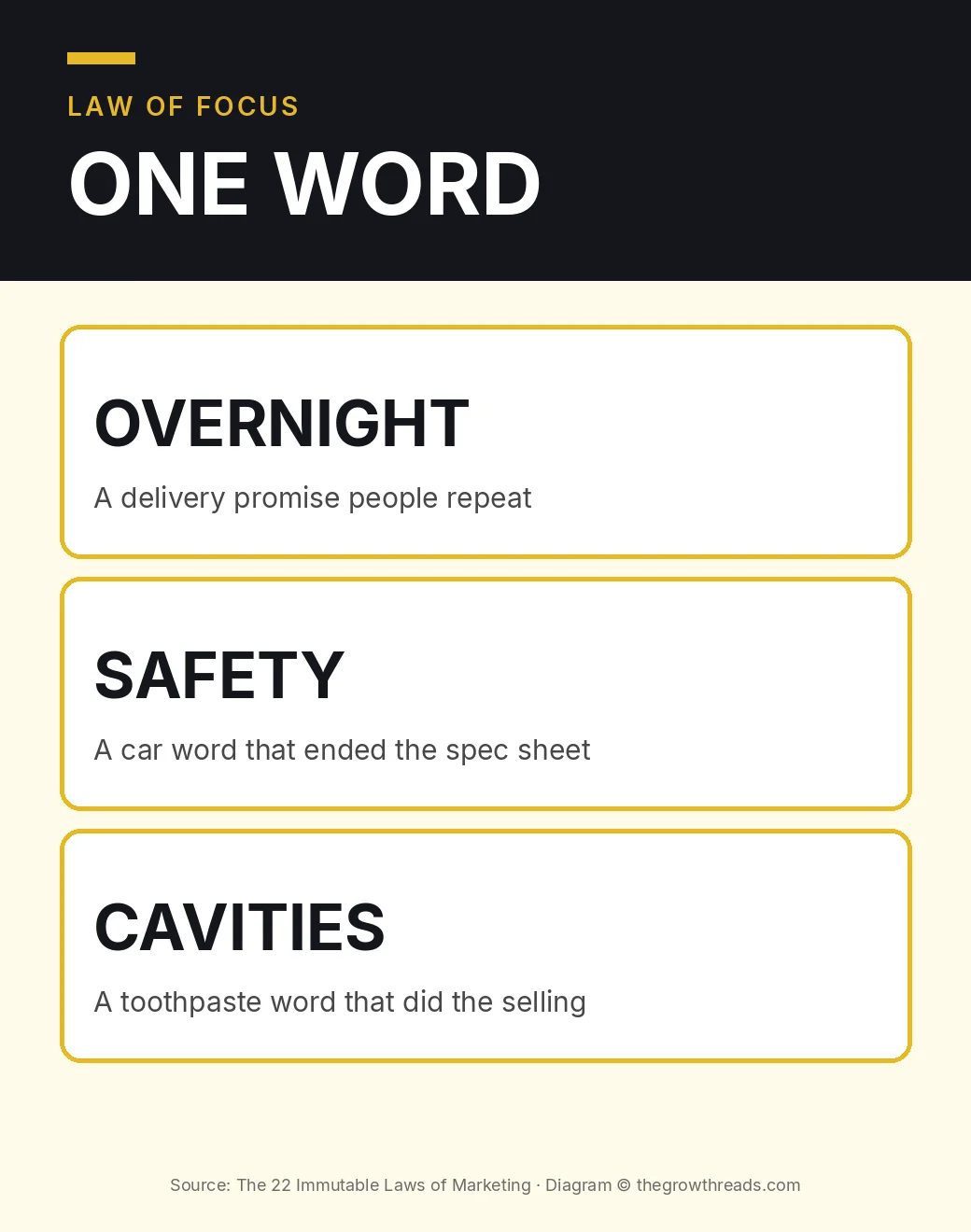
- Law of focus: Own one word. Overnight, safety, and cavities beat a paragraph of features.
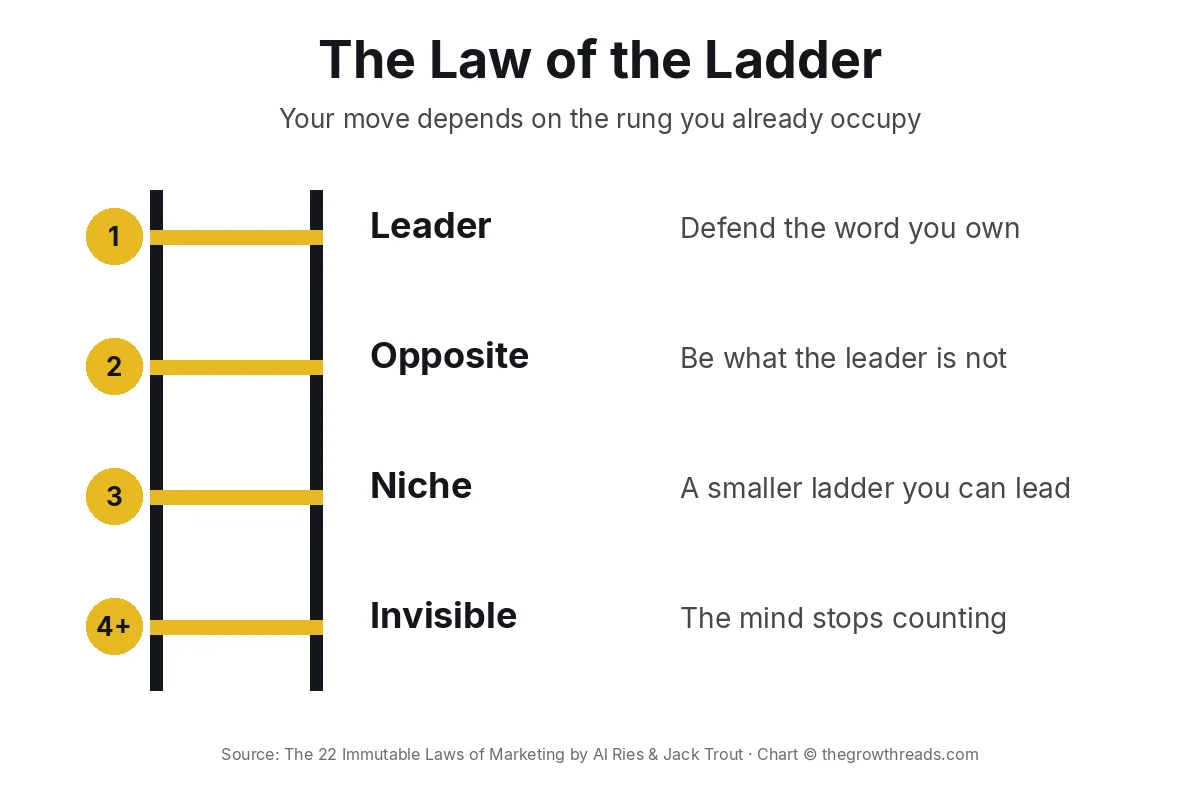
- Law of the ladder: Leaders defend the word. A clear second takes the opposite. Lower rungs need a smaller ladder.
- Law of duality: A category tends toward two brands. A plan to stay third runs out of memory.
- Law of line extension: Stretching a winning name spends the meaning you earned.
- Law of sacrifice: Give up a line, an audience, or an extra promise so the word stays repeatable.
- Law of resources: A position needs repetition and fuel. Mentioned once, it stays a slogan.
What is The 22 Immutable Laws of Marketing about?
The 22 Immutable Laws of Marketing argues that marketing is a battle for a spot in the prospect’s mind, not a contest to build a better product. Al Ries and Jack Trout offer 22 rules for being first, owning one word, and refusing to stretch a brand until it means nothing.
About the author
Al Ries (1926–2022) and Jack Trout (1935–2017) spent decades telling companies to stop describing the product and start claiming a place in the buyer’s mind. Ries came up through advertising and later built a consulting practice he shared with his daughter, Laura Ries. Trout led Trout & Partners and argued the same idea from the strategy side. In the early 1970s they put the word positioning into the business vocabulary, then published Positioning in 1981. The 22 Immutable Laws of Marketing arrived in 1993 as the short field version: twenty-two rules, each with a warning that breaking it costs the word you thought you owned. Their stance is practical. Pick a place a stranger can repeat. Sacrifice until that place is obvious. Fund it long enough that the market can learn it. Explore all Al Ries book summaries →
Key concepts at a glance
| Concept | What it means | Use it when |
|---|---|---|
| Law of leadership | Being first beats being a little better | A rival’s name is already the category |
| Law of the category | Open a shelf you can be first on | You cannot lead the shelf you are on |
| Law of the mind | Memory beats the marketplace | You launched first and nobody remembers |
| Law of focus | Own one word people can repeat | The homepage lists five equal promises |
| Law of the ladder | The plan must match your rung | You are a clear number two, or lower |
| Law of duality | Markets tend toward two brands | The plan assumes a permanent third place |
| Law of line extension | Stretching a name spends its meaning | A new offer would borrow the flagship |
| Law of sacrifice | Give something up to keep the word | Every audience still feels essential |
Be first in a category and in the mind
The first four laws belong together. Leadership says it is better to be first than to be better. If that seat is taken, draw a new category in which you are the first name. Being first in the warehouse does not count if you are second in memory. Marketing is not a lab test of which product is superior. It is a fight for the idea the buyer already carries.
Picture a solo consultant who sells productivity coaching. That phrase is a crowded category, and someone else is already the name people say. A better worksheet will not move the rung. A new category might. Founder calendars, or a meeting-load audit, is a smaller shelf, and smaller is the point. You can be first on a shelf the current leader does not bother to own. The sentence you want is plain: we are first in this, stated in words a buyer would actually use.
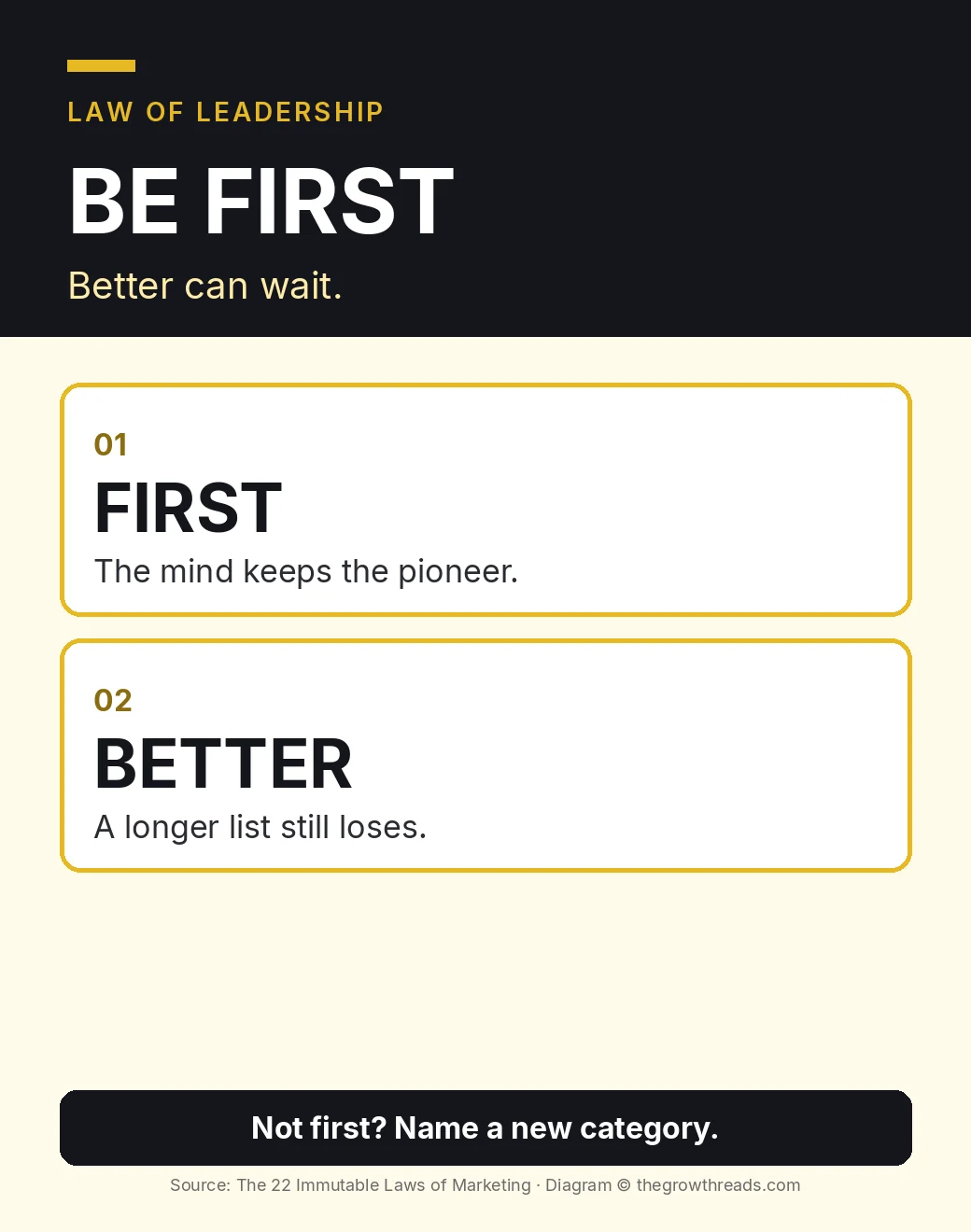
Car rental is the short illustration they trust. The company that was first kept the category name. The number two did not win by claiming to be better. It took a humble opposite, a promise to try harder. A new category still has to be real. Premium holistic solutions is not a shelf a buyer can point at. Overnight was. If you cannot finish we are first in, in a buyer’s words, you do not have a category yet.
Own one word and know which rung you are on
Focus is the law they want you to feel in the headline. The most powerful concept in marketing, as they frame it, is owning a word in the prospect’s mind. The teaching examples are short because the word is the point. One brand came to own overnight. Another owned safety. Another owned cavities. Nobody needed a paragraph once the word was seated. Exclusivity follows at once. Two companies cannot own the same word. If the leader has the obvious one, a copy of that word advertises them.
The ladder tells you which plan you are allowed to run. Rung one defends the word. Rung two takes the attribute the leader is not. Lower rungs are usually invisible, because prospects stop counting. Duality says a market becomes a two-horse race, so a plan to stay third runs out of memory. Name the rung before the tactic. Copying a leader’s media plan only reminds people of the leader.
Sacrifice, time, and the single move
The middle laws are about what you refuse. Perspective says marketing effects show up over time, so a tactic that spikes this week can still be the wrong position. Line extension is the pressure that arrives after a win. The name starts to mean something, and the company stretches it across flavors, audiences, and side offers until the original word goes soft. Sacrifice is the counter. You give up a product line, a segment, or a second promise. The attribute law says that for every trait a leader owns, an opposite trait is open. Candor says a plain admission of a limit can earn trust a boast will not.
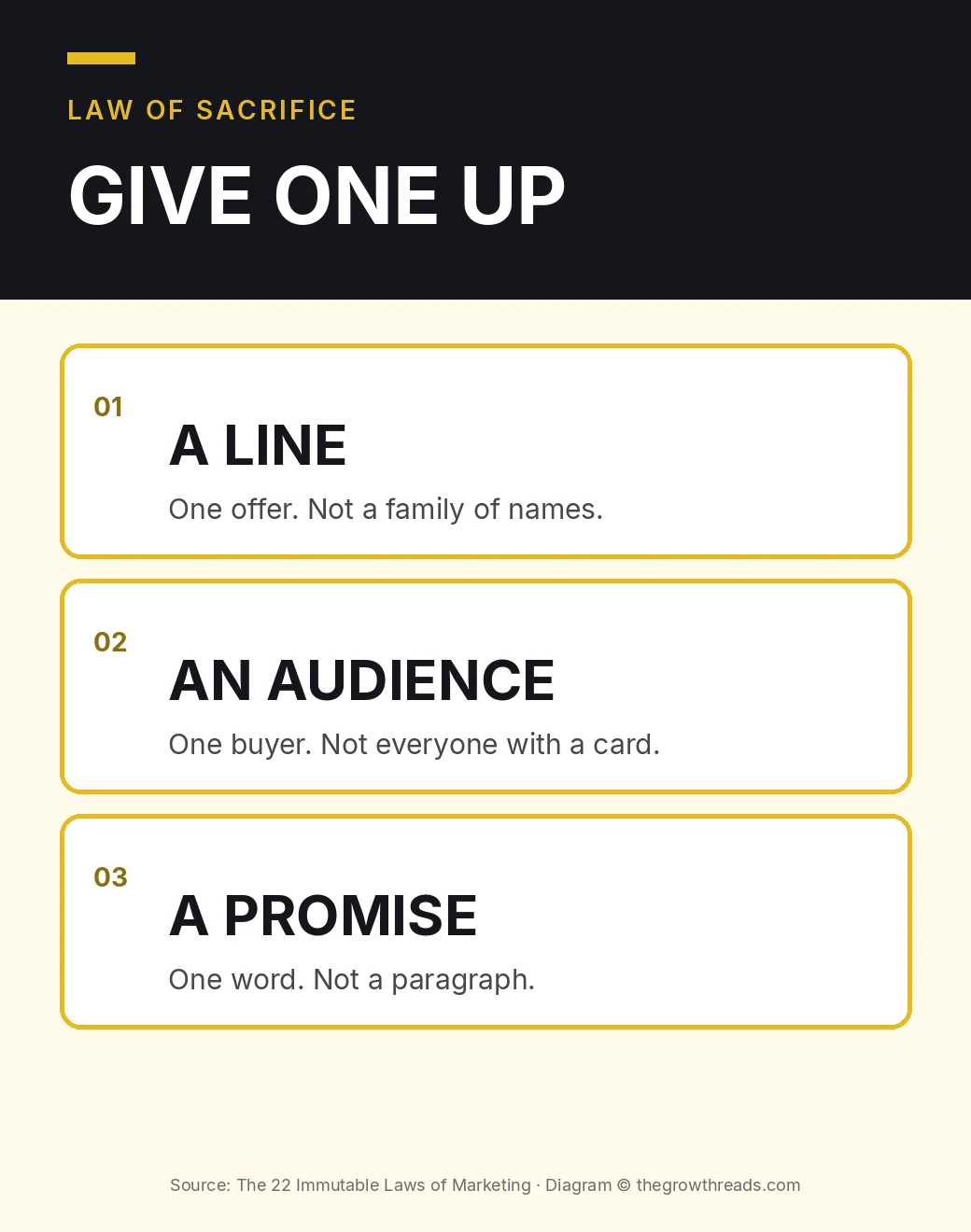
Singularity says one move will matter this season, not a stack of twelve. Unpredictability says you cannot write a competitor’s next year, so do not build a plan that needs them to stand still. Coaching, plus a course, plus a template, plus a community, under one new name, is line extension done in advance. The sacrifice can be simple. No course this year. The word stays meeting load, repeated until a stranger can say it.
Success, hype, and the resources to stay
The last laws describe how a lead is lost. Success breeds arrogance. The company starts to believe the name will carry any new idea, which is how line extension gets a budget. Failure is to be expected and accepted. A position that does not stick should be dropped, not defended out of pride. Hype says the loudest launch can be the weakest position. Acceleration separates a fad from a trend. A fad can fill a season. It is a poor foundation for a name you want people to repeat in five years.
Resources is the law ambitious teams skip. Without enough repetition, and without enough fuel, an idea does not get off the ground. For a solo business the fuel may be hours rather than a media buy. The law still holds. A word you mention once is not a word you own. Put the repetition on the calendar, and keep the other ideas in a notebook until this word is the one people say when you leave the room. The 22 laws are not a call to be timid. They are a call to concentrate. First in a real category. One word. One sacrifice. Enough fuel to stay until the market learns it.
Who is The 22 Immutable Laws of Marketing best for — and who should read something else first?
This book is best for founders, marketers, and consultants whose homepage reads like a menu, and for anyone who needs language for why the fifth offer is the problem. It is short, about 143 pages and roughly three hours, and the work after reading is a series of cuts rather than a new stack of channels.
Read something else first when the gap is different. If enthusiasts already love a technology product and the mainstream still cannot name the category, start with Crossing the Chasm. If the position is roughly right and the words on the page are muddy, start with Building a StoryBrand. If you have not chosen where you will play, start with Playing to Win, then come back and pick the word. If you want permission and a smallest market more than a category fight, start with This Is Marketing. This is the wrong first book if you need a habit system. The laws will not design your morning. They will tell you which claim to stop making.
Questions to reflect on
- What category are you actually first in, stated so a stranger could repeat it?
- What single word do you want to own, and which word does the leader already own?
- Which rung are you on, and is the current plan the plan for that rung?
- Which product, audience, or promise would you cut if the word had to stay sharp?
- What hour or budget is missing for that word to be learned, not just launched?
🔥 Ready to own one word in your market?
Be first in a real category, cut the extra promise, and repeat the word until it sticks.
How to apply The 22 Immutable Laws of Marketing (7-day plan)
- Day 1: Write the category in one sentence. If a leader already owns it, write a narrower category beside it and circle the one you can be first in.
- Day 2: Pick the word. Remove every other adjective from the homepage headline so only that word remains.
- Day 3: Name your rung. If you are not first or a clear second, write the opposite of the leader in a single line.
- Day 4: List every offer that borrows your main name. Cross out one extension you will not launch this quarter.
- Day 5: Choose the sacrifice. Write the audience you will stop recruiting, and the sentence you will use when they ask.
- Day 6: Name the single move for the next 30 days. One channel, one promise, one proof.
- Day 7: Set the resource. Block a weekly hour that exists only to repeat the word, and put the first repetition on the calendar.
Frequently asked questions
What is The 22 Immutable Laws of Marketing about?
The 22 Immutable Laws of Marketing is Al Ries and Jack Trout’s short field guide to how a brand gets into memory and stays there. HarperBusiness published it in 1993. Marketing, they argue, is a battle of perceptions, not a contest to build a slightly better product. The discipline repeats: be first, or open a category you can be first in; own one word a prospect can repeat; refuse the line extension that spends that word; and put real time behind the position. The book is about 143 pages. Use it when your homepage says five things and the market remembers none of them.
What does "be first, not better" actually mean?
The law of leadership says the mind stores the name that arrived first, then treats later arrivals as copies. A better feature list rarely knocks that name out. Car rental is the teaching story. The company that was first kept the category, and the rival’s promise to try harder worked as an opposite, not as a claim of being better. Use this when a competitor’s name is the category people already say. If you cannot be first there, open a narrower category you can lead. First means first in a category a buyer can name without your help.
How is this book different from Positioning?
Positioning, their 1981 book, named the battle for a place in the mind. The 22 Immutable Laws of Marketing, published in 1993, turns that stance into short rules you can hold against a name, a rung, and a product line. Leadership, category, focus, the ladder, duality, line extension, sacrifice, and resources are the working set. Read the laws when you want a checklist for this week’s homepage and offer list. The earlier book is the longer argument. The Growth Reads does not yet have a separate Positioning summary, so start here when you want the field manual you can apply before Friday.
What is the law of focus?
The law of focus says the most powerful idea in marketing is owning a single word in the prospect’s mind. One brand came to mean overnight. Another came to mean safety. Another came to mean cavities. Once the word is seated, a paragraph of features is extra. Exclusivity says two companies cannot own that same word. If a leader already sits on the obvious one, copying it advertises them. Take an opposite attribute instead. A homepage with five equal promises owns no word at all. Pick one, remove the rest from the headline, and repeat it until a stranger says it back.
Why do Ries and Trout warn against "line extension"?
A name that starts to mean something creates pressure to stretch it. New flavors, new audiences, and side offers all want to borrow the winning word. Line extension is how a brand spends the meaning it earned. The flagship word gets fuzzy while the line looks bigger. Sacrifice is the counter-move. Give up a product, a segment, or a second promise so the word stays sharp. A new offer can look like growth in month one. The cost shows up later, when people can no longer say what you are first in. Keep the extra idea in a notebook until the original word is secure.
Are these laws still useful when marketing is digital?
Yes. The laws describe memory, not a media format. Search, feeds, and retail pages still reward the name people already file under one word. A faster landing page does not replace being first in a category, or the opposite stance of a clear number two. What changed is the speed of a test. You can try a word for a week and watch whether anyone repeats it. What did not change is the cost of standing for everything. Some 1993 brand stories have aged, and a few outcomes have been debated since. Own one word, and do not spend it on a line extension. Choose the position before the channel.
Who should read this book first, and who should wait?
Read it first if you are a founder, marketer, or consultant and your offer list is ahead of your position. The book takes about three hours. The application is a series of small cuts. Wait if a different gap is blocking you. Teams the mainstream still cannot categorize should read Crossing the Chasm first. Teams with a fair position and muddy language should read Building a StoryBrand. Teams that have not chosen where to play should read Playing to Win, then come back for the word. If you want a habit system rather than a market position, this is the wrong first book.
Related summaries
- Crossing the Chasm summary — be first with a beachhead before you ask the mainstream to care.
- This Is Marketing summary — choose the smallest market and earn the right to be remembered.
- Purple Cow summary — make the word remarkable enough that people repeat it.
- Building a StoryBrand summary — keep the page to one problem, one guide, and one plan.
- Best productivity books — the silo list this summary sits in.