

★★★★½ 4.5/5 — A belief you can test this week.
Best for: Multipassionate people stuck between a real dream and the sentence I can’t.
Reading time: ~5 hrs · guide: 16 min
Difficulty to apply: Easy to learn, daily to keep.
Everything Is Figureoutable in one minute
Everything is figureoutable means a next step exists, and you can hunt for it.
Marie Forleo trains that hunt. Her mother used the phrase while fixing the house, radio on, no manual required. Forleo turns the line into a weekly practice: name the stuck point in one sentence, swap I can’t for How can I, shrink the first move until it fits in twenty minutes, and ask one person for one specific thing. The belief starts the search. The log of small tests is the proof you keep.
Key takeaways
- The sentence is the tool: I can’t keeps the problem closed. How can I opens a search you can run today.
- Name the stuck point: One sentence is enough. A life story hides the test.
- Shrink before you start: A twenty-minute version beats a perfect plan you never begin.
- Excuses have swaps: Time, money, readiness, and identity each have a smaller door.
- Fear and intuition differ: Fear is loud and about the future. Intuition is quiet and about now.
- Dreams need a season: Give one project ninety days. Let the other ideas wait on a list.
- The first no is data: Change the ask, the person, or the proof, then ask again.
- Reclaim two blocks: A one-day audit often finds hours the calendar says you lack.
- Pass the map on: The problem you solve becomes a path someone else can use.

What is Everything Is Figureoutable about?
Everything Is Figureoutable is Marie Forleo’s field guide for people who stall on the sentence I can’t. She turns her mother’s kitchen phrase into a weekly practice: name the real problem, swap the words, run one small test, and ask for help before you call the dream impossible.
About the author
Marie Forleo grew up in New Jersey watching her mother repair whatever the house threw at her, radio crackling, tools already out. That scene became the line she teaches. Before the book, she worked on a trading floor, taught fitness, and coached people who wanted a different life and could not see step one. She later built MarieTV and B-School as classrooms for makers who sell ideas online. Explore all Marie Forleo book summaries →
Portfolio published Everything Is Figureoutable in 2019, about 288 pages of language tools, decision checks, and start-now drills. The book reads like a coach in the room: short stories, a clear mantra, and exercises you can run the same week. Readers pick it up when a dream is real and the vocabulary around it is still someday.
Key concepts at a glance
| Concept | What it means | Use it when |
|---|---|---|
| The figureoutable sentence | A belief that a next step exists | You hear yourself say I can’t |
| How can I | A question that starts a search | The problem is named and still feels huge |
| The twenty-minute test | The smallest version you can run today | You are waiting to feel ready |
| Excuse swap | A smaller door for time, money, readiness, or identity | A reason shows up before the work |
| Fear versus intuition | Loud future worry versus a quiet present no | You cannot tell a warning from a stall |
| Ninety-day season | One project gets the calendar | You want several dreams at once |
| The second ask | A new person, a clearer request, or better proof | The first answer was no |
The orange radio: install the belief
The book opens on a kitchen memory. Forleo’s mother moved through the house fixing what broke, a Tropicana-orange radio nearby, long before a search bar could supply a tutorial. When her daughter asked how she knew what to do, the answer was blunt and repeatable. Her mother told her, “Everything is figureoutable.”
Forleo treats that line as an installed belief, the way you might install a tool you reach for under stress. The point is resourcefulness. You may not know the answer yet. You can still look, test, and ask. She wants the sentence in your mouth on ordinary days, so it is available on the day a project stalls.
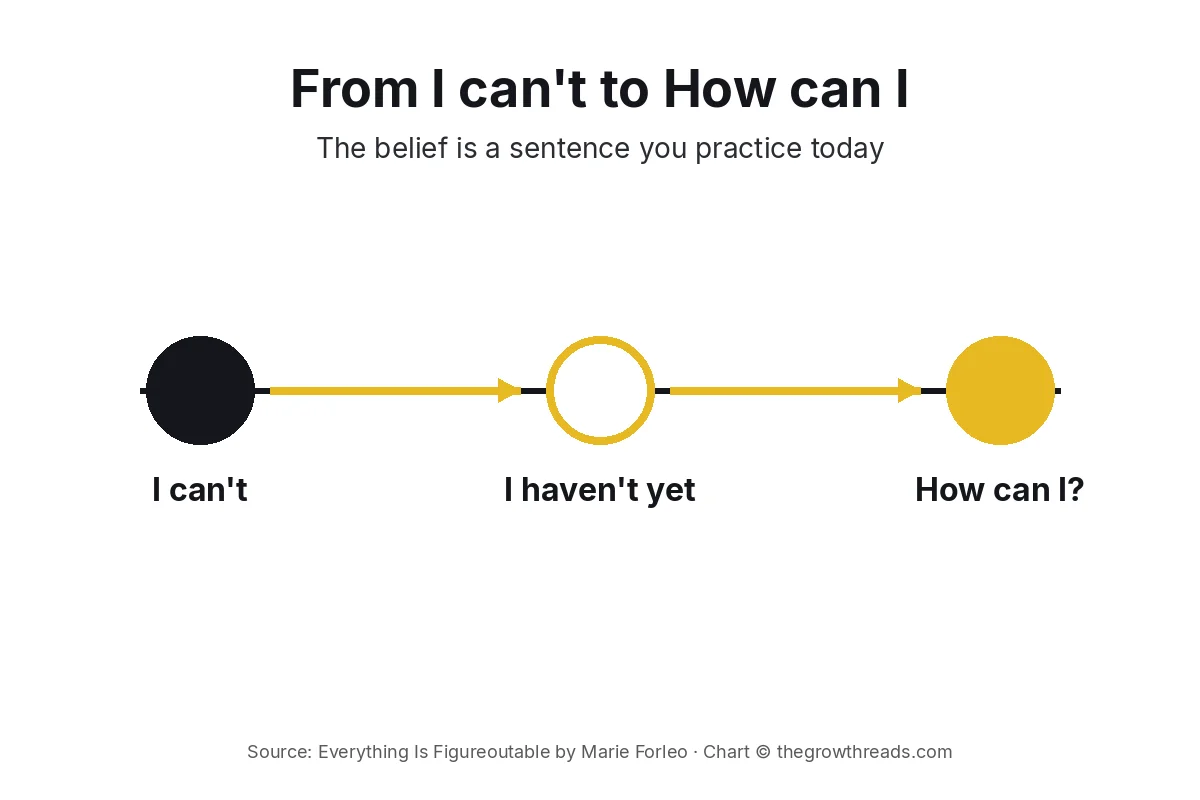
The early chapters connect the belief to language. I can’t ends the search. I haven’t yet admits a gap and keeps you in motion. How can I turns the gap into a question with constraints: twenty minutes, no new budget, one conversation. Forleo’s road map is that short loop, practiced until it is boring. Boring is a feature. A belief you only feel during a highlight does not survive a Tuesday.
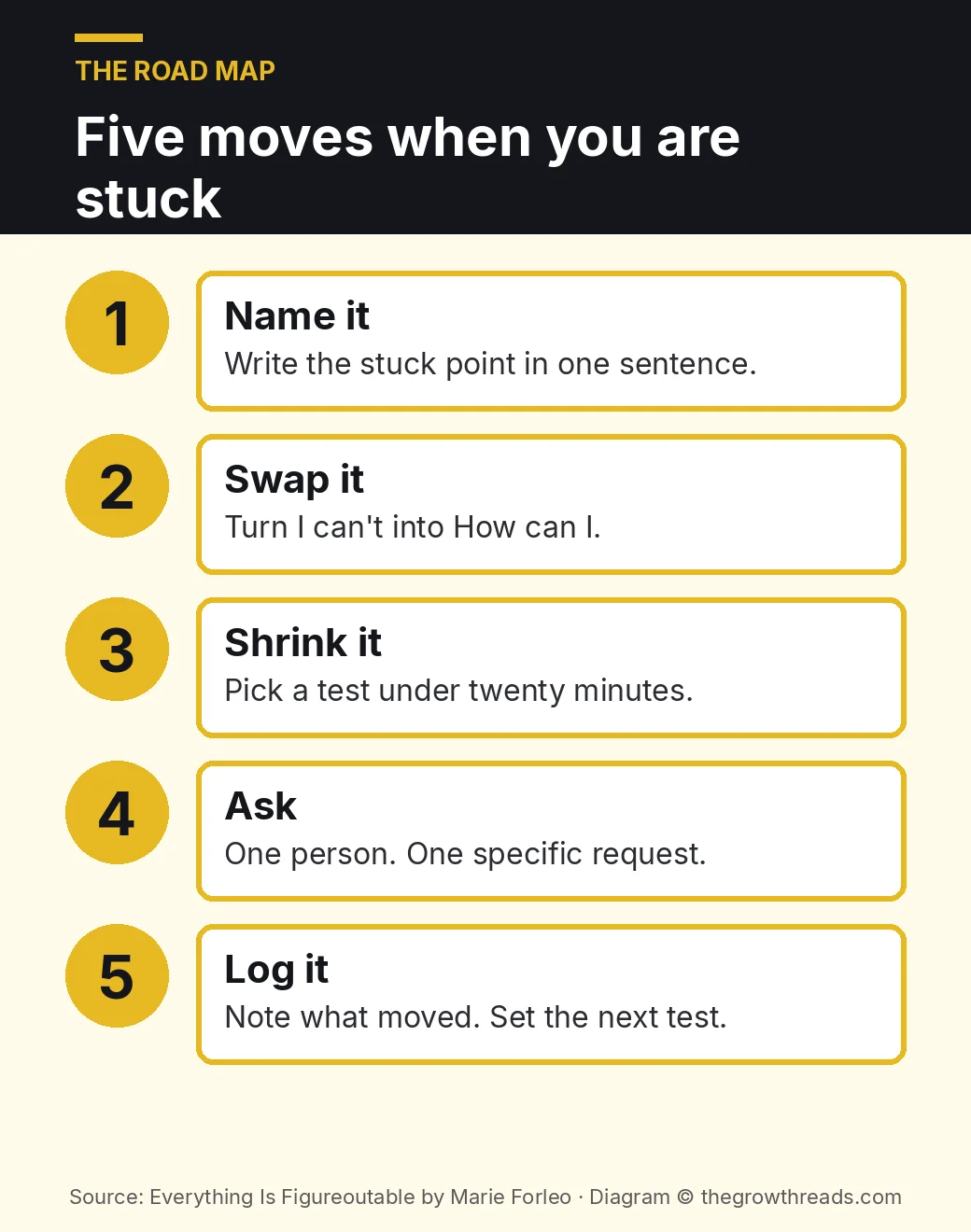
Use the loop on a live stuck point this week. Write the sentence you have been repeating. Cross out the closed version. Write the how question underneath it, with a constraint you could meet before dinner. That is the whole installation. The rest of the book shows what to do when the excuse, the fear, or the first no shows up.
Clear the excuse and check the fear
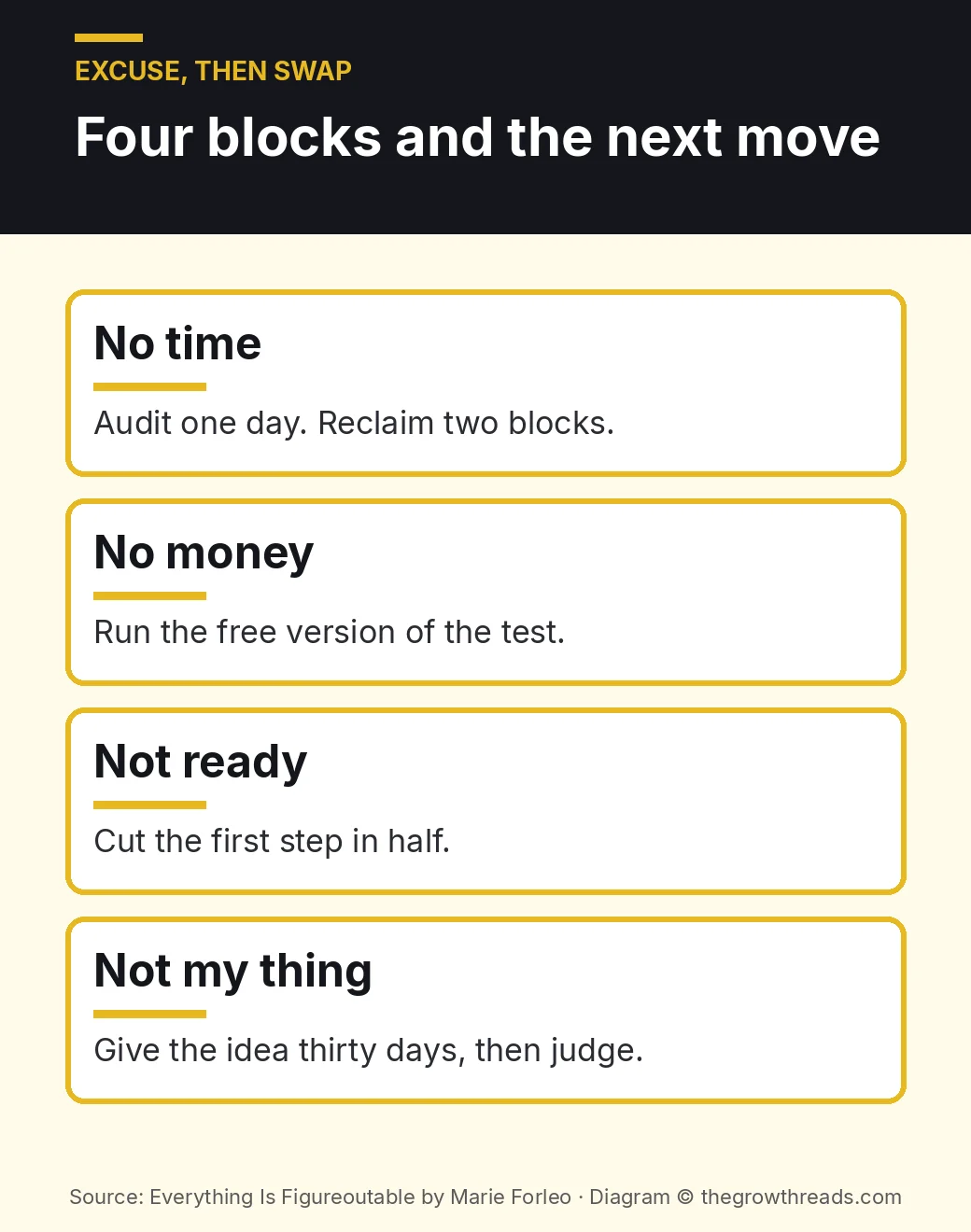
Once the sentence is open, Forleo expects a reason to appear. The chapters on excuses sort the usual ones into doors you can still walk through. No time becomes a one-day audit: mark the blocks that were scrolling, optional errands, or work that someone else could own. She is hunting two reclaimable blocks, not a fantasy calendar. No money becomes the free version of the test, a borrowed tool, a public tutorial, a conversation that costs nothing.
Not ready is her favorite disguise. The swap is to cut the first step in half until readiness is irrelevant. If the course feels like too much, outline the first lesson. If the business feels like too much, write the offer in one paragraph and show it to one person. Not my thing gets a thirty-day trial instead of a permanent identity. You are allowed to discover that a dream does not fit. You earn that conclusion with a test, not with a mood on day one.
Fear gets its own check, because a real warning and a stall can use the same words. Fear, in Forleo’s telling, is loud and aimed at a future you cannot see. It shrinks the menu until delay looks wise. Intuition is quieter and about this moment. It tends to arrive as one clear yes or one clear no. Ask where you feel it, how far ahead it is looking, and whether it closes every option or points at one.
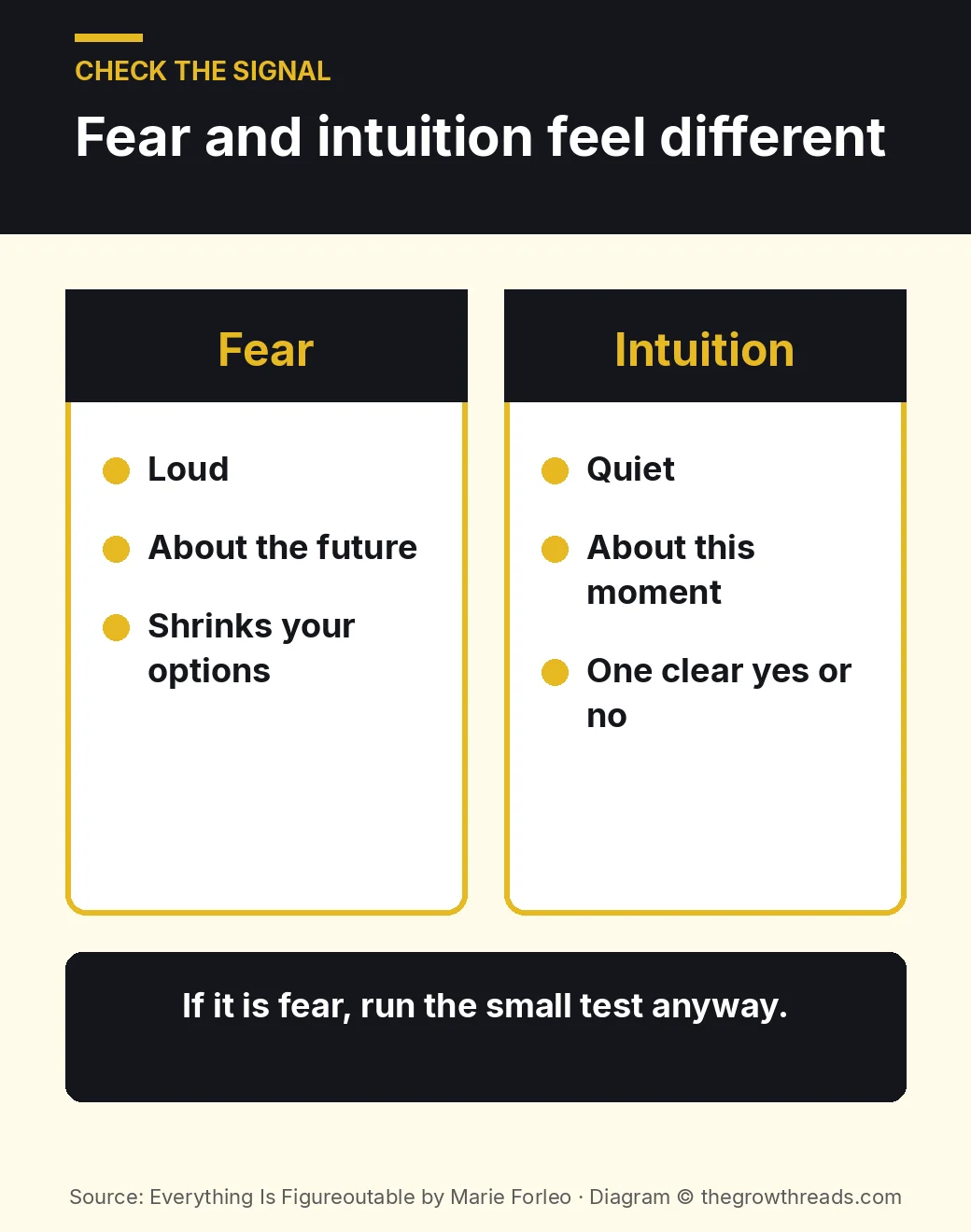
If the signal is fear, run the twenty-minute test anyway and let the result update you. If the signal is a steady no, honor it and move the dream off this season’s calendar. That second path matters. A figureoutable life is a series of chosen problems. It is a practice of picking the problem that deserves your blocks.
Name the dream and start before you are ready
The middle of the book asks for a dream specific enough to schedule. Forleo wants a picture you can describe, plus a season long enough to learn and short enough to review. Ninety days is the working length. Multipassionate readers, the ones with five true interests, get explicit permission to park four of them. The parked list is a promise that those ideas are safe. The calendar gets one project, one test, and one ask.
Starting before you are ready is the chapter people quote and then skip. Forleo makes it concrete. Ship the ugly version to one person. Publish the rough page. Teach the idea in a single conversation before the slide deck exists. Progress, in the following chapter, is the record of those ugly versions. Perfection is the sentence that sends you back to research. She would rather see a dated log than a polished plan with no first rep.
A written when-and-where line belongs on that log. Forleo points to planning research, including a widely shared 42 percent follow-through figure, as a reason to name the day and the hour. Use the number as a prompt to write the slot. The test itself is the teacher: what you learned, what you will shrink next, who you will ask. If the dream needs a skill you do not have, the figureoutable move is the smallest practice that builds it, scheduled like any other meeting.
Refuse the first no and pass the map on
Later chapters assume you have already asked and heard no. Forleo treats refusal as information with a next move. Change the request so it is smaller and more specific. Change the person so you are asking someone who can actually help. Change the proof you bring: a sample, a one-page result, a clearer reason their yes is easy. One no is a data point. A pattern of nos is a signal to reshape the offer or the dream for this season.
She is allergic to the private struggle that never makes a request. Resourcefulness includes other people. The ask should be easy to answer: a name, a review of one paragraph, a fifteen-minute call, a tool you can return. Write it down before you send it. A vague cry for help produces a vague no. A precise ask produces a yes, a no, or a redirect you can use.
The closing movement of the book turns the solved problem outward. Forleo argues that your special gift is the map you can hand someone who is one step behind you. That might be a short post, a template, a class, or a conversation. Contribution is the point of the practice once your own test is working. The epilogue brings it back to the daily sentence. Lasting progress, in her frame, is the belief you reuse when the next problem arrives, which it will.
Who is Everything Is Figureoutable best for — and who should read something else first?
Read this first if you are multipassionate, between careers, or sitting on a dream you describe with I can’t, I don’t have time, or I’m not ready. It is a strong fit for makers, coaches, and operators who already know they care and need language plus a first test. The exercises are light enough to finish in a week beside a full-time job.
Start somewhere else if the sentence is already open and the missing piece is a system. Atomic Habits builds the daily rep. Good Strategy Bad Strategy forces you to name the real obstacle before you pick a season. Exactly What to Say helps when the next figureoutable move is a conversation with a buyer. Come back to Forleo when the stall is the words in your head.
Questions to reflect on
- Which stuck sentence have you repeated most often this month?
- What is the twenty-minute version of that problem you could run before tomorrow night?
- Is the loud feeling fear about the future, or a quiet no about this dream?
- Which one project deserves the next ninety days, and which ideas can wait on a list?
- Who is the one person you will ask, and what exact request will you make?
🔥 Ready to make the next problem figureoutable?
Install the sentence, run one small test, and keep the map.
How to apply Everything Is Figureoutable (7-day plan)
- Day 1: Write the stuck sentence you have been saying. Circle every I can’t, I don’t have time, and I’m not ready.
- Day 2: Rewrite three of those lines as How can I questions. Add a constraint: twenty minutes, zero new spend, or one person.
- Day 3: Audit yesterday in thirty-minute blocks. Mark two blocks you can reclaim this week for the test.
- Day 4: Name the dream in one sentence and give it a ninety-day season. Park the other ideas on a list you will reopen at the review.
- Day 5: Run the fear check. If it is loud and about the future, do the twenty-minute test anyway. If it is a steady no, switch the season’s project.
- Day 6: Send one specific ask. If the answer is no, write the second version: a smaller request, a different person, or better proof.
- Day 7: Share the ugly result with one person. Log what moved. Put next week’s test on a day and a time.
Frequently asked questions
What does "everything is figureoutable" actually mean?
Everything is figureoutable means a next step exists and you can search for it. Marie Forleo learned the line from her mother, who fixed the house without waiting for a specialist. The phrase is a practice: name the stuck point in one sentence, replace I can't with How can I, shrink the first move until it fits in about twenty minutes, and ask one person for one specific thing. A closed sentence can be opened, and a small test teaches the following move. Use it when a dream is real and your words have stalled on someday.
Is Everything Is Figureoutable worth reading if you already like mindset books?
Yes, if you want the belief turned into a week of moves. Mindset books explain why a fixed sentence keeps you stuck. Forleo spends her pages on the swap itself: the words you say, the size of the first test, the difference between a loud fear and a quiet no, and the second ask after someone refuses you. Read it when you already agree that effort matters and you still lack a plan for Thursday. Pair it with a skills book when the dream needs a habit design or a strategy kernel. Your log of tests is what makes the week different from another highlight.
What is Forleo's road map when you feel stuck?
She walks a short loop. Name the problem in one sentence. Ask how, with a constraint such as twenty minutes or no new spending. Run that tiny version before the plan feels complete. Ask one person for one concrete thing. Write down what moved and what you will try next. She also points to a written when-and-where plan, a research habit often linked with higher follow-through, including a widely quoted 42 percent figure. Treat that number as a nudge to write the plan, not as a guarantee that every goal jumps by the same amount. The loop is the part you can repeat on a messy afternoon.
How do you tell fear from intuition in this book?
Forleo treats them as different signals. Fear is loud, aimed at a future you cannot see, and it shrinks the menu until delay feels safest. Intuition is quieter, about this moment, and it lands as one clear yes or one clear no. Check where you feel it, what time horizon it uses, and whether it closes every door or points at one. If the signal is fear, she wants the twenty-minute test anyway. If the signal is a steady no, honor it and choose a different dream for this season. The check keeps courage from becoming stubbornness.
What if you want five dreams at once?
Forleo's answer is a season, not a permanent identity. Pick one project for about ninety days. Give it the calendar blocks, the test, and the ask. Let the other dreams stay on a list you can reopen at the review. Multipassionate people often stall because every idea feels like a vote against the others. A season removes that fake trial. At day ninety, keep going, switch, or shrink again based on the log, not on a mood. You can love five directions and still ship one. The book is especially useful if your notes app is full and your week is empty.
How long does Everything Is Figureoutable take to read and use?
The Portfolio edition is about 288 pages, roughly a five-hour read if you move straight through. The useful version is shorter. You can run the practice in one sitting: one stuck sentence, one swap, one twenty-minute test, one ask. Plan on sixteen minutes for that first pass, then a week of small reps. The later chapters on refusal and contribution matter once the test is real and someone has told you no. Read those with a live project. The book earns its keep in the log you keep after you close it.
Which book should you read after Everything Is Figureoutable?
Choose the gap you still feel. If the sentence is open and you need daily reps, read Atomic Habits and build the twenty-minute test into a cue. If resistance shows up as soon as the work gets specific, read The War of Art and treat the stall as a signal to start. If you want a tougher standard for which dream deserves the season, read Grit and Good Strategy Bad Strategy. Stay with Forleo for another week if you have not yet made the second ask. A new book will not replace a request you are avoiding.
Related summaries
- You Are a Badass by Jen Sincero, for the stories that keep a dream small.
- Grit by Angela Duckworth, for staying with the season after the first test.
- The Magic of Thinking Big by David J. Schwartz, for the size of the aim.
- Limitless by Jim Kwik, for learning the skill the test reveals you need.
The full productivity shelf is on the best productivity books pillar.