

★★★★★ 4.5/5 — Brach blends Buddhist mindfulness with Western psychology into a practical case that meeting our pain with clear awareness and compassion, rather than judgment, is the path out of chronic self-rejection.
Best for: chronic self-critics, anyone drawn to mindfulness practice, and those who feel a persistent sense of not being “enough” · Reading time: ~8 hrs (this guide: ~15 min) · Difficulty to apply: Moderate — the RAIN practice is simple to learn, sitting with difficult emotion takes real practice
Radical Acceptance in one minute
The greatest cage we live in isn’t circumstance — it’s the trance of unworthiness that keeps us from meeting our own pain and joy with an open heart. Tara Brach, a clinical psychologist and longtime meditation teacher, argues in this 2003 book that most people carry a chronic, often unconscious sense of not being good enough, and that this “trance” quietly shapes decisions, relationships, and self-talk regardless of how much external circumstances actually improve. Drawing on both Buddhist mindfulness practice and Western psychotherapy, Brach lays out radical acceptance as the combination of two capacities working together: clear seeing, meaning honestly recognizing what’s actually happening in your inner experience, and compassion, meaning holding that experience with kindness rather than judgment. The book’s central practical tool, RAIN — Recognize, Allow, Investigate, Nurture — gives readers a concrete meditation for meeting difficult emotions in the moment rather than being run by them.
Key takeaways
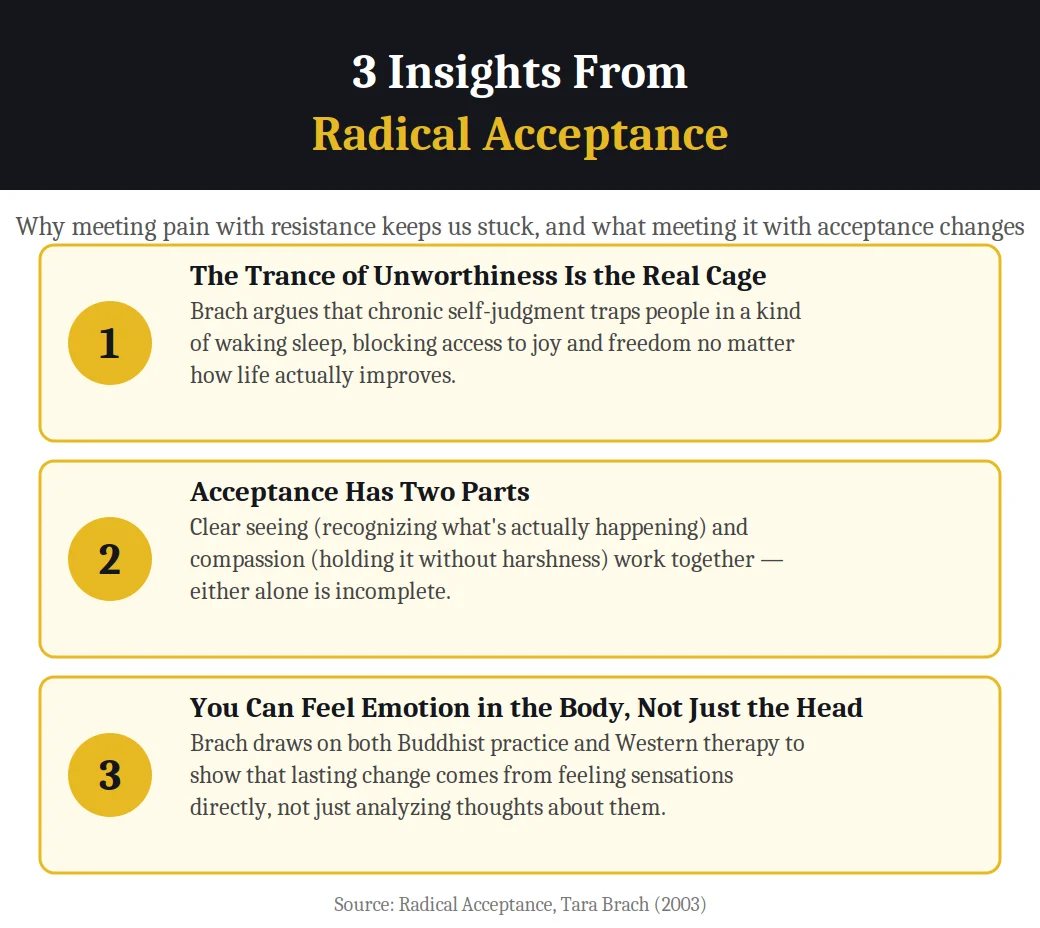
- The trance of unworthiness is a specific, common pattern: a chronic, often unconscious belief that something is fundamentally wrong or lacking in you, which persists even as external circumstances improve.
- Radical acceptance has two parts, not one: clear seeing (honestly recognizing what’s happening) and compassion (holding it with kindness) — either alone is incomplete without the other.
- RAIN gives the practice concrete steps: Recognize what’s present, Allow it to be there, Investigate it with curiosity, and Nurture yourself with compassion in response.
- Feeling lives in the body, not just the head: Brach draws on both Buddhist practice and Western experiential therapy to show that lasting change comes from directly feeling sensations, not just analyzing thoughts about them.
- Resistance to pain often creates more suffering than the pain itself: fighting, avoiding, or numbing a difficult emotion tends to prolong and intensify it rather than resolve it.
- The sacred pause interrupts autopilot: a brief, deliberate break from goal-driven momentum creates space for real awareness to arise instead of reactive habit.
- Self-judgment and anxiety function as a self-imposed cage: Brach argues people often continue judging themselves harshly even after achieving the external goals they believed would finally bring peace.
- Acceptance is not passive resignation: radically accepting an experience means honestly meeting it as it is right now, which is different from giving up on wanting things to change.
- Compassion for yourself and compassion for others are linked: Brach argues that the capacity to hold your own pain with kindness directly expands your capacity to hold others’ pain the same way.
What is Radical Acceptance about?
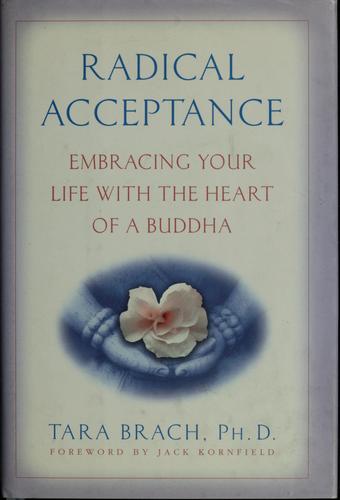
Radical Acceptance is Tara Brach’s argument that a chronic, often unconscious sense of unworthiness — what she calls the “trance of unworthiness” — quietly shapes how people think, relate, and treat themselves, regardless of how much their external circumstances actually improve. Drawing on her training as a clinical psychologist and decades as a Buddhist meditation teacher, Brach presents radical acceptance as the combination of clear seeing, honestly recognizing what’s actually happening internally, and compassion, holding that experience with kindness rather than harsh judgment. The book’s central practical tool is RAIN, a four-step meditation — Recognize, Allow, Investigate, Nurture — for meeting difficult emotions directly rather than being controlled by them.
About the author
Tara Brach is a clinical psychologist, meditation teacher, and founder of the Insight Meditation Community of Washington, D.C. She holds a Ph.D. in clinical psychology and has spent decades integrating Buddhist mindfulness practices with Western psychotherapy. Her 2003 book, Radical Acceptance, introduced a wide general audience to the trance of unworthiness and the RAIN meditation practice, which has since become one of the most widely taught tools in mindfulness-based therapy. Brach continues to teach internationally and hosts a popular weekly podcast of talks and guided meditations. Explore all Tara Brach book summaries →
Key concepts at a glance
| Concept | What it means | Use it when |
|---|---|---|
| The trance of unworthiness | A chronic, often unconscious sense of not being good enough that persists despite external success | You notice persistent self-criticism regardless of your actual achievements |
| Clear seeing + compassion | Honestly recognizing what’s happening, held with kindness rather than judgment | You’re facing a painful experience and want to meet it constructively |
| RAIN (Recognize, Allow, Investigate, Nurture) | A four-step meditation practice for meeting difficult emotions in the moment | A strong emotion arises and you want a concrete way to work with it |
| The sacred pause | A brief, deliberate break from goal-driven momentum to notice what’s present | You feel yourself on autopilot, reacting rather than choosing |
| Feeling in the body | Directly sensing emotion physically, rather than only analyzing it mentally | Thinking about a feeling isn’t resolving it |
Part 1: The trance of unworthiness
Brach opens with what she considers the central obstacle to a fulfilling life: a chronic, often unconscious belief that something is fundamentally wrong or lacking in us. She calls this the “trance of unworthiness,” and argues it functions like a waking sleep — people caught in it continue to judge and doubt themselves even after reaching external goals they once believed would finally bring peace. The trance isn’t simply low self-esteem in a particular area; it’s a pervasive undercurrent that colors relationships, ambition, and the ability to simply enjoy being alive.
TGR Note: This connects directly to Self-Compassion‘s account of why self-esteem, built on comparison and achievement, doesn’t reliably resolve chronic self-doubt — both books point to unconditional kindness toward yourself as the more durable fix.
Part 2: Clear seeing and compassion together
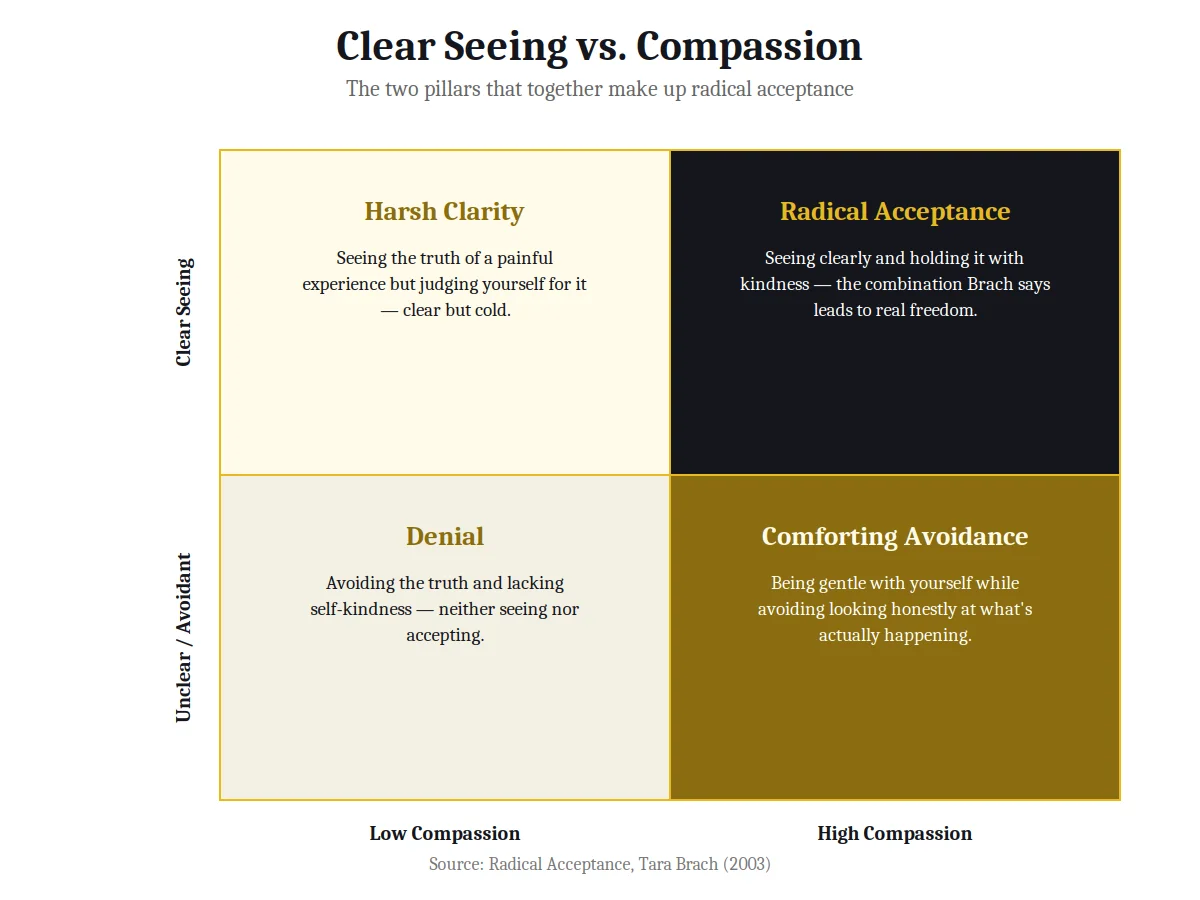
Brach argues that genuinely working with the trance of unworthiness requires two capacities operating together, not separately. Clear seeing means honestly recognizing what’s actually happening in your inner experience, without minimizing or exaggerating it. Compassion means holding that experience with kindness rather than harshness once you’ve seen it clearly. Seeing clearly without compassion produces harsh, cold self-awareness that doesn’t actually help; compassion without clear seeing can slide into avoidance, comforting yourself without honestly looking at what’s true. Radical acceptance is specifically the combination of both at once.
TGR Note: This pairing echoes The Untethered Soul‘s case that most suffering comes from resisting present experience rather than the experience itself — both books treat honest, non-resistant awareness as the doorway to freedom.
Part 3: The RAIN practice
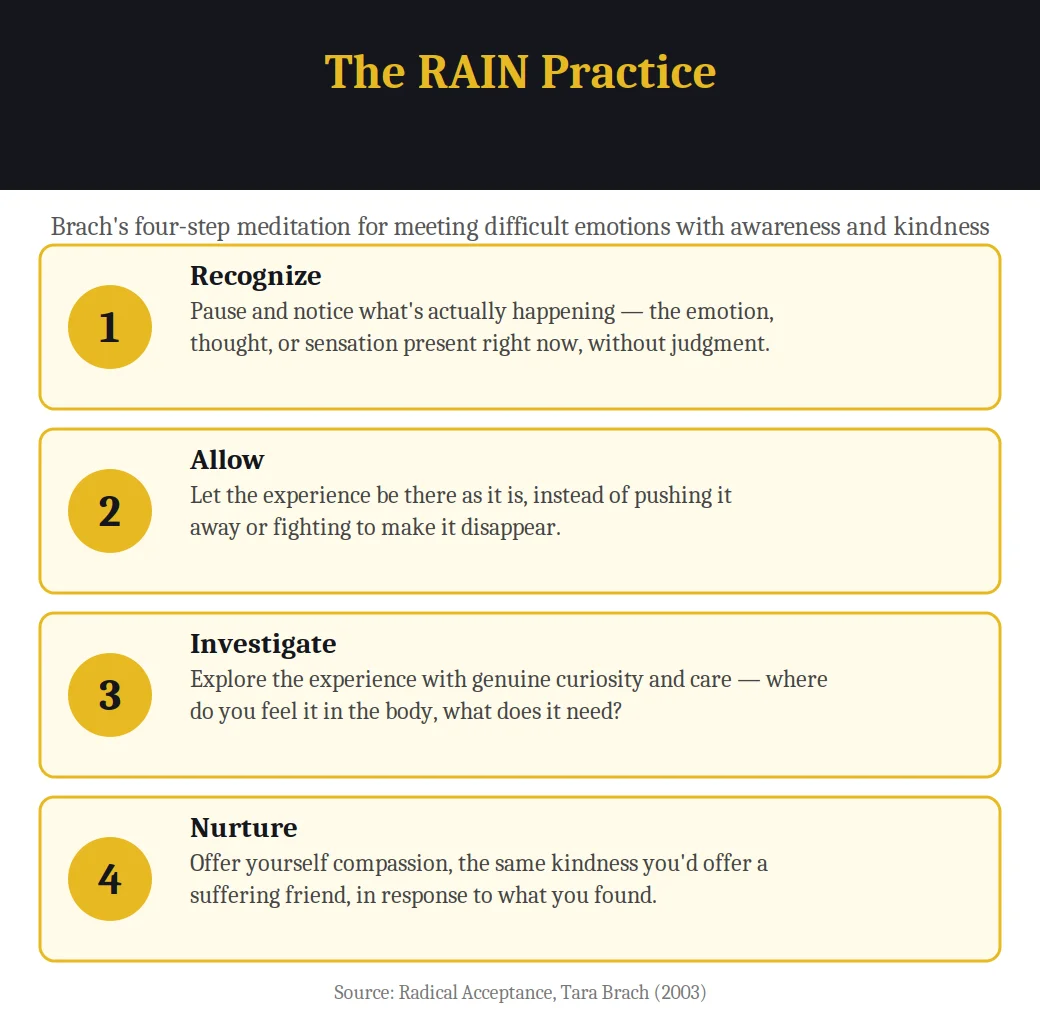
Brach’s central practical contribution is RAIN, a four-step meditation for meeting difficult emotions directly. Recognize means pausing to notice what’s actually present — an emotion, thought, or physical sensation — without immediately judging it. Allow means letting that experience be there as it is, rather than pushing it away or fighting to make it disappear. Investigate means exploring it with genuine curiosity, often by asking where it lives in the body and what it seems to need. Nurture means offering yourself the same compassion you’d offer a suffering friend, in direct response to what you found.
RAIN can be practiced as a standalone sitting meditation or applied spontaneously the moment a difficult feeling arises during ordinary life — in a hard conversation, before a stressful meeting, or in the middle of a wave of self-criticism. Brach emphasizes that the goal isn’t to make the difficult feeling go away faster, but to change your relationship to it, so it no longer runs the show unexamined.
Part 4: The sacred pause and living the practice
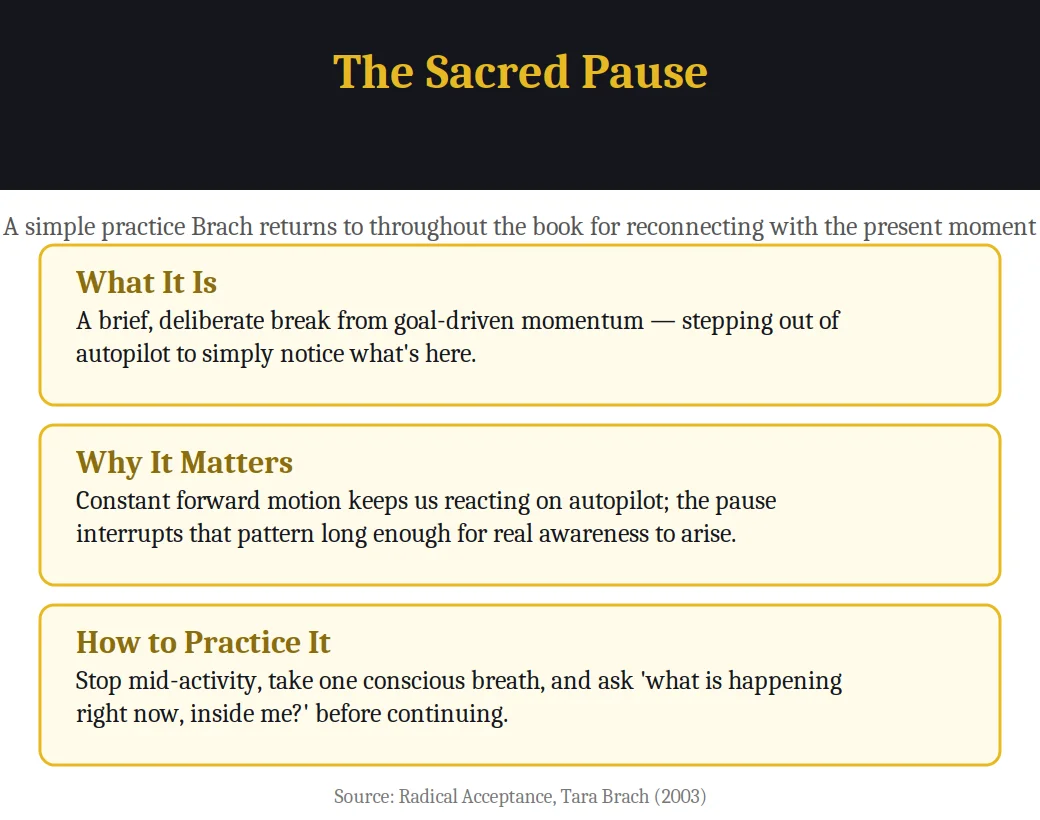
Brach closes with what she calls the sacred pause — a brief, deliberate break from constant goal-driven momentum. Modern life keeps most people moving from task to task on a kind of autopilot, reacting rather than genuinely choosing. The pause interrupts that pattern just long enough for real awareness to arise: stopping mid-activity, taking one conscious breath, and asking what’s actually happening inside right now before continuing.
Brach’s larger point is that radical acceptance isn’t a one-time insight but an ongoing practice, returned to again and again across a lifetime. The trance of unworthiness doesn’t disappear permanently after a single realization; what changes is your capacity to recognize it more quickly, meet it with more compassion, and let it dictate your choices less completely each time it arises.
Who is Radical Acceptance best for — and who should read something else first?
This book is best for chronic self-critics, anyone drawn to mindfulness or Buddhist-influenced practice, and those who feel a persistent undercurrent of not being “enough” despite outward success. It rewards readers open to meditation practice and Buddhist psychology paired with clinical insight, rather than purely secular self-help.
If your interest is more specifically in general present-moment awareness and resisting less, The Untethered Soul covers closely related ground. If self-criticism specifically, rather than the broader trance of unworthiness, is your main obstacle, Self-Compassion offers a more research-focused, secular treatment of the same core problem. And if fear and self-doubt show up mainly around performance and action, Russ Harris’s The Happiness Trap applies a similar acceptance-based approach through a different clinical lens.
Questions to reflect on
- Where in your life do you notice the trance of unworthiness — judging yourself despite evidence of your own competence or worth?
- Think of a recent difficult emotion: did you meet it with clear seeing, compassion, both, or neither?
- The next time a strong emotion arises, could you try the RAIN steps — recognizing, allowing, investigating, and nurturing — instead of reacting immediately?
- When did you last take a genuine sacred pause, rather than moving straight from one task to the next on autopilot?
- Is there a part of yourself you find hardest to hold with compassion — and what would it look like to meet it the way you’d meet a suffering friend?
🔥 Ready to meet your own pain with an open heart?
This guide covers the core practice — the book gives you Brach’s full teachings, meditations, and case stories.
How to apply Radical Acceptance (7-day plan)
- Day 1: Notice one moment the trance of unworthiness shows up — a harsh self-judgment despite evidence to the contrary.
- Day 2: Practice the RAIN steps with a mild difficult emotion: Recognize, Allow, Investigate, Nurture.
- Day 3: Take three sacred pauses today — brief, deliberate breaks to notice what’s happening inside before continuing.
- Day 4: When a strong feeling arises, try feeling it in your body first, before analyzing it mentally.
- Day 5: Identify a part of yourself you find hard to accept, and practice holding it with the same kindness you’d offer a friend.
- Day 6: Notice a moment you resisted or avoided a difficult emotion, and reflect on whether the resistance made it worse.
- Day 7: Reflect on how your relationship to the trance of unworthiness has shifted this week, even slightly.
Frequently asked questions
What is the main idea of Radical Acceptance?
A chronic, often unconscious sense of unworthiness shapes how people treat themselves regardless of external success, and meeting that pattern with clear seeing and compassion together, rather than judgment, is the path to genuine freedom.
What is the trance of unworthiness?
A chronic, often unconscious belief that something is fundamentally wrong or lacking in you, which persists even as external circumstances improve.
What does RAIN stand for?
Recognize, Allow, Investigate, and Nurture — a four-step meditation practice Tara Brach developed for meeting difficult emotions with awareness and self-compassion.
What are the two pillars of radical acceptance?
Clear seeing, honestly recognizing what’s actually happening, and compassion, holding that experience with kindness — Brach argues both are necessary together.
Is Radical Acceptance a religious book?
It draws on Buddhist psychology and meditation practice, blended with Western clinical psychology, but is written for a general audience regardless of religious belief.
What is the sacred pause?
A brief, deliberate break from goal-driven momentum, used to interrupt autopilot reactions and create space for real awareness of the present moment.
How is Radical Acceptance different from Self-Compassion?
Self-Compassion offers a research-focused, secular framework centered on self-kindness, common humanity, and mindfulness, while Radical Acceptance blends Buddhist meditation practice with clinical psychology around the broader trance of unworthiness.
Related summaries
If Radical Acceptance resonated, these dig further into related territory: Self-Compassion on responding to self-doubt with kindness, The Untethered Soul on resisting present experience less, and The Happiness Trap on an acceptance-based approach to difficult emotion. For more, see our best psychology books pillar page.
How we analyze books: We work from the full book — reconstructing its core arguments in our own words, adding commentary that connects it to related research and other books in our library, and pressure-testing the advice in a practical 7-day plan. Ratings weigh usefulness, readability, and evidence quality. Read our full methodology.
Related Psychology Summaries
Emotional Agility Summary & Review: Get Unstuck and Thrive
Lost Connections Summary & Review: Depression Isn’t All in Your Head
Outliers Summary & Review: Why Success Is Never a Solo Act
The Defining Decade Summary & Review: Why Your Twenties Matter
The Happiness Trap Summary & Review: Stop Chasing, Start Living