

★★★★☆ 4.6/5 — A reframe of depression and anxiety as signals of disconnection, not just broken brain chemistry, with a genuinely practical roadmap back to connection.
Best for: Anyone who has felt like standard depression advice (“exercise more, think positive”) misses the point, and wants to understand the social causes behind the numbers.
Reading time: ~7 hrs to read the book · 12 min for this guide
Difficulty to apply: Moderate — the insights are simple, but several solutions require changing your environment, not just your mindset.
Lost Connections in one minute
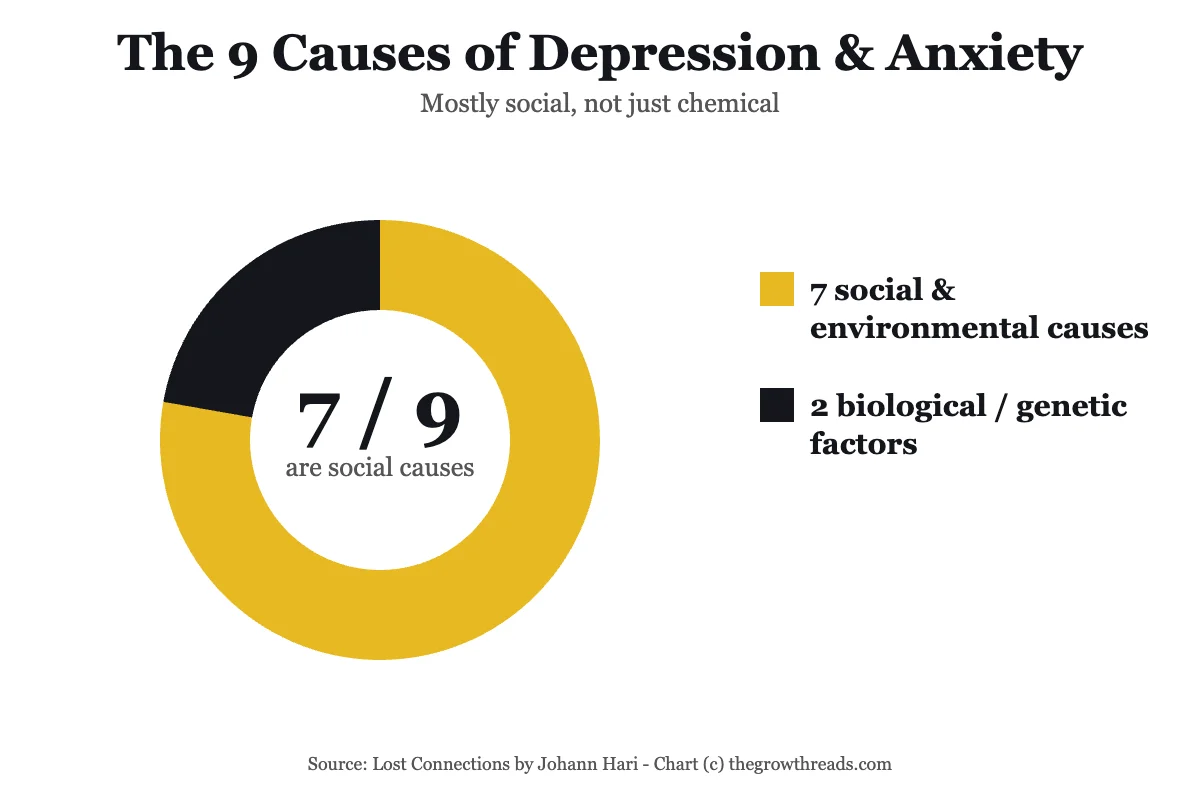
Depression and anxiety are rising across the Western world not because more of us have broken brains, but because more of us have lost the connections human beings need to thrive. Investigative journalist Johann Hari spent three years and traveled forty thousand miles interviewing the scientists who study depression to answer a question that had haunted him since his teenage years on antidepressants: why does the pain keep coming back? He found that of the nine evidence-backed causes of depression and anxiety, only two are biological — genetic sensitivity and real changes in the brain. The other seven are social and environmental: disconnection from meaningful work, from other people, from meaningful values, from childhood trauma, from status and respect, from the natural world, and from a hopeful future. If disconnection is the driver, Hari argues, then reconnection — not medication alone — has to be part of the solution. Lost Connections doesn’t dismiss antidepressants, and it isn’t a self-help checklist. It’s a reported argument for treating mental health as inseparable from the way we live, work, and relate to each other — and it closes with real-world experiments, from Berlin housing co-ops to a UK “social prescribing” pilot, that show what reconnection actually looks like in practice.
Key takeaways
- Only 2 of the 9 evidence-based causes of depression and anxiety are biological. The other 7 are social: disconnected work, people, values, status, nature, trauma, and future.
- The chemical-imbalance theory is incomplete. Genes create sensitivity to pain, not the pain itself — the “low serotonin” explanation oversimplifies decades of mixed evidence.
- Disconnected work is a major driver. Depression tracks with how little control and voice a person has at work, not just how hard the job is.
- Loneliness has become the default, not the exception. The number of close friends people report has fallen sharply since the 1980s, and loneliness reliably predicts later depression.
- “Junk values” — money, image, and status for their own sake — correlate with worse mental health than intrinsic values like relationships, growth, and community.
- Status and respect operate on us the way rank operates on primates. Low or threatened social status raises the same stress hormones seen in low-ranking baboons.
- Childhood trauma resurfaces in adult depression far more often than standard diagnostic categories acknowledge.
- Reconnection is a practical program, not a platitude. Hari documents real interventions — social prescribing, worker co-ops, community gardening, guaranteed income pilots — with measurable results.
- Antidepressants can genuinely help some people, but they are best understood as one tool among several, not a complete answer on their own.
- Recovery often means changing your environment, not just your mindset — the book’s central, and most actionable, reframe.
What is Lost Connections about?
Lost Connections is Johann Hari’s 2018 investigation into the real causes of depression and anxiety. Drawing on interviews with leading researchers across nine countries, Hari argues that most depression stems from disconnection — from work, people, values, status, nature, and a secure future — rather than solely from brain chemistry, and he profiles real-world “reconnection” programs that offer evidence-based alternatives and complements to medication.
About the author
Johann Hari is a British journalist and the New York Times bestselling author of Chasing the Scream, Lost Connections, and Stolen Focus. He has written for the New York Times, the Guardian, and Le Monde, and his TED talks have been viewed more than seventy million times. Hari’s reporting is rooted in his own decades-long experience with depression and antidepressant use, which began as a teenager. That personal history — including a public reckoning over past journalistic missteps earlier in his career, which he has openly addressed — shapes the book’s approach: he doesn’t write as a detached outsider, but as someone who went looking for answers he needed himself. His investigative method, built on long-form interviews with scientists and the people living the research, gives Lost Connections its reported, story-driven feel rather than the tone of a clinical textbook. Explore all Johann Hari book summaries →
Key concepts at a glance
| Concept | What it means | Use it when |
| The 9 causes | 2 biological (genes, brain chemistry) + 7 social causes of depression and anxiety | You want a fuller picture than “chemical imbalance” alone |
| Disconnection theory | Depression as a rational response to unmet human needs, not just a malfunction | Standard advice hasn’t addressed why you feel low |
| Junk values | Money, image, and status pursued for their own sake, at the expense of relationships and growth | Your ambitions feel hollow even when you’re “winning” |
| The 7 reconnections | Hari’s solutions framework, mirroring the 7 social causes | You’re ready to act, not just understand |
| Social prescribing | Doctors prescribing community activities and support alongside or instead of medication | You want to see reconnection tested in a real health system |
| Status and stress hormones | Low or threatened social rank raises the same stress hormones found in primates | Workplace or social hierarchy is wearing you down |
| Guaranteed income pilots | Case studies where unconditional income reduced anxiety and depression symptoms | Financial insecurity is a major stressor for you |
| Not anti-medication | Hari’s stance is nuanced: antidepressants can help, but shouldn’t be the only intervention offered | You’re deciding how medication fits into a broader plan |
Part One: Questioning the Old Story
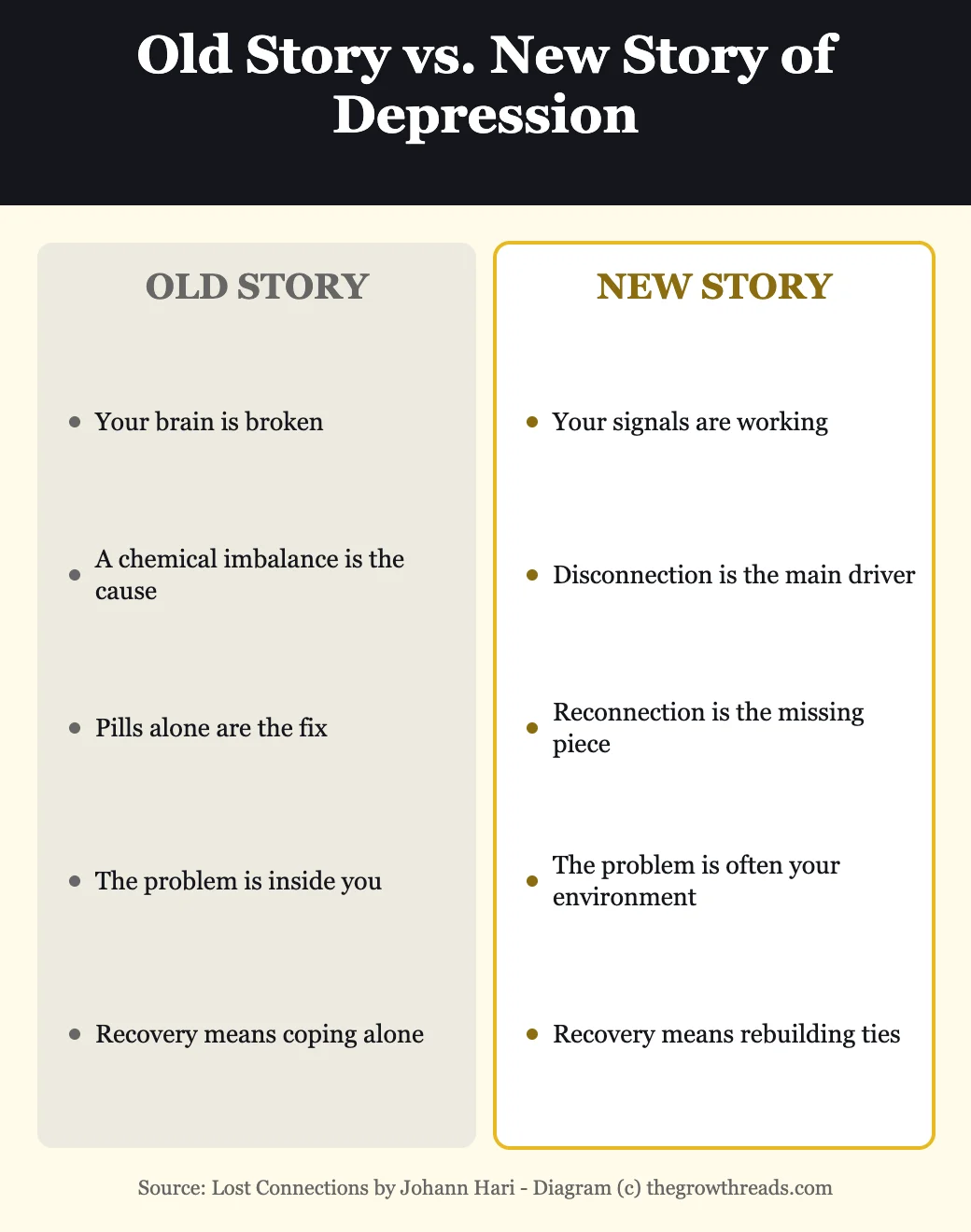
Hari opens with his own case history: an adolescent in real pain, a doctor who reached for a prescription pad, and a relief that faded within months, prompting a stronger dose, and then another. It’s a familiar arc for millions of people, and Hari uses it to ask a bigger question — not “does medication work,” but “why has depression kept rising across decades in which antidepressant prescriptions have also kept rising?” If the chemical-imbalance story were the whole truth, he reasons, then treating the chemistry should have made society steadily less depressed. It hasn’t.
He’s careful here, and this is one of the book’s most misunderstood points: the evidence for a simple “low serotonin causes depression” model is much thinner than the public pitch it received in the 1990s and 2000s. Genes do matter — twin studies suggest a meaningful hereditary component to sensitivity — but genes mostly set a threshold, not a verdict. What crosses that threshold, for most people, is life. That reframing — from “your brain is broken” to “your signals are working, and they’re responding to something real” — is the hinge the rest of the book turns on.
TGR Note: This isn’t the only book pushing back on an overly mechanical view of mental health. The Body Keeps the Score makes a parallel case for trauma living in the body, not just “in your head,” and Feeling Good offers the cognitive-therapy toolkit that pairs well with Hari’s environmental lens — the two approaches aren’t in competition, they operate at different levels of the same problem.
Part Two: The Seven Social Causes
This is the book’s engine room. Hari walks through each social cause with a mix of research and reporting, and the throughline is that each one maps onto something ordinary, not exotic.
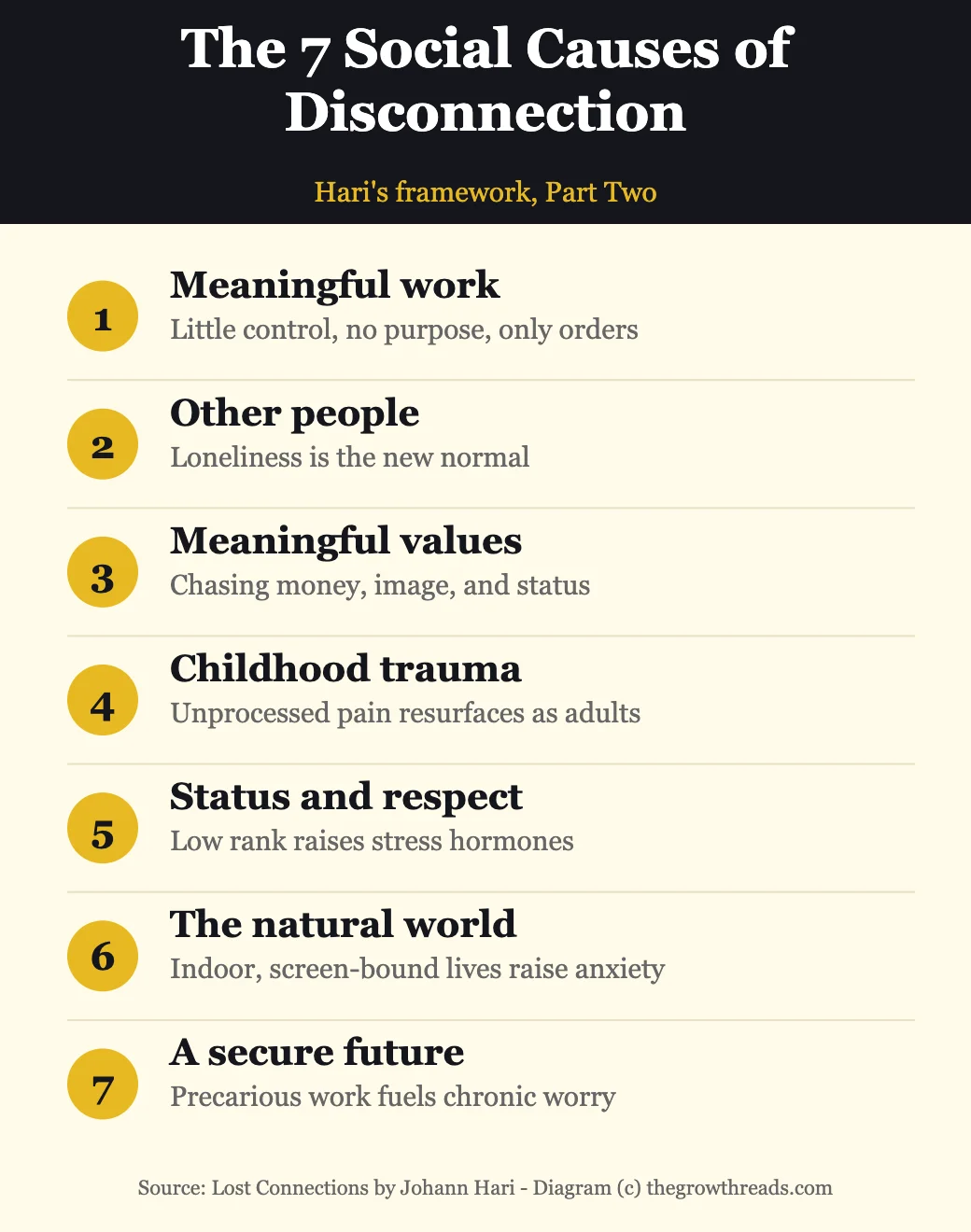
Disconnected work comes first, backed by Gallup data showing the majority of workers are disengaged or actively disengaged from their jobs, and by a study of British civil servants where depression tracked rank — with control over one’s work, not workload itself, as the deciding factor. Disconnected people follows: loneliness has become common enough to function as a public-health issue in its own right, and Hari cites research finding it predicts later depression more reliably than the reverse. Disconnected values covers the well-documented finding that people who orient their lives around money, image, and status report lower wellbeing than those oriented around relationships, growth, and community — not because ambition is bad, but because “junk values” don’t deliver the payoff they promise.
The section on childhood trauma is the book’s most personal, tracing how unresolved pain from early life resurfaces in adult mood in ways that a purely biochemical model misses entirely. Status and respect draws on primate research: baboons at the bottom of a troop’s hierarchy carry chronically elevated stress hormones, and Hari finds the same biological signature in humans whose status is low or under threat — which is one reason economic inequality tracks so closely with population-level anxiety. The chapter on the natural world is the most surprising to skeptical readers: controlled studies show measurable mood benefits from green space exposure, benefits that have shrunk as daily life has moved indoors and onto screens. Finally, a secure future — the chronic hum of financial and employment precarity — closes the causes section, setting up the guaranteed-income research that reappears later in the solutions.
What makes this section more than a list is how consistently the pattern repeats: control, not effort, predicts wellbeing at work; the number of people you can call at 2am predicts mood more than the number of people you know casually; and the gap between your actual life and the life your “junk values” told you to want predicts dissatisfaction better than your income does. Hari isn’t asking readers to accept nine unrelated data points — he’s asking them to notice that disconnection, in one form or another, is the thread running through all seven.
TGR Note: The status-and-stress-hormones research here rhymes with The Happiness Hypothesis, which covers similar primate-status findings from a broader wellbeing angle. If disconnected work is the cause that lands hardest for you, later research on autonomy and purpose — the same territory covered from a workplace-design angle in books on flow and engagement — adds useful depth here.
Part Three: The Two Biological Factors
Hari doesn’t discard biology — he right-sizes it. Twin and family studies suggest genes explain a meaningful share of variance in depression and anxiety risk, and there are real, measurable changes in the brains of people experiencing severe depression. What he pushes back on is the leap from “biology is involved” to “biology is the whole explanation.” Genetic sensitivity functions more like a dial that turns up the volume on your environment than a switch that determines your mood on its own. Two people with identical genetic risk can have very different outcomes depending on how connected or disconnected their lives are — which is precisely why the social causes matter as much as, or more than, the biological ones for most people, most of the time.
This section also handles the “some people just have a chemical illness that needs medication” cases fairly — Hari is explicit that for some individuals, particularly those with more severe or treatment-resistant presentations, medication is a genuine lifeline, not a crutch. The book’s argument isn’t “pills are bad.” It’s “pills alone, for everyone, was always an incomplete answer” — and the data on rising depression rates despite rising prescription rates backs that up.
He also draws a useful distinction between depression as a category and depression as an experience: two people can meet the same diagnostic criteria for very different underlying reasons — one shaped more by genetics and brain chemistry, another almost entirely by circumstance — and yet receive the same standard prescription. Part of what makes the book’s “9 causes” framework practically useful, rather than just academically interesting, is that it gives readers language to ask a more precise question than “what’s wrong with me”: which of these nine, specifically, is driving what I’m feeling right now — and which of them can I actually change?
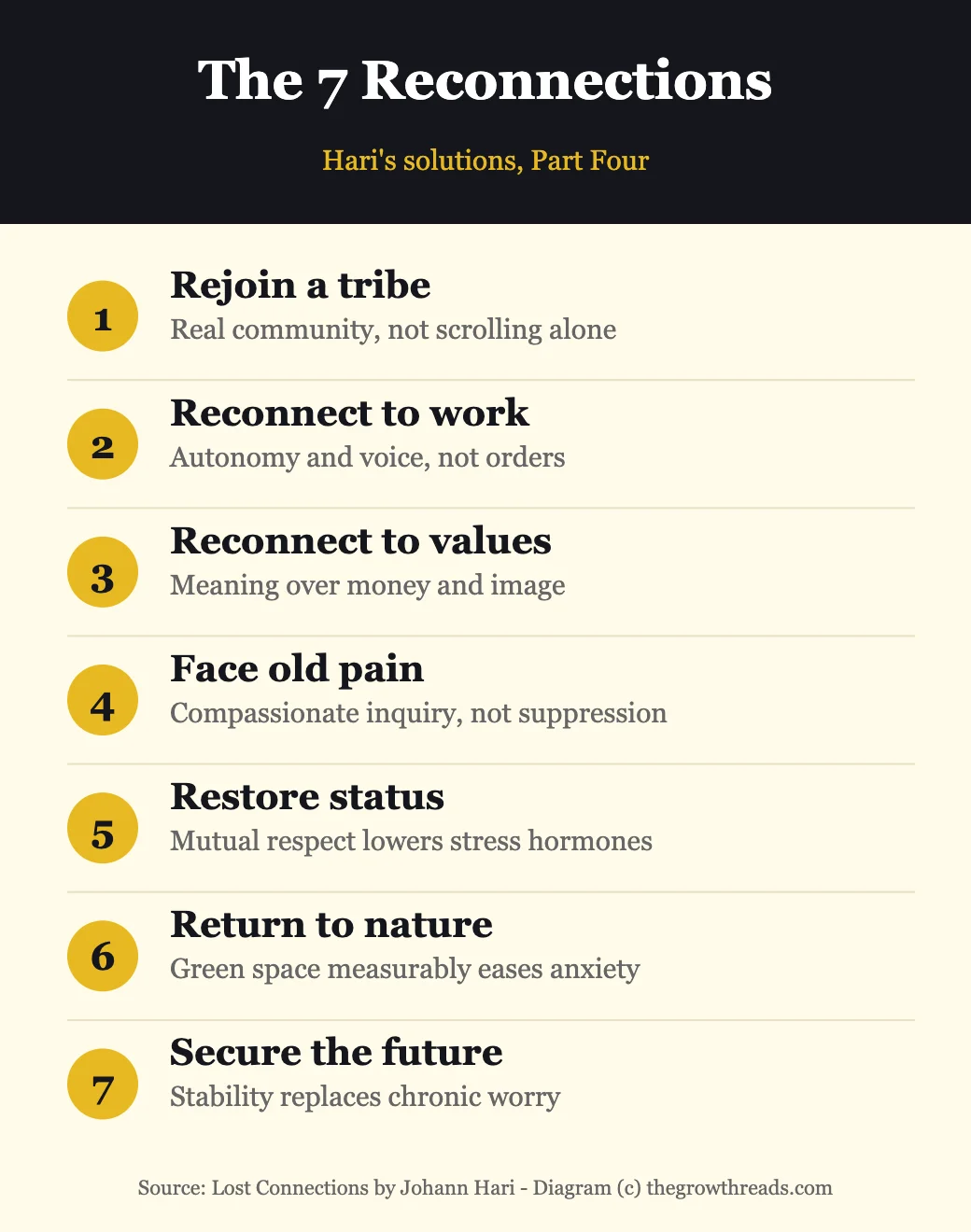
Part Four: The Seven Reconnections
The solutions mirror the causes, and this is where Lost Connections earns its keep as more than a diagnosis. Hari profiles a Berlin housing collective that rebuilt social ties through shared struggle and governance, a UK “social prescribing” scheme where doctors refer patients to gardening groups and community programs alongside or instead of medication, and businesses restructured as worker cooperatives where employees reported measurably lower anxiety once they gained real say over their work. He also covers guaranteed-income experiments — most notably a Canadian pilot — where unconditional cash reduced hospital visits for anxiety and depression and gave people back a sense of control over their future.
None of these are presented as silver bullets, and Hari is upfront that some — particularly income-security policy — require collective action, not just individual effort. But the throughline across all seven reconnections is consistent: rebuild the specific connection that’s missing, and the symptoms it was driving tend to ease.
The Berlin case study is worth dwelling on because it’s the clearest illustration of the book’s thesis in miniature. A group of residents facing eviction organized together, first out of necessity, and found that the act of fighting collectively — showing up for each other, sharing a goal, feeling useful to people who depended on them — measurably improved their mood and reduced stress, independent of whether the fight itself succeeded. Hari’s point isn’t that protest cures depression; it’s that the ingredients present in that group (shared purpose, mutual reliance, a sense of mattering to others) are the same ingredients missing from a lot of isolated modern life, and they’re ingredients you can look for — or build — in far less dramatic circumstances: a volunteer shift, a shared hobby, a standing weekly dinner with the same people.
TGR Note: If the “rejoin a tribe” reconnection resonates most, Man’s Search for Meaning is the classic companion read on finding purpose even in disconnection’s harshest forms. And if you want a gentler entry point into the “face old pain” reconnection specifically, Radical Acceptance and Self-Compassion both go deeper on that one piece.
Who is Lost Connections best for — and who should read something else first?
Lost Connections is best for readers who already have some support in place — whether that’s a doctor, therapist, or trusted person — and want a framework for understanding the social forces behind their depression or anxiety, plus ideas for what to change in their life and environment. It’s also a strong read for managers, policymakers, and anyone designing workplaces or communities, since several of its “solutions” are structural rather than personal.
If you’re looking for a step-by-step cognitive toolkit rather than a systemic diagnosis, start with Feeling Good instead. If your primary concern is trauma specifically rather than depression broadly, The Body Keeps the Score goes deeper on that single thread. And if you’re in acute crisis right now, this book — or any book — is not a substitute for reaching out to a mental health professional or a crisis line first.
Questions to reflect on
- Which of the seven social causes — work, people, values, trauma, status, nature, or future — feels most present in your life right now?
- Where in your life are you pursuing “junk values” (money, image, status) at the expense of the things that actually sustain you?
- Who are the people you’d call if you needed real support tonight — and when did you last invest in that relationship?
- What would it look like to gain more autonomy or voice in your work, even in a small way, this month?
- If a doctor could “prescribe” one piece of your life to change, alongside or instead of medication, what would you want it to be?
🔥 Ready to understand what’s really driving your anxiety?
Get the full research and every reconnection strategy in Lost Connections.
How to apply Lost Connections (7-day plan)
- Day 1: Rate each of the 7 causes (work, people, values, trauma, status, nature, future) from 1–5 for how disconnected it currently feels. Circle your lowest two.
- Day 2: Reach out to one person you’ve lost touch with — a short message is enough. The goal is one real exchange, not a reunion.
- Day 3: Spend 20 minutes outdoors, away from screens, in the middle of your day. Notice how you feel before and after.
- Day 4: Write down three “junk values” you’ve been chasing lately (money, image, approval) and one intrinsic value you’ve been neglecting.
- Day 5: Identify one small piece of autonomy you could ask for at work — a schedule change, a process tweak, a say in a decision — and ask for it.
- Day 6: If old pain came up as you read, note it without judgment and consider whether it’s time to bring it to a therapist or trusted confidant.
- Day 7: Pick your single lowest-scoring cause from Day 1 and commit to one concrete, recurring action that addresses it over the next month.
Frequently asked questions
Is Lost Connections against antidepressants?
No. Johann Hari is explicit that antidepressants genuinely help some people, especially in more severe cases, and he doesn’t advocate stopping medication without medical guidance. His argument is that medication alone has been oversold as a complete answer, and that addressing the social causes of depression — work, relationships, values, status, nature, and financial security — should be part of treatment too, not an afterthought.
What are the 9 causes of depression in Lost Connections?
Two are biological: genetic sensitivity and physical changes in the brain. Seven are social: disconnection from meaningful work, from other people, from meaningful values, from childhood trauma, from status and respect, from the natural world, and from a secure future. Hari argues the seven social causes explain most of the rise in depression and anxiety over recent decades.
Is the science in Lost Connections controversial?
Some of it is debated. Critics have pointed out that Hari’s critique of the chemical-imbalance model, while grounded in real research, sometimes reads more definitively than the underlying science supports, and that his proposed structural solutions (guaranteed income, workplace democracy) are harder to implement broadly than his case studies suggest. The core observation — that social and environmental factors meaningfully affect depression and anxiety — is well supported; the strength of some individual claims is more contested.
What is social prescribing, and does it actually work?
Social prescribing is a practice, piloted in parts of the UK health system, where doctors refer patients to community activities — gardening groups, exercise classes, arts programs, or peer support — alongside or instead of medication. Hari profiles pilot programs with encouraging results, and the broader practice has since been adopted more widely in UK primary care, though large-scale, long-term outcome data is still developing.
How long does it take to read Lost Connections?
At 416 pages, most readers finish the book in six to eight hours, or a few sittings over a week. The chapters are short and story-driven, which makes it easy to read in smaller pieces if the subject matter feels heavy.
What should I read after Lost Connections?
If you want a trauma-specific deep dive, try The Body Keeps the Score. For a cognitive-therapy toolkit that pairs well with Hari’s environmental lens, Feeling Good is a strong next step. And for the meaning-and-purpose thread that runs through the “reconnection” solutions, Man’s Search for Meaning is the classic companion.
Is Lost Connections a substitute for therapy or medical advice?
No. The book is a work of investigative journalism, not a clinical treatment plan, and it isn’t a substitute for professional medical or mental health advice. If you’re experiencing depression, anxiety, or thoughts of self-harm, please speak with a doctor, therapist, or a crisis support service — the book’s ideas are best used alongside professional support, not instead of it.
Related summaries
- Man’s Search for Meaning — finding purpose through connection to values, even in extremity.
- The Happiness Hypothesis — the status and social-comparison research that echoes Hari’s status chapter.
- Self-Compassion — a gentler toolkit for the “face old pain” reconnection.
- Radical Acceptance — for readers who want to go deeper on processing difficult emotion.
- See the full Best Psychology Books list for more.
How we analyze books: Every TGR summary is built from a full read of the source material, cross-checked against the author’s published interviews and essays, and organized around practical application rather than critique. Read our full methodology.
Related Psychology Summaries
Flow Summary & Review: The Science of Losing Yourself in What You Do
Influence Summary & Review: The Psychology of Persuasion
Switch Summary & Review: The Rider-Elephant-Path Framework for Real Change
The 48 Laws of Power Summary & Review: Reading the Hidden Game of Influence
When the Body Says No Summary & Review: How Suppressed Emotion Makes You Sick