

★★★★½ 4.6/5 — the missing training plan for the virtue that aims courage, discipline, and justice.
Best for: people who read a lot and still make the same expensive mistake
Reading time: ~8 hrs (400 pages) · this guide ~12 min
Difficulty to apply: Medium — the reps are daily, not dramatic
Wisdom Takes Work in one minute
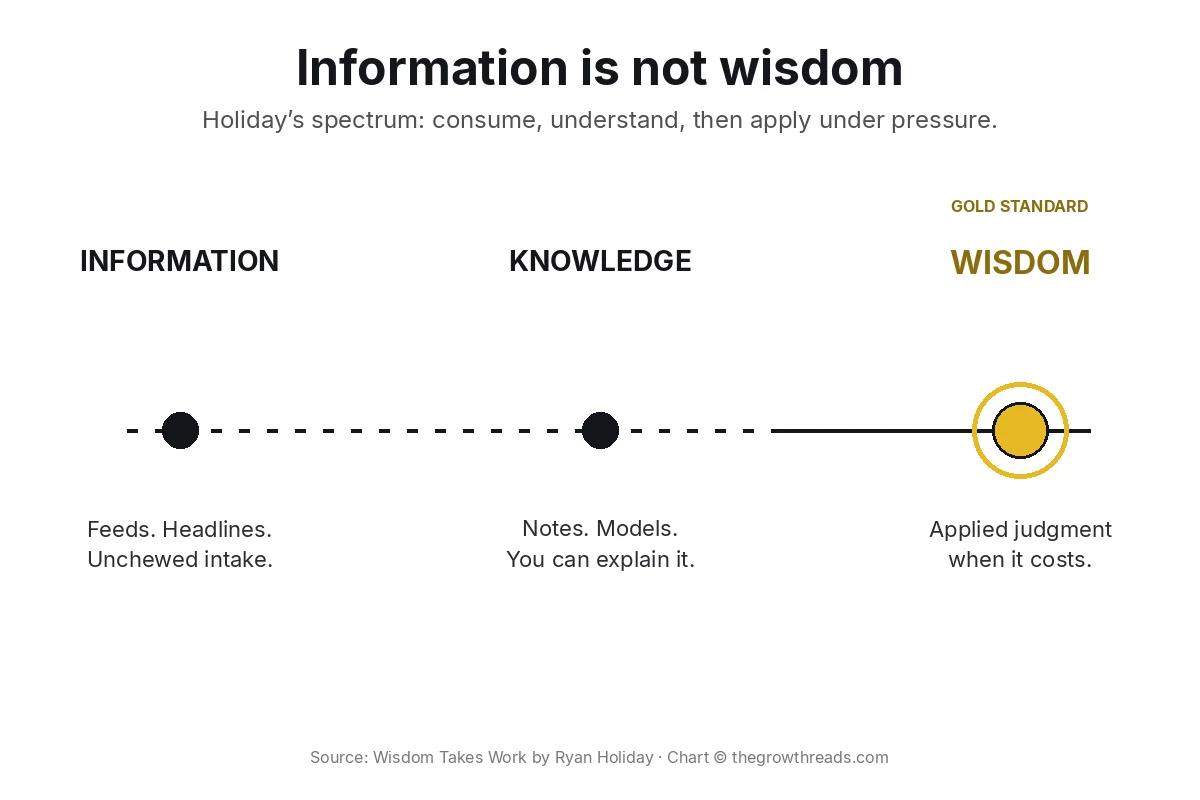
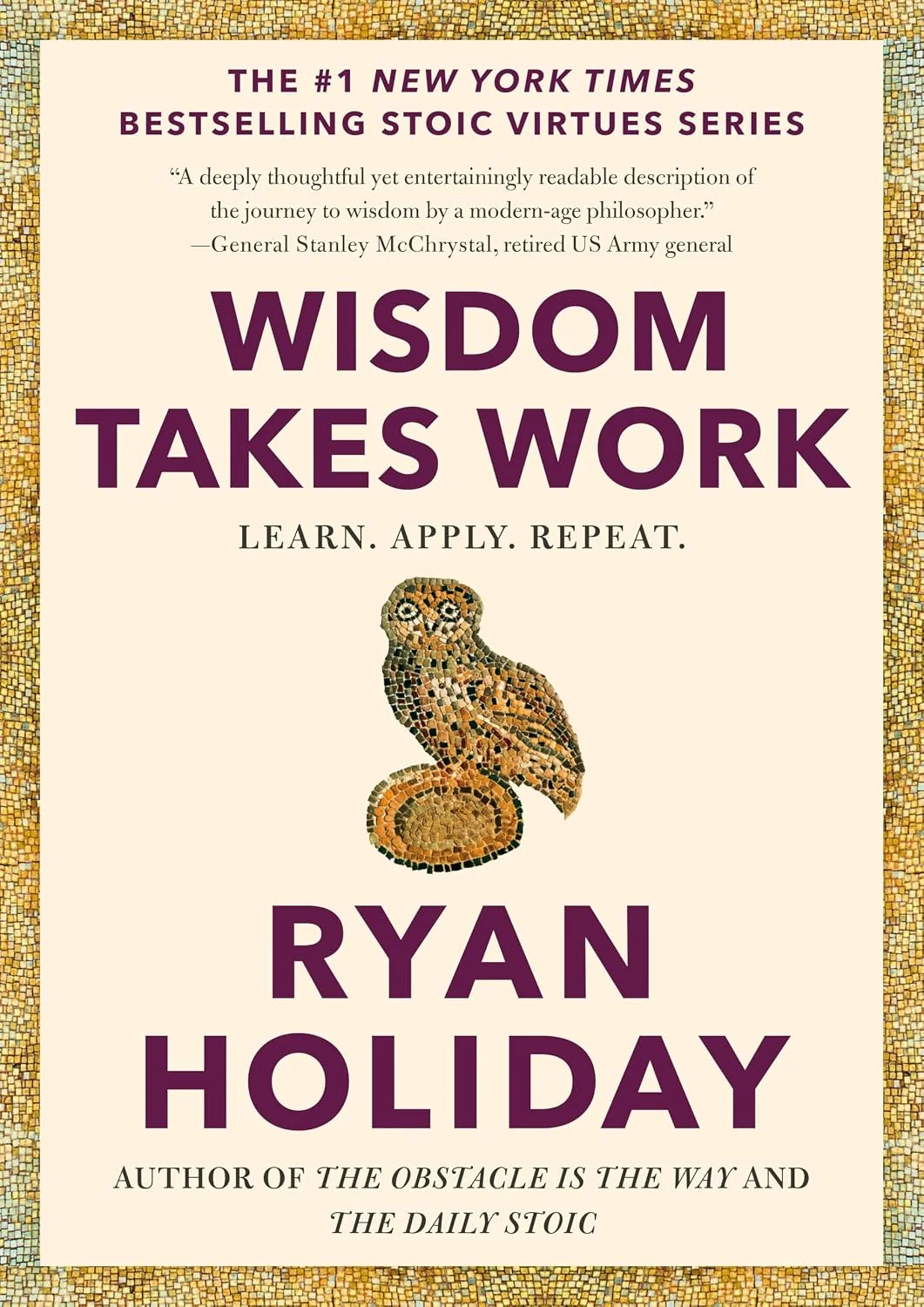
No one stumbles into wisdom. Seneca said it first; Ryan Holiday turns it into a training ground. Wisdom Takes Work: Learn. Apply. Repeat. is the last book in his Stoic Virtues series, after courage, discipline, and justice. The claim is blunt. Wisdom is not a personality, a degree, or a well-curated feed. It is work you do on purpose: read people who already paid the tuition, find a teacher who will slow you down, get miles on live problems, and use the lesson when it costs.
The other half is a wreck chart. A full cup cannot be filled. A junk information diet makes you louder and less useful. Intelligence without this training is a sharper fool. This Wisdom Takes Work summary is the loop: learn, apply, repeat — plus a week of small reps so the hardcover does not become another unopened object.
Key takeaways
- Wisdom is the hinge: Courage, discipline, and justice still need a mind that can aim. Without it they become rashness, grind, and self-righteousness.
- No one is wise by chance: Treat schooling as something you run, not something that ended at graduation.
- Talk to the dead: Books are conversations with people who already sat the exam. Almost every path to wisdom runs through them.
- Listen harder than you speak: A closed mouth is an open classroom. Most of us reverse that ratio on purpose.
- Keep a second brain: Capture the line you will need on a tired Tuesday. Study systems, then use one you will actually open.
- Empty the cup: You cannot learn what you think you already know. Humility is a skill, not a mood.
- Watch the information diet: Headlines and hot takes are calories. Go to the source. A podcast is not a briefing.
- Change your mind: A fool stays the same. When the facts move, update the map.
- Stay a student, then teach: Lincoln watched a trial he had been iced out of. Then he went home to study. Teaching locks the loop.
- Learn. Apply. Repeat.: Unapplied notes are still information. Wisdom is judgment used when it costs.
What is Wisdom Takes Work about?
Wisdom Takes Work is Ryan Holiday’s last Stoic Virtues book. Wisdom is not a download. You train it through reading, teachers, and experience, then apply judgment when it costs. Ego, junk information, and a frozen mind are the rocks that wreck that training. The loop is learn, apply, repeat.
About the author
Ryan Holiday is a writer and former marketer who brought Stoic practice back to a mass audience with The Obstacle Is the Way, Ego Is the Enemy, Stillness Is the Key, and The Daily Stoic. He runs The Painted Porch bookstore on Main Street in Bastrop, Texas, and has spent a decade turning Marcus Aurelius, Seneca, and Epictetus into field manuals rather than classroom ornaments. The Stoic Virtues series — Courage Is Calling, Discipline Is Destiny, Right Thing, Right Now, and this closer — treats character as four trainable skills. Wisdom Takes Work is the one that aims the other three. The voice is the usual Holiday cadence: short chapters, historical scenes, and a demand that you do something before you buy another notebook. Explore all Ryan Holiday book summaries →
Key concepts at a glance
| Concept | What it means | Use it when |
|---|---|---|
| The agoge | A self-run training ground: books, teachers, miles, a sound body. | You treat education as a finished certificate. |
| Talk to the dead | Read as a conversation with people who already sat the exam. | Your inputs are all living, loud, and current. |
| Second brain | A commonplace book you will actually open on a tired Tuesday. | You highlight everything and retrieve nothing. |
| Empty the cup | You cannot pour into a mind that already knows. | You win the room and lose the lesson. |
| Information diet | Calories versus food. Go to the source; skip the buffet of takes. | You feel informed and still cannot decide. |
| Stay a student | Keep going after the title. Watch the trial you were iced out of. | Success has started protecting your ego. |
| Learn. Apply. Repeat. | Unapplied notes are still information. Wisdom is used judgment. | The notebook is full and the week is unchanged. |
Part 1: Wisdom is the hinge virtue
Holiday opens where the series has been heading. The ancients named four cardinal virtues — courage, temperance, justice, wisdom — and called them hinges, from the Latin cardo. A door that does not swing is furniture. A person with three virtues and no wisdom is a hazard with good intentions. Courage without judgment is a charge in the wrong direction. Discipline without judgment is a beautiful grind at the wrong target. Justice without judgment is a sermon that cannot see the actual human in front of it.
That is why this book feels slower than the first three. It is not a pep talk. The mind has to be trained the way the body is trained, and modern life pays you to skip it. Reaction is rewarded. Restraint looks unfashionable. A person who cannot listen or update will still be handed tools — and those tools amplify the error.
Seneca’s line sits over the whole project: no man was ever wise by chance. If you like Holiday’s earlier books, this is the operating system they assumed. If you are new, it is still a complete manual. You do not need the series in order. You need a willingness to be a beginner in public, which is the first unpaid cost.
Part 2: The Agoge — build a training ground
Part I is titled The Agoge, Sparta’s word for a training ground. Holiday is not asking you to romanticize a brutal city-state. He is asking you to stop waiting for an institution to finish your mind. Montaigne is the opening scene: a man who treated education as something that eventually reverts into your own hands. Schoolmasters, Montaigne said, can be like birds that never taste the food they stuff into other beaks. Judgment can do without a pile of facts. A pile of facts cannot do without judgment.
The practical stack is almost rude in its simplicity. Talk to the dead — read. Holiday’s own line is the one worth keeping: there are many paths to wisdom, but nearly every one of them runs through books. Charles de Gaulle, in the middle of running a country, still read two or three a week. You have time. You have been spending it on the buffet. Be curious like a physicist who never grew up. Ask the question adults trained out of you. Focus, because wisdom is a contact sport with one object at a time. Learn to listen: when the mouth opens, the ears shut. Keep a second brain, a commonplace book, a system you will actually use — study all the tools, then pick one.
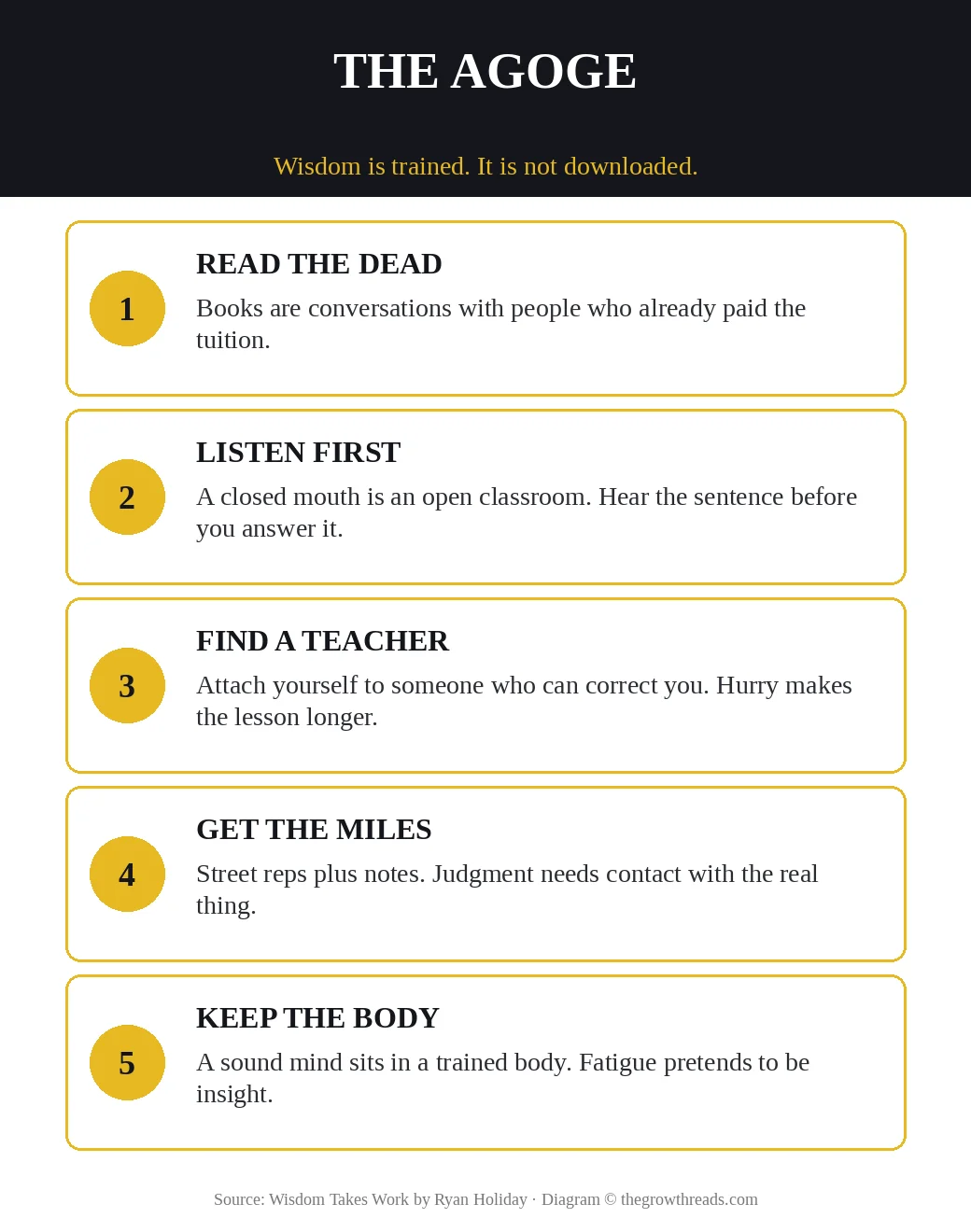
Then the human pieces people skip because they require embarrassment. Find a classroom and show up. Find a teacher; Banzo wanted mastery fast, and each plea to hurry added decades. A student in a hurry learns the slowest. Apprentice. Join a scene like Franklin’s Junto, not a mastermind that flatters you. Study the past as a lens on Tuesday. Get miles: book smarts without street reps is a costume. Keep the body in the deal. Fatigue pretends to be insight.
TGR Note. The “second brain” chapter is Holiday’s nod to capture, not a software stack. If you want the filing system, Building a Second Brain and The PARA Method are the TGR companions. If the bottleneck is attention rather than notes, Deep Work is the room you do the reading in. Capture is useless if the calendar never sits still long enough to talk to the dead.
Part 3: The Sirens — the rocks that wreck judgment
Part II is The Sirens. The mind battles itself: prejudices, shortcuts, the need to be right. Holiday’s useful distinction is that ignorance is temporary and solvable. Stupidity is refusing the solve. Empty the cup, including the dirty cup — Horace’s warning that whatever you pour into an unclean vessel goes sour. We use that powerful mind, too often, to invent reasons for what we already wanted to do.
Write to think. Thomas Merton on the page was not announcing conclusions; he was finding them. Amazon’s six-page memo is the corporate version of the same rule: if you cannot write it, you do not yet think it. Assemble a board of directors who can check you, not a room that rubber-stamps the founder. Do not be a know-it-all. Epictetus told gifted Roman students it is impossible to learn that which you think you already know. Watch the information diet the way you would watch food: too much, too processed, and you starve while feeling full. Go to the source. A summary of a summary of a briefing is not research.
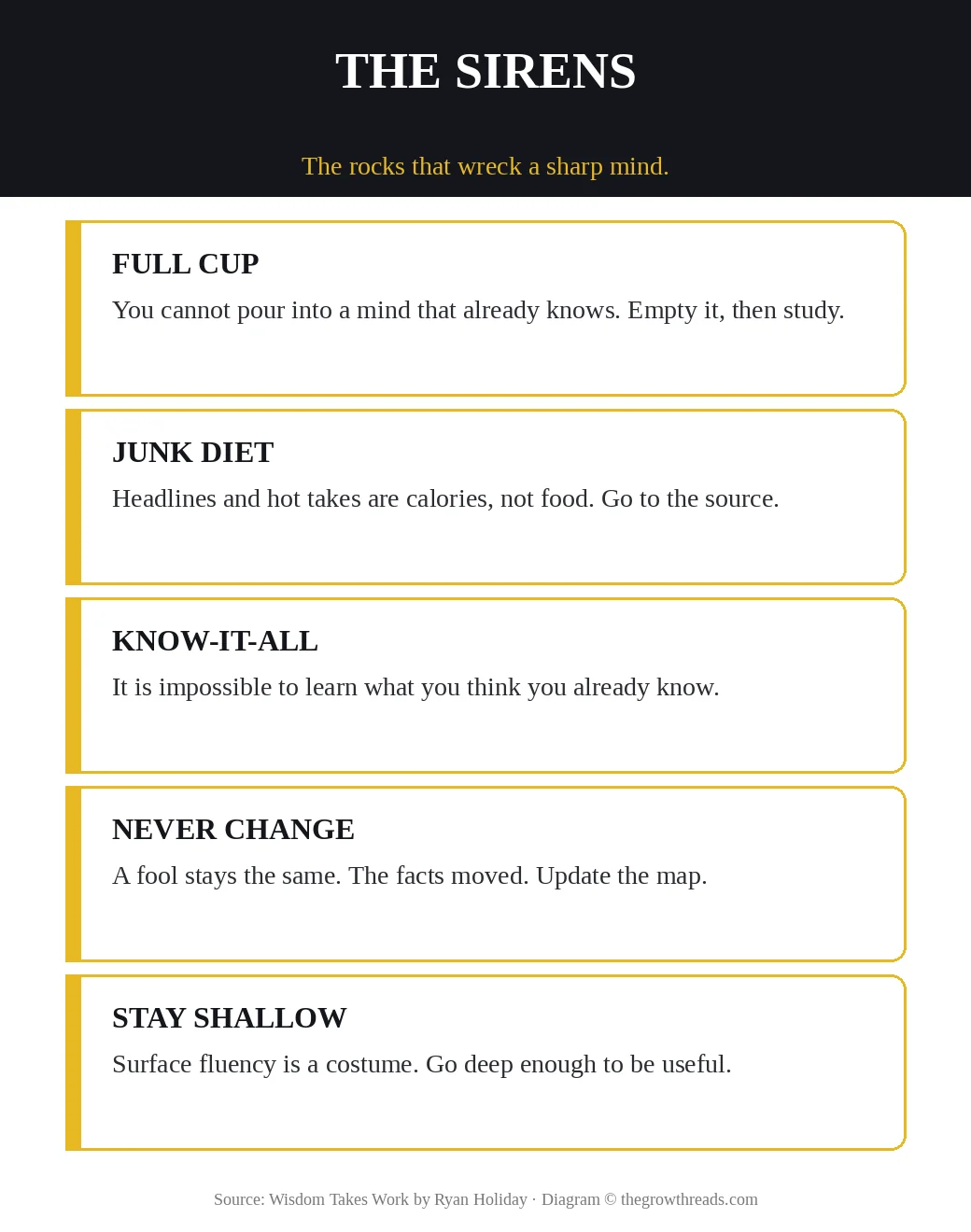
The later sirens are character, not media. Think for yourself. Change your mind when the facts move — Keynes’s test still works. Seek disagreement so the mind does not live in a bubble. Seek criticism the way pain flags an injury. Make mistakes in the open so the lesson is coded for other people. Go deep. Do not fall for the clean story you wish were true. Being wrong is not the sin. Being confidently wrong is.
TGR Note. The know-it-all siren is the same enemy Holiday named years earlier in Ego Is the Enemy. If this chapter stings, start there — it is shorter. For the information diet, Clear Thinking is the ordinary-moment companion: win the space before the feed writes your conclusion. Holiday is not anti-input. He is anti-unchewed input.
Part 4: The Apotheosis — stay a student, then teach
Part III is The Apotheosis: what the training is for. Wisdom, in Holiday’s scenes, is not erratic. It is calm, patient, and able to hire the person who once insulted you because they are the right operator — Lincoln putting Edwin Stanton at War. Empathy here is not agreement. It is the German Umwelt: enough care to notice another person’s world so you can aim justice instead of a cartoon. Humility is the irony of the whole book. The smarter you get, the less you need to feel like a smart person.
Always stay a student. Lincoln, iced out of a big case, stayed and watched, then went home to study because better-prepared people were coming west. Be a teacher: you learn the idea twice when you hand it over. Keep a journal. Free yourself from the stories that own you. Suffer into truth — the bill is never free, and learning from it is not automatic. Do not lose the wonder. Grasp the essence, the way Lincoln wanted a general to see the whole country as the soil. Distill. Then leave an example.
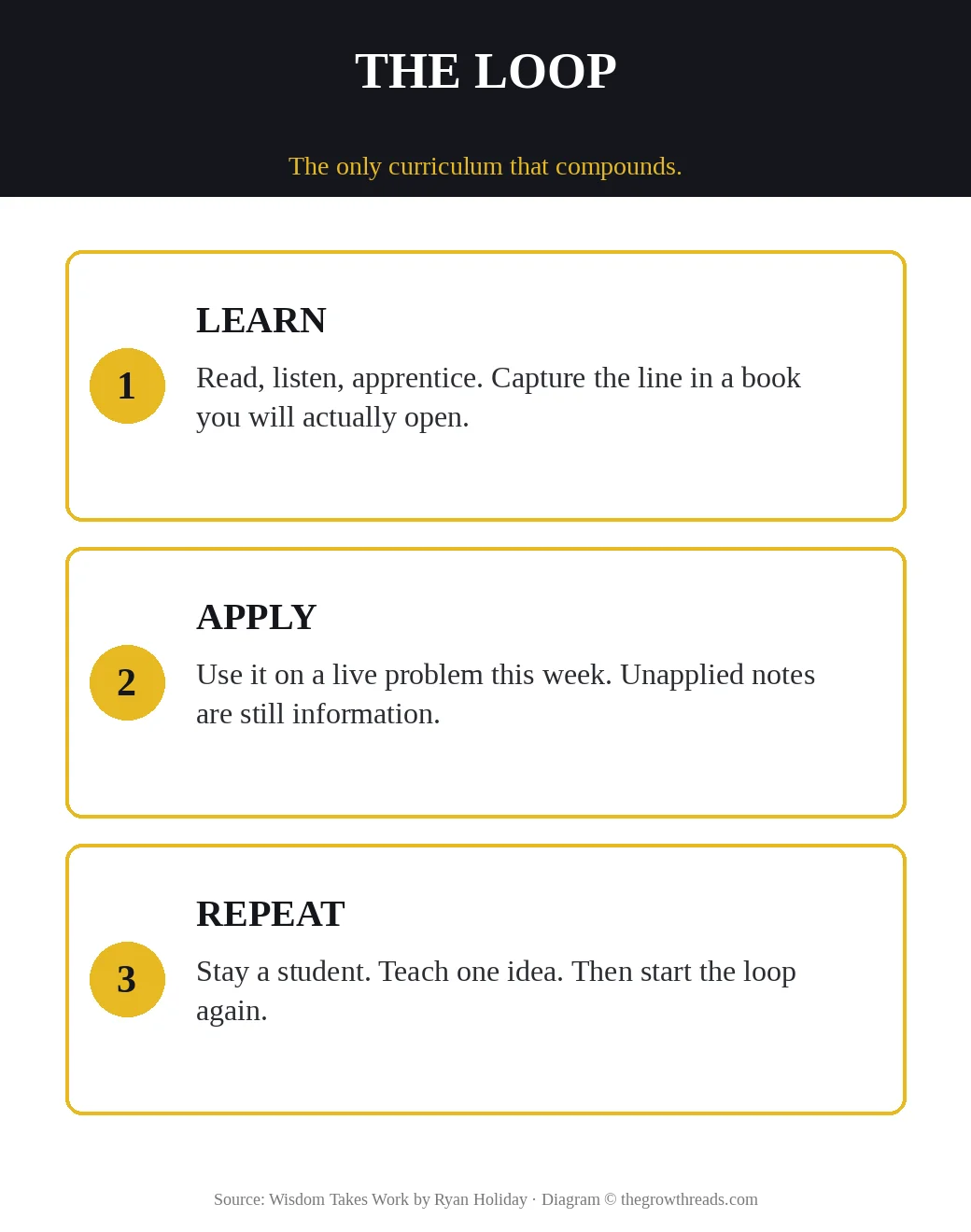
The closer is the series thesis in one line. Wisdom is virtue; virtue is wisdom. The four hinges exist so that at the critical point, character kicks in. Nobody is born with it. Once you learn something, as John Lewis’s mother told him, no one can take it away — if you use it. The subtitle is the whole curriculum: learn, apply, repeat. Holiday’s afterword is quieter than the rest of his catalog. He argues less. He admits he is wrong more often. That is not branding. That is the metric.
TGR Note. If you want the other three hinges in this same cadence, read Courage Is Calling, Discipline Is Destiny, and Right Thing, Right Now. Wisdom is the aiming book. The others are what you aim. For a daily page instead of a fourth hardcover, The Daily Stoic is the habit companion.
Who is Wisdom Takes Work best for — and who should read something else first?
Best for managers, founders, students, and heavy readers who can narrate a well-informed week and still repeat an expensive error. It is also the right Holiday if you finished the first three virtues and felt the missing piece was judgment, not hustle.
Read something else first if you cannot start — go to Courage Is Calling or Eat That Frog. If the enemy is ego more than a missing curriculum, Ego Is the Enemy is shorter. If you need stillness more than schooling, Stillness Is the Key is the quieter book. If you want systems for the notes Holiday only sketches, Building a Second Brain will file what this book tells you to capture.
Questions to reflect on
- What did I consume yesterday that I could not apply if someone asked me to use it by Friday?
- Who is allowed to tell me I am wrong — and when did I last make that easy for them?
- Which book on my shelf is a conversation I have been postponing with someone already dead?
- Where am I performing certainty because changing my mind would cost face?
- What is one idea I learned this month that I have already taught, and one I have only highlighted?
🔥 Ready to train wisdom instead of collecting takes?
Run Holiday’s loop this week: learn one hard page, apply it once, repeat.
How to apply Wisdom Takes Work (7-day plan)
- Day 1 — Talk to the dead. Read twenty pages of a hard book, not a feed. Write one line you could use on a live problem.
- Day 2 — Empty the cup. On one page, list what you are sure is true about that problem. Mark two items as untested.
- Day 3 — Ask a better question. Take those two items to a person who will not flatter you. Listen without defending for ten minutes.
- Day 4 — Change the diet. One long source, no take buffet. If you cannot name the author and the date, it does not count.
- Day 5 — Write to think. One page, no bullets recycled from a thread. If you cannot write it, you do not think it yet.
- Day 6 — Apply it once. Use yesterday’s page on the actual problem. A sent note, a revised decision, a changed number — not a new highlight.
- Day 7 — Teach and lock the loop. Explain the idea to one person. Put tomorrow’s twenty pages on the calendar. Repeat.
Frequently asked questions
What is Wisdom Takes Work about?
Wisdom Takes Work is Ryan Holiday’s closing book in the Stoic Virtues series. It argues that wisdom is not a trait you inherit or a feed you finish. You train it the way a craftsman trains: reading people who already paid the tuition, finding teachers who will correct you, getting miles on real problems, and applying judgment when it costs. The second half names the wrecks — a full cup, a junk information diet, the need to be the smartest person in the room — and the last third is the loop: stay a student, teach, keep your wonder.
Is Wisdom Takes Work worth reading if I already read The Obstacle Is the Way?
Yes, if Obstacle taught you to use a hard event and you still binge takes instead of building judgment. Obstacle is perception, action, and will under pressure. This book is the schooling that makes those three trustworthy. You can finish Obstacle in a weekend. Wisdom Takes Work wants a commonplace book, a living teacher, and a diet that is not made of headlines. If you already keep notes and change your mind in public, you will move faster; the Agoge chapters will still give you a cleaner training list.
How is Wisdom Takes Work different from Discipline Is Destiny?
Discipline Is Destiny is temperance: what you will not do, how you hold the body and the calendar. Wisdom Takes Work is the aiming virtue. You can be brutally consistent at the wrong target. Holiday’s point is that courage, discipline, and justice need a mind that can listen, update, and see the essence of a mess. Read Discipline when the issue is starting. Read this when the issue is thinking — when you already work hard and still fall for a clean story that is not true.
Do I need to read the Stoic Virtues series in order?
No. Each book stands alone. Courage Is Calling is action while afraid. Discipline Is Destiny is self-command. Right Thing, Right Now is who the work is for. Wisdom Takes Work is how you keep from becoming a sharp fool. Reading them in order is tidy because wisdom is the hinge that aims the other three, but a manager drowning in feeds can start here. If you have read none of Holiday, Ego Is the Enemy is still the shortest companion for the know-it-all siren this book names.
What is the Agoge in Wisdom Takes Work?
The agoge was Sparta’s training ground. Holiday borrows the word for a self-education you actually run: talk to the dead through books, stay curious, ask the question, listen, keep a second brain, find a classroom and a teacher, apprentice, join a scene, study the past, travel, get experience, and keep the body sound. The image is not a military fantasy. It is a refusal to treat school as something that ended at twenty-two. An education is taken, not issued, and the list is a week you can start without a new app.
How long does it take to read Wisdom Takes Work?
The hardcover is about 400 pages. A focused reader finishes in seven to nine hours. The chapters are short, in Holiday’s usual cadence, so you can take one essay a morning for six weeks and actually use it. That slower pass is closer to the book’s point than a weekend binge, because the work is application, not coverage. This summary is a twelve-minute map plus a seven-day plan so the first loop can start before the hardcover even arrives on the desk.
Who should not start with Wisdom Takes Work?
Skip it as a first Holiday if you need a push to begin — start with Courage Is Calling or a two-minute habit book. Skip it if you want a textbook of logic or a research methods course; this is a field manual of stories, not a methods paper. If your problem is a frozen calendar, Discipline Is Destiny or Eat That Frog will move the week faster. Start here when you already consume plenty and need the training that turns intake into judgment.
Related summaries
- Courage Is Calling — act while afraid
- Discipline Is Destiny — self-command as a skill
- Right Thing, Right Now — aim the work
- Ego Is the Enemy — empty the cup
- Best productivity books — the full TGR pillar
How we analyze books: we reconstruct the argument, add original application notes, and skip chapter-by-chapter reproduction. Read our full methodology.