

★★★★☆ 4.4/5 — 101 short lessons. Pick four. Live so people miss you.
Best for: hard workers whose week looks successful and whose life is getting thin.
Reading time: ~5 hours (256 pages) · this guide ~12 min
Difficulty to apply: Easy to start one lesson; medium to stop collecting all 101 as highlights.
Who Will Cry When You Die in one minute
When you were born, you cried while the world rejoiced. Live so that when you die, the world cries and you rejoice. Robin Sharma’s Who Will Cry When You Die (HarperCollins, 1999) is 101 named practices for a life people will actually miss — a sibling to The Monk Who Sold His Ferrari, not another Julian Mantle fable. Start the day before the inbox does. Name a calling in one sentence. Treat trouble as a classroom. Say no to a full calendar that is not a life. Keep an idea book. Do one kindness that can be dated. Success is a scoreboard. Significance is how you left people. Do not highlight all 101. Practice four this week. The funeral test is a calendar with the right names on it.
Key takeaways
- The funeral test is the scoreboard: who would cry, and for what reason you can name.
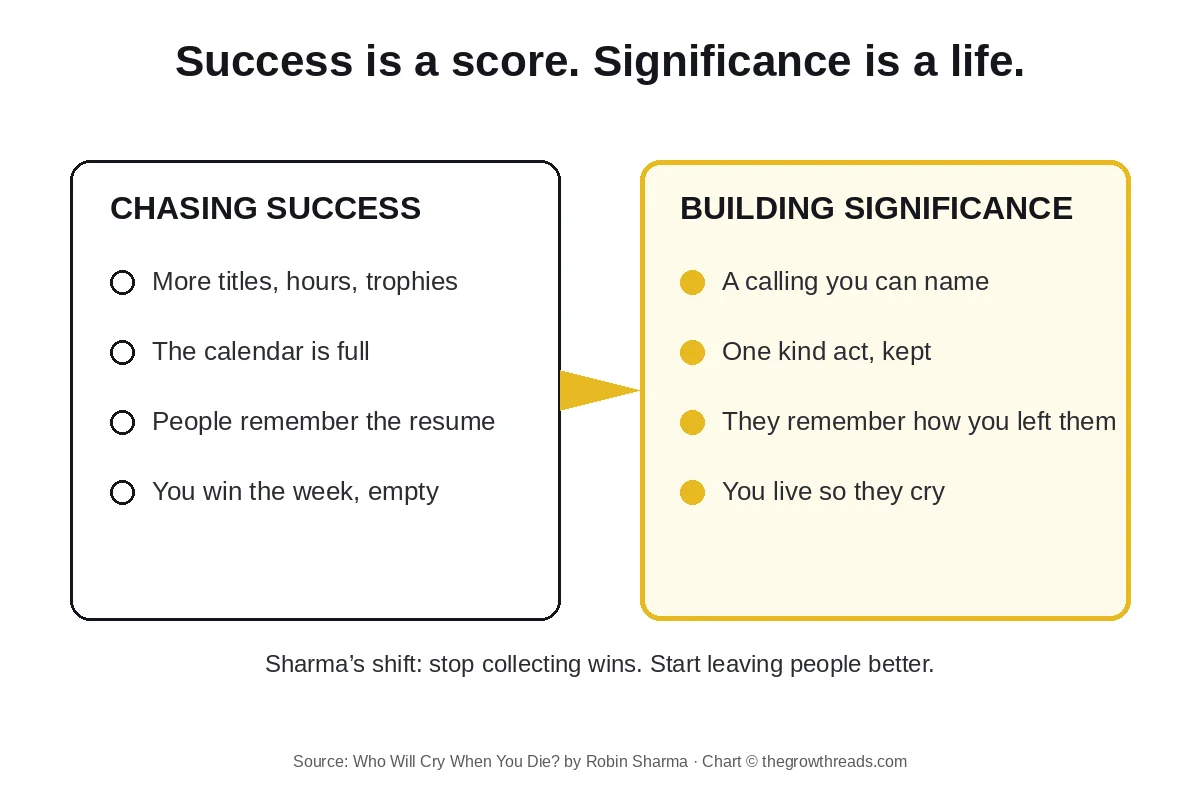
- Success is not significance: titles and hours can fill a week that nobody will miss.
- A calling is a sentence: who you serve and what you will not trade, not a personal brand.
- Start the day well: quiet minutes before the world starts it for you — the seed of Sharma’s later 5 a.m. work.
- Guard the mind like a garden: you become what you rehearse; pull the weeds before noon.
- See troubles as blessings: the snag is a classroom, not a verdict on your name.
- Learn to say no: a packed diary is often a thin life in costume.
- Keep an idea book: capture, then do one thing. Quotes without action are decoration.
- Kindness has to be dated: a stranger, a note, a call — local, not abstract.
- 101 is a kit, not a quiz: pick four moves. Do not collect the set.
What is Who Will Cry When You Die about?
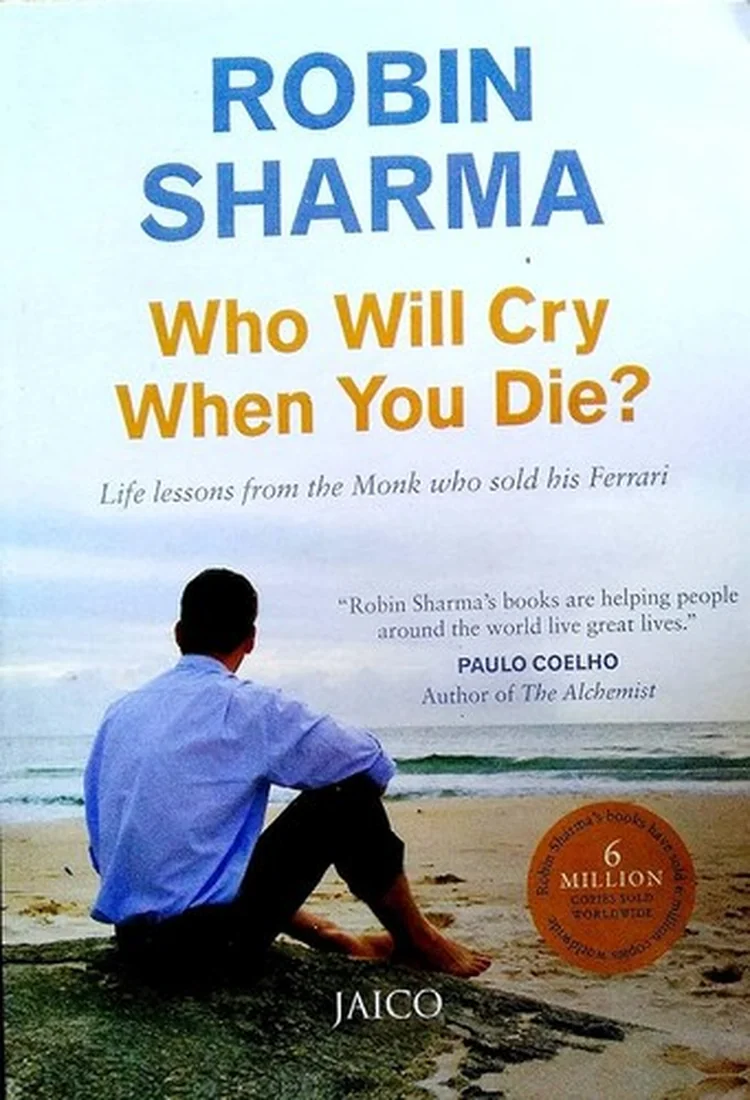
Who Will Cry When You Die is Robin Sharma’s 101 short lessons for a life of significance. Each chapter names one practice — mornings, calling, mind, action, people — so you stop chasing a glittering empty success and start leaving people better than you found them.
About the author
Robin Sharma is a Canadian writer and leadership speaker who left a litigation career after The Monk Who Sold His Ferrari (1997) found a global audience. The fable’s Sivana virtues — a mind like a garden, the purpose of life as a life of purpose — made him a go-to voice for professionals who wanted character without abandoning work. Who Will Cry When You Die, two years later, is the field kit: 101 named lessons instead of one story. He later wrote The 5 AM Club, which takes a single lesson from this book — start your day well — and builds a whole morning operating system around it. The through-line is mastery of the inner day so the outer day is worth missing when it ends. He still writes and speaks on leadership; the useful unit remains a small, kept practice, not a slogan. Explore all Robin Sharma book summaries →
Key concepts at a glance
| Concept | What it means | Use it when |
|---|---|---|
| Funeral test | Live so people cry for a reason you can name, not for a title. | The week looks successful and the life feels thin. |
| Significance vs success | Success is a score. Significance is how you left people. | You are collecting wins and starving relationships. |
| Calling | One sentence: who you serve and what you refuse to trade. | Purpose talk stays a mood board. |
| Start the day well | Quiet minutes before inboxes. Later: the 5 AM Club. | Mornings are already other people’s. |
| Mind as garden | You become the thoughts you rehearse. | Replay and comparison eat noon. |
| Troubles as blessings | The snag is a classroom, not a verdict. | A miss is turning into a personality. |
| The no | Protect the compass. A full calendar is not a life. | You cannot name what you declined this month. |
| Dated kindness | One local act, written down, done. | You admire compassion and never schedule it. |
Part 1: Keep a compass, then start the day
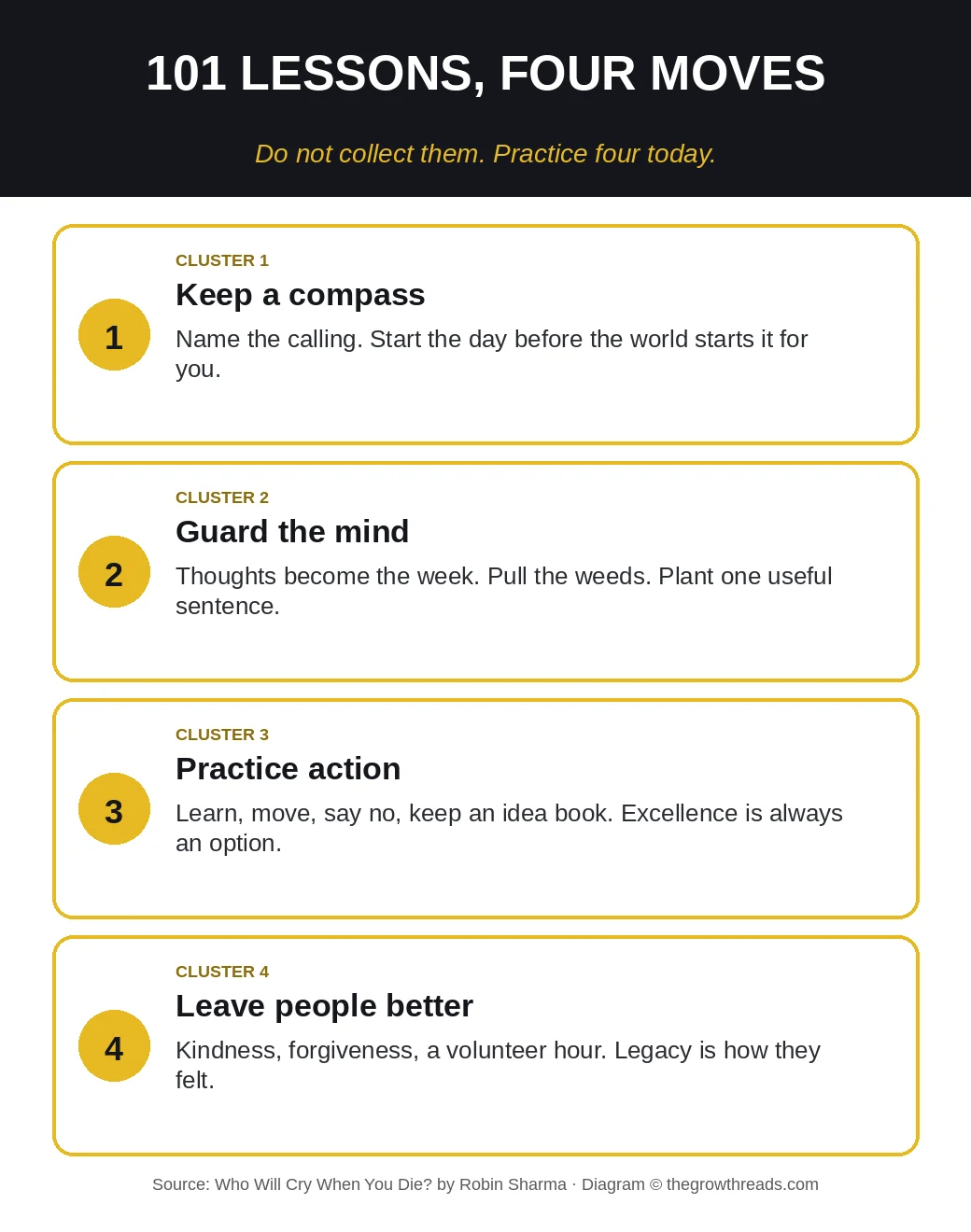
Sharma opens with an ancient line, not a productivity hack: when you were born, you cried while the world rejoiced; live so the reverse is true. That is the book’s only thesis. The 101 lessons are how. The first cluster is orientation. Discover your calling — not a personal brand, a sentence about who you serve and what you will not trade for a prettier title. Carry your own compass. Honor your past without living in it. These are filters for the next yes. If you cannot name the calling, every invitation looks like opportunity, and the calendar fills with other people’s urgency.
Then the day itself. Start your day well. Get up early. Learn to meditate. Sharma would later devote a whole fable to the first hour; here it is one lesson among many, which is useful. You do not need a 5 a.m. identity to take twenty quiet minutes before the inbox. The point of the morning is to meet the calling before the world assigns you a different one. A professional who “does not have time” for a compass already has a compass: whoever emailed first. Write the sentence. Protect the first block. Then go to work as someone who chose the work.
TGR Note: If the compass sentence will not come, The Monk Who Sold His Ferrari is the picture: Julian Mantle leaves a glittering empty success for a few virtues you can hold. This book is the kit. The 5 AM Club is “start your day well” as a morning OS — use it after the sentence exists.
Part 2: Guard the inner life
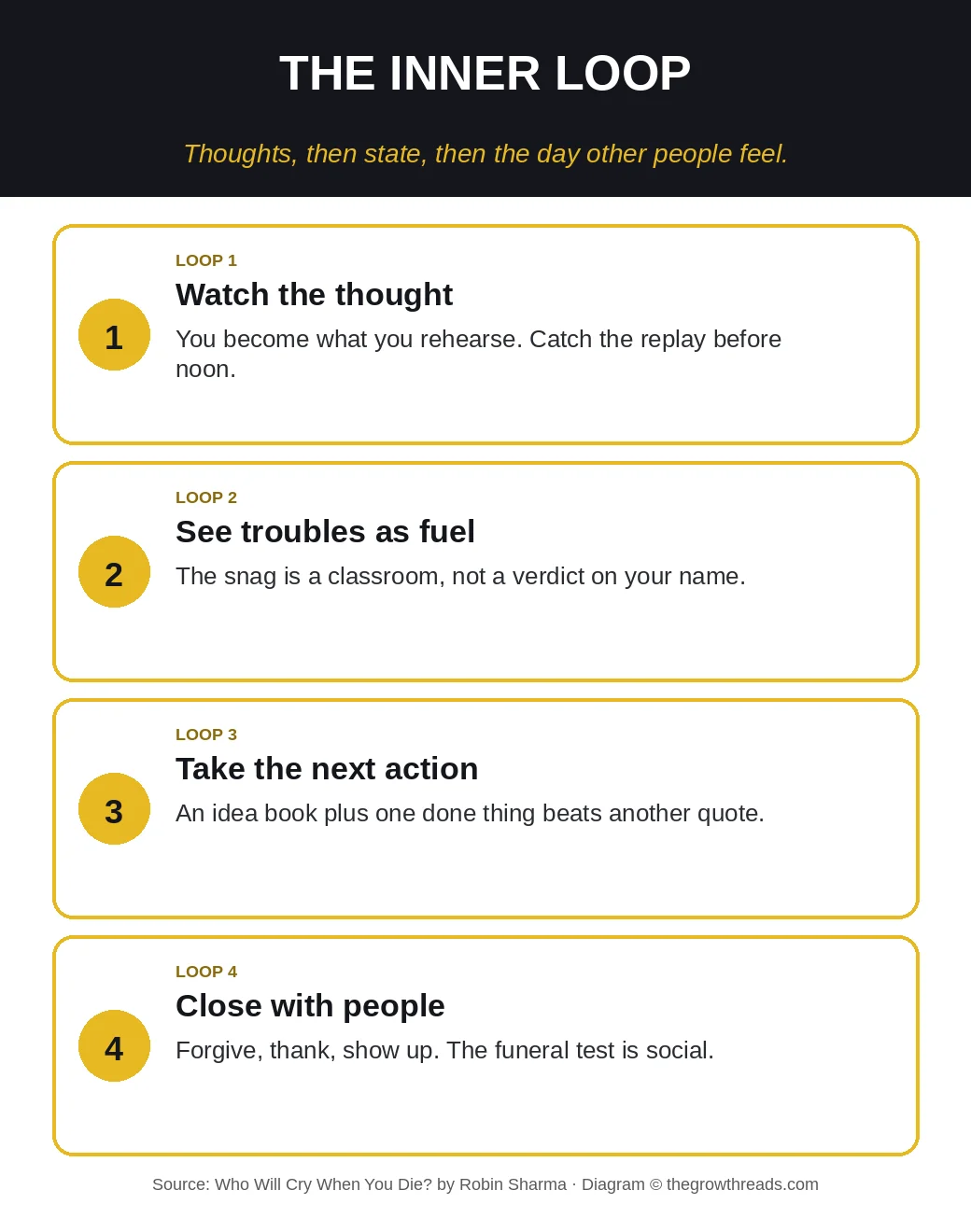
A second cluster is mental hygiene. Sharma’s garden metaphor from Monk returns in quieter form: the quality of your life follows the quality of your thoughts. Maintain your perspective. See troubles as blessings. Practice tough love on your own excuses. Laugh more. Forgive. It is a working rule: you rehearse the replay or you plant a useful sentence, and the afternoon follows whichever you chose. Catch the thought before noon. If the snag is already a personality — “I am the person this happens to” — you have left the classroom. Troubles as blessings is not sunny denial. It is a decision to extract a next move from the miss instead of a story about your luck.
The inner loop is short enough to run on a weekday. Watch the thought. Name it without decorating it. Pick the next physical action — a walk, a call, a closed laptop — so the body leaves the loop the mind cannot talk its way out of. Sharma’s tone is pastoral, not clinical. If you need the science of attention residue, Deep Work and Focus will serve you better. This book is for the person whose attention is fine and whose inner commentary is not. The funeral test applies inside the head too: would you want today’s voice to be the one people remember?
TGR Note: For a weekly framework that puts first things first after the inner noise drops, The 7 Habits of Highly Effective People is the operating system. Sharma gives you tonight’s lesson title. Covey gives you the roles and the big rocks. Use the lesson, then the week, not a stack of unread systems.
Part 3: Practice the action habit
A third cluster is output. Keep an idea book. Practice the action habit. Learn to say no. Become a student for life. The idea book is not a second-brain product. It is a pocket list so the good thought does not wait for a perfect app. Capture, then do one. Quotes without a next action are interior design. Saying no is the adult version of the compass: every yes you cannot name is a no to the calling. Excellence is always an option is the standard when the work is boring. None of these need a retreat. They need a dated check.
Sharma is cheerful about smallness. Plant a tree. Take a holiday every day of your life — a pocket of unhurried attention, not a booking. Read. The action habit is how 101 lessons avoid becoming a personality quiz. You do not “become” the kind of person who would keep an idea book. You buy a cheap notebook and write three lines on Tuesday. If the week requires a new identity before a first action, you are back in Monk’s glittering office, decorating the stall. Two evening blocks will carry most of this cluster. If a task needs a course or a rebrand, ask whether the first kept promise still depends on it.
TGR Note: If action is the bottleneck and the compass is already clear, Mini Habits and The War of Art will get the body in the chair faster than another Sharma chapter. How Will You Measure Your Life is the sterner calendar test: your diary is already the strategy.
Part 4: Leave people better than you found them
The last cluster is social, which is where the funeral test stops being a metaphor. Be kind to a stranger. Be a better parent, partner, colleague. Become a volunteer. Practice forgiveness where you are still quietly collecting interest. Sharma’s point is blunt: significance is local. Nobody is eulogized for inbox zero. They are remembered for how you left them — the call you returned, the credit you passed, the hour you showed up when it was inconvenient. Date it. Abstract compassion is a mood. Dated kindness is a life. If your week has no slot that would make someone cry later, the week is a success story with the wrong audience.
Live fully so you can die happy is not a travel slogan. It means stop postponing the calling to a retirement that may not be kinder. The 101st lesson is the same as the first: a life other people will miss is built in small, named, kept acts. One short attributed opening, used as Sharma uses it: “When you were born, you cried while the world rejoiced. Live your life in such a way that when you die, the world cries while you rejoice.” Put four moves on this week’s list. Do them. Then pick four more. The book is a kit. Kits are for use, not for display.
Who is Who Will Cry When You Die best for — and who should read something else first?
Best for people whose week already looks successful and whose life is getting thin — operators, parents, founders, and specialists with a full calendar and a weak funeral test. Also for readers who loved Monk or The 5 AM Club and want a daily kit instead of another fable. Students assigned the title as a moral reader will find the lessons short enough to practice, not only to summarise.
Read something else first if you need a workplace system — start with Getting Things Done or Deep Work. If you need a habit loop with cues and identity, Atomic Habits or Mini Habits. If mornings are the only bottleneck, The 5 AM Club is the narrower tool. If the diary is already lying about family and work, How Will You Measure Your Life will sting more usefully than 101 gentle prompts. If you want the fable first, The Monk Who Sold His Ferrari is the door.
Questions to reflect on
- If the funeral were next month, which four people would cry — and for what dated act?
- What is my calling in one sentence: who I serve and what I will not trade?
- What did I say yes to this week that was really a no to that sentence?
- Which trouble am I treating as a verdict instead of a classroom?
- What kindness can I date, do, and write down before Friday?
🔥 Ready to live a life people will miss?
Pick four lessons. Date one kindness. Protect one no.
How to apply Who Will Cry When You Die (7-day plan)
- Day 1 — Funeral test. Write four names who would cry, and why. If you cannot, the week has the wrong audience.
- Day 2 — Calling sentence. One line: who you serve, what you will not trade. Put it at the top of the idea book.
- Day 3 — Start the day well. Twenty quiet minutes before inboxes. No performance. Sit, walk, or write.
- Day 4 — One hard no. Decline a request that fails the sentence. Send it before noon.
- Day 5 — Troubles as fuel. Take one current snag. Write the next physical action. Do it the same day.
- Day 6 — Dated kindness. A stranger, a note, a call. Write what you did. Abstract compassion does not count.
- Day 7 — Four more. Do not reread all 101. Circle four unused lesson titles for next week. Keep the notebook.
Frequently asked questions
What is Who Will Cry When You Die about in one paragraph?
Who Will Cry When You Die is Robin Sharma’s 101 short lessons on living a life people will miss. It is a sibling to The Monk Who Sold His Ferrari, not a sequel fable: each chapter is a named practice — start the day well, discover your calling, see troubles as blessings, learn to say no, keep an idea book, practice kindness. Sharma’s claim is that significance is built in dated, local acts, not in a title or a packed calendar. Read it when you keep collecting quotes and have not yet picked one move for this week. The funeral test is the scoreboard: who would cry, and why.
How long does it take to read Who Will Cry When You Die?
The HarperCollins paperback runs 256 pages of very short chapters, most two to four minutes. Most readers finish it in four to five hours, or in two weeks of one lesson a night. The real clock is not the page count. Sharma wants a practice, not a binge. This summary is a twelve-minute pass through four clusters, a success-versus-significance chart, and a seven-day TGR plan. If you only have a lunch break, read the one-minute section, write your calling in one sentence, and do one kindness before dinner. Reread a lesson when the week gets loud.
Is Who Will Cry When You Die worth reading if I already read The Monk Who Sold His Ferrari?
Yes, if Monk left you convinced and still quote-rich. Monk is a fable with a handful of Sivana virtues you can hold in one hand. This book is a kit of 101 named moves for the same life: mornings, calling, mind, action, people. You will hear the garden metaphor and the warning against a glittering empty success. You will not get a second Julian Mantle story. Use Monk when you need the picture. Use this when you need tomorrow’s lesson title. If you already live the virtues, skip to How Will You Measure Your Life or The 7 Habits instead of collecting a hundred more prompts.
What are the most useful lessons in Who Will Cry When You Die?
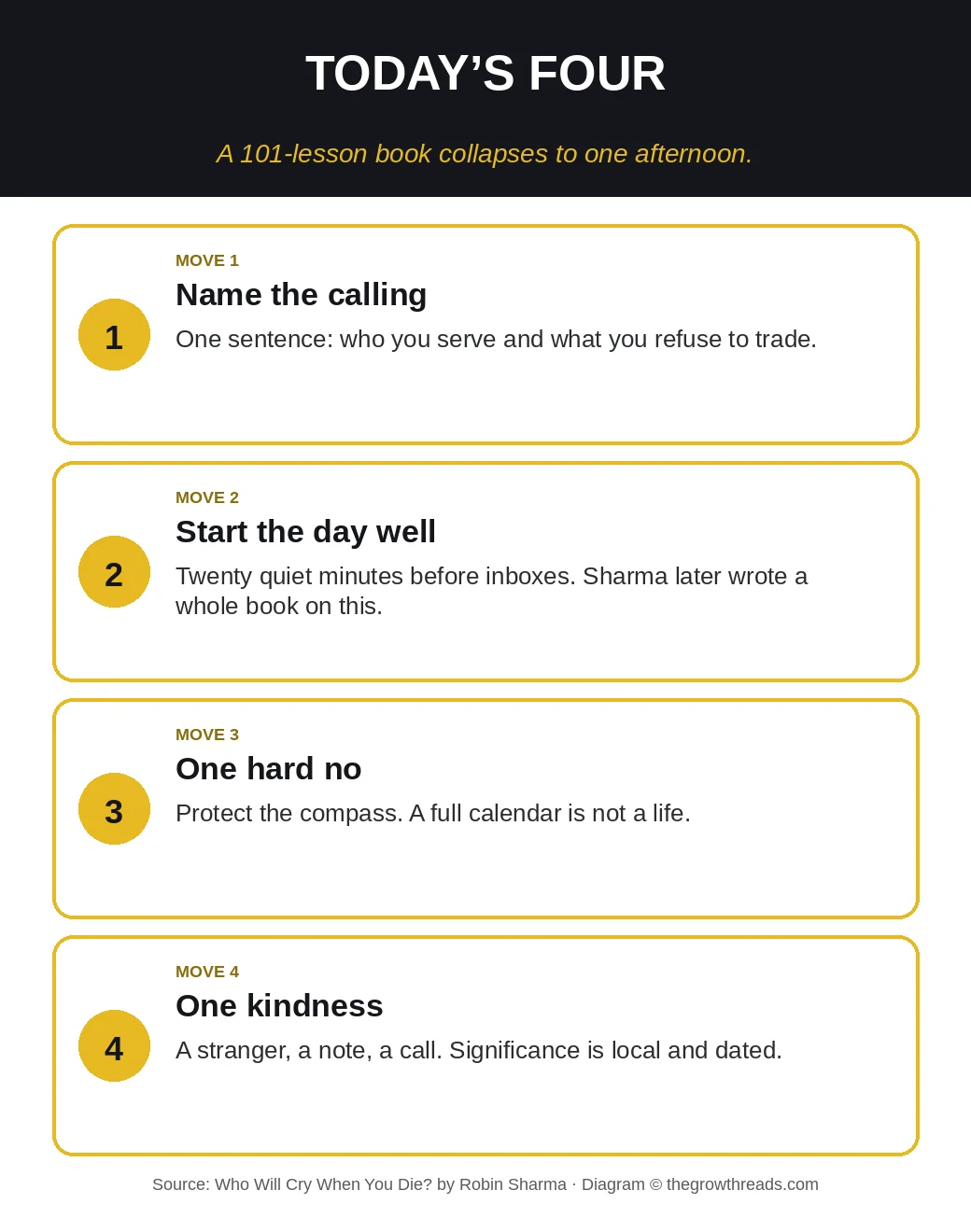
Four carry most of the weight. Discover your calling — a sentence about who you serve, not a branded purpose workshop. Start your day well — quiet minutes before the inbox, the seed of Sharma’s later 5 AM Club. See troubles as blessings — treat the snag as a classroom, not a verdict. Learn to say no — a full calendar is not a life. Add one kindness that can be dated. The other ninety-seven lessons are variations: idea books, walking, volunteering, forgiveness, reading. Pick four. Practice them. Do not highlight all 101 and call that growth.
Who is Who Will Cry When You Die best for?
People who already work hard and can feel the week succeeding while the life thins out — operators, parents, founders, and specialists with a full calendar and a thin funeral test. Also for readers who loved Monk or The 5 AM Club and want a daily kit instead of another fable. It is less useful if you need a workplace system (Getting Things Done, Deep Work) or a research-backed habit loop (Atomic Habits). Those books change the calendar. This one asks who the calendar is for. Students assigned the title as a moral reader will also find the lessons short enough to use, not only to summarise.
How is Who Will Cry When You Die different from The 5 AM Club?
The 5 AM Club is one lever: own the first hour with a 20/20/20 block of movement, reflection, and growth. Who Will Cry When You Die is 101 levers around a life other people will miss. Starting the day well is one lesson among many, written years before the 5 AM fable. Read 5 AM Club when mornings are the bottleneck. Read this when the bottleneck is meaning — calling, no, kindness — and a 5 a.m. alarm would only make an empty week start earlier. They stack. They are not substitutes. Keep the morning book if you already have a compass; keep this if you do not.
Who Will Cry When You Die vs The 7 Habits vs How Will You Measure Your Life?
The 7 Habits is Covey’s character operating system: be proactive, begin with the end in mind, put first things first. How Will You Measure Your Life is Christensen’s warning that your calendar is already your strategy for family and work. Sharma’s book is the pocket version of that funeral test, split into 101 named acts. Read Covey when you need a weekly framework. Read Christensen when your diary is lying to you. Read Sharma when you want a lesson you can do tonight without a matrix. Link them. Do not stack all three in one week or you will own three systems and still skip the kindness.
Related summaries
- The Monk Who Sold His Ferrari — the fable this kit belongs to.
- The 5 AM Club — start-the-day-well, turned into a morning system.
- How Will You Measure Your Life — your calendar is already the strategy.
- The 7 Habits of Highly Effective People — the weekly character OS.
- Best productivity books — the full Productivity pillar.
How we analyze books: every book on The Growth Reads is read cover to cover, summarized in thousands of words of original analysis, and rated against our five-criteria rubric (lasting impact, evidence quality, practical application, writing & originality, external consensus). Read our full methodology.