

★★★★½ 4.5/5 — A freedom claim for people who already work hard and still hand the week away.
Best for: operators and makers whose calendar is a public inbox and whose delay story still gets a vote.
Reading time: ~4.5 hours (234 pages) · this guide ~12 min
Difficulty to apply: Medium. The unit is one protected block and one honest no, not nine new slogans.
The Motivation Manifesto in one minute
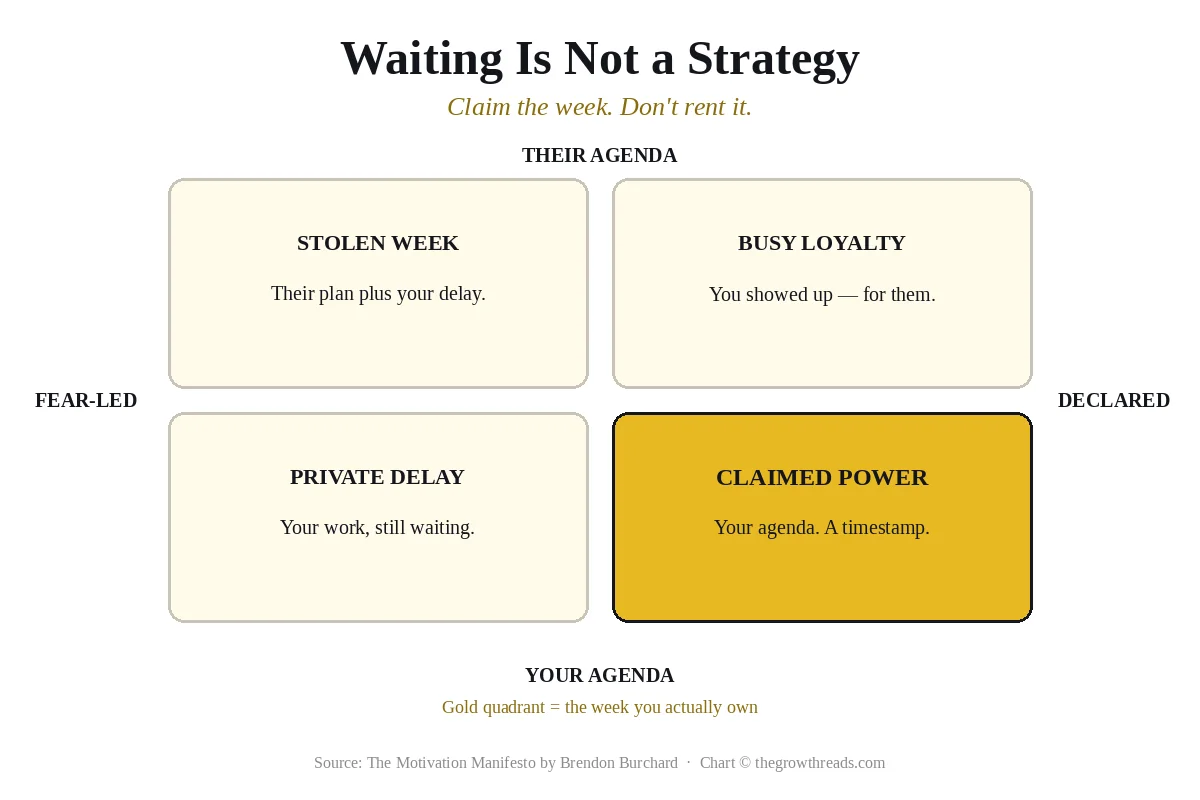
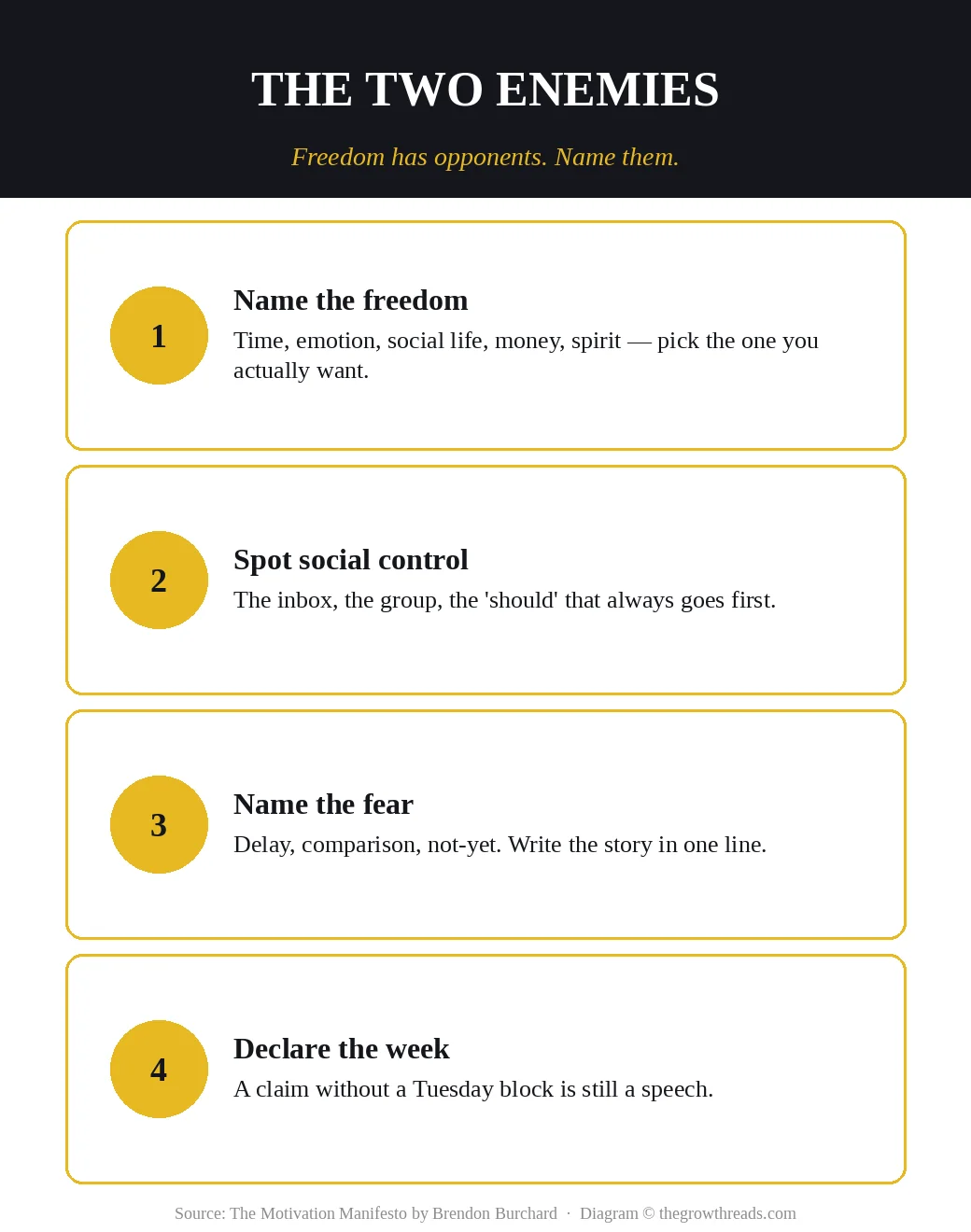
Motivation is not a mood that visits. It is the energy of a freedom you actually claim. Brendon Burchard’s The Motivation Manifesto says the main human motive is personal freedom — time, emotion, social life, money, spirit — and that two enemies stand in the way: other people’s agendas, and fear. The answer is nine declarations you practice. Presence. A reclaimed calendar. Demons named. A next step while you are still afraid. Integrity when nobody checks. Attention that is not split. Time slowed on purpose. You do not need a new personality by Friday. You need a week that is yours.
You do not install nine posters. Name whose agenda ran yesterday, protect one thirty-minute block, and take the smallest next step inside it.
Key takeaways
- Freedom is the motive: Time, emotion, social life, money, spirit. Productivity is how you stop donating those hours.
- Two enemies: Social control (the default calendar) and fear (the delay story). Most stolen weeks are both.
- Motivation is claimed: Waiting to feel ready is how the inbox wins. Declare the week, then work it.
- Presence is a power move: Half-here is how you lose the hour you already blocked.
- The agenda is the manifesto: If it is not on the calendar, it is a speech.
- Demons prefer delay: Name the story in one line. Then the next step, not a better story.
- Advance while afraid: Courage is a timestamp. Joy is fuel, not a prize after the grind.
- Integrity is unglamorous: Keep the promise you already made. That is the quiet declaration.
- Slow time on purpose: More life in the same hours. Speed is not the same thing as freedom.
What is The Motivation Manifesto about?
The Motivation Manifesto is Brendon Burchard’s 2014 claim that personal freedom is the real motive under your to-do list, and that nine practiced declarations — presence, a reclaimed agenda, courage, integrity, slowed time — beat waiting to feel motivated while other people run the week.
About the author
Brendon Burchard is a high-performance trainer whose courses and talks have reached tens of millions of people. After a near-fatal car crash in his twenties he turned toward the question that still sits under this book: what would you do with a life you actually claimed? He went on to research the habits of high performers and to write High Performance Habits, the more tactical companion. The Motivation Manifesto is the earlier, more lyrical volume — nine declarations instead of six measured practices. The voice is manifesto on purpose. The useful residue is a calendar you defend and a next step you take while fear still has a comment. He remains one of the most-followed personal-development trainers working in public, and this is the book where he tells you the week is yours before he tells you how to run it. Explore all Brendon Burchard book summaries →
Key concepts at a glance
| Concept | What it means | Use it when |
|---|---|---|
| Personal freedom | Choice over time, emotion, social life, money, and spirit. | Your output is high and your life still feels rented. |
| Social control | Other people’s plans as the default week. | The inbox, the group chat, and the meeting decide first. |
| Internal enemy | Fear dressed as delay, comparison, or “not yet.” | You know the next step and still shop for a better mood. |
| Presence | Full attention as a power practice, not a spa day. | You blocked the hour and still split the screen. |
| Reclaimed agenda | A calendar that matches the life you say you want. | The manifesto lives in notes, not in Tuesday. |
| Advance with abandon | Move before the feeling arrives. | Courage is waiting in the parking lot of the work. |
| Integrity | Keep the promise when nobody is scoring it. | You are great in public and sloppy with your own word. |
| Slow time | Depth in the same hours. Speed is not freedom. | The week is full and none of it happened to you. |
Part 1: Freedom is the motive — fear and the crowd are the tax
The book opens as a declaration of personal power, then a short brief on human nature. Burchard’s claim is simple and easy to skip because it sounds like a poster: people want liberty of choice. Time they can spend. Feelings they can steer. Relationships they chose. Money that buys optionality. A spiritual life that is not rented from a feed. Productivity culture usually starts at the task. He starts at the reason the task is even yours. If the week is only a reaction to whoever asked first, you can be extremely efficient at a life you did not pick.
Two enemies make that theft look normal. The external one is social control — the mediocre default of other people’s urgency, comparison, and “should.” The internal one is fear, which rarely announces itself as fear. It shows up as delay, over-research, a nicer plan, a need to feel ready. Motivation, in this frame, is not a spark you wait to catch. It is the energy that appears when you pursue a freedom you have actually named. That is why the book is a manifesto instead of a tip list. Tips still run on someone else’s map. A declaration changes who the map is for. If The Motivation Myth is start-first, feel-it-later, this chapter is name-the-freedom, then start. You can use both. You cannot use neither and still call the week yours.
TGR Note: If the remaining leak is a missing deep-work door, Deep Work closes it without manifesto language. If the remaining leak is too many yeses, Essentialism is the disciplined no. Burchard is the claim those books still need: the hours you protect have to be for a life you chose.
Part 2: Presence, agenda, and the demons that steal Tuesday
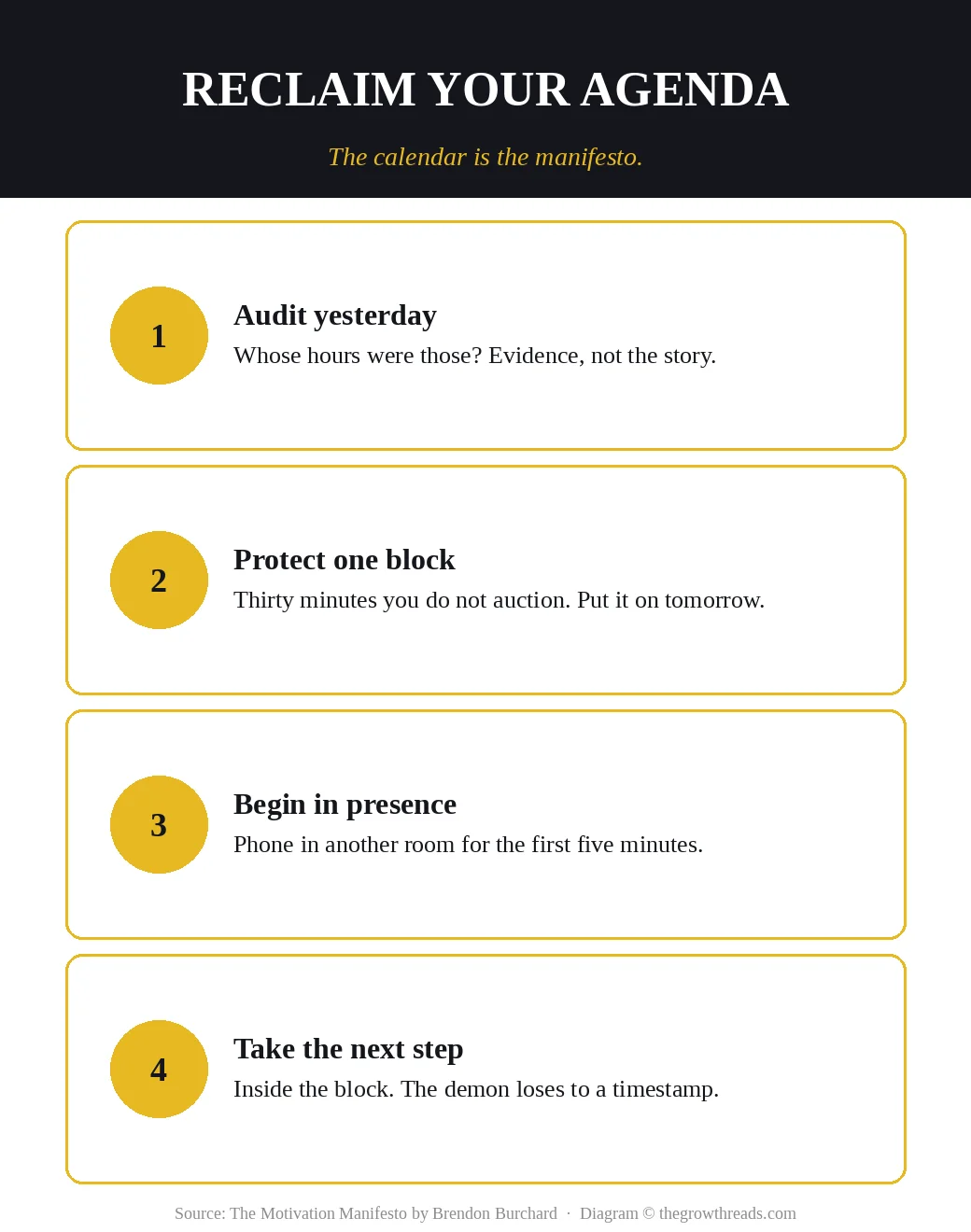
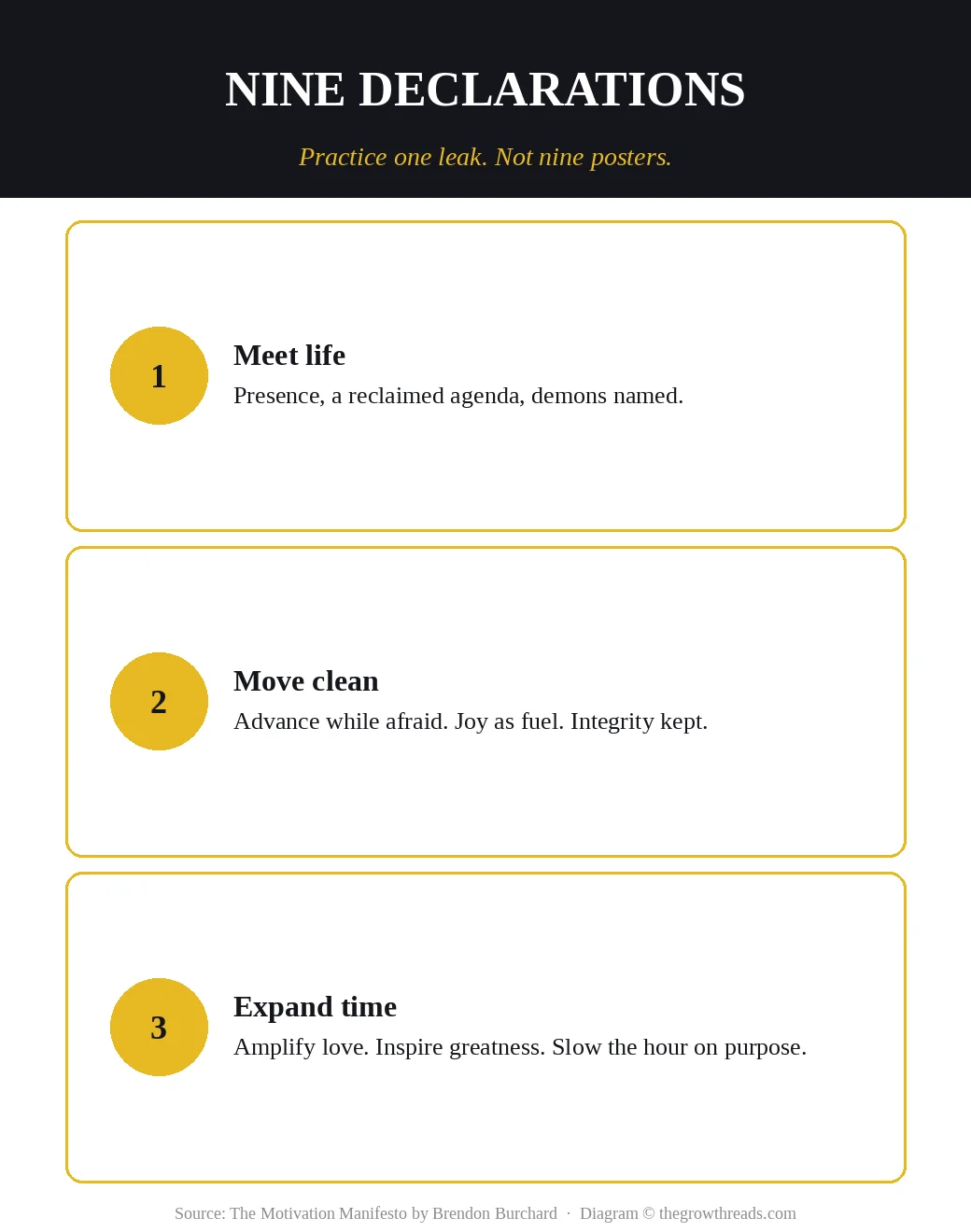
The first three declarations are the productivity core. Meet life with full presence and power — not half-here, not one eye on the lock screen. Reclaim your agenda — because a vision that never hits the calendar is a speech. Defeat your demons — the delay story, the comparison tab, the identity that says you will start when you are a more serious person. None of this requires a retreat. Presence can be the first five minutes of a block with the phone in another room. The agenda can be one thirty-minute slot you do not auction. The demon can be one sentence on paper so it stops sounding like wisdom.
This is the chapter people underline and then donate anyway. The inbox is a social-control machine with excellent UX. Fear is a project manager who always has one more prerequisite. Burchard’s move is to treat both as opponents you can see, not as weather. If Atomic Habits installs identity through a cue, this book installs identity through a claim: I am someone whose week is not public property. The cue still helps. The claim is what the cue is for. Readers coming from You Are a Badass will hear a cousin — stop waiting for permission — with a stricter calendar. Permission without a Tuesday block is still a poster.
TGR Note: If the leak is still a two-minute start, Mini Habits is the first unit. If the leak is a week with no identity cue, stay with Atomic Habits. Come back to the manifesto when the tiny start exists and the hours still belong to whoever pinged you.
Part 3: Advance clean — courage, joy, and integrity
Declarations four through six are how you move once the block exists. Advance with abandon: take the step while it still feels early. Practice joy and gratitude: not as a reward after the grind, as fuel that keeps the work from turning into another social script of misery. Do not break integrity: keep the promise you already made, including the one you made to yourself at 7 a.m. Courage here is a timestamp. Joy is a refusal to make excellence look like punishment. Integrity is the unglamorous declaration, the one that does not photograph well and is the whole game.
High-output people often skip this trio because it sounds soft next to a shipping metric. It is not soft. A week of advancing without joy becomes a second job you resent. A week of joy without integrity becomes a mood. A week of integrity without advance becomes a private scoreboard with no motion. Burchard wants all three in the same calendar, which is why the language stays militant. If Discipline Equals Freedom is Jocko’s door — stop negotiating every morning — this is the reason the door is even yours. If Relentless is the walk toward pressure, this chapter is the walk you take without turning the pressure into a personality. You still send the thing. You do not have to become a machine to send it.
TGR Note: If you want drills after the claim, High Performance Habits is the same author’s field manual — necessity and courage with more measurement. The manifesto is not a replacement for those six habits. It is the reason they are not just another productivity costume.
Part 4: Love, greatness, and time you can actually inhabit
The last three declarations keep the manifesto from collapsing into a selfishness brief. Amplify love — undivided attention as a practice, not a leftover. Inspire greatness — pull someone else up; freedom that never leaves your desk is still a small room. Slow time — presence as a way to get more life out of the same hours, which is the productivity twist hiding in the poetry. Speed can be a social-control value. You can win the week on paper and remember none of it. Slowing time is not quitting. It is refusing to let velocity impersonate a life.
This is also where the book earns its place next to mortality-aware titles without becoming a philosophy seminar. If Four Thousand Weeks is the finite-time argument, Burchard is the finite-attention argument in manifesto clothes. You do not need his stage. You need one conversation without a split screen, one hour without a podcast, one person you actually try to make braver. Then you put next week’s protected block on the calendar before Sunday dissolves into other people’s plans. The nine declarations are a stack, not a quiz. Most readers only have one leak this month. Name it. Run the matching day from the plan. Repeat until the week looks like a life you would claim twice.
TGR Note: If the remaining leak after the claim is still waiting to feel ready, return to The Motivation Myth. If the remaining leak is influence without a self, stay with High Performance Habits. The manifesto is the spine those two books can hang on.
Who is The Motivation Manifesto best for — and who should read something else first?
Best for people whose skill is already real and whose week is still public property: operators, makers, anyone whose inbox is the de facto strategy. If you want the later drill set from the same author, start with High Performance Habits. If you want locker-room pressure, start with Relentless. If you want a disciplined no, start with Essentialism.
Read something else first if you need a tiny start or a cue. Begin with Mini Habits or Atomic Habits. If the leak is waiting to feel ready, read The Motivation Myth. Come to The Motivation Manifesto when you can already work and still give the hours away.
Questions to reflect on
- Whose agenda ran yesterday — and what is the evidence, not the story?
- Where in your week do you wait to feel motivated before the next honest step?
- What is the delay story you currently dress up as preparation?
- Which promise did you already make and then quietly unmake?
- If freedom had a thirty-minute block this week, where would it sit on Tuesday?
🔥 Ready to claim the week instead of waiting to feel it?
Name the freedom. Protect one block. Take the next step while fear still has a comment.
How to apply The Motivation Manifesto (7-day plan)
- Day 1 — Name whose agenda ran yesterday. Write one sentence. Circle the hours that were not yours. No nine-point manifesto yet.
- Day 2 — Reclaim one thirty-minute block. Put it on tomorrow. Do not offer it away. Phone in another room for the first five minutes.
- Day 3 — Defeat one demon in writing. The delay story in one line. Then the smallest next step inside the protected block.
- Day 4 — Advance while it still feels early. Send, ship, or start before you feel ready. Courage here is a timestamp, not a mood.
- Day 5 — Keep one promise you already made. Integrity is the unglamorous declaration. Do the thing you told someone — including yourself.
- Day 6 — Give undivided attention once. One conversation or one page of work with no split screen. Love and presence share a calendar.
- Day 7 — Slow one hour on purpose. Walk, eat, or review the week without a podcast. Write next week’s protected block before Sunday ends.
Frequently asked questions
What is The Motivation Manifesto about?
The Motivation Manifesto argues that the main human motive is personal freedom — time, emotion, social life, money, and spirit — and that two enemies block it: other people’s agendas, and fear. Burchard answers with nine declarations you practice, not a mood you wait to feel. Presence, a reclaimed calendar, courage, integrity, and slowed time are the units. Read it when you already know what matters and still give the week away. High Performance Habits is the later how-to companion; this book is the claim that the how-to is even for.
How long does it take to read The Motivation Manifesto?
The Hay House edition is about 234 pages. Most readers finish in four to five hours. This summary is a twelve-minute pass: freedom versus social control, the nine declarations, and a seven-day plan. If you only have lunch, audit tomorrow’s calendar for one block that is actually yours and put a fifteen-minute presence practice on it. Come back to the lyrical chapters once that slot exists. The book is a manifesto, not a workbook — the application is a declared week, not a highlighter tour of all nine lines.
Is The Motivation Manifesto just motivational hype?
The tone is declarative on purpose. The mechanism underneath is practical: treat motivation as the energy of a freedom you named, then defend the calendar, the no, and the next honest move. That is closer to Essentialism and Deep Work than to a pep rally. If you want research habits without the manifesto voice, start with High Performance Habits — same author, six practices. If you want start-first without the freedom frame, start with The Motivation Myth. Read this when the leak is not knowledge. The leak is handing the week to whoever asked first.
How is The Motivation Manifesto different from High Performance Habits?
High Performance Habits is Burchard’s later field manual: clarity, energy, necessity, productivity, influence, courage — practices measured across high performers. The Motivation Manifesto is the earlier claim: you are allowed to want personal freedom, and you must declare it against fear and other people’s plans. HPH tells you how the week looks when you are already in the work. This book tells you why the week is even yours to design. If you want drills, start with HPH. If you keep doing the drills for everyone except yourself, start here. They stack; they are not duplicates.
What are the nine declarations in The Motivation Manifesto?
They are practices, not posters: meet life with full presence and power; reclaim your agenda; defeat your demons; advance with abandon; practice joy and gratitude; do not break integrity; amplify love; inspire greatness; slow time. Presence and agenda fix the stolen week. Demons and advance fix the delay. Joy and integrity keep the work clean. Love, greatness, and slowed time stop the grind from becoming a second social script. You do not install nine slogans on Monday. You pick the one leak — usually the calendar or the delay — and run it for seven days.
Who should read something else before The Motivation Manifesto?
If you still need a two-minute start, begin with Mini Habits. If you need a cue-and-identity install, begin with Atomic Habits. If the leak is waiting to feel ready, The Motivation Myth is the start-first cousin. If the leak is a missing deep-work door, Deep Work closes it without manifesto language. Come here when you can already work and still donate the hours. Operators, makers, and anyone whose calendar is a public inbox will recognize the enemy. The book assumes you want more life in the same hours, not a new personality by Friday.
What should I do on day one with The Motivation Manifesto?
Write one sentence: whose agenda ran yesterday? Then put a thirty-minute block on tomorrow that you do not offer away. That is reclaiming the agenda in one move. Do not rewrite all nine declarations. Presence can be the first five minutes of that block with the phone in another room. The manifesto is not a substitute for the block. Read a chapter after the slot exists, not instead of putting it there. If the block already exists and the leak is delay, name the demon in one line and take the smallest next step inside the same half hour.
Related summaries
- High Performance Habits — the same author’s later field manual.
- The Motivation Myth — start first; let the feeling catch up.
- Essentialism — the disciplined no that protects the agenda.
- Deep Work — close the door once the week is yours.
- Best productivity books — the full Productivity silo.
How we analyze books: every book on The Growth Reads is read cover to cover, summarized in thousands of words of original analysis, and rated against our five-criteria rubric (lasting impact, evidence quality, practical application, writing & originality, external consensus). Read our full methodology.