

★★★★½ 4.4/5 — The safety lecture was the trap. Best for makers and marketers who keep shrinking the work to look professional. Reading time ~4 hrs (guide: 25 min). Difficulty to apply: the ideas are simple; being seen is the hard part.
The Icarus Deception in one minute
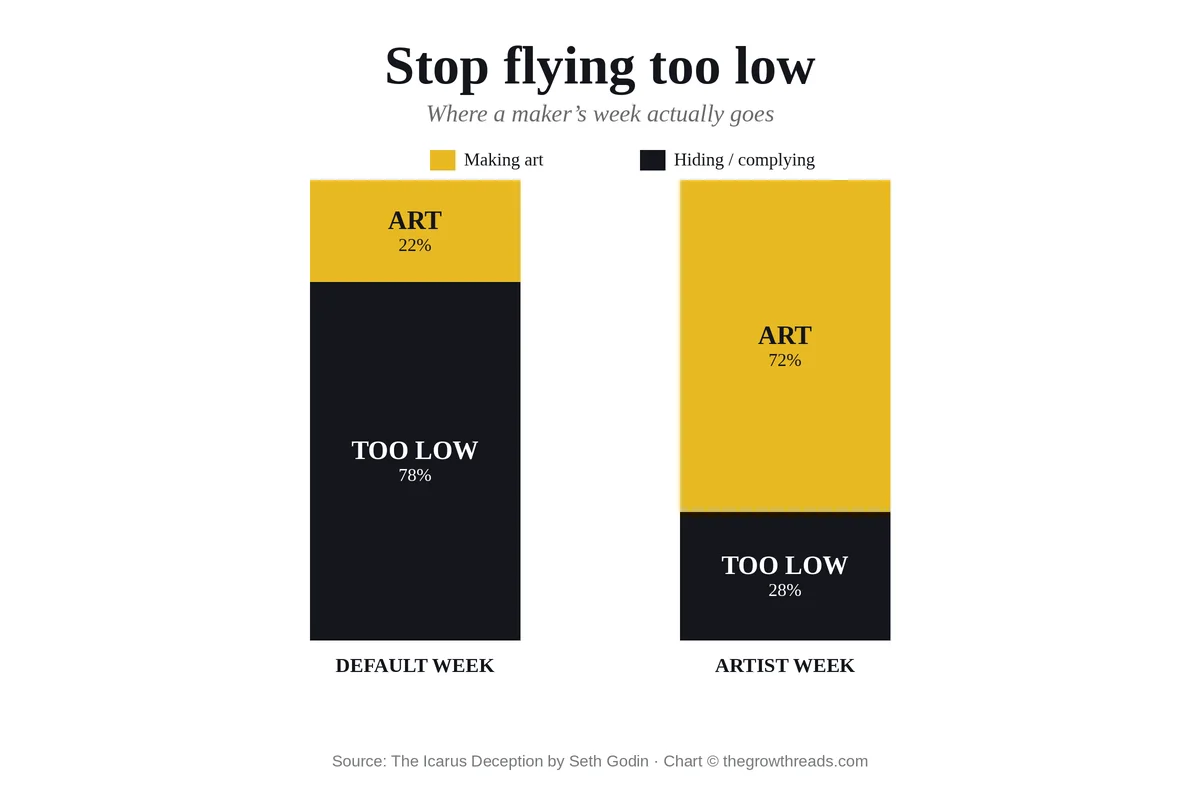
You were trained to fly low, then told that was wisdom. Seth Godin retells the Icarus story as a career briefing. The version we inherited only remembers the sun. The neglected half of the warning is the sea: wax wings fail when you hug the water too. Industrial work paid people to stay damp — follow the map, colour inside the lines, wait to be picked. That was a real job for a long time. It is a lousy strategy in a connection economy, where the scarce move is to make a gift that might not work and to be seen doing it.
The book is a manifesto of short essays, not a project plan. Its useful claim is narrow and sharp: the crash that looks like prudence is under-ambition, not hubris. If you already know what you should ship and you keep sanding it down until nobody could object, this is the posture reset. Pair it with a shipping cadence from The Practice if you need the daily reps after the myth cracks.
Key takeaways
- The forgotten half of the myth: flying too low soaks the wings. Hiding is not a conservative strategy; it is a different way to fall.
- The industrial bargain expired: compliance, average quality, and waiting to be picked used to buy safety. They now buy invisibility.
- Art is a gift that might fail: not a medium, not a job title — human work offered without a guarantee.
- Connection is the new scarce asset: people notice what is personal, generous, and slightly inconvenient to ignore.
- Shame is the altitude cap: the lizard brain would rather you be ignored than judged. That preference feels like professionalism.
- Hubris is a feature of the work: if the piece cannot possibly fail, you are doing a chore, not making a gift.
- Pick a smallest viable audience: “everyone” is how average work gets approved. One named person is how art gets specific.
- Initiation beats permission: maps arrive after someone pokes. Waiting for the brief is flying at wavetop.
- Shipping is the practice of height: you do not become brave and then publish. You publish, and bravery is the residue.
What is The Icarus Deception about?
The Icarus Deception is Seth Godin’s 2012 manifesto that the real career risk is flying too low. Industrial systems trained us to comply and hide; a connection economy rewards personal, generous work that might not work. Safety now lives in being seen, not in staying average.
About the author
Seth Godin has spent three decades turning marketing into a daily writing practice. After a run of books that named tribes, remarkable products, and the Dip, he kept returning to the same worker: the person who knows what to make and still waits for a map. The Icarus Deception (Portfolio, 2012) sits beside Linchpin and The Practice as the myth layer — why shrinking the work still feels like the adult move. He founded the altMBA and Akimbo workshops, blogs daily, and treats shipping as the point of the education, not a graduation prize. The through-line is consistent: stop waiting to be picked, make a gift, and let the audience be small enough to actually change. Explore all Seth Godin book summaries →
Key concepts at a glance
| Concept | What it means | Use it when |
|---|---|---|
| The Icarus Deception | We were taught that hubris is the danger. The practical crash is under-ambition. | You are shrinking a piece so nobody can dislike it. |
| Industrial vs connection economy | Maps, compliance, and average used to be safety. Connection now pays for personal work. | Your “safe” process produces work no one remarks on. |
| Art (Godin’s definition) | A human gift that might not work — not a medium or a job title. | You are hiding behind credentials instead of a point of view. |
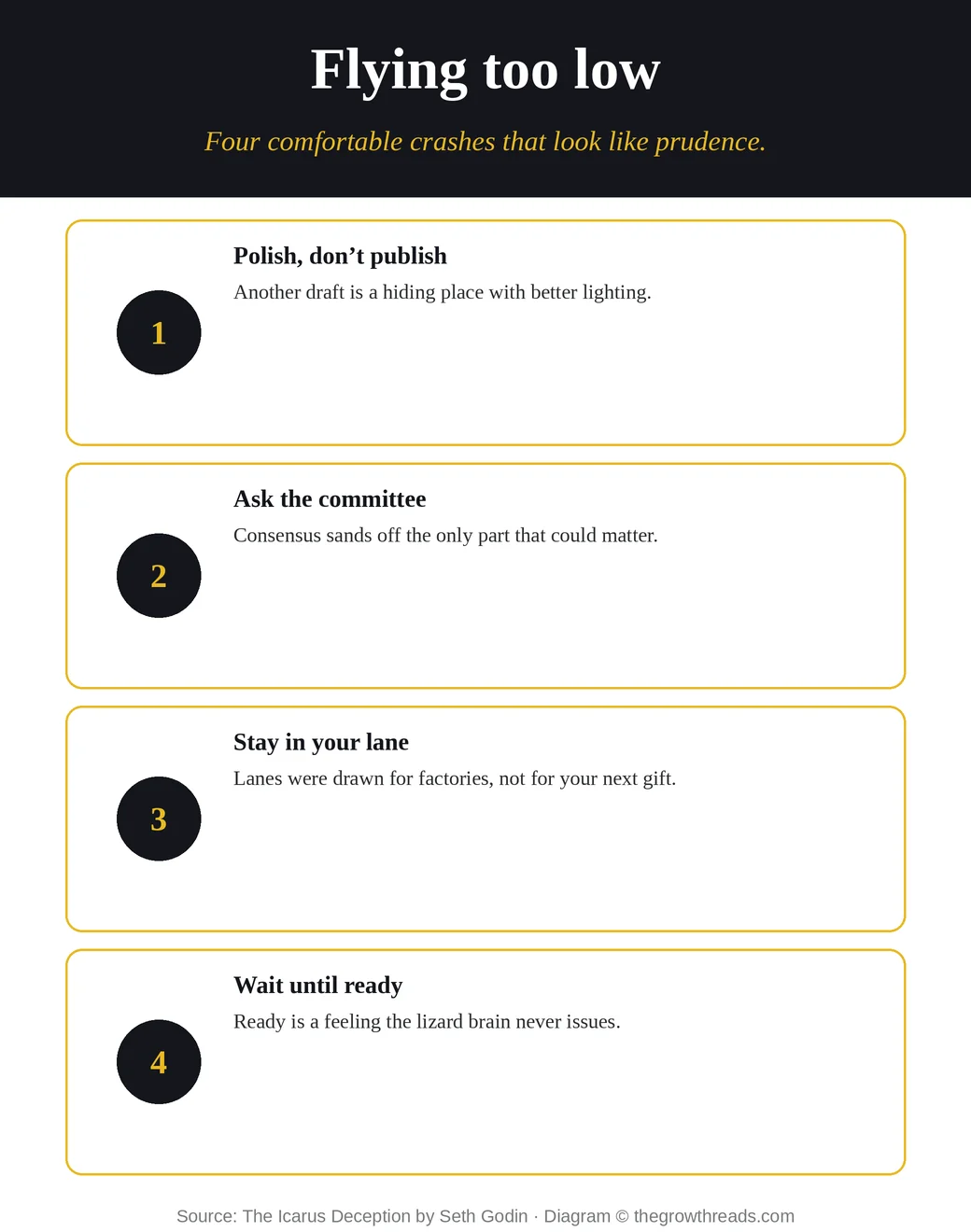
| Flying too low | Polish, committees, lanes, and “ready” as ways to stay unseen. | The calendar is full and nothing you made could fail. |
| Shame / being seen | The lizard brain prefers invisibility to judgment. | You delay a post, a demo, or a messy first version. |
| Smallest viable audience | Name the person the gift is for. “Everyone” is how work goes bland. | Feedback is vague because the audience is a crowd. |
| Initiation | Someone has to poke before a map exists. | You are waiting for a brief that will never be written. |
| Hubris as a feature | If failure is impossible, you are not making art. | The plan has been de-risked until it cannot matter. |
Part 1: The myth that taught you to stay damp
School Icarus is a safety poster. Do not get ideas. Do not get close to the sun. Godin asks you to notice what the poster leaves out. Daedalus also warned his son not to fly too low, because sea spray soaks the wax and the wings fail the other way. That second warning is the book. A culture that survived on factories had every reason to preach low flight: interchangeable workers, predictable output, managers who could sleep at night. The lecture was not evil. It was matched to a machine that needed people who would not improvise.
The mismatch is now. When the machine no longer needs your compliance as much as it needs your point of view, the old lecture becomes expensive. You still hear it in stand-ups (“let’s not get ahead of ourselves”), in design reviews (“can we make this less… you”), and in the private vow to wait one more quarter until the portfolio is airtight. Each of those moves feels like risk management. Godin names them as altitude loss. The person who never leaves wavetop does not look reckless. They look employable. They also never make the thing only they could make.
This is why the book opens as a myth, not a matrix. The voice calling itself prudent is often the sea. A week full of template work is not careful — it is the industrial habit after the factory moved.
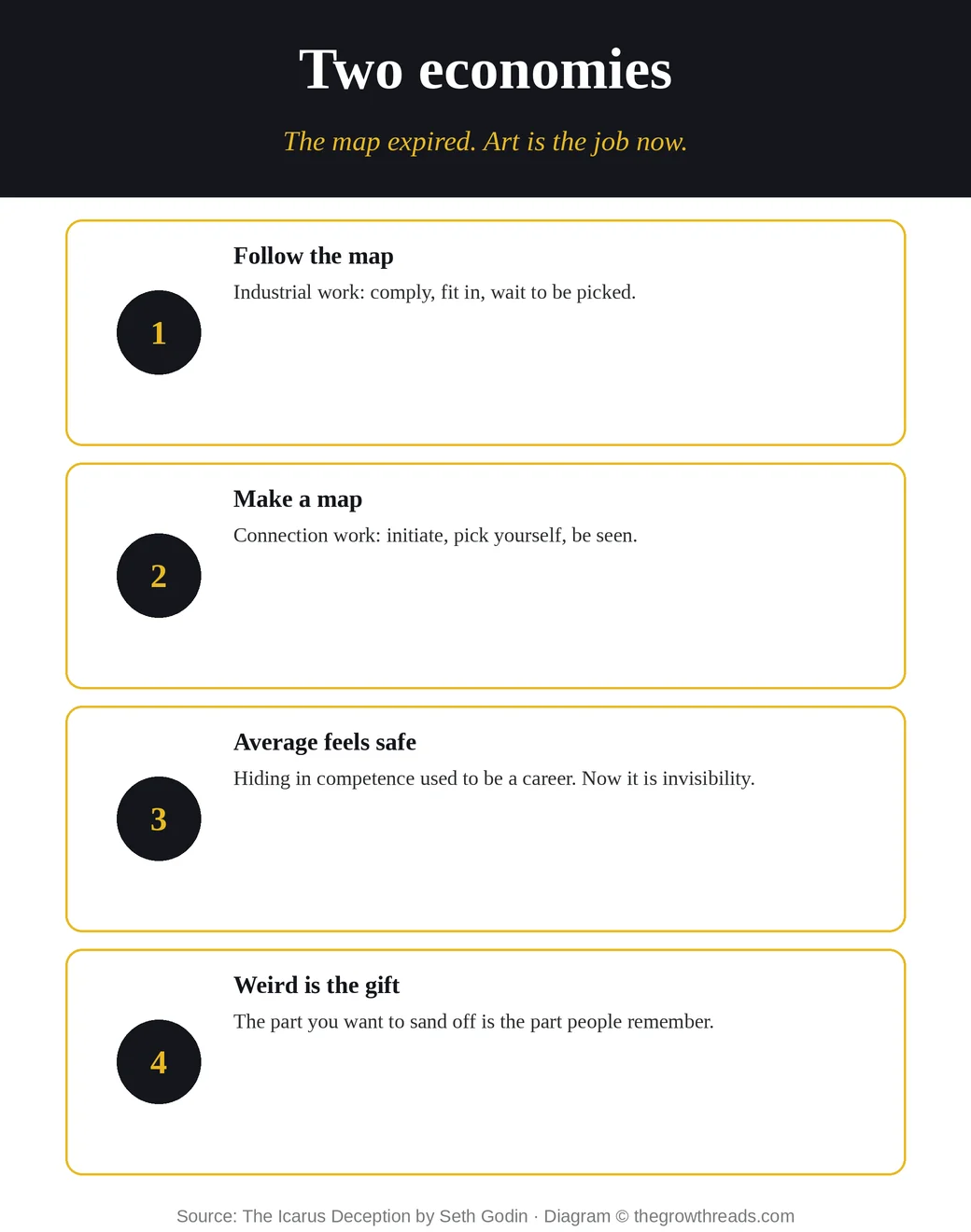
TGR Note: If the industrial-bargain argument feels familiar, it is the same spine as Linchpin — become the person who cannot be replaced by a process. Purple Cow is the market version: very good is the same as invisible. Icarus is the inner story that keeps you producing very good on purpose.
Part 2: Art is the job the map cannot assign
Godin’s “art” is easy to misread as a pep talk for painters. He means something colder. Art is work a human does as a gift, where the recipient might not want it, and where you cannot hide behind a spec. A generous product launch can be art. So can a pricing page that tells the truth, a hiring note that names a real standard, or a workshop that might bomb. The test is not aesthetics. The test is whether you brought yourself and accepted that it might not work.
That test is why the connection economy cares. People do not forward competent templates. They forward the thing that felt like it was made for them, by someone who could have played it safer. Industrial work scaled by removing the person from the product. Connection work scales (when it scales) because the person is still in it. You cannot A/B-test your way to that without eventually shipping a version that could embarrass you.
Stop asking “is this art?” as status. Ask where the gift is, and who it is for. If you cannot name the person, you will sand the piece until it could belong to anyone. Godin is not asking you to quit payroll. He is asking you to stop using payroll as an alibi for never making a gift.
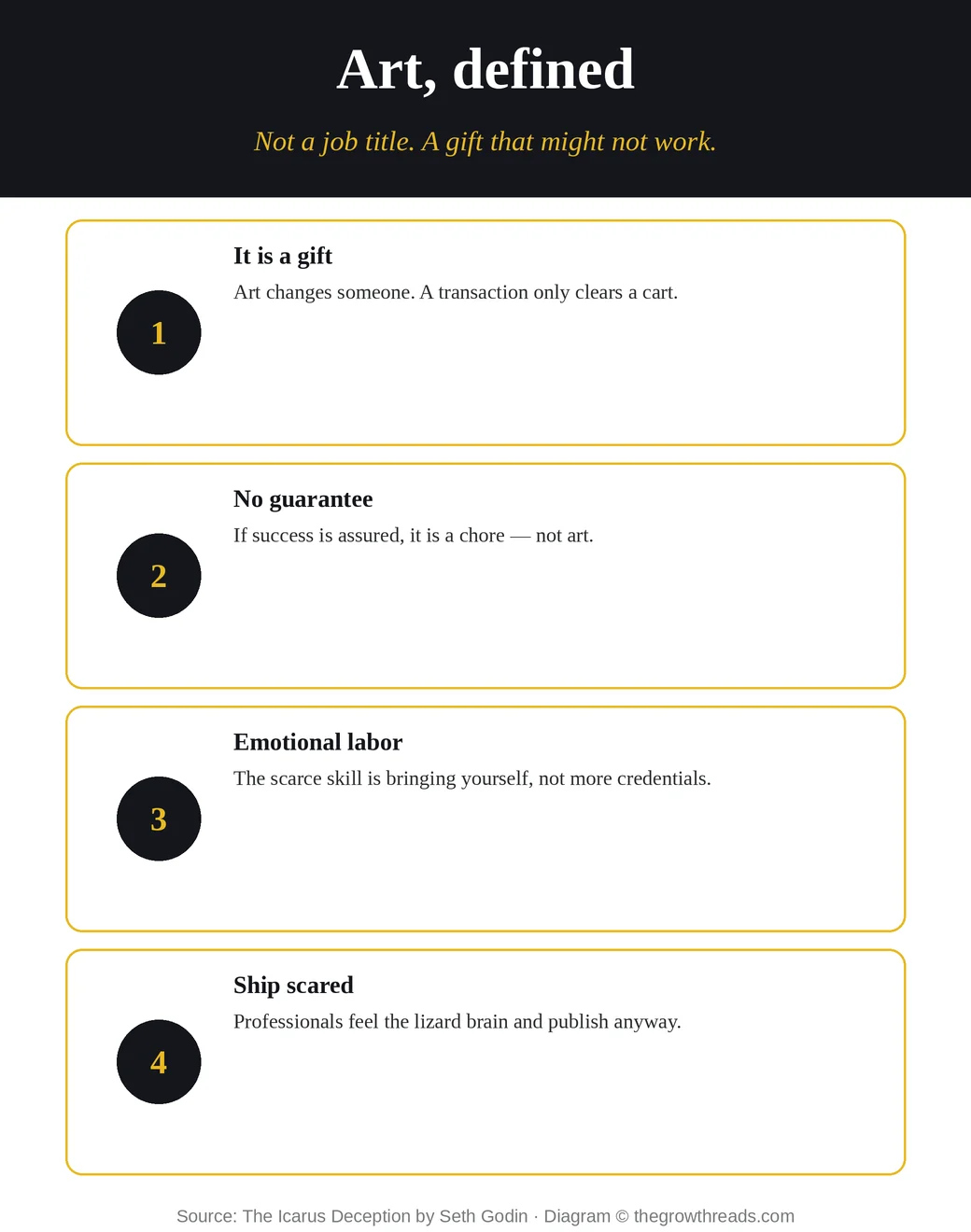
TGR Note: The daily version of this argument is The Practice: you ship whether you feel like an artist or not. Steal Like an Artist is the cousin for people who freeze because they think originality has to be a lightning strike. Icarus is the altitude. Those two are the hands.
Part 3: Shame, the lizard brain, and the comfort of average
Most people do not fail to fly because they lack a framework. They fail because being seen still feels like a threat. Godin keeps returning to shame — not as therapy-speak, as an operating system. The lizard brain would like you to be slightly disappointed in private rather than judged in public. Average work is the perfect habitat for that brain: it cannot be mocked because it cannot be noticed. Committees love it. Lanes love it. “Let’s run it by a few more people” is how an organisation helps you stay damp without ever saying the word fear.
Watch the tells he keeps circling. Another draft when the draft already said the thing. A slide that used to have a point of view and now has four caveats. A product that was weird on Tuesday and “on brand” by Friday. None of those are quality. They are altitude. Quality would mean the gift still has edges and still arrived. The too-low crash is when the edges are gone and the arrival is late.
Pressfield called this Resistance. Godin calls it the lizard. You do not need a mascot. Catch the tell: the sentence you delete because it sounds like you, the demo you postpone until the deck is “ready.” Ready is a story that keeps the wings wet with spray.
TGR Note: The War of Art is the field manual for the same enemy under another name. Poke the Box is the initiation drill — start before the map exists — which is Icarus at the first five minutes of the week rather than the myth layer.
Part 4: How high will you fly — a practice, not a stunt
The title question is not a dare to quit your job on a Wednesday. It is a design brief for the next gift. Height, in this book, is specificity plus exposure. You name a smallest viable audience. You make something they could reject. You put it where they can find it without a fourteen-step approval maze. Then you repeat, because one brave post is a stunt and a stunt is still a way to get back to wavetop with a story.
Godin’s useful arrogance is small. It is not “I will be famous.” It is “this might not work, and I am making it anyway.” That is the hubris the industrial lecture tried to train out of you. In a connection economy it is the job. The artist does not wait to feel ready, does not outsource the point of view to a committee, and does not confuse more hours of hiding with more craft. Craft is what you do to the gift so the named person can use it. Hiding is what you do to yourself so nobody can score you.
A week of this looks ordinary. Keep load-bearing work: payroll, safety, the real deadline. Steal hours from theatre — extra polish, the meeting that dilutes a decision, the lane that photographs well. Put those hours into one public gift that could fail by Friday. That is flying. Not a TED Talk.
TGR Note: If the ‘noun versus verb’ split helps: Keep Going is the reminder to do the work instead of collecting the identity. Icarus is why the identity of ‘careful professional’ is so sticky — it is the industrial myth wearing a nicer coat.
Who is The Icarus Deception best for — and who should read something else first?
Best for independent makers, marketers, founders, and leads who already have skill and still present the safest version of the work. If you recognise the week that was full and somehow produced nothing that could be rejected, this book names the pattern without asking you to become a painter.
Read something else first if you need a habit architecture — start with Atomic Habits. If your problem is attention, not altitude, use Deep Work. If you want the original “become indispensable” argument, Linchpin is the clearer job case. If you already believe the myth and just need a shipping cadence, skip ahead to The Practice. Icarus will frustrate anyone hunting for a 12-step system; it is a posture book on purpose.
Questions to reflect on
- Where in this week’s calendar is work that only looks like craft — extra polish nobody will use?
- Who is the one person the next gift is actually for? Can you say their name without adding “and the market”?
- What sentence did you delete because it sounded too much like you?
- Which meeting exists to make a decision safer rather than better?
- If failure were allowed on Friday, what would you ship by Thursday noon?
🔥 Ready to stop flying too low?
Read the manifesto, then ship one gift that could fail this week.
How to apply The Icarus Deception (7-day plan)
- Day 1 — Name the damp work. List three tasks from the last week that were competent and unrejectable. Circle the one that used to have a point of view.
- Day 2 — Name the person. Write one sentence: this gift is for _____ so they can _____. If you write “everyone,” start over.
- Day 3 — Cut one committee. Remove one approval, one extra reviewer, or one “quick alignment” from the path of that gift.
- Day 4 — Put the deleted sentence back. Restore the line that sounded like you. That discomfort is altitude, not a typo.
- Day 5 — Ship a version that could fail. Send, post, demo, or publish a small public artefact before it is ready. Capture the lizard script in one line.
- Day 6 — Keep the load-bearing compliance. Do the payroll, the safety check, the real deadline. Steal time only from theatre, not from promises.
- Day 7 — Install a 45-minute art block. Same time tomorrow week. The block is for gifts with a name on them, not for inbox zero.
Frequently asked questions
What is The Icarus Deception about in one paragraph?
Seth Godin argues the safety lecture we inherited is backwards. The industrial economy trained people to fly low: follow the map, fit in, wait to be picked. That used to be a career. In a connection economy the scarce work is art — personal, generous work that might not work. Flying too low (hiding, polishing, staying average) is the crash that looks like prudence. The book is a manifesto for picking yourself, making a gift, and being seen on purpose.
What does Seth Godin mean by art in this book?
Art is not a job title and not limited to painting or music. Godin uses it for any human work offered as a gift that might be rejected: a product that could flop, a talk that could bomb, a process someone might ignore. If the outcome is guaranteed, it is a chore. If it requires you to bring yourself and risk being seen, it is art. That definition is why the book sits in a productivity silo — it is about how you spend the hours, not about galleries.
Is The Icarus Deception the same as Linchpin or The Practice?
They share a family, not a plot. Linchpin is the case for becoming indispensable through emotional labor. The Practice is the daily shipping ritual that makes the case real. The Icarus Deception is the myth underneath both: the story that told you safety lives in flying low. Read Linchpin if you need the job argument. Read The Practice if you need a cadence. Read Icarus if you keep shrinking good work because shrinking still feels like the professional move today.
How long does The Icarus Deception take to read?
The Portfolio hardcover runs about 241 pages of short, punchy essays rather than long chapters. Most readers finish it in three to five hours. The ideas land fast; the friction is applying them at the desk the next morning. Budget a week of small public reps after the first read rather than a second complete pass. A 25-minute pass through this summary plus one shipped gift this week will beat a highlighted copy that never leaves the shelf unused at all.
Who should read The Icarus Deception — and who should start elsewhere?
It is strongest for independent makers, marketers, and leads who already know what good work looks like and still hide it. If you need a habit system, start with Atomic Habits. If you need a shipping cadence, start with The Practice or The War of Art. If you want the original “be indispensable” argument, start with Linchpin instead. Icarus is the permission-and-posture book, not a project-management manual and not a critique of markets with a spreadsheet attached to the argument.
How do I apply The Icarus Deception at work this week?
Pick one piece of work you have been sanding down to survive review. Name the smallest viable audience for it — one person, not “the market.” Ship a version that could fail in front of them before Friday. When the urge to add another round of polish shows up, treat it as the lizard brain asking you to fly lower, not as quality control. Keep the necessary compliance (payroll, safety, the actual deadline). Cut the hiding that only protects your reputation.
Is the Icarus myth historically accurate in Godin’s telling?
Godin uses the myth as a working metaphor, not as a classics paper. The familiar school version stresses hubris: do not fly too close to the sun. He emphasises the neglected half of the warning — wax wings also fail if you fly too low and the sea soaks them. Whether every ancient source weights the two dangers equally is beside the practical point. The useful claim is modern: organisations still reward low flight, while the work that creates connection requires you to risk height.
Related summaries
- Linchpin by Seth Godin — the job case for emotional labor and becoming indispensable.
- The Practice by Seth Godin — the daily shipping ritual that makes Icarus operational.
- Poke the Box by Seth Godin — initiation: start before the map exists.
- Purple Cow by Seth Godin — why very good is the same as invisible in a crowded market.
- Best productivity books — the full TGR Productivity shortlist.
How we analyze books: we read for the mechanism you can use this week, not for a takedown. We paraphrase arguments, add original notes and plans, and keep quotes short. Read our full methodology.