

★★★★½ 4.6/5 — Stop swinging one hammer at every problem.
Best for: operators who keep using one favourite framework on every mess.
Reading time: ~4 hrs (guide: 40 min)
Difficulty to apply: Medium — the nine tools are simple; using two this week is the work.
The Great Mental Models in one minute
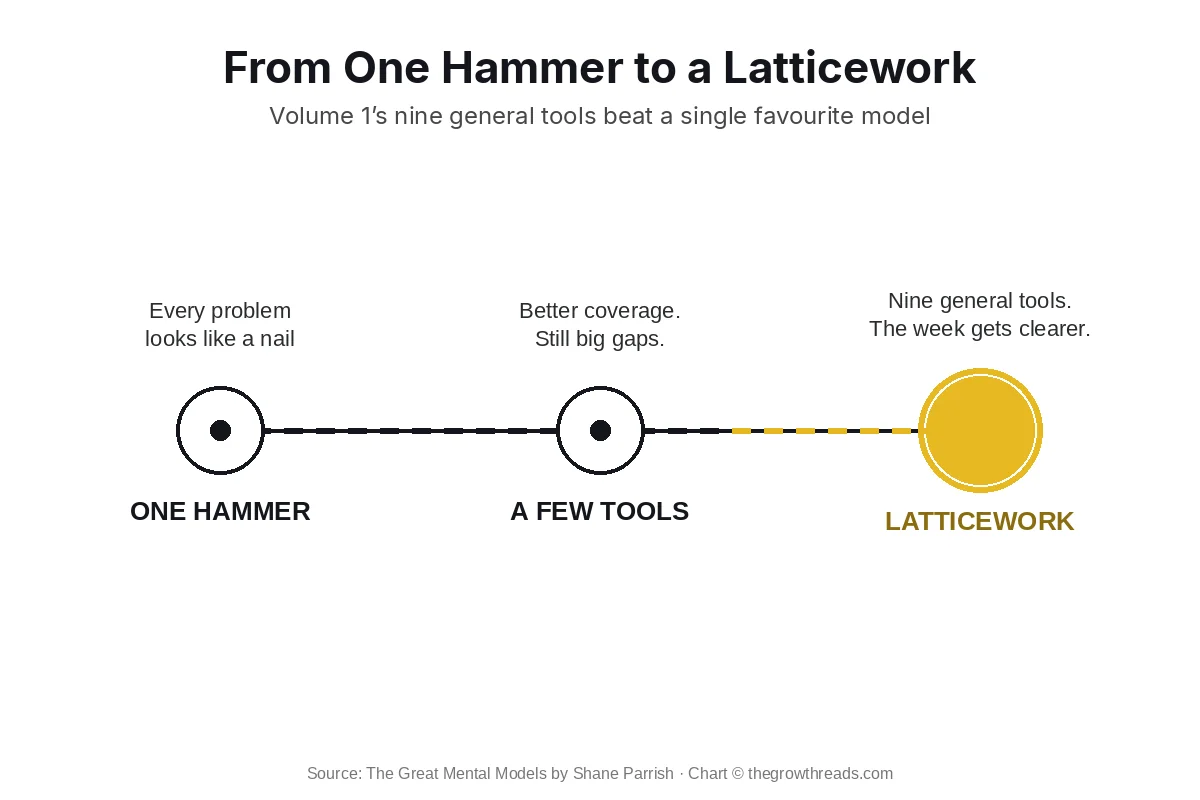
If you only own one model, every problem starts to look like a nail. Shane Parrish and Rhiannon Beaubien wrote Volume 1 of The Great Mental Models as a small latticework: nine general thinking tools you can carry into a meeting. The map is not the territory. Stay inside your circle of competence. Strip a problem to first principles. Run a thought experiment. Ask “and then what?” Think in probabilities. Invert. Prefer the simpler explanation. Do not assume malice when a mess will do. Charlie Munger’s latticework sits behind the series. You do not need nine names. You need two of them to change a sentence you say out loud this week.
Key takeaways
- A lattice beats a hammer: one favourite framework will mangle problems it was not built for.
- The map is not the territory: dashboards, OKRs, and org charts are maps. Update them when the ground moves.
- Draw your circle of competence: guess less. Learn, hire, or pass when the problem sits outside it.
- Go to first principles: strip the inherited story and ask what must be true.
- Run it in your head first: a thought experiment is cheaper than a six-week bet.
- Write the second order: the first consequence is obvious. The third one is where the week breaks.
- Think in ranges: fake certainty is a tell. Probabilities keep you honest.
- Invert before you add: ask what would guarantee failure, then delete those moves.
- Subtract with Occam and Hanlon: simpler explanations and incompetence beat conspiracy.
- Carry two models this week: a unused lattice is still a hammer in storage.
What is The Great Mental Models about?
The Great Mental Models Volume 1 is a short guide to nine general thinking tools — map versus territory, circle of competence, first principles, thought experiments, second-order thinking, probability, inversion, Occam’s razor, and Hanlon’s razor. You need a latticework of models, not one hammer, so ordinary decisions stop getting forced through a single favourite frame.
About the author
Shane Parrish is the founder of Farnam Street (fs.blog) and host of The Knowledge Project, a long-running interview show on decision-making. He built the site as a public notebook for worldly wisdom after years of studying how people actually choose under pressure, then turned that notebook into books. Clear Thinking (2023) is the later, in-the-moment companion: defaults, safeguards, ordinary hours. The Great Mental Models series — co-written with Rhiannon Beaubien, a writer and researcher at Farnam Street — is the toolbox. Volume 1 first appeared with Latticework Publishing around 2020 and was reissued by Portfolio in 2024. The voice is calm, numbered, and allergic to vibes. He would rather you leave with two tools that fire than with a poster of nine. Explore all Rhiannon Beaubien book summaries →
Key concepts at a glance
| Concept | What it means | Use it when |
|---|---|---|
| Latticework | Many models, lightly held, that cover more of the problem. | You keep forcing every issue through one framework. |
| Map ≠ territory | The plan, dashboard, or job title is a sketch of reality. | The metric is green and the customer is gone. |
| Circle of competence | Know the edge of what you can actually judge. | You are about to opine outside the work you have done. |
| First principles | Strip the story; keep what must be true. | The team is copying a competitor’s ritual. |
| Thought experiment | Run the move in your head before you spend the week. | The calendar wants a six-week project and you have a hunch. |
| Second-order thinking | Ask what happens after the first result. | The “win” creates a mess in month two. |
| Probabilistic thinking | Ranges and odds, not fake yes/no. | Someone says “this will definitely work.” |
| Inversion | Study how to fail, then avoid those moves. | The plan is only a list of hopeful additions. |
| Occam / Hanlon | Simpler explanations; mess before malice. | The story in your head needs a villain. |
Part 1: Build a lattice, not a hammer
The opening move is not a model. It is a warning. If the only tool you trust is a 2×2, a stand-up, or “just ship,” you will shove unlike problems into that shape until they look solved. Parrish’s debt is to Charlie Munger: you want a latticework of mental models so the world has more than one handle.
Two models do most of the seeing. The map is not the territory. A roadmap, a KPI tree, a persona deck, last quarter’s strategy memo: all maps. Useful. Incomplete. Dangerous when you defend the map against a customer who already left. When the dashboard is green and churn is up, the map is stale. Update the sketch. Do not yell at the ground.
Circle of competence is the second seeing tool. Draw the edge of what you can actually judge from reps, not from podcasts. Inside the circle you can move fast. Outside it you learn, hire, or pass. The ego cost is the point. Most expensive mistakes are confident guesses in a neighbour’s circle. Write the circle on the decision, not as a personality brand.
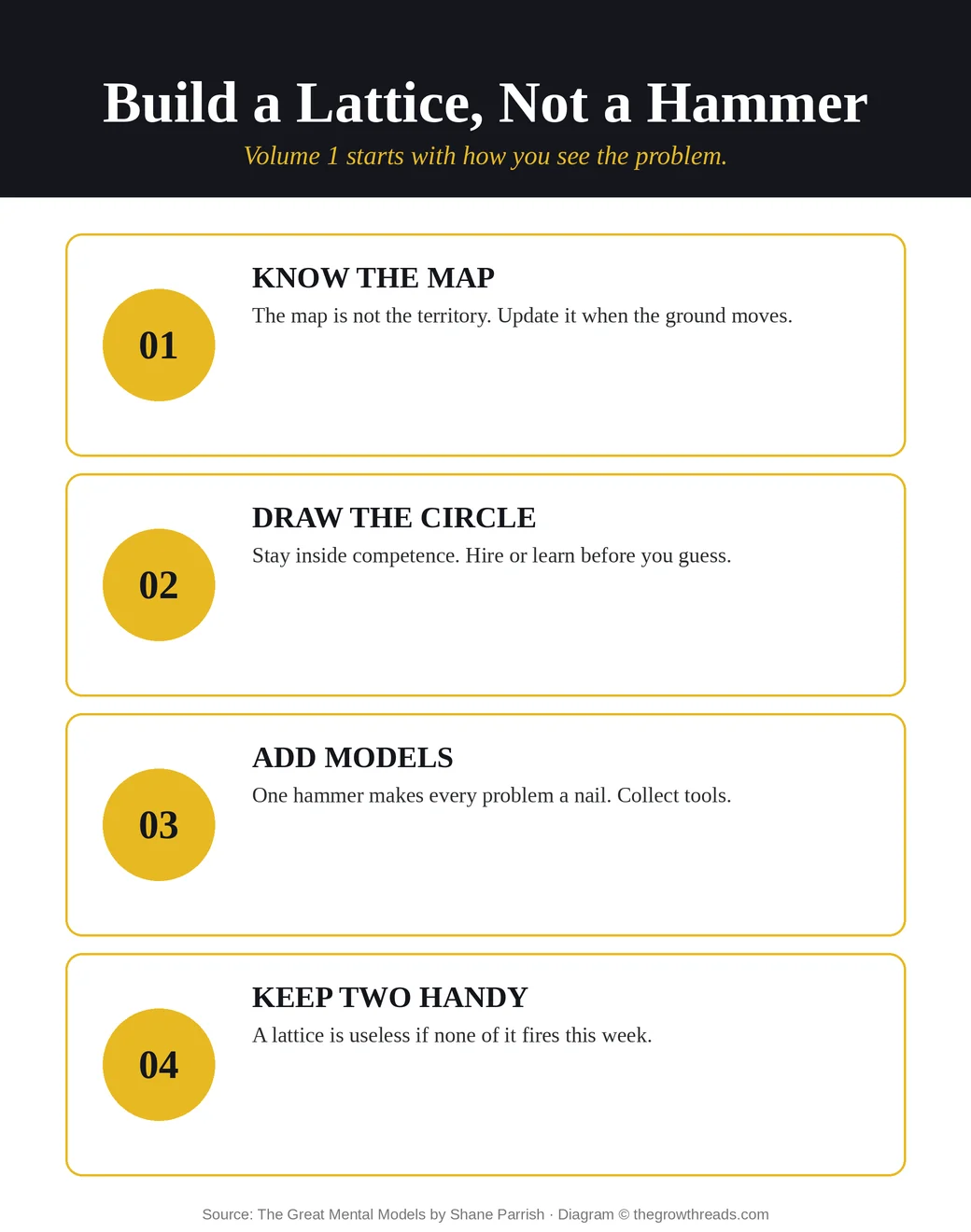
The practical test is short. Name the map you are treating as real, and where it might be wrong. Draw the circle: which parts can you score, which parts are theatre. If both answers are “I don’t know,” you need a smaller bet or a better person in the thread — two models, one meeting.
TGR Note. Parrish’s later Clear Thinking summary is the companion for the moment of choice — defaults, ego, inertia. Volume 1 is the kit those moments reach for. If you want the source of the “latticework” metaphor in the investor’s own voice, read our Poor Charlie’s Almanack summary. Munger collected models for capital allocation. This book translates the habit for people who ship products and run weeks, not portfolios.
Part 2: Think from the ground up
First-principles thinking is the book’s demolition tool. You do not start with “how we do it here.” You ask what must be true for the result to exist: physics, incentives, time, money, a user who still has a job. Inherited process is a map that forgot it was a map. First principles is how you notice the ritual that survived a company that no longer exists. You will not rebuild a calendar from atoms every Monday. You will strip one stuck project this week.
Thought experiments are how you test the rebuild without spending the quarter. Einstein’s elevator is the famous picture; Parrish wants the office version. If we stopped the weekly report, what would actually break by Friday? If we shipped to ten users instead of the full list, what would we learn that a deck cannot tell us? The experiment is a rehearsal. Cheap. Fast. Honest about which “must” was only a habit.
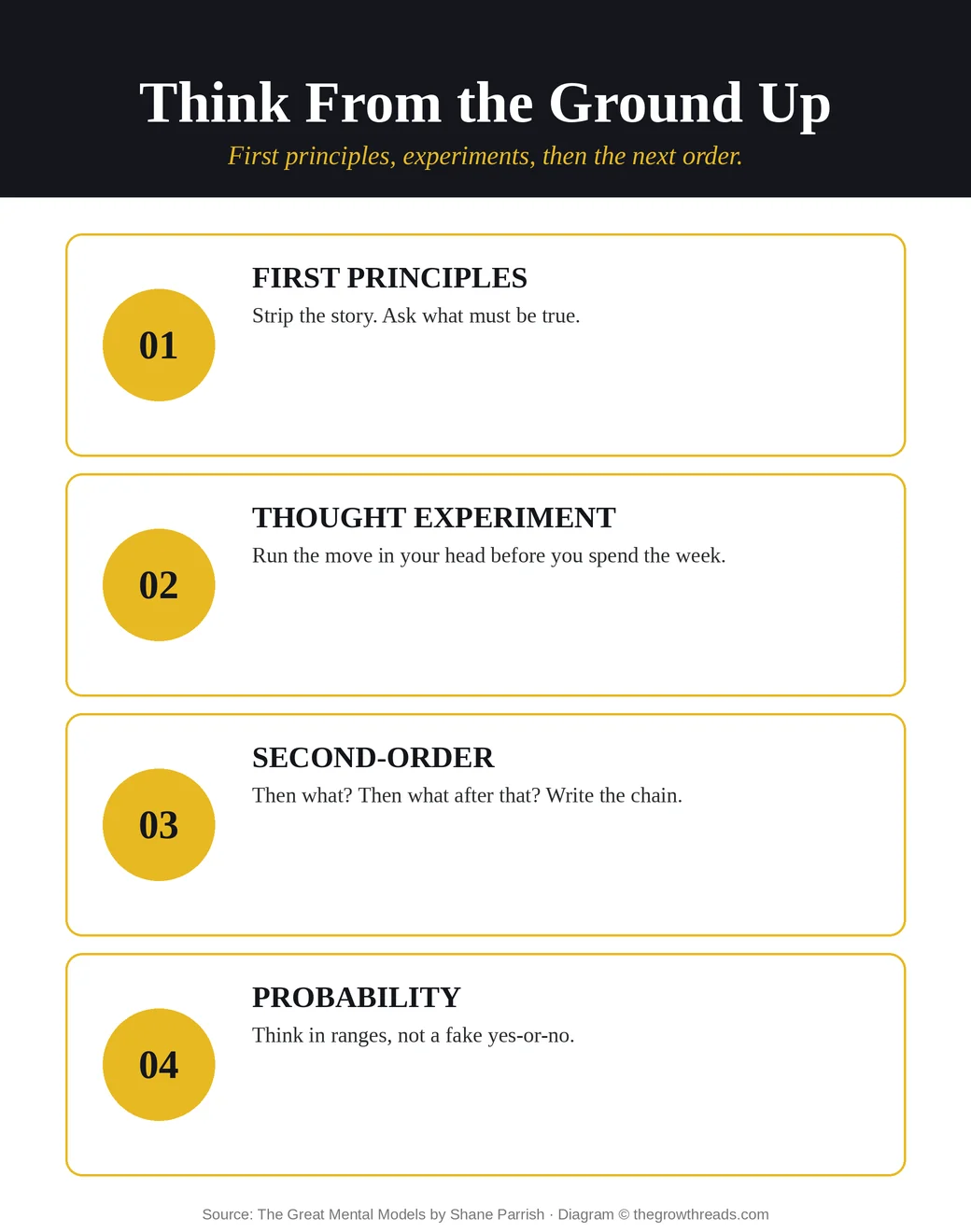
Then the book turns the camera forward. Second-order thinking asks what happens after the first win. A discount fills the funnel and trains customers to wait. A hire removes a bottleneck and creates a new one in review. Write the second and third effects before you celebrate the first. Probabilistic thinking sits next to it. “This will work” is a pose. “This is 60% to help and 20% to create a support pile” is a plan you can staff.
TGR Note. If second-order chains are the part that clicked, Thinking in Systems is the deeper map of stocks, flows, and delays. For a computer-science version of everyday trade-offs, Algorithms to Live By is the playful sibling.
Part 3: See around the corner — then subtract
Inversion is the most useful page in the book for people who already have too many ideas. Instead of “how do we make this succeed?” you ask “how would we guarantee it fails?” Then you delete those moves. Missed sleep. No owner. A launch on a Friday. A metric nobody can move. Inversion is not pessimism. It is a filter. Most teams are better at adding work than at naming the few actions that would sink the week. Write the failure recipe. Cross it off the plan.
Occam’s razor and Hanlon’s razor are the quiet pair. Occam: prefer the explanation that needs fewer special stories. The site is slow because the image is huge, not because a rival hired a wizard. Hanlon: do not assume malice when incompetence, a bad incentive, or a missing spec will do. You will still meet actual villains. You will meet more dropped balls. Starting with a conspiracy makes you a worse colleague and a slower fixer.
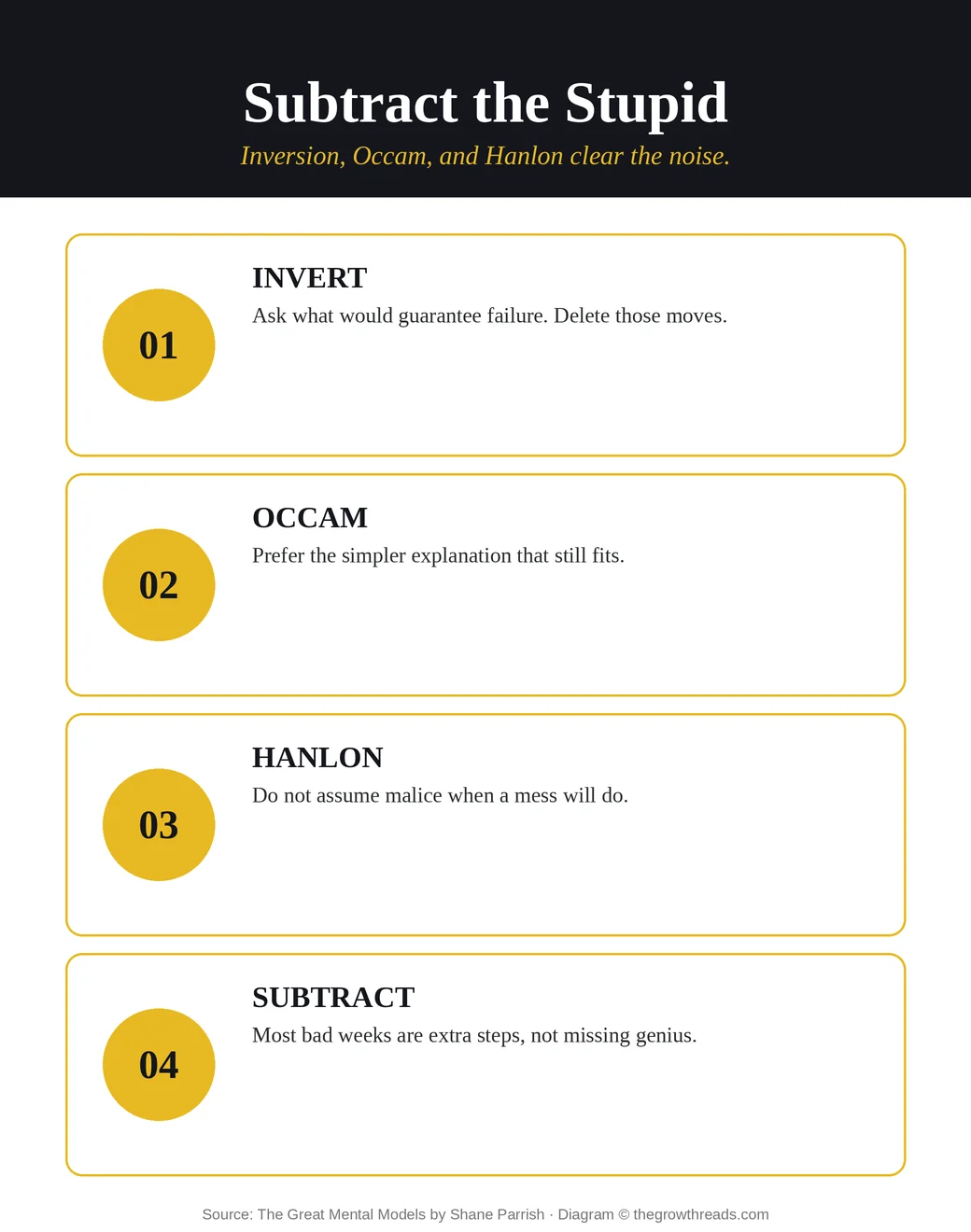
Put the last four together and the week gets quieter. Invert the launch. Prefer the simple cause of the outage. Assume the late email is a full calendar, then verify. That is a working subset, not nine models. Subtract first. Add only what survives inversion.
TGR Note. Inversion is cousin to “premortem” thinking. If you want the generalist’s argument for collecting tools instead of going narrower, Range is the career-scale version of a latticework. If the gap is follow-through, not frames, The Progress Principle will do more for Monday than a tenth model. Use Volume 1 to see. Use a small-wins book to move.
Part 4: Install two models, not a poster
The series can become a collection hobby. Volume 2, Volume 3, a Notion gallery of razors. That is still one hammer: the identity of being a person who “has models.” The install is smaller. Pick one live decision — a hire, a price, a yes to a project. Run map versus territory. Draw the circle. Invert. Write the second order. Send the note. If the note changes a sentence in the room, the lattice is real. If it only changes your highlights, you summarized a book.
Keep a card, not a wiki. Front: the two models for this month. Back: one sentence each in your words. Swap a model when it has fired twice. Volume 1 is short so you can reread inversion in twenty minutes before a nasty meeting. Leave two tools on the table. Put the rest on the wall.
Who is The Great Mental Models best for — and who should read something else first?
Best for people who already ship and still mash every problem through one favourite frame — founders, PMs, analysts, leads who can feel the week rhyming for the wrong reason. Also for readers of Farnam Street who want the nine general tools in one place instead of a decade of posts.
Read something else first if the gap is a habit loop, not a missing lens: start with Atomic Habits. If you freeze at the ordinary moment of choice, Clear Thinking is the better first Parrish. If you need a bias catalog, Thinking, Fast and Slow is the long academic route. If you want capital allocation in Munger’s own scrapbook, Poor Charlie’s Almanack. If the problem is finishing, not framing, The Progress Principle or Finish will move the week faster.
Questions to reflect on
- What is the one model you used on three unlike problems this month — and what did it flatten?
- Which map (dashboard, title, plan) are you defending even though the territory already moved?
- Where are you opining outside your circle of competence, and who actually has reps?
- If you inverted your current project, which three moves would guarantee a bad month?
- Which two models will sit on a card this week, and which live decision will they touch by Friday?
🔥 Ready to stop swinging one hammer?
Get The Great Mental Models Volume 1 and put two thinking tools on a card this week.
How to apply The Great Mental Models (7-day plan)
- Day 1 — Map vs territory: Take one live decision. Write the map you are treating as real (deck, KPI, job title). Write one way the ground already disagrees.
- Day 2 — Circle of competence: Draw a circle: inside (reps), edge (learnable), outside (hire or pass). Mark where today’s decision sits.
- Day 3 — First principles: Strip one stuck process to three must-be-true facts. Delete one ritual that only exists because “we always have.”
- Day 4 — Thought experiment: Write the cheapest rehearsal: if we did X for ten people, what would break by Friday? Do not staff the full version yet.
- Day 5 — Second-order + odds: For the remaining option, write the second and third effects. Give it a rough probability instead of “this will work.”
- Day 6 — Invert: List five ways to guarantee a bad outcome. Remove any that are currently on the plan. Apply Occam or Hanlon to one annoying story in your head.
- Day 7 — Install two: Pick the two models that actually changed a sentence. Put them on a card. Use both on Monday’s first meeting. Leave the other seven on the wall.
Frequently asked questions
What is The Great Mental Models about?
Volume 1 is Shane Parrish and Rhiannon Beaubien’s field guide to nine general thinking tools: the map is not the territory, circle of competence, first principles, thought experiments, second-order thinking, probabilistic thinking, inversion, Occam’s razor, and Hanlon’s razor. The point is a latticework, not a favourite hammer. You use two models on a real decision this week, then keep the ones that fire. It is a thinking manual, not a memoir and not a quote poster. The install is a card, not a wiki.
Who should read The Great Mental Models?
Read it if you keep applying one framework — OKRs, a 2×2, “just ship” — to every mess. It is for operators, PMs, founders, and analysts who need better questions, not another pep talk. Skip it as a first book if you cannot keep a basic habit yet; start with Atomic Habits. If your problem is the moment of choice, not the missing model, read Clear Thinking. If you want the academic bias catalog, Thinking, Fast and Slow is thicker. Come here when the week already ships and still rhymes for the wrong reason.
How is The Great Mental Models different from Clear Thinking?
Clear Thinking is Parrish’s later book about ordinary moments: defaults, safeguards, and not rising to the occasion. Volume 1 of The Great Mental Models is the toolbox those moments use. One is posture. One is instruments. If you freeze at the decision, start with our Clear Thinking summary. If you decide fast and keep using the wrong lens, start here. They stack. You do not need the whole four-volume set before this one is useful. Read them as a pair, not as rivals.
Do I need to memorize all nine models?
No. Parrish’s latticework is a workshop wall, not a quiz. Carry two this week. Map versus territory plus inversion will already change a meeting. First principles plus second-order thinking will already change a product bet. The failure mode is collecting names and using none. Write the two on a card. Use them on one live decision. Add a third only after those two have fired twice. An unused ninth model is still a hammer in a drawer. Two that fire beat nine on a poster.
Is Volume 1 enough, or do I need the whole series?
Volume 1 is the general thinking layer — how you see, bound, invert, and update. Later volumes add physics, biology, systems, and math models. Start here. If Volume 1 never leaves the shelf, Volume 3 will not save you. When these nine show up in your notes without a prompt, then buy the next book. Most readers get more from two models in use than from twelve models in a highlight file. The series is optional; the card is not.
How long does The Great Mental Models take to read?
The Portfolio edition is a short hardcover — about an evening, or four hours if you take notes. Applying it is the longer job. A useful test is seven days: one model a day on a real decision, then a review of which two actually changed a sentence you said out loud. If nothing in your calendar moved, you summarized the book. You did not install it. Reread the inversion chapter before you reread the whole set. Twenty minutes before a nasty meeting is enough.
What is the fastest way to apply The Great Mental Models this week?
Pick one live decision, not a hypothetical. Write the map you are treating as real. Draw your circle of competence around it. Invert: list what would guarantee a bad outcome, then delete those moves. Write the second-order effect of the remaining option. That is four models in forty minutes. Send the note to the person who has to live with the result. The lattice starts when a second brain is in the thread, not when the notebook is full. Do that once before you buy Volume 2.
Related summaries
- Clear Thinking Summary — Parrish’s later book on ordinary-moment defaults.
- Thinking in Systems Summary — stocks, flows, and delays behind second-order effects.
- Range Summary — why a lattice of tools beats a narrower specialty too soon.
- Algorithms to Live By Summary — computer-science models for everyday trade-offs.
- 20 Best Productivity Books of All Time (2026) — the full Productivity pillar.
How we analyze books: we read for the operating system, test the parts you can use in a week, and write the plan we would hand a friend. Read our full methodology.