

★★★★☆ 4.4/5 — busy is not the same as alive; activate the ten drives on purpose.
Best for: high-functioning people whose calendar is full and whose week still feels dim
Reading time: ~7 hours (Free Press hardcover, 2012, ~270 pp) · this guide ~12 min
Difficulty to apply: Medium — naming the empty drive is easy; practicing the forward five is the work
The Charge in one minute
Most productivity books tell you to manage the list. This one tells you to manage the charge underneath it. Brendon Burchard wrote The Charge after watching capable people win the week and still feel faintly dead inside it. Happiness, he says, is a weak target. The real hunger is to feel fully alive — engaged, stretched, useful, present. That feeling is not a personality. It is ten human drives you can starve or feed.
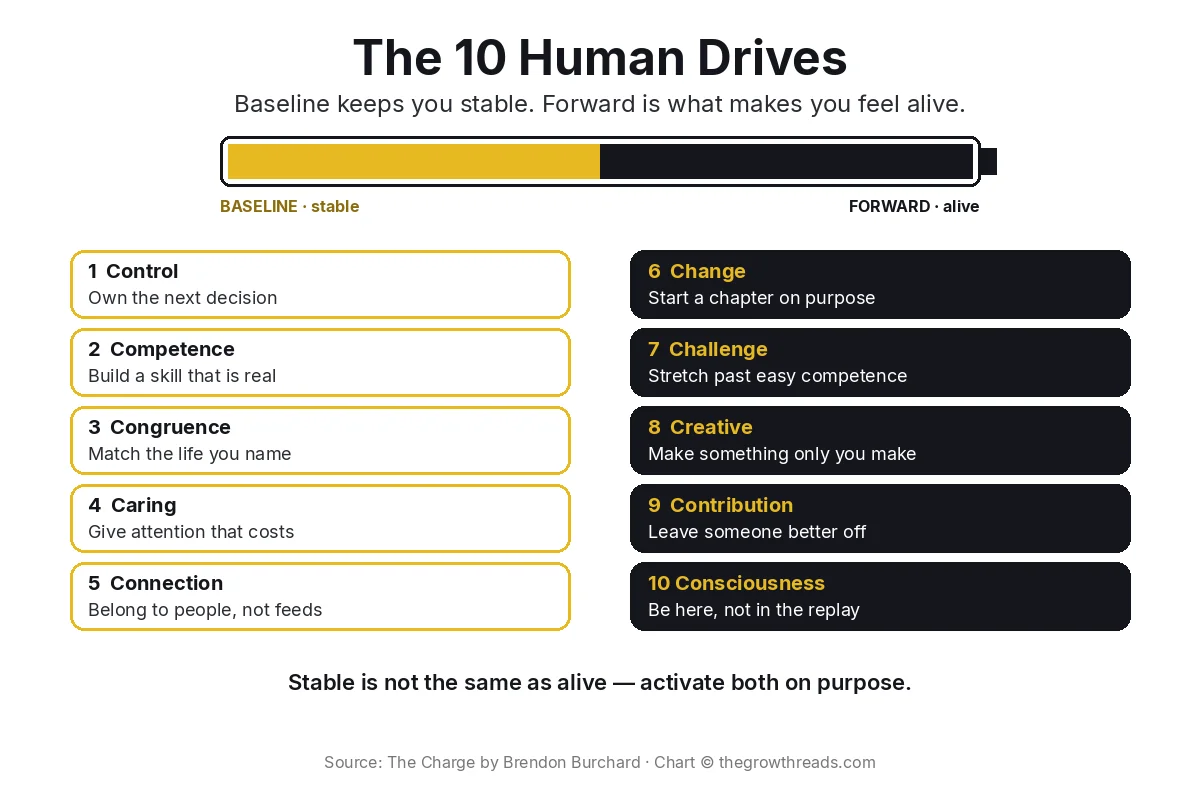
Five of those drives are baseline: control, competence, congruence, caring, connection. Feed them and the week is stable. Five are forward: change, challenge, creative expression, contribution, consciousness. Feed those and the week lights up. The method is simple. Stop waiting to feel motivated. Pick the empty drive. Run a small daily action. Repeat.
Key takeaways
- Alive beats happy. Comfort is a floor. A charged life is the point — engagement, stretch, and presence, not a mood spike.
- Ten drives, two sets. Baseline keeps you stable. Forward is what makes you feel lit. You need both on purpose.
- Control is the first baseline. If other people own every next decision, the rest of the drives leak.
- Competence is a charge, not a trophy. Getting better at one real skill feeds the week more than a new title.
- Congruence is calendar honesty. Values you cannot find in Tuesday’s hours are slogans, not values.
- Caring and connection are not the feed. Attention that costs you, and people you can tell the truth to, are the baseline social pair.
- Forward drives are optional only in theory. Skip change, challenge, making, contribution, and presence, and success still feels flat.
- Activate; do not wait. The drives are skills. Practice them like practice, not like weather.
- Charged people shift rooms. Your energy is a strategy. It changes the people who have to work next to it.
What is The Charge about?
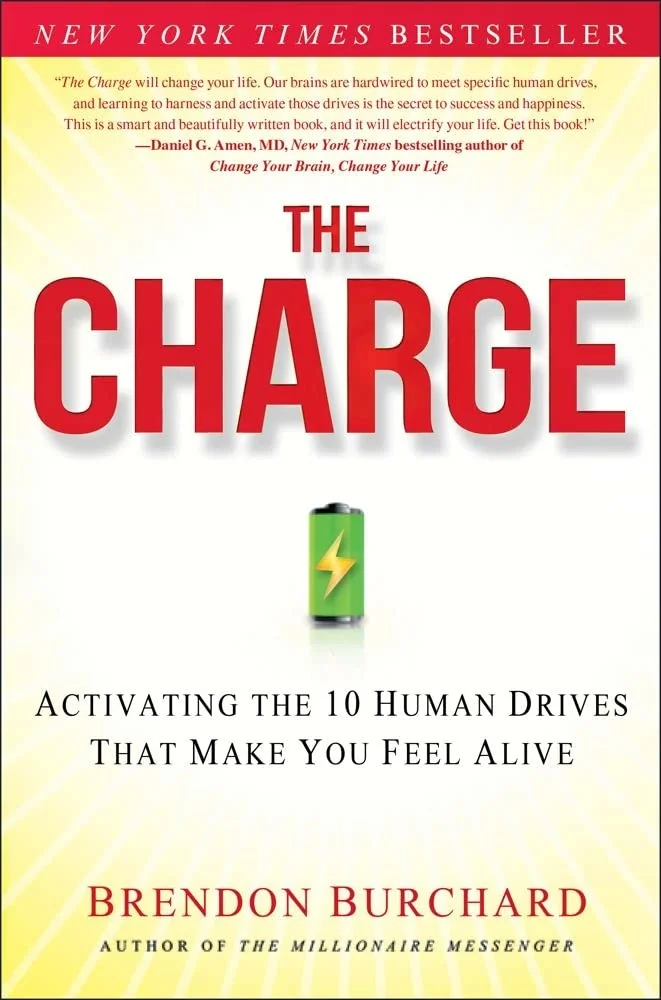
The Charge is Brendon Burchard’s practical map of the ten human drives that make a person feel fully alive. It splits those drives into a baseline set that keeps you stable and a forward set that lights the week, then shows how to activate each on purpose instead of waiting for motivation.
About the author
Brendon Burchard is a high-performance coach whose courses and talks have reached tens of millions of people. A near-fatal car crash in his late teens became the origin story he still teaches from: stop postponing the life you claim you want. He built a training company around that question, then wrote The Millionaire Messenger, The Charge (2012), The Motivation Manifesto, and High Performance Habits, the last drawn from interviews with high performers. You listen because he turns a foggy hunger — I want to feel more alive — into a list you can run on an ordinary Tuesday. Wikipedia: Brendon Burchard. Explore all Brendon Burchard book summaries →
Key concepts at a glance
| Concept | What it means | Use it when |
|---|---|---|
| Charged life | Fully alive — engaged, stretched, useful, present — not merely happy | The week is a win on paper and still feels dim |
| Baseline drives | Control, competence, congruence, caring, connection | The week is wobbly and you keep calling it a mood |
| Forward drives | Change, challenge, creative expression, contribution, consciousness | You are stable and still not lit |
| Control | You own the next decision | The calendar is a list of other people’s urgencies |
| Congruence | Hours match the values you name | You talk a life you cannot find in Tuesday |
| Challenge | Stretch past easy competence | You are good at the job and bored inside it |
| Creative expression | Make something only you would make | The week is all response and no making |
| Consciousness | Be here, not in the replay or the preview | You finish days you did not actually attend |
Part 1: The charged life and five strategic insights
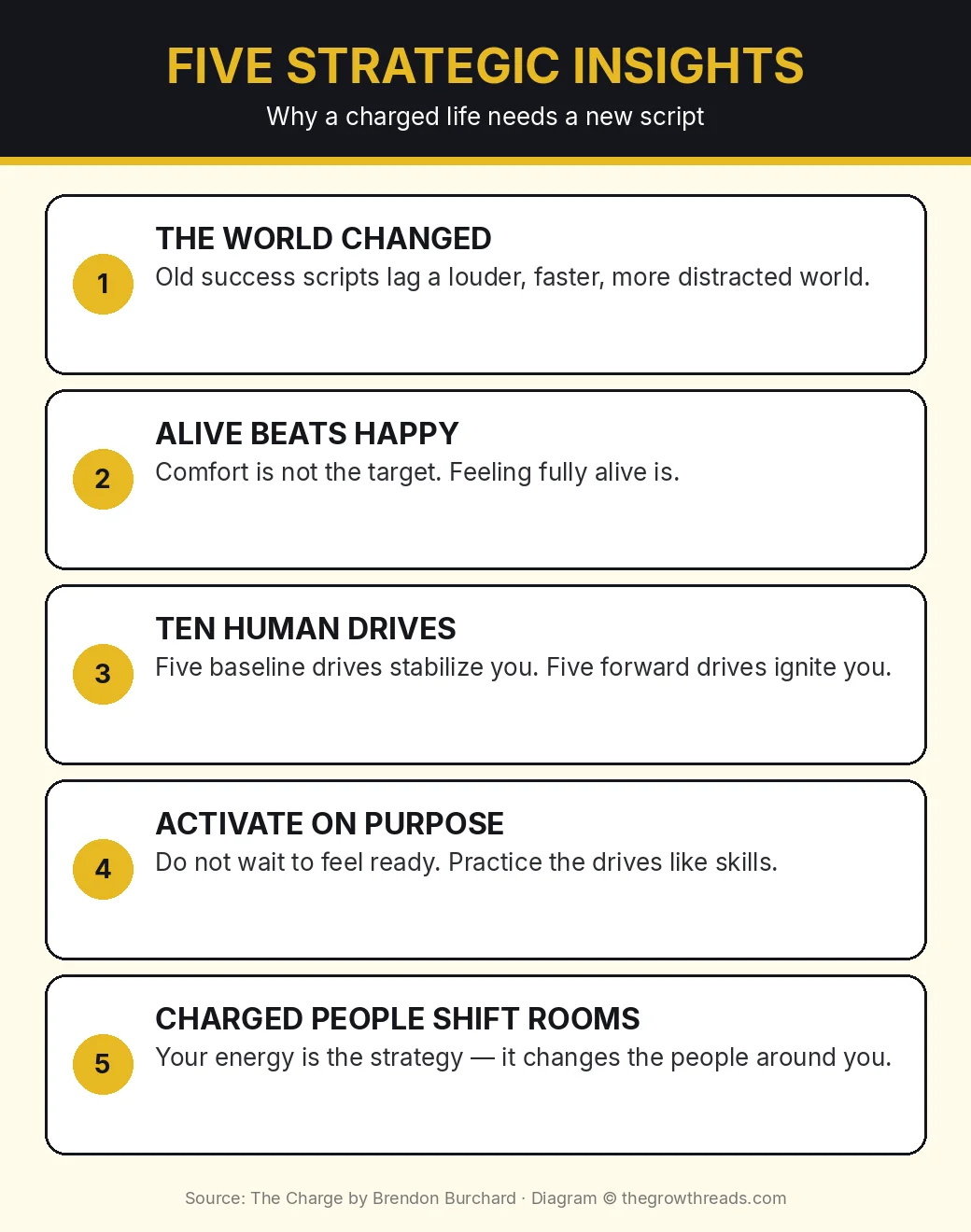
Burchard opens with a diagnosis most high-functioning readers recognize and rarely say out loud. The world sped up. Attention got cheaper to steal. Old success scripts — work hard, be nice, wait your turn — still produce a paycheck and no longer produce a pulse. People are not failing the script. The script is failing the nervous system that has to live it. The first insight is that you need a new strategy for a new world, not a louder pep talk for the old one.
The second insight is the book’s spine. We do not only seek happiness. We seek to feel alive. Happiness is a weather report. Aliveness is engagement: a stretch that matters, a person who needs you, a moment you actually inhabit. The third insight names the machinery: ten human drives, always on, always hungry. The fourth is the one that turns the book into a practice. You must activate those drives. Waiting to feel ready is how a decade disappears. The fifth is social. Charged people change rooms. Energy is not a private hobby. It is how a team, a family, a Tuesday meeting goes.
Read that way, The Charge is a strategy document for a life that has to run in public. If your system only protects the list, you will keep winning weeks you do not want to repeat.
TGR Note: Pink’s Drive names autonomy, mastery, and purpose as the deep fuel. Clear’s Atomic Habits shrinks the action until it can start. Burchard sits one layer over both: even a well-run habit stack can leave you stable and unlit if the forward drives never get a turn. Use Pink to remember the fuel. Use Clear to start. Use this book to name which tank is empty.
Part 2: Baseline drives — control, competence, congruence
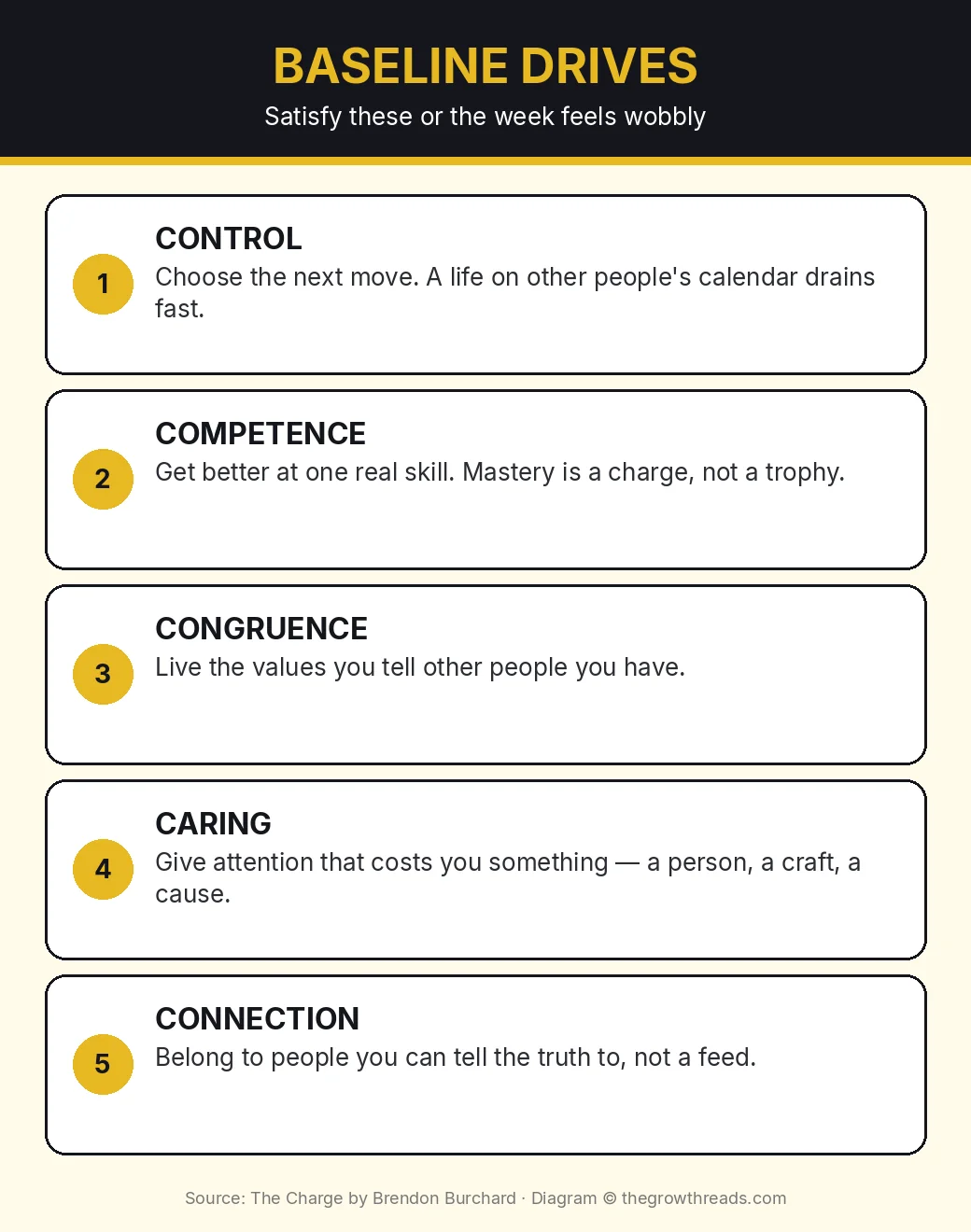
Control is first because without it the other drives are rented. If every next move belongs to a boss, a thread, a family calendar you never edited, you will call the leftover fatigue “being responsible.” Burchard’s move is smaller than a resignation letter. Own one decision today that used to be automatic. Protect one block. Say one clean no. Control is not domination. It is authorship of the next hour.
Competence is the drive high performers fake with busyness. Being in demand is not the same as getting better. The charge comes from a skill that is actually compounding — a craft, a language, a body of work — not from a full inbox. Pair this with Peak if you want the science of deliberate practice. Burchard’s point is simpler: if you cannot point at the skill you are currently building, the week is consuming competence instead of feeding it.
Congruence is the quiet one, and the one that makes the other two honest. You can own your calendar and still fill it with a life you do not respect. Congruence asks whether Tuesday’s hours match the values you would claim at dinner. If they do not, the nervous system knows. The fix is one hour moved from a value you perform to a value you keep.
TGR Note: If the competence gap is a missing shipping habit, Tiny Habits still wins the first two minutes. If the congruence gap is too many yeses, Essentialism and The One Thing cut the list so a value has a place to land. Burchard is not replacing those books. He is telling you which baseline is actually empty before you install another system on top of the wrong hole.
Part 3: Baseline social pair, then the forward five
Caring and connection finish the baseline set. Caring is attention that costs you — a person, a craft, a cause that would notice if you vanished. Connection is belonging to people who can hear the unpolished version, not a network that only claps. A week with neither can still look social. It will not feel like a life. Burchard’s test is blunt: who would you text at 9 p.m. with a real sentence, and who did you actually give an hour to that was not transactional?
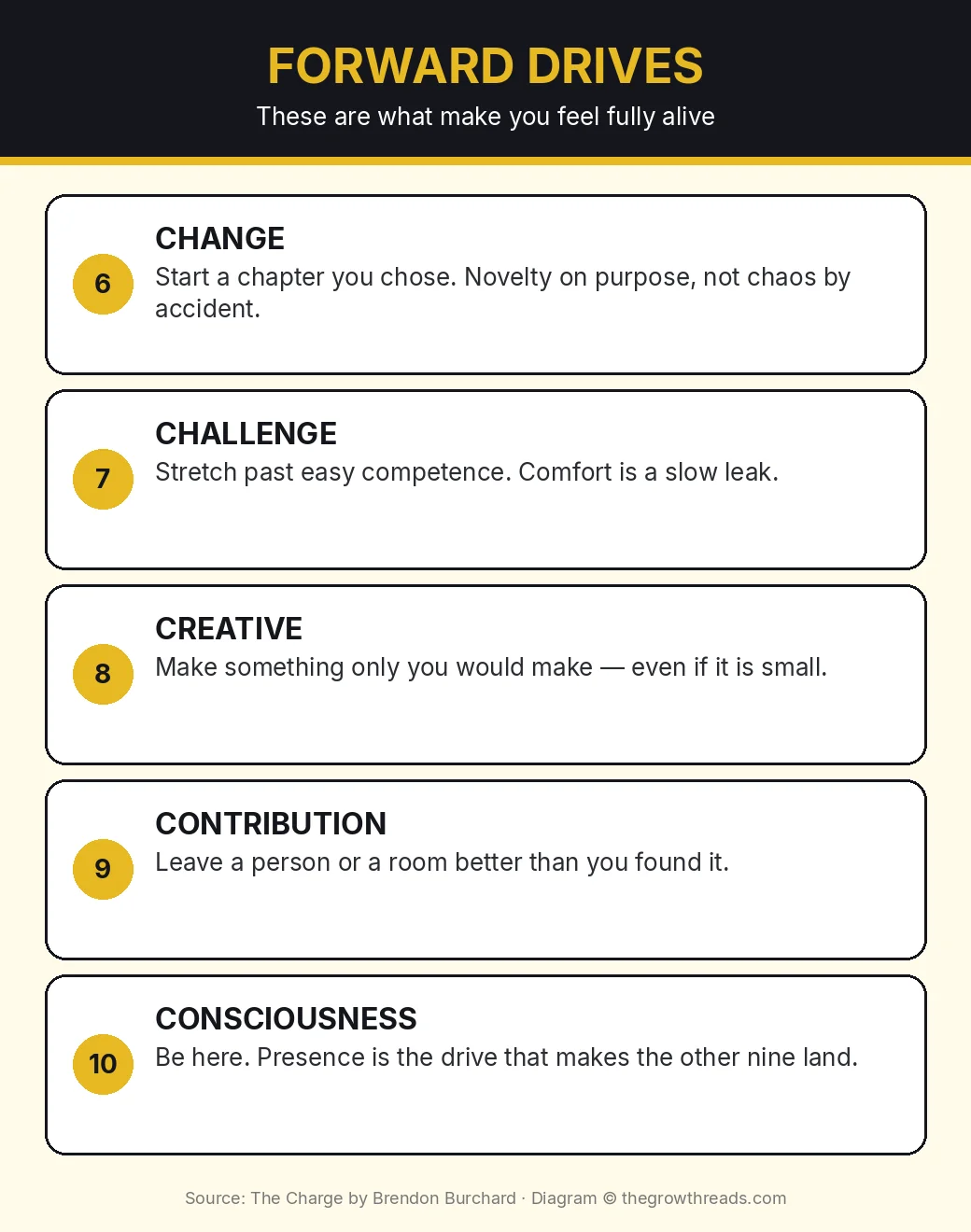
Then the book turns. Forward drives are why a stable life can still feel like a well-run waiting room. Change is a chapter you start on purpose, not chaos that happens to you. Challenge is stretch past the skill you could do half-asleep. Creative expression is making a thing — a paragraph, a dish, a deck, a garden — that did not exist because a ticket asked for it. Contribution is leaving a person or a room better. Consciousness is the drive that makes the other nine land: you are here, not in yesterday’s replay or tomorrow’s preview.
People skip this half because it does not show up on a performance review. That is the trap. The review can stay green while the person doing the work goes grey. Put one forward drive on the same calendar as the baseline, or admit you optimized for stable and called it a life.
TGR Note: High Performance Habits is Burchard’s later, denser operating system — six habits instead of ten drives. Read it when you already know you want to live charged and need the weekly practices. The Motivation Manifesto is the sermon on personal freedom. The Charge is the dashboard those two books assume. If you want grit under a hard stretch, Grit and Can’t Hurt Me supply the pain tolerance. This one supplies the why the stretch is for.
Part 4: Activate on purpose — a charged week is a practice
The last move is the one most readers already suspected and hoped to skip. You do not wait to feel charged and then act. You act in the direction of the empty drive and the feeling follows, late and unimpressed, like strength after a month of lifting. Activation is a scheduled action, not a mood. Control gets a protected hour. Competence gets a drill. Congruence gets a calendar edit. Caring gets a specific person. Connection gets a real conversation. Change gets a chapter you named. Challenge gets a stretch with a date. Creative expression gets twenty minutes of making. Contribution gets a help that is not a transaction. Consciousness gets ten minutes with the phone in another room.
You will not run all ten at full volume. Pick one baseline and one forward. Run them for a week. Score the ten. The unused low score is next week’s pair. The point is to stop leaking charge through a week that only feeds the drives a boss can see.
Burchard closes where he started: charged people are a public good. A parent, a lead, a maker who is lit does different work. If you lead anyone, including a future version of yourself, the ten-drive audit is how you stop showing up as a well-organized drain.
TGR Note: Deep Work buys the hours consciousness and competence need. The Compound Effect is the math of small daily choices, which is exactly how a drive gets fed. Feel-Good Productivity argues from mood as fuel. Burchard would nod, then ask which of the ten you are actually feeding. Use the hours. Use the math. Use the mood. Name the drive first so those tools are not applied to the wrong hole.
Who is The Charge best for — and who should read something else first?
Best for capable people whose systems already work and whose weeks still feel underlit. If you can keep a calendar, ship work, and still finish Friday wondering why the win did not register in your body, start here. It is also the right Burchard book if you have not yet read him and you want the map before the later research.
Read something else first if you do not have a next action at all — Getting Things Done or Atomic Habits will give you a start. If the problem is too many projects, Essentialism cuts the list so a drive has somewhere to live. If you already want Burchard’s operating system, skip ahead to High Performance Habits. If you need a one-focus wedge, The One Thing is cleaner. This book is a dashboard, not a shovel.
Questions to reflect on
- Which baseline drive was empty this week — and what did you call that emptiness instead?
- Where did you optimize for happy or efficient and skip alive?
- What is one decision you will own tomorrow that used to belong to someone else?
- Which forward drive has not had a calendar block in a month?
- Who received real caring from you this week, and who only got a reaction?
🔥 Ready to stop winning weeks you do not want to repeat?
Get The Charge, then use the 7-day plan to feed one baseline drive and one forward drive.
How to apply The Charge (7-day plan)
- Day 1 — Score the ten. 1 to 5 each drive. Circle the lowest baseline and the lowest forward. Those two are the week.
- Day 2 — Own one decision. Control: one no, or one block nobody else gets to fill.
- Day 3 — Practice a skill. Competence: thirty minutes of getting better, not catching up.
- Day 4 — Congruence check. Move one hour from a performed value to a kept one.
- Day 5 — Caring plus connection. One costly attention and one real conversation. Not a group emoji.
- Day 6 — One forward action. Change, challenge, or make something that did not have a ticket.
- Day 7 — Contribute, then be here. Help without a transaction. Ten minutes of presence. Re-score the ten.
Frequently asked questions
What is The Charge about in one paragraph?
The Charge is Brendon Burchard’s 2012 guide to feeling fully alive, not merely busy or briefly happy. He argues that modern life drains ten human drives, then shows how to activate them on purpose. Five baseline drives — control, competence, congruence, caring, and connection — keep you stable. Five forward drives — change, challenge, creative expression, contribution, and consciousness — are what make a week feel lit from the inside. The book is a diagnostic and a practice: name which drive is empty, then run a small daily action until the charge returns.
What are the 10 human drives in The Charge?
Burchard splits the ten drives into two sets. Baseline: control (you own the next decision), competence (you are getting better at something real), congruence (your calendar matches your values), caring (you give attention that costs you), and connection (you belong to people, not a feed). Forward: change (you start a chapter you chose), challenge (you stretch past easy competence), creative expression (you make something), contribution (you leave a person or a room better), and consciousness (you are actually here). Miss the baseline and the week wobbles. Miss the forward set and the week can look successful while still feeling flat.
What is the difference between “baseline” and “forward” drives?
Baseline drives are the floor. When control, competence, congruence, caring, and connection are fed, you feel stable enough to work. When they are empty, you spend the week putting out fires and calling it a personality problem. Forward drives are the ceiling. Change, challenge, creative expression, contribution, and consciousness are what turn a stable week into a charged one. A common miss is to optimize only the floor — inbox, gym, a few loyal people — and wonder why life still feels dim. The Charge’s rule is blunt: activate both sets on purpose. Stable is not the same as alive.
How is The Charge different from High Performance Habits?
The Charge (2012) is the diagnostic of aliveness: ten drives, five insights, and a charged-life practice. High Performance Habits (2017) is the later research playbook: six habits — clarity, energy, necessity, productivity, influence, courage — drawn from interviews with high performers. Read The Charge when the problem is ‘I am functioning and still not lit.’ Read High Performance Habits when you already know the destination and need daily practices that scale. They stack. The drives tell you which tank is empty. The six habits are how many people keep the tanks full once they can name them.
Who is Brendon Burchard, and why listen to him?
Brendon Burchard is a high-performance coach and one of the most-followed personal development trainers online. A near-fatal car accident in his late teens pushed him to stop postponing the life he said he wanted. He built a training company around that question, then wrote The Millionaire Messenger, The Charge, The Motivation Manifesto, and High Performance Habits. You listen because he turns a vague hunger — I want to feel more alive — into a checklist you can run on a Tuesday. The later research book is denser. This one is the map of the ten drives that book assumes you already feel.
Is The Charge still useful if I already read High Performance Habits?
Yes, if the six habits feel like a gym you never enter because you cannot name what is empty. The Charge is the intake form. It is shorter on citations and longer on the feeling of a drained week. People who already live the six habits often still skip creative expression, contribution, or consciousness, then call the leftover dullness ‘just being an adult.’ Use this book as a ten-point audit once a quarter. Use High Performance Habits as the weekly operating system. If you want a still-tighter motivation text, The Motivation Manifesto is the sermon. This one is the dashboard.
How should I apply The Charge this week?
Pick one baseline drive and one forward drive, not all ten. Write a one-line action for each that can finish today. Control might be one decision you will not outsource. Creative expression might be twenty minutes of making something nobody assigned. Do that pair for seven days. On day seven, score each of the ten drives from 1 to 5 and notice which score did not move. That unused drive is next week’s pair. Do not add a new app. Do not wait for a retreat. The 7-day plan in this summary is the method, scaled to a week. Repeat it. Charge is a practice, not a mood.
Related summaries
- High Performance Habits — Burchard’s later six-habit operating system, once the drives have names.
- The Motivation Manifesto — the freedom sermon that sits next to this dashboard.
- Atomic Habits — the start-small machine for any drive you just circled.
- Feel-Good Productivity — mood as fuel, from a more popular lane than the ten-drive audit.
More in this silo: best productivity books.
How we analyze books: every book on The Growth Reads is read cover to cover, summarized in thousands of words of original analysis, and rated against our five-criteria rubric (lasting impact, evidence quality, practical application, writing & originality, external consensus). Read our full methodology.