

★★★★½ 4.5/5 — Treat cooking as a lab for meta-learning. DiSSS first, then a handful of techniques beat a shelf of recipes.
Best for: ambitious beginners who want to get good at a skill in months — cooking, language, a craft — and keep drowning in material instead of method.
Reading time: ~16 hours (672 pages) · this guide ~12 min
Difficulty to apply: Easy to understand. Medium to finish — pick META plus one branch, not the whole brick.
The 4-Hour Chef in one minute
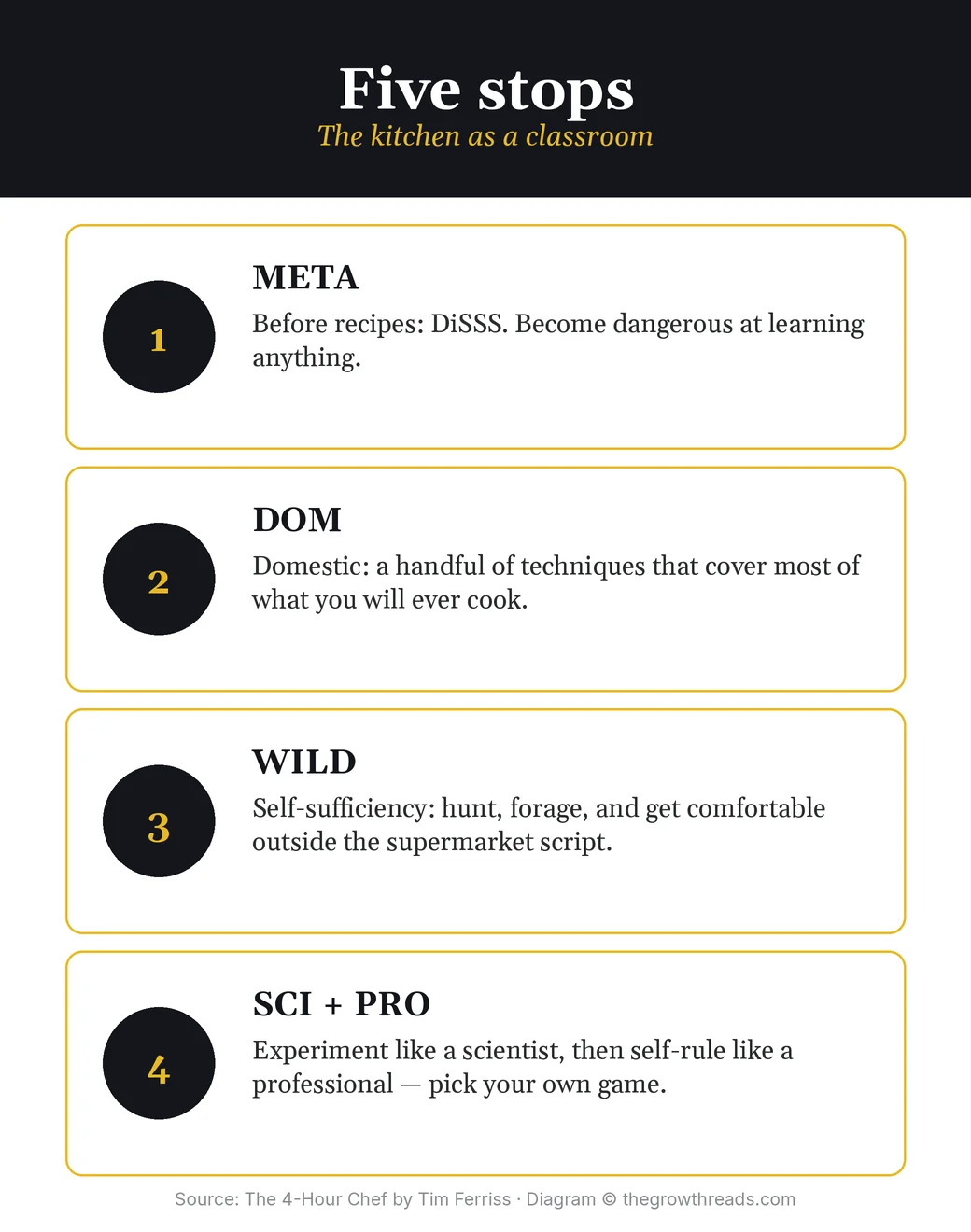
The 4-Hour Chef is not a cookbook that wandered into self-help. It is a learning system that borrowed a stove. Tim Ferriss, a lifelong non-cook, used kitchens from Buenos Aires to Okinawa to reverse-engineer how fast learners actually get good. The payload sits in META: DiSSS — deconstruct, select, sequence, stakes — plus CaFE (compression, frequency, encoding). Cooking is the lab because dinner grades you in two hours. The long middle (DOM, WILD, SCI, PRO) is that stack run on food, self-sufficiency, experiments, and self-rule. Steal the stack even if you never truss a chicken.
Key takeaways
- Meta-learning first: Learn how you will learn before you collect another recipe, course, or app.
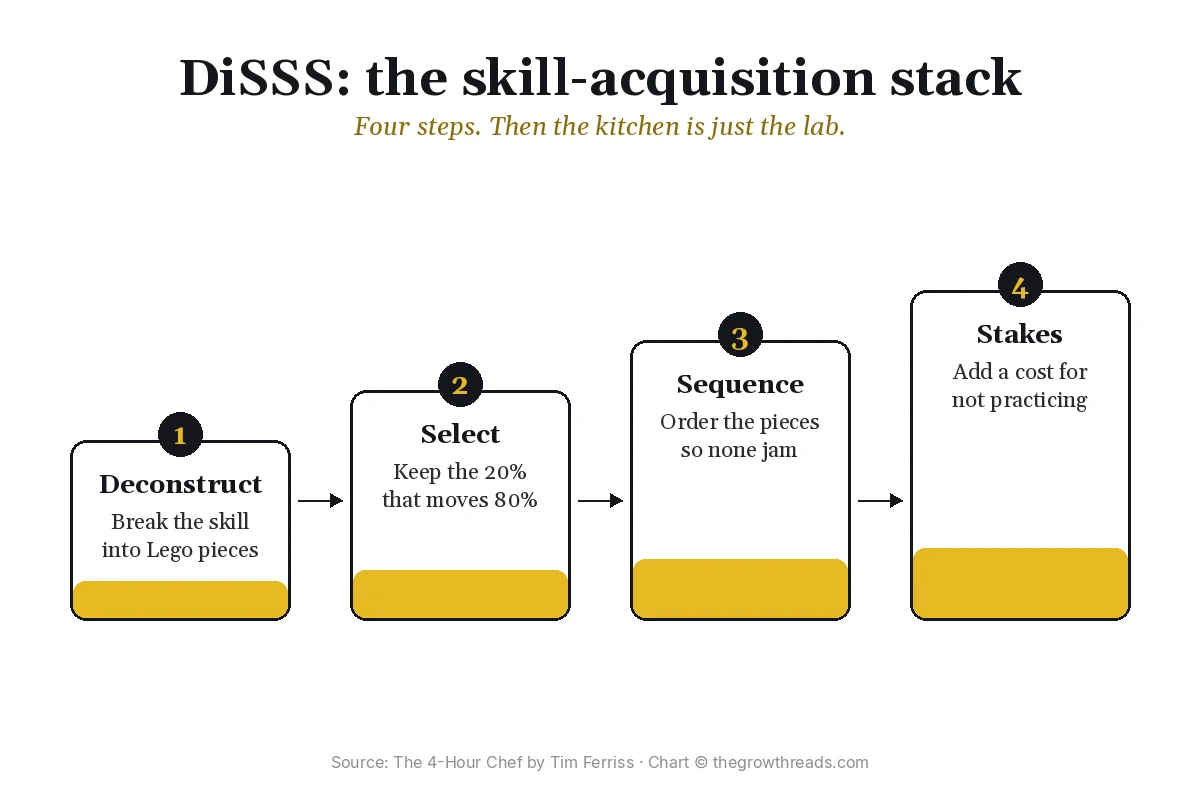
- DiSSS: Deconstruct the skill, select the 20%, sequence the pieces, then add stakes so practice happens.
- Material vs method: Recipes are material. Heat control, searing, and braising are method. Method transfers; material piles up.
- 80/20 is a cut, not a slogan: A handful of techniques cover most of what you will ever cook — or code, or speak.
- Failure points: Map where people quit (knife work, grammar, the first ugly week) and design around that ditch, not around the diploma.
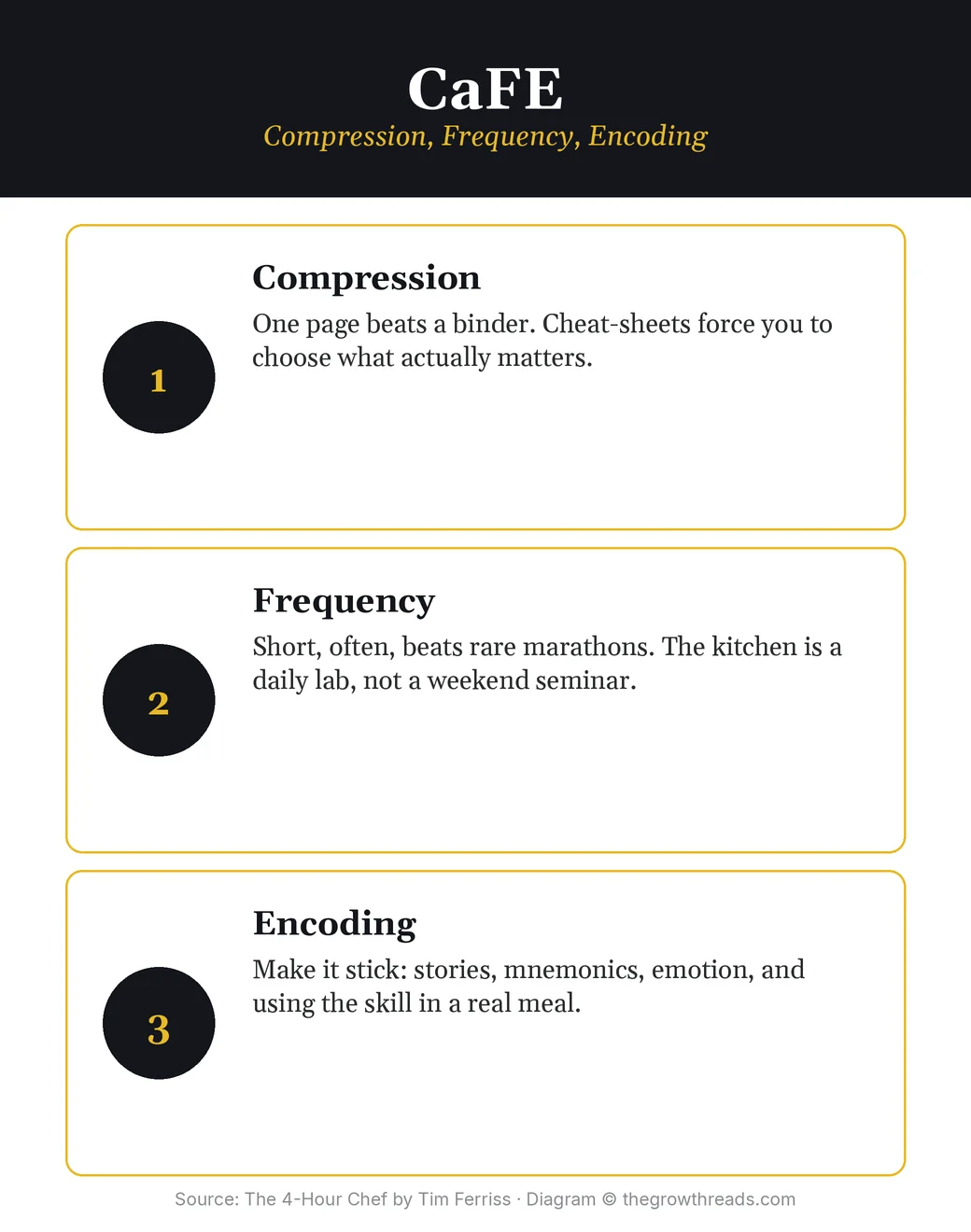
- CaFE: Compress to one page, practice often in short blocks, encode with stories and real use.
- Stakes beat motivation: A dinner already promised, a public date, a bet. Willpower is a bad scheduler.
- Constraints are a feature: Limited gear and a short list make you practice instead of shopping.
- The kitchen is optional: DiSSS works on any skill with fast feedback. Food is just the honest scoreboard.
What is The 4-Hour Chef about?
The 4-Hour Chef is Tim Ferriss’s 2012 guide to learning any skill quickly, using cooking as the lab. He installs DiSSS before recipes, then runs that stack through domestic technique, self-sufficiency, experiments, and self-rule so a non-cook can get competent — and anyone can steal the method.
About the author
Timothy Ferriss became famous for The 4-Hour Workweek, which asked whether a 40-year career had to be the only path to a good life. He followed it with The 4-Hour Body, then this 2012 New Harvest brick: part cookbook, part field manual for rapid skill acquisition. Ferriss is a podcaster and professional tester — he picks a domain and hunts the smallest methods that move the needle. The 4-Hour Chef aims that habit at the stove. He was not a chef. That is the point: a lifelong non-cook is a cleaner lab rat than a prodigy. Later books collect other people’s tactics; this one shows his own learning operating system. Explore all Timothy Ferriss book summaries →
Key concepts at a glance
| Concept | What it means | Use it when |
|---|---|---|
| DiSSS | Deconstruct, Select, Sequence, Stakes — the meta-learning stack. | You are about to buy a course instead of designing practice. |
| Deconstruction | Split the skill into Lego pieces; find the failure points. | The domain feels like a cathedral and you do not know the door. |
| Selection (80/20) | Keep the methods and material that produce most of the result. | You have 40 tabs and still cannot scramble an egg. |
| Sequencing | Order the pieces so early wins unlock later ones. | You keep starting on chapter 12 because it looks advanced. |
| Stakes | A real cost for skipping practice. | You “will start Monday” and Monday keeps moving. |
| CaFE | Compression, Frequency, Encoding — how learning sticks. | You binge a weekend and forget it by Thursday. |
| Material vs method | Recipes vs transferable technique (heat, sear, braise). | Your shelf grew and your skill did not. |
| Minimum effective dose | The smallest input that still produces the outcome. | You are adding gear and hours instead of better drills. |
Part 1: META — learn the skill of learning first
Ferriss opens with a rude claim: most people fail at new skills because they skip the first job. They collect material — recipes, playlists, PDFs — and call it preparing. Preparation without a method is shopping. META is the method. Cooking is the example because it is brutally scored. Nobody can hide behind a theory omelette.
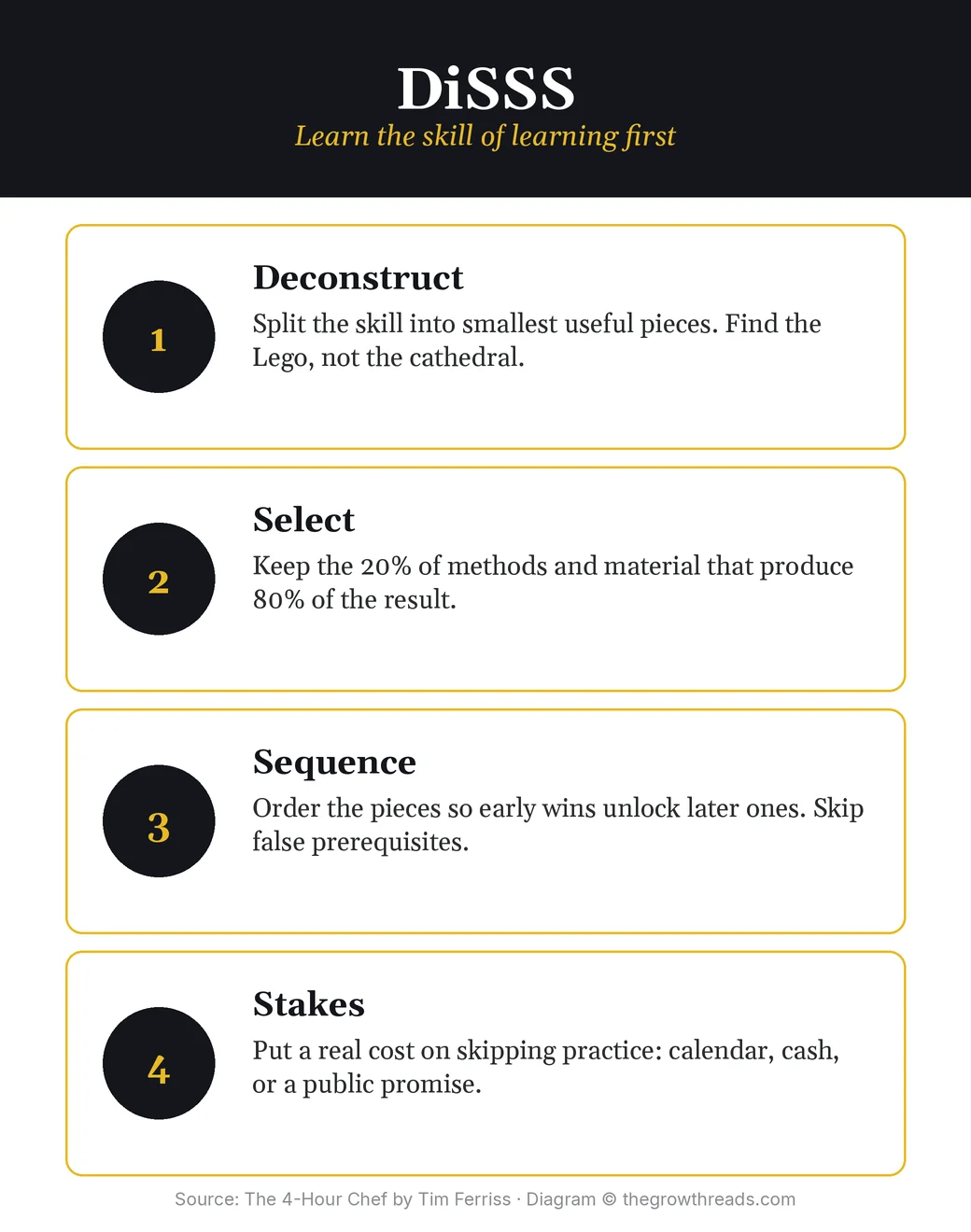
DiSSS is the spine. Deconstruct means taking the cathedral apart until you see bricks. “Learn Spanish” is not a brick. Survival phrases and the verbs you will actually say are. In the kitchen, “learn to cook” becomes heat, salt, sear, braise. Ferriss also hunts failure points: the ditch where students quit. Language learners drown in grammar. New cooks drown in a 28-ingredient first recipe. Design around the ditch, not the diploma photo.
Select is 80/20 with teeth. Which methods produce most of the result? Which techniques show up in everything else? If you cannot throw something away, you have not selected — you have hoarded with better lighting. Sequence is the order those pieces should arrive. Eggs teach heat before a roast teaches spectacle. Stakes close the loop. Motivation is a mood. A dinner party on Saturday is a calendar fact. The embarrassment of moving it is the feature.
TGR Note: If you want the same 80/20 instinct without 670 pages of food, The First 20 Hours caps the lab at three weeks and Ultralearning is the aggressive sibling. Ferriss is the one who makes you cook the experiment. For the original lifestyle-design cut, start with The 4-Hour Workweek — DEAL for the job, DiSSS for the craft.
Part 2: DOM — the kitchen as a daily lab
DOM, “the domestic,” is where the stack hits a stove. Ferriss’s bet is that a small set of techniques covers most of what a home cook will ever need. You do not need 400 recipes. You need heat you can feel, browning you can see, a moist method, a dry method, and a sauce that forgives you. The rest is costume.
He uses constraints on purpose: limited pans, a short list, one skill per session. Constraints stop you from turning practice into a mall trip. The first meals are diagnostics. Eggs tell you if you can manage heat. A sear tells you if you can wait for a pan to be hot. Braising tells you if you can leave something alone. That is frequency: short sessions on a Tuesday. Compression is the one-pager — if the method will not fit, you have not selected yet.
Encoding is the part people skip: a mnemonic, a story, a meal served to someone else. Using the skill at a table of two beats highlighting another chapter. If you only collect recipes, you are stuck the night the app dies. If you own method, onions and eggs still feed people. That is the 80% outcome — not “become a chef,” but “stop being helpless at 7pm.”
TGR Note: DOM is deliberate practice with dinner as the scoreboard. For the science of designed drills, pair this with Talent Is Overrated. If the real problem is getting the first two minutes to happen, Atomic Habits will put the pan on the stove; DiSSS will stop you from filling the pan with a 40-step recipe.
Part 3: WILD — self-sufficiency as a practice stance
WILD is the uncomfortable third: hunting, fishing, foraging — food before the plastic tray. You do not have to become a hunter to use it. The argument is self-sufficiency as a learning stance. Most modern skills arrive pre-sliced. Someone else wrote the framework and hosted the platform. WILD asks what happens when you cannot outsource the ugly step.
Get closer to the raw input. Whole ingredients instead of kits. The primary source instead of a thread about the primary source. Put yourself in a room where the skill is not optional and the feedback is not a like-count. A fish you have to clean is an honest teacher. So is a spreadsheet you have to ship by Friday without a template. WILD is stakes plus reality, and a permission slip to be a beginner in public.
If hunting is not your sport, keep the stance. One weekend of cooking from a market without a recipe app is WILD enough. The point is not romance. It is to stop practicing in a padded editor where nothing can go wrong and therefore nothing gets encoded.
TGR Note: Uncomfortable practice is the through-line of Tools of Titans — Ferriss’s later interviews keep returning to people who put skin in the game. If your issue is not skill design but sitting still long enough to train, Deep Work is the attention half of the same problem.
Part 4: SCI + PRO — experiment, then pick your own game
SCI is Ferriss the tinkerer: modernist tricks, odd textures, permission to play. Skip the hydrocolloids and keep the rule. Once you own a method, run experiments on purpose — one variable, notes, another pass. Play is how encoding happens when the drill would otherwise bore you into quitting.
PRO is the close: swaraj, self-rule. World-class people, in Ferriss’s telling, are not well-rounded. They pick a game and design practice that would look lopsided on a report card. After META–DOM, you can chart the next skill yourself: deconstruct, cut, order, date. The book is a choose-your-own-adventure. META is required. Everything after is a branch. You are supposed to leave pages unread. Finishing as a personality test is the opposite of selection.
Take the stack out of the kitchen. A language: 100 sentences, daily 20 minutes, a conversation booked Friday. A tool at work: five workflows that cover 80% of tickets, demoed Thursday. A body skill: two lifts, three sessions, a number you will hit in public. The stove was never the product. Competence on purpose was.
Who is The 4-Hour Chef best for — and who should read something else first?
Best for people who keep buying material and never get a method: the course hoarders, the recipe-screenshoters, the ambitious beginners who want to be good at something in months and keep starting at chapter 12. If you like physical feedback and you will actually cook, DOM will make DiSSS sticky. If you will not cook, steal META and run it on a skill with equally fast scoring.
Read something else first if you need a thin book this week. This one is a brick; sampling META is the intended use, but if 670 pages will become another unfinished identity, start with The First 20 Hours or Atomic Habits. If your real problem is the job rather than the craft, The 4-Hour Workweek is the sibling. If you want other people’s tactics without a stove, Tools of Titans and Tribe of Mentors. Come back here when you are ready to design one skill on purpose.
Questions to reflect on
- What skill am I “researching” that I have not deconstructed into Lego pieces?
- Where is my failure point — the ditch where I usually quit — and how would I sequence around it?
- What 20% of methods would still get me 80% of the outcome I actually want?
- What stake could I put on the calendar this week that I would be embarrassed to move?
- Am I collecting material, or practicing a method I could use if the app died tonight?
🔥 Ready to learn one skill on purpose?
Write DiSSS for one outcome. Cook the first drill this week — or run the same four steps on a skill that is not food.
How to apply The 4-Hour Chef (7-day plan)
- Day 1 — Name the skill. Write one sentence: the 80% outcome you actually want (not “be a chef” — “cook four weeknight meals without a recipe app”). List ten Lego pieces the skill seems to have.
- Day 2 — Deconstruct and cut. Circle the three pieces that, if missing, make everything else fail. Star the failure point where people quit. Cross out two pieces that are costume, not skill.
- Day 3 — Select the 20%. From methods and material, keep one primary method and five drills. If a video or book is “nice to have,” it is not in the 20%. Write the list on one page.
- Day 4 — Sequence. Order those five drills so the first one can be done tonight with what you already own. Put the fake prerequisite last or delete it.
- Day 5 — Stakes. Put a date on the calendar in seven days: a meal, a demo, a call, a publish. Tell one person. The cost of skipping is now social, not theoretical.
- Day 6 — CaFE in miniature. Compress the one-pager again. Practice the first drill three times for 20 minutes, not once for an hour. Encode it by teaching one step out loud.
- Day 7 — Ship the lab. Do the thing for a real human (dinner, a recorded demo, a live call). Write three observations that are facts. Keep one correction. Schedule next week’s three short sessions.
Frequently asked questions
What is The 4-Hour Chef about in one paragraph?
The 4-Hour Chef is Tim Ferriss’s 2012 meta-learning manual dressed as a cookbook. Cooking is the lab because dinner is honest: it either tastes good or it does not. Before any recipe, Ferriss installs DiSSS — deconstruct the skill, select the 20% that moves 80%, sequence the pieces, then add stakes so practice actually happens. The rest of the book (DOM, WILD, SCI, PRO) is that method run on food, hunting, experiments, and self-rule. You can steal the stack for languages, lifts, or a new job without becoming a chef.
What is DiSSS in The 4-Hour Chef?
DiSSS is Ferriss’s four-step stack for learning anything on purpose. Deconstruct splits a skill into smallest useful pieces and finds the failure points where most people quit. Select keeps the 20% of methods and material that produce most of the result — techniques over recipe collections. Sequence puts those pieces in an order so early wins unlock later ones and fake prerequisites get skipped. Stakes put a cost on not practicing: a dinner you already promised, a calendar block, a bet. Run the four before you buy another course.
Is The 4-Hour Chef a cookbook or a productivity book?
Both, and the productivity half is why it belongs in this silo. The middle is full of techniques, gear constraints, and meals — enough to take a non-cook to competent. The payload is META: how to learn a skill in months instead of collecting binders. If you never cook, you can still use DiSSS and CaFE (compression, frequency, encoding) on whatever you actually need. If you do cook, the kitchen gives you a daily lab with fast feedback. Read it as a learning book that happens to make dinner.
How is The 4-Hour Chef different from The 4-Hour Workweek?
The 4-Hour Workweek redesigns the job: DEAL, 80/20 on clients, mini-retirements, location. The 4-Hour Chef redesigns skill. Same author, same allergy to default paths, different lever. Workweek asks which tasks to drop. Chef asks which 20% of a craft to keep and in what order. If your bottleneck is a calendar full of low-value work, start with Workweek. If your bottleneck is “I have time and still cannot get good at the thing,” start here. They stack: freedom without skill is empty; skill without freedom is a nicer cage.
How long does it take to read The 4-Hour Chef?
The New Harvest hardcover runs about 670 pages. A straight-through read is roughly 14–18 hours, and most people should not do that. Ferriss designed it as a choose-your-own-adventure: META is mandatory, DOM is the kitchen lab, WILD/SCI/PRO are optional branches. This guide takes about twelve minutes and gives you DiSSS, CaFE, and a 7-day plan. Read META this week. Cook from DOM when you want the feedback loop. Skip the hunting chapters if they are not your sport. The book rewards sampling, not finishing as a personality test.
Do I need to cook to use the DiSSS method?
No. Cooking is the worked example because it is physical, social, and scored in one evening. DiSSS is the transferable part. Deconstruct Spanish, a sales call, or a deadlift the same way: pieces, 20%, order, stakes. Frequency still beats marathons. Compression still beats hoarding tabs. The kitchen just makes cheating obvious — a bad omelette does not let you hide behind theory. If you hate cooking, pick a skill with equally fast feedback and run the same four steps. The recipes are optional. The stack is not.
What should I read after The 4-Hour Chef?
For a thinner skill book with a 20-hour cap, read The First 20 Hours. For designed practice and why naive hours plateau, read Talent Is Overrated and Peak. For the lifestyle-design sibling, The 4-Hour Workweek. For tactics from other high performers, Tools of Titans and Tribe of Mentors. If you need the next two minutes to happen before any stack, Atomic Habits. Stay in the Productivity silo unless you specifically want a conventional cookbook — this one is a classroom that happens to use a stove.
Related summaries
- The 4-Hour Workweek — redesign the job; this book redesigns the skill.
- The First 20 Hours — a thinner cap on getting usefully good fast.
- Ultralearning — aggressive self-directed skill projects.
- Tools of Titans — tactics from the people Ferriss interviewed after this lab.
- Best productivity books — the full Productivity silo, ranked and compared.
How we analyze books: every book on The Growth Reads is read cover to cover, summarized in thousands of words of original analysis, and rated against our five-criteria rubric (lasting impact, evidence quality, practical application, writing & originality, external consensus). Read our full methodology.