

★★★★½ 4.5/5 — the fastest way to borrow a network: eleven sharp questions, 130+ short replies, and a method for skipping years of other people’s tuition.
Best for: Doers who will steal one answer this week — and who are happy to skip freely
Reading time: ~10 hours (624 pages, designed to be sampled) · this guide ~16 min
Difficulty to apply: Easy — each profile is a handful of answers you can test without finishing the book
Tribe of Mentors in one minute
Tim Ferriss turned forty, realised he had no plan for the next decade, and instead of hunting a single guru he sent eleven questions to more than 130 people already living the lives he wanted to understand. Tribe of Mentors is the result: short life advice from athletes, investors, artists, and operators, organised as compact profiles you are meant to skip through.
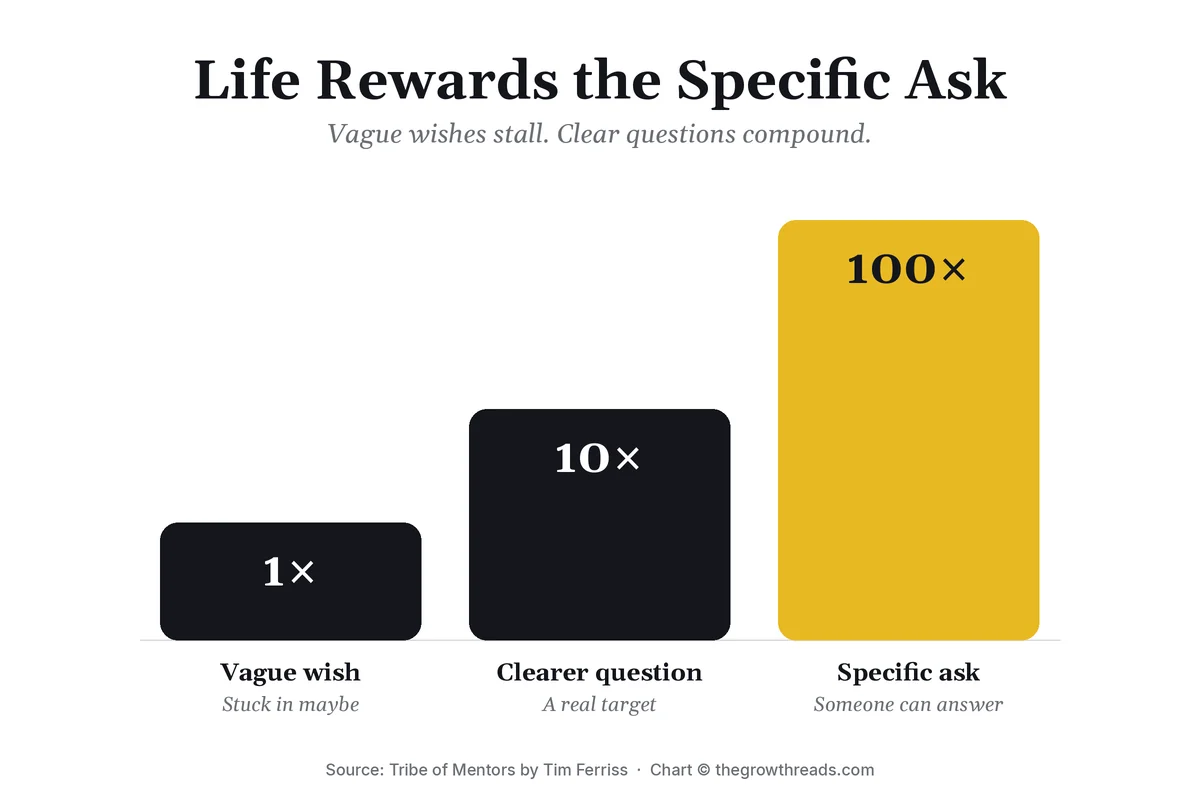
The claim underneath the celebrity names is practical. Life punishes the vague wish and rewards the specific ask. You do not need one perfect mentor. You need a reusable set of questions, a permission slip to skip, and the habit of stealing one tested move at a time.
Key takeaways
- A tribe beats a guru: One advisor has one biography. A hundred short replies let you pattern-match across lives that do not look like yours.
- The questions are the asset: Ferriss spent years refining eleven asks. Guests answered three to five. You can send the same list this month.
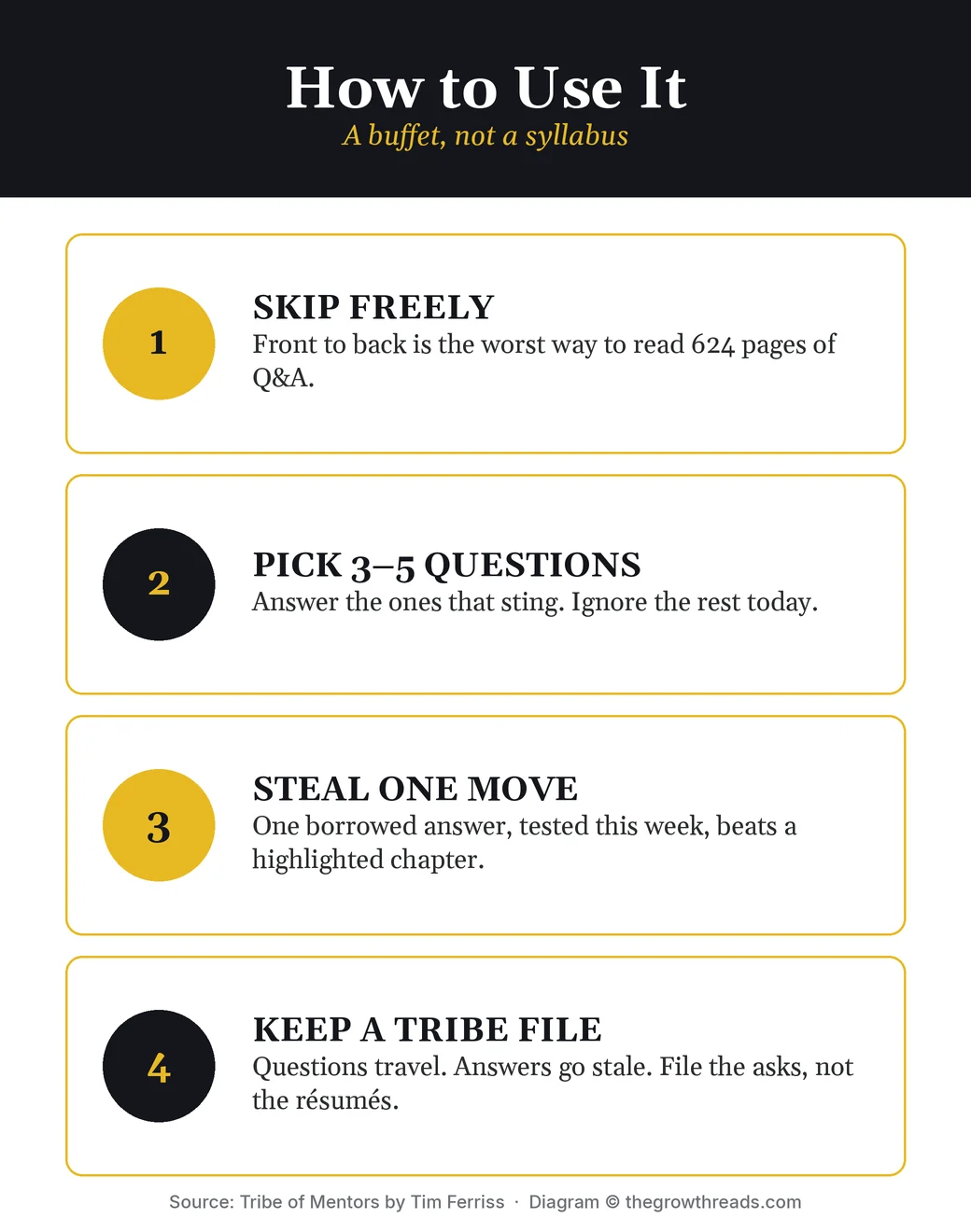
- Skip freely or the book fails: 624 pages of Q&A is a buffet. Front to back is the least effective way to use it.
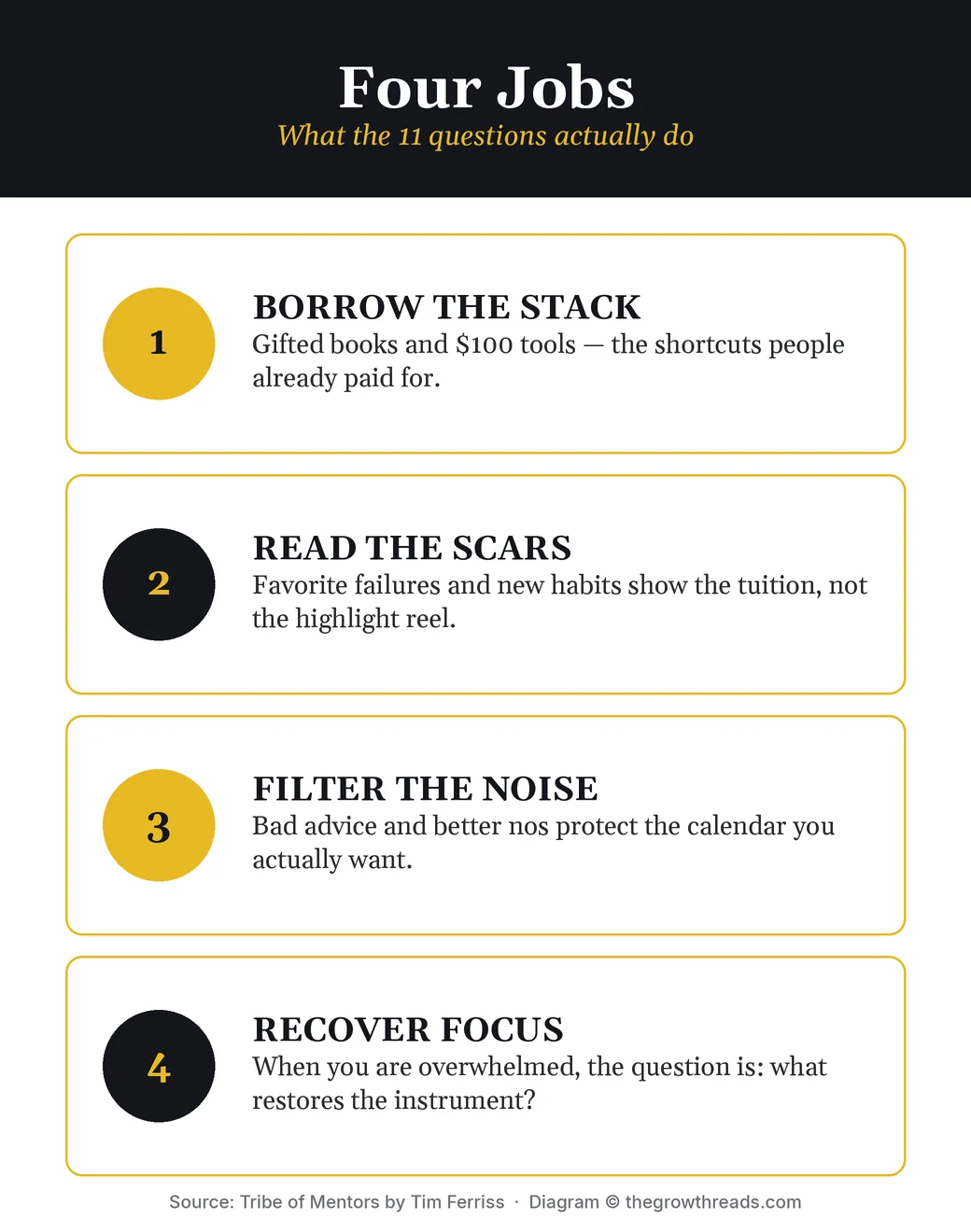
- Gifted books are a shortcut syllabus: The titles people actually buy for friends compress years of browsing into a weekend list.
- The $100 stack is a minimum effective dose: Cheap, specific tools show up because they survived contact with a real week.
- Favourite failures are the useful biography: Origin myths flatter. The loss that trained someone is the page you can use.
- Saying no is a skill with tactics: Calendars fill with lukewarm yeses. The better guests treat decline as design, not mood.
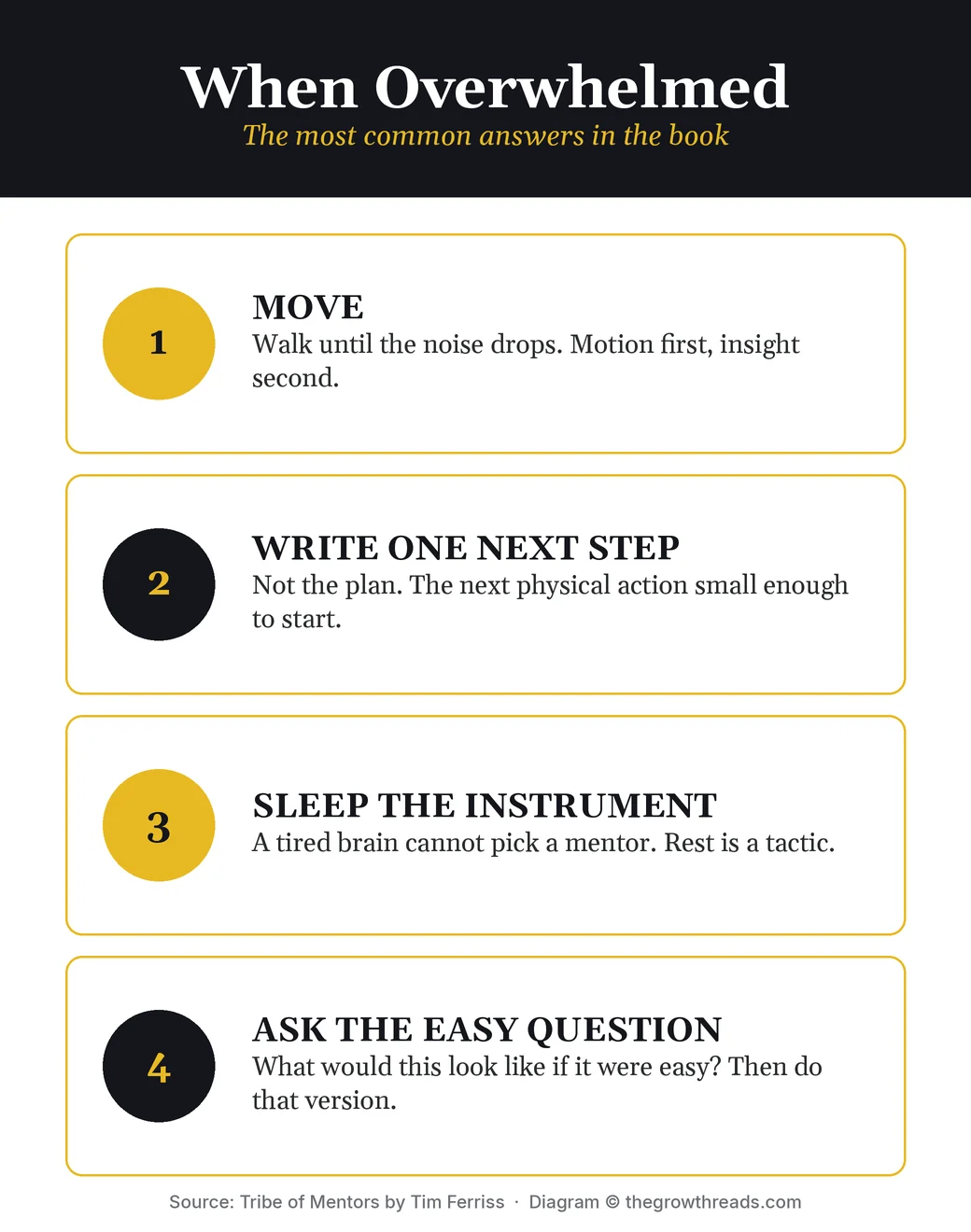
- Overwhelm has a protocol: Walk, write the next action, sleep, or ask what the easy version would look like — then do that version.
- Less than 10% were podcast regulars: This is a new roster, not a reprint of Tools of Titans.

What is Tribe of Mentors about?
Tribe of Mentors is Tim Ferriss’s 2017 book of short life advice from more than 130 world-class performers, built from eleven questions he sent at forty. Guests answered their favourite three to five asks in compact profiles meant to be sampled, not marched through.
About the author
Tim Ferriss is an American author, entrepreneur, and podcaster whose first book, The 4-Hour Workweek, was rejected twenty-six times before it popularised lifestyle design and spent years on the bestseller lists. He followed it with The 4-Hour Body and The 4-Hour Chef, then in 2014 launched The Tim Ferriss Show, which became one of the world’s most downloaded interview podcasts. Tribe of Mentors, published in 2017 as he turned forty, is the book he built when he realised he had no plan for the next decade: instead of hunting one guru, he sent eleven questions to more than 130 world-class performers. Ferriss also writes candidly about depression and a near-suicide in college, which is why the book’s questions about failure and overwhelm land as tools rather than slogans. Explore all Timothy Ferriss book summaries →
Key concepts at a glance
| Concept | What it means | Use it when |
|---|---|---|
| Specific ask | A question someone can actually answer | You have been wishing in generalities for months |
| Tribe, not guru | Many short replies beat one biography | You are waiting to be chosen by a single mentor |
| Answer 3–5 | Skip the questions that do not sting | The full list of eleven feels like homework |
| Gifted-book list | Titles people buy for friends, not for show | Your reading pile is random and unread |
| $100 stack | Cheap tools that survived a real week | You keep buying systems and using none |
| Favourite failure | The loss that trained the later win | You are hiding a miss that still runs you |
| Better no | Decline as design, not a mood | Next week is already a polite maybe |
| Overwhelm protocol | Move, write one step, sleep, or shrink the ask | You cannot think your way into the next action |
Part 1: Why a tribe — Ferriss at 40 and the 11 questions
The book starts as a personal emergency, not a content strategy. In 2017 Ferriss turned forty, The 4-Hour Workweek turned ten, people in his circle died, and he stood on a stage and explained how close he had come to suicide in college. The questions that followed were the ordinary midlife set: which goals were actually his, how much life he had missed by overplanning or underplanning, how to be kinder to himself, how to say no to noise so he could say yes to the few adventures he still wanted.
Written down, the list produced anxiety rather than clarity. His move — the same move he has used on business and training problems for years — was to ask, What would this look like if it were easy? The easy version was not “find a sage and wait to be chosen.” It was: write the most ambitious list of people alive, get a book deal so the ask had a reason, and send an identical set of eleven questions with permission to answer only three to five. Half the list declined or never replied. Enough said yes that the experiment became 624 pages.
Eight of the questions had already been pressure-tested on The Tim Ferriss Show; three were new. The design detail that matters is the skip rule. He asked for favourite questions, not a complete interview. Steal the same rule: never send eleven asks to a busy person. Send three.
TGR Note: This is the companion to Tools of Titans, not a reprint: longer tactics live there; the reusable questions live here. If you want Ferriss’s own system rather than a chorus, start with The 4-Hour Workweek and come back when you need other people’s answers.
Part 2: The borrowed stack — books, $100 tools, and the billboard
The first questions look lightweight until you watch them repeat. “What book have you given most as a gift?” is not a taste test. It is a forced ranking of the ideas someone is willing to put in a friend’s hands. Across a hundred replies, clusters appear: Viktor Frankl’s Man’s Search for Meaning, Stoic letters, Sapiens, poor-Charlie-style mental models, and Ferriss’s own earlier books. You do not need to adopt the cluster. You need one title you will actually open this week. That is a weekend syllabus, not a personality.
The $100 question does the same job for objects. Ferriss asks for brand and model because vague “I bought a notebook” is useless, and because cheap tools that survive contact with a real week are closer to a minimum effective dose than another annual-planning app. Noise-cancelling headphones, a better pillow, a kettlebell, a simple notebook, a kitchen scale — the pattern is not luxury. It is removing one recurring friction for less than a nice dinner. If a world-class operator still uses a $30 object every day, that is a stronger recommendation than a $2,000 course they mention once.
The billboard question is the values test. Guests hang a sentence they would be willing to live under in public. The useful move is not to collect slogans. It is to notice which sentence you would be slightly embarrassed to put over your desk — usually the one you are not practising. Ferriss’s sharper billboard is the introduction itself: a problem well put is already half-solved, and most people stay stuck on a wish nobody could answer.
TGR Note: The $100 stack is Ferriss’s object-level version of the minimum effective dose in Tools of Titans. The billboard is a values filter in the same family as Essentialism and The One Thing — one sentence that makes a hundred lukewarm yeses easier to refuse.
Part 3: Scars and filters — failure, advice, and better nos
The “favourite failure” question is where the book earns its keep. Guests are not asked for a humblebrag. They are asked for the miss that later made the win possible — the rejected book, the firing, the injury, the launch that flopped and freed them to start the thing that actually worked. Ferriss’s own catalogue includes a first book rejected more than two dozen times and a later launch that underperformed in bookstores and accidentally created the conditions for the podcast. The pattern is consistent enough to treat as a finding: the story people tell on stage is usually the second draft. The first draft is the failure they stopped hiding.
Advice for a driven student, and the twin question about bad recommendations in your field, are how the book fights generic hustle. The useful replies are subtractive: ignore hours as a proxy for seriousness, and ignore the idea that you must suffer to count as committed. Maria Sharapova’s point that losing makes you think in ways victories cannot is the athletic version of the same filter. You need to stop following the safe recommendation that is keeping the actual work unattempted.
The no question is the calendar version. Ferriss asks what people have become better at declining in the last five years, and what tactic made it possible. The answers are rarely willpower. They are scripts, default declines, office hours, and the recognition that a full calendar of maybes is how ambitious people get mediocre. If you only steal one tactic from this section, steal a written no you can send in sixty seconds. A tribe is useless if you have no hours left to use it.
TGR Note: The failure pages sit beside Hidden Potential (distance travelled beats the highlight reel) and the habit machinery in Atomic Habits that keeps any stolen tactic alive past week two. For the resistance that still stops you sending the email, The War of Art names it more sharply than a Q&A can.
Part 4: When you lose the plot — recovering focus with a tribe file
The last question is the one Ferriss added because he needed it: when you feel overwhelmed or unfocused, what do you do? What do you ask yourself? The replies cluster with almost suspicious agreement. People walk. They write the next physical action, not the plan. They sleep. They exercise. They shrink the unit of work until it is too small to respect. They ask a better question of themselves — often Ferriss’s own easy-version prompt. TED’s Chris Anderson talks about letting go as a way to get things done; Dustin Moskovitz talks about reducing suffering in how he meets difficulty. The through-line is not a morning routine. It is treating a fried nervous system as a systems problem, not a character problem.
The way to keep the book after you close it is a tribe file, not a pile of highlights: the three questions you would actually send, one borrowed answer you are testing this week, and two people two years ahead of you. If you finish 624 pages and your questions are unchanged, you collected celebrities. If you change the asks you put to your own week, you used the tribe.
TGR Note: The overwhelm cluster is a lighter, more social cousin of Deep Work (protect the instrument) and the Stoic daily habit in The Daily Stoic. If your problem is that nothing you start survives a fortnight, skip another interview and install the machinery in Tiny Habits first.
Who is Tribe of Mentors best for — and who should read something else first?
It is best for people who already have a direction and want better questions: founders, makers, athletes, and managers who will test one borrowed answer for a week and drop it without drama. It rewards magpies who keep a notes file. It is a poor first book if you need a single argument and a closed system.
If you want one clean thesis, start with Deep Work or Essentialism. If you want Ferriss’s own operating system, The 4-Hour Workweek is tighter. If you want longer interviews and his frameworks between the guests, Tools of Titans is the denser shelf. If habits die by Friday, Atomic Habits will do more than another chorus of famous names.
Questions to reflect on
- Which of the eleven questions would actually sting if you answered it honestly tonight?
- Whose gifted-book list are you treating as homework, and which single title will you open for twenty pages?
- What $100 friction have you been “meaning to fix” for a year?
- What failure are you still narrating as an ending rather than as tuition?
- Who is two years ahead of you, and which three asks would you send them this week?
🔥 Ready to borrow a tribe?
The eleven questions only work if you run them on your actual week — then use the 7-day plan below.
How to apply Tribe of Mentors (7-day plan)
- Day 1 — Read the introduction, not the book. Read Ferriss’s opening on turning forty and the line that life punishes the vague wish. Write the one problem you actually want help with this month.
- Day 2 — Pick three questions. From the eleven, circle the three that sting. Ignore the rest. You are not taking an exam.
- Day 3 — Steal a reading list. Skim gifted-book answers until you have three titles. Order or borrow one. Start twenty pages, not a syllabus.
- Day 4 — Copy one $100 tool. Choose a specific, cheap upgrade a guest named that matches a friction in your week — noise, sleep, capture, or a physical tool — and buy or substitute it today.
- Day 5 — Write a favourite failure. One page: what looked like a loss, what it actually trained, and what you will stop hiding about it.
- Day 6 — Run a no audit. Open next week’s calendar. Decline, shorten, or postpone one commitment that is not an obvious yes. Write the sentence you will use next time.
- Day 7 — Build the tribe file. Create a note titled “Questions I can send.” Paste your three asks. Send one of them to a person two years ahead of you, or answer it yourself in writing if you are not ready to send.
Frequently asked questions
What is Tribe of Mentors about in one paragraph?
Tribe of Mentors is Tim Ferriss’s 2017 collection of short life advice from more than 130 world-class performers. After turning forty with no plan for the next decade, he sent the same eleven questions to athletes, investors, artists, and operators, and asked each person to answer their favourite three to five. The book is those replies, arranged as compact profiles you can skip through — a reference of borrowed answers you can test this week, not a single argument to finish in order.
Is Tribe of Mentors worth reading?
It is worth owning if you will actually steal from it. A morning of reading can hand you a reading list, a $100 tool, and a sentence for a sticky note. If you want one thesis developed over three hundred pages, this is the wrong shape — Ferriss says so in the introduction. If you want a book you can open on a stuck Tuesday, take one specific ask from, and close, it earns a place next to Tools of Titans.
Should I read Tools of Titans or Tribe of Mentors first?
Start with Tools of Titans if you want longer entries and Ferriss’s own frameworks woven between the guests. Start with Tribe of Mentors if you want a faster pass: eleven questions, short replies, and a roster where fewer than ten percent had been on the podcast. They are companions, not substitutes. If you want Ferriss’s own system rather than a chorus, The 4-Hour Workweek is the tighter book. Keep Titans as the tactics shelf and this as the questions file.
Do I need to read Tribe of Mentors cover to cover?
No, and the book is designed against that. Ferriss invited guests to skip questions; you should skip profiles. Read the introduction, then jump to the question that names your current problem — saying no, a failure you have not metabolised, or what to do when you are overwhelmed. Mark one answer you can test this week. Marching through all 624 pages in order is how people stall and never return, which is the only way the format actually fails.
What are the 11 questions in Tribe of Mentors?
The eleven asks cover gifted books, a $100 purchase, a favourite failure, a billboard, a worthwhile investment, an unusual habit, a new belief from the last five years, advice for a driven student (and what to ignore), bad recommendations in your field, what you have become better at declining, and what you do when unfocused. Guests answered three to five. The list is the reusable asset — send a subset to someone ahead of you this month, or answer three of them yourself on paper tonight.
Is Tribe of Mentors still relevant in 2026?
The gadgets in the $100 answers have moved on, but the questions have not. Gifted-book lists still compress years of browsing. Favourite-failure stories still beat origin myths. Overwhelm replies still cluster around walking, writing a next step, sleeping, and asking what the easy version would look like. Treat brand names as illustrations and the asks as the product. That is why the book outlasts a podcast episode from the same year, and why it still earns a 2026 reread.
How is Tribe of Mentors different from a typical interview book?
Most interview books follow one person through a long conversation. Tribe of Mentors is inverted: the questions stay fixed and the people change, so you can compare a hundred ways to say no instead of sitting through origin stories. Ferriss also asked people outside his podcast rolodex. You leave with a template you can reuse on a teacher, a manager, or a peer two years ahead — which is the point of assembling a tribe rather than waiting for a guru.
Related summaries
- Tools of Titans Summary & Review
- The 4-Hour Workweek Summary & Review
- Essentialism Summary & Review
- Atomic Habits Summary & Review
- Best Productivity Books
How we analyze books: every book on The Growth Reads is read cover to cover, summarized in thousands of words of original analysis, and rated against our five-criteria rubric (lasting impact, evidence quality, practical application, writing & originality, external consensus). Read our full methodology.