

★★★★☆ 4.5/5 — Name the reversible decision, write the way back, and start it this week.
Best for: A solo founder or a new manager sitting on a choice they could undo.
Reading time: Harvard Book Store lists 288 pages for this ISBN; Open Library lists 256. The two letters are an evening.
Difficulty to apply: The door note is one sitting. Calling a one-way door a two-way door is the hard part.
Invent and Wander in one minute
A decision you could undo is still waiting when you run a heavy process on a door you could walk back through.
In his 2015 letter to shareholders, Jeff Bezos separates two kinds of decisions. Some are consequential and irreversible, or nearly irreversible. He calls them one-way doors, Type 1, and he says they must be made methodically, carefully, slowly, with great deliberation and consultation. If you walk through and do not like what you see, you cannot get back to where you were. Most decisions, he writes, are not like that. They are changeable and reversible. He calls them two-way doors, Type 2. “You can reopen the door and go back through.” Those can and should be made quickly by high judgment individuals or small groups.
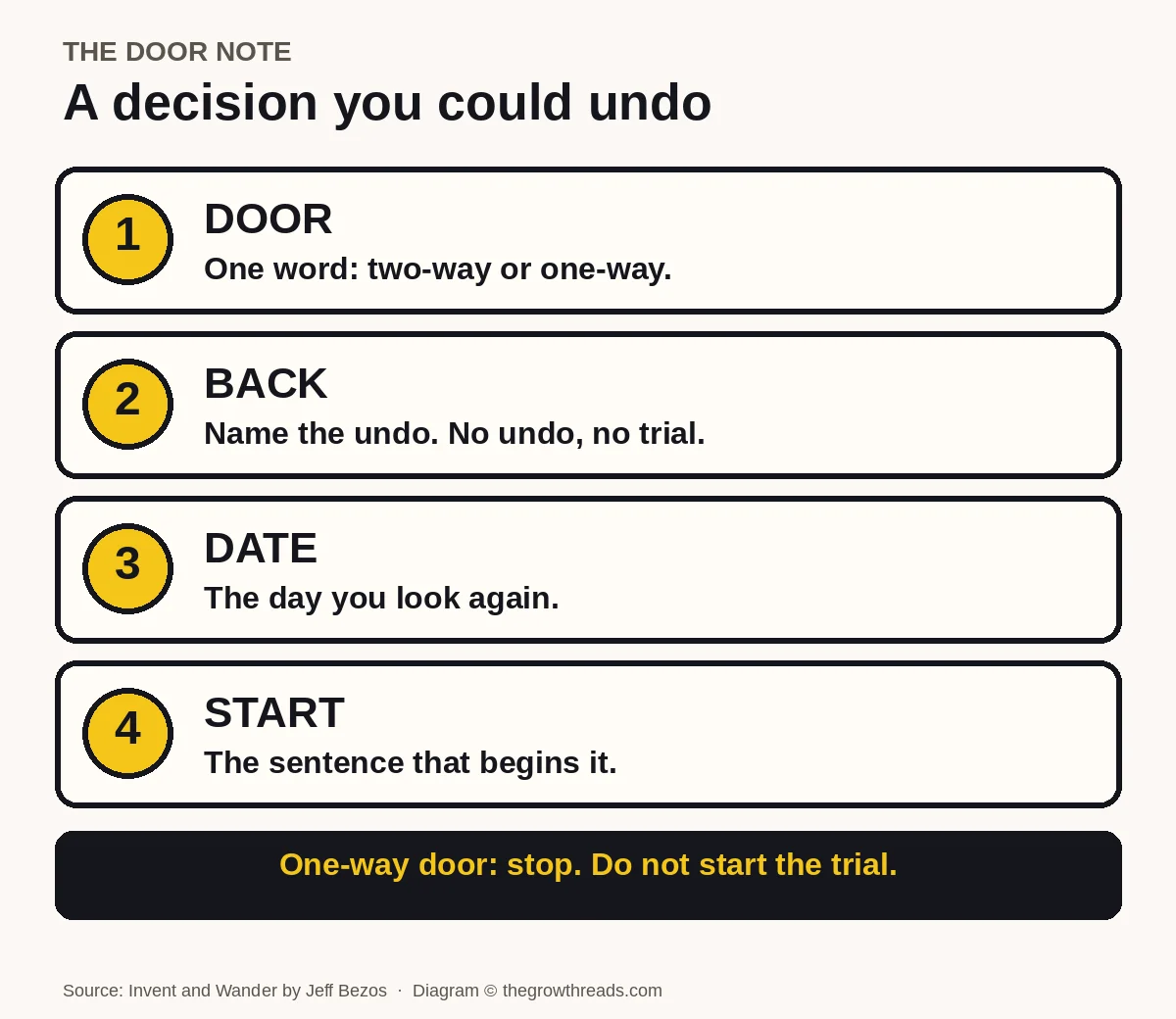
Invent and Wander collects those letters. The move here is ours, and it is smaller than Amazon: name the door, the way back, the date you look again, and the sentence that starts the trial. A one-way door stops the light process. The short version is a decision you could undo is still waiting.
Key takeaways
- Two-way door: Changeable and reversible. Most decisions, he says, should be made quickly by a high-judgment person or a small group.
- One-way door: Consequential and irreversible, or nearly so. Made slowly, with deliberation and consultation.
- Heavy process on a light door: Large organizations tend to use the Type 1 process on Type 2 decisions, and invention slows.
- The other mistake: Using the light process on Type 1 decisions, he writes, is how companies die before they get large.
- Around 70 percent: Most decisions, with somewhere around 70 percent of the information you wish you had. Not a score, and not for a one-way door.
- Disagree and commit: Say the disagreement, then commit, including if you are the boss. Add the date and the undo.
- Do not decide by exhaustion: If you want different outcomes, name the objective. More meetings are not a door.
- Four lines, then a date: Door, way back, look-again date, and the sentence that starts the trial. On the date, keep it or walk back.
What is Invent and Wander about?
Invent and Wander collects Jeff Bezos’s shareholder letters, speeches, and interviews, with an introduction by Walter Isaacson. For a founder stuck on a reversible choice, the useful part is the 2015 letter’s two kinds of doors and the 2016 letter’s rules for deciding faster.
Harvard Book Store lists ISBN 9781647820718 from Harvard Business Review Press on 17 November 2020, at 288 pages, co-published with PublicAffairs. Open Library lists 256 pages for the same ISBN. Amazon’s page for ISBN-10 1647820715 carries the full title. The print book was not opened, and no sentence here uses a page number. The 2015 letter is the investor PDF, including the 1997 letter at the end. The 2016 letter was read from the SEC exhibit and checked against aboutamazon.com, dated 17 April 2017, which credits Amazon Staff while the letter is signed by Bezos. The 2015 PDF is public. Speeches and interviews in the print book were not opened.
About the author
Jeffrey Preston Bezos, born in 1964, is the founder, executive chairman, and former president and CEO of Amazon. The 2015 and 2016 letters are signed while he was chief executive. In the 2016 letter he says he has reminded people it is Day 1 for a couple of decades, and that he took the name Day 1 with him when he moved buildings. Harvard Book Store describes this book as his own words on the principles behind Amazon and Blue Origin. Walter Isaacson wrote the introduction. Both letters are signed Jeffrey P. Bezos, Founder and Chief Executive Officer. This page reviews the letters, not that introduction. Explore all Jeff Bezos book summaries →
Key concepts at a glance
| Concept | What it means | Use it when |
|---|---|---|
| Two-way door | Changeable. You can reopen it. | You can name the undo. |
| One-way door | Irreversible, or nearly so. Made slowly. | You cannot get back. |
| One-size-fits-all | The heavy process used on a reversible call. | Every choice waits on another draft. |
| Around 70 percent | Most decisions, short of the information you wish you had. Not a score. | The door is already two-way. |
| Disagree and commit | Say the disagreement, then commit. The boss does this too. | No consensus, and the door swings back. |
| Escalation | Different objectives will not yield to more meetings. | You want different outcomes. |
| Jettison | The 1997 letter says to drop programs that do not return enough. | The look-again date arrives. |
Two kinds of doors
In the 2015 letter, one pitfall of a large company is one-size-fits-all decision making. Some decisions are consequential and irreversible, or nearly irreversible. Those are Type 1, one-way doors, and the slow process is on purpose. Most decisions are two-way doors. A suboptimal Type 2 decision does not have to be lived with for long, because you can reopen the door. Large organizations tend to put the heavy process on many Type 2 decisions. That is another draft and another night, while a choice you could undo sits still.
The footnote is the brake. He writes that companies which habitually use the light Type 2 process on Type 1 decisions go extinct before they get large, and he notes survivorship bias. A signed promise or a title you already announced is not a place to be casual. Name the door before you pick the speed.
The bet you can walk back
Bezos writes that failure and invention are inseparable twins. If you know in advance that something is going to work, it is not an experiment. Most large organizations like the idea of invention and will not suffer the failed experiments required to get there. He is specific about the odds. Given a ten percent chance of a 100 times payoff, you should take that bet every time, and you will still be wrong nine times out of ten. Baseball caps a swing at four runs. In business, he says, you can occasionally score 1,000, which is why big winners pay for many experiments.
He names AWS, Marketplace, and Prime as bets that worked, and Auctions and zShops as misses before Marketplace. You do not need a new city. You need one reversible trial: a higher price on the next three proposals, a two-week standup with one owner, or a tool you can cancel. If you cannot name the undo, the light process stays off.
TGR Note: Do not borrow the 100 times payoff as a forecast. A miss you can reopen is an experiment. The Effective Executive is for which decisions only you should make.
High-velocity decision making
The 2016 letter starts with a question from an all-hands: what does Day 2 look like? His answer is stasis, then irrelevance, then painful decline, then death, in extreme slow motion. A company might harvest Day 2 for decades. His starter pack is customer obsession, a skeptical view of proxies, the eager adoption of external trends, and high-velocity decision making. Day 2 companies, he says, make high-quality decisions slowly. Day 1 has to do both. He offers four thoughts.
First, never use one process for every decision. Many decisions are reversible two-way doors and can use a light-weight process. He asks, so what if you are wrong, and points to the prior letter. The light process assumes you can correct the call. If you cannot, you are not in this paragraph.
Second, most decisions should probably be made with somewhere around 70 percent of the information you wish you had. “If you wait for 90%, in most cases, you’re probably being slow.” You still have to recognize and correct a bad decision. Being slow, he says, is going to be expensive for sure. He does not define the percent. Write the one fact you wish you had. If it would not change the way back, the wait is the slowness he calls expensive. If the fact is whether you can undo the choice, you do not have a two-way door yet.
Third, disagree and commit. If you have conviction and no consensus, ask whether the other person will gamble with you on it. The boss owes the same move. On an Amazon Studios original he stated his doubts and wrote back at once that he disagreed and committed. He says that was a real disagreement, not a private dismissal. If you disagree and the door is two-way, commit until a date, with the undo written down.
Fourth, escalate real misalignment. Different objectives will not be solved by more meetings. Without escalation, stamina decides, and he calls that an awful process. His scene is letting third-party sellers compete on Amazon’s own pages. If you and one other person want different outcomes, say which objective is in force. The sentence is the escalation.
TGR Note: Decisive is a different decision book. The two scripts, including the one-way stop, are on the decision that is still waiting.
Day 1, and the date you look again
Both letters attach the 1997 letter and say it is still Day 1. In 1997 he tells shareholders he will measure programs, jettison those that do not provide acceptable returns, step up the ones that work, and learn from success and failure. He will make bold rather than timid investments where he sees a sufficient probability of a market-leadership advantage. Some will not pay off. That is still a lesson.
The jettison line is the look-again date for a company that does not write a shareholder letter. On that date the question is the one you already wrote: keep the trial, or walk back. A new research question that morning is the heavy process returning. Put the date on a calendar you will open. A note you never open is a decision still in your head.
He also warns that process can become the thing, so a bad outcome gets defended because the steps were followed. In a one-person company that committee is three friends and a rewritten page. If you can walk back, the speed is this week. He asks whether you have settled only for decision quality, or whether you are mindful of velocity too. If the door swings back, start. If it does not, do the slower work on purpose.
TGR Note: Working Backwards is for after the trial is chosen. The letters are the prior step: whether this decision deserves a trial at all.
Who is Invent and Wander best for — and who should read something else first?
Read this if you are a solo founder or a new manager and a reversible decision is still in your head. The test does not need an offsite. Can you get back to where you were? If yes, write the way back and start. If no, keep the slow process.
Read something else first if the door is not the problem. If people nodded and the work came back as a different job, start with The Art of Action and ask for a backbrief. If the same kind of ask keeps returning, start with An Elegant Puzzle and decide whether to close it, solve the category, or hand it on. If you want Amazon’s working system rather than Bezos’s letters, read Working Backwards. If the issue is which decisions you should stop making yourself, read The Effective Executive. The pillar list of productivity book summaries is the wider shelf.
Questions to reflect on
- Which decision on your list could you undo, and what is the undo in one sentence?
- Which decision cannot be undone, and who still needs to be consulted before you move?
- What fact are you waiting to learn, and would that fact change the way back?
- If you disagree with the person who has to live with this, will you commit to their version until a date, or do you want different outcomes?
- On the look-again date, if the trial is mediocre, will you keep it, walk back, or open a new question?
🔥 Ready to start the door you can undo?
Read the letters, then write the way back before the week ends.
How to apply Invent and Wander (7-day plan)
- Day 1 — List decisions, not themes. One line each. “Try the higher price on the next three proposals” is a decision. “Fix how we charge” is a theme.
- Day 2 — Name the door. Mark each line one-way or two-way. If you cannot say which, it is not ready.
- Day 3 — Write the way back. Name the undo: the old price, the old agenda, or the tool you cancel. No undo means no trial.
- Day 4 — Calendar the date. On a two-way door, that is the day you keep it or walk back. On a one-way door, it is the slower check, not a start.
- Day 5 — Send the sentence. This is a two-way door. We try the trial until the date. The way back is the undo. On that date we keep it or we walk back.
- Day 6 — Stop a one-way door. Say you are not starting a trial, name the slower check, and name the date of that check.
- Day 7 — Disagree, or name the objective. If the door is two-way, disagree and commit until the date, with the undo written down. If you want different outcomes, say which objective is in force.
Frequently asked questions
What is Invent and Wander?
Invent and Wander collects Jeff Bezos’s shareholder letters, speeches, and interviews, with an introduction by Walter Isaacson. Harvard Book Store lists ISBN 9781647820718 from Harvard Business Review Press on 17 November 2020, at 288 pages, co-published with PublicAffairs. Open Library lists the same ISBN as a hardcover of that date with 256 pages. This review does not open the print book and uses no page number. The copy read in full is the 2015 letter, including the 1997 letter attached to it, and the 2016 letter.
What does Jeff Bezos mean by a two-way door?
In the 2015 letter Bezos says most decisions are changeable and reversible. He calls them two-way doors, and also Type 2. If you made a suboptimal Type 2 decision, you do not have to live with the consequences for long, because you can reopen the door and go back through. He says those decisions can and should be made quickly by high-judgment individuals or small groups. For a founder, that speed is a named trial with a way back and a date. If you cannot name the undo, you do not have a two-way door yet, and the light process stays off.
What is a one-way door, and when should you slow down?
Bezos calls some decisions consequential and irreversible, or nearly irreversible. Those are one-way doors, Type 1. If you walk through and dislike the other side, you cannot get back to where you were. He says they must be made methodically, carefully, slowly, with great deliberation and consultation. A footnote adds that companies which habitually use the light Type 2 process on Type 1 decisions go extinct before they get large, and he notes survivorship bias. A signed price, a title already announced, or any promise you cannot take back belongs in that slower lane.
Did Bezos say to decide with 70 percent of the information?
In the 2016 letter he writes that most decisions should probably be made with somewhere around 70 percent of the information you wish you had. If you wait for 90 percent, in most cases you are being slow. He says you must recognize and correct bad decisions, and that being slow is going to be expensive for sure. He does not define 70 percent as a score, and he does not put the line on a one-way door. Use it only after the door is two-way and the way back is named. If the missing fact is whether you can undo the choice, you do not have a door yet.
What does disagree and commit ask you to do?
In the 2016 letter Bezos says the phrase saves time when you have conviction and there is no consensus. He suggests asking if the other person will gamble with you on it, since no one can know for sure. The boss should do this too. On an Amazon Studios original he stated his doubts, the team wanted to proceed, and he wrote back at once that he disagreed and committed. He calls that a real disagreement and a quick commitment, not a private dismissal. On a small team, put the date and the undo in the same sentence.
Is Invent and Wander the same book as Working Backwards?
No. Invent and Wander is Bezos’s collected writings: the shareholder letters, plus speeches and interviews, with Isaacson’s introduction. Working Backwards is a different book, by Colin Bryar and Bill Carr, about operating habits inside Amazon. Our Working Backwards summary is a separate review and a different slug. Read Invent and Wander, or the two letters this page uses, when the problem is a reversible decision you have not started. Read Working Backwards when you want the working system around a bet you have already chosen to run. The letters tell you which process a door deserves. They do not hand you a press-release template.
How do you start a decision you could undo this week?
Write one decision, not a theme. Mark it two-way only if you can name the undo, and put the look-again date on the calendar first. Send one sentence with the trial, the way back, and the date you keep it or walk back. If the door is one-way, do not start a trial. Name the slower check and its date. If you disagree and the door is still two-way, commit until that date with the undo written down. If you want different outcomes, say which objective is in force.
Related summaries
- Working Backwards summary — the operators’ book about how Amazon runs a bet, not Bezos’s letters.
- Decisive summary — a different decision book, for when you want a wider set of tools.
- The Effective Executive summary — which decisions stay with you, and which you stop making.
- A decision you could undo is still waiting — the door note, written for this morning’s problem.
- Best productivity books — the shelf this summary joins.
How we analyze books: we read a checkable copy, paraphrase the argument, and add a way to use it the same week. For this review the copy was the 2015 shareholder letter, including the attached 1997 letter, and the 2016 shareholder letter. The print book was not opened, and no page number is used. Read our full methodology.