

★★★★½ 4.5/5 — A 30-day lab for changing your relationship with your phone. Not a monk vow. A protocol you can finish.
Best for: people who pick up the phone without meaning to and want a sequenced plan, not another essay about willpower.
Reading time: ~4 hours (184 pages) · this guide ~12 min
Difficulty to apply: Easy to start (notifications, grayscale, bedroom). Medium to keep — the hard part is filling the gaps with real life.
How to Break Up with Your Phone in one minute
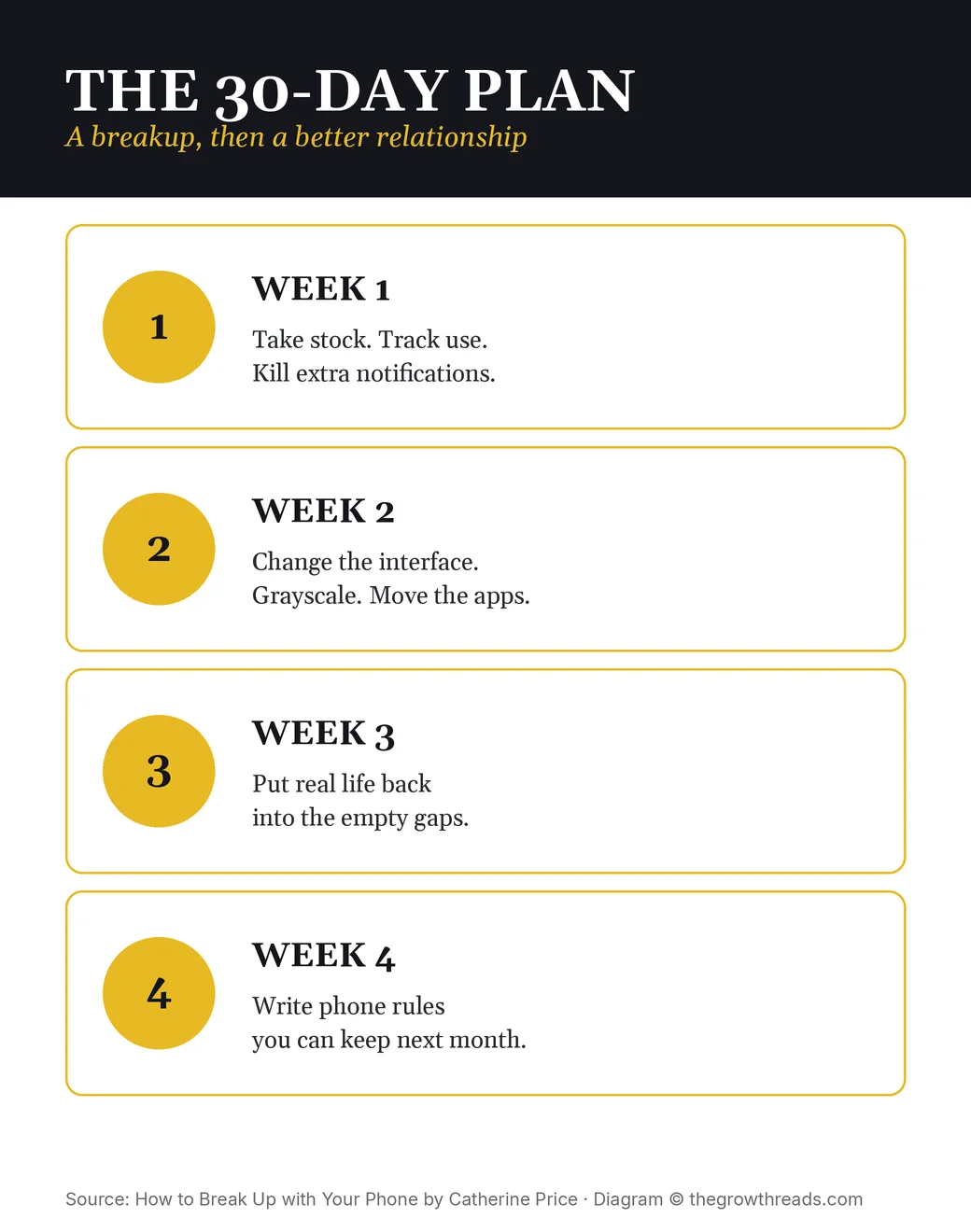
Your phone is not a neutral tool you happen to overuse. It is a slot machine in your pocket. Catherine Price’s 2018 book is a reporter’s 30-day experiment in changing that relationship without throwing the device in a lake. Part one is the wake-up: variable rewards, social pings, bottomless feeds, and the downtime you lose when every spare minute gets filled. Part two is the breakup — four weeks of tracking, stripping notifications, changing the interface, then putting actual life back in the gaps. The goal is not a monastery. It is a phone you pick up on purpose.
Key takeaways
- Breakup, not divorce: Keep the tool. Change the relationship. Maps and messages stay. The slot machine does not get your idle minutes.
- The product worked: You did not fail at willpower. Variable rewards, badges, and infinite scroll are designed to be hard to put down.
- Downtime is the point: Idle minutes are when memory consolidates, ideas show up, and you notice how you feel. Filling them is the cost.
- Track before you purge: Week one is observation. Screenshot, screen time, and a notification pass beat a dramatic app massacre on day one.
- Change the interface: Grayscale, a tools-only home screen, and charging outside the bedroom add friction where motivation fails.
- Fill the gaps: If you only subtract apps, the thumb finds a new feed. Week three puts a walk, a person, or a hobby in the empty slot.
- Write phone values: Week four is rules you can keep in month two — not a streak on a tracker.
- Relapse is data: A missed evening tells you the cue. Restart the next action, not your identity.
- Presence is a practice: Conversations, meals, and sleep improve when the device is in another room, not on the table face-down.
What is How to Break Up with Your Phone about?
How to Break Up with Your Phone is Catherine Price’s 2018 30-day plan for taking your life back from a smartphone without quitting it. She shows why phones hook like slot machines, what filling every gap costs you, then walks four weeks: track, change the interface, reclaim downtime, and write keepable rules.
About the author
Catherine Price is a science journalist who has written for The New York Times, The Washington Post, the Los Angeles Times, and Popular Science. Her 2015 book Vitamania investigated the vitamin industry with the same reporter’s habit: follow the claim until the mechanism shows up. How to Break Up with Your Phone (Ten Speed Press, 2018) started as a personal experiment. She could not sit through a meal or a conversation without reaching for the device, then designed a 30-day protocol and tested it on herself and volunteers. She later wrote The Power of Fun. She is not a monk. She is a journalist who ran a lab on her own thumb — a sequenced month, not a sermon. Explore all Catherine Price book summaries →
Key concepts at a glance
| Concept | What it means | Use it when |
|---|---|---|
| Slot-machine design | Variable rewards, badges, and infinite scroll make stopping feel unnatural. | You blame willpower for a product that is working as designed. |
| Downtime | Unfilled minutes are when the mind wanders, consolidates, and feels. | Every spare moment already has a feed in it. |
| Trial separation | A 30-day change of relationship, not a forever ban. | You want a protocol with an end date, not a new identity. |
| Notification hygiene | Most badges are marketing. Humans can wait in the app. | Your lock screen is a to-do list written by other companies. |
| Interface friction | Grayscale, buried apps, tools-only home screen. | You open social video before you notice you meant to check the weather. |
| Bedroom charging | The phone sleeps in another room. You use a real alarm. | The last and first thing you see is a glowing rectangle. |
| Fill the gaps | Replace subtracted scrolling with a chosen activity. | You deleted apps and still feel itchy at 9:40pm. |
| Phone values | Written rules for what the device is for after day 30. | The month ended and the old home screen is creeping back. |
Part 1: The wake-up — why the phone feels magnetic
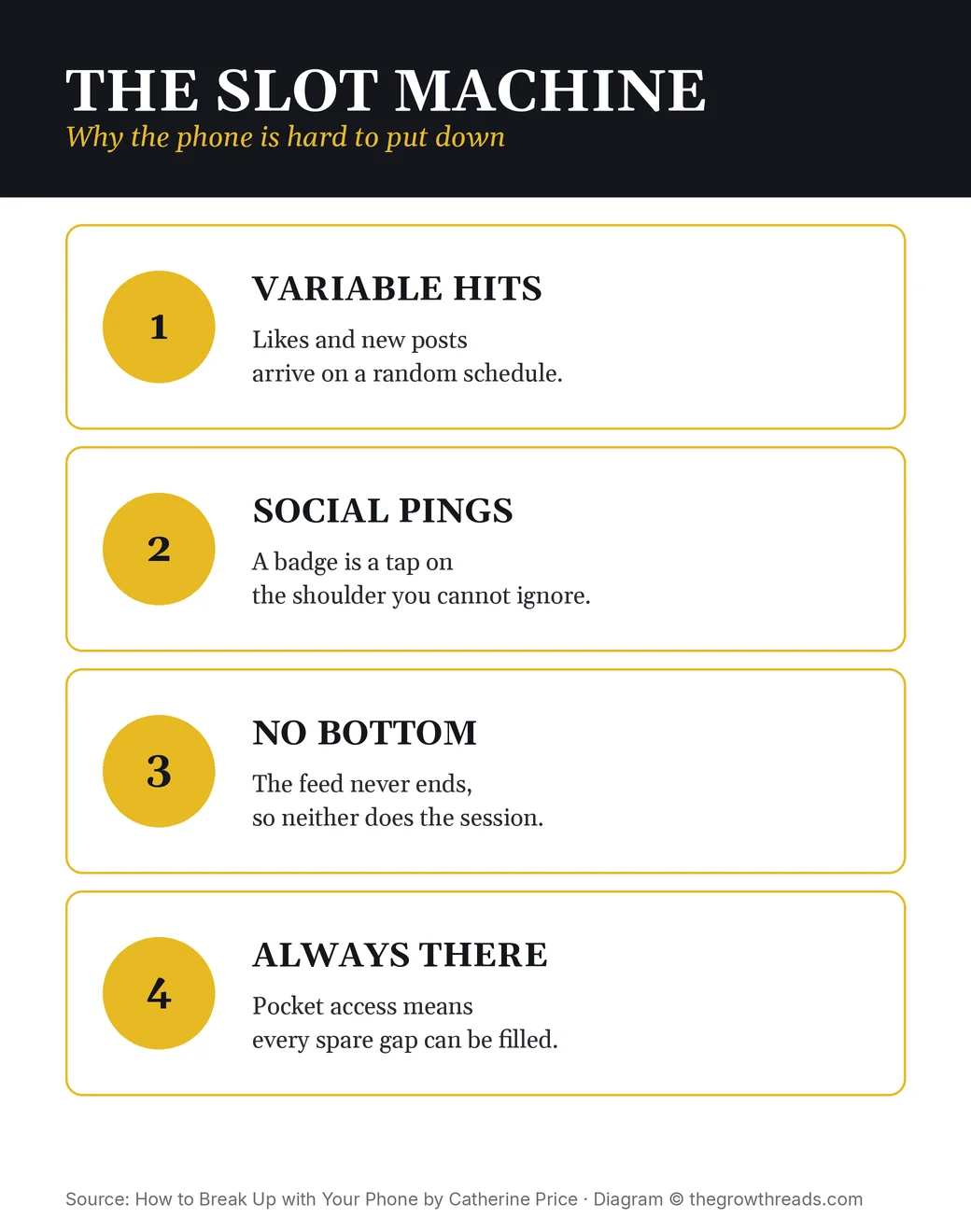
Price starts with a relief, not a scolding. If you reach for the phone at a red light, in bed, or in the two minutes before a meeting, you are not uniquely weak. You are using a product whose business model is time. Slot machines pay on a variable schedule. So do likes, new posts, and “one more” videos. You cannot predict which tap will feel good, so you keep tapping. That is the same reinforcement logic casinos refined, applied to a rectangle that never has to let you walk away.
Three other hooks pile on. Social pings — badges, names, the sense someone is waiting — are a tap on the shoulder you were not using. Bottomless feeds remove the end of the session; there is no last page. And the device is always there, which means every gap is available: the kettle, the toilet, the elevator, the child in the other room. Price wants you to see the stack clearly before you change a setting. Shame is a bad designer. Mechanism is a good one. Once you can name variable rewards, you stop arguing with your character and start arguing with the home screen.
TGR Note: If you want the industry and childhood-attention layer after this wake-up, Stolen Focus is the reported companion. If you want the philosophy of which tools deserve a place at all, Digital Minimalism is the value audit. Price is the weekday protocol. Read her when you already agree the phone is a problem and need the next thirty days, not another diagnosis.
Part 2: What filling every gap costs you
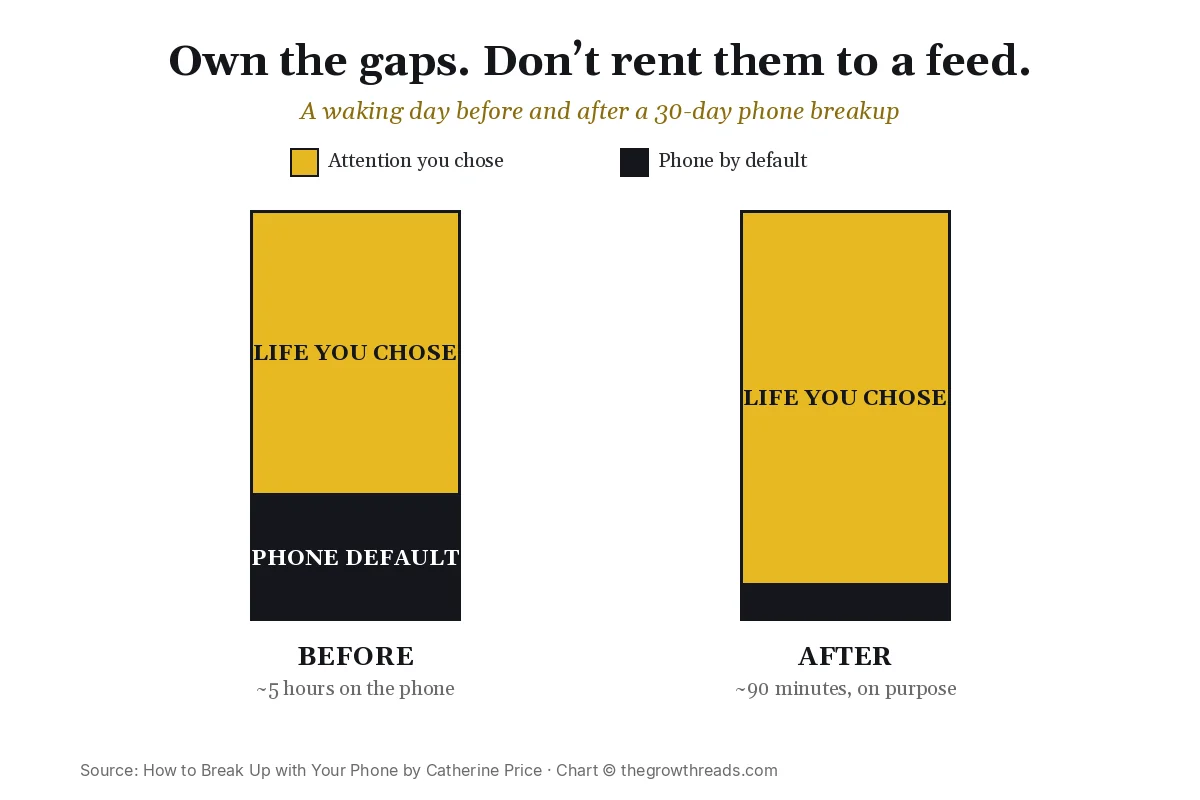
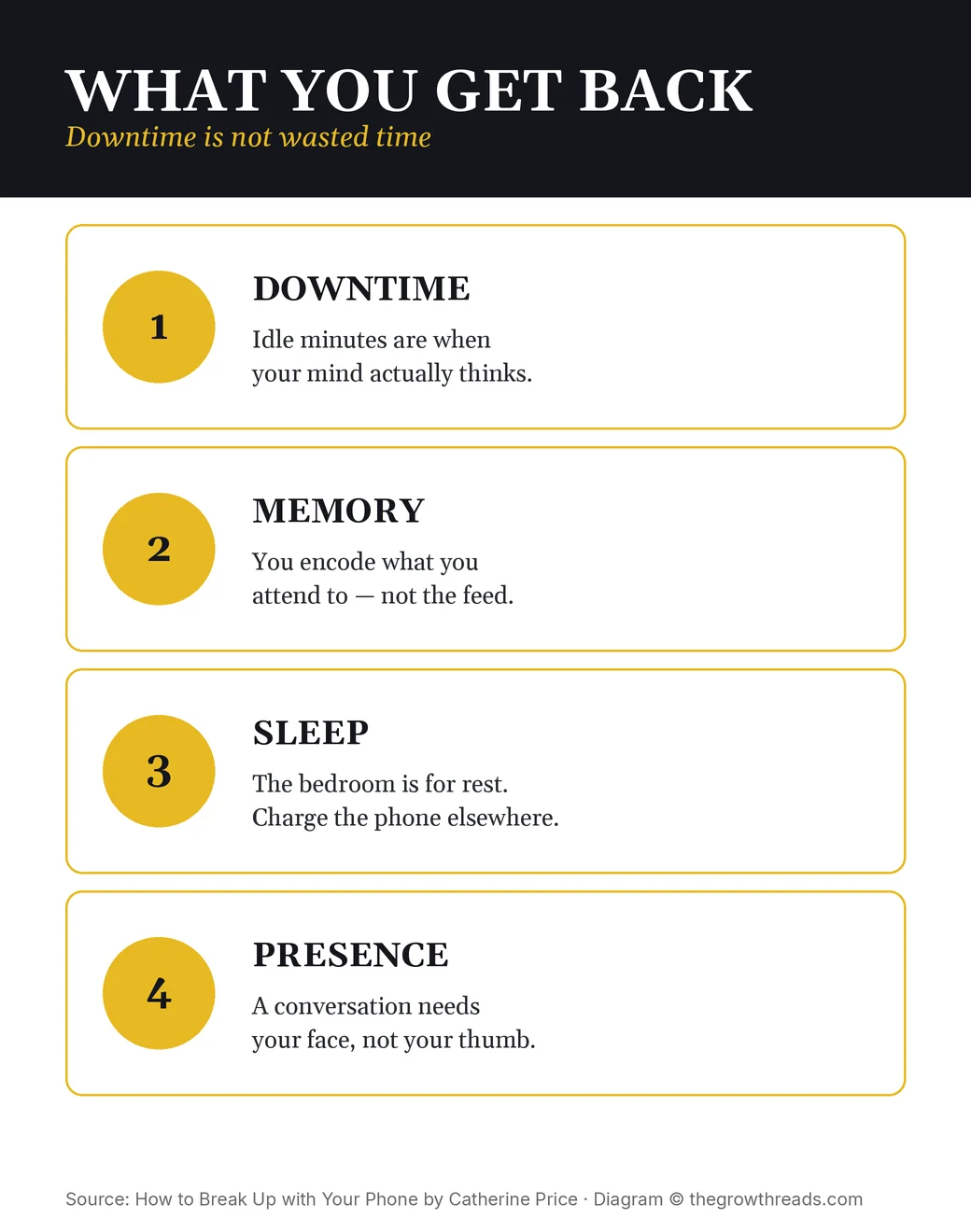
The hidden invoice is downtime. Price’s most useful claim is not that phones steal hours — you already know the screen-time number. It is that they steal the minutes between hours: the walk to the store, the wait, the pause after a hard conversation. Those gaps are where memory consolidates, where you notice you are lonely or hungry or angry, and where a half-formed idea is allowed to finish. When every gap is rented to a feed, you get a life that is fully occupied and oddly thin. You were there. You also were not.
The rest of the cost list is familiar on purpose: sleep chopped by a glowing bedroom, conversations split by “just checking,” meals you cannot taste because part of you is in a thread. Face-down on the table still wins. Presence needs the device in another room. Price also ties attention to memory: you encode what you attend to. A day of half-attention will not be there when you try to recall it. That is why the 30-day plan treats boredom as a feature. If you never feel bored, you never give the mind the unfilled minute it uses to think.
TGR Note: For the attention-as-muscle half of the same problem, Focus (Daniel Goleman) and Deep Work tell you what to do with the hours Price frees. Make Time is the daily-design sibling: highlight, laser, energize. Price gets the phone off the nightstand. Those books spend the morning.
Part 3: Trial separation — weeks 1 and 2 of the 30-day plan
Part two of the book is the lab. Price does not start with a desert island. Week one is taking stock. Screenshot the home screen so you remember what “normal” looked like. Turn on tracking so the argument is a number, not a mood. Walk through notifications and keep the humans. Disable the rest. Charge the phone outside the bedroom. Notice the physical cue — the phantom buzz, the hand already in the pocket — without immediately solving it. The point of week one is to see the relationship clearly while it is still the old one.
Week two changes the environment. Grayscale removes the candy. Social feeds come off the home screen or off the phone. What remains on page one should look like a toolbox: maps, camera, calendar, the messenger you actually use. App limits and physical distance (phone in a drawer while you work, in the kitchen while you eat) add the friction willpower never supplied. This is environment design, the same instinct as putting running shoes by the door. You are not becoming a better person in week two. You are making the slot machine uglier and farther away. That is enough for a lot of people to notice they were not choosing the last forty taps.
TGR Note: If the hook is an internal itch — anxiety, boredom, a feeling you are escaping — pair week two with Indistractable. Nir Eyal works the cue from the inside; Price works the table, the charger, and the home screen. Atomic Habits is the environment-design cousin: make the old tap invisible, the new one obvious. Do not run all three as a personality overhaul. Run Price’s month. Steal one lever from the others.
Part 4: A new relationship — weeks 3 and 4, then the rules you keep
Week three is the part people skip, and the part that makes the month stick. You have subtracted. Now you add. Walks without earbuds. A book on the table where the phone was. A call instead of a like. A hobby you abandoned because you were “so busy” while also somehow scrolling. Price is blunt: the thumb will fill a vacuum. If the vacuum is still there on day 18, a new app will apply for the job. Reclaiming your life is not a mood. It is a calendar of things that are not a rectangle.
Week four writes the new relationship down. What is the phone for. Where does it sleep. Which apps are tools. Which are slot machines you will open only at a desk, or on Wi-Fi, or after dinner, or not on weekdays. The rules have to survive a normal Tuesday, including a job that texts you. That is why Price frames this as a breakup you can live with, not a purity score. Relapse gets treated as a note: which cue, which app, which hour. Then you do the next action. After day 30, keep the five rules that still earn their place and drop the theater. The test is week five, when nobody is counting. If the bedroom is still phone-free and the home screen still looks like a toolbox, the relationship changed. That was the product.
Who is How to Break Up with Your Phone best for — and who should read something else first?
Best for people who already know they overuse the phone and want a month with steps, not a new worldview. Knowledge workers who “just check” between tasks. Parents who hate that they phub at dinner. Anyone who has read the essays and still wakes up inside an app. If you like experiments, Price’s reporter tone will feel like a lab notebook rather than a guru.
Read something else first if you want the philosophy of attention before a checklist — start with Digital Minimalism. If the real problem is an inner itch, start with Indistractable. If you want the system that manufactures distraction, Stolen Focus. If the phone is already quiet and you need long thinking blocks, Deep Work. Come back to Price when you are ready to run thirty days on the device itself.
Questions to reflect on
- What do I want the phone FOR — in one sentence — and which apps on the home screen do not belong to that sentence?
- When I feel the phantom buzz, what am I actually avoiding: boredom, a hard task, a feeling, a person in the room?
- Where does the phone sleep, and what would change if it could not reach the pillow?
- Which gap in my day (kettle, commute, bed, meal) is currently rented to a feed, and what would I put there instead?
- If I kept only five phone rules next month, which five would still be true on a messy Tuesday?
🔥 Ready to take the gaps in your day back?
Run the 30-day plan. Keep the tool. Stop renting every spare minute to a slot machine.
How to apply How to Break Up with Your Phone (7-day plan)
- Day 1 — Screenshot your home screen and turn on screen-time tracking. Write one sentence: what you want the phone FOR (maps, messages, camera) versus what it currently does. Do not delete anything yet.
- Day 2 — Notification pass. Turn off badges and alerts for anything that is not a human who might need you today. Leave phone, messages, calendar. Everything else can wait in the app.
- Day 3 — Charge the phone outside the bedroom. Buy or dust off a $10 alarm clock. Put the device to bed in the kitchen before you put yourself to bed.
- Day 4 — Change the interface. Grayscale on. Social video and feeds off the home screen (folder on the last page, or deleted). Home screen is tools only.
- Day 5 — One phone-free block: a meal, a walk, or a 30-minute conversation with the device in another room. Notice the itch without solving it with a tap.
- Day 6 — Fill one former-scroll slot with a real activity you already like (book, stretch, call, puzzle, kitchen). The gap will be filled by something. Pick it.
- Day 7 — Write five phone rules you will still keep next month. Put them on paper, not in a notes app. Schedule a 20-minute review seven days from now.
Frequently asked questions
Do I have to quit my smartphone to follow How to Break Up with Your Phone?
No. This is a breakup, not a divorce. You still need maps, messages, and a camera. The 30-day plan is a trial separation so you can see what the phone is for versus what it has become. Week one is observation and notification cuts. Later weeks change the home screen, grayscale, and where it sleeps. The end state is a tool you pick up on purpose. If your job requires a phone, keep the work apps and run the rest of the protocol on everything that is not the job.
How is How to Break Up with Your Phone different from Digital Minimalism?
Cal Newport’s Digital Minimalism is a philosophy: decide which tools serve your values, then operate on those terms. Price is a 30-day lab. She assumes you already know the phone is a problem and need a sequenced protocol — track, strip pings, change the interface, then fill the gaps. Read Newport for the why. Read Price for the weekday checklist: grayscale, bedroom charger, home-screen reset. They stack. Philosophy without a protocol stalls; a protocol without values becomes another diet.
Does grayscale actually help, or is it a gimmick?
Grayscale is friction, not magic. Color helps apps sell the next tap — red badges, saturated video, a new thumbnail. Grey makes the slot machine less pretty, which is often enough to break an automatic reach. Price uses it as one week-two lever, next to burying social apps and charging outside the bedroom. If grayscale alone does nothing, the hook is the habit loop, not only the candy colors. Keep the lever that worked. Drop the one that did not.
What if my job requires Slack, email, and a phone all day?
Then you do not pretend to be a monk. Separate work tools from slot-machine tools. Keep calendar, maps, authentication, and the messenger your job actually uses. Bury the apps that turn a two-minute check into twenty. Week one’s notification pass is built for this: most badges are marketing, not work. Charge outside the bedroom even if you are on call — use a cheap alarm. Take one meal or walk without it. The plan fits a job. It does not fit filling every spare thirty seconds.
How long until I notice a difference?
Many people feel the itch in the first 48 hours — that is week one working, not a failure. Sleep often improves once the phone leaves the pillow. Conversations get easier with the device in another room. The bigger shift is week three, when you put something in the gaps: a walk, a book, a person. If you only delete apps, the thumb finds a new feed. Give the month the whole month. Then keep the five rules that still earn their place.
What if I fall off on day four?
Start the day you are in. A missed evening is data: which cue, which app, which mood. Write it down. Then do the next listed action — not a restart-from-zero ceremony. Relapse-as-identity is how diets die; relapse-as-note is how a 30-day lab works. If a rule is too strict for your actual life, rewrite it. The win is a relationship you can keep in week five, not a perfect streak on a tracker.
What should I read after How to Break Up with Your Phone?
If you want the philosophy of attention, read Digital Minimalism. If the problem is an internal itch — boredom, anxiety — Indistractable is the next lab. For the industry layer, Stolen Focus. If the phone is already quieter and you need long thinking blocks, Deep Work. If replacement habits need to stick, Atomic Habits. Stay in this silo. Give Price the month first, then pick the sibling that matches whatever is still in the way.
Related summaries
- Digital Minimalism — the value audit; Price is the 30-day lab.
- Indistractable — internal triggers when the home screen is already clean.
- Stolen Focus — why attention is under siege beyond your willpower.
- Deep Work — what to do with the hours the breakup returns.
- Best productivity books — the full Productivity silo, ranked and compared.
How we analyze books: every book on The Growth Reads is read cover to cover, summarized in thousands of words of original analysis, and rated against our five-criteria rubric (lasting impact, evidence quality, practical application, writing & originality, external consensus). Read our full methodology.