

★★★★½ 4.5/5 — the map for work that a script cannot copy.
Best for: Knowledge workers whose week can be written as a checklist — and makers who need language to defend design, story, and care
Reading time: ~7 hours (272 pages) · this guide ~12 min
Difficulty to apply: Easy to name the six senses — harder to put one on tomorrow’s calendar
A Whole New Mind in one minute
If your job can be written as a spec, someone cheaper — or some software — can run the spec. Daniel H. Pink’s A Whole New Mind (Riverhead, 2005) is the career map after the Information Age. L-Directed skills still get you in the door. They no longer keep you in the room. Abundance, Asia, and automation make sequential knowledge work cheap. What holds value is high concept plus high touch: invention, story, symphony, empathy, play, and meaning. This summary is the application layer — six senses as drills, not a personality test, and a 7-day plan on a job you already have.
Key takeaways
- The Conceptual Age is already here: Calculating the answer is table stakes. Framing a problem people care about is the scarce skill.
- Three forces flatten scripted work: Abundance, Asia, and automation. If a week is a checklist, price it like a checklist.
- L-Directed still matters: Logic and sequence get you hired. They are no longer a moat.
- High concept + high touch: Invent and combine; then care, empathize, and play. One without the other is a stunt or a hug.
- Six senses, not a vibe: Design, Story, Symphony, Empathy, Play, Meaning — each is a practice you can put on a calendar.
- Design is function people keep: Utility that looks like a file folder loses to utility someone wants to live with.
- Story beats a stack of facts: People remember a narrative with a person in it. They forget the slide with fourteen bullets.
- Symphony is the whole: Specialists still need someone who sees how the pieces fit — and what is missing.
- Empathy and play are production tools: Not extras after the “real work.” They notice what the metric cannot see.
- Meaning is the long game: Stuff is abundant. Purpose is not. Build the week so it is about more than the pile.
What is A Whole New Mind about?
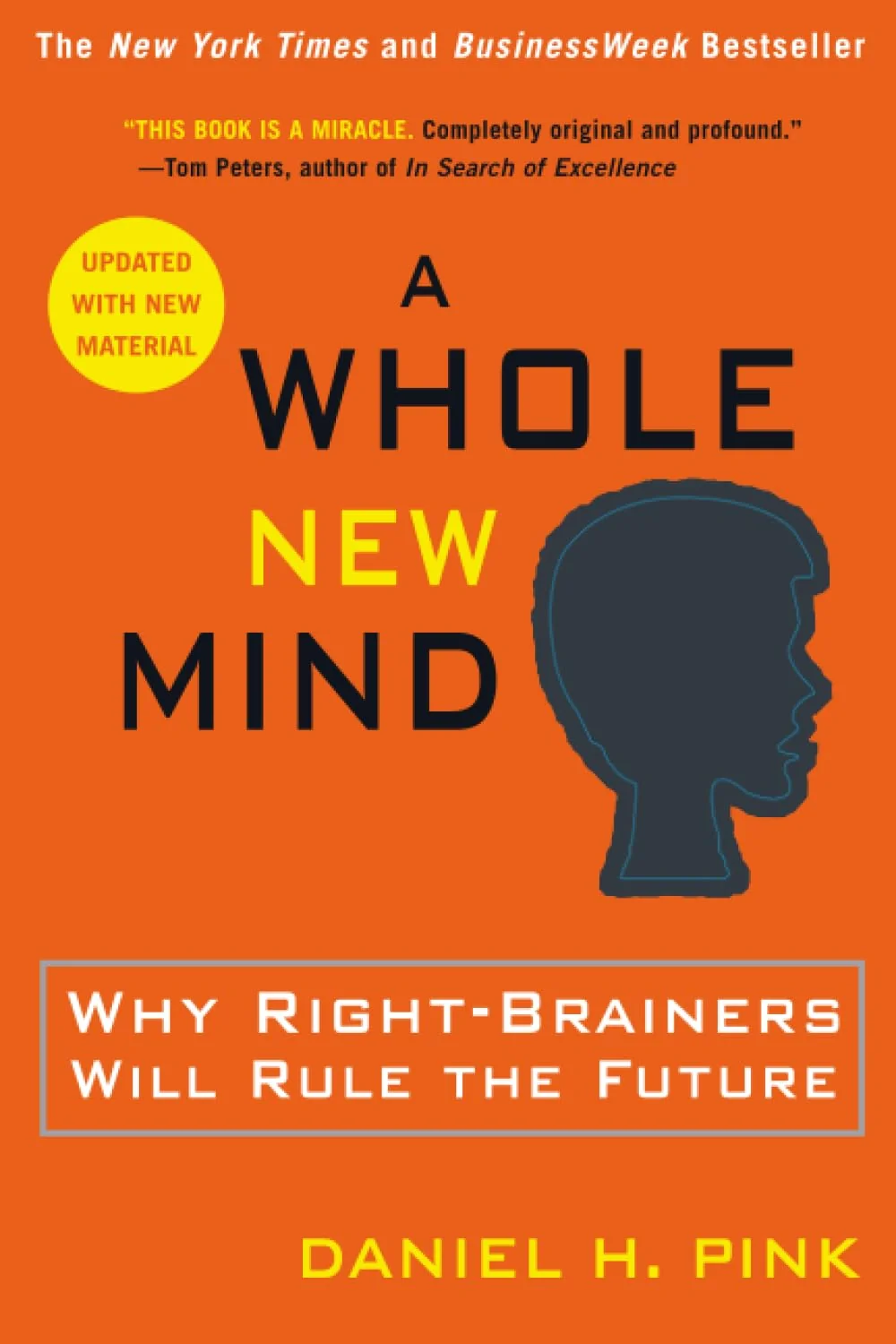
A Whole New Mind argues that right-brain aptitudes — design, story, symphony, empathy, play, and meaning — are now career insurance, because left-brain knowledge work can be offshored, automated, or drowned in abundance. Pink shows how to practice those six senses at work, not just admire them.
About the author
Daniel H. Pink was born in 1964, trained as a lawyer at Yale, and never practiced. He wrote speeches in the Clinton White House, including for Vice President Al Gore, then left politics to write about how work actually feels. Free Agent Nation (2001) named the shift away from the organization man. A Whole New Mind (2005) was the breakout: a New York Times bestseller that gave managers a vocabulary for “soft” skills they could no longer treat as decoration. Later books — Drive, When, The Power of Regret — keep the same move: a finding you can use on Tuesday. Read him when you want a map you can walk, not a theory you can quote. Explore all Daniel H. Pink book summaries →
Key concepts at a glance
| Concept | What it means | Use it when |
|---|---|---|
| Conceptual Age | After information: inventors, empathizers, meaning-makers win | Your “knowledge work” is a script someone else can follow |
| L-Directed / R-Directed | Sequential analysis vs. simultaneous, contextual, big-picture thought | The room only rewards the spreadsheet |
| Abundance, Asia, Automation | Three forces that make routine knowledge cheap | You cannot name why a client would miss you |
| High concept | Invent, combine, tell, detect pattern | The deliverable is correct and lifeless |
| High touch | Empathy, care, human presence, play | People comply and do not stay |
| Six senses | Design, Story, Symphony, Empathy, Play, Meaning | You need a practice, not a personality label |
| MFA as the new MBA | Aesthetic and narrative literacy as management skill | The MBA toolkit still cannot explain why the product feels cheap |
| Design | Utility plus significance — something people keep | The file works and nobody wants it |
Part 1: The Conceptual Age — abundance, Asia, automation
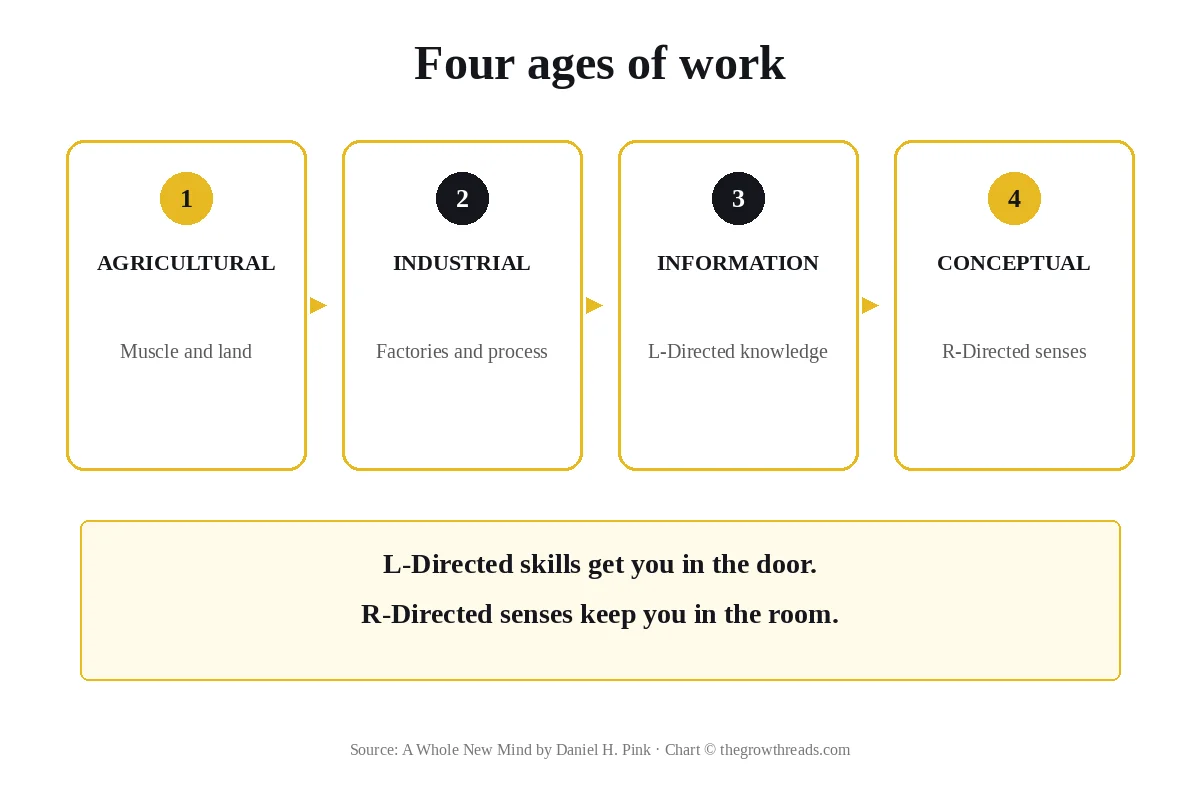
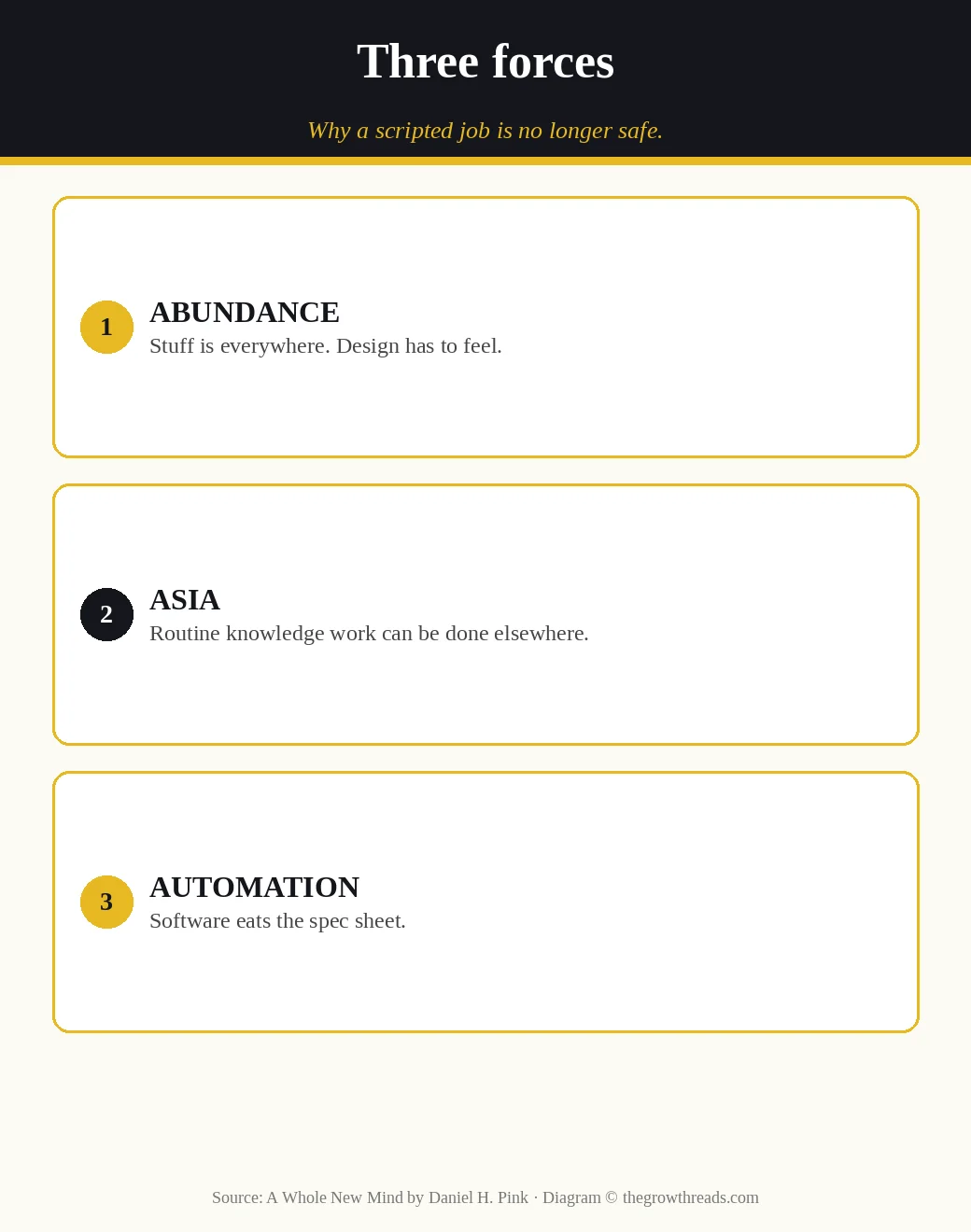
Pink’s first move is a history of work in four rooms. Agricultural work asked for muscle. Industrial work asked for process. Information work asked for L-Directed knowledge: lawyers, accountants, analysts who could take a problem apart in sequence. Those skills were scarce. Then three forces showed up at once.
Abundance. When goods are scarce, function is enough. When every aisle is full, people choose what feels designed. “It works” is now the floor. If your output is interchangeable, the buyer has a hundred other floors.
Asia. In 2005 Pink was writing the offshoring wave: routine knowledge work moving to cheaper offices that could follow the same spec. Some travelogues have dated. The mechanism has not. If the valuable part of your week is a procedure, the procedure will find a lower price.
Automation. Software eats the spec sheet. Pink was already watching tax software nibble at credentialed jobs. Twenty years later the nibble is a bite. The useful question is still: what remains when the calculation is free?
Pink does not throw L-Directed skill in the bin. You still need to count, code, and argue in order. Those skills get you the interview. They are no longer a career. The people who stay will add what a script cannot copy. That is the door into high concept and high touch.
TGR Note: If the thing flattening your week is not offshoring but a clock you never chose, our When summary is later Pink — timing science, not labor-market maps. Read A Whole New Mind to name which abilities to practice. Read When to name which hour to practice them. Do not collect both as permission to skip Day 1.
Part 2: High concept, high touch — and the MFA in the room
High concept, in Pink’s usage, is the ability to invent, combine, tell, and detect pattern. High touch is empathy, care, and a stretch toward purpose. He wants both in the same person, or at least on the same team. A brilliant gadget nobody loves is a warehouse. A warm service with no invention is a smile on a dying product.
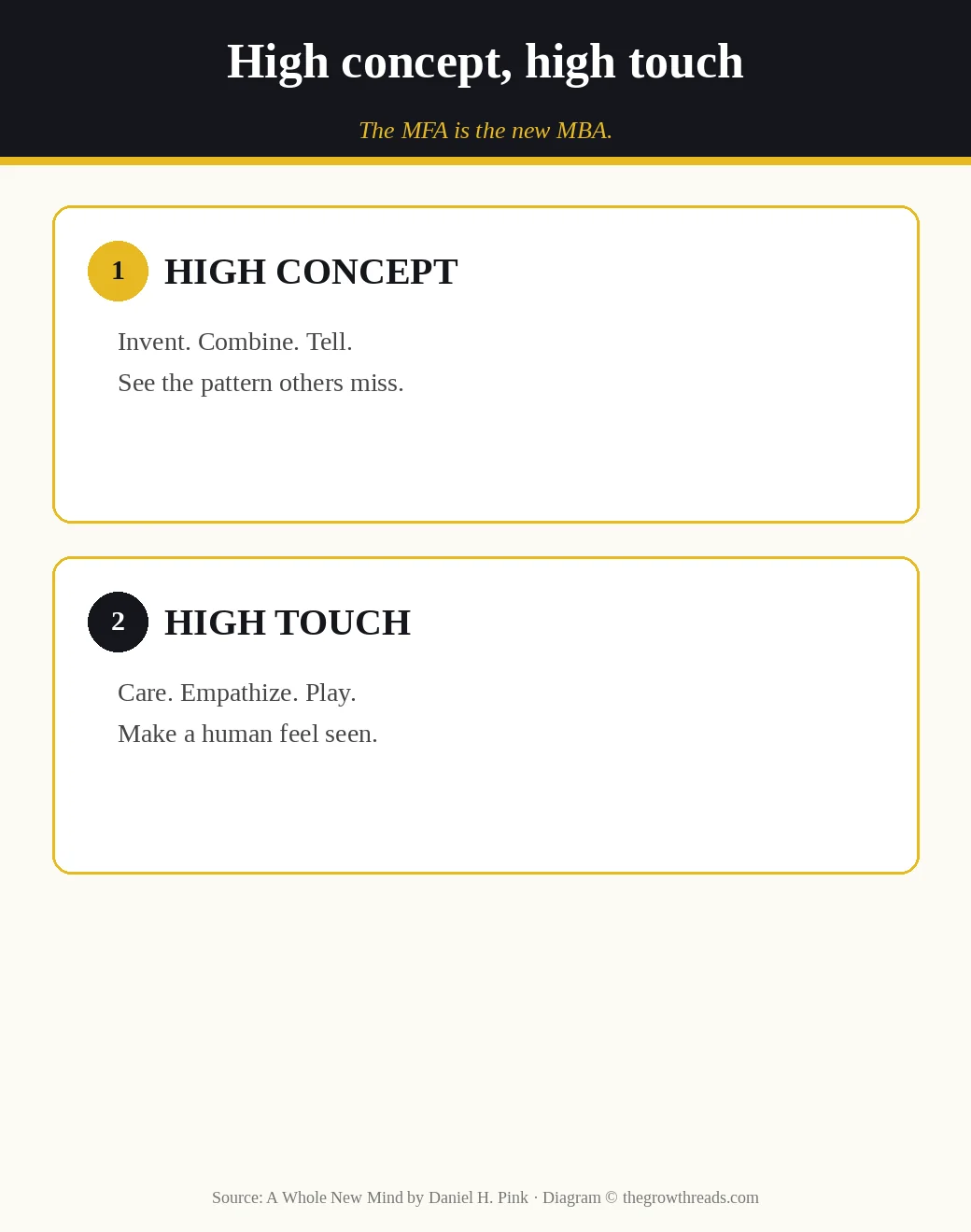
The line people remember is the one quote this review keeps: “The MFA is the new MBA.” Pink is not sending every analyst to art school. He is telling managers that aesthetic and narrative literacy are now operating skills. If you cannot tell why one interface feels like a tool and another feels like a chore, you will ship the chore. The MFA line is a dare: put someone in the room who can see.
L-Directed thinking is sequential and analytic. R-Directed is simultaneous and contextual. Most real work uses both. The Information Age overpaid the first. Your job is to notice which half of your week is still a script — and to add the other half on purpose, not as a weekend personality.
TGR Note: If you already believe makers should be in the room and you need courage more than a map, our Creative Confidence summary is the studio version of the same argument. Pink names the labor market. The Kelleys name the fear that keeps you from drawing the first ugly sketch. Use Pink to pick the sense. Use Creative Confidence to start before you feel ready.
Part 3: Design, Story, Symphony
The second half of the book is a kit. Each sense gets a chapter and a short list of ways to practice. You do not need the 2005 field trips. You need the drill.
Design is utility plus significance. A chair that holds you is function. A chair you refuse to put on the curb is design. At work this is not “make it pretty.” Would a person keep this slide, form, or error message if they had a choice? Keep a file of objects that feel inevitable. Steal the feeling, not the layout. One designed touch on a real deliverable beats a mood board you never apply.
Story is context wrapped around fact. Brains keep narratives and drop orphan data. A consultant who only delivers findings loses to the one who can say who wanted what, what broke, and what a person did next. Take one metric this week and write it as a three-beat story with a person in the middle. If you cannot, you do not understand the metric yet.
Symphony is seeing relationships, combining unlike things, and noticing what is not there. Specialists still matter. Someone has to hear the whole score. Draw your project as boxes and arrows once this week — for your eyes, not the deck. Circle the missing box. That circle is symphony.
These three senses are the high-concept cluster. A cheaper clone of your checklist cannot invent them, because the clone does not know what to combine, what to make beautiful, or which story the numbers are hiding.
Part 4: Empathy, Play, Meaning — then go to work
Empathy is detecting what another person feels and acting in their world, not yours. Logic still wins arguments. Empathy wins the room that has to live with the decision. Sit with one user without a script. Watch verbs. If you only interview people through a form you wrote, you will hear the form.
Play is games, humor, and joy as production, not pizza Friday. Humor marks the gap between how the process claims to feel and how it actually feels. Ten minutes of unstructured play on the calendar is a serious intervention if your team only knows how to grind.
Meaning is the sense abundance cannot supply. End one week with a sentence that is not a KPI: who was helped, what was beautiful, what you would still do if the metric vanished. If you cannot write the sentence, the week was only accumulation.
Empathy, play, and meaning are high touch. They keep people in the work high concept invented. Skip them and you get clever products that feel like a slap. Skip high concept and you get kind rooms that ship nothing new. The last instruction is to go practice, not to pick a camp.
TGR Note: Seth Godin’s Linchpin summary is the emotional twin: become indispensable by making emotional labor, not by being the best cog. Pink gives you six named practices. Godin gives you the identity dare. If you already make and the problem is staying in motion, Keep Going is the daily verb. Use one book this week. Do not stack three covers as a personality.
Who is A Whole New Mind best for — and who should read something else first?
Read this if your week can be written as a spec: analysis, reporting, coordination, anything a cheaper office or a model can imitate. Read it if you already draw or write and need language to defend that work in a throughput room.
Read something else first if you cannot start. If the block is motivation, our Drive summary is the later Pink you actually need — even though it lives in Leadership. If the block is sitting down to make, Creative Confidence or Keep Going will get a sketch on the page faster. If you want story as a life craft, Big Magic is the permission slip, not the career insurance.
Questions to reflect on
- Which slice of your job could a stranger run from a one-page spec?
- Where did you last add design — not decoration — to something someone has to use?
- If you told this week as a story, who is the person in the middle — and what did they want?
- What is the missing box in your current project that only shows up when you look at the whole?
- When did you last sit with a user without a script, and what verb did you notice?
🔥 Ready to practice a sense, not quote one?
Get A Whole New Mind, then run the 7-day plan on one scripted slice of a job you already have — not on a personality type you were born without.
How to apply A Whole New Mind (7-day plan)
- Day 1 — Name the script. Write the slice of your job a stranger could run from one page. Circle it. That circle is the target, not your whole identity.
- Day 2 — One designed touch. Take a real deliverable. Change one thing so a person would keep it: hierarchy, language, a human error state. Ship it.
- Day 3 — Story the metric. Take one number you already report. Write three beats: who wanted what, what broke, what a person did next. If you cannot, you do not know the number yet.
- Day 4 — Draw the whole. Boxes and arrows for the project, on paper. Circle the missing box. Send that circle to one teammate as a question, not a slide.
- Day 5 — Sit without a script. Twenty minutes with one user, patient, teammate, or customer. Watch verbs. Do not pitch.
- Day 6 — Ten minutes of play. Put it on the calendar like a meeting. Humor, a game, a walk with no agenda. Notice what the grind had been hiding.
- Day 7 — Meaning sentence. One sentence that is not a KPI: who was helped, what was beautiful, what you would still do if the metric vanished. Book the same hour next week. Pick a different sense if this one stuck.
Frequently asked questions
What is A Whole New Mind about in one paragraph?
A Whole New Mind is Daniel H. Pink’s 2005 argument that the Information Age is giving way to a Conceptual Age. Left-brain, sequential, spreadsheet work still matters, but it is no longer enough, because abundance, Asia, and automation can copy a spec. The people who stay valuable combine high concept (invention, story, pattern) with high touch (empathy, play, meaning). Pink names six senses to practice — Design, Story, Symphony, Empathy, Play, and Meaning — and treats them as career insurance you can train, not a personality type you were born with.
What are the six senses in A Whole New Mind?
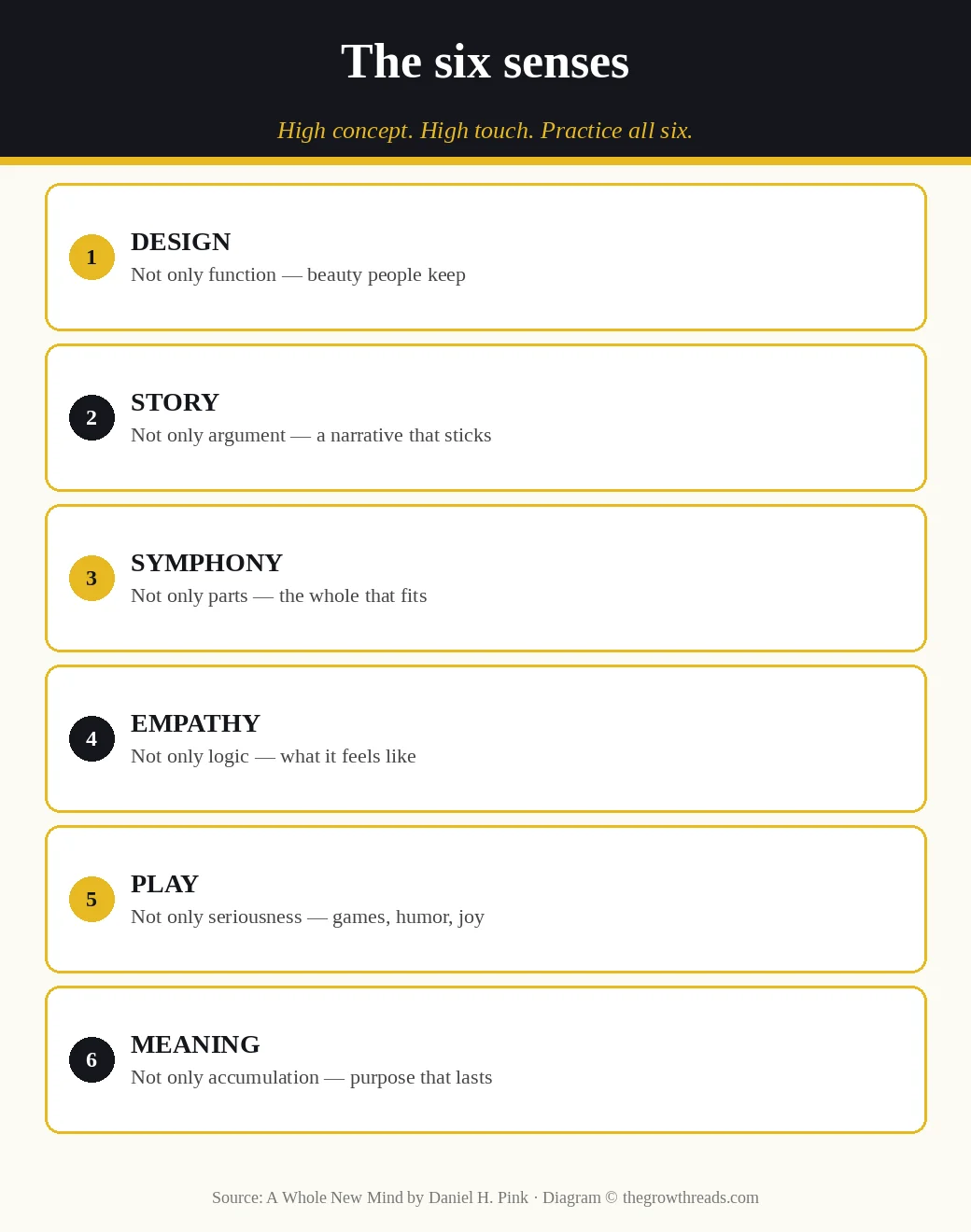
The six senses are Design, Story, Symphony, Empathy, Play, and Meaning. Design is function plus beauty someone keeps. Story is fact wrapped in a narrative a person can retell. Symphony is seeing how pieces fit instead of mastering one slice. Empathy is detecting what a situation feels like, not only what it scores. Play is humor, games, and lightness that keep people in the work. Meaning is purpose that outlasts a quarterly pile of stuff. Pink’s move is to treat each as a drill, not a vibe: a portfolio, a story you can tell, a sketch, a conversation you actually sit in.
What does Daniel Pink mean by the Conceptual Age?
Pink’s Conceptual Age is the era after agriculture, industry, and information, when the scarce skill is not calculating the answer but framing a problem people care about. L-Directed abilities — logic, sequence, analysis — get you hired. R-Directed abilities — artistry, empathy, big-picture, meaning — keep you in the room when the calculation is cheap. He is not asking you to throw away spreadsheets. He is asking you to pair them with something a script cannot ship: a designed object, a story, a symphony of pieces, a human who felt understood.
Is A Whole New Mind still relevant in 2026?
Yes, if you read the six senses as practice and the 2005 offshoring examples as a snapshot. Some Asia-and-outsourcing stories have aged; the automation story has only gotten louder. Software now drafts the memo the book worried a cheaper analyst would write. The useful core is unchanged: if your week is a spec someone else can follow, you need Design, Story, Symphony, Empathy, Play, and Meaning on the calendar. Skip the dated travelogues. Keep the drills. Then pair the book with later Pink — When for timing — if you want a 2018 science layer on top of the 2005 map.
Who should read A Whole New Mind?
Read it if your job can be written as a checklist: analysis, law-lite, reporting, project coordination, anything a cheaper office or a model can imitate. It is also a strong read for makers who already draw or write and need language to defend that work in a room that only counts throughput. Skip it as your first Pink if you cannot start anything — Drive is the motivation book. Skip it if you need a studio ritual more than a map — Creative Confidence and Keep Going will put you at the desk faster. Use this summary’s 7-day plan so the six senses become a week, not a poster.
How is A Whole New Mind different from Drive?
A Whole New Mind is about which abilities hold value when knowledge work is cheap. Drive, six years later, is about what actually moves people once they are in the work: autonomy, mastery, purpose. One is a labor-market map plus six practices. The other is a motivation engine. You can use both. If your problem is “my tasks are copyable,” start with A Whole New Mind. If your problem is “I know what to do and still stall,” start with Drive. Do not collect both as a reason to delay Day 1 of either 7-day plan.
How do I apply A Whole New Mind this week if I am not a designer?
You do not need an MFA. Day 1 name the scripted slice of your job. Day 2 add one designed touch to a real deliverable. Day 3 tell the work as a story with a person in it. Day 4 draw the whole, not the task list. Day 5 sit with one user without a script. Day 6 put ten minutes of play on the calendar. Day 7 write why the week mattered besides the metric. That is the book in a job you already have — spreadsheet, clinic, classroom, or shop. Book the same hour next week before the six senses become a quote.
Related summaries
- When — later Pink: timing science for when to do the work
- Creative Confidence — start the sketch before you feel like a designer
- Linchpin — become hard to replace by making emotional labor
- Keep Going — forget the noun, do the verb, daily
- Best productivity books — the full silo list
How we analyze books: every book on The Growth Reads is read cover to cover, summarized in thousands of words of original analysis, and rated against our five-criteria rubric (lasting impact, evidence quality, practical application, writing & originality, external consensus). Read our full methodology.