

★★★☆☆ 3.6/5 — Crowds go mad together. Write your exit before the story feels obvious.
Best for: Savers and operators who already invest and still feel late when a chat lights up with a sure thing
Reading time: ~12–18 hrs for the full Victorian text; ~4 hrs for the money chapters (guide: 15 min)
Difficulty to apply: Moderate — the stories are easy; the pause is the work
Extraordinary Popular Delusions in one minute
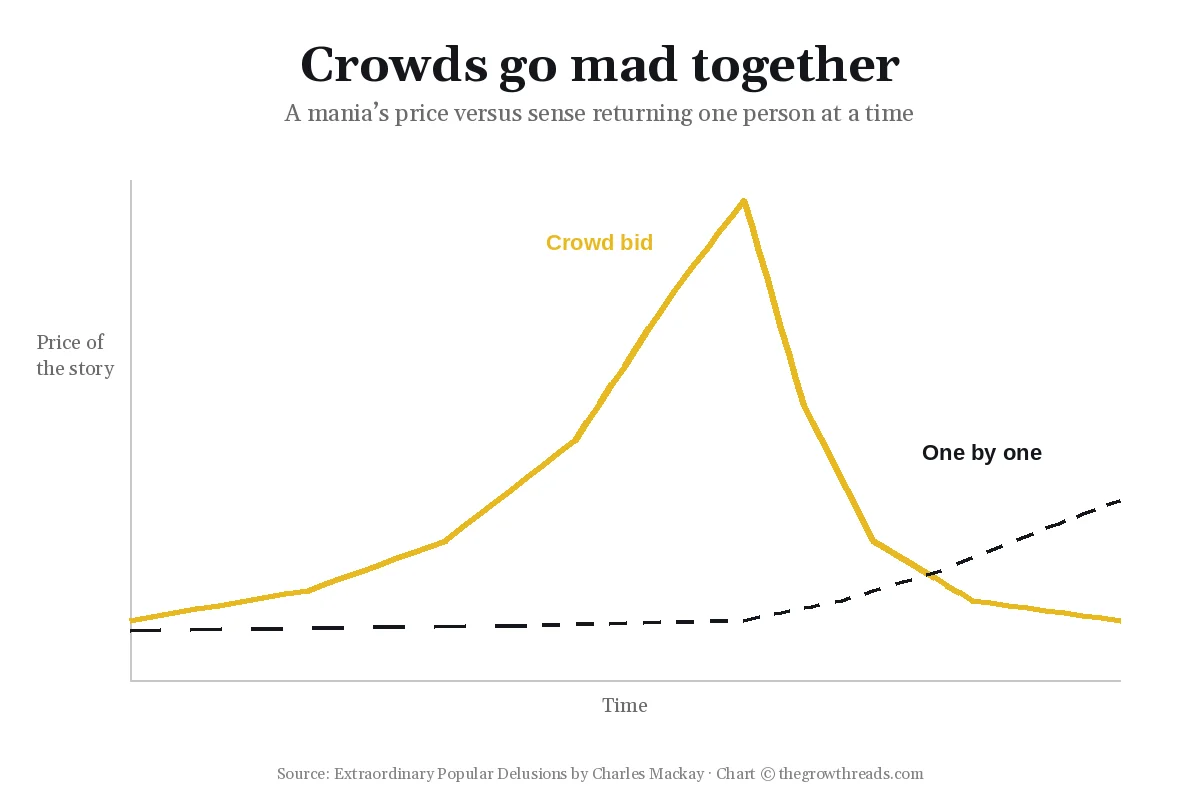
A crowd will buy a story that feels too obvious to question, then come back to its senses one person at a time. Charles Mackay’s 1841 book is an early map of that sequence: Dutch tulip contracts, John Law’s Mississippi shares, the South Sea Bubble, and a long list of crazes that never listed on an exchange. Steal one weekday move: before you buy what “everyone” already sees, write the rule you will still follow when the room is quiet.
Key takeaways
- The asset is often a story: Tulips, a colony, a government-backed share — Mackay’s manias sold a plot more than a cash flow.
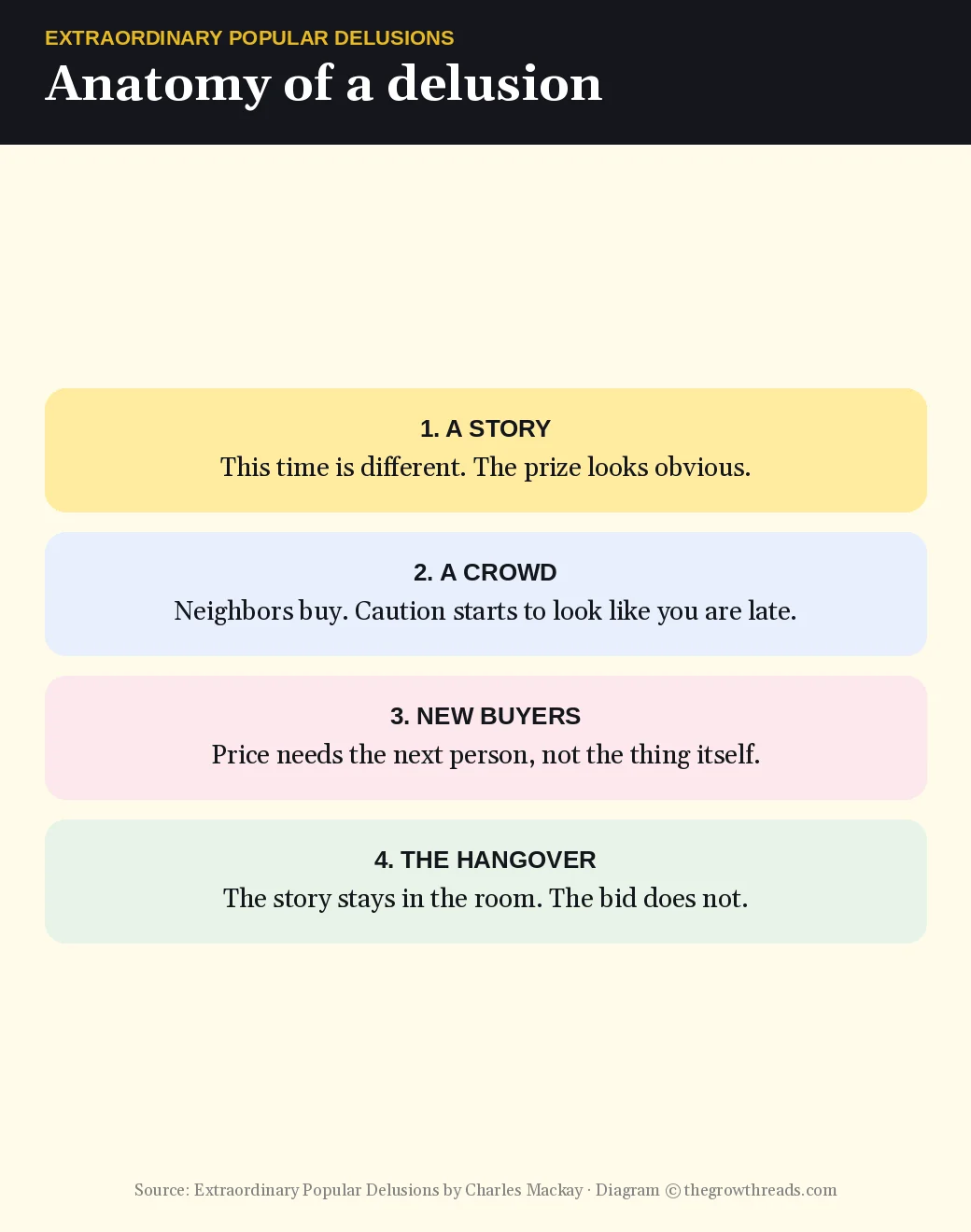
- Social proof is the bid: Neighbors buying is what makes caution feel like you are late.
- New buyers keep the price: When the next person is the product, you are inventory.
- Copycats arrive late and loud: South Sea’s unnamed “undertaking of great advantage” is the prospectus you should still refuse.
- Sense returns privately: Mackay’s line is that people go mad in herds and recover one by one.
- The engine is not only markets: Relics, crusades, fortune-tellers, and witch hunts run the same loop.
- A written rule beats a mood: The useful output is a sentence you will obey when bored, not a forecast.
- A pause is the application: Forty-eight hours and a named story beat trying to call a top.
- This is not a first money book: Get a budget and a defensive frame first; then use Mackay as memory for manias.
What is Extraordinary Popular Delusions about?
Extraordinary Popular Delusions and the Madness of Crowds is Charles Mackay’s 1841 study of crowd crazes: Dutch tulips, John Law’s Mississippi shares, the South Sea Bubble, and fashions that never listed on an exchange. Use it as a field guide to social proof, not a trading system.
About the author
Charles Mackay (27 March 1814 – 24 December 1889) was a Scottish journalist, poet, and songwriter whose name now sits on one book. He edited the Illustrated London News, wrote popular songs including Cheer, Boys, Cheer, and spent his working life explaining public mood in print. Extraordinary Popular Delusions appeared in 1841 as Memoirs of Extraordinary Popular Delusions and grew, with engravings, in 1852. Investors still steal the three money chapters — tulips, John Law’s Mississippi scheme, the South Sea Bubble — because they show a crowd buying a story. The rest of the book argues the same engine runs outside markets. Read him as a reporter of social proof, not as a market timer. Explore all Charles Mackay book summaries →
Key concepts at a glance
| Concept | What it means | Use it when |
|---|---|---|
| Popular delusion | A story a crowd treats as obvious. | A chat calls a yes “too clear to miss.” |
| Greater-fool bid | Price needs the next person, not the thing. | The brochure talks about who will buy after you. |
| Tulip contract | A fashionable object priced like a house. | An ordinary item suddenly has a waiting list and a tavern market. |
| Mississippi scheme | Paper money plus a colony plot. | A new instrument is sold as a nation-making story. |
| South Sea copycat | A company whose purpose is the rush itself. | You cannot explain the product in one sentence. |
| Herd sense | People think together, then wake up alone. | You need the room’s timing to feel safe. |
| Written rule | A sentence that still holds when you are bored. | Excitement is the only argument for acting today. |
| Cooling-off | No new position on the loud day. | A pitch arrives with a crowd attached. |
Part 1: Tulip mania — when a flower becomes a wage
Mackay’s first money set piece is Haarlem and Amsterdam in the 1630s. A tulip bulb — especially a broken, flamed variety such as Semper Augustus — stops being a garden object and becomes a contract. Taverns take the trades. People who never grew a flower start talking in florins. Mackay’s scenes are journalistic: a bulb priced like a house, a sailor who eats a specimen thinking it is an onion, a market that feels like it can only go one way. Then the bid thins. The story stays in the room for a while. The cash does not.
What to steal is not a 1637 price table. It is the sequence. First the object is scarce and pretty. Then the object is a ticket to status. Then the ticket is a promise that someone else will pay more next week. That third step is the delusion. You do not need a greenhouse to stand in it. Any fashionable asset can put you there: a collectible, a listing, a group-chat coin. The useful question is ugly and small: if nobody new walks in, what is this worth to me?
TGR Note: Benjamin Graham’s Mr. Market in The Intelligent Investor is the same person with a daily quote. Mackay shows the party before the quote. Morgan Housel in The Psychology of Money names the inner pinch — FOMO, room for error — that makes the tavern feel like homework you skipped.
Part 2: John Law and the Mississippi scheme
The second set piece is Paris, 1719–20. John Law, a Scotsman with a theory about paper money, gets a bank, then a company tied to France’s Louisiana claim, then a public that treats shares like a national project. Mackay walks rue Quincampoix: carriages, servants, people who had never owned a share, prices that print themselves because the story is the currency. The colony is far away. The paper is near. That gap is the product.
When the scheme breaks, it breaks as a story breaking. Law’s machine needed belief that the paper stood for something growing on another continent. Once the belief slips, the same printing that felt like prosperity feels like a trick. Steal the operator’s view: a new instrument plus a distant plot plus easy credit is a pitch, not a proof. Write who is paid if you say yes — the bank, the company, the neighbor who got in last month — before you admire the map.
TGR Note: Michael Lewis in Liar’s Poker and The Big Short reports modern floors that sold a package faster than it was understood. Mackay’s Law is the ancestor: a story that prints its own demand. Read the incentive, then the colony brochure.
Part 3: The South Sea Bubble — debt dressed as equity
Britain, 1720. The South Sea Company offers a way to turn national debt into shares. The political blessing is part of the product. Prices run. Copycat companies bloom, including Mackay’s famous subscription “for carrying on an undertaking of great advantage, but nobody to know what it is.” That line is the whole book in one prospectus. If you cannot name the work, you are the inventory.
Isaac Newton’s later remark — that he could calculate the motions of the heavens but not the madness of people — is the hangover quote everyone remembers. Mackay’s chapter is more useful than the quip. It shows how a government-adjacent story licenses ordinary greed, then how the same room hunts for culprits once the bid is gone. The application is not “never own equities.” It is: if the pitch is the rush, wait. A forty-eight-hour rule would have killed most of those copycats without requiring a forecast of the crash date.
TGR Note: Nassim Taleb in Fooled by Randomness and The Black Swan studies luck wearing a producer’s suit. South Sea is luck plus a political story. A Random Walk Down Wall Street is the later, calmer conclusion: you probably cannot out-guess the crowd’s clock, so stop trying to join it late.
Part 4: The same engine outside the exchange
The money chapters are why this book lives in a finance silo. Mackay’s larger claim is that the engine is not a ticker. Alchemy, magnetisers, relics, crusades, fortune-tellers, haunted houses, the admiration of great thieves, witch hunts — he keeps showing a crowd that wants a plot with a villain, a prize, and a ritual. The useful reread for a money person is not “those people were credulous.” It is: I use the same shortcuts. I copy the room. I dislike being last. I like a story that makes my yes feel moral.
That is why the 7-day plan is a pause, not a model. You cannot out-argue a herd from inside it. You can write a sentence on Monday that still binds you on a loud Thursday. You can name the story (“this listing cannot miss,” “this fund is the new railroad”). You can refuse any product whose purpose is the rush. Mackay’s own later career is a warning kept for the FAQ: as a newspaper editor during Railway Mania he cheered a boom he might have recognised on the page. Knowing the pattern does not exempt you. The rule has to live outside your mood.

Who is Extraordinary Popular Delusions best for — and who should read something else first?
This book is for people who already save and still feel a pinch when a group chat treats a yes as obvious. History-curious investors, operators who sit near a pitch, and anyone who has bought a fashionable object “just this once” will get a long memory out of the three money chapters. It is not a first budgeting book and not a first investing manual. If you need accounts and automation, start with I Will Teach You to Be Rich or The Total Money Makeover. If you want a defensive frame for markets, start with The Intelligent Investor or The Simple Path to Wealth. If you want weekday psychology without Victorian length, start with The Psychology of Money, then come back here for the herd. This is education, not financial advice.
Questions to reflect on
- What is one purchase or yes from the last year that needed a new person to walk in after you?
- Which group chat currently treats a story as too obvious to question?
- What sentence would you still follow if you were bored and the room was quiet?
- Can you explain the last product you almost bought in one sentence that names the work, not the rush?
- Who gets paid if you say yes this week — and who holds the paper if the story cools?
🔥 Ready to step aside?
Get Extraordinary Popular Delusions and write the rule you will still obey when the crowd is sure.
How to apply Extraordinary Popular Delusions (7-day plan)
Small and concrete. This is a pause habit, not a market call, and not financial advice.
- Day 1 — Name the room. Write one place a crowd currently sounds sure: a chat, a listing, a workplace plan. One line.
- Day 2 — Name the story. In one sentence, what are they selling? If you cannot, that is the finding.
- Day 3 — Who is paid? Write who benefits if you say yes this week. Fee, bonus, status, or a neighbor already in.
- Day 4 — The greater-fool test. Ask: if nobody new walks in, what is this worth to me? Circle the answer.
- Day 5 — Write the rule. One sentence you will still follow when bored. Example: no new position on a day the chat is loud.
- Day 6 — Forty-eight hours. Pick one live yes and delay it two nights. Note what changes when the urgency has to wait.
- Day 7 — Stand aside once. Skip one fashionable add-on this week. Record the pinch, then the quiet. That gap is the book.
Frequently asked questions
What is Extraordinary Popular Delusions about?
Extraordinary Popular Delusions and the Madness of Crowds is Charles Mackay’s 1841 study of how groups lose their heads together. The chapters investors still steal are the money manias: Dutch tulip contracts, John Law’s Mississippi scheme in Paris, and Britain’s South Sea Bubble. The rest of the book runs the same argument through alchemy, relics, crusades, fortune-tellers, and witch hunts. Mackay’s claim is social, not technical: a crowd will pay for a story that feels obvious, then come back to its senses slowly, one person at a time. Use it as a field guide to social proof, not as a trading system or a first budgeting book.
Is Extraordinary Popular Delusions still worth reading in 2026?
Yes, if you want a long memory for manias rather than a new product. The Victorian sentences are slower than a modern money memoir, and some of Mackay’s numbers have been argued over by later historians. The useful part has not aged: a story plus neighbors plus a fear of being late will still move cash. Pair it with a living behavior book if you want weekday language, then keep Mackay for the pattern. The 7-day plan below is a pause habit, not a forecast. This is education, not financial advice, and it will not tell you which ticker to buy.
What are the three financial manias Mackay covers?
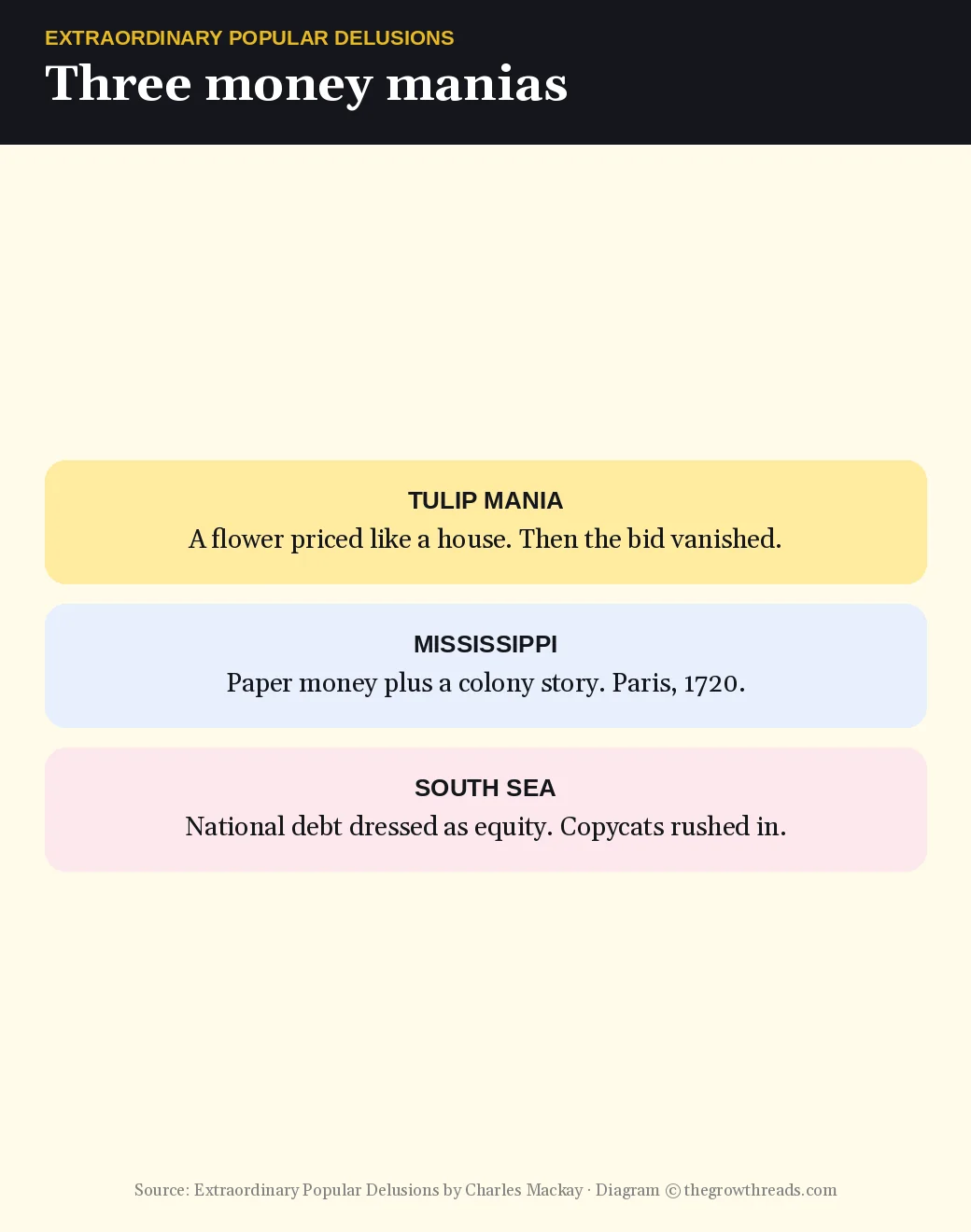
Three set pieces sit at the front of most investor editions. Dutch tulip contracts in the 1630s show a flower priced like a house until the bid vanished. John Law’s Mississippi scheme in 1719–20 Paris shows paper money plus a colony story that printed its own demand. Britain’s South Sea Bubble in 1720 shows national debt dressed as equity, then a rush of copycat companies, including the famous subscription “for carrying on an undertaking of great advantage, but nobody to know what it is.” Steal the shared plot: the asset was a story that needed the next buyer.
Did Mackay get tulip mania right?
Later scholars have argued that Mackay told the tulip chapter as a sharper crash than the surviving records support, and that some of his prices were newspaper colour rather than a complete market tape. That debate belongs in a footnote, not in your next yes. The practical sequence he is pointing at — a fashionable object, tavern contracts, a belief that someone else will pay more, then a day with no bid — still describes how ordinary people get pulled into a story. Use the chapter as a warning about greater-fool pricing, not as a spreadsheet of 1637 Amsterdam.
What does Mackay mean by “madness of crowds”?
He does not mean that every group is foolish. He means that people think in herds, go mad in herds, and “recover their senses slowly, and one by one.” The madness is social proof plus a story that feels too obvious to question. In the money chapters the story is a flower, a colony, or a government-backed share. Outside markets it is a relic, a prophecy, or a hunt. The useful inversion is private: write your rule before the room is loud, because the return to sense is not a meeting. It is one person stepping aside.
Who should read Extraordinary Popular Delusions — and who should start elsewhere?
Read it if you already save, already invest, and still feel a pinch when a chat lights up with a sure thing. History-curious operators who sit near a pitch will get more than traders looking for a setup. If you need a first budgeting book, start with I Will Teach You to Be Rich or The Total Money Makeover. If you want a first defensive investing frame, start with The Intelligent Investor or The Simple Path to Wealth. If you want weekday money psychology without Victorian length, start with The Psychology of Money, then come back to Mackay for the herd.
How do I apply Extraordinary Popular Delusions without trying to time markets?
Do not turn Mackay into a crystal ball. The 7-day plan is a pause: write one rule you will still follow when bored, wait forty-eight hours on any new yes that arrived with a crowd, and name the story you are being sold. You are not trying to call a top. You are trying to stop buying a prospectus nobody can explain. Indexing, a written policy, and a cooling-off rule are enough. If a friend is selling urgency, that is the tell. This is not financial advice; it is a way to keep your own clock when the room has one.
Related summaries
- The Psychology of Money — the inner pinch that makes a herd feel like homework you skipped.
- Liar’s Poker — a modern floor that sold the story; Mackay is the older map.
- The Intelligent Investor — Mr. Market as a daily quote; Mackay as the party before it.
- Fooled by Randomness — luck wearing a producer’s suit during the boom.
Browse every title in our Best Money Books pillar page.
How we analyze books: our summaries are built from a full read of the source text, cross-referenced against the author’s published interviews and research where relevant, and structured around practical application rather than critique. We disclose our editorial process and affiliate relationships in full. Read our full methodology.