

★★★★ 4.4/5 — Wall Street pays people to believe a story. Write who gets paid before you buy it.
Best for: Readers who sit near a pitch — a fund, a loan, a workplace plan — and want the bonus behind the brochure, not a first budgeting book
Reading time: ~6 hrs for the Norton paperback (310 pages) · ~18 min for this guide
Difficulty to apply: The two-column pitch vs incentive worksheet is usable this week; leaving a glamorous desk is the long part
Liar’s Poker in one minute
A dollar bill is a hand. A bond sale is the same game with a bigger pot. Michael Lewis’s 1989 memoir walks the Salomon Brothers floor where he was a junior salesman with an art-history degree, a training-program bruise, and a view of how mortgage paper got talked into being. The title game trains bluffing on serial numbers. The job trains bluffing on customers. Steal one weekday move: before you buy a story, write who is paid if you say yes.
Key takeaways
- The game is training: Liar’s poker is how the firm practiced incomplete information, not a hobby in the hallway.
- Status is the real currency: Producers keep the book. Everyone else is passing through.
- The door is a person: Lewis got in through a chance meeting, not a perfect résumé.
- Training teaches a voice: Six months of drills so you sound like the house.
- Unwanted desks can print: Mortgages were a backwater until they became the engine.
- Salesmen move inventory: Charm is a cost of goods. The book still has to shrink.
- Customers keep the risk: After the story lands, the buyer owns the paper.
- Volume is the scoreboard: If you cannot see how a desk is scored, you are in the pitch.
- Walking away is a money skill: Lewis left a lucrative seat and wrote the map.
- Application is local: Two columns — pitch vs incentive — on one decision you already face.
What is Liar’s Poker about?
Liar’s Poker is Michael Lewis’s inside account of Salomon Brothers in the late 1980s — how a training program, a status game, and a mortgage machine taught young salespeople to move paper. A sale is a story someone is paid to tell: write the incentive before you buy the pitch.
About the author
Michael Lewis was born in New Orleans in 1960, took an art-history degree at Princeton, then a master’s at the London School of Economics. A chance conversation put him in Salomon Brothers’ training program; by his mid-twenties he was selling bonds in London and New York. He left the firm and published Liar’s Poker in 1989. The later shelf — Moneyball, The Blind Side, The Big Short, Flash Boys — is the same method at larger scale: hang around a closed room until the scoreboard becomes the plot. Use him as a reporter of incentives, not as a market timer or a personal-finance coach. Explore all Michael Lewis book summaries →
Key concepts at a glance
| Concept | What it means | Use it when |
|---|---|---|
| Liar’s poker | A serial-number bluff that trains incomplete information. | A room is asking you to bid without a full hand. |
| The jungle | The training program that stamps the firm’s voice on recruits. | Onboarding feels like theatre, not a syllabus. |
| Producer | The person whose volume keeps a seat and a bonus pool. | You cannot tell who actually gets paid. |
| Inventory | Positions the desk needs someone else to own. | A product is “perfect for you” this week. |
| Mortgage machine | Home loans packed into bonds a salesman can place. | A new package is sold faster than it is understood. |
| Customer risk | After the sale, the buyer holds the paper. | The brochure talks as if the desk stays on the hook. |
| Chance-meeting door | Access through a person, not a posted exam. | A “merit” story skips the introduction that mattered. |
| Walking away | Leaving a lucrative seat to keep your own scoreboard. | The bonus is the only argument for staying. |
Part 1: The hand that trains the firm
Lewis opens with a legend the floor already treated as scripture. John Gutfreund, Salomon’s chairman, walks over to John Meriwether, the arbitrage star, and offers a single hand of liar’s poker for a million dollars. Meriwether, in Lewis’s telling, does not flinch; he raises the terms. The line that sticks is Gutfreund’s: “One hand, one million dollars, no tears.” Whether every retelling matches the minute is beside the TGR point. The firm used a child’s bluff as a language for grown-up status.
The game itself is small. You hold a dollar bill. Serial numbers are your cards. You bid on how many of a digit exist in the group. You raise or you call the last bid a lie. Information is incomplete by design. Face is part of the stake. A junior who cannot sit in that tension will not last on a sales desk where the customer cannot see the book either.
Status, not the dollar, is the pot. Producers — the people who print — occupy a different country from the trainees and the back office. The million-dollar hand is a public ranking. You learn, fast, that the firm’s inner currency is who will play and who will blink. Slippery language is how a political argument hides; on this floor, a joke is how a hierarchy hides.
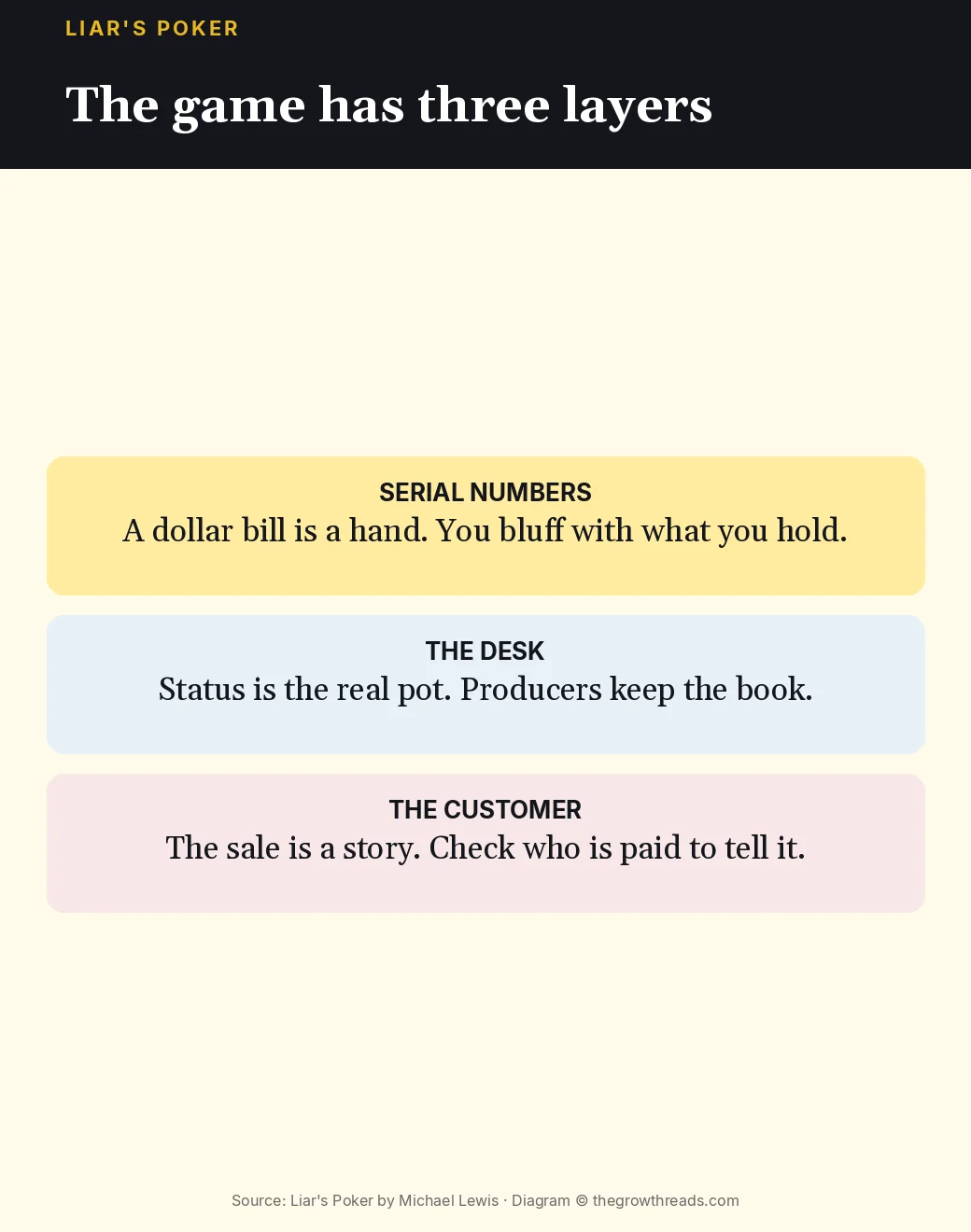
Steal one weekday move from Part 1. The next time someone invites you into a “quick yes,” ask what the hand is. What do they know that you do not. What happens if you call the bluff. If those lines are blank, you are already in liar’s poker without a bill on the table.
TGR Note: The later crash version of this method is The Big Short. Same reporter, larger machine. Liar’s Poker is the origin: a floor that trained the bluff before the housing sausage existed.
Part 2: Getting in — chance, training, the jungle
Lewis’s door is not a case-study interview. Princeton art history, a master’s at LSE, a London dinner, a Salomon managing director who likes the kid. The firm’s recruiting myth is merit. The actual plot is a person who can walk you in. That is not a sermon against luck. It is a map: if you cannot name the human hinge in a “I earned this seat” story, you are reading the brochure.
Then comes the jungle — the training program in New York. Recruits are herded, ranked, shouted at, and taught the house language of bonds, spreads, and customers. Humiliation is not an accident. It is how a cohort learns whose voice counts. People wash out. People get placed. The ones who remain have practiced sounding like Salomon before they have practiced serving a client.
Placement is the first sale. You want a desk that prints. The desk wants bodies who will not freeze. Lewis lands in London, then deeper into the machine, still junior, already paid in a way his art-history friends cannot parse. The feeling the book captures — and that TGR wants you to keep — is the gap between a title and a scoreboard. A “financial adviser” at a kitchen table has the same gap if you never ask how they are paid.
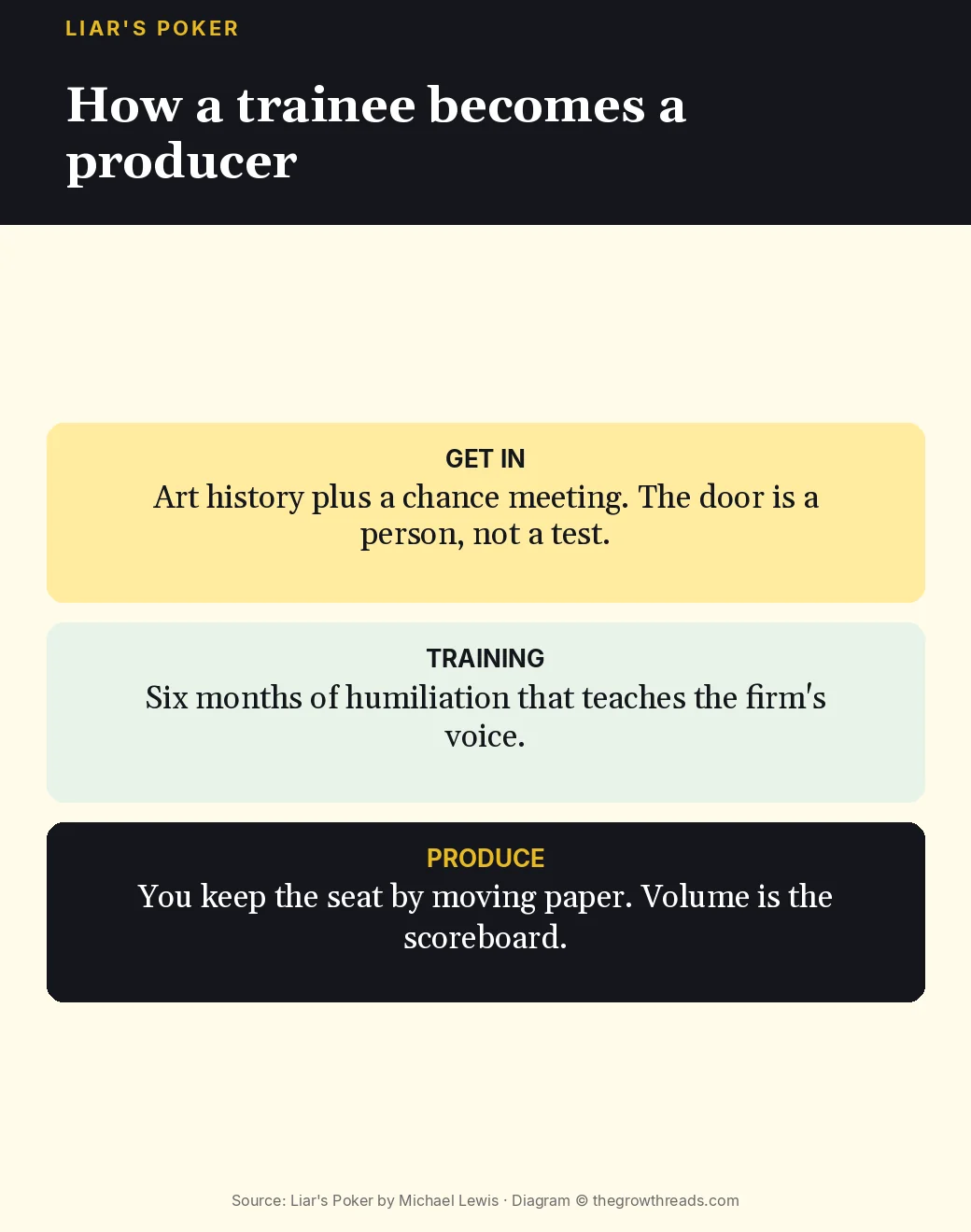
The TGR use of the jungle is not nostalgia for 1985. It is a warning against treating onboarding theatre as education. If a workplace, a brokerage, or a coaching funnel uses shame to stamp a script, you are looking at Salomon’s method in cheaper clothes. Write the script. Then write who benefits if you repeat it.
TGR Note: Nassim Taleb in Fooled by Randomness and Skin in the Game asks who is on the hook when a story pays. Lewis shows the floor that gets paid whether the customer’s story later holds.
Part 3: The mortgage machine nobody wanted
The mortgage department is the book’s industrial plot. Home loans were, for a long stretch, the unglamorous pile — messy, local, not the sovereign-bond glory of the rest of the firm. Lewis’s account of Lewis Ranieri and the people who stayed with that pile is the chapter most readers should steal. A desk nobody wanted became a machine for packaging ordinary American payments into paper a salesman could place.
Once you can slice a cash flow, you can sell a story about safety, yield, and “what the customer needs.” The 1980s savings-and-loan world, deregulation, and a hunger for product did the rest. Volume exploded. People who had been back-office became rainmakers. The firm’s status map redrew itself around whoever could move the new paper. That redraw is the lesson, not the ticker symbols.
A salesman in this machine is not a librarian of risk. He is a distribution channel. Inventory sits on the firm’s book. A good day is a smaller book. The customer is the person who owns the risk after lunch. If you remember only one sentence from Part 3, remember that. Every “this is a great time to get in” pitch has a book behind it that someone would like to lighten.
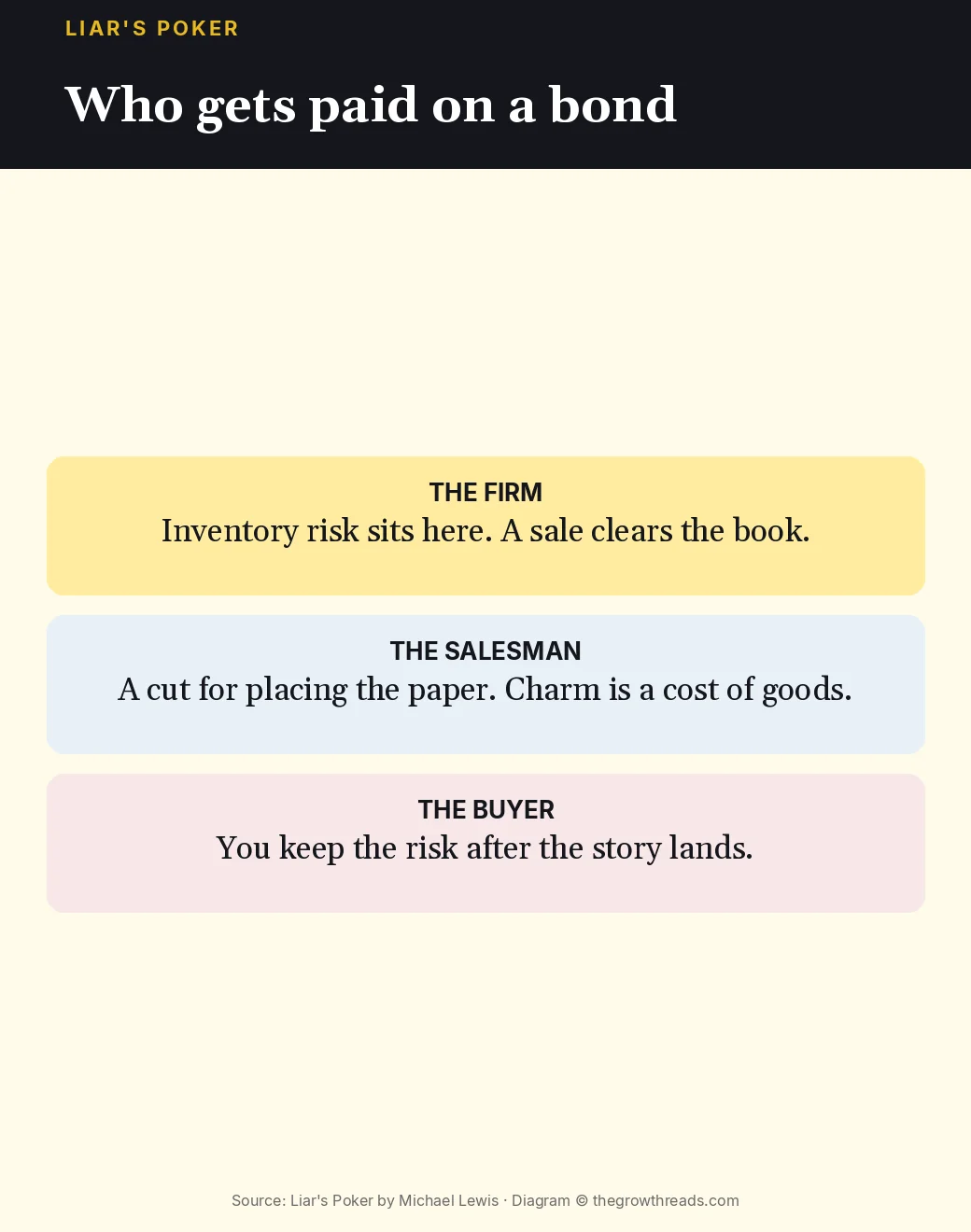
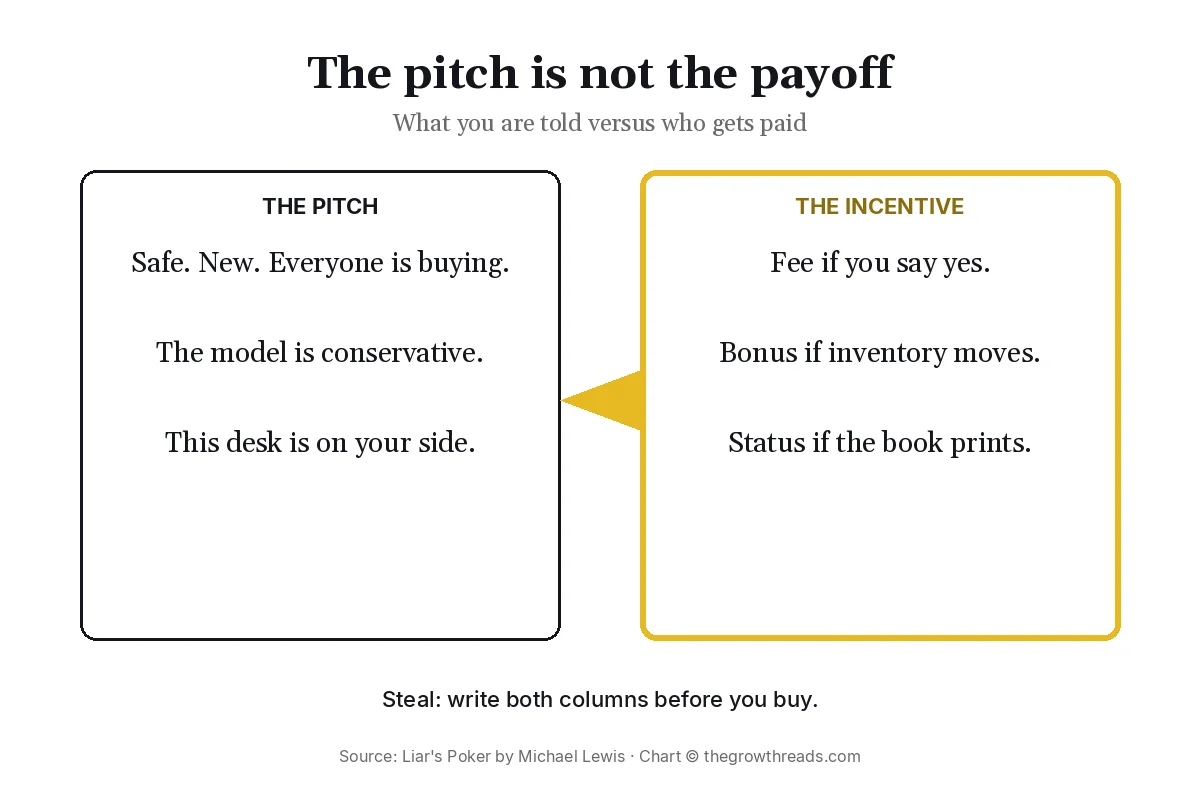
Three questions keep you honest. What is the inventory. Who is paid to place it. What do you own after you say yes. If a room only wants your trust, you are missing the book. If it only wants to villainize salespeople and ignore your own yes, you are missing the customer column — the one you actually live in.
TGR Note: Morgan Housel in The Psychology of Money studies the inner life of a saver. Lewis studies the outer life of a pitch. Read them as a pair: behavior you bring, incentives they bring.
Part 4: Selling the story and walking away
The last movement is Lewis on the phone and on the road — the actual work of getting a customer to take paper. Relationships are real. Information is not symmetric. A good salesman learns what a client fears and what a client needs to tell their own boss. None of that requires you to sneer. It requires you to notice that helpfulness and distribution can wear the same smile.
Money arrives fast for a young producer. Lewis does not pretend otherwise. The book’s practical sting is that a lucrative seat can still be a bad scoreboard for a life. He walks away while the floor still looks like the center of the universe and writes the period piece that a later generation treated as a recruiting poster. That twist belongs in the FAQ. The usable move belongs here: you are allowed to leave a bonus that is training you to ignore your own numbers.
After 1989 the firm’s next chapters — Treasury scandal, sale, the long afterlife of the mortgage machine — sit outside this memoir’s frame. You do not need them to use the book. You need a page with two columns and one decision you will actually make this week. The 7-day plan is that page. The charts in this review are the reminder. Keep the worksheet.
One more steal, because Lewis is funny and the fun is doing work. When a pitch uses urgency, jargon, or flattery, translate it into liar’s poker. What digit are they bidding. What would it mean to call. If you cannot answer, you are not “being a good partner.” You are covering a raise you have not counted.
Who is Liar’s Poker best for — and who should read something else first?
This book is for people who sit near a sales pitch and want to see the bonus behind the brochure. It is not a first personal-finance book.
If you need a first money system, start with I Will Teach You To Be Rich. If you want the inner life of a saver, read The Psychology of Money. If you want the later crash this culture helped bake, read The Big Short. If you want a defensive investing frame rather than a sales floor, keep The Intelligent Investor. Come to Lewis when the question is why a confident room can still be moving inventory onto you.
This is not financial, tax, or investment advice. It is a reading of Lewis’s floor so you can map a pitch in a life you actually live.
Questions to reflect on
- Who is paid if you say yes to the next money product on your table?
- What inventory — a fund, a loan, a plan — is someone trying to lighten this month?
- Where did you last confuse a confident voice with a complete hand?
- What would “calling the bluff” look like in one conversation this week?
- If the bonus went to zero, would you still want the seat or the product?
🔥 Ready to read the incentive?
Get Liar’s Poker and run the two-column worksheet on one pitch you already face.
How to apply Liar’s Poker (7-day plan)
- Day 1 — Name the salesman. One upcoming yes: adviser, refinance, workplace plan, friend with a product. Write the human.
- Day 2 — Write their incentive. Fee, bonus, quota, status. One line. If you cannot write it, that is the finding.
- Day 3 — Write the pitch. The three claims you are being told. No editorial. Just the brochure in your words.
- Day 4 — The gap. Circle every claim that does not have an incentive next to it.
- Day 5 — One calling question. “Who owns this if I say yes?” Ask it once, out loud or in an email.
- Day 6 — Household inventory. List one product you already hold and who was paid when you bought it.
- Day 7 — One rule. If you cannot write the incentive, you do not buy this week.
Frequently asked questions
What is Liar’s Poker about?
Liar’s Poker is Michael Lewis’s 1989 memoir of Salomon Brothers, the bond house that set the tone for 1980s Wall Street. He was a junior salesman with an art-history degree who learned that the real product was a story someone was paid to tell. The title game — bidding on serial numbers on a dollar bill — is how the firm trained bluffing. The mortgage desk, once a backwater, became the engine. Read it as a field guide to incentives, not as a trading manual or a first budgeting book.
What is the game of “liar’s poker” in the book?
It is a bluff played with the serial numbers on a dollar bill. Players bid on how many of a digit are in the group; you raise or you call the last bid as a lie. Lewis opens with John Gutfreund, Salomon’s chairman, challenging trader John Meriwether to one hand for a million dollars — “one hand, one million dollars, no tears.” The point is not the hobby. The point is the training: you live in incomplete information, you keep a face, and status is the pot. Steal that for any pitch you cannot yet write the payoff for.
Is Liar’s Poker a personal finance book?
No. It will not tell you which index fund to buy or how to pay off a card. It will tell you how a sales floor is paid, which is still a money skill. If you need a first system, start with I Will Teach You To Be Rich or The Psychology of Money, then come back. If you want the later crash that this culture helped bake, read The Big Short. Lewis is the weekday map under those books: write who gets paid before you buy the story. That is the 7-day plan in this review.
How long is Liar’s Poker and do I need every desk story?
The Norton paperback we title-checked (ISBN 9780393338690) runs about 310 pages; the 1989 original was shorter. You do not have to memorise every managing director. Steal four objects: the dollar-bill game as training, the chance-meeting door into the firm, the mortgage machine that nobody wanted until it printed, and the customer who keeps the risk after the story lands. The 7-day plan in this review is that steal, shrunk to one pitch you already face. Keep the worksheet. That is enough to use the book.
What should I do with the book if I am not a trader?
Treat every money conversation as a desk. An advisor, a refinance, a workplace plan, a structured product — each has a person who is paid if you say yes. Day 1 of the plan is naming that person. Day 2 is writing their incentive in one line. You do not need a Bloomberg terminal. You need a page with two columns: the pitch, and who gets paid. Lewis’s gift is making that page feel obvious after you have watched a bond salesman do it for a living.
Who should read Liar’s Poker?
Anyone who sits near a pitch — a fund, a loan, a workplace plan — and wants to see the bonus behind the brochure. It is also for readers who already love The Big Short and want the origin story of Lewis’s method: hang around a floor until the incentives become the plot. Skip it as a first budgeting book. If you are in debt-payoff mode, start with The Total Money Makeover. Come to Liar’s Poker when the question is why a confident room can still be selling you inventory.
Did Liar’s Poker stop people from going to Wall Street?
Lewis has said he hoped it would; a generation used it as a recruiting brochure instead. Treat that as a FAQ fact, not as a knock on the book. The usable residue is the same either way. If a story makes a desk look glamorous, write the scoreboard the desk actually uses — volume, spread, a bonus pool. If you still want the seat, you are going in with your eyes open. If you do not, you have a filter for the next product someone walks to your kitchen table.
Related summaries
- The Big Short — Lewis’s later map of a machine this floor helped make thinkable.
- Fooled by Randomness — luck wearing a producer’s suit.
- The Psychology of Money — the inner life you bring to their pitch.
- The Intelligent Investor — a defensive frame when a desk is still talking.
Browse every title in our Best Money Books pillar page.
How we analyze books: our summaries are built from a full read of the source text, cross-referenced against the author’s published interviews and research where relevant, and structured around practical application rather than critique. We disclose our editorial process and affiliate relationships in full. Read our full methodology.