

★★★★★ 4.7/5 — The clingy week is a leap. Treat it as development, not a broken baby.
Best for: New parents in a fussy window, caregivers who want a due-date leap calendar, and anyone who turns a cranky week into a personality verdict
Reading time: ~9 hrs for the Countryman 464-page sixth edition · ~40 min for this guide
Difficulty to apply: Easy to understand. The work is naming this week’s world and adding comfort — not inventing a new sleep rule at 2 a.m.
The Wonder Weeks in one minute
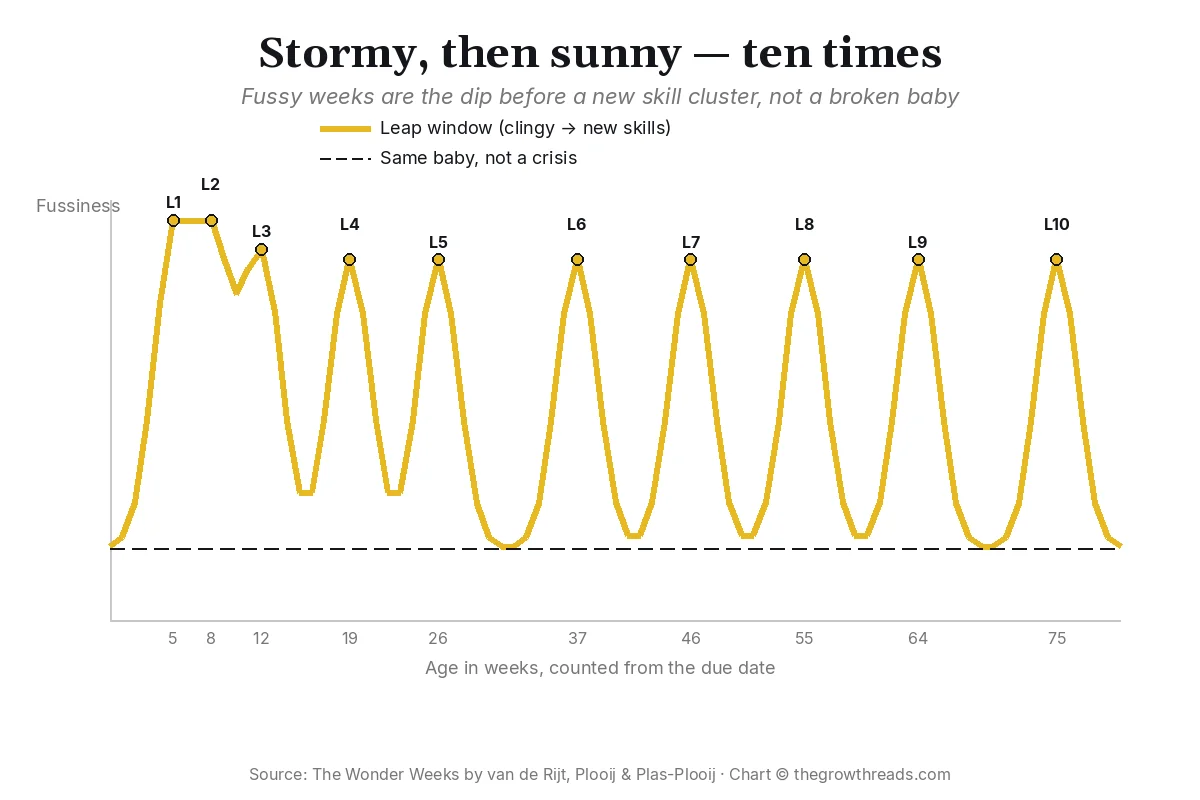
Hetty van de Rijt and Frans Plooij’s The Wonder Weeks (Dutch 1992; English 2003; sixth edition 2019 with Xaviera Plas-Plooij) is a field guide to ten timed mental leaps in a baby’s first 20 months. Count age from the due date. Each leap opens clingy and cranky, then a new kind of perception, then a skill cluster. Windows sit around weeks 5, 8, 12, 19, 26, 37, 46, 55, 64, and 75 — a map, not a court date. Last “regression”: did you rewrite the method, or add contact and play this world’s games? Fever or a feed is a clinician, not a leap. Educational, not medical advice.
Key takeaways
- Fussy is often a leap, not a verdict: Clingy plus cranky plus a shorter fuse is the opening of a new world, not proof you failed the last routine.
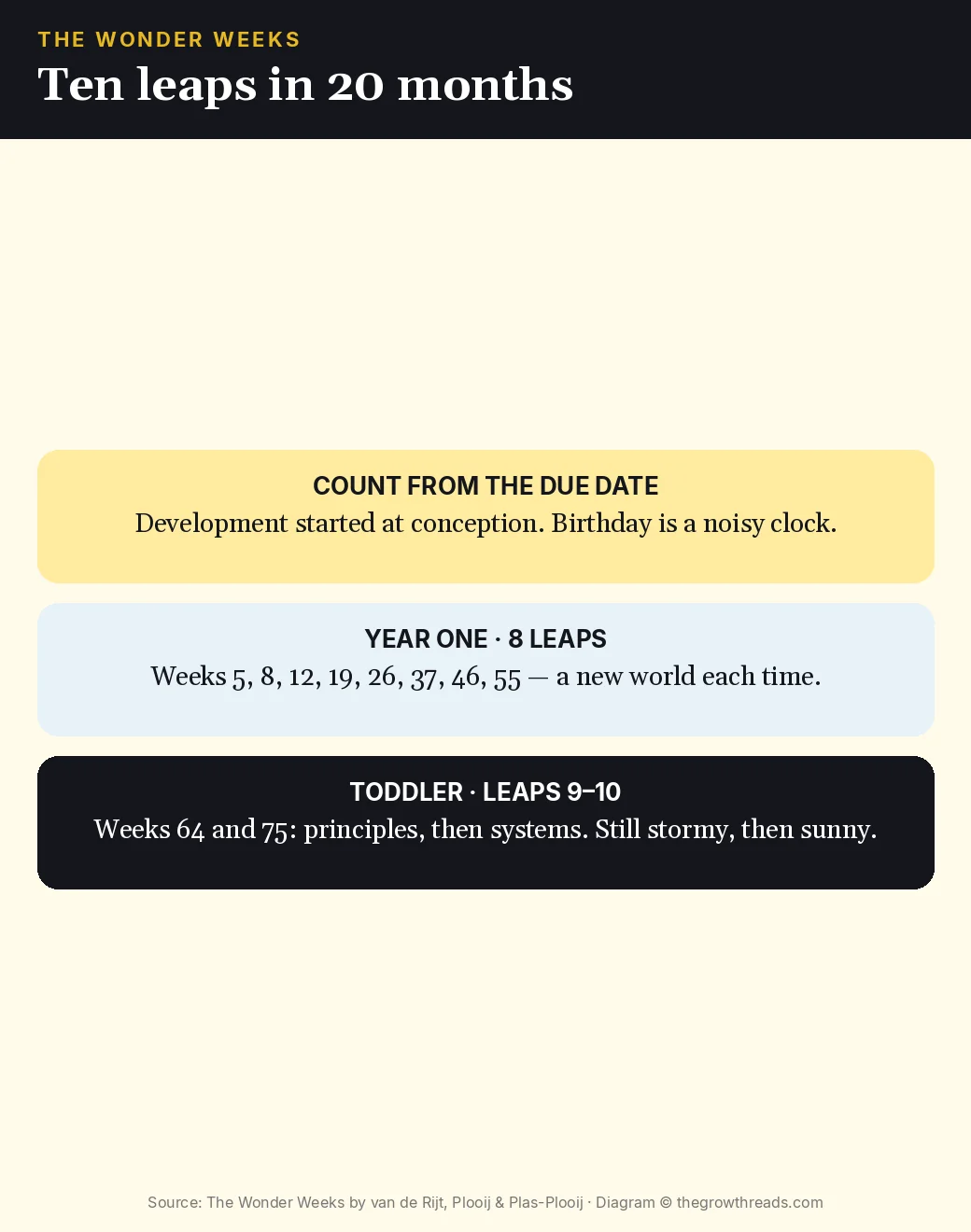
- Count from the due date: Development started at conception. Birthday is a noisy clock for these windows.
- Ten leaps in 20 months: Eight in year one, two in the toddler stretch. Each one is a new layer of perception.
- Stormy, then sunny: The dip comes first. Skills cluster after. Do not grade the baby in the dip.
- A new world bores the old toys: What worked last month can suddenly fail. That is the leap, not a spoiled child.
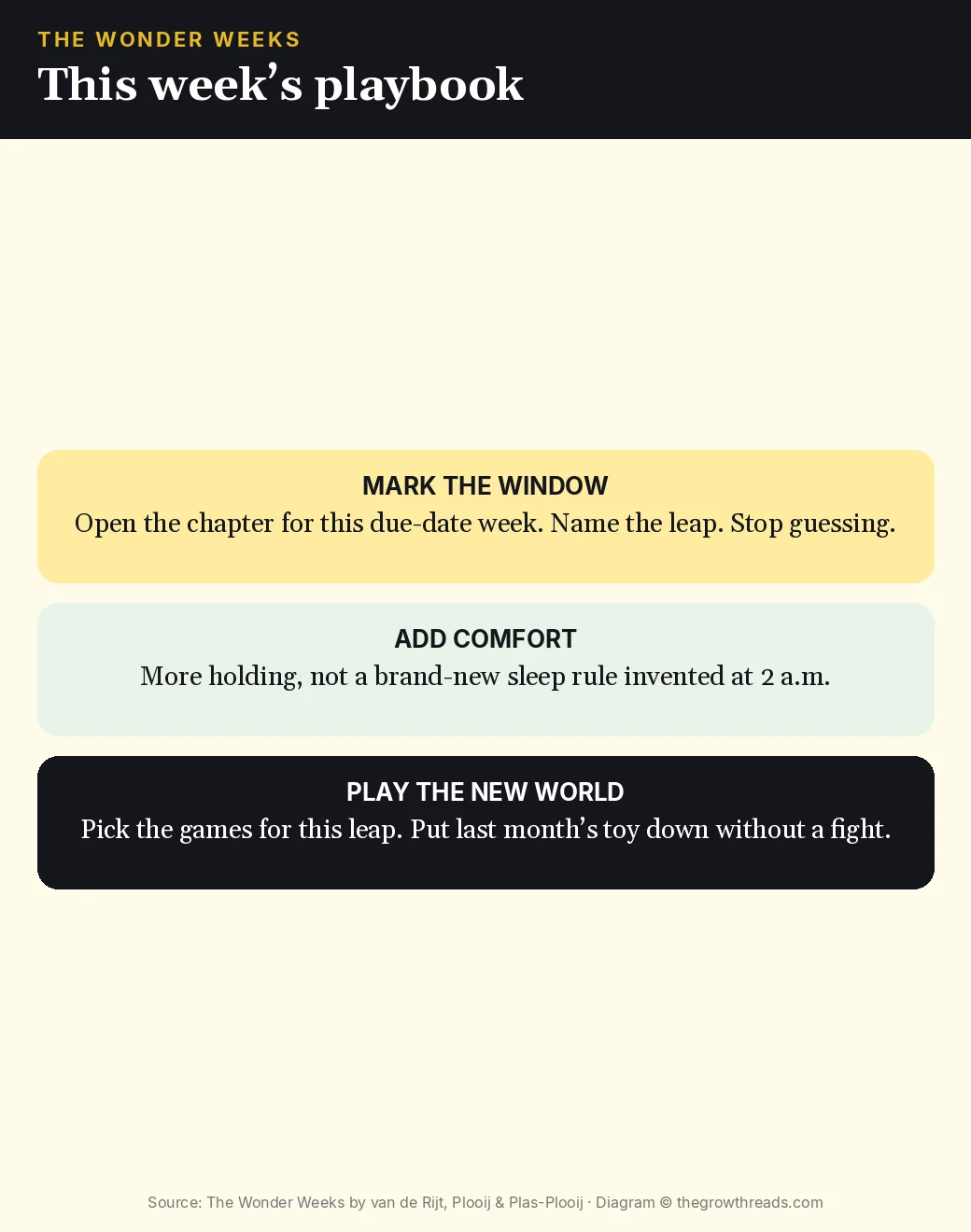
- Comfort is the job in the storm: More holding. The same sleep skeleton. Not a brand-new training program invented overnight.
- Play the world you are in: Each chapter has games that match the new perception. Use those. Put the last world down.
- Windows are ranges: Exact-day precision is the marketing version. Use the table to look up this week, not to sue the calendar.
- Sleep wobbles ride some leaps: The sixth edition’s sleep chapter says keep the routine and add contact. Nights that look like illness still belong to a clinician.
- The test is a new skill, not a quieter personality: After the window, look for what they can suddenly do — not whether they became an easy baby forever.
What is The Wonder Weeks about?
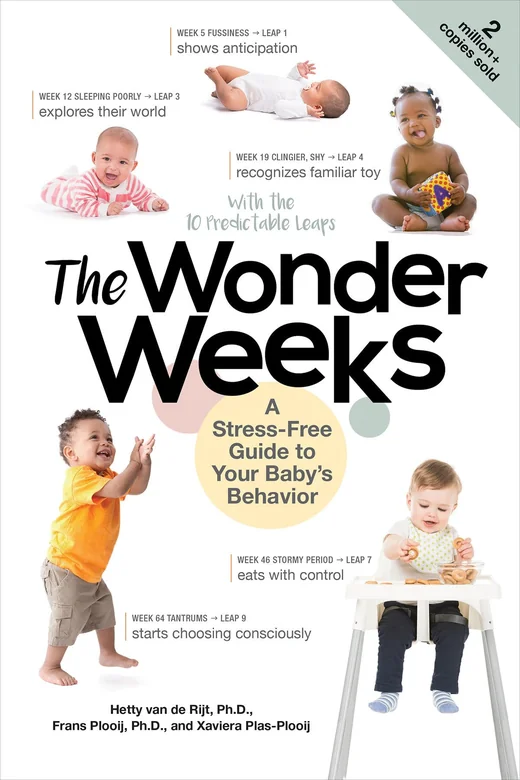
The Wonder Weeks is a parent handbook of ten age-linked mental leaps in the first 20 months: why babies get clingy on a due-date calendar, what new perception arrives next, and which games match that world. A map for a fussy week — not a substitute for a pediatrician.
About the author
Hetty van de Rijt (1944–2003) was a Dutch physical anthropologist with a Cambridge Ph.D. Frans X. Plooij (born 1946) is a Dutch behavioural biologist and developmental psychologist who took his Ph.D. at Groningen on chimpanzee infancy. In 1971–73 they watched mother–infant chimps with Jane Goodall at Gombe, then brought the same ethological eye to human families in Dutch homes: clingy “regression periods,” then a burst of new skills. The 1992 Dutch book Oei, ik groei! and the later English Wonder Weeks are that fieldwork turned into a parent calendar. After Hetty’s death, their daughter Xaviera Plas-Plooij — a journalist and the public face of the later editions and app — joined Frans on the sixth edition. The stance is practical: name the leap, add comfort, play the new world. Explore all Frans X. Plooij book summaries →
Key concepts at a glance
| Concept | What it means | Use it when |
|---|---|---|
| Due-date age | Leap timing is counted from the due date, not the birthday | A “late” baby seems off the poster’s week numbers |
| Leap | A new layer of perception comes online, then a skill cluster | Old games suddenly bore them and nights get louder |
| Stormy week | Clingy, crying, cranky opening of the leap | You are about to call it a personality change |
| Sunny week | The stretch after the dip, when new abilities show | You forgot to look for what they can suddenly do |
| New world | Sensations, patterns, events, relationships, categories, sequences, programs, principles, systems | You need this chapter’s games, not last month’s |
| Ten windows | About weeks 5, 8, 12, 19, 26, 37, 46, 55, 64, 75 | You need a page to open tonight, not a theory |
| Age-right play | Toys and games that match the new perception | A toy from the last leap now gets thrown |
| Sleep wobble | Nights can dip with a leap; keep the skeleton, add contact | You are writing a new sleep program at 2 a.m. |
Part 1: The leap calendar — due date, stormy, then a new world
The first gift is a different villain. The usual story says you spoiled them or “lost the routine.” The book says a new kind of seeing is coming online, and the old world feels wrong for a while. Age for these windows is due-date age. A baby born three weeks early is not “behind” the poster if you count from the day they were due.
The authors started with chimps, not a nursery. At Gombe they saw infants cling harder in predictable stretches, then push into new skills — a pattern ethologists had already flagged in other primates. In Dutch living rooms they asked whether human babies showed the same age-linked dips. A 1992 paper described those regressions as disorganization at the onset of a transition. Later groups in Sweden, Spain, and England looked for the same kind of period. The parent book is those notes turned into ten chapters you can open at 9 p.m.: a stormy opening, a named world, a list of games. You do not need a perfectly punctual brain to use the list. When clinging and crankiness arrive together, look up this week instead of guessing.
TGR Note: If you are still pregnant and need this week’s body-and-baby checklist rather than a leap chart, start with What to Expect When You’re Expecting. Murkoff is the week-as-unit cousin. Plooij will not write your third-trimester appointment. For adult sleep that is not a baby’s fussy window, Why We Sleep is the other door. None of them is a dare to skip a pediatrician.
Part 2: Year one — eight worlds, from sensations to programs
Year one is eight leaps. Stop treating them as eight personality changes. Week 5 is changing sensations. Week 8 is patterns — faces, repeats, “I know this.” Week 12 is smooth transitions. Week 19 is events, which is why peekaboo suddenly matters. Week 26 is relationships: distance, inside/outside, you and the toy. Week 37 is categories. Week 46 is sequences you can run. Week 55 is programs: a little plan with steps. You do not need the philosophy. You need this world’s games, because last month’s toy is now a thrown object.
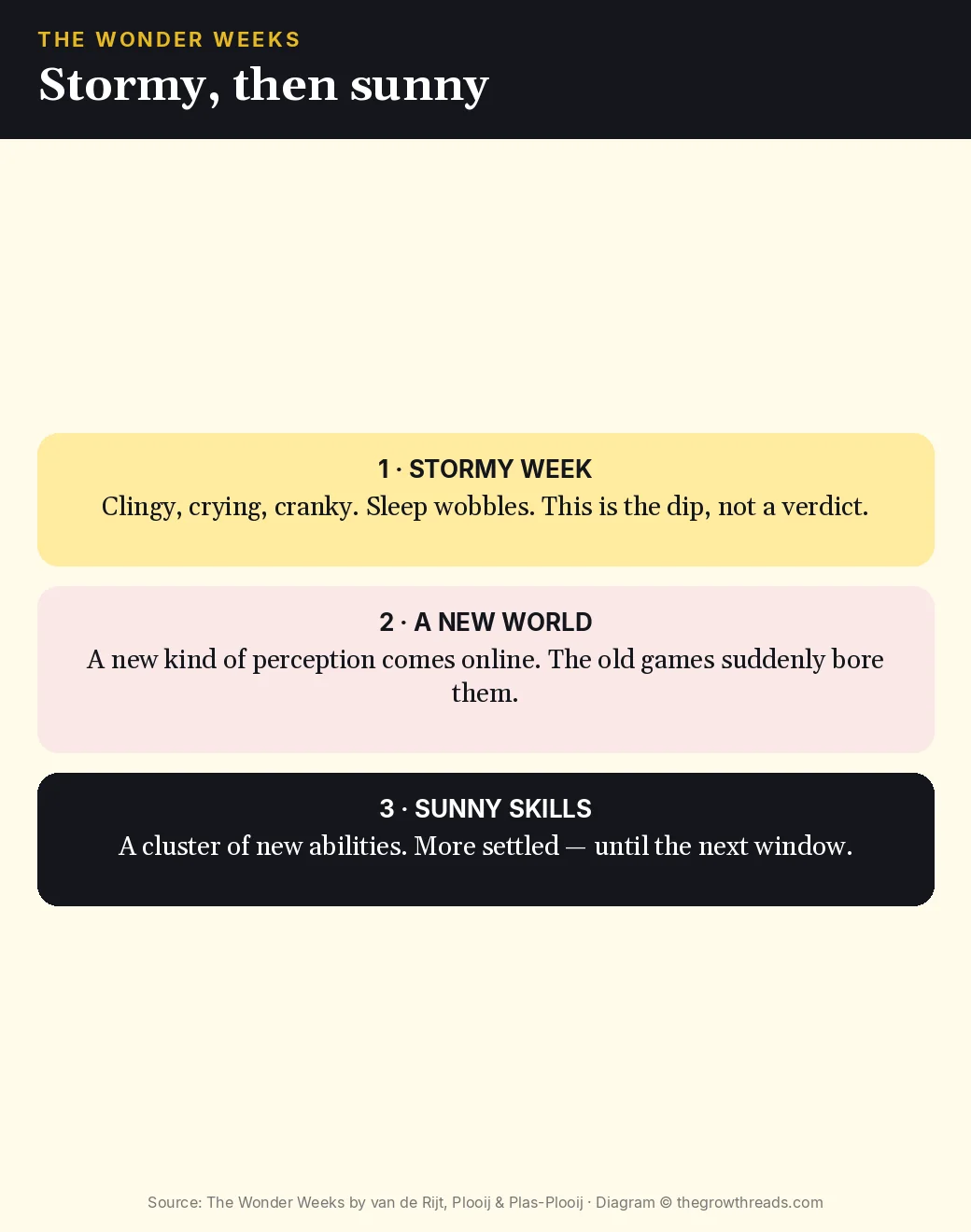
The stormy-then-sunny loop is the part you feel. In the dip the baby wants more of you. Sleep shortens. A relative says stop picking them up. The book’s move is the opposite of a toughness contest: extra contact is the point, because a new layer is coming online. Then the sunny stretch shows the cluster — a reach that works, a babble that is clearly a turn. Grade the week by the new skill, not by whether they became “easy.” Tape the due-date table inside a cupboard and steal that loop.
TGR Note: If you want the adult version of “the brain can rewire,” The Brain That Changes Itself is Doidge’s map — not a baby book, and not a reason to skip the leap in front of you. For the clock that makes nights louder in grown-ups, The Circadian Code is Panda’s meal-and-light timing. Stack after the fussy window, not instead of holding the baby.
Part 3: Toddler leaps, sleep, and the extra-comfort job
Leaps nine and ten sit in the second year: principles around week 64, systems around week 75. The storm looks different — more “no,” more choosing — and relatives will call it terrible. Same three moves: name the world, add comfort, play what matches. Principles is why a toddler suddenly cares that a rule is a rule. Systems is why the household looks like moving parts. You will not get a lab that prints “week 64.” You will get a week where the old trick stops. Open the chapter instead of raising your voice.
The 2019 sleep chapter is the piece parents were already asking the app for. Some fussy windows ride along with nights that fall apart. A to-the-day “regression calendar” would need huge samples; treat the table as a map. Keep the routine you had. Add wind-down and contact. Do not install a brand-new method at 2 a.m. because a chart said leap seven. Illness, poor feeding, or a baby who does not look like your baby still belongs to a clinician. Extra comfort is the job you can do tonight without becoming a sleep coach.
TGR Note: If the adult in the room cannot meet a fussy night because their own nervous system is loud, Full Catastrophe Living is the ten-minute floor this book will not teach. For movement as brain care later, Spark is the school-and-exercise cousin.
Part 4: Play that matches the leap — without treating a calendar as a diagnosis
Use the book without turning it into a religion. Open this week’s chapter. Pick two games. Put last month’s star toy in a basket. Write down one new skill after the dip so the storm has an ending in your notes. The calendar is not a diagnosis. It will not tell you whether a fever is a leap. One early follow-up with four babies did not find the pattern cleanly, and the authors have said illness or family stress can hide a dip. Hold the table loosely. Keep the page that tells you what to play on a Thursday.
The test is not a quieter baby forever. Did you add contact instead of a new rule. Did a skill show up that was not there last month. The 7-day plan below is our application layer, not a treatment protocol. If feeding or a medical worry is in the room, stay with the person who already knows this child. Treat a clingy week as development — and still pick up the phone when it does not look like development.
TGR Note: If the problem is adult rumination and a body that will not downshift, Why Zebras Don’t Get Ulcers is Sapolsky’s stress physiology — not a leap chart. If trauma is the door in a parent, The Body Keeps the Score and a clinician, not a stricter nap. For a pregnancy clock you can open by week, stay with What to Expect. Stack after the baby in front of you, not instead of care.
Who is The Wonder Weeks best for — and who should read something else first?
Read it if you have a baby under 20 months, you are in a clingy week, and you want a due-date calendar plus games that match a new world. It is a field handbook, not a sleep course or a medical text.
Read something else first if you are still pregnant and need this week’s body list — start with What to Expect When You’re Expecting. If the problem is adult sleep, start with Why We Sleep. If you want adult neuroplasticity, start with The Brain That Changes Itself. If a baby looks ill, skip the book and call the person who has the chart. This is not medical advice and not a substitute for pediatric care.
Questions to reflect on
- Last “regression” — did you treat it as a leap, or as a verdict on your routine?
- Are you counting from the due date, or from the birthday poster in the group chat?
- What game from last month are you still forcing that this world has outgrown?
- In the last stormy night, did you add comfort or invent a new sleep rule?
- After the last dip, which new skill showed up?
🔥 Ready to treat this fussy week as a leap?
Open this week’s chapter, add comfort, and play the new world instead of rewriting the method tonight.
How to apply The Wonder Weeks (7-day plan)
- Day 1: Write the due date. Circle today’s due-date age in weeks. Open that leap’s chapter. One page, not the whole book.
- Day 2: List three stormy signs you actually saw (cling, cry, sleep wobble). No personality essay. If a sign looks like illness, call, don’t chart.
- Day 3: Add one extra comfort block — twenty minutes of contact you would have skipped. Do not install a new sleep method.
- Day 4: Play one game from this chapter. Put last month’s star toy in a basket. Watch what they do instead of teaching.
- Day 5: Tell one other caregiver the leap’s name in one sentence. Same comfort plan. No debate club.
- Day 6: Keep the night routine you already had. More contact if they ask. Still no new protocol at 2 a.m.
- Day 7: Write one new skill that showed up. Keep one comfort habit. Leave the verdict.
Frequently asked questions
What is The Wonder Weeks about?
It is Hetty van de Rijt and Frans Plooij’s parent-facing map of ten age-linked “leaps” in the first 20 months — later editions add their daughter Xaviera Plas-Plooij and a sleep chapter. Each leap starts with a stormy window (clingy, crying, cranky), then a new kind of perception, then a cluster of skills. Age is counted from the due date, not the birthday. The usable move is to name the window, add comfort, and play the games for this world instead of inventing a personality verdict at 2 a.m. The 7-day plan in this guide is our application layer, not a protocol. It is not medical advice.
What does a “stormy week” actually look like?
A stormy week is the book’s name for the regression that opens a leap: more clinging, more crying, a shorter fuse, sleep that wobbles, and a baby who wants you and only you. It is not a diagnosis and not proof you “broke” a routine. The dip shows up because a new layer of perception is coming online, so the old world feels wrong. After it, the sunny stretch is when new skills cluster. If feeding, breathing, fever, or a rash is the story, that is a clinician, not a leap chart. Use the label to add comfort. Do not use it to delay care.
Do the leaps happen on an exact day?
No. The book gives windows counted from the due date — roughly weeks 5, 8, 12, 19, 26, 37, 46, 55, 64, and 75 — not a birthday-party alarm. Some babies show the dip early, some late, some mildly. The authors’ own research treated these as age-linked periods, not a minute-hand. Sleep researchers have said a calendar that precise would need huge samples; the practical layer still holds: when clinging and crankiness arrive together, look up this week’s world instead of rewriting your whole method overnight. Treat the table as a map, not a court date. Your pediatrician still owns anything that looks like illness.
How is a leap different from a sleep regression?
Parents use “sleep regression” for any week nights fall apart. The Wonder Weeks says some of those weeks sit on a leap: the brain is busy, the baby wants more contact, and sleep is one of the things that wobbles. The 2019 sixth edition added a sleep chapter for that reason. The move is not a brand-new training program invented at 2 a.m. Keep the routine you already had, add comfort, and play the new world in daylight. If nights were already a medical or feeding problem, stay with the person who has the chart. A leap label is a hypothesis about timing, not a sleep-course substitute.
Is this medical advice — and should I ignore my pediatrician?
No, and no. This summary and the book are educational. Van de Rijt and Plooij are researchers, not your child’s doctor. Do not skip vaccines, feeding plans, or a visit because a chapter says this is “just a leap.” Fever, poor feeding, breathing trouble, a soft spot that worries you, or a gut feeling that this is not the usual cranky week — those go to a clinician the same day. The uncontroversial layer you can use this week is extra contact, age-right play, and a due-date calendar. Personal questions go to the person who has your baby’s history.
Which edition should I buy, and how long is it?
The Countryman Press / W. W. Norton sixth-edition paperback we link is ISBN-13 9781682684276, ASIN 168268427X, 464 pages, published 10 September 2019 (the Dutch original Oei, ik groei! appeared in 1992; the first English edition in 2003). Most readers use it as a leap-by-leap handbook, not a book you finish in one sitting: open this week’s chapter, use the games, put it down. That is a nine-hour sit if you read straight through, or a year of short visits. Buy the edition you will actually keep on the changing table. The 7-day plan below is ours, not a substitute for the checklists in each leap chapter.
The Wonder Weeks vs What to Expect vs Why We Sleep — which first?
Read The Wonder Weeks first if you are in a clingy week with a baby under 20 months and you want a leap calendar plus games. Read What to Expect When You’re Expecting first if you are still pregnant and need this week’s body-and-baby list, not a leap chart. Read Why We Sleep first if the problem is adult sleep, not a baby’s fussy window. They do not cancel each other. Murkoff will not explain a 26-week “relationships” world. Walker will not tell you which toy matches leap four. Plooij will not write your third-trimester appointment. Start with the loop you are actually in this month.
Related summaries
- What to Expect When You’re Expecting — the pregnancy week-as-unit map.
- Why We Sleep — adult sleep science, not a baby leap chart.
- The Brain That Changes Itself — adult neuroplasticity.
- Full Catastrophe Living — a ten-minute floor for the adult in the room.
Browse the Best Health Books pillar.
How we analyze books: our summaries are built from a full read of the source text, cross-referenced against the author’s published interviews and research where relevant, and structured around practical application rather than critique. Read our full methodology.