

★★★★★ 4.4/5 — A Harvard cardiologist’s drill for eliciting the opposite of fight-or-flight.
Best for: People whose stress shows up as a racing heart, a tight jaw, or a mind that will not power down.
Reading time: ~4 hrs · guide: 12 min
Difficulty to apply: Easy
The Relaxation Response in one minute
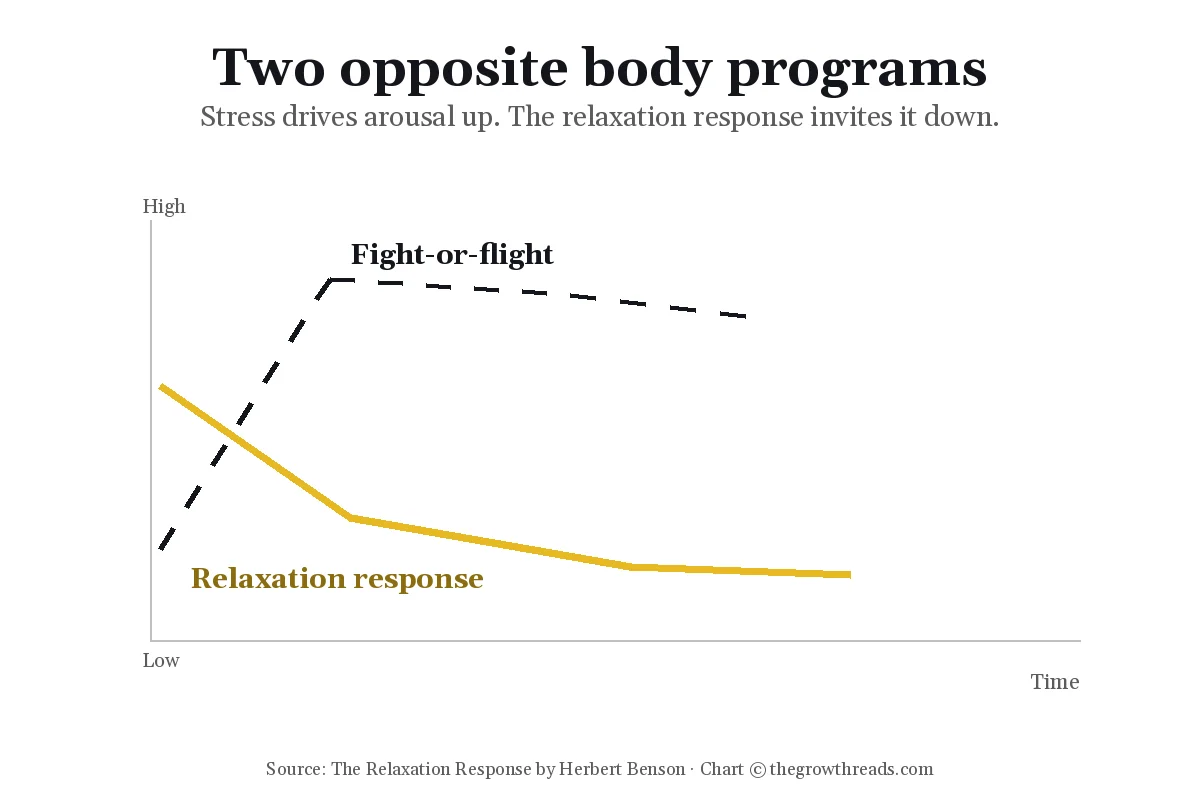
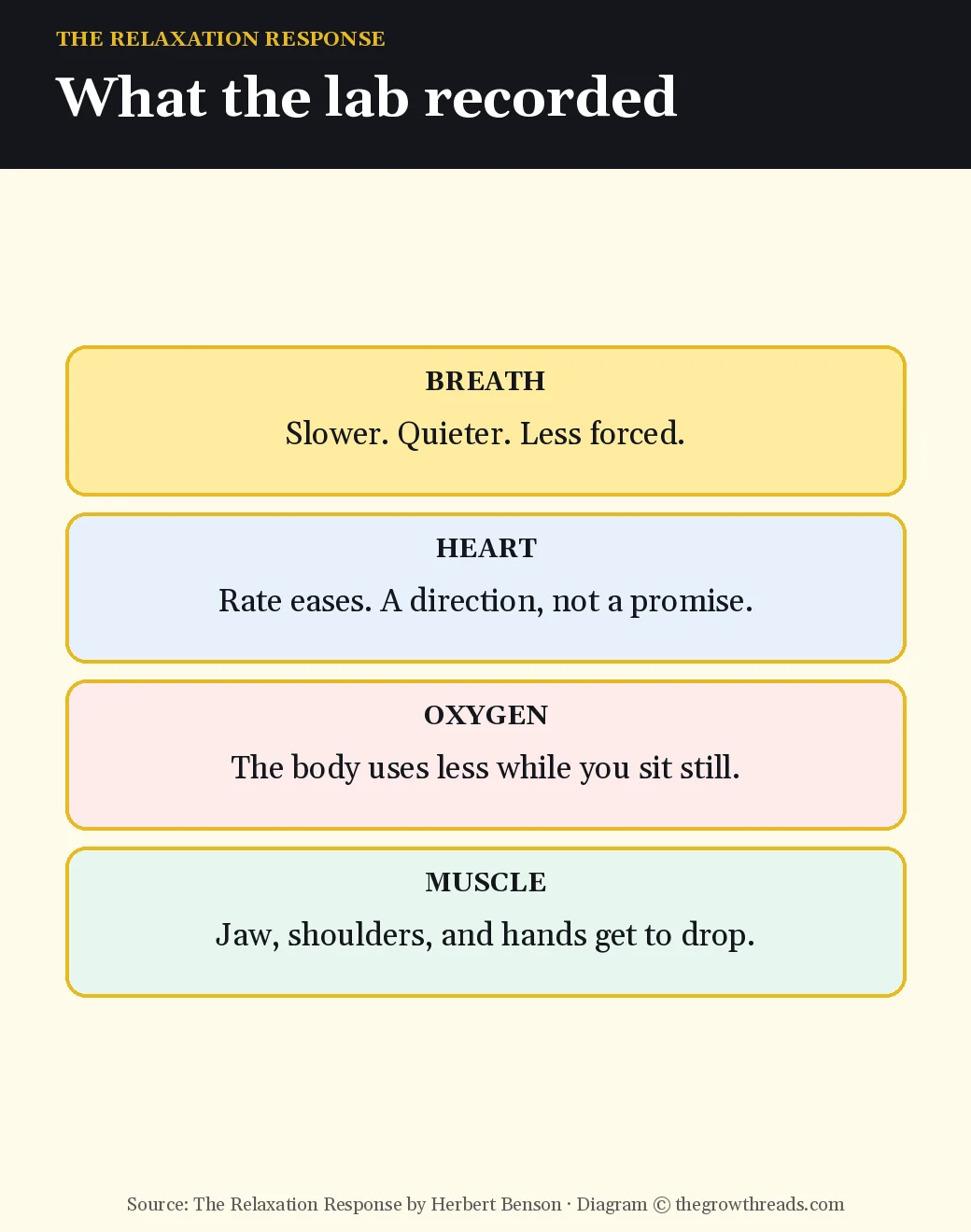
You do not have to feel calm before you can practice calm. Herbert Benson, a Harvard cardiologist, spent the early 1970s measuring people who sat quietly and repeated a simple mental device. Their breathing slowed, their heart rate eased, their muscles loosened, and their bodies used less oxygen, while they stayed awake. He named that pattern the relaxation response: the physiologic opposite of Walter Cannon’s fight-or-flight program.
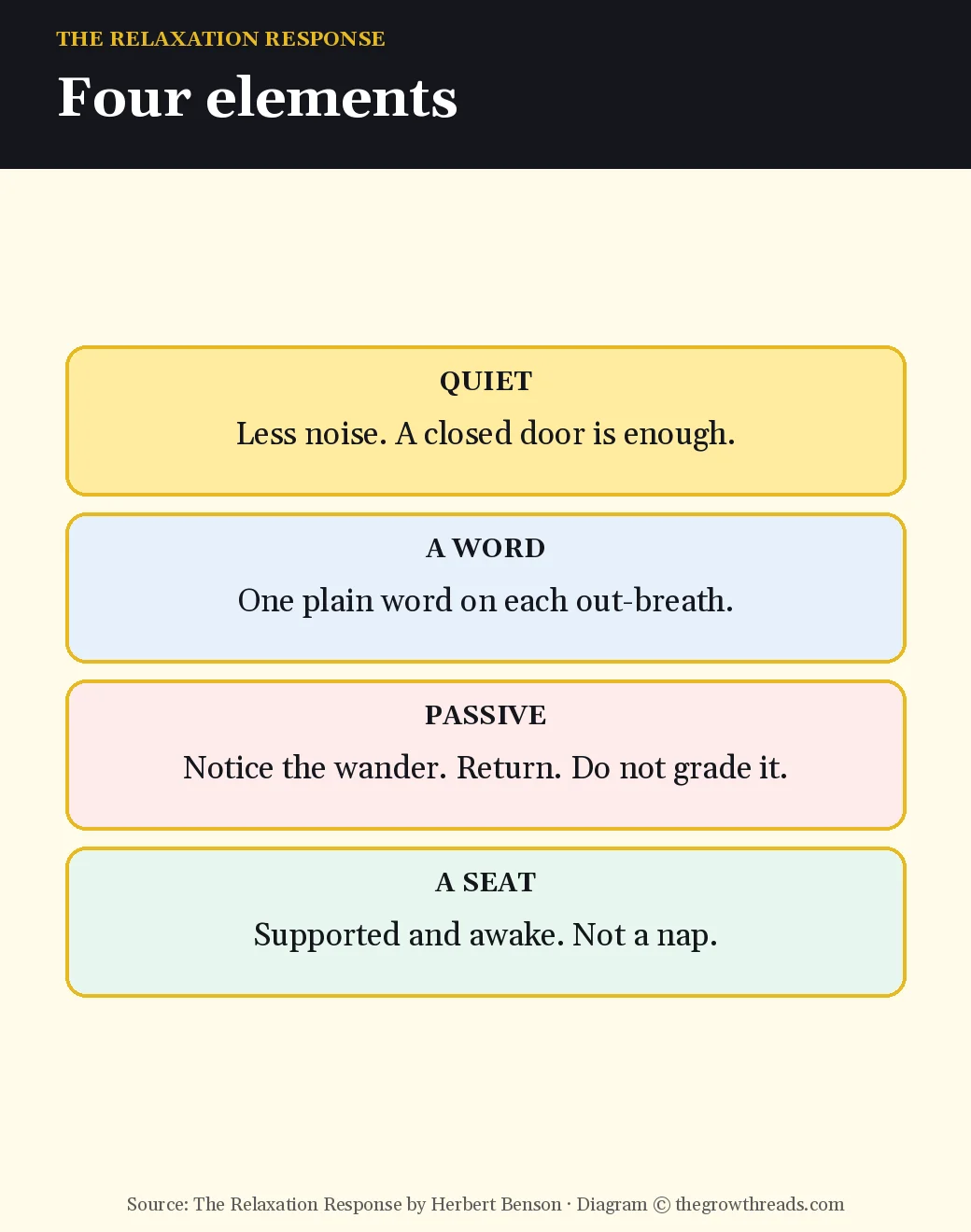
The book, written with Miriam Z. Klipper and first published in 1975, argues that this pattern is a human capacity, not the property of one tradition. You elicit it with four plain conditions: a quieter setting, one repeated word, a passive attitude when the mind wanders, and a comfortable seat. Ten to twenty minutes, once or twice a day, is the dose. Use it beside medical care, not instead of it.
Key takeaways
- Fight-or-flight is a body program: Cannon’s emergency setting raises heart rate, breath, and muscle tension. It is old hardware, not a character flaw.
- The relaxation response is the opposite program: A quiet, awake state in which those same levers move the other way.
- Meditation prompted it. No one tradition owns it: He measured Transcendental Meditation, then argued any practice with the same elements could elicit the pattern.
- Four elements are enough: A quieter setting, one repeated word, a passive attitude, and a comfortable seat.
- Passive means ungraded, not limp: When attention leaves, return to the word. Do not score the return.
- The dose is short: Ten to twenty minutes, once or twice a day, not on top of a heavy meal.
- The word can be ordinary: Benson suggested “one.” A short prayer word is fine. Novelty is not the point.
- Bring it to your clinician: Hope for blood pressure sits beside usual care, not instead of it.
- Do not grade the first week: A noisy mind is the material, not proof that you failed.
- Pair it with sleep if you need more: This is the on-ramp. It does not replace a full clinic or a real night.
What is The Relaxation Response about?
The Relaxation Response is Benson and Klipper’s case that a quiet, repeatable practice can elicit the body’s opposite of fight-or-flight. It explains the stress response, shows the laboratory pattern Benson measured, and teaches four elements anyone can use for ten to twenty minutes a day.
About the author
Herbert Benson (April 24, 1935 – February 3, 2022) was a cardiologist and a professor of mind/body medicine at Harvard Medical School. Measuring Transcendental Meditation practitioners, he found a repeatable quieting pattern: slower breathing, a gentler heart rate, lower oxygen use, and slower brain waves. He named it the relaxation response and argued that it belonged to human physiology, not to one brand of meditation. Explore all Herbert Benson book summaries →
He founded the Mind/Body Medical Institute at Massachusetts General Hospital, later the Benson-Henry Institute, and published more than 190 papers and a dozen books. Miriam Z. Klipper is the collaborating writer credited with him on this 1975 book, the short paperback that carried the method out of the lab.
Key concepts at a glance
| Concept | What it means | Use it when |
|---|---|---|
| Fight-or-flight | The emergency program that speeds heart, breath, and muscle tension. | “Just relax” fails in a real alarm. |
| Relaxation response | The awake, quiet opposite of that program. | You want a name for the state you are training. |
| Mental device | A repeated word or short phrase that gives attention a landing spot. | Silence turns into planning. |
| Passive attitude | You return when you wander, and you do not grade the return. | You keep quitting because a session felt “bad.” |
| Quiet environment | Fewer inputs. A door is enough. Perfection is not required. | You are waiting for a silent life. |
| Comfortable position | Supported, awake, not a nap posture. | You either fall asleep or you brace the whole time. |
| The dose | Ten to twenty minutes, once or twice a day, away from a heavy meal. | You want a Sunday marathon instead of a daily sit. |
| Adjunct, not a substitute | A practice to bring to care, not a reason to abandon it. | A prescription is already in the picture. |
Fight-or-flight is a body program
Benson starts where a cardiologist would. The body has a fast setting for danger. Walter Cannon called it fight-or-flight. Heart rate climbs, blood pressure rises, breathing gets quick, and muscles prepare to hit or to run. That program is a gift when the threat is real and it ends. It is a poor roommate when the threat is an inbox, a grudge, or a cuff reading you then worry about.
Vague advice does not touch a program this physical. Telling a tense person to relax is like telling a smoke alarm to be reasonable. Benson does not call anxious people weak. He treats the always-on setting as physiology that modern life pulls all day.
In the first minute of a spike, the body is ahead of the argument. The book asks for a physical counter-move you can run without winning a debate against yourself. You sit, breathe out, repeat a word, and let the emergency program lose its audience.
TGR Note: If the alarm is old trauma rather than today’s schedule, read The Body Keeps the Score before you ask a twenty-minute drill to do a therapist’s job. For the biology of chronic stress itself, Why Zebras Don’t Get Ulcers is the companion, not a competitor.
The laboratory opposite of that program
The research that pushed Benson into this book began with people who already had a practice. Transcendental Meditation was in the room, and it was measurable. Practitioners sat, used a repeated sound, and their bodies changed in a direction fight-or-flight does not go. Oxygen use dropped. Breathing slowed. Heart rate quieted. Blood lactate came down. Brain activity shifted toward the slower waves of relaxed wakefulness.
Benson’s useful move was to refuse a franchise. If the pattern showed up whenever someone repeated a mental device and took a passive attitude, then the pattern was human. A mantra could elicit it. So could a prayer word. So could the plain word “one,” said silently on the out-breath. He wanted the minimum recipe a patient could remember after the visit.
The clinical hope is modest. People with high blood pressure, tension headaches, and a body that would not come down are the readers he had in mind. He does not promise that every cuff reading will fall. He says the opposite program is trainable, and that regular practice is how you train it. Someone sits twice a day. The week is still the week. The spike, when it comes, has a shorter lease. Exact points of blood pressure belong in your own log and in a clinic, not in a slogan.
TGR Note: Breathing is the lever you can feel, which is why Breath belongs on the same shelf. The relaxation response still needs a real night: Why We Sleep covers the repair this daytime drill cannot do.
Four elements, and no single tradition owns them
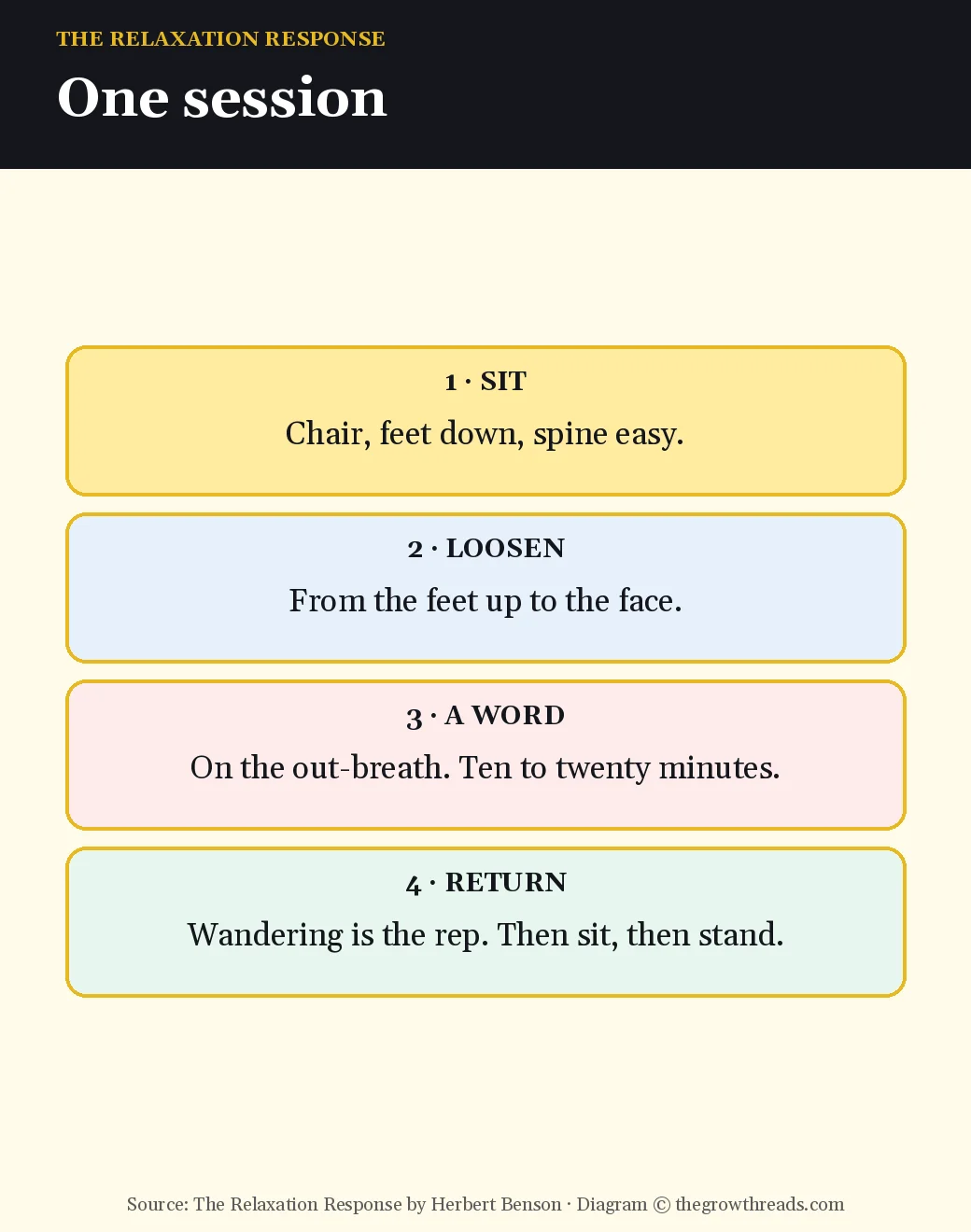
Benson reduces the elicitation to four conditions. None of them is exotic. Together they are specific enough to practice on a Wednesday.
A quiet environment means fewer inputs, not a monastery. A closed door, a parked car, a chair with the phone in another room. If you wait for a silent life, you will not practice. Turn one noise down for the length of the session.
A mental device is a place to put attention. The book’s suggestion is the word “one,” repeated silently on each out-breath. A short phrase from a faith you actually hold can serve the same role. A rotating set of clever words will not. The device works because it is boring. The mind wants a problem. You hand it a word instead.
A passive attitude is the element people skip. You will think about email. The instruction is not to purge the thought. It is to decline the second thought, the one that says you are failing. Return to the word. Worrying about whether you are doing it right is itself effort, and effort feeds the program you came to set down.
A comfortable position keeps you awake and unhurt. Sit in a chair that holds you, feet on the floor. Lying down is a nap risk. The aim is relaxed wakefulness. Sleep is a different prescription, and it has its own hour.
TGR Note: If you want the eight-week clinic around this same territory, go to Jon Kabat-Zinn’s Full Catastrophe Living. Benson is the single lever. Kabat-Zinn is the longer course. Start with the lever if twenty minutes is all this week will honestly hold.
How to elicit it on an ordinary day
Sit comfortably and close your eyes. Loosen the body from the feet toward the face. On each out-breath, say your one word silently. Continue for ten to twenty minutes. When you notice you have left, come back. At the end, sit for a minute before you open your eyes, then stand. Jumping straight into email throws the emergency program a fresh bone.
Twice a day is the book’s preferred rhythm. Once a day still counts if twice would make you quit. Do not stack the session on a large meal. Benson noted that digestion competes with the quieting pattern, so leave a couple of hours after you eat. Morning is the easy window. A second short sit in the late afternoon catches the hour when the jaw has clenched since lunch.
Skip the harsh alarm. Glance at a clock if you must, then close your eyes again. Do not practice while driving, and do not treat a session as permission to skip medicine, sleep, or a visit you already need. One word, one chair, two weeks. If a sit feels useless, write “returned” and go to work. The return was the session. Later Benson books explore belief and healing. You do not need them to use this one. The paperback we linked is the 2000 William Morrow edition, Benson and Klipper on the byline.
Who is The Relaxation Response best for — and who should read something else first?
Read this if you want one physical practice for stress and you will actually sit for fifteen minutes. It fits a blood-pressure conversation, shoulders that live near the ears, and anyone who has been told to relax and would like a procedure instead of a mood.
Read something else first if the alarm is trauma, panic that needs a clinician, or pain that has swallowed the week. Start with The Body Keeps the Score, and use Benson’s drill as a companion once you have support. For a full curriculum, start with Full Catastrophe Living. For the science of chronic stress before any technique, start with Why Zebras Don’t Get Ulcers. This book will not tell you what to eat or how to lift. It makes those efforts easier to keep.
Questions to reflect on
- Where did fight-or-flight show up in your body in the last two days: jaw, chest, hands, stomach, or none of those?
- Which single word will you repeat for the next fourteen days, and where will you write it so you do not renegotiate?
- What fifteen-minute window is actually free, and is it at least two hours after the meal that knocks you out?
- When a session feels pointless, what sentence will you use instead of “I am bad at this”?
- Which one signal will you watch for two weeks — sleep onset, afternoon tension, or a home pressure log — without changing any treatment on your own?
🔥 Ready to elicit the relaxation response?
A short book you can turn into a ten-to-twenty minute drill this week.
How to apply The Relaxation Response (7-day plan)
This is a reading plan for the book, not medical advice. If you are being treated for blood pressure, heart disease, or a mental health condition, keep that care in place and tell your clinician you are adding a short seated practice.
- Day 1 — Write the four elements. Quiet, one word, passive attitude, a real chair. Choose the word. Do not practice yet. Leave the phone outside that room.
- Day 2 — One ten-minute sit. Feet down, eyes closed, loosen from the feet up, word on the out-breath. When you wander, return. Stop at ten.
- Day 3 — Add a one-line log. Before and after, note jaw, breath, and mood in four words. No score. The log is a witness, not a judge.
- Day 4 — Lengthen or repeat. Take the sit to fifteen minutes, or add a second ten-minute sit. Do not do both.
- Day 5 — Count returns, not failures. Twelve returns is a trained session. If you skipped because yesterday felt silly, that is the sit to repair.
- Day 6 — Tie it to a cue you already keep. After the kettle or after the laptop closes. Not within two hours of a heavy meal. No harsh alarm.
- Day 7 — Keep the drill. Stay with Benson another week if the sit is usefully boring. Move toward Kabat-Zinn if you want the longer clinic. If blood pressure brought you here, bring the log to your next visit. Do not edit your own treatment.
Frequently asked questions
What does Benson mean by a “passive attitude”?
A passive attitude means you stop scoring the session while it is happening. The mind will leave. That is not a failed rep. Benson’s instruction is to notice you have drifted, decline the little lecture, and come back to the word. Straining to be peaceful is still a form of effort, and effort is the fight-or-flight program wearing a calm costume. Passive does not mean slumped or half-asleep. It means you let the quiet arrive at its own pace and you treat distraction as a bell, not a verdict. If you finish and feel nothing special, the practice still counts. The book is training a response, not a mood.
What is the relaxation response, in plain words?
It is the name Benson gave to a quiet, awake state that runs opposite the fight-or-flight program. Breathing slows, the heart rate eases, muscles loosen, and the body uses less oxygen. You are not asleep, and you are not talking yourself into a feeling. A repeated mental device, usually one simple word, plus a passive attitude toward whatever the mind does next, is enough to elicit it. Benson’s point was that many traditions had been producing this pattern for centuries. He described it in the language of a cardiology lab so a reader could practice it without joining a particular school.
How is this different from resting or from sleep?
Rest can be a collapsed evening on the couch with a racing mind. Sleep is a different brain state, and you cannot run your day from it. The relaxation response is a deliberate, eyes-closed quiet in which you stay awake and keep a very small job: the out-breath and the word. Benson measured it as its own pattern, not as a nap and not as ordinary sitting. People who fall asleep in the chair are usually tired, or they practiced lying down. Sit supported, keep the session short, and let real sleep happen at night. The drill is a daytime way to come down, not a substitute for the night.
Does the book say this replaces blood-pressure medicine?
No. This summary is a reading of the book, not medical advice, and it is not a reason to change a prescription on your own. Benson was a cardiologist writing for people whose pressure, headaches, or worry sat on top of an always-on alarm. He presented the practice as something to bring alongside usual care, not as a replacement for it. Some readers in the book see lower readings when they practice regularly. That is a reason to keep a log and show it to your clinician. It is not a reason to empty the pillbox because a session felt pleasant.
Which word should I repeat, and does it have to be “one”?
Benson offered the word one because it is plain and it does not drag a story behind it. A short prayer word from your own tradition works for the same reason, if you can say it without turning the session into a performance. The mental device gives attention a place to land. Pick one word and keep it for a month. Switching words every day is another way of trying hard. If a sacred word matters to you, use it with the same passive attitude. If it does not, one is enough. The physiology he described does not depend on a brand name.
How long before the practice is worth keeping?
Give it two weeks of short, boring sessions before you judge it. Benson’s dose is ten to twenty minutes, once or twice a day, not a heroic hour on Sunday. The first days often feel like nothing, or like a catalogue of undone tasks. That is the mind doing what minds do. Keep the window small enough that you do not negotiate with it. A useful check is crude and personal: how fast you fall asleep, whether your jaw is tight at four in the afternoon, whether you snap at the first interruption. Do not expect a personality transplant. Expect a slightly quicker path back to baseline.
How is this different from Full Catastrophe Living?
Full Catastrophe Living is Jon Kabat-Zinn’s book-length clinic: an eight-week mindfulness course with body scans, yoga, and a lot of guided practice. The Relaxation Response is the shorter on-ramp. Benson isolates one physiologic pattern and the four conditions that elicit it, then asks you to run that drill. Read Benson when you want a single lever this week. Read Kabat-Zinn when you want the longer container, a teacherly curriculum, and a wider set of practices around pain and illness. They are allies. Many people do well to start with Benson’s twenty minutes, then move to Kabat-Zinn if they want the full course.
Related summaries
- Full Catastrophe Living — the eight-week mindfulness clinic if you want a longer course after this drill.
- Why Zebras Don’t Get Ulcers — the biology of why human stress lingers.
- Breath — what to do with the inhale and the exhale once you are actually sitting.
- Why We Sleep — the night shift this daytime practice cannot replace.
- Best health books — the Health shelf this summary joins.