
Money is a tool — and the best finance books teach you how to wield it wisely. From building wealth on any income to understanding the psychology behind your spending, these books cut through the noise with practical, evidence-based strategies.
Top 10 Money & Finance Books
Our highest-rated picks — based on depth, practicality, and lasting impact.
Latest Summaries
Recently published reviews in this topic.


All Money Book Reviews
The Intelligent Investor Summary & Review: Timeless Wisdom for Building Wealth
Benjamin Graham's definitive guide to value investing. Mr. Market, margin of safety, defensive vs enterprising investing, and a 7-day action plan.
Read Review
The Millionaire Next Door Summary & Review: How Wealth Is Actually Built
Real millionaires live below their means. Our full Millionaire Next Door summary covers Stanley and Danko's PAWs vs UAWs, the wealth formula, FAQs and...
Read Review
I Will Teach You to Be Rich Summary & Review: The 6-Week Money Automation System
Automate your money, spend on what you love. Our full I Will Teach You to Be Rich summary covers Ramit Sethi's conscious spending plan...
Read Review
Think and Grow Rich Summary & Review: Napoleon Hill’s Timeless Success Formula
Napoleon Hill's 1937 classic distilled the mindset of 500 wealthy achievers. Our full Think and Grow Rich summary covers the 13 principles, the 6-step...
Read Review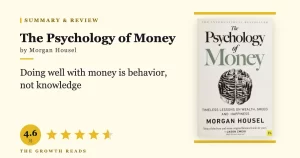
The Psychology of Money Summary & Review: Why Your Mindset Matters More Than Your Portfolio
Doing well with money is about behavior, not brains. Our full Psychology of Money summary covers Morgan Housel's key lessons, takeaways, FAQs, and a...
Read ReviewBrowse All Money & Finance Summaries
We’ve reviewed 59 money books — each with key takeaways, practical lessons, and honest ratings.
How We Select & Review Money Books
The Growth Reads editorial team reads every money and personal-finance book we cover in full before writing a summary. We prioritize books grounded in verifiable numbers — actual historical returns, published research on saving and investing behavior, or decades of real-world track records — over books that promise a shortcut without showing their work.
Each book is evaluated against the same three criteria we use across every topic on this site: depth (does it go beyond generic “spend less than you earn” advice?), practicality (can you actually apply its system with your own paycheck and accounts?), and lasting impact (does its core argument still hold up years after publication, through different market conditions?). Where a book cites a specific statistic — a historical stock-market return, a savings rate, a compounding example — we check it against the author’s own sourcing rather than repeating the claim uncritically.
Books enter this topic from several directions: investing classics that have survived multiple market cycles (The Intelligent Investor, One Up On Wall Street, A Random Walk Down Wall Street), behavioral and psychology-driven money books (The Psychology of Money, The Behavior Gap), practical budgeting and system books (You Need a Budget, I Will Teach You to Be Rich), and newer additions covering modern income streams and FIRE-style independence (Quit Like a Millionaire, Just Keep Buying, The 5 Types of Wealth). We periodically re-review earlier summaries to make sure the numbers and examples still hold up.
Every summary ends with a practical takeaway, not just a recap of the book’s argument, and every rating reflects an honest read of the whole book, not the publisher’s marketing copy. We are an independent publisher: our reviews aren’t affiliated with or endorsed by the authors or publishers of the books we cover, and while some links on this page are affiliate links (Amazon, Bookshop.org), that has no bearing on which books make this list or how we rate them.
Nothing on this page is personalized financial advice — these are book summaries and reviews, not a substitute for a licensed financial advisor who knows your specific situation.
For our full ranked countdown, see 24 Best Money Books of All Time.
Frequently Asked Questions
What’s the best book to understand money and personal finance?
For a broad, foundational start, The Psychology of Money by Morgan Housel is the most-cited modern classic — it explains the behavioral side of money rather than tactics. For investing specifically, The Intelligent Investor by Benjamin Graham and One Up On Wall Street by Peter Lynch are the two most-recommended starting points.
What money books do professional investors actually read?
The Intelligent Investor, Poor Charlie’s Almanack, and Common Stocks and Uncommon Profits are the three most frequently cited by professional and semi-professional investors, since all three are grounded in decades of market-tested principles rather than short-term tactics.
Is Rich Dad Poor Dad worth reading?
Yes, but treat it as a mindset book rather than a tactical investing manual — its core distinction between assets and liabilities has reshaped how millions of readers evaluate spending. Pair it with a systems book like I Will Teach You to Be Rich for the practical “how.”
Best money book for beginners or students?
I Will Teach You to Be Rich by Ramit Sethi and You Need a Budget by Jesse Mecham are the two most practical starting points for anyone setting up their finances for the first time — both give concrete, step-by-step systems rather than general philosophy.
How many money books should I read to get the basics?
Three to five is enough to cover the fundamentals: one behavioral/mindset book (The Psychology of Money), one budgeting/system book (I Will Teach You to Be Rich or You Need a Budget), and one investing classic (The Intelligent Investor or One Up On Wall Street). Beyond that, further reading has diminishing returns unless you’re specializing in a specific strategy.
What money book should I start with?
The Psychology of Money for a broad, low-commitment classic that applies no matter your income or goals, or The Simple Path to Wealth if you want a direct, no-nonsense investing plan.
Should I read money books or just talk to a financial advisor?
They serve different purposes — books teach the underlying principles and behavioral discipline that apply to any financial situation, while a licensed advisor can give personalized advice for your specific accounts, tax situation, and goals. We’d recommend both: read the books to understand the “why,” and talk to a professional for decisions specific to your circumstances. Nothing here is a substitute for licensed financial advice.
What books does Warren Buffett recommend on investing?
Buffett has repeatedly recommended The Intelligent Investor by his mentor Benjamin Graham as the best book ever written on investing, and Poor Charlie’s Almanack (the collected wisdom of his longtime partner Charlie Munger) for the broader mental-models approach behind Berkshire Hathaway’s decisions.
Are FIRE (financial independence) books like Quit Like a Millionaire realistic?
The underlying math — save and invest a high percentage of income, let compounding do the work — is sound and well-documented. Whether the specific timelines in books like Quit Like a Millionaire or Financial Freedom are realistic for you depends heavily on your income, location, and risk tolerance; treat the framework as directional, not a guarantee.
How often is this list updated?
We review and refresh this page at least yearly, and add new money and personal-finance books as they’re published and reviewed. Older summaries are periodically checked to confirm cited statistics and market examples still hold up.
Explore Other Topics
More book summary hubs on The Growth Reads.