

★★★★☆ 4.2/5 — The sharpest, most rigorous skeptic’s case for why deep learning alone isn’t enough.
Best for: Readers who want a technically grounded counterweight to AI hype, and a clear-eyed view of what “trustworthy AI” would actually require.
Reading time: ~7 hrs to read the full book · 11 min for this guide
Difficulty to apply: Moderate — the ideas mostly change how critically you evaluate AI claims, more than they change daily habits.
Rebooting AI in one minute
Deep learning is extraordinarily good at pattern-matching and extraordinarily bad at understanding — and mistaking one for the other is the single biggest source of overconfidence in AI today. Gary Marcus, a cognitive scientist, and Ernest Davis, a computer scientist, make a technically grounded case that today’s most celebrated AI systems lack genuine common sense: a working model of how objects, people, and causes behave in the world. That gap explains why systems that ace benchmark tests can still fail embarrassingly on situations a five-year-old would handle easily.
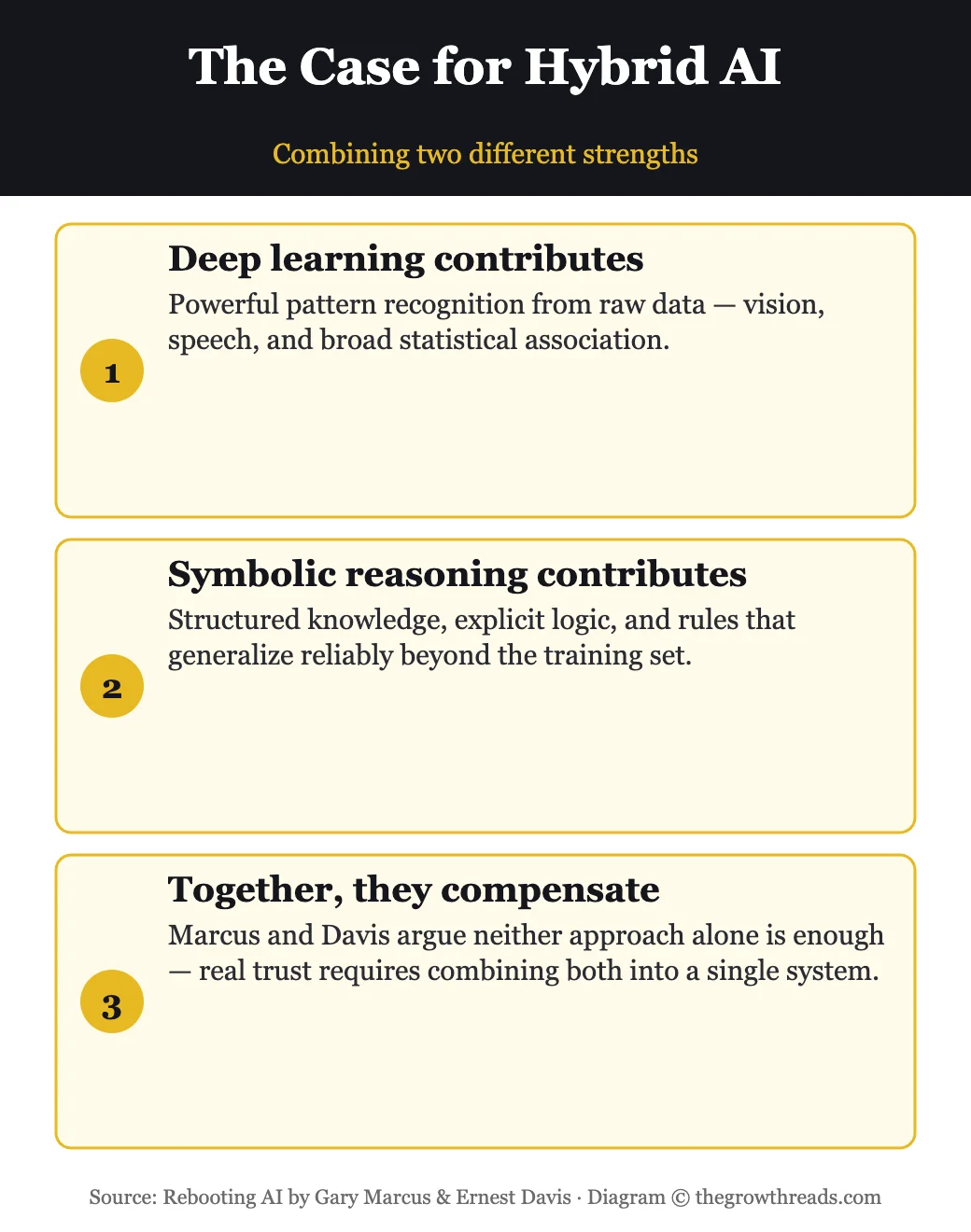
Their proposed fix isn’t to abandon deep learning, but to combine it with symbolic reasoning — structured knowledge and explicit logic that generalizes reliably, rather than statistical correlation that only works within the bounds of its training data. The book was written specifically as a corrective to AI hype cycles, and its core technical critique has aged well as a lens for evaluating each new wave of AI systems, including today’s large language models.
Key takeaways
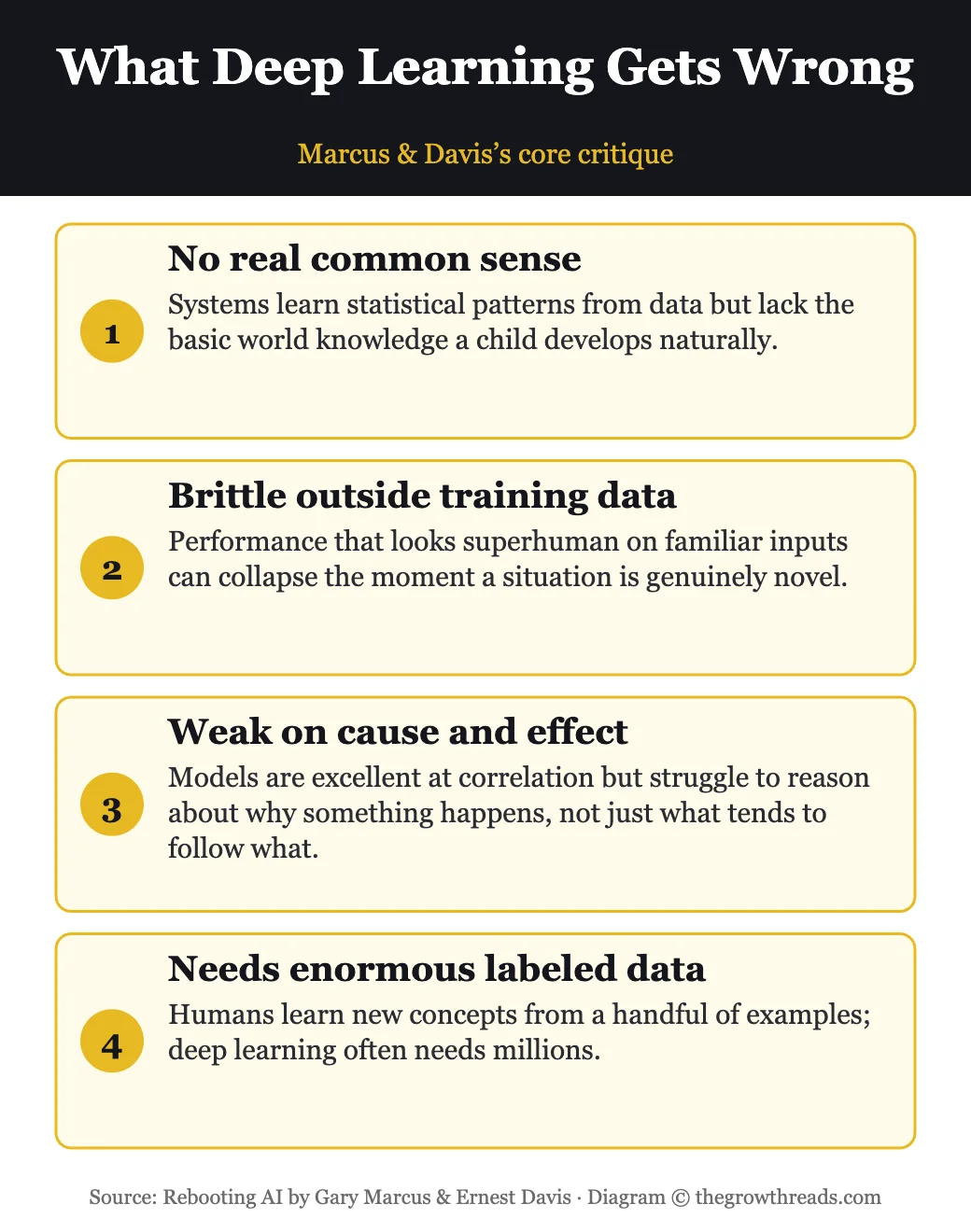
- Deep learning is pattern-matching, not understanding. It finds statistical regularities in data without building a genuine model of how the world works.
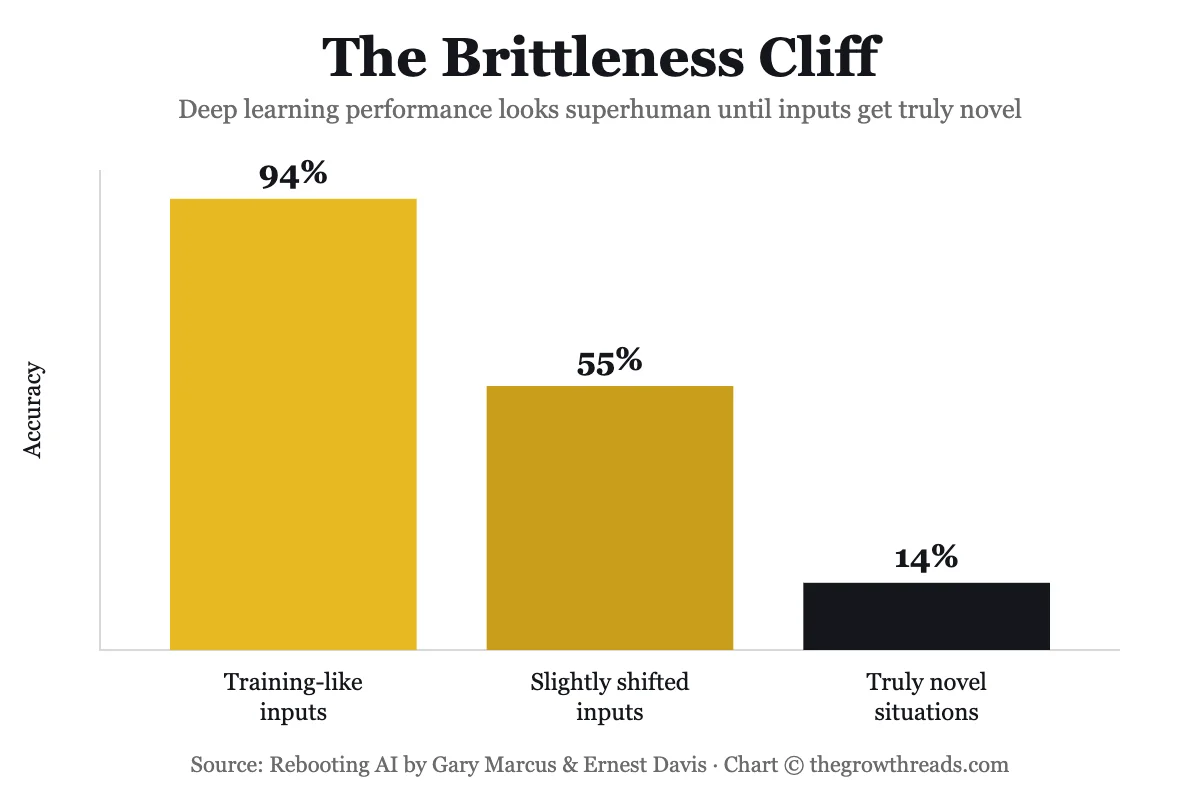
- Impressive benchmark performance can hide deep brittleness. A system that scores well on standard tests can fail badly the moment inputs shift even slightly from its training distribution.
- Common sense is the missing ingredient. Humans reason about unfamiliar situations using a lifetime of basic physical and social knowledge that current AI systems don’t genuinely possess.
- Correlation isn’t causation, and AI mostly learns correlation. Deep learning systems are weak at reasoning about cause and effect, which limits how well they generalize to genuinely new situations.
- Data efficiency reveals the gap. Children learn new concepts from a handful of examples; deep learning models often require millions, a sign something fundamental is still missing.
- Hybrid AI is the proposed path forward. Combining deep learning’s pattern recognition with symbolic reasoning’s structured knowledge is Marcus and Davis’s core technical recommendation.
- Trustworthy AI requires more than accuracy. It requires robustness to novelty, transparency about reasoning, and genuine causal understanding, not just a high score on a leaderboard.
- Overclaiming AI capabilities has real costs. The authors argue that hype cycles lead to premature deployment in high-stakes domains where brittleness has serious consequences.
- Skepticism and progress aren’t opposites. The authors position their critique as a way to accelerate real progress, not to dismiss AI research altogether.
- The book’s core argument remains a live debate. The tension between scaling pure deep learning versus building in structured knowledge is still central to AI research today.
What is Rebooting AI about?
Rebooting AI argues that today’s deep learning systems excel at pattern-matching but lack genuine common sense and causal understanding, making them more brittle than their benchmark scores suggest. Gary Marcus and Ernest Davis propose combining deep learning with symbolic reasoning as the path to AI that’s actually trustworthy, rather than merely impressive on familiar tests.
About the authors
Gary Marcus is a cognitive scientist, entrepreneur, and professor emeritus at NYU, known both for his research on human language and cognition and for being one of AI’s most prominent public skeptics of pure deep-learning approaches. Ernest Davis is a computer science professor at NYU specializing in common-sense reasoning and knowledge representation, giving the book a rigorous technical foundation beneath its accessible, argument-driven prose. Together they bring complementary expertise — Marcus on how human minds actually reason, Davis on how to formally represent that reasoning in machines — that shapes the book’s central hybrid-AI argument.
| Concept | What it means | Use it when |
|---|---|---|
| Common sense | A working, general model of everyday physics, people, and objects | Explaining why an AI system fails at something a child would find obvious |
| Brittleness | Strong performance on familiar inputs that collapses on novel ones | Diagnosing why a benchmark-topping model still fails in the real world |
| Symbolic reasoning | Structured knowledge and explicit logic, as opposed to statistical pattern-matching | Understanding the alternative approach Marcus and Davis want combined with deep learning |
| Hybrid AI | Systems that combine deep learning’s pattern recognition with symbolic reasoning’s structure | Evaluating proposed paths toward more reliable AI |
| Causal reasoning | Understanding why something happens, not just what tends to follow what | Assessing whether a system can generalize to genuinely new situations |
| Data efficiency | How many examples a system needs to learn a new concept reliably | Comparing how “smart” a system’s learning process really is |
Part 1: Why deep learning’s success is narrower than it looks
Marcus and Davis open by acknowledging deep learning’s genuine achievements — image recognition, speech transcription, game-playing — before methodically dismantling the assumption that these successes generalize into broad intelligence. Their core technical point is that deep learning systems are pattern-matchers operating over statistical regularities in training data, not systems that build a genuine causal model of the world. This distinction explains a recurring pattern the authors document extensively: systems that achieve superhuman scores on standard benchmarks can fail in ways that look almost comical the moment an input shifts even slightly outside the training distribution — a stop sign with a sticker on it, a sentence phrased in an unusual but perfectly grammatical way, an image rotated by an angle the training set never included.
The authors are careful technical writers, and much of the book’s persuasive power comes from walking through specific documented failures rather than asserting the critique abstractly. The throughline is always the same: benchmark accuracy measures performance on a particular distribution of test cases, and that’s a fundamentally different thing from robust understanding.
TGR Note: Janelle Shane documents the same brittleness pattern with much lighter, funnier examples in You Look Like a Thing and I Love You — this book supplies the rigorous technical case underneath those hilarious failures.
Part 2: The case for combining deep learning with symbolic reasoning
Having diagnosed the problem, Marcus and Davis turn to their proposed solution: hybrid AI that combines deep learning’s strength at pattern recognition with symbolic reasoning’s strength at structured, generalizable logic. Symbolic systems, an older approach to AI, encode explicit knowledge and rules — the kind of representation that lets a system reason reliably about situations it has never literally seen before, because it’s reasoning from principles rather than matching to prior examples.
The authors don’t argue for abandoning deep learning; they argue neither approach alone is sufficient, and that the field’s near-total focus on scaling deep learning at the expense of symbolic methods was a strategic mistake. This argument was contrarian when the book published, given how dominant pure deep-learning approaches had become, and it remains one of the more actively debated positions in AI research — later, larger language models achieved impressive results through scale alone, while still exhibiting many of the exact brittleness patterns the book documents.
TGR Note: Ajay Agrawal, Joshua Gans, and Avi Goldfarb’s distinction between prediction and judgment in Prediction Machines maps closely onto this book’s split between pattern-matching and reasoning — both books locate the same gap, from different disciplinary angles.
Part 3: What it would take to build AI we can actually trust
Marcus and Davis do not just diagnose deep learning’s weaknesses — they lay out a constructive path forward. Their core proposal is hybrid AI: systems that combine the pattern-recognition strengths of neural networks with the structured, symbolic reasoning that classical AI pioneered decades ago. Instead of treating deep learning as the whole solution, they argue it should be one component inside a larger architecture that also includes explicit knowledge representation, causal models, and built-in common sense.
The authors sketch four standards any AI system needs to clear before it deserves real trust. It needs a foundation of common sense — the vast web of everyday facts about how objects, people, and situations behave that humans absorb without ever being explicitly taught. It needs robustness — the ability to perform reliably even when the input drifts away from the exact distribution it was trained on, rather than failing silently or bizarrely. It needs transparency — the capacity to explain its reasoning in terms a person can audit, not just produce an unexplainable output. And it needs causal understanding — a grasp of why things happen, not just which patterns tend to co-occur, so the system can reason about interventions and counterfactuals instead of only correlations.
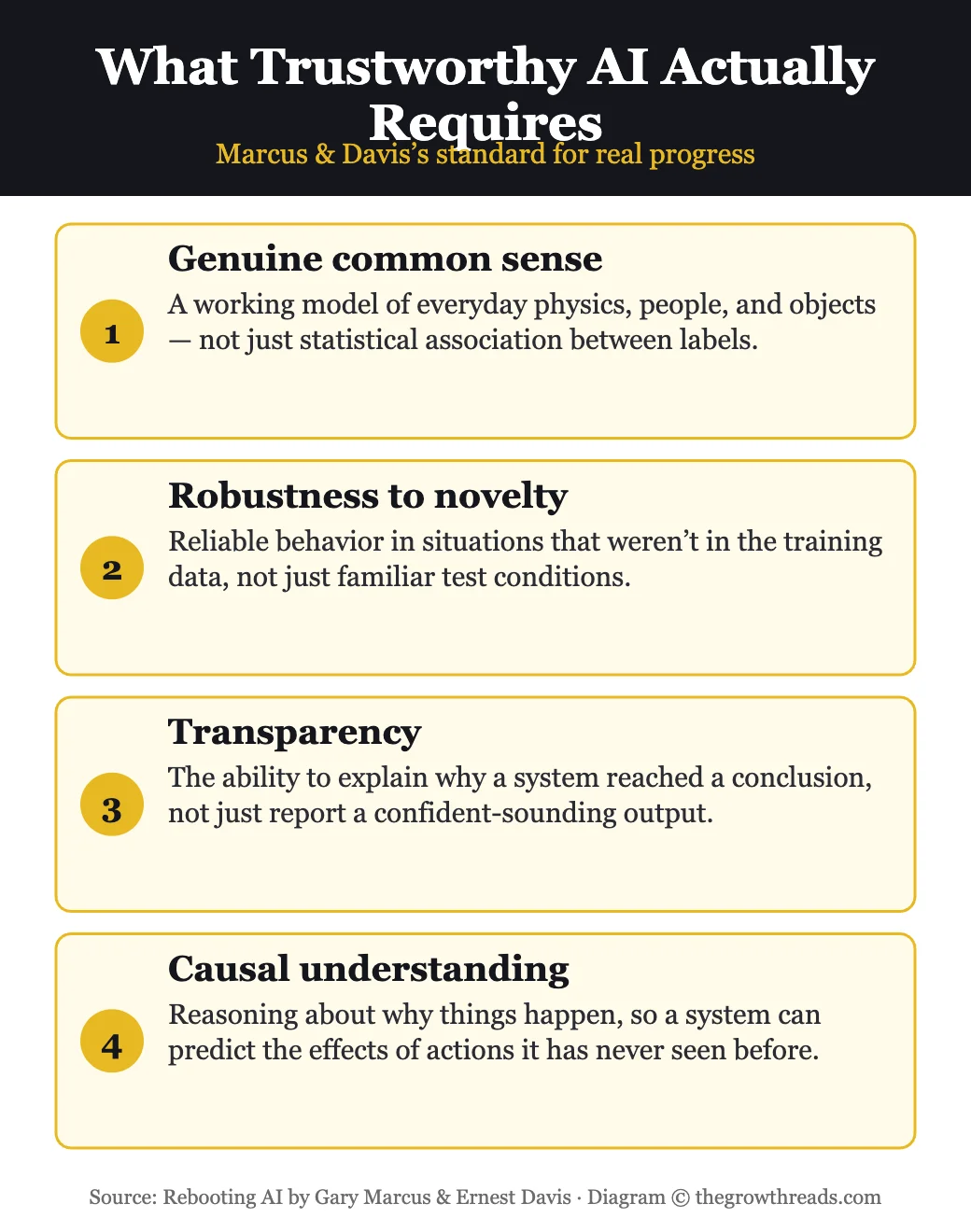
None of this, the authors stress, means throwing deep learning away. It means being honest about what it is good at (perception, pattern-matching, interpolation within a known distribution) and pairing it with the kind of structured reasoning that lets a system generalize to situations it has never seen — the way a human driver can reason about a completely novel obstacle in the road rather than needing to have seen that exact obstacle in training data before.
Who is Rebooting AI best for — and who should read something else first?
Rebooting AI is the right next book if you have already absorbed the AI-is-changing-everything narrative and want a technically credible counterweight — someone with real AI research credentials explaining exactly where the hype outruns the science, and what would need to be true for the field to close that gap. It rewards readers who want vocabulary and mental models for evaluating AI claims critically, whether that is a product manager assessing a vendor’s promises or a curious reader tired of breathless headlines.
If you want the more optimistic, momentum-focused case for how far deep learning has already come, start with You Look Like a Thing and I Love You instead — it covers the same technology with a lighter, more celebratory touch. If your interest is specifically economic — how AI actually changes jobs, decisions, and business strategy — Prediction Machines is the better starting point. And if safety and alignment are your primary concern rather than capability limits, The Alignment Problem and Human Compatible go deeper on that specific angle.
Questions to reflect on
- Think of a recent AI tool you used or saw demoed — did it show any of the brittleness patterns Marcus and Davis describe, like breaking on a slightly unusual input?
- Where in your own work or decisions do you currently lean on an AI system’s output as if it “understands” the situation — and where might that trust be misplaced?
- What would “common sense” actually look like as a checklist item you could test an AI system against, in your specific domain?
- Can you separate, in your own mind, what a piece of AI news is claiming the technology can do versus what it has actually been demonstrated to do?
- If hybrid AI (deep learning plus symbolic reasoning) is where the field is heading, what would change about how you evaluate or select AI tools over the next few years?
🔥 Ready to think more clearly about what AI can — and can’t — actually do?
Grab Rebooting AI and get the clearest, most technically grounded reality check on deep learning available today.
How to apply Rebooting AI (7-day plan)
- Day 1 — Audit your AI assumptions. List every AI tool or feature you currently use or evaluate, and write one sentence on what you assume it “understands” versus what it is actually doing (pattern-matching on training data).
- Day 2 — Stress-test one tool. Take one AI system you rely on and deliberately give it a slightly unusual, out-of-distribution input. Note whether it degrades gracefully or fails in a surprising way.
- Day 3 — Practice the four-part checklist. Pick a real or hypothetical AI use case and score it against common sense, robustness, transparency, and causal understanding — where is it weakest?
- Day 4 — Read one AI headline critically. Find a piece of AI news and separate the actual demonstrated capability from the implied or hyped capability.
- Day 5 — Map a hybrid solution. For one AI application you know well, sketch what a hybrid deep-learning-plus-symbolic-reasoning version might add that a pure neural-network version lacks.
- Day 6 — Talk it through. Explain the difference between correlation-based pattern matching and causal understanding to a colleague or friend, using a concrete example from your own work.
- Day 7 — Set your own trust bar. Write down, in one paragraph, what evidence would need to exist before you would trust an AI system with a high-stakes decision in your domain.
Frequently asked questions
Is Rebooting AI against AI or deep learning?
No. Marcus and Davis are AI researchers themselves and are clear that deep learning is a genuinely powerful tool for perception and pattern-recognition tasks. Their argument is narrower: that deep learning alone is not sufficient for general intelligence, and that treating it as a complete solution leads to overconfident, sometimes risky deployments. The book’s proposal is to combine deep learning with other techniques, not to abandon it.
Do I need a technical or computer science background to read this book?
Not really. Marcus and Davis write for a general audience and explain technical concepts like neural networks and training data in plain language with everyday analogies. Readers with some technical curiosity will get more out of a few sections, but no programming or math background is required to follow the core argument.
Has anything changed since Rebooting AI was published, given how fast AI has moved?
The book predates the large language model wave, and some specific examples feel dated as a result. That said, the core critique — that pattern-matching systems can be brittle outside their training distribution and lack robust causal understanding — has remained a live and actively debated topic among AI researchers, which is part of why the book’s framework still holds up as a way of thinking about AI capability claims.
What is “hybrid AI” in simple terms?
Hybrid AI means combining neural networks (which excel at recognizing patterns in large amounts of data) with symbolic or rule-based reasoning systems (which excel at explicit logic, structured knowledge, and step-by-step inference). The idea is that each approach compensates for the other’s weaknesses, producing a system that is both flexible and reliable.
Who are Gary Marcus and Ernest Davis?
Gary Marcus is a cognitive scientist, entrepreneur, and professor emeritus at New York University who has written extensively on the limits of deep learning. Ernest Davis is a computer scientist at NYU whose research focuses on common-sense reasoning and knowledge representation in AI. Their combined backgrounds in cognitive science and formal AI give the book both a psychological and a technical lens.
How long does it take to read Rebooting AI?
Most readers finish it in six to eight hours of straight reading, or about a week at a relaxed pace of 30-40 minutes a day. The chapters are organized around distinct themes (perception, language, common sense, robustness), so it also works well read in short standalone sessions.
Is this book still relevant if I already use modern AI tools daily?
Yes — arguably more so. The specific brittleness and common-sense failures Marcus and Davis document are the same category of issue that still shows up in today’s most advanced systems. Understanding the underlying pattern helps you evaluate any new AI tool critically, rather than needing a fresh mental model every time the technology changes.
Related summaries
- You Look Like a Thing and I Love You — a lighter, more playful look at how neural networks actually think.
- The Alignment Problem — the safety and ethics side of AI’s current limitations.
- Human Compatible — a provably-safe-AI framework that pairs well with this book’s trust checklist.
- More Technology book summaries