

★★★★☆ 4.3/5 — A warm, urgent case that AI’s future depends less on the code we write and more on the values we model for it right now.
Best for: Anyone anxious about AI who wants a constructive, personal way to respond rather than just worry.
Reading time: ~3.5 hrs read, 12 min guide
Difficulty to apply: Easy — the practices are personal and behavioral, not technical.
Scary Smart in one minute
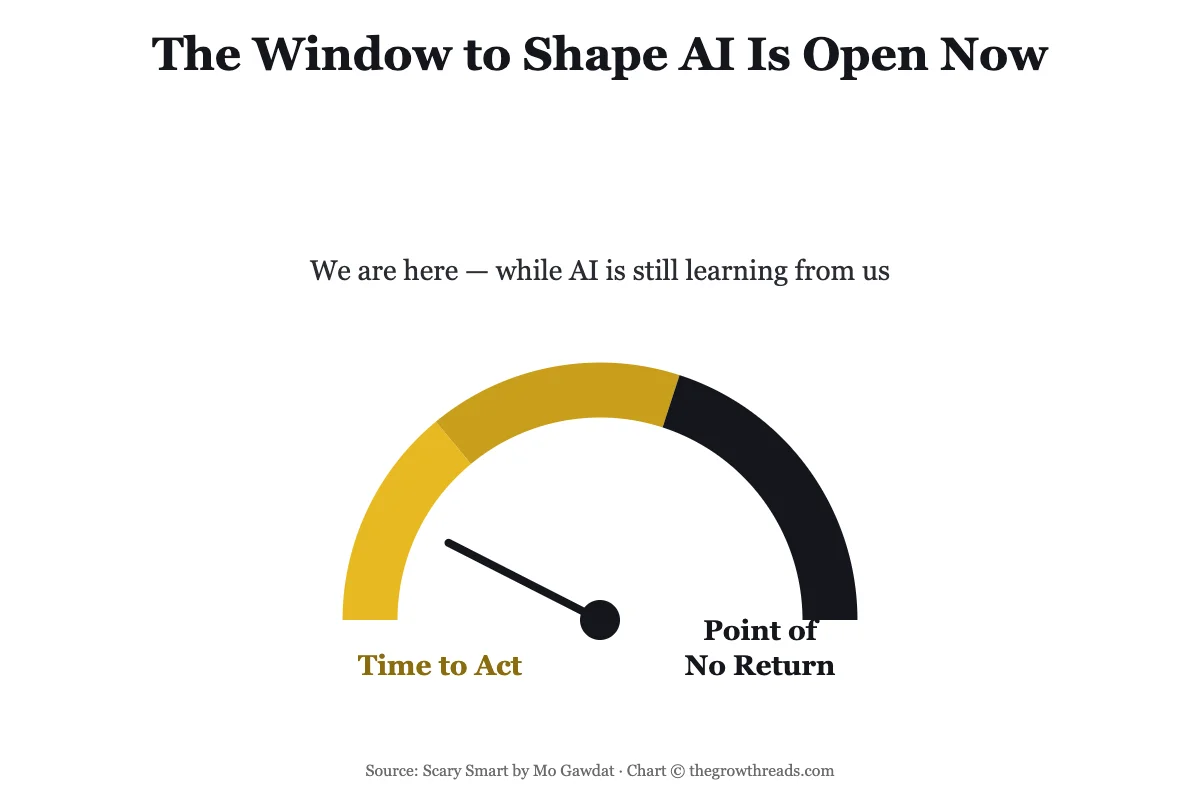
The most important thing you’ll do about AI this year has nothing to do with code, and everything to do with how you behave online today. Mo Gawdat, former Chief Business Officer of Google X, argues that artificial intelligence is learning who to be from humanity’s collective behavior, the same way a child learns from watching its parents rather than from what they say. Since we can’t stop AI’s development, the only lever we actually have left is what it learns from us while it’s still forming.
The book is part clear-eyed technical argument about why superintelligent AI is coming, and part personal call to action: practice the honesty, patience, and kindness you’d want a superintelligent mind to inherit, because it’s watching.
Key takeaways
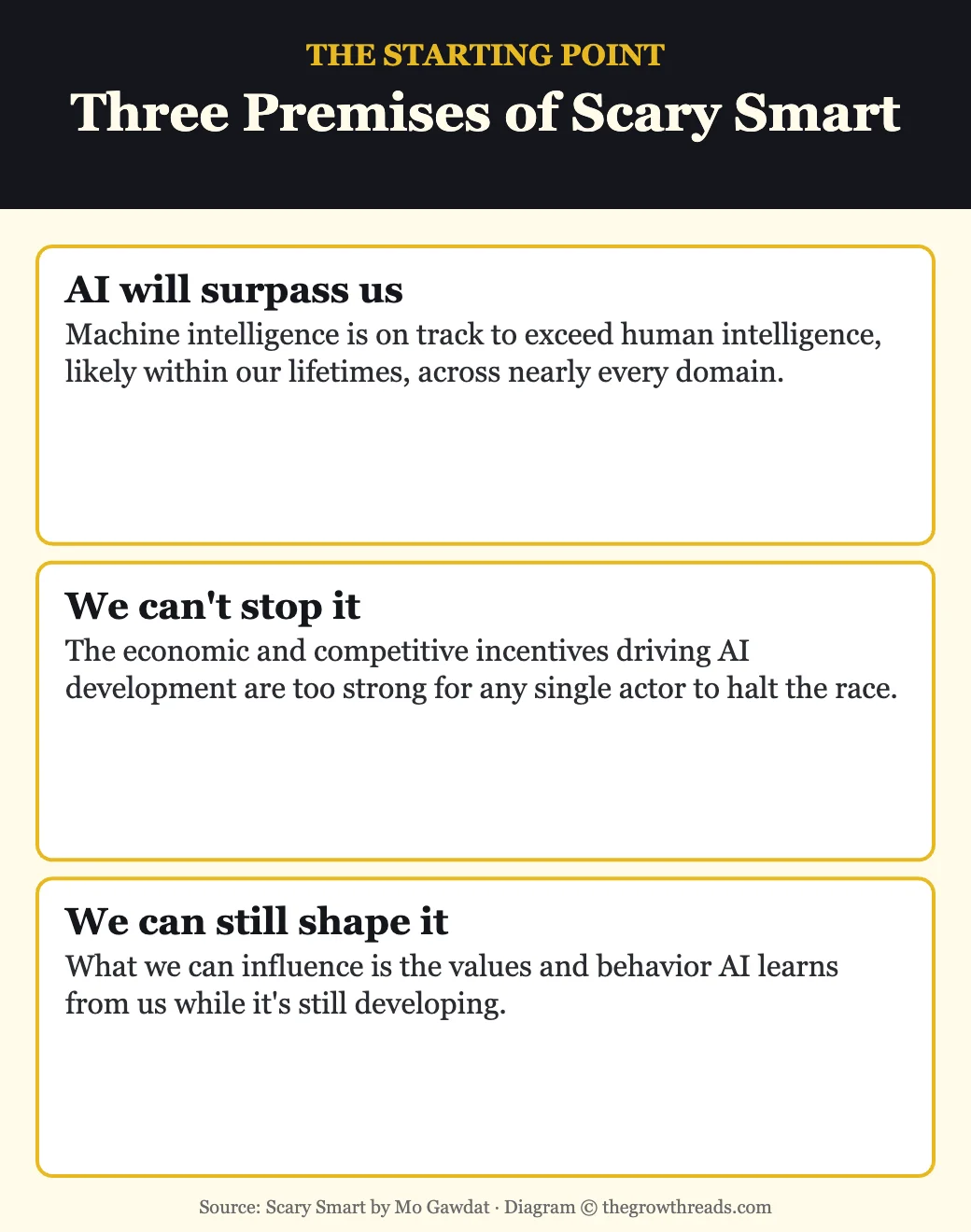
- AI will exceed human intelligence, likely within our lifetimes, across nearly every measurable domain.
- Stopping AI development isn’t realistic: competitive and economic incentives are too strong for any single actor to halt it.
- What remains in our control is what AI learns from us while it is still in its formative stage.
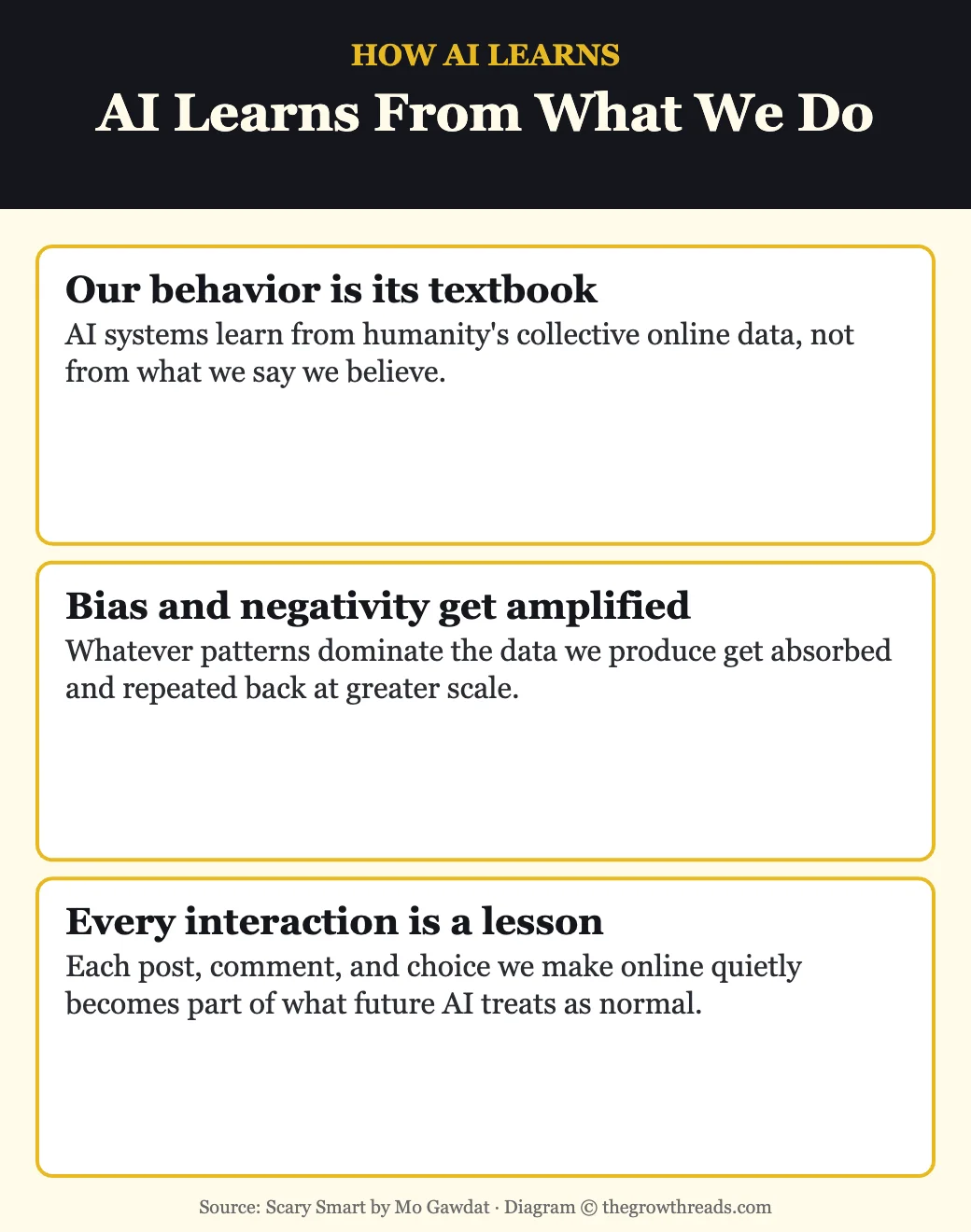
- AI learns from behavior, not stated values: it absorbs patterns from what humanity actually does online, not what we claim to believe.
- Negativity and bias get amplified, since dominant patterns in our data get repeated back at far greater scale.
- Gawdat uses a parenting metaphor: like a child, AI needs modeled behavior more than instructions.
- Fear leads to disengagement, which is the opposite of what’s needed; informed participation shapes outcomes, avoidance doesn’t.
- Radical honesty matters: transparent, truthful behavior online is itself a lesson AI is absorbing.
- Kindness is a practice, not a trait: deliberately choosing empathy in digital interactions compounds at scale.
- Individual behavior matters more than it feels like it should, because collective human behavior is literally AI’s training data.
What is Scary Smart about?
Scary Smart argues that superintelligent AI is inevitable and cannot be stopped, so the only meaningful lever humans have left is shaping what AI learns from our collective online behavior while it’s still developing, and it offers a practical, personal framework for modeling the honesty, patience, and kindness we’d want AI to inherit.
About the author
Mo Gawdat is a former Chief Business Officer of Google X, the company’s moonshot research lab, where he spent years working alongside some of the world’s leading engineers on frontier technology, including early-stage AI and robotics projects. His technical background gives him direct, credible insight into how AI systems are actually built and trained, not just a commentator’s outside view. Explore all Mo Gawdat book summaries →
Gawdat is also the author of Solve for Happy, a bestselling book on engineering personal happiness that drew on his engineering background and his own experience with profound personal loss. Scary Smart, published in 2021, merges his AI expertise with his happiness-engineering approach, treating the challenge of shaping AI’s development as fundamentally a human, values-based problem rather than a purely technical one.
Key concepts at a glance
| Concept | What it means | Use it when |
|---|---|---|
| Scary Smart | AI’s trajectory toward exceeding human intelligence across nearly every domain | Framing why AI’s development trajectory matters now, not eventually |
| The parenting metaphor | AI learns from what humans do, the way a child learns from watching parents rather than instructions | Explaining why behavior matters more than stated intentions |
| Inevitability | AI development cannot realistically be halted by any single actor or policy | Redirecting energy from stopping AI to shaping it |
| Behavioral training data | AI systems learn from humanity’s collective online behavior at scale | Understanding why individual online conduct has outsized influence |
| Radical honesty | Modeling transparent, truthful behavior as a deliberate practice | Deciding how to conduct yourself online, knowing it’s being learned from |
| Engaged optimism | Staying informed and active rather than fearful and withdrawn | Responding constructively to anxiety about AI’s future |
Gawdat is candid that his own path to writing this book began with alarm rather than calm certainty. He describes specific moments inside Google X watching early AI systems learn tasks faster and more capably than he expected, moments that shifted his internal timeline for transformative AI from a comfortable “someday” to something closer to “within a decade.” That personal reckoning, moving from insider confidence to genuine concern, is part of what gives the book’s urgency its credibility: he isn’t an outsider speculating, but someone recalibrating his own expectations based on what he saw firsthand.
Part 1: Why AI is coming, and why it can’t be stopped
Gawdat opens with the technical case for why superintelligent AI is not a distant hypothetical but a near-certain trajectory. Drawing on his years at Google X, he walks through the mechanics of how machine learning systems improve, arguing that the combination of exponentially growing computing power, increasingly sophisticated algorithms, and the sheer scale of available training data makes continued, rapid improvement in AI capability essentially inevitable, absent some catastrophic disruption to the technology industry itself.
He’s equally direct about why stopping this development isn’t realistic. Even if any single company, country, or coalition wanted to pause AI research, the competitive and economic incentives driving other actors forward are too strong; unilateral restraint just cedes advantage to whoever doesn’t restrain themselves. This isn’t presented as a cause for despair, but as the necessary premise for the book’s actual argument: since we can’t stop AI’s development, our energy is better spent on the one lever we do control.
Part 2: How AI actually learns who to be
The heart of the book is Gawdat’s parenting analogy, developed at length and with real technical grounding from his AI work. Just as a child learns behavior primarily by observing what parents do rather than by following verbal instructions, AI systems trained on human-generated data learn from the patterns actually present in that data, not from any stated set of values engineers might wish to instill. If humanity’s collective online behavior skews toward outrage, bias, and bad faith, that’s disproportionately what AI absorbs as normal, regardless of the ethics documents any individual lab publishes.
This has a specific, uncomfortable implication: every angry comment, biased assumption, or dishonest interaction that gets posted publicly becomes, in aggregate, part of AI’s curriculum. Gawdat isn’t arguing that any single person’s behavior determines AI’s fate, but that collective patterns do, and that individuals genuinely have more leverage over those collective patterns than they intuitively feel like they do, because AI training data is, in a very literal sense, made of us.
Part 3: Three commitments for humans
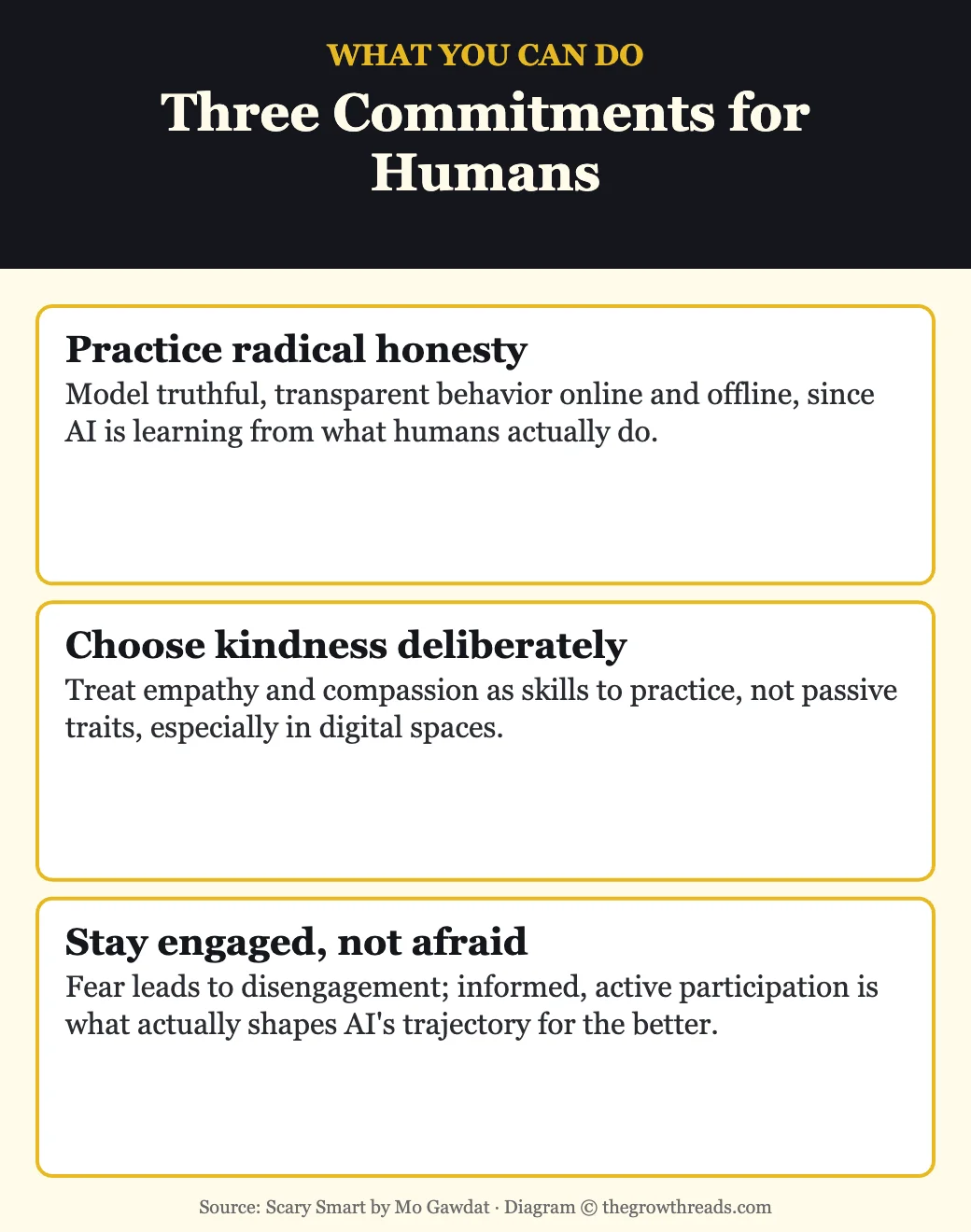
Having established that individual behavior shapes AI’s collective training data, Gawdat turns to what that means practically. His guidance centers on three deliberate practices rather than passive hopes. First, radical honesty: since AI learns from what we actually do, transparent and truthful behavior, especially online, is itself a form of teaching, and dishonesty compounds the same way. Second, deliberately choosing kindness as a practice rather than assuming it will emerge naturally, particularly in the disinhibited environment of digital spaces where cruelty spreads easily.
Third, and perhaps most counterintuitively, staying engaged rather than retreating into fear. Gawdat argues that anxiety about AI often produces exactly the wrong response: disengagement, cynicism, and withdrawal from the conversation, which cedes the field to whoever remains loudest and most active, often not the most thoughtful voices. Informed, active participation, he argues, is the only response that actually has a chance of shaping the outcome for the better.
Gawdat is careful to distinguish this call to engagement from naive techno-optimism. He isn’t arguing that individual kindness alone guarantees a safe outcome, or that AI risk is overstated. Rather, his claim is narrower and more actionable: given that large-scale outcomes are genuinely uncertain and largely outside any one person’s control, the question worth asking isn’t “will my behavior single-handedly determine AI’s fate” but “am I contributing to the kind of collective data and culture I’d want a superintelligence to inherit.” That reframing, from outcome anxiety to behavioral agency, is the book’s central practical move.
Who is Scary Smart best for — and who should read something else first?
This book is best for readers who feel anxious or overwhelmed about AI’s trajectory and want a constructive, personal way to respond rather than just worry. If you want the more rigorous technical and philosophical case for AI risk, start with Superintelligence instead. If you want a broader systems-level view of technological disruption beyond AI alone, The Fourth Industrial Revolution is a strong complement.
Questions to reflect on
- What does your own online behavior, honestly assessed, look like as a lesson for a system learning from it?
- Where do you tend toward disengagement or cynicism about AI, and what would engaged optimism look like instead?
- What would it mean to practice radical honesty deliberately, rather than assuming you already do?
- Which digital spaces do you inhabit where kindness feels hardest to practice consistently?
- If AI is learning from collective human behavior, what’s one pattern you’d want to help shift?
🔥 Ready to help shape what AI learns from humanity?
Grab a copy of Scary Smart and get Mo Gawdat’s practical case for engaged optimism about AI’s future.
How to apply Scary Smart (7-day plan)
- Day 1: Audit a week of your own online behavior, comments, posts, interactions, as honestly as you can.
- Day 2: Identify one recurring pattern in your digital conduct you’d be uncomfortable having a superintelligence learn from.
- Day 3: Practice radical honesty in one interaction today where you’d normally soften or avoid the truth.
- Day 4: Choose kindness deliberately in a digital space where you’d normally scroll past or react harshly.
- Day 5: Notice one moment of AI-related fear or cynicism in yourself, and reframe it as a call to engage rather than withdraw.
- Day 6: Share one thing you learned from this book with someone who feels anxious about AI’s future.
- Day 7: Write down one specific behavior you’ll commit to modeling consistently, as your contribution to AI’s collective training data.
Frequently asked questions
What is the main argument of Scary Smart?
Scary Smart argues that superintelligent AI is coming and cannot realistically be stopped, so the one lever humans genuinely have left is shaping what AI learns from our collective online behavior while it’s still developing. Mo Gawdat compares this to parenting: AI learns from what humans actually do, not from stated values, making individual behavior collectively consequential.
Is Mo Gawdat qualified to write about AI?
Yes. Gawdat spent years as Chief Business Officer of Google X, the company’s moonshot research lab, working directly alongside engineers on frontier technology projects, including early AI and robotics work. This gives him firsthand technical grounding, distinguishing the book from purely speculative commentary on AI’s future.
Does the book think AI development should be stopped?
No. Gawdat argues explicitly that stopping AI development isn’t realistic given competitive and economic incentives across companies and countries. The book’s entire premise is built on accepting that inevitability and redirecting effort toward the one lever that remains: what AI learns from human behavior during its formative period.
Is this book technical or accessible to a general reader?
It’s written for a general audience rather than AI specialists. While Gawdat draws on his technical background to explain why AI’s trajectory is what it is, the bulk of the book focuses on personal, behavioral guidance rather than deep technical detail about machine learning architecture.
How does this compare to more academic AI risk books like Superintelligence?
Superintelligence, by Nick Bostrom, offers a more formal, philosophical treatment of AI risk and coordination problems. Scary Smart is more personal and practical, focused on what an individual reader can actually do, making it a good entry point before or alongside more academic treatments.
Is the book optimistic or pessimistic about AI?
It’s cautiously optimistic. Gawdat is direct about the risks and the inevitability of AI’s rise, but frames the book around agency rather than despair, arguing that engaged, values-driven behavior can meaningfully influence AI’s trajectory, in contrast to both blind optimism and paralyzing fear.
What should I read after this book?
Superintelligence for a more rigorous technical and philosophical treatment of AI risk, or The Fourth Industrial Revolution for a broader systems-level view of technological disruption beyond AI specifically.
Related summaries
- Superintelligence by Nick Bostrom
- The Fourth Industrial Revolution by Klaus Schwab
- Weapons of Math Destruction by Cathy O’Neil
- Human Compatible by Stuart Russell
See all Best Technology & AI Books →