

★★★★☆ 4.4/5 — The clearest economics-first explanation of what AI actually is and why it matters for business.
Best for: Managers, founders, and strategists who want a rigorous mental model for where AI creates value, not just a list of use cases.
Reading time: ~7 hrs to read the full book · 11 min for this guide
Difficulty to apply: Moderate — the framework is simple, but applying it well requires real thinking about your own decisions and workflows.
Prediction Machines in one minute
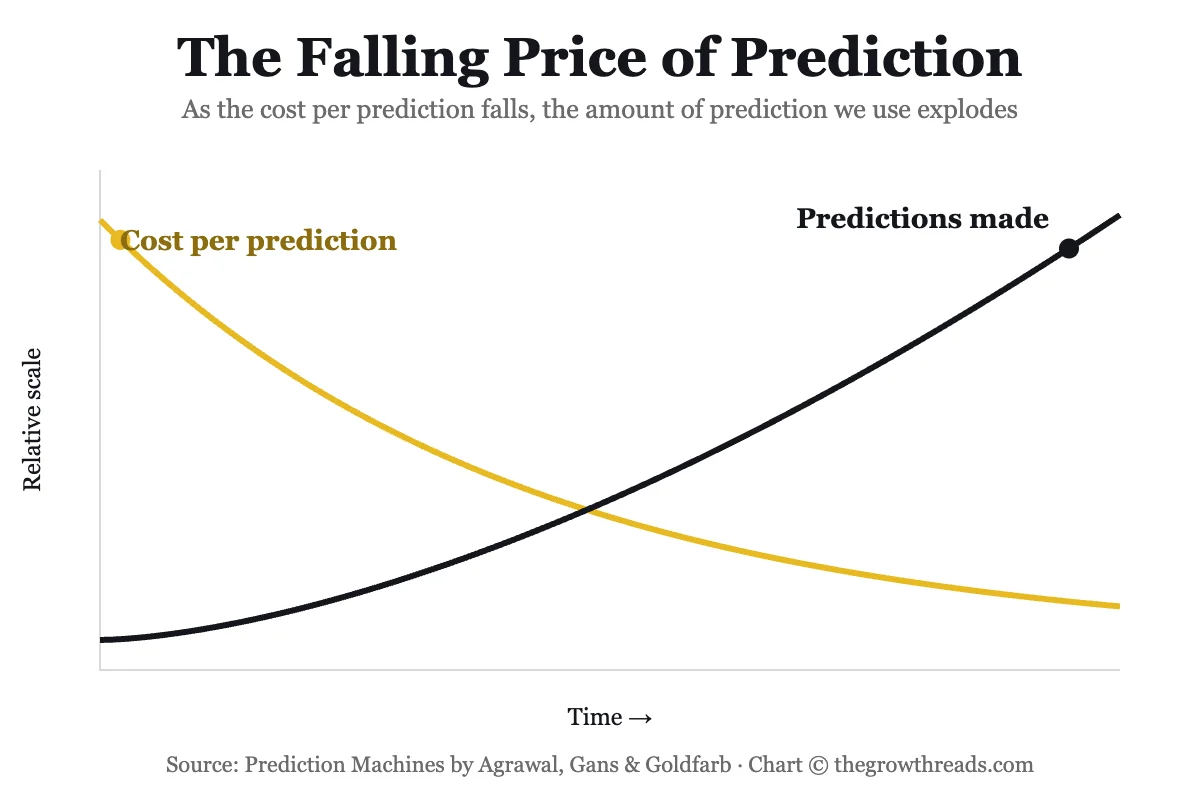
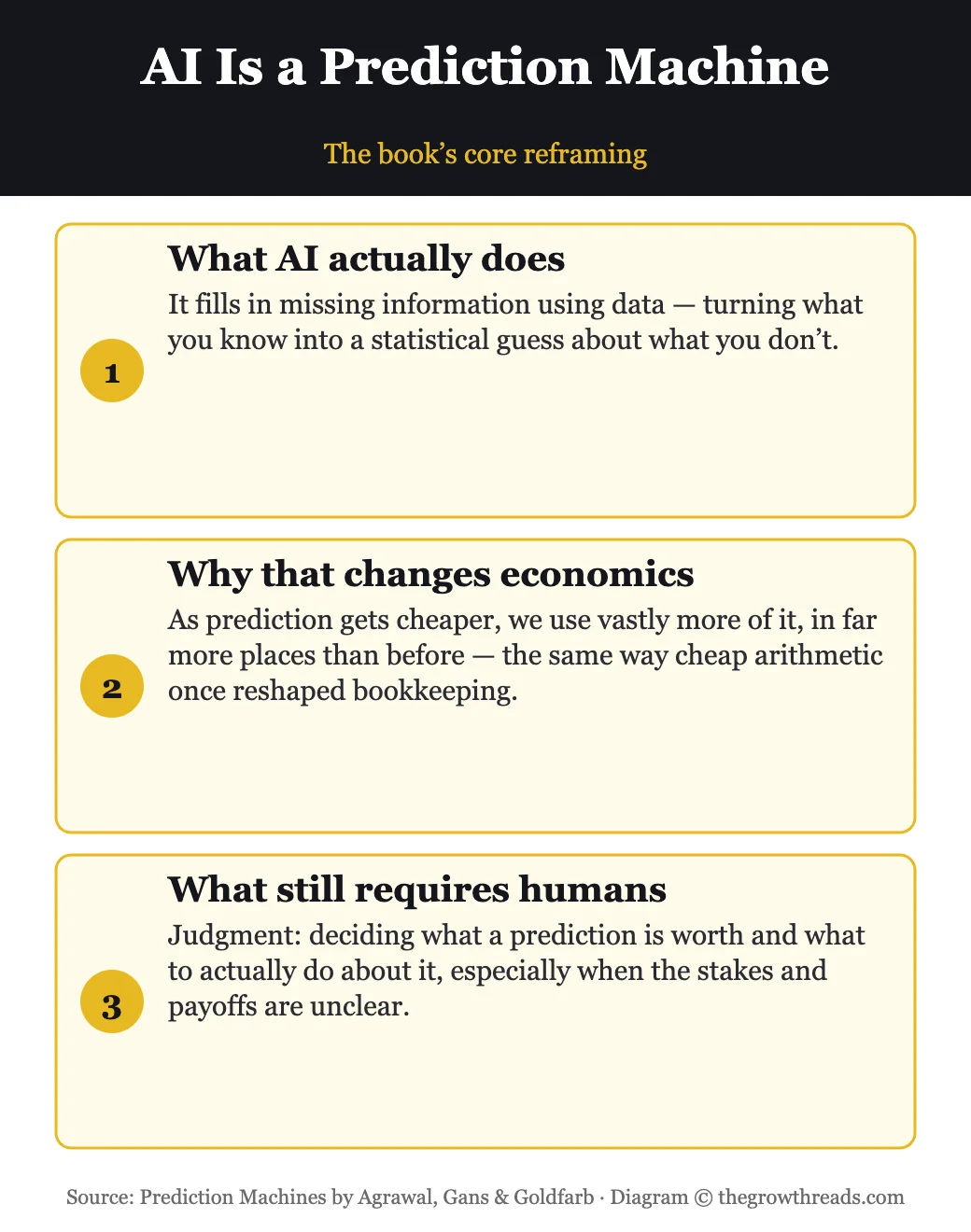
Artificial intelligence, at its economic core, is a technology that makes prediction cheap — and cheap prediction changes what’s worth doing across nearly every industry. Ajay Agrawal, Joshua Gans, and Avi Goldfarb, all economists, strip away the hype and argue that AI should be understood the same way economists understand any technology: by what it makes cheaper. AI makes prediction — filling in missing information using data — dramatically cheaper, and when something gets cheap, we use vastly more of it.
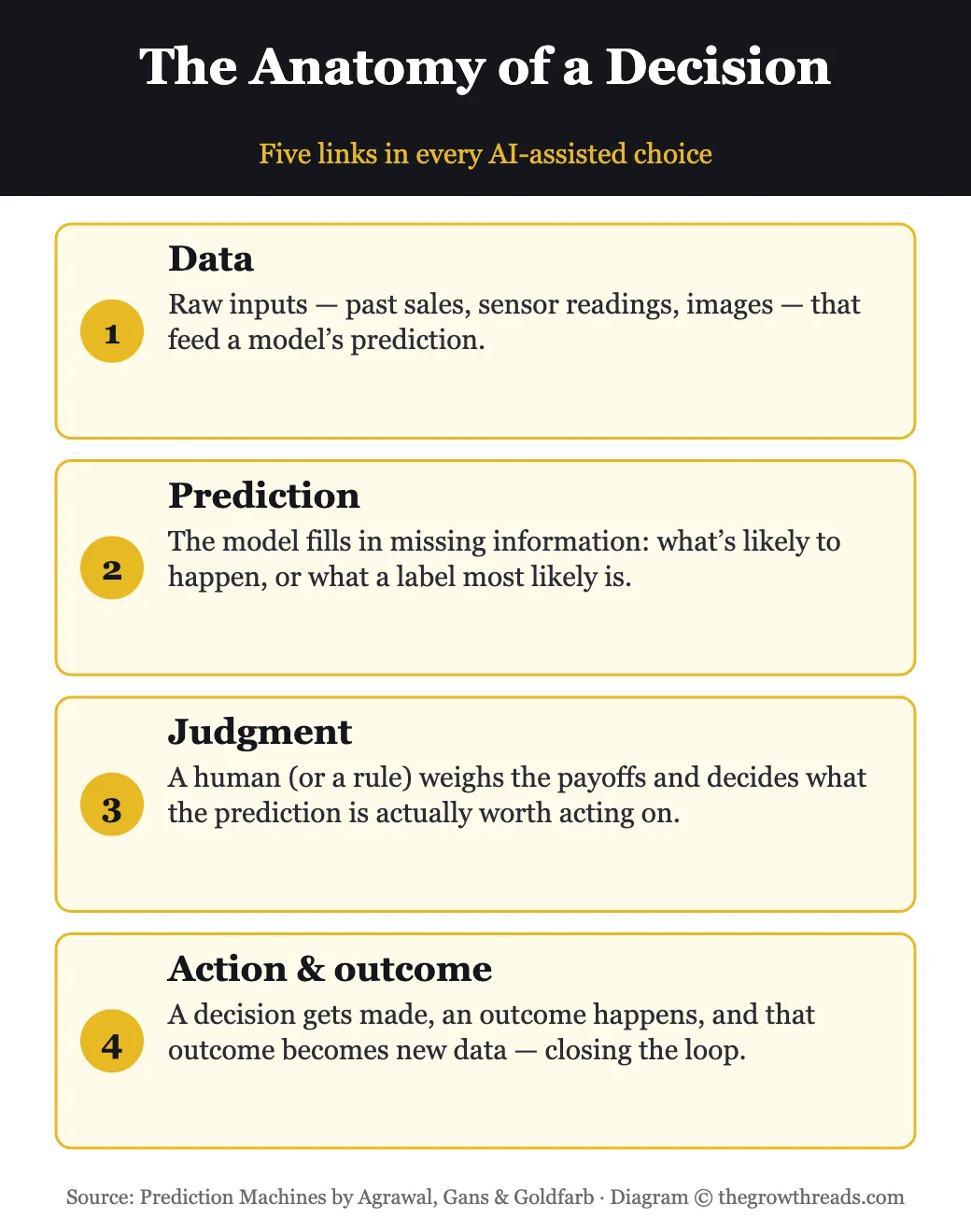
The book’s most useful contribution is a simple anatomy of decision-making: data feeds prediction, prediction feeds judgment, judgment feeds action, and action produces outcomes that become new data. As AI takes over the prediction step, the authors argue, human judgment — deciding what a prediction is actually worth and what to do about it — becomes the more valuable, scarcer input, not a less important one.
Key takeaways
- AI is fundamentally a prediction technology. It fills in missing information using data, whether that’s forecasting demand, classifying an image, or estimating a probability.
- Cheaper prediction means more prediction, everywhere. When any input drops in price, we use dramatically more of it — the same logic that made cheap arithmetic ubiquitous applies to cheap prediction.
- Every decision has an anatomy: data, prediction, judgment, action, outcome. AI automates the prediction step; humans (or explicit rules) still supply the judgment.
- Prediction and judgment are complements, not substitutes. As prediction gets cheaper and more abundant, the value of good judgment about what to do with it goes up, not down.
- Judgment means weighing payoffs, not just estimating probabilities. Knowing it will likely rain isn’t the same as deciding whether to carry an umbrella — that’s a judgment call about costs and benefits.
- AI adoption isn’t just “add a model” — it changes the whole workflow. Point solutions bolt AI onto existing processes; full solutions redesign the process entirely around cheap prediction.
- The biggest gains come from redesigning decisions, not automating tasks. Companies that rethink what decisions look like when prediction is nearly free capture far more value than those that just speed up old workflows.
- Uncertainty doesn’t disappear, it moves. Better prediction reduces uncertainty about outcomes but shifts attention to uncertainty about the right judgment and payoffs.
- AI strategy is fundamentally an economics problem. The right question isn’t “can AI do this?” but “does cheaper prediction change what’s worth doing here?”
- This economic framework ages well. Written in 2018 and updated since, its core logic still explains generative AI and large language models just as cleanly as it explained earlier machine learning systems.
What is Prediction Machines about?
Prediction Machines argues that AI is best understood as a drop in the cost of prediction — filling in missing information using data. As prediction becomes cheap and abundant, human judgment about what to do with predictions becomes the more valuable, scarcer skill. Agrawal, Gans, and Goldfarb offer an economics-based framework for deciding where AI actually creates value in a business.
About the authors
Ajay Agrawal, Joshua Gans, and Avi Goldfarb are all economists at the University of Toronto’s Rotman School of Management, and co-founders of the Creative Destruction Lab, a program that has helped launch hundreds of AI and deep-tech startups. Their backgrounds in innovation economics and industrial organization give the book its distinctive angle: rather than treating AI as a purely technical subject, they analyze it the way economists analyze any general-purpose technology — by what it makes cheaper and what that means for decision-making, competition, and strategy across an economy.
| Concept | What it means | Use it when |
|---|---|---|
| Prediction | Filling in missing information using data — the core economic function of AI | Explaining what a given AI system is actually doing under the hood |
| Judgment | Weighing payoffs to decide what a prediction is actually worth acting on | Identifying the human role that remains essential alongside AI |
| Anatomy of a decision | The chain of data, prediction, judgment, action, and outcome | Mapping where AI fits into an existing workflow or process |
| Economics of complements | When one input gets cheaper, demand rises for the things that go with it | Explaining why judgment becomes more valuable, not less, as AI improves |
| Point solution | Bolting an AI prediction onto an existing process without redesigning it | Diagnosing why an AI project delivered less value than expected |
| Full solution | Redesigning a decision or workflow entirely around cheap, abundant prediction | Planning an AI initiative meant to capture the largest possible value |
Part 1: AI is a drop in the cost of prediction
The authors open with a deliberately narrow, economist’s definition: AI, in its current dominant form, is a prediction technology. It takes data you have and generates a statistical guess about data you don’t have — whether that’s the likelihood a transaction is fraudulent, what a customer will buy next, or the most probable next word in a sentence. This might sound like it undersells AI, but the authors argue it’s precisely this narrowness that makes the concept useful. Economists have a long, well-tested toolkit for analyzing what happens when the cost of something falls sharply, and they apply that toolkit directly to prediction.
Historical parallels do the heavy lifting here: when the cost of arithmetic collapsed with the spreadsheet, the demand for arithmetic didn’t shrink, it exploded — more calculations were run, in more contexts, by more people, than anyone anticipated. The same logic applies to prediction: as AI makes it cheap, organizations will find far more places to use it than the obvious, headline use cases, because cheap prediction unlocks decisions that weren’t previously worth automating at all.
TGR Note: Erik Brynjolfsson and Andrew McAfee describe the same exponential, compounding pattern from a broader macroeconomic angle in The Second Machine Age — this book zooms into the specific mechanism (falling prediction costs) driving that larger story.
Part 2: The anatomy of a decision
With prediction defined, the authors build out the book’s central framework: every decision can be broken into data, prediction, judgment, action, and outcome, forming a loop where outcomes become new data for future predictions. AI’s current capabilities sit almost entirely in the prediction step. Judgment — deciding what a given prediction is actually worth, given the specific payoffs of being right or wrong — remains a distinctly human (or explicitly programmed) function that AI does not replace.
This distinction does real diagnostic work. A weather model predicting rain with 70% confidence hasn’t told you whether to carry an umbrella — that requires judgment about how much you value staying dry versus carrying extra weight, judgment the model was never asked to supply. The authors use this anatomy to explain why some AI deployments succeed spectacularly (where judgment was already clear and prediction was the real bottleneck) and others disappoint (where the hard part was actually the judgment, not the prediction).
TGR Note: Brian Christian’s account of reward hacking in The Alignment Problem is essentially a story about the judgment step going wrong — a system optimized a prediction perfectly while the judgment behind its objective was badly specified.
Part 3: Why judgment becomes more valuable, not less
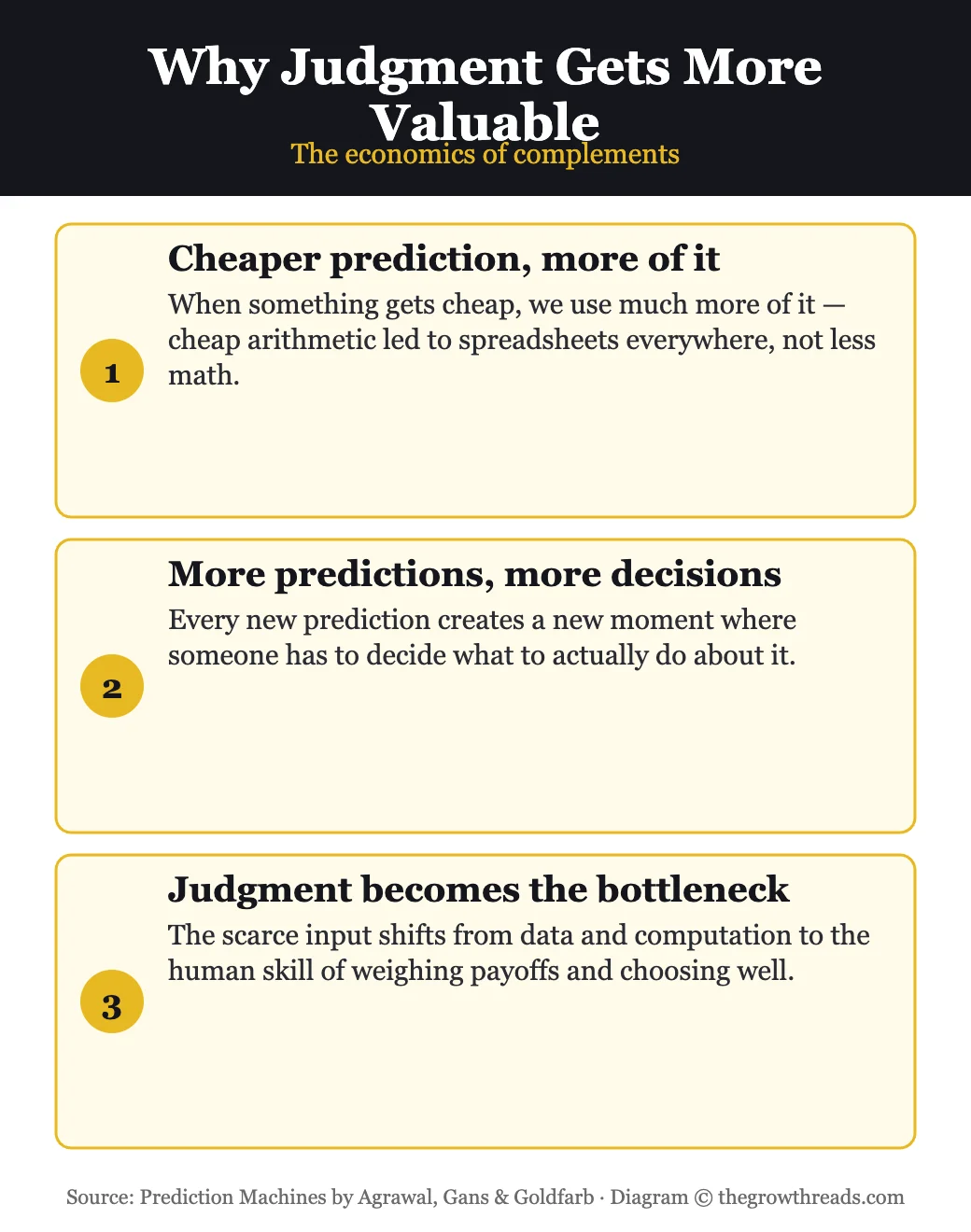
The book’s most counterintuitive and useful argument is about complements. When the price of one input falls, economic theory says demand rises for the things that go with it, not the things that compete with it. Prediction and judgment are complements: as AI supplies more, cheaper predictions, the number of moments where someone has to decide what to actually do with that prediction multiplies. The scarce resource shifts from the prediction itself to the judgment applied to it.
This reframes a common fear productively. The question isn’t “will AI replace human judgment,” it’s “as AI supplies dramatically more predictions, where does the resulting flood of judgment calls get made, and by whom?” Organizations that recognize this early can deliberately invest in developing and concentrating judgment where it matters most, rather than being caught flat-footed by a surge in decisions that suddenly need a human call.
TGR Note: Ethan Mollick’s practical advice in Co-Intelligence — always keep a human in the loop — is the individual, day-to-day expression of this book’s economic argument that judgment stays essential precisely because prediction is getting cheap.
Who is Prediction Machines best for — and who should read something else first?
This book is ideal for managers, founders, and strategists who want a rigorous framework for evaluating AI investments, rather than a list of impressive demos. Its economics-first approach rewards readers who want to understand why AI creates value, not just where it’s being deployed.
If you want a more hands-on, day-to-day guide to working with AI tools yourself, start with Co-Intelligence instead. If you want the broader macroeconomic and labor-market picture this book’s ideas feed into, The Second Machine Age is the natural next step. And for a deeper look at where AI systems can go wrong even when prediction is accurate, The Alignment Problem picks up the thread.
Questions to reflect on
- Where in your work do you currently make judgment calls that a cheaper, better prediction could improve?
- What decisions in your organization aren’t automated today simply because prediction has always been too expensive or slow?
- If AI supplied ten times more predictions in your field tomorrow, who would make the resulting judgment calls?
- Where might you be treating an AI project as a point solution when it deserves a full redesign?
- What judgment skill would be most valuable for you to strengthen as prediction keeps getting cheaper?
🔥 Ready to think about AI like an economist?
Get Prediction Machines and build a rigorous framework for where AI actually creates value.
How to apply Prediction Machines (7-day plan)
- Day 1: List five decisions you or your team make regularly, and identify the prediction each one depends on.
- Day 2: For one of those decisions, ask whether the bottleneck is really the prediction, or the judgment about what to do with it.
- Day 3: Identify a decision that isn’t automated today purely because good prediction has always been too slow or expensive to get.
- Day 4: Audit a recent AI tool your team adopted — was it a point solution bolted onto an old process, or did it change the workflow itself?
- Day 5: Practice separating prediction from judgment explicitly in one real decision this week — write down the prediction, then write down the judgment call separately.
- Day 6: Identify one judgment skill (weighing tradeoffs, understanding stakeholder priorities, ethical reasoning) worth deliberately strengthening in your role.
- Day 7: Sketch what your role or team might look like if a specific prediction in your workflow became instant and nearly free.
Frequently asked questions
What is Prediction Machines about?
It’s a book by three economists arguing that AI’s core economic function is making prediction — filling in missing information using data — dramatically cheaper. As prediction gets cheap, the authors argue, human judgment about what to do with predictions becomes the more valuable, scarcer skill, not a less important one.
What is the difference between prediction and judgment in this book?
Prediction is filling in missing information — estimating what’s likely to happen or what a data point most likely represents. Judgment is deciding what that prediction is actually worth acting on, by weighing the costs and benefits of different outcomes. AI currently automates prediction; judgment remains a human or explicitly programmed function.
What is the “anatomy of a decision”?
It’s the book’s core framework: every decision moves through data, prediction, judgment, action, and outcome, with outcomes becoming new data that feeds future predictions. Mapping a specific decision onto this chain helps identify exactly where AI can add value and where human judgment still has to do the work.
Why does the book say judgment becomes more valuable as AI improves?
Because prediction and judgment are economic complements, not substitutes. As prediction gets cheaper and more abundant, more decisions get made, which means more moments requiring judgment about what to actually do — increasing, not decreasing, the total demand for good judgment.
What’s the difference between a “point solution” and a “full solution”?
A point solution bolts an AI prediction onto an existing process without redesigning it, capturing only incremental value. A full solution redesigns the entire decision or workflow around the fact that prediction is now cheap and abundant, which is where the authors argue the largest gains actually come from.
Is this book still relevant given how AI has changed since its release?
Yes — the core economic argument (AI as cheap prediction, judgment as the complementary scarce input) applies just as cleanly to generative AI and large language models as it did to earlier machine learning systems, and an updated edition extends the original arguments to more recent developments.
Who is this book written for?
Primarily managers, founders, and strategists who need a rigorous framework for evaluating AI investments and understanding where AI actually creates business value, rather than a technical guide to building AI systems or a general-audience introduction to machine learning.
Related summaries
- Co-Intelligence by Ethan Mollick
- The Second Machine Age by Brynjolfsson & McAfee
- The Alignment Problem by Brian Christian
- Browse all Technology book summaries
How we analyze books: We read the full text, cross-reference key claims against the author’s interviews and published research, and build original diagrams to make the core frameworks easier to apply. Read our full methodology.