

★★★★☆ 4.4/5 — A research-grounded, warmly written case that attachment theory applies to friendship just as much as romance, and that adult friendship requires deliberate effort society doesn’t teach us to make.
Best for: readers who want to understand their own patterns around initiating and sustaining friendship, backed by real psychological research · Reading time: ~8 hrs (this guide: ~11 min) · Difficulty to apply: Moderate — the concepts are accessible, but acting against an insecure attachment pattern takes real practice
Platonic in one minute
Marisa G. Franco, PhD, argues that the same attachment styles — secure, anxious, avoidant — that shape romantic relationships also shape friendship, just less visibly, because friendship has no cultural script forcing people to name problems and repair them. There’s no engagement, wedding, or legal status attached to friendship, so an anxious person can quietly stop reaching out and drift away, or an avoidant person can keep a friendship permanently shallow, with no one ever calling it a breakup. Franco extends this with research on the “liking gap” — the finding that people consistently underestimate how much new acquaintances liked them after a conversation, a gap that’s especially pronounced for anxiously attached people who read ordinary silence as rejection. Her broader critique is cultural: modern society organizes love into a hierarchy with romantic partnership at the top, treating friendship as a “junior” relationship not worth much sacrifice or planning — a framing she traces back to a historical inversion, since “platonic love” was originally considered by Renaissance scholars to be superior to romantic love, not secondary to it. Published in 2022, the book became an instant New York Times bestseller and combines Franco’s own research background in rejection sensitivity with practical guidance for building and sustaining adult friendship deliberately.
Key takeaways
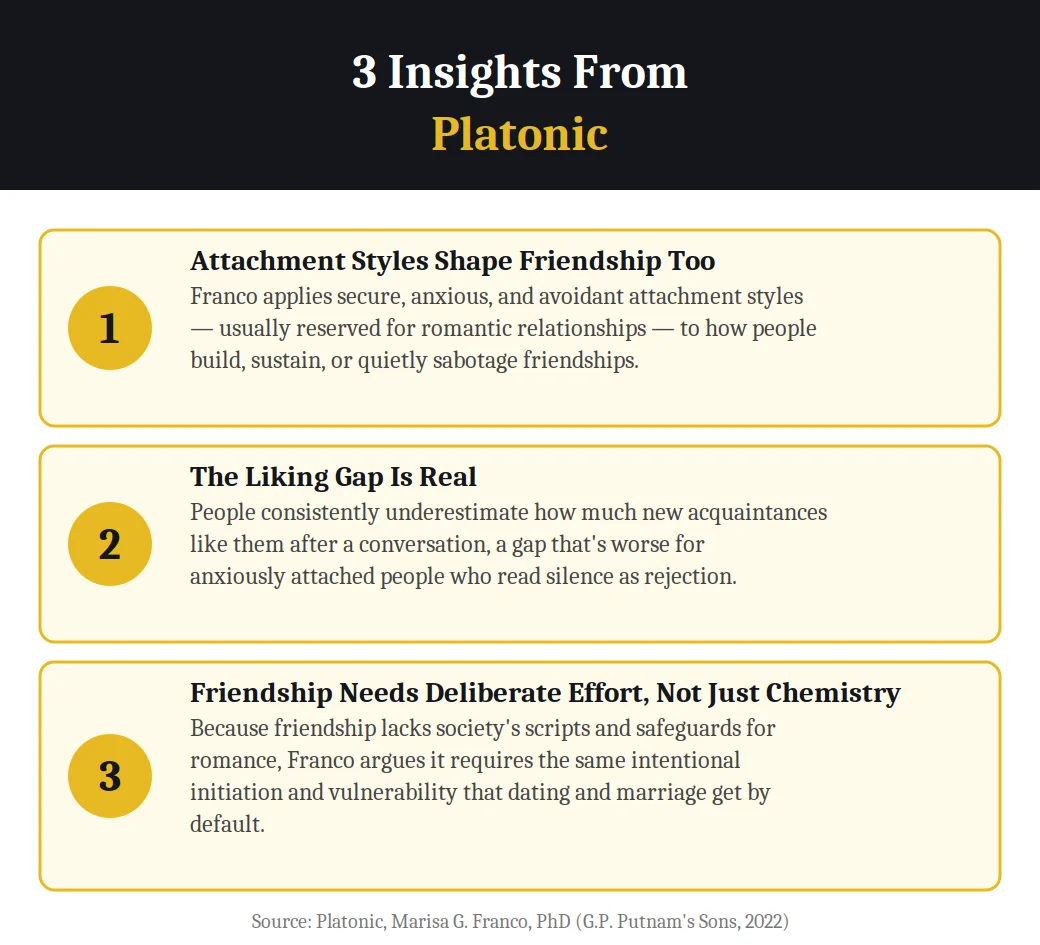
- Attachment styles shape friendship, not just romance: secure, anxious, and avoidant patterns influence how people initiate, sustain, and sometimes sabotage friendships, just as they do romantic bonds.
- Friendship has no cultural script: unlike marriage, there’s no engagement or legal status forcing people to name friendship problems and repair them, so insecure patterns can end a friendship with no formal “breakup.”
- The liking gap distorts how we read others: people systematically underestimate how much new acquaintances liked them after a conversation — worse for anxiously attached people who misread silence as rejection.
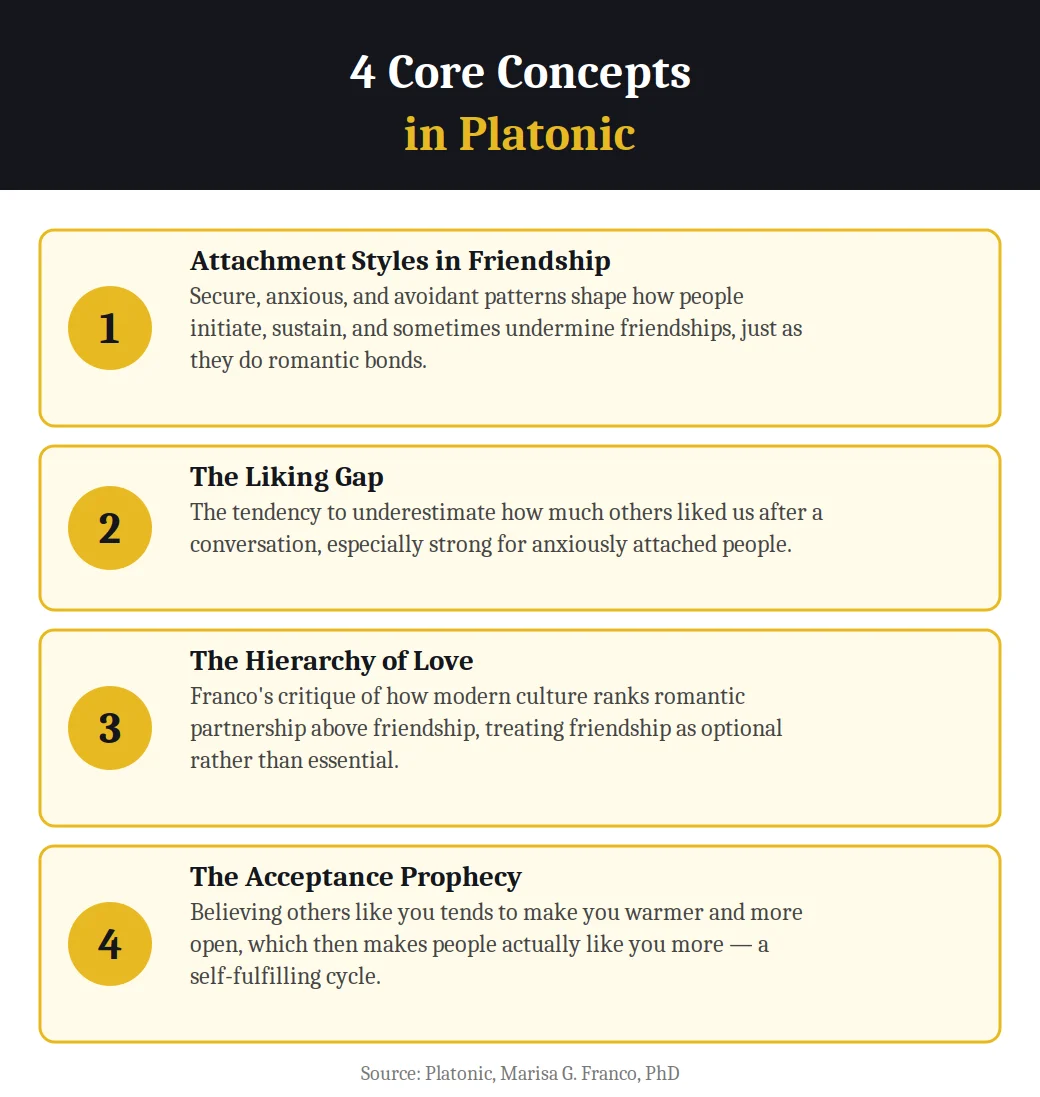
- Believing you’re liked becomes self-fulfilling: the “acceptance prophecy” shows that assuming others like you makes you warmer and more open, which then makes people actually like you more.
- Modern culture ranks romance above friendship: Franco’s “hierarchy of love” critique argues this is a historical inversion, since Renaissance scholars once considered platonic love superior to romantic love.
- The “organic friendship” myth discourages effort: believing adult friendships should form effortlessly, the way childhood ones did, discourages the deliberate initiation modern friendship actually requires.
- Proximity and repetition matter more than chemistry: the conditions that reliably create friendship — proximity, repeated unplanned interaction, low-guard settings — are abundant in school but vanish in adult life.
- Anxious attachment can create the very distance it fears: hesitating to initiate out of fear of “being too much” often produces the isolation the anxious person was trying to avoid.
- Avoidant attachment favors width over depth: a wide but shallow social network can substitute shared activities for the emotional vulnerability that real closeness requires.
What is Platonic about?
Platonic is Marisa Franco’s case that attachment theory — the framework explaining how secure, anxious, and avoidant patterns shape romantic bonds — applies just as powerfully to adult friendship, even though friendship lacks the cultural scripts and safeguards that force people to name and repair problems in a marriage. Drawing on her own research into rejection sensitivity and social connection, Franco explains why adult friendship feels so much harder to build and maintain than childhood friendship, introduces research on the “liking gap” showing people underestimate how much others like them, and critiques a modern cultural “hierarchy of love” that treats romantic partnership as more essential than platonic bonds. Published in 2022 by G.P. Putnam’s Sons, the book became an instant New York Times bestseller, pairing psychological research with practical, actionable guidance for building deeper friendships as an adult.
About the author
Marisa G. Franco, PhD, is a psychologist, professor at the University of Maryland, and researcher whose scholarly work centers on rejection sensitivity and social connection. After a difficult breakup in 2015 left her leaning heavily on friends, Franco became convinced that platonic bonds were underrated compared to the cultural weight placed on romantic partnership — an insight she developed into Platonic, applying attachment theory (originally built to explain infant-caregiver and romantic bonds) to adult friendship for the first time in a mainstream book. Platonic became an instant New York Times bestseller, and Franco continues to research and write on connection, loneliness, and the psychology of adult relationships. Explore all Marisa G. Franco, PhD book summaries →
Key concepts at a glance
| Concept | What it means | Use it when |
|---|---|---|
| Attachment Styles in Friendship | Secure, anxious, and avoidant patterns shape how people build and sustain friendships | You’re trying to understand a recurring pattern in how your friendships start or fade |
| The Liking Gap | The tendency to underestimate how much others liked us after a conversation | You’re hesitant to reach out again after meeting someone new |
| The Hierarchy of Love | The cultural ranking of romantic partnership above friendship | You’re evaluating how much time and effort you invest in friendships versus romance |
| The Acceptance Prophecy | Believing you’re liked tends to make you warmer, which makes people like you more | You’re deciding whether to assume the best or worst about a new acquaintance |
| Conditions for Bonding | Proximity, repeated interaction, and low-guard settings that reliably build friendship | You’re trying to recreate the conditions that made friendship easy earlier in life |
Part 1: Attachment theory, applied to friendship
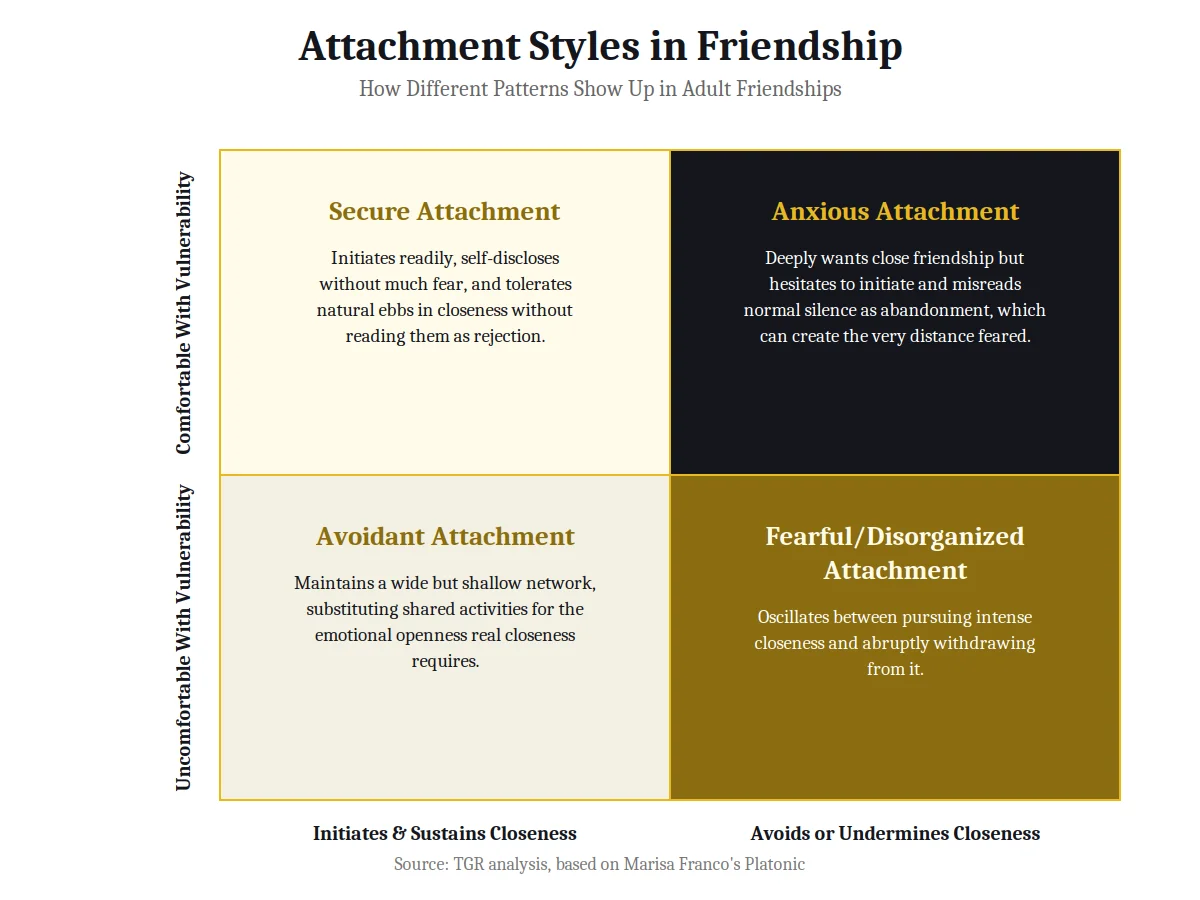
Franco’s foundational move is applying attachment theory — usually reserved for infant-caregiver bonds and romantic relationships — to adult friendship. Secure attachment shows up as readily initiating contact, self-disclosing without much fear, and tolerating the natural ebbs and flows of closeness without reading them as rejection. Anxious attachment shows up as deeply wanting close friendship while hesitating to initiate for fear of “being too much,” often misreading ordinary silence or busyness as abandonment — which paradoxically helps create the very distance feared. Avoidant attachment tends to produce a wide but shallow network, substituting shared activities for the emotional vulnerability that real closeness requires. Because friendship carries none of marriage’s built-in pressure to name and repair problems, these patterns can run unchecked for years, quietly shaping who stays close to us and who drifts away.
TGR Note: Franco’s case that friendship needs the same deliberate initiation as romance connects to research on how The Sleep Revolution reframes recovery and rest as active choices, not passive conditions — both argue that things people assume happen “naturally” actually require intention.
Part 2: The liking gap and the acceptance prophecy
A key research finding Franco builds on is the “liking gap”: across studies, people conversing with a new acquaintance consistently underestimate how much that person liked them — the other person almost always liked the interaction more than we assume. This gap is worse for anxiously attached people, who are primed to read ambiguous signals (a slow reply, a quiet friend) as evidence of rejection rather than as the ordinary noise of daily life. Franco pairs this with the “acceptance prophecy”: when people assume others like them, they behave more warmly and openly, which in turn makes others actually like them more — a self-fulfilling cycle that mirrors, in reverse, how assuming rejection can create the very distance a person fears.
Part 3: The hierarchy of love and why adult friendship is hard
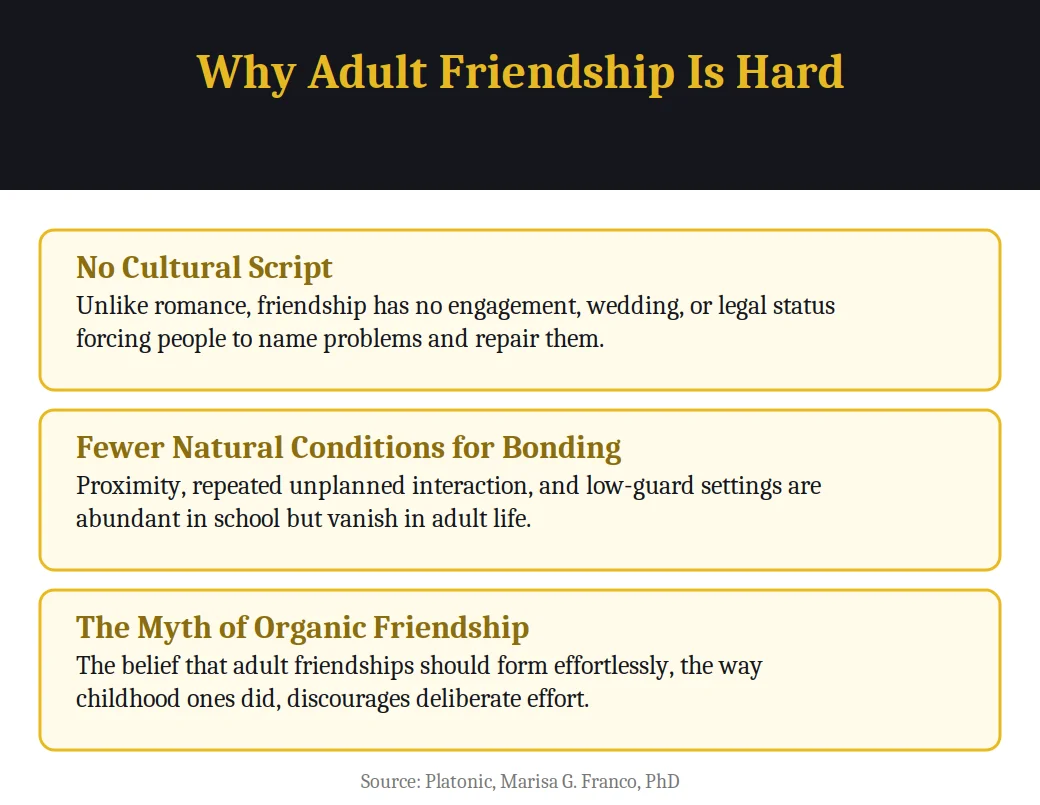
Franco’s broader cultural critique is that modern society organizes love into a hierarchy with romantic partnership at the top, treating friendship as a “junior” relationship — nice to have, but not worth real sacrifice or planning. She traces this as a historical inversion: “platonic love,” named for Plato, was originally considered by Renaissance scholars a purer, even superior form of love compared to romance. Combined with what Franco calls the myth of “organic” friendship — the belief that adult friendships should form effortlessly the way childhood ones did — this hierarchy discourages the deliberate effort friendship actually requires as an adult, once the natural bonding conditions of school (proximity, repeated unplanned interaction, low-guard settings) disappear from daily life.
Who is Platonic best for — and who should read something else first?
This book is best for readers who want to understand their own recurring patterns around initiating, sustaining, or avoiding friendship, backed by real psychological research rather than generic advice. It’s especially useful for anyone who suspects their attachment style — anxious or avoidant — might be quietly shaping how their friendships form or fade.
If you want to look more closely at how rest and recovery, not just connection, shape overall well-being, The Sleep Revolution offers a complementary case for treating another “assumed automatic” part of life as something requiring deliberate attention.
Questions to reflect on
- Which attachment pattern — secure, anxious, or avoidant — feels most true to how you approach friendship?
- Have you ever assumed someone didn’t like you as much as they actually did, based on the liking gap research?
- How much time and effort do you invest in friendships compared to a romantic relationship, and does that ratio feel right to you?
- Do you believe adult friendships should form “organically,” and how might that belief be limiting your effort to build them?
- What’s one small, deliberate step you could take this week to initiate or deepen a friendship?
🔥 Ready to stop waiting for friendship to happen naturally?
This guide covers the core framework — the book gives you Franco’s full research, attachment-style assessments, and practical strategies for building lasting friendships.
How to apply Platonic (7-day plan)
- Day 1: Reflect on which attachment style — secure, anxious, avoidant — best describes your friendship patterns.
- Day 2: Reach out first to someone you’ve been hesitant to contact, testing the liking-gap research in practice.
- Day 3: Notice one moment where you assumed rejection instead of ambiguity, and consider a more generous interpretation.
- Day 4: Identify a recurring, low-guard setting (a class, a group, a regular event) where you could build repeated contact with the same people.
- Day 5: Practice one small act of vulnerability with a friend you’d like to grow closer to.
- Day 6: Evaluate how much planning and effort you put into friendship compared to romance, and adjust if it feels lopsided.
- Day 7: Schedule one recurring commitment (a standing coffee, a regular call) with a friend you want to keep close.
Frequently asked questions
Do attachment styles really apply to friendship, not just romance?
Yes — Franco argues the same secure, anxious, and avoidant patterns shape how people build and sustain friendships.
What is the liking gap?
The tendency to underestimate how much a new acquaintance liked you after a conversation.
What is the hierarchy of love?
Franco’s term for how modern culture ranks romantic partnership above friendship, treating friendship as optional.
Why is adult friendship harder than childhood friendship?
The natural bonding conditions of school — proximity, repeated contact, low-guard settings — largely disappear in adulthood.
What is the acceptance prophecy?
Believing others like you tends to make you warmer, which makes people actually like you more.
Was “platonic love” always considered secondary to romance?
No — Franco notes Renaissance scholars originally considered it a purer, even superior form of love.
Is this book based on real psychological research?
Yes — Franco is a psychologist whose academic work centers on rejection sensitivity and social connection.
Related summaries
If Platonic resonated, these dig further into related territory: other titles in our best relationship books pillar page.
How we analyze books: We work from the full book — reconstructing its core arguments in our own words, adding commentary that connects it to related research and other books in our library, and pressure-testing the advice in a practical 7-day plan. Ratings weigh usefulness, readability, and evidence quality. Read our full methodology.