

★★★★☆ 4.2/5 — Getting Results the Agile Way takes the Agile software methodology and turns it into a simple, repeatable personal operating system for work and life.
Best for: Anyone who has tried to-do-list systems that eventually collapse under their own weight
Reading time: ~20 minutes (book: ~5 hours, 274 pages)
Difficulty to apply: Easy — the core system fits on an index card
Getting Results the Agile Way in one minute
“Be the author of your life and write your story forward.” That’s how J.D. Meier opens Getting Results the Agile Way, and the whole book is built to make that possible without turning your life into a project plan. Meier spent 25 years at Microsoft, including a stint as innovation coach for CEO Satya Nadella’s team, watching software teams succeed with Agile development while individuals around them drowned in overflowing to-do lists. His answer was Agile Results® — a lightweight system that borrows Agile’s best ideas (short cycles, “good enough” iteration, flexible scope) and applies them to a single person’s week, day, month, and year.
The system doesn’t ask you to adopt anything all at once. Meier is explicit that three basic habits — the Rule of 3, the Monday Vision / Daily Outcomes / Friday Reflection rhythm, and setting boundaries around your “Hot Spots” — deliver most of the value on their own. Everything else in the book (motivation techniques, productivity tactics, ways to use stories to design your day) is optional depth you can add once the basics stick.
Key takeaways
- Outcomes beat activities: hours logged don’t matter if nothing you actually wanted got finished.
- The Rule of 3 is scale-invariant: pick 3 outcomes for the day, 3 for the week, 3 for the month, 3 for the year — never more.
- Monday Vision, Daily Outcomes, Friday Reflection is the weekly engine: plan Monday, execute daily, review Friday.
- “Good enough” beats perfect: ship a version now; improve it in v2 and v3 rather than stalling for the ideal first draft.
- Fix time, flex scope: cap the time box for a task and adjust what fits inside it, instead of letting scope balloon and time overrun.
- Results over productivity: staying “busy” with spare capacity often means working low-value items — deliberate slack protects you for what matters.
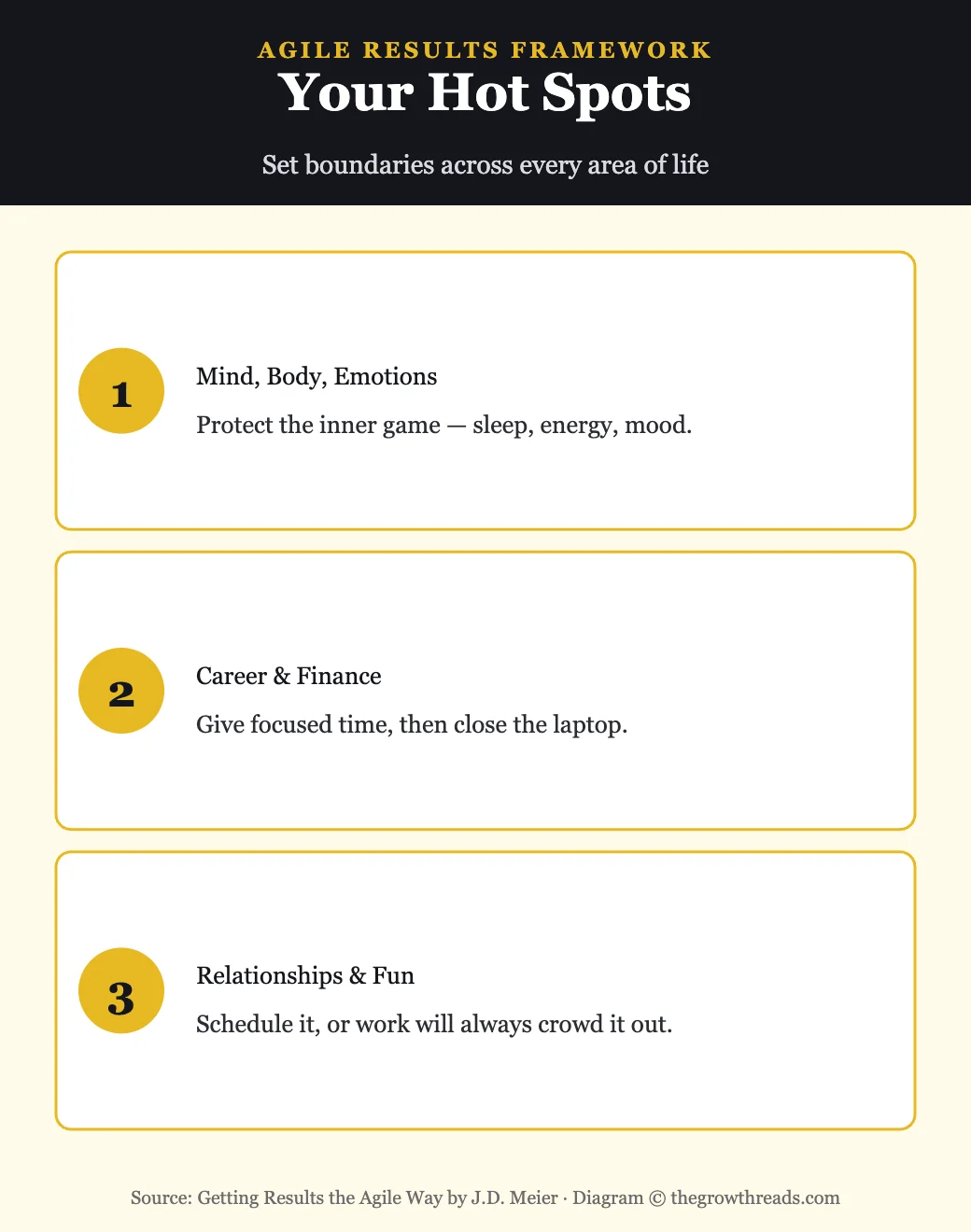
- Hot Spots need boundaries: mind, body, emotions, career, finance, relationships, and fun each need protected time or work will crowd them out.
- Energy matters as much as time: match demanding work to your high-energy windows instead of fighting your own rhythm.
- “Next best thing” beats a rigid queue: when working through a backlog, pick whatever adds the most value right now, not just what’s oldest.
- The system compounds through repetition: the weekly rhythm is meant to be run indefinitely, not “finished” — each Friday reflection feeds the next Monday vision.
What is Getting Results the Agile Way about?
Getting Results the Agile Way is J.D. Meier’s guide to Agile Results® — a personal productivity system that adapts Agile software development principles (short cycles, iteration, flexible scope) into a simple weekly rhythm for work and life, built around the Rule of 3 and protected boundaries for every important area of your life.
About the author
J.D. Meier spent 25 years at Microsoft, where his roles spanned engineering leadership, innovation strategy, and a stint as the former head coach for CEO Satya Nadella’s innovation team. He created the “Book of Dreams” framework used internally at Microsoft to spark innovation, and has written more than 1,500 articles covering mind, body, emotions, career, finance, relationships, and fun — the same categories that show up in the book’s “Hot Spots” framework. Getting Results the Agile Way, published in 2011 with a foreword by Michael Kropp, distills what Meier learned coaching individuals and teams inside one of the world’s largest software companies into a system anyone can run without any Agile or software background. Explore all J.D. Meier book summaries →
Key concepts at a glance
| Concept | What it means | Use it when |
|---|---|---|
| Agile Results® | A personal system adapting Agile software principles to daily/weekly life | Your current to-do system keeps collapsing under its own weight |
| The Rule of 3 | Cap outcomes at 3, at every timescale — daily, weekly, monthly, yearly | You feel overwhelmed by an ever-growing list |
| Monday Vision | Choosing the week’s 3 outcomes at the very start of the week | Setting up before Monday’s inbox takes over |
| Daily Outcomes | Picking each day’s 3 priorities, tied back to the weekly vision | Starting each morning with intention instead of reaction |
| Friday Reflection | A short weekly review of wins and lessons | Closing the loop so next week improves on this one |
| Fix time, flex scope | Time-box the work; let what fits inside adjust, not the deadline | A task keeps expanding past its allotted time |
| Hot Spots | The 7 life areas (mind, body, emotions, career, finance, relationships, fun) needing boundaries | One area of life is quietly crowding out the rest |
| Next Best Thing | Choosing the highest-value item from the backlog, not just the oldest | Working through a long list of stored, unprioritized tasks |
Part 1: Why Agile Results Instead of Another To-Do List
Meier opens by naming the failure mode of most personal productivity systems: they work for a few weeks, then collapse the moment life gets unpredictable, because they were built for a world that holds still. Agile software development succeeded, in Meier’s account, precisely because it assumes change is constant — it plans in short cycles, ships “good enough” versions, and adjusts scope rather than fighting reality. Agile Results applies the same logic to a single person’s day, week, month, and year.
The system’s origin is practical, not theoretical. Meier developed it over years inside Microsoft, coaching engineers and leaders — including a stretch as innovation coach for CEO Satya Nadella’s team — who were fluent in Agile at the team level but had no equivalent system for their own individual workload. He noticed the same pattern repeatedly: people who ran disciplined two-week sprints at work still drowned in an unstructured personal task list, because nobody had translated the team-level discipline down to the individual level. Agile Results is that translation, built and refined against real teams rather than designed in the abstract.
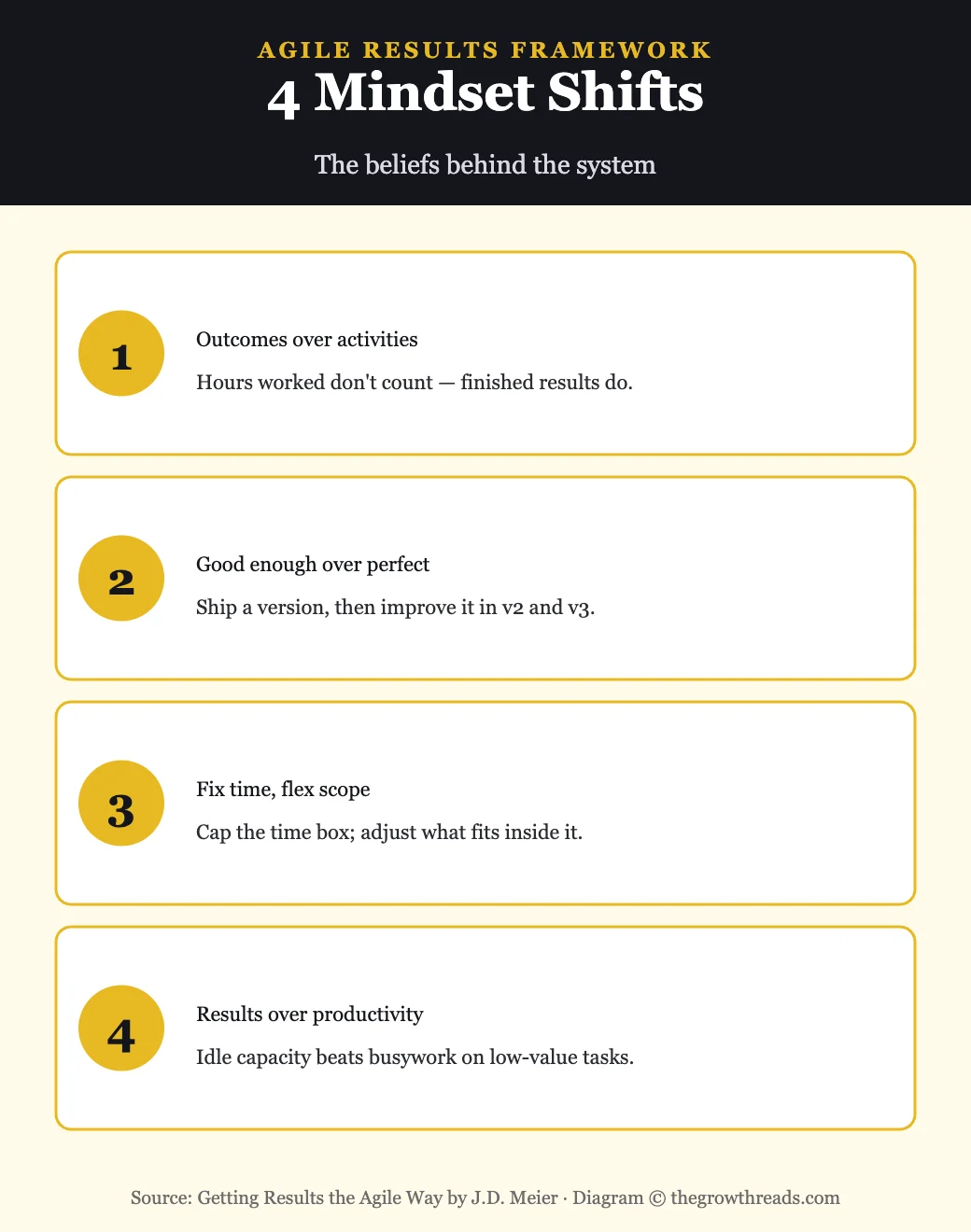
The book’s first mindset shift is outcomes over activities. Most task lists measure input — hours worked, tasks checked off — rather than output, whether anything that mattered actually got finished. Meier’s fix is to write every item on your list as a finished result (“Draft sent to client” rather than “work on client draft”), which forces clarity about what “done” actually looks like before you start.
The second shift, “good enough” over perfection, gives you permission to ship a first version and improve it later rather than stalling until conditions are ideal. Paired with the third shift, fix time, flex scope — capping the time box for a task and letting the scope adjust to fit, instead of letting the deadline slip — this creates a system that keeps moving even when the plan was imperfect from the start.
TGR Note: The “outcomes over activities” shift echoes the core argument in Ashley Whillans’s Time Smart — both books treat time spent as a poor proxy for value created. Whillans applies the lens to happiness; Meier applies it to weekly execution.
Part 2: The Rule of 3 and the Weekly Rhythm
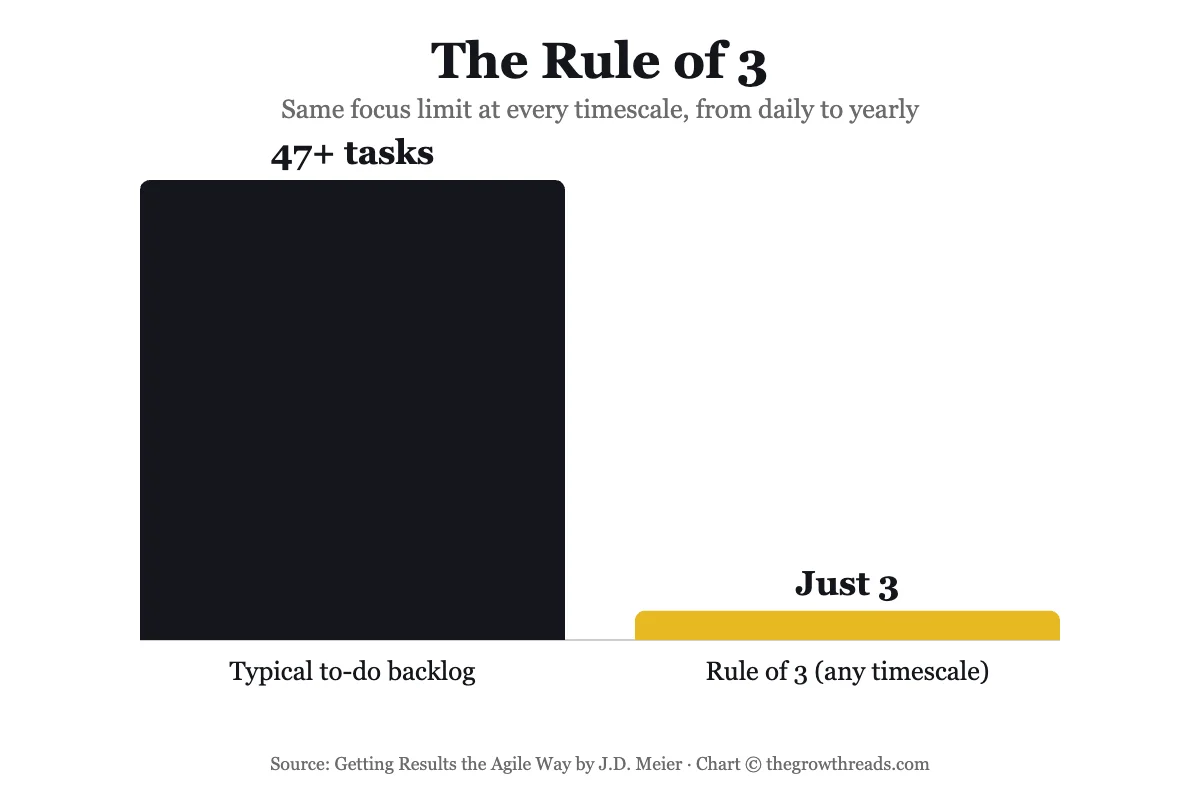
The operational core of the book is deceptively simple: never hold more than three outcomes at any timescale. Three things for today. Three for the week. Three for the month. Three for the year. The number doesn’t change as the timescale grows — what changes is the size of the outcome. A daily “3” might be finishing a report section; a yearly “3” might be launching a product. Meier’s argument is that this constraint is what actually protects focus — most backlogs run into the dozens, but almost nobody can meaningfully hold more than three priorities in working memory at once.
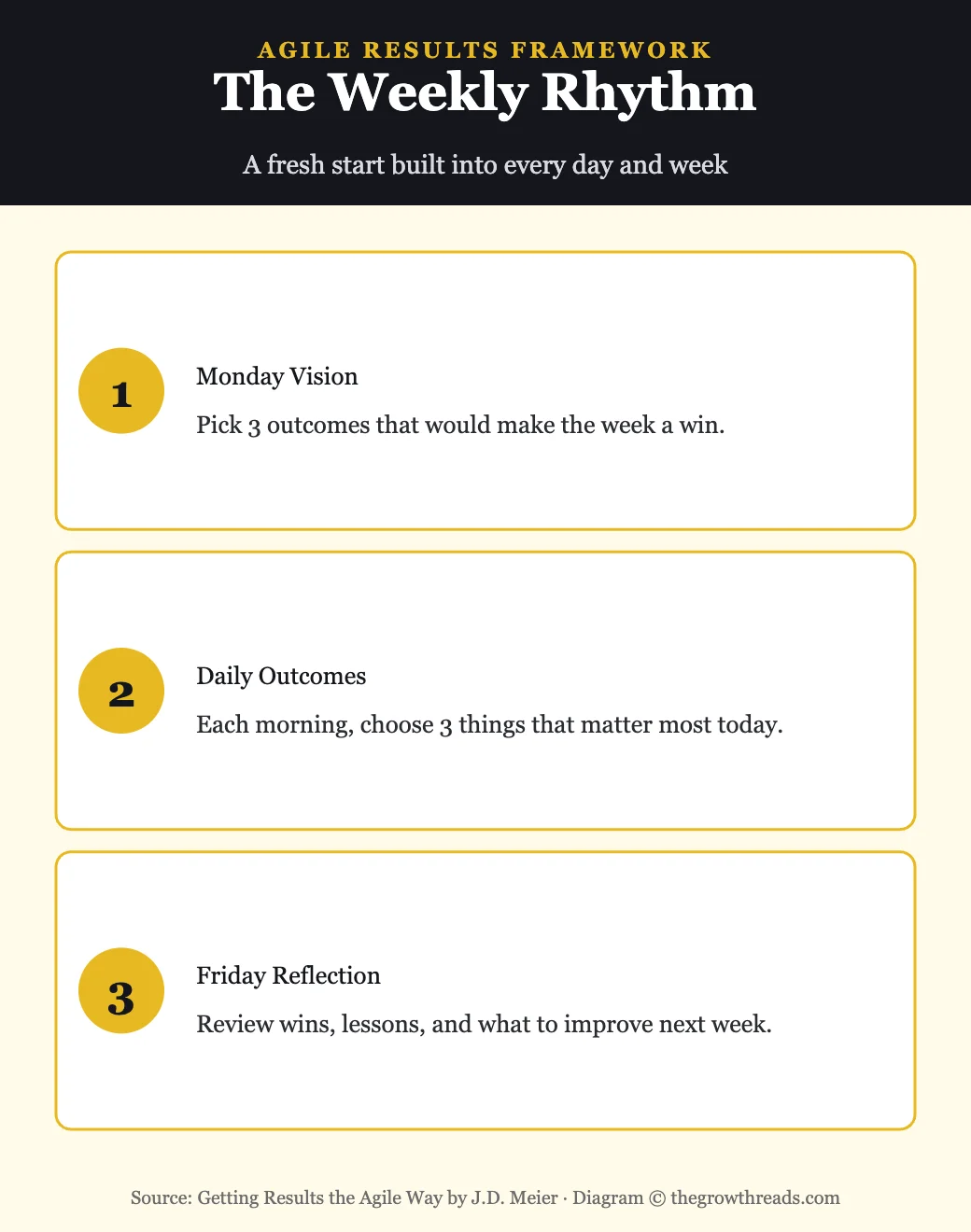
That constraint plugs directly into the book’s weekly engine: Monday Vision (choose the week’s three outcomes before the inbox takes over), Daily Outcomes (each morning, pick three things tied back to that vision), and Friday Reflection (a short review of what worked, what didn’t, and what to carry into next week). Because the cycle repeats every week indefinitely, small improvements compound — each Friday’s lesson becomes an input to the following Monday’s plan, the same way an Agile team’s retrospective feeds the next sprint.
Meier also introduces “Next Best Thing” as the rule for working through a backlog: rather than grinding through tasks in the order they arrived, you scan for whatever will add the most value right now. Combined with the Rule of 3, this keeps a large backlog from ever needing to be fully organized — it just needs to be scanned regularly for its next highest-value item.
This is a deliberate break from most task-management advice, which typically pushes toward exhaustive organization — folders, contexts, priority tiers. Meier’s bet is that the organizing effort itself is often wasted, since most of a backlog will never become the “next best thing” no matter how neatly it’s filed. Spending less time maintaining the list and more time asking “what’s most valuable right now” is, in his framing, a more honest use of limited attention than building an elaborate system to manage tasks that may never get done anyway.
TGR Note: The Monday-to-Friday rhythm pairs naturally with Richard Koch’s The 80/20 Principle — use Koch’s lens to identify which 20% of possible outcomes would actually move the needle, then use Meier’s Rule of 3 to commit to acting on them each week.
Part 3: Hot Spots — Boundaries Across Every Area of Life
Where many productivity systems focus narrowly on work output, Meier extends Agile Results across what he calls “Hot Spots” — the recurring areas of life that need their own protected boundaries: mind, body, emotions, career, finance, relationships, and fun. The argument is that neglecting any one of these eventually undermines the others; a career pushed at the expense of health or relationships produces results that don’t hold up.
Practically, this means treating non-work Hot Spots with the same boundary-setting Meier applies to work: a maximum time box for email, a minimum time box for exercise or family, explicit “off” boundaries so work doesn’t silently expand into the rest of life. He pairs this with attention to energy, not just time — matching demanding tasks to your natural high-energy windows rather than fighting your own rhythm, and treating rest as a legitimate input to results rather than a reward you earn only after finishing everything.
This is also where the book’s “results over productivity” shift does its work: Meier is explicit that filling every open hour with activity is a trap. Deliberate slack — unscheduled time — is what makes room for the highest-value “next best thing” when it appears, rather than everything being pre-committed to lower-value busywork.
Energy management gets its own attention alongside time. Meier encourages tracking which parts of the day you’re naturally sharpest — for most people, a window in the morning — and reserving that window for the work that most needs it, rather than burning peak energy on email or routine tasks that could run on autopilot later. Over a week, this small reallocation compounds: the same total hours worked produce meaningfully more finished, high-quality outcomes when demanding work lands during high-energy windows instead of fighting against low ones.
TGR Note: The Hot Spots framework overlaps closely with the “roles” concept in Stephen Covey’s tradition, explored in First Things First. Read them together: Covey supplies the “why” for balancing life roles against the clock, Meier supplies a lighter-weight weekly mechanism for actually doing it.
Part 4: Making the System Your Own
Meier is careful to frame Agile Results as a starting scaffold, not a rigid prescription. The book spends its later chapters on optional layers — using short stories or metaphors to reframe a hard day, identifying personal “problem-solving heroes” to borrow perspective from when stuck, and adjusting the system’s cadence for people whose weeks don’t follow a standard Monday-to-Friday shape. None of these are required for the system to work; they’re depth for readers who want to extend it.
The throughline across all of this is that Agile Results is meant to be lived with, not completed. There’s no final state where the system is “done” — like an Agile team’s sprint cadence, it’s meant to run indefinitely, absorbing whatever changes in your life and adjusting scope rather than breaking. Several reviewers note the book repeats its core ideas often; that repetition is deliberate, since Meier’s own framing is that a system only works if you can recall and apply it without the book in front of you.
Meier is also candid that the weekly cadence is a default, not a mandate. Readers with irregular schedules — shift workers, freelancers, parents of young children — are encouraged to keep the underlying shape (a planning moment, daily execution, a review moment) while adjusting which days anchor it. The Rule of 3 and the fix-time-flex-scope habit port over cleanly to any cadence; only the calendar labels (“Monday,” “Friday”) need to move.
TGR Note: If the full Agile Results system feels like more structure than you need right now, Dan Martell’s Buy Back Your Time offers a complementary angle — instead of organizing your own outcomes more tightly, it asks which of them shouldn’t be on your list at all.
Who is Getting Results the Agile Way best for — and who should read something else first?
This book is best suited to readers who’ve tried conventional to-do-list systems and watched them collapse the first time a week got chaotic — Agile Results is explicitly designed to flex rather than break. It’s also a strong fit for anyone with a software or Agile background, since the metaphors will feel immediately familiar.
If you want a system with more anecdote-driven motivation and less repetition of core principles, Meier’s own reviewers point to The 80/20 Principle as a complementary read with a different texture. And if your core problem is an inbox and task list that’s grown too large to organize at all, start with 168 Hours to audit where your time actually goes before adopting a new system on top of it.
Questions to reflect on
- What are your 3 outcomes for this week — and would you recognize Friday as a win if you hit exactly those three?
- Look at your current to-do list. How many items are written as activities (“work on X”) rather than finished outcomes (“X delivered”)?
- Which of your 7 Hot Spots (mind, body, emotions, career, finance, relationships, fun) has had no protected time in the last two weeks?
- Where in your week are you fighting your own energy rhythm — doing demanding work when you’re naturally low, or vice versa?
- What’s one task you’ve been trying to make perfect that would deliver most of its value at “good enough”?
🔥 Ready to build your own Agile Results system?
Start with the Rule of 3 this Monday — it’s the single habit that makes the rest of the system click.
How to apply Getting Results the Agile Way (7-day plan)
- Day 1 (Monday) — Monday Vision: Write down exactly 3 outcomes that would make this week a win.
- Day 2 — Daily Outcomes: Each morning this week, pick 3 things tied to Monday’s vision before opening email.
- Day 3 — Rewrite your backlog: Take 10 items from your to-do list and rewrite each as a finished outcome, not an activity.
- Day 4 — Time-box one task: Pick one task prone to dragging on, give it a hard time box, and let scope flex instead of the deadline.
- Day 5 — Audit your Hot Spots: List all 7 (mind, body, emotions, career, finance, relationships, fun) and mark which have zero protected time this week.
- Day 6 — Protect one Hot Spot: Block time for the Hot Spot you neglected most, and treat it as non-negotiable.
- Day 7 (Friday) — Friday Reflection: Review your 3 weekly outcomes. What worked? What will you carry into next Monday’s vision?
Frequently asked questions
What is the main idea of Getting Results the Agile Way?
The main idea is that personal productivity systems fail when they’re built for a static world, because life is constantly changing. J.D. Meier adapts Agile software development principles — short cycles, “good enough” iteration, flexible scope — into a personal system called Agile Results, built around the Rule of 3 (never more than 3 outcomes at any timescale) and a weekly rhythm of Monday Vision, Daily Outcomes, and Friday Reflection.
What is the Rule of 3 in Getting Results the Agile Way?
The Rule of 3 caps your outcomes at exactly three, at every timescale — three things for today, three for the week, three for the month, three for the year. The number stays constant; only the size of the outcome changes with the timescale. Meier presents it as the single highest-leverage habit in the book because most people can’t meaningfully hold more than three priorities in working memory at once.
What are Hot Spots in Getting Results the Agile Way?
Hot Spots are the recurring life areas Meier says need their own protected boundaries: mind, body, emotions, career, finance, relationships, and fun. The framework argues that neglecting any one of these eventually undermines the others, so each needs explicit time boundaries rather than being left to whatever time work doesn’t consume.
Do I need an Agile or software background to use this book?
No. While the system borrows terminology and principles from Agile software development, Meier translates everything into plain personal-productivity language — outcomes, time boxes, weekly reviews. Readers with an Agile background may find the metaphors especially intuitive, but the book doesn’t assume any prior knowledge of software methodologies.
Is Getting Results the Agile Way repetitive?
Some readers note that the book circles back to its core principles multiple times rather than relying heavily on new anecdotes. This appears to be a deliberate choice — Meier’s own framing is that a personal system only works if you can recall and apply it without the book in hand, so the repetition reinforces retention rather than padding the page count.
How is this different from Getting Things Done?
Getting Things Done focuses heavily on capturing and organizing tasks into trusted lists and contexts. Agile Results focuses less on organizing the full backlog and more on choosing a small, fixed number of outcomes at each timescale (the Rule of 3) and running a repeating weekly rhythm around them. Many readers use the two together — GTD-style capture for the backlog, Agile Results for deciding what to actually act on each week.
What’s a good first step if I only have 10 minutes?
Write down exactly three outcomes — not activities — that would make this week a genuine win. Phrase each as a finished result (“Proposal sent” rather than “work on proposal”). That single step, repeated every Monday, is the core engine of the entire system.
Related summaries
- Time Smart by Ashley Whillans — the wellbeing research behind valuing outcomes over hours worked.
- The 80/20 Principle by Richard Koch — how to identify which outcomes are worth your Rule of 3.
- First Things First by Stephen Covey — a deeper look at balancing life roles against the clock.
- Buy Back Your Time by Dan Martell — deciding which outcomes shouldn’t be yours to own at all.
- Browse all Productivity book summaries →
How we analyze books: Every TGR summary is built from a full reading of the source material, cross-checked against the author’s published interviews and research where relevant, and structured around practical application rather than just recap. We never reproduce a book chapter-by-chapter — instead we synthesize the core arguments, verify claims where possible, and add original frameworks (diagrams, 7-day plans, reflection questions) you won’t find in the book itself. Read our full methodology.