

★★★★☆ 4.4/5 — A meticulously researched case that sustainable weight loss comes from exploiting your body’s own physiology with specific, evidence-backed foods and habits, not willpower alone.
Best for: readers who want a rigorously cited, whole-food approach to weight loss instead of another restrictive fad diet · Reading time: ~10 hrs (this guide: ~12 min) · Difficulty to apply: Moderate — the individual tweaks are simple, but the book is dense with citations worth digesting slowly
How Not to Diet in one minute
Sustainable weight loss isn’t about willpower — it’s about exploiting your body’s own physiology, and Michael Greger, MD, builds his case from more than 4,000 cited clinical studies. The book’s central idea is caloric density: foods like vegetables, fruits, and legumes let you eat a large, filling volume for relatively few calories, illustrated by Greger’s comparison that ten carrots contain roughly the same calories as a bottle of Coke, yet take vastly longer to eat and chew. Beyond food choice, Greger organizes 21 specific, evidence-tested “tweaks” — from having vinegar before a meal to finishing eating earlier in the day — into a “Weight Loss Multiplier” framework, each contributing a modest, measurable boost to fat loss that compounds when stacked together. Published in 2019 as a follow-up to his bestseller How Not to Die, the book also debunks popular diet myths around low-carb eating and exercise-alone weight loss, while devoting real attention to fiber, gut microbiome health, and the engineered hyper-palatability of processed foods that override natural satiety signals.
Key takeaways
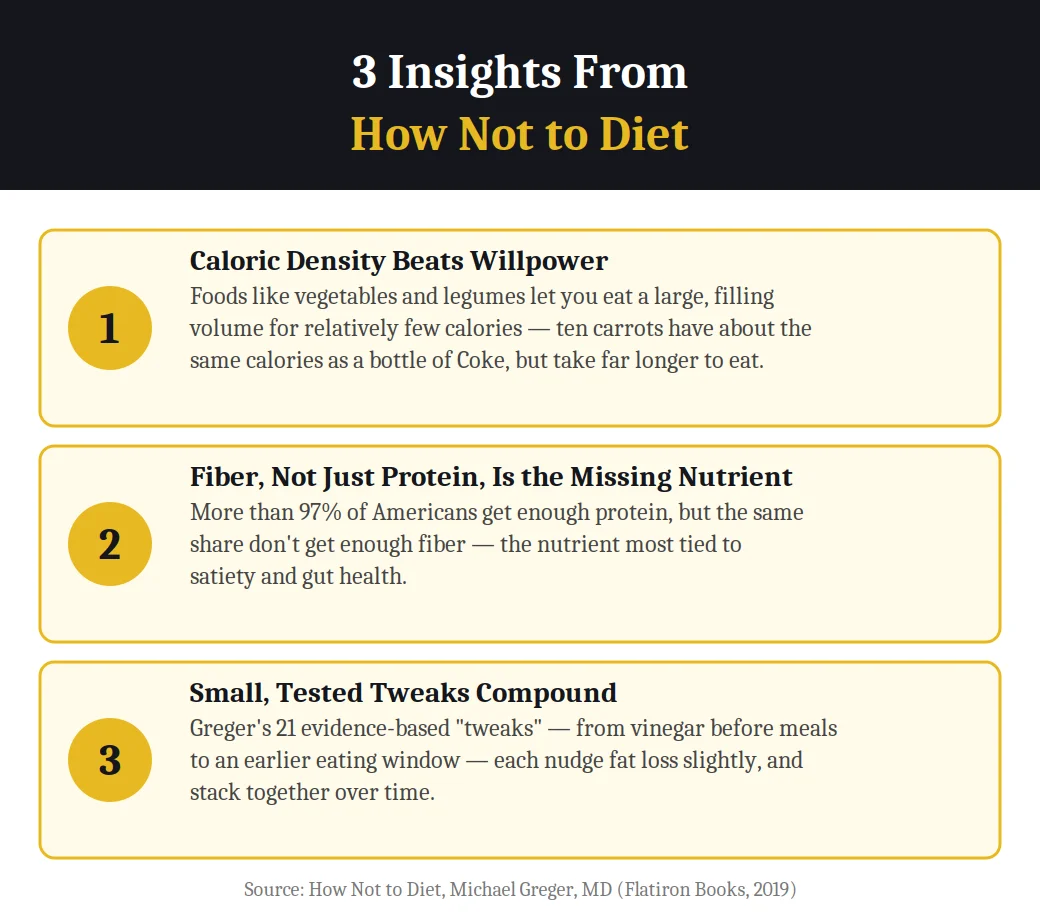
- Caloric density matters more than counting calories alone: low-density foods like vegetables and legumes let you eat a large, filling volume for relatively few calories, making satiety easier to achieve without deprivation.
- Fiber is the real missing nutrient, not protein: more than 97% of Americans get enough protein, but the same share don’t get enough fiber — the nutrient most tied to satiety, gut bacteria, and slower digestion.
- The Weight Loss Multiplier ranks 21 tested tweaks: specific foods and habits, from black cumin to vinegar to an earlier eating window, are each assigned an approximate calorie-equivalent effect on fat loss.
- AMPK activation is a recurring biological thread: vinegar, exercise, and fasting are all linked to activating the body’s metabolic “master switch,” tied to blood sugar control and fat burning.
- Timing matters as much as content: front-loading calories earlier in the day and finishing eating by early evening are both linked to better metabolic outcomes than eating the same food later.
- Low-carb diets misidentify the real culprit: Greger argues dietary carbohydrates are harder for the body to convert into stored fat than dietary fat is, challenging a core premise of popular low-carb approaches.
- Exercise alone rarely produces meaningful weight loss: without dietary change, physical activity by itself tends to produce only modest results, making food choices the primary lever.
- Processed foods are engineered to override satiety: hyper-palatable combinations of fat, sugar, and salt are deliberately designed to encourage overconsumption beyond what natural fullness signals would allow.
- Frequent self-monitoring predicts long-term success: simple habits like weighing yourself regularly are among the most consistent predictors of durable weight-loss outcomes in the cited research.
What is How Not to Diet about?
How Not to Diet is Michael Greger’s evidence-based case that sustainable weight loss comes from working with the body’s own physiology — through caloric density, fiber, meal timing, and specific tested foods — rather than through willpower or restrictive fad diets. Built on a review of more than 4,000 clinical studies, the book organizes its recommendations into 21 ranked “tweaks,” each with an approximate evidence-based impact on fat loss, while also debunking popular diet myths around low-carb eating, intermittent fasting, and exercise-only weight loss. Published in 2019 as a companion to Greger’s bestselling How Not to Die, the book closes with a weight-loss chart pyramid summarizing which foods and habits carry the strongest evidence behind them.
About the author
Michael Greger, MD, is a physician, author, and founder of NutritionFacts.org, a non-profit that distills nutrition science research into free videos and articles for the public. A New York Times bestselling author of How Not to Die, Greger has testified before the U.S. Congress, presented to numerous medical conferences, and served as an expert witness in food-safety litigation. His work is built on systematically reviewing published clinical research — How Not to Diet alone cites more than 4,000 studies — to translate evidence-based nutrition science into practical, everyday recommendations for the general public. Explore all Michael Greger, MD book summaries →
Key concepts at a glance
| Concept | What it means | Use it when |
|---|---|---|
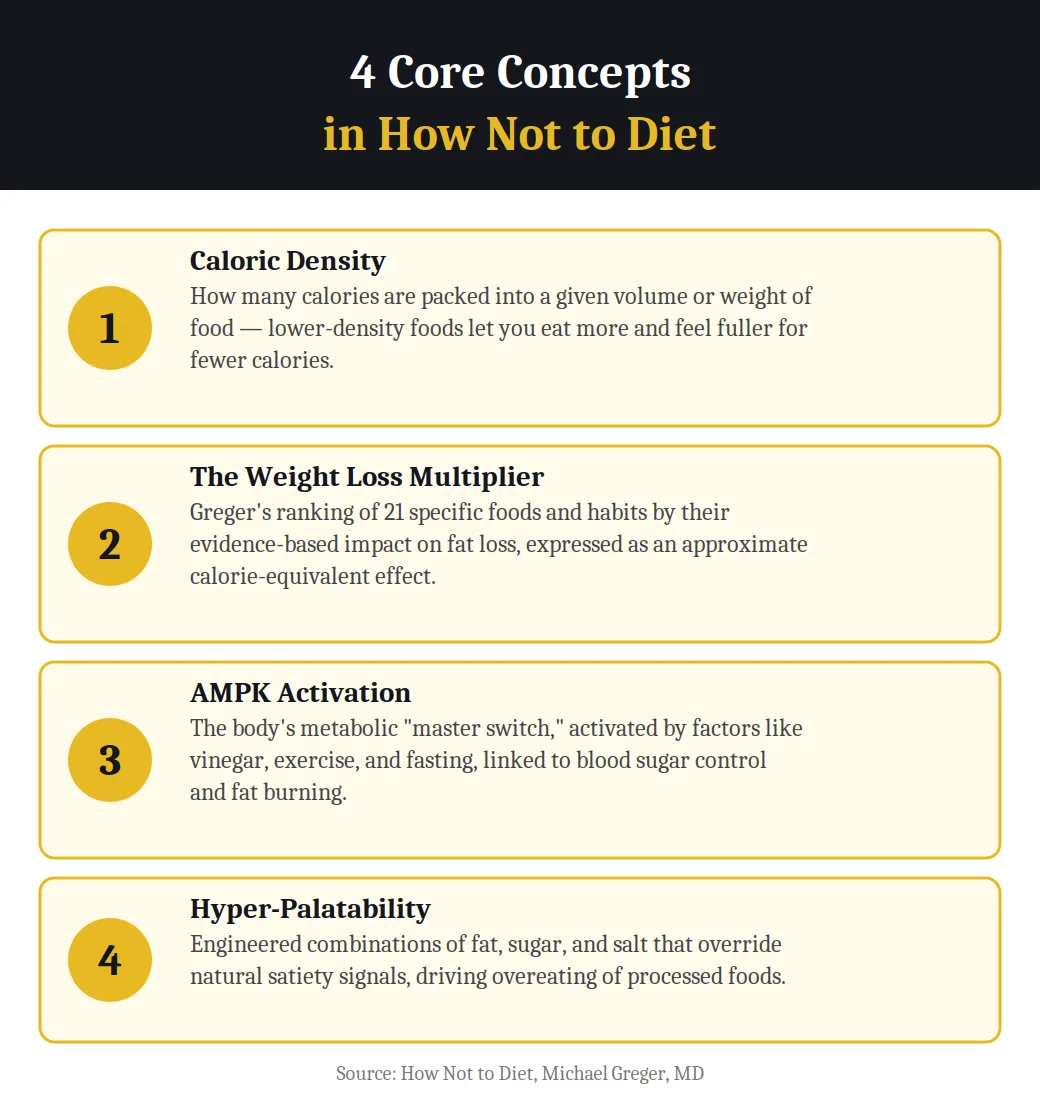
| Caloric Density | How many calories are packed into a given volume or weight of food | You’re choosing what to eat to feel full without overeating calories |
| The Weight Loss Multiplier | A ranking of 21 specific foods and habits by their evidence-based fat-loss impact | You want to prioritize which small changes to make first |
| AMPK Activation | The body’s metabolic “master switch,” activated by vinegar, exercise, and fasting | You’re evaluating why a specific food or habit is linked to fat burning |
| Hyper-Palatability | Engineered combinations of fat, sugar, and salt that override natural satiety signals | You’re trying to understand why certain processed foods feel hard to moderate |
| Meal Timing | When you eat, not just what, affects metabolic outcomes | You’re deciding when to schedule your largest meals or your eating window |
Part 1: Caloric density and the missing nutrient
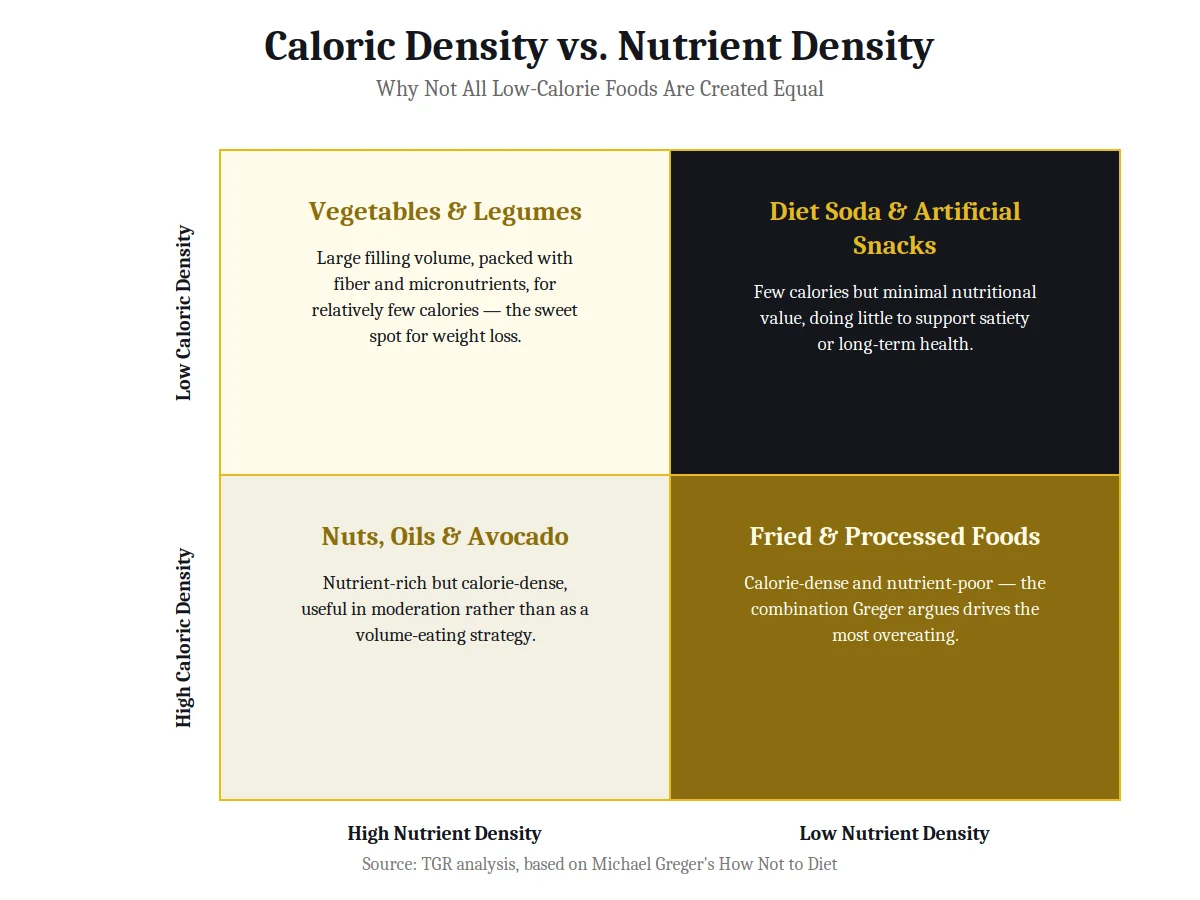
Greger’s foundational concept is caloric density — how many calories are packed into a given volume or weight of food. Vegetables, fruits, and legumes let you eat a large, physically filling amount of food for relatively few calories; his memorable illustration is that ten carrots contain roughly the same calories as a bottle of Coke, yet take vastly longer to chew and eat, triggering satiety signals along the way that a sugary drink never does. This connects directly to fiber, which Greger identifies as the real missing nutrient in the modern diet: more than 97% of Americans already get enough protein, but the same overwhelming share fall short on fiber, the nutrient most closely tied to satiety, slower gastric emptying, and a healthy gut microbiome that produces beneficial short-chain fatty acids.
TGR Note: Greger’s caution against relying on willpower alone connects to Younger Next Year‘s argument that daily physical habits, not motivation in the moment, are what actually determine long-term health outcomes.
Part 2: The Weight Loss Multiplier and 21 tweaks
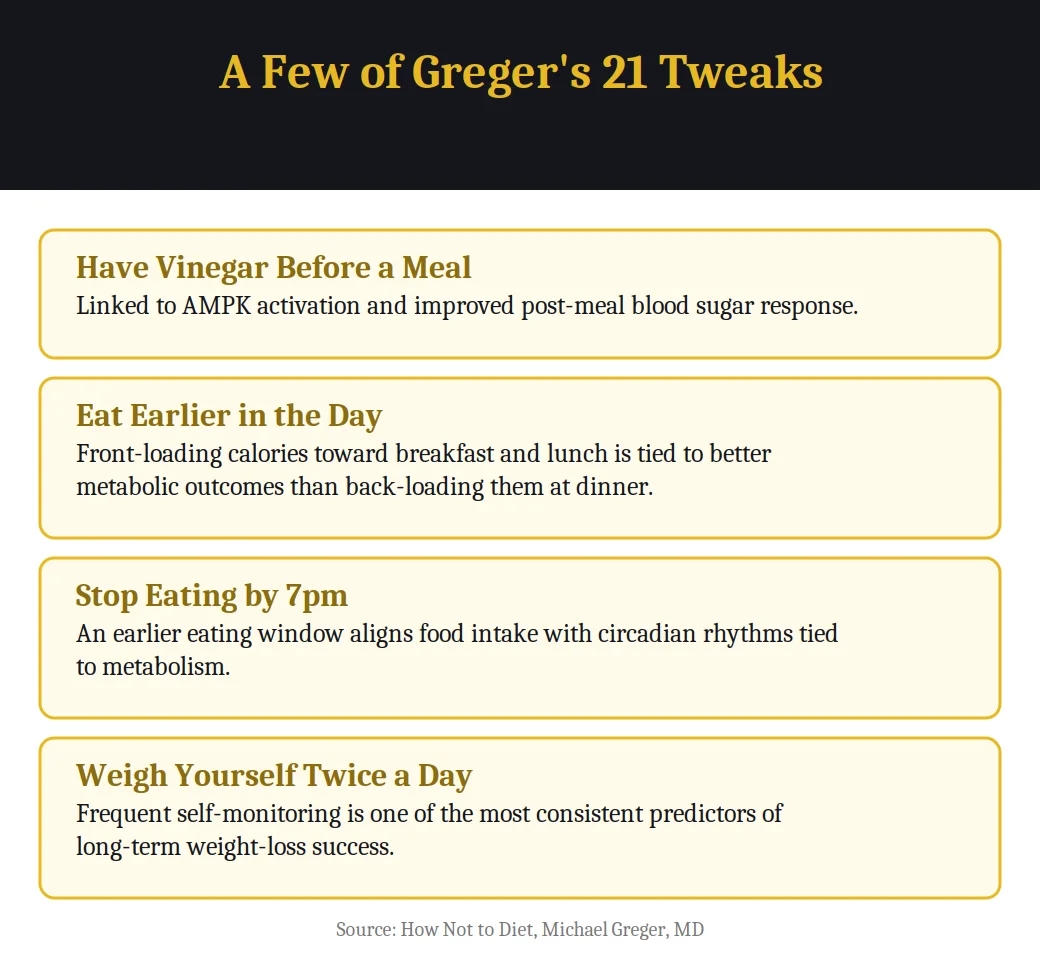
Rather than a single silver-bullet food, Greger organizes his recommendations into a “Weight Loss Multiplier” — 21 specific, evidence-tested tweaks grouped by when you apply them: at each meal, in daily doses, throughout the day, and in the evening. Each tweak, from having vinegar before a meal to including a small daily dose of black cumin, carries an approximate calorie-equivalent effect drawn from clinical trials, and several converge on activating AMPK, the body’s metabolic “master switch” linked to blood sugar control and fat burning. Greger is careful to frame these as modest individual nudges rather than dramatic fixes — the real result comes from stacking several tweaks together consistently over time, rather than relying on any single one in isolation.
Part 3: Timing, myths, and hyper-palatability
Greger devotes significant attention to when you eat, not just what: front-loading calories toward breakfast and lunch rather than dinner, and finishing eating earlier in the evening, are both linked in the cited research to better metabolic outcomes, likely tied to circadian rhythm effects on insulin sensitivity. He challenges popular diet myths directly — arguing dietary carbohydrates are harder for the body to convert into stored fat than dietary fat is, complicating a core premise of low-carb approaches, and showing that exercise alone, without dietary change, tends to produce only modest weight loss. Finally, he addresses the food industry’s role in engineering hyper-palatable combinations of fat, sugar, and salt specifically designed to override natural satiety signals, framing overeating processed food less as a personal failing and more as a predictable response to deliberately engineered products.
Who is How Not to Diet best for — and who should read something else first?
This book is best for readers who want a rigorously cited, whole-food approach to weight loss and are willing to sit with a dense, footnote-heavy text rather than a quick, simplified program. Its evidence-first style rewards readers who want to understand the “why” behind each recommendation, not just a checklist to follow blindly.
If you want a broader look at daily habits that support healthy aging beyond diet specifically, Younger Next Year offers a complementary, exercise-and-connection-focused companion to this book’s nutrition focus.
Questions to reflect on
- Which foods in your regular diet are calorie-dense but not very filling, and what lower-density alternative could replace them?
- Are you getting enough fiber, given that most people fall short even while meeting their protein needs?
- Which one or two of Greger’s 21 tweaks feels most realistic to add to your routine this week?
- Do you currently eat most of your calories earlier or later in the day, and how might shifting that timing feel?
- Can you identify a hyper-palatable processed food in your pantry that might be engineered to override your natural sense of fullness?
🔥 Ready to work with your body’s physiology instead of against it?
This guide covers the core framework — the book gives you Greger’s full citations, all 21 tweaks, and the complete weight-loss chart.
How to apply How Not to Diet (7-day plan)
- Day 1: Swap one calorie-dense, low-fiber snack for a lower-density, higher-fiber alternative like vegetables or legumes.
- Day 2: Try having a small amount of vinegar before a meal and notice how it affects your appetite afterward.
- Day 3: Shift one meal earlier in the day, front-loading calories toward breakfast or lunch instead of dinner.
- Day 4: Set a cutoff time for eating in the evening and stick to it for the rest of the week.
- Day 5: Identify one hyper-palatable processed food you eat regularly and consider a whole-food substitute.
- Day 6: Weigh yourself and note the number, establishing a baseline for regular self-monitoring.
- Day 7: Choose two of Greger’s 21 tweaks to commit to consistently over the coming weeks.
Frequently asked questions
What is caloric density?
How many calories are packed into a given volume or weight of food — lower-density foods let you eat more and feel fuller for fewer calories.
What is the Weight Loss Multiplier?
A ranking of 21 specific foods and habits by their evidence-based impact on fat loss, each with an approximate calorie-equivalent effect.
Why does the book emphasize fiber over protein?
Because more than 97% of Americans already get enough protein, but the same share fall short on fiber, which drives satiety and gut health.
Does the book support low-carb diets?
No — Greger argues dietary carbohydrates are harder to convert into stored fat than dietary fat is, challenging a core low-carb premise.
Is exercise alone enough to lose weight, according to the book?
No — the cited research shows exercise without dietary change tends to produce only modest weight loss.
What is AMPK?
The body’s metabolic “master switch,” activated by factors like vinegar, exercise, and fasting, linked to blood sugar control and fat burning.
How is this different from Younger Next Year?
Younger Next Year focuses on exercise and connection for healthy aging; How Not to Diet focuses specifically on evidence-based nutrition for weight loss.
Related summaries
If How Not to Diet resonated, these dig further into related territory: Younger Next Year on exercise and healthy aging, and other titles in our best health books pillar page.
How we analyze books: We work from the full book — reconstructing its core arguments in our own words, adding commentary that connects it to related research and other books in our library, and pressure-testing the advice in a practical 7-day plan. Ratings weigh usefulness, readability, and evidence quality. Read our full methodology.