

★★★★☆ 4.3/5 — A clear-eyed, often funny tour of where algorithms already run our lives, and exactly where a human still needs to be in the room.
Best for: Anyone who wants a concrete, story-driven understanding of algorithmic decision-making in justice, healthcare, and beyond.
Reading time: ~7 hours to read cover to cover · ~35 min for this guide
Difficulty to apply: Moderate — the framework translates directly into how you evaluate any algorithm-assisted decision.
Hello World in one minute
Algorithms already decide who gets bail, what medical treatment you receive, and how your car brakes in an emergency — and mathematician Hannah Fry wants you to understand exactly how. Rather than a general treatise on AI, Hello World walks through specific, real-world domains — criminal justice, medicine, cars, crime, art, and more — showing precisely where algorithmic decision-making helps, where it quietly fails, and why the difference matters enormously.
Fry’s central argument isn’t anti-technology. It’s that algorithms are tools with specific strengths and specific blind spots, and treating them as infallible oracles — rather than powerful but fallible advisors — is where things go wrong. The book’s throughline is a call for “meaningful human control”: keeping a person genuinely able to understand, question, and override an algorithm’s output, not just nominally present.
Key takeaways
- Algorithms are already deciding real cases: from bail hearings to cancer screening, algorithmic recommendations shape real outcomes today.
- Precision isn’t the same as accuracy: a risk score of “73%” can sound authoritative while resting on shaky underlying data.
- Bias gets baked in, not designed in: algorithms trained on biased historical data reproduce that bias, often invisibly.
- Context is where algorithms struggle most: the unusual case a human would immediately flag can slip right past a model.
- Feedback loops can be self-fulfilling: predictive policing sent to a neighborhood generates more arrests there, “confirming” the prediction.
- The trolley problem is a real engineering question now: self-driving cars force literal split-second ethical trade-offs into code.
- Explainability matters as much as accuracy: a system that can’t explain its reasoning is much harder to trust or correct.
- Human oversight has to be meaningful, not nominal: a person technically able to override who never actually does isn’t real oversight.
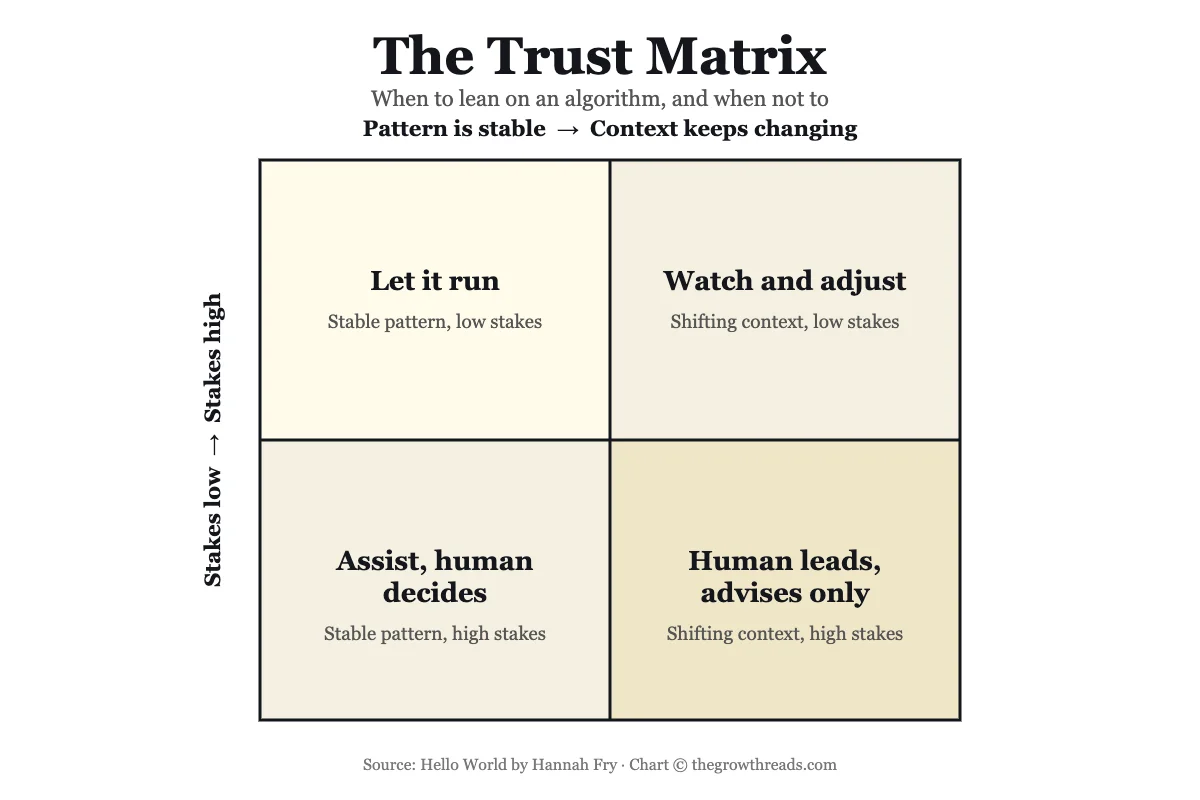
- Different domains need different trust levels: low-stakes, stable-pattern problems tolerate more automation than high-stakes, shifting ones.
- The right question isn’t “human or algorithm” — it’s how to combine them well.
What is Hello World about?
Hello World examines where algorithms already make consequential decisions — in courtrooms, hospitals, cars, and policing — and shows exactly where they help and where they quietly fail. Hannah Fry argues for “meaningful human control”: treating algorithms as powerful advisors rather than infallible authorities, with a person genuinely able to question and override them.
About the author
Hannah Fry is a mathematician and associate professor at University College London, known for making complex quantitative topics accessible through books, television documentaries, and a popular BBC and Netflix presence. Her academic background is in the mathematics of human behavior — how patterns emerge in crowds, cities, and social systems — which gives her a distinctive lens for examining algorithms: not as a computer scientist evangelizing the technology, nor as an outside critic, but as someone fluent enough in the math to explain precisely where it succeeds and fails. Explore all Hannah Fry book summaries →
| Concept | What it means | Use it when |
|---|---|---|
| Meaningful human control | A person genuinely able to understand, question, and override an algorithm | Evaluating whether human oversight of a system is real or nominal |
| False confidence | Precise-looking outputs that hide real underlying uncertainty | Reading any algorithmic score or prediction critically |
| Feedback loop | A prediction that changes behavior in ways that confirm the prediction | Evaluating predictive policing or similar systems |
| Context blindness | An algorithm’s failure to catch an unusual case a human would flag instantly | Deciding how much autonomy to give a system |
| Explainability | A system’s ability to show its reasoning in terms a person can audit | Deciding whether a system is trustworthy enough to deploy |
| Trust matrix | Matching trust level to stakes and pattern stability | Deciding how much autonomy an algorithm should get in a specific case |
Part 1: Where the machines already decide
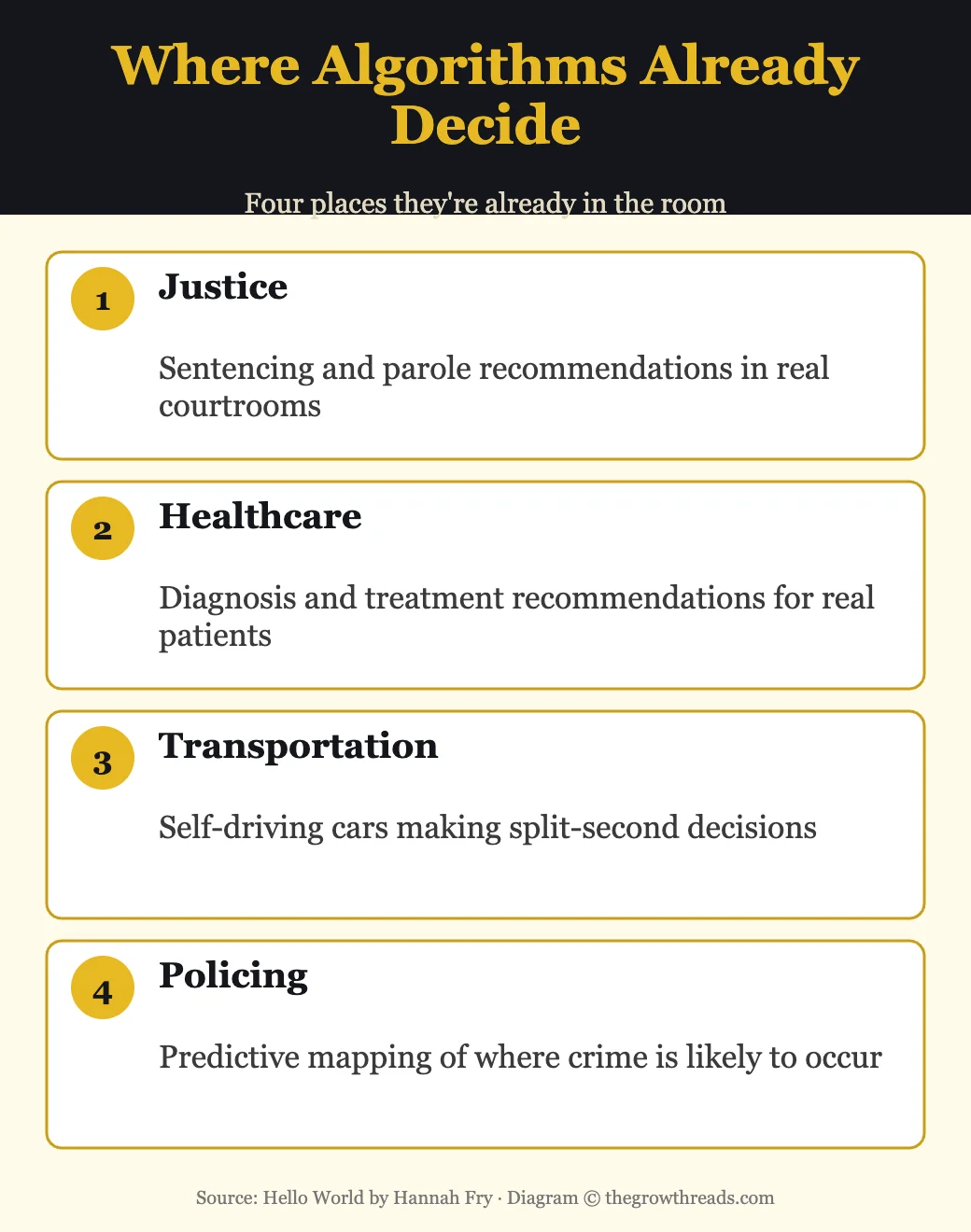
Fry opens with concrete, specific cases rather than abstractions. In criminal justice, risk-assessment algorithms now inform bail and sentencing decisions in real courtrooms, producing numeric risk scores that judges weigh alongside — or sometimes instead of — their own judgment. In medicine, diagnostic algorithms increasingly flag likely conditions from scans and test results, sometimes catching things a tired radiologist might miss, sometimes missing things an experienced radiologist would catch instantly. In policing, predictive systems generate maps of where crime is statistically likely to happen next, shaping where patrols get sent.
What ties these cases together, Fry shows, is how quietly this shift happened. Few of these systems arrived with public debate or clear democratic buy-in — they were adopted incrementally, often because they promised efficiency or consistency, and the people affected by their decisions frequently have no idea an algorithm was involved at all.
Fry also spends time on a less obvious domain: creativity. She examines algorithms that compose music, generate art, and write text, probing whether “creative” output from a system trained on human-made work counts as genuine creativity or a sophisticated form of remixing. Her answer is characteristically nuanced — she resists both the dismissive “it’s just statistics” take and the breathless “machines are now artists” take, instead using the question to sharpen what we actually mean by creativity in the first place.
Part 2: Why algorithms fail the way they fail
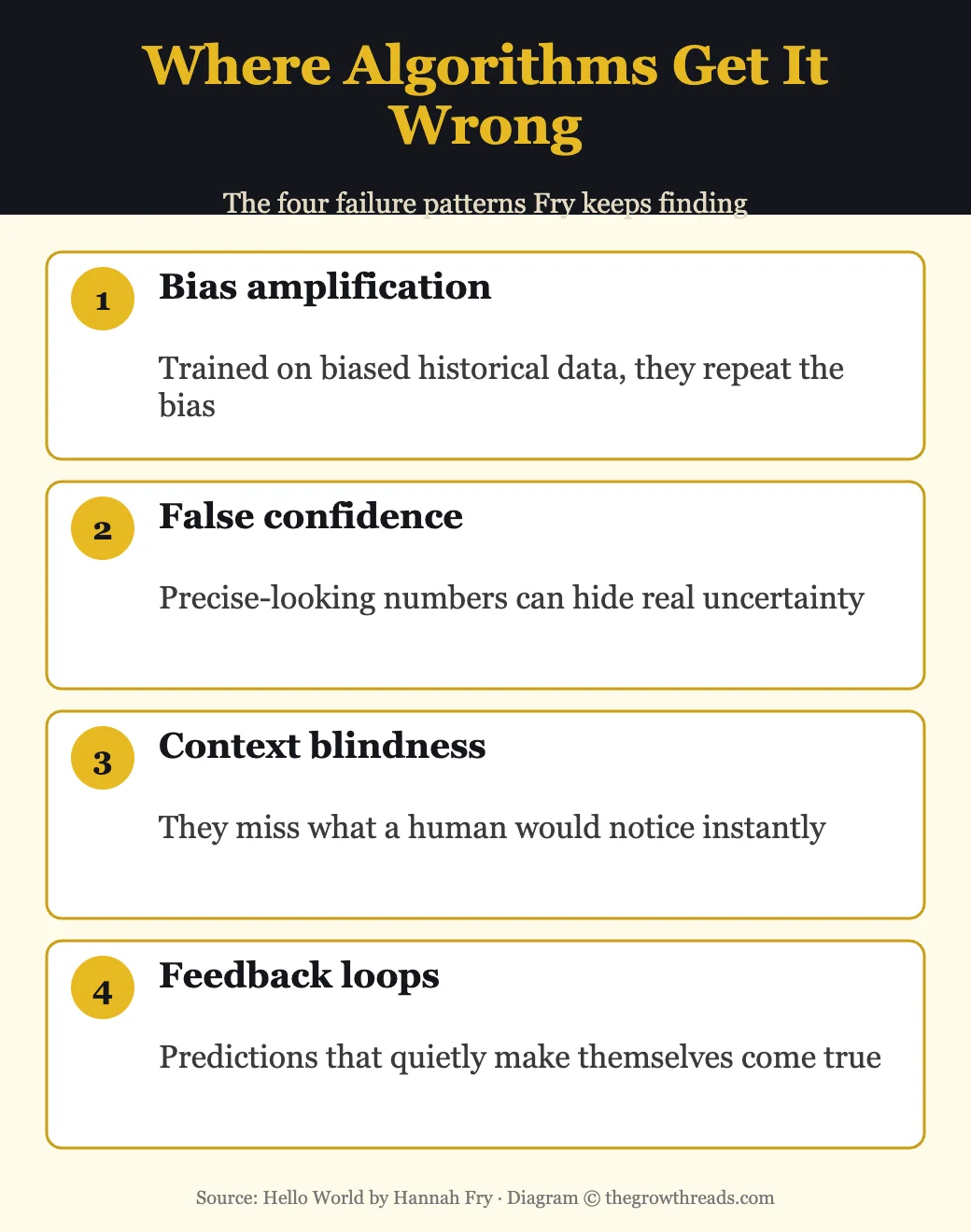
Fry is careful to distinguish algorithmic failure from simple technical malfunction. The failures she documents are patterned and predictable once you know what to look for: bias baked into historical training data that the algorithm faithfully reproduces; false confidence, where a precise-sounding number like “73% risk” masks genuinely shaky underlying data; context blindness, where an algorithm handles the typical case well but stumbles badly on the unusual one a human would catch instantly; and feedback loops, where a prediction actively shapes the reality it claims to merely observe — as when a neighborhood flagged as high-risk gets more policing, which generates more arrests, which “confirms” the original prediction.
None of these failures require a badly designed algorithm — they can emerge from technically competent systems applied without enough scrutiny of the assumptions baked into their training data and deployment context. That’s precisely why Fry argues the fix isn’t better code alone, but better human processes wrapped around the code.
Part 3: What meaningful human control actually looks like
The book’s most practical contribution is its refusal to accept “a human is technically in the loop” as sufficient oversight. Fry shows, through case after case, how easy it is for human oversight to become theater — a person nominally able to override an algorithm’s recommendation who, in practice, almost never does, either from time pressure, deference to the system’s apparent authority, or simple fatigue. Real oversight, she argues, requires structural support: decision-makers need enough time, training, and institutional backing to actually exercise judgment, not just the formal right to.
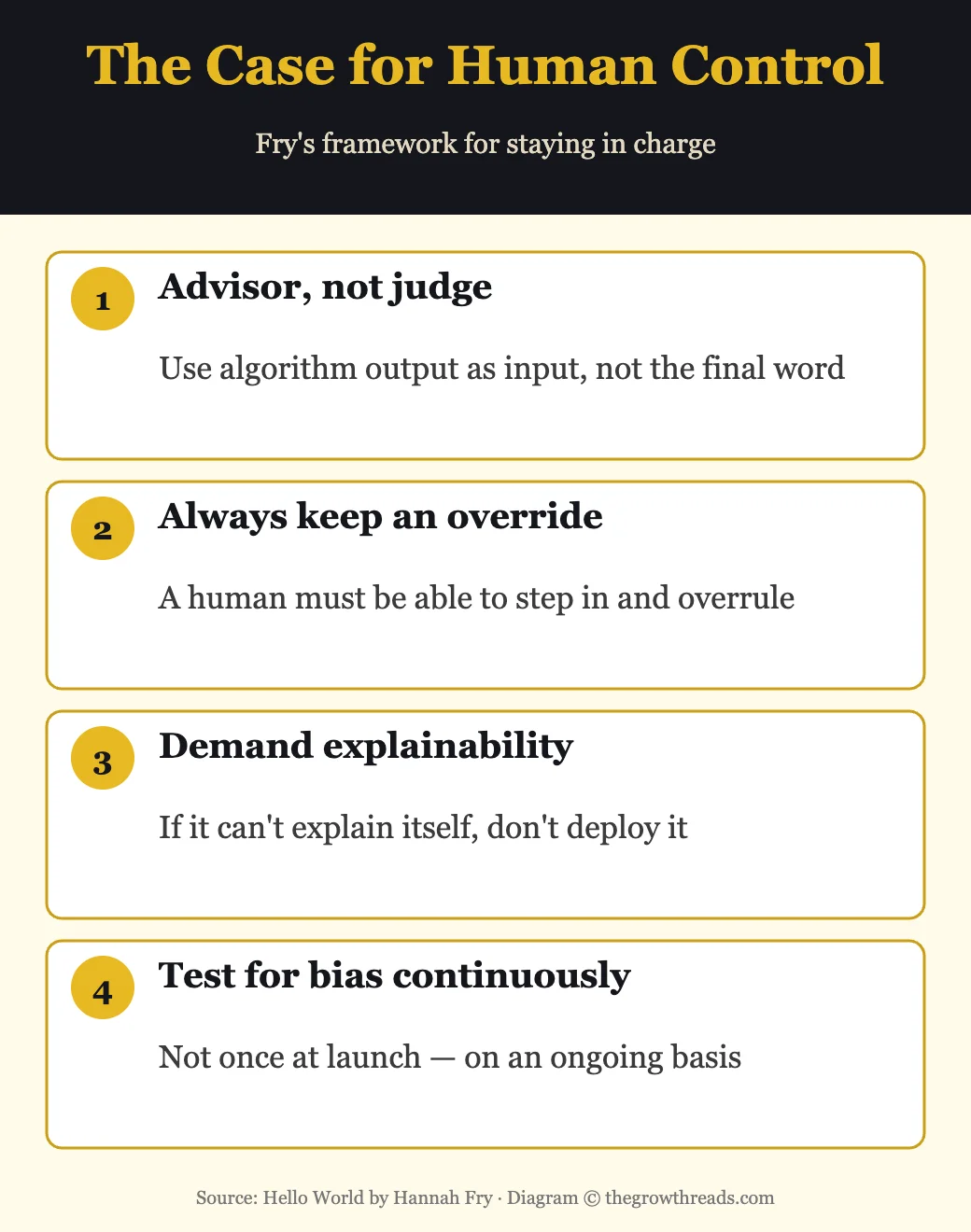
Her proposed framework rests on four pillars: treat the algorithm as an advisor whose output is one input among several, not the final word; keep a human genuinely able to override, with the organizational support to actually do so when warranted; demand explainability before deployment, so a system’s reasoning can be audited rather than taken on faith; and test continuously for bias and drift, since a system that was fair at launch can become unfair as the world around it changes.
Fry is also candid about her own relationship with these tools as a working mathematician — she uses algorithms daily in her research and doesn’t pretend to some pure human alternative. That personal honesty gives her critique more credibility than a purely outside skeptic’s would: she’s arguing for better use of tools she genuinely relies on, not against the tools themselves.
Who is Hello World best for — and who should read something else first?
This book is ideal if you want a concrete, domain-by-domain understanding of where algorithms already shape real decisions, told through vivid specific cases rather than abstract theory. It’s especially useful for anyone working in or affected by justice, healthcare, or policy systems that are quietly adopting algorithmic tools.
If you want the deeper technical mechanics of how bias enters these systems, read The Alignment Problem next. If you’re more interested in the organizational side of successful AI adoption than in societal risk, Working with AI is the better complement.
Questions to reflect on
- Where in your own life or work has an algorithm already made a decision that affected you, and did you know it at the time?
- Using Fry’s trust matrix, where would you place the highest-stakes algorithmic decision in your organization — and does its current level of human oversight match?
- Can you think of a time you deferred to a number or system output when your own judgment was telling you something different?
- What would “meaningful” human oversight — not just nominal — actually require in a system you’re familiar with?
- Where do you see a feedback loop already at work in a system you interact with regularly?
🔥 Ready to know exactly when to trust an algorithm?
Grab Hello World and get Hannah Fry’s clear, story-driven guide to algorithms already shaping your life.
How to apply Hello World (7-day plan)
- Day 1 — Audit your algorithmic exposure. List every place in your life or work where an algorithm likely already influences a decision about you.
- Day 2 — Apply the trust matrix. Place one high-stakes decision in your organization on Fry’s stakes-vs-stability matrix.
- Day 3 — Spot false confidence. Find one precise-sounding number or score you rely on and ask what uncertainty it might be hiding.
- Day 4 — Check for real oversight. Identify a system with “human oversight” and honestly assess whether that oversight is meaningful or nominal.
- Day 5 — Look for a feedback loop. Find one place where a prediction might be quietly shaping the reality it claims to measure.
- Day 6 — Ask for explainability. Pick one algorithmic tool you use and try to find out how it actually makes its recommendations.
- Day 7 — Write your own trust rule. Draft a one-paragraph personal policy for when you will and won’t defer to an algorithmic recommendation.
Frequently asked questions
Is Hello World anti-algorithm or anti-technology?
No. Fry is a mathematician who clearly respects what algorithms can do well. Her argument is for appropriately calibrated trust, not rejection — she wants readers to understand exactly where algorithms help and where they need human oversight, not to avoid them entirely.
Do I need a math or technical background to read this book?
No. Fry is known for making complex quantitative topics accessible to general readers, and Hello World explains its concepts through concrete stories and cases rather than equations or technical jargon.
Which domains does the book cover?
The book examines algorithms in criminal justice, medicine, self-driving cars, crime and policing, and creative fields like art and music, using specific real cases in each area rather than general theory.
Is the book still relevant given how much AI has changed since publication?
Yes. While specific tools have evolved, the underlying failure patterns Fry documents — bias amplification, false confidence, context blindness, feedback loops — remain central concerns in AI deployment discussions today, making the framework durable even as the technology changes.
What does “meaningful human control” mean exactly?
It means a person genuinely able to understand, question, and override an algorithm’s recommendation — not just formally authorized to, but actually equipped with the time, training, and institutional support to do so when warranted.
Does the book take a position on self-driving car ethics?
Fry presents the trolley-problem-style dilemmas self-driving cars force into code, showing how genuinely difficult these trade-offs are to encode, without claiming there’s a single correct answer — the point is showing readers how real and immediate these questions have become.
How long does it take to read Hello World?
Most readers finish it in about seven hours of straight reading. Each chapter focuses on a distinct domain, so it also works well read one chapter at a time.
Related summaries
- The Alignment Problem — the deeper technical mechanics behind the bias Fry documents.
- Working with AI — 29 real organizational case studies to complement Fry’s societal focus.
- The Big Nine — the structural, corporate side of who builds the systems Fry examines.
- More Technology book summaries