

★★★★☆ 4.0/5 — A well-researched, personally grounded case that eating, moving, and sleeping are one interconnected system, and that small daily choices compound into far more than any single dramatic overhaul.
Best for: readers who want an accessible, research-backed synthesis of everyday health habits with a concrete 30-day plan to start · Reading time: ~5 hrs (this guide: ~10 min) · Difficulty to apply: Easy — the recommendations are intentionally small and low-friction rather than a demanding program
Eat Move Sleep in one minute
Tom Rath argues that eating, moving, and sleeping aren’t three separate wellness categories to manage independently — they’re one interconnected system, where weakness in any one domain undermines the other two. Poor sleep leads to worse food choices and less activity the next day; inactivity disrupts sleep quality and appetite regulation; and low-quality eating saps the energy needed to move and sleep well. Rather than advocating dramatic diet overhauls or extreme fitness regimens, Rath — drawing on more than two decades of research synthesis from his work at Gallup — argues that small, sustainable daily decisions compound into outsized differences in health and longevity over time. The book carries real personal weight: Rath has lived with von Hippel-Lindau (VHL) disease since age 16, a rare genetic disorder that has caused tumors in multiple organs and required repeated surgeries, and he wrote the book after the deaths of several friends from cancer and heart disease pushed him to share the health research he had relied on personally for years. Published in 2013, the book closes with a practical 30-day guide for turning its research into daily habits.
Key takeaways
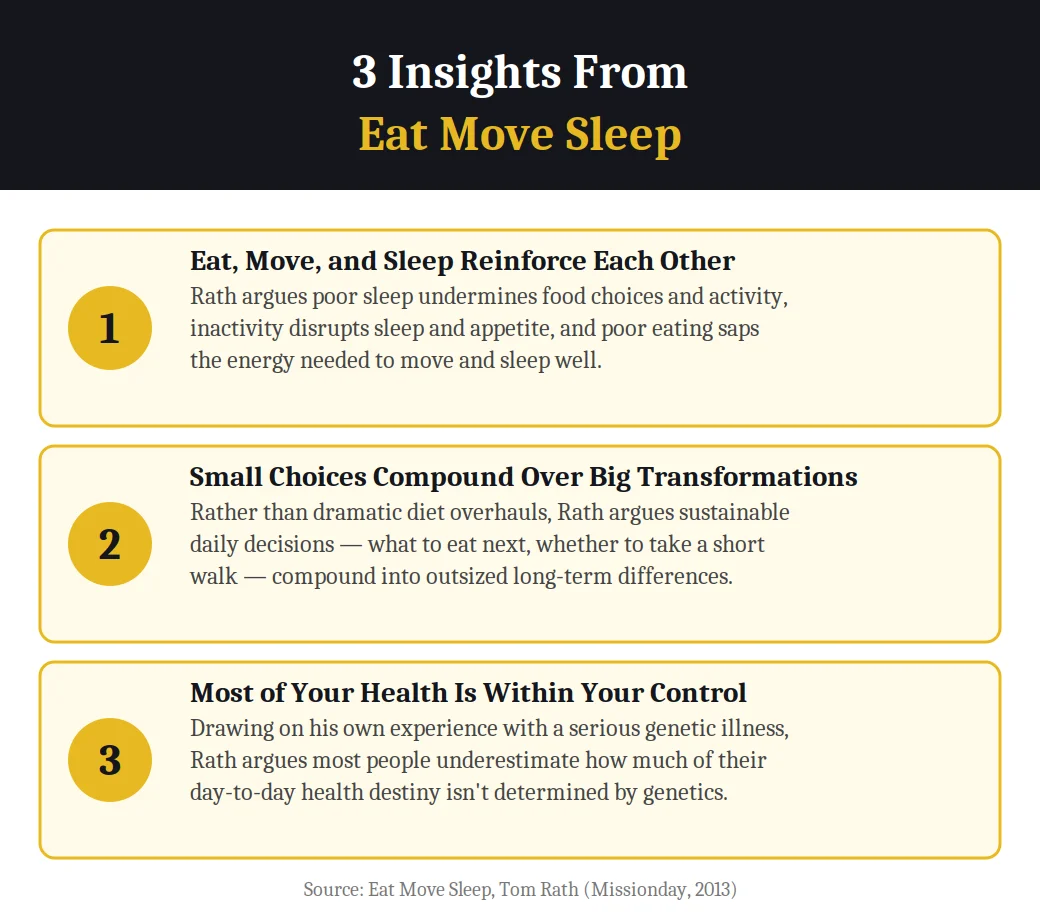
- Eat, move, and sleep reinforce each other: weakness in one domain undermines the other two — poor sleep worsens food choices and activity, and poor eating saps the energy for movement and rest.
- Small choices compound over big transformations: Rath argues sustainable daily decisions matter more over time than occasional dramatic diet or fitness overhauls.
- Most of your health is within your control: drawing on his own experience with a serious genetic illness, Rath argues day-to-day health outcomes are less genetically fixed than most people assume.
- Quality matters as much as quantity: what you eat and how you move is emphasized alongside — not instead of — simple totals like calories or step counts.
- Consistent daily activity beats occasional workouts: research on chronic inactivity suggests periodic exercise doesn’t fully offset long stretches of daily sitting.
- Sleep loss has same-day costs: reduced sleep is linked to measurable next-day declines in alertness, food choices, and activity levels.
- The book synthesizes hundreds of studies: Rath’s approach draws on a large body of existing peer-reviewed research rather than presenting new original studies of his own.
- A 30-day guide anchors the practical takeaway: the book closes with a structured, actionable plan for implementing its research into daily habits.
- The framing rejects fad diets and extreme regimens: Rath is explicit that sustainable, modest changes beat short-lived intense efforts that are hard to maintain.
What is Eat Move Sleep about?
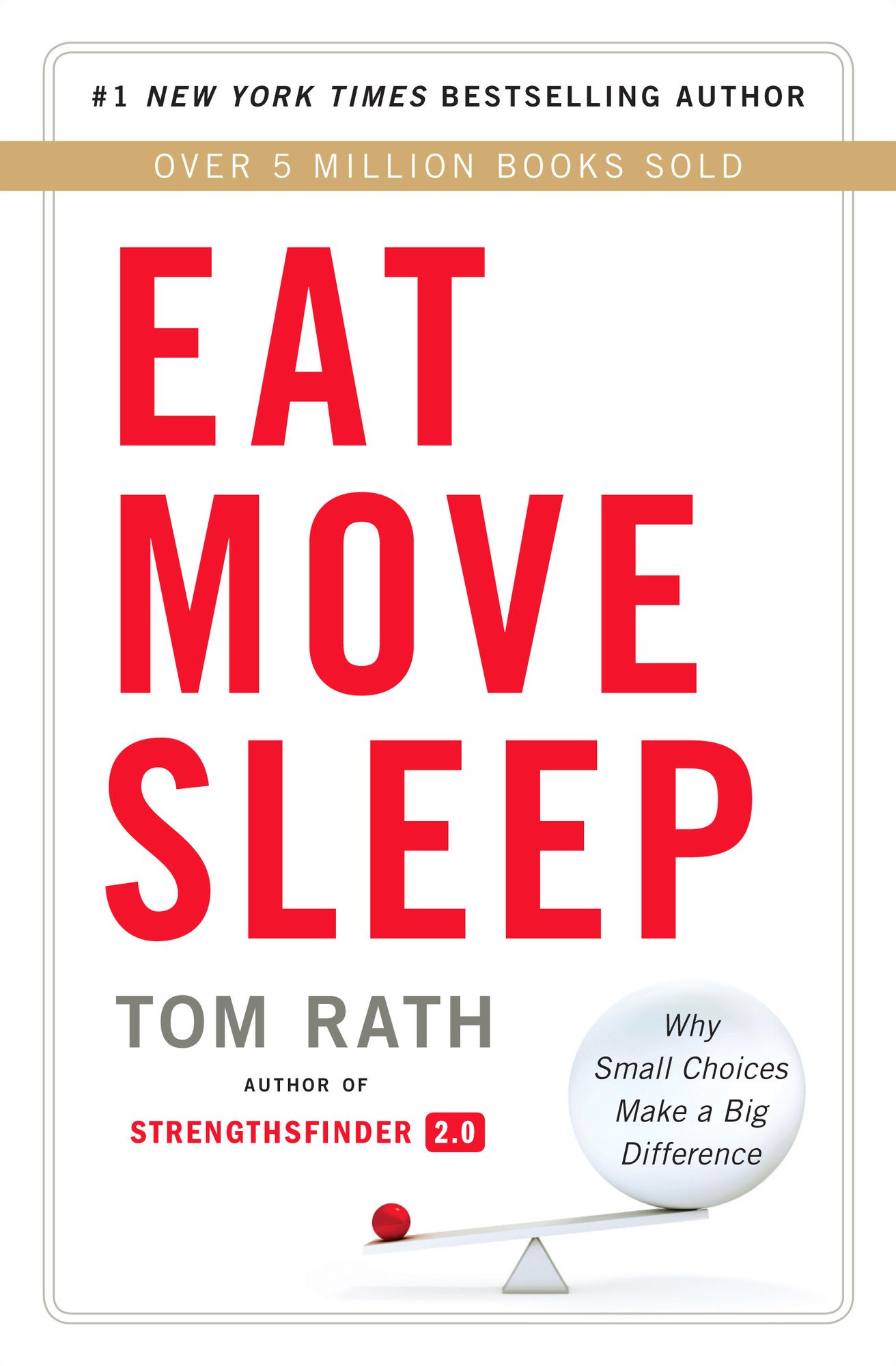
Eat Move Sleep is Tom Rath’s case that eating, moving, and sleeping function as one interconnected system rather than three independent wellness categories, and that small, sustainable daily choices in each domain compound into significant long-term differences in health — more reliably than dramatic diet or fitness overhauls. Structured as short, research-backed chapters pairing a finding with an actionable tip, the book closes with a 30-day guide for implementation. Rath wrote the book while living with von Hippel-Lindau disease, a rare genetic disorder that has caused tumors across multiple organs since he was a teenager, and after the deaths of several friends from preventable disease pushed him to synthesize the health research he’d relied on personally into an accessible, everyday framework. Published in 2013 by Missionday, the book draws on hundreds of peer-reviewed studies to make its case.
About the author
Tom Rath is a researcher and author best known for StrengthsFinder 2.0 and several other bestselling books built on large-scale survey research, developed during his long tenure at Gallup, where his grandfather Donald O. Clifton was a pioneering figure in strengths-based psychology. At age 16, Rath was diagnosed with von Hippel-Lindau (VHL) disease, a rare inherited genetic disorder that causes tumors to grow in multiple organs; over the following decades he has undergone repeated surgeries and treatment for tumors in his eyes, kidneys, adrenal glands, pancreas, spine, and brain, and now serves as vice chairman of the VHL Alliance. After the deaths of several friends from cancer and heart disease, Rath took a sabbatical from Gallup to write Eat Move Sleep, distilling the health research he had personally relied on for over two decades into a practical, everyday framework. Explore all Tom Rath book summaries →
Key concepts at a glance
| Concept | What it means | Use it when |
|---|---|---|
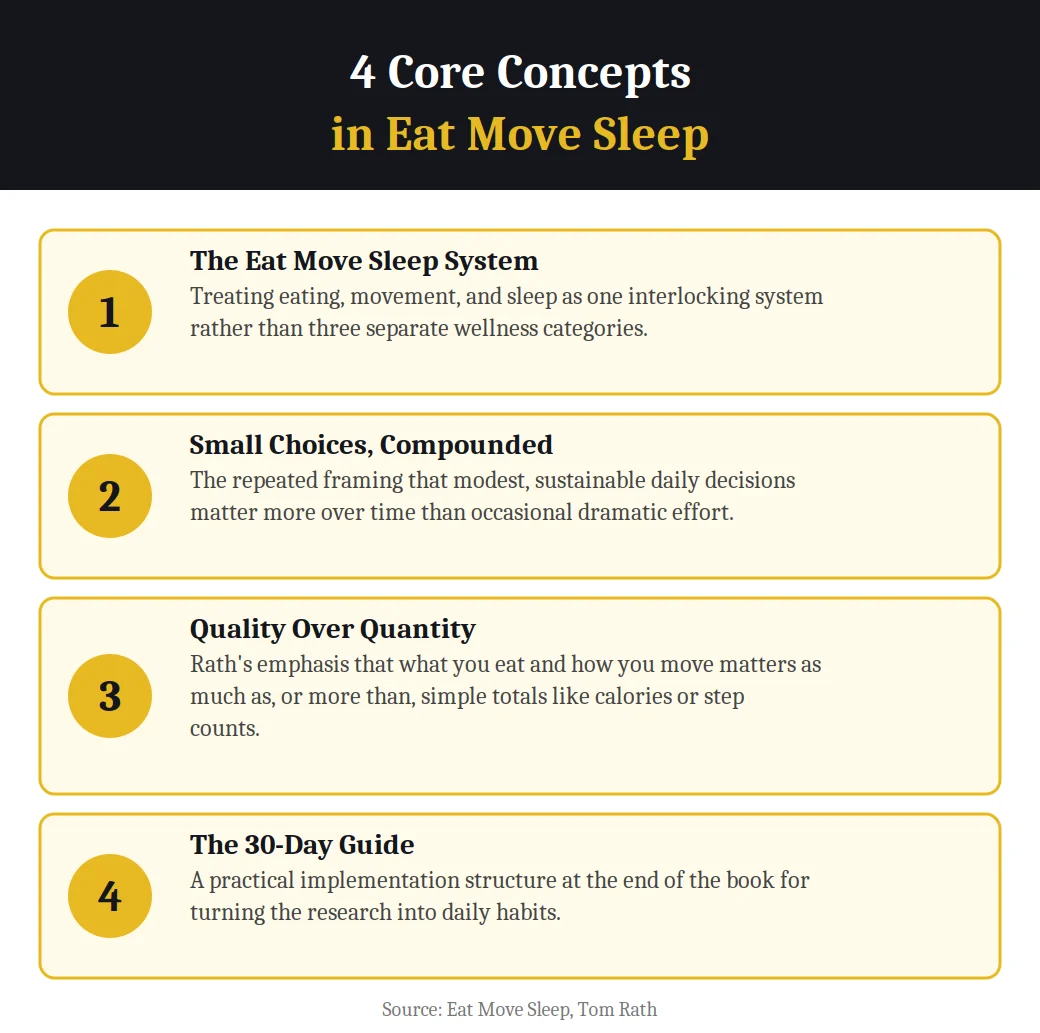
| The Eat Move Sleep System | Treating eating, movement, and sleep as one interlocking system rather than separate categories | You’re trying to understand why fixing one health habit alone hasn’t worked |
| Small Choices, Compounded | Modest, sustainable daily decisions that matter more over time than occasional dramatic effort | You’re deciding between a big overhaul and starting with a smaller, sustainable change |
| Quality Over Quantity | What you eat and how you move matters as much as simple totals like calories or steps | You’re evaluating a food or activity choice beyond just counting numbers |
| The 30-Day Guide | A practical implementation structure for turning the book’s research into daily habits | You want a concrete starting plan rather than abstract principles alone |
| Health Within Your Control | The idea that day-to-day choices matter more than most people assume, even against a genetic backdrop | You’re weighing how much effort is worth investing given your family health history |
Part 1: Eating, moving, and sleeping as one system
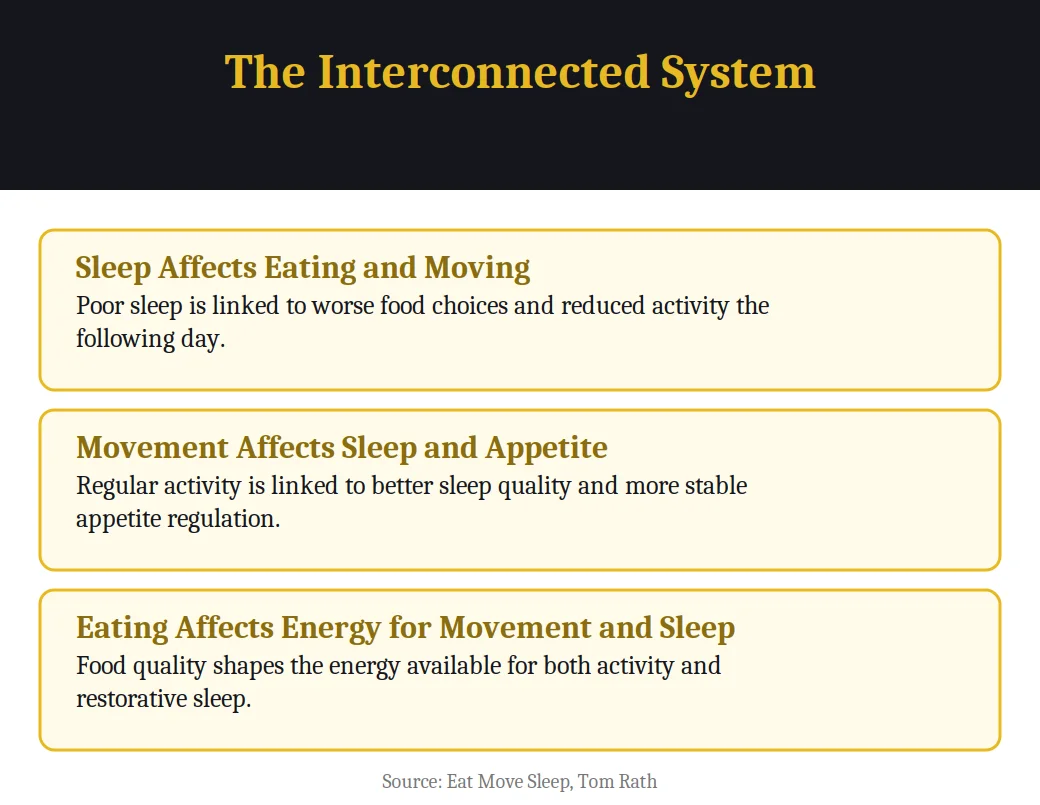
Rath’s foundational argument is that eating, moving, and sleeping shouldn’t be treated as separate wellness projects, because each one directly shapes the other two. Poor sleep is linked to worse food choices and reduced physical activity the next day; low activity levels are linked to disrupted sleep and less stable appetite regulation; and poor-quality eating saps the energy needed for both movement and restorative sleep. This reframing matters practically: rather than trying to fix diet, exercise, and sleep as three unrelated to-do items, Rath argues that improvements in any one domain tend to support progress in the other two, and that neglecting one can undermine effort in the others.
TGR Note: Rath’s case that sleep quality shapes next-day food and activity choices connects directly to The Sleep Revolution‘s argument that rest is a foundational input, not a separate wellness category to address last.
Part 2: Small choices over dramatic overhauls
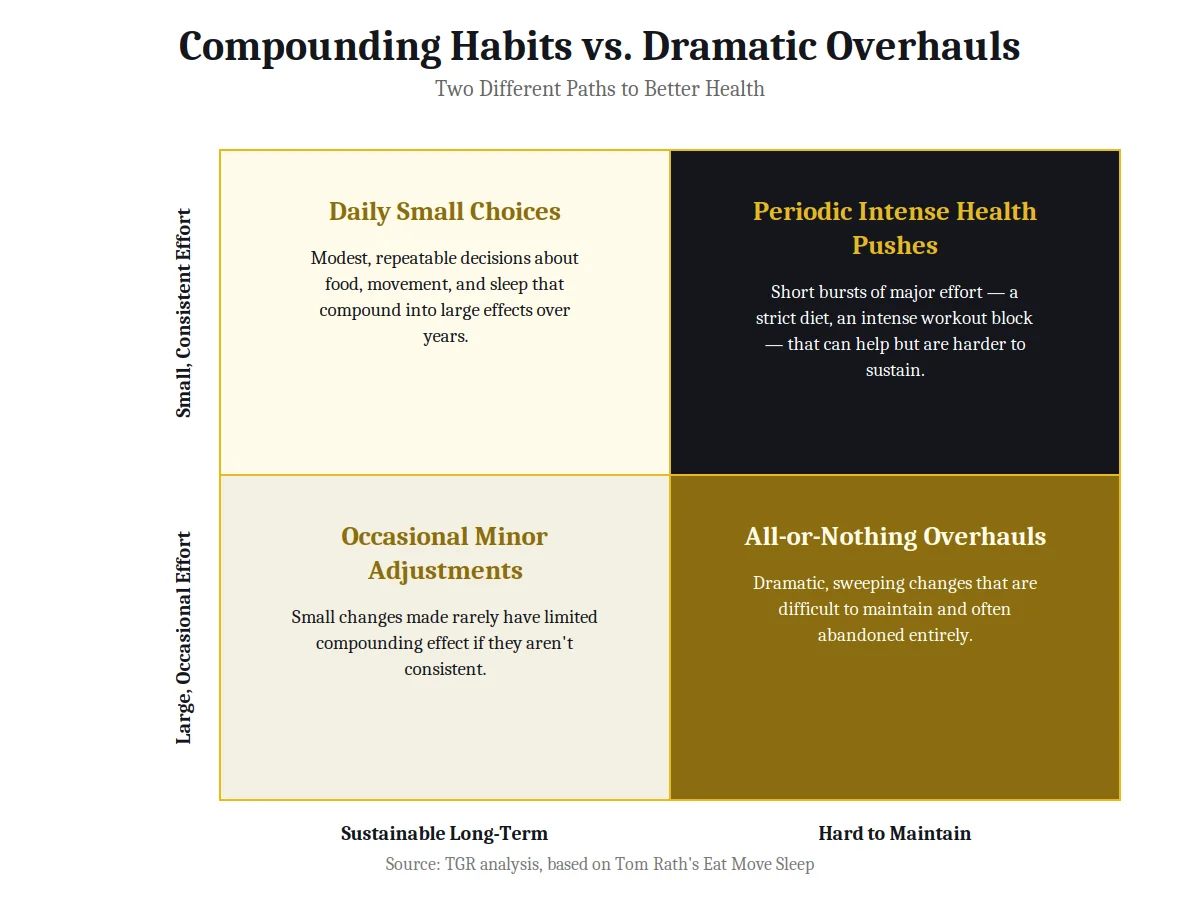
Rath is explicit in rejecting fad diets and extreme fitness regimens in favor of small, sustainable daily decisions — what to eat at the next meal, whether to take a short walk, what time to put the phone away — arguing these compound into far larger differences over years than occasional intense efforts that are harder to sustain. This is where the book’s personal dimension is most visible: having lived with a serious genetic illness since his teenage years, Rath argues that most people significantly underestimate how much of their day-to-day health outcome is within their control, independent of family history or genetic risk. The practical implication is a lower barrier to entry — readers aren’t asked to overhaul their entire life at once, but to start making marginally better choices consistently.
Part 3: Research synthesis and the 30-day guide
Eat Move Sleep is built as a synthesis of a large body of existing peer-reviewed research — citing hundreds of studies across nutrition, physical activity, and sleep science — rather than presenting new original research of its own. Each short chapter pairs a specific finding with an immediately actionable tip, and the book closes with a 30-day guide intended to translate its research into a concrete daily implementation plan. This structure makes the book easier to act on than to read as a single continuous narrative, and it’s worth noting Rath isn’t a physician, nutritionist, or sleep scientist by training — his background is in employee engagement and organizational research at Gallup, which shapes the book’s tone as an accessible distillation of existing science rather than original clinical research.
Who is Eat Move Sleep best for — and who should read something else first?
This book is best for readers who want an accessible, well-cited synthesis of everyday health research and a low-friction way to start improving eating, movement, and sleep habits together, rather than tackling each in isolation. Readers looking for a rigorous, single-domain deep dive — into nutrition science specifically, or sleep science specifically — may find the book’s broad, three-domain scope less detailed than a more focused title.
If you want a deeper focus on sleep specifically, The Sleep Revolution covers similar interconnected-health territory with a narrower, sleep-first lens.
Questions to reflect on
- Which of the three domains — eating, moving, or sleeping — feels weakest in your current routine, and how might it be affecting the other two?
- Have you been chasing a dramatic overhaul instead of a small, sustainable change you could actually maintain?
- How much of your health do you currently attribute to genetics versus daily choices — and does that assumption hold up?
- What would a realistic 30-day plan for improving one small habit in each domain look like for you?
- Which single small choice, made consistently, would you expect to compound the most over the next year?
🔥 Ready to treat eating, moving, and sleeping as one system?
This guide covers the core framework — the book gives you Rath’s full research citations and the complete 30-day implementation guide.
How to apply Eat Move Sleep (7-day plan)
- Day 1: Notice which of the three domains — eating, moving, sleeping — feels weakest right now, without judgment.
- Day 2: Make one small food swap at a single meal, rather than overhauling your whole diet.
- Day 3: Add a short walk or movement break somewhere it wasn’t part of your routine before.
- Day 4: Set a consistent bedtime and notice how it affects your energy the next day.
- Day 5: Track how your sleep from the night before affected your food choices and activity today.
- Day 6: Choose one small habit in each domain (eat, move, sleep) you can realistically sustain, not just try once.
- Day 7: Write down your simplified 30-day plan, starting with the smallest version of each habit.
Frequently asked questions
What is the core argument of Eat Move Sleep?
That eating, moving, and sleeping form one interconnected system, and small daily choices in each compound into large health differences over time.
What motivated Tom Rath to write this book?
His lifelong experience with von Hippel-Lindau disease and the deaths of several friends from preventable disease.
Does the book recommend dramatic diet or fitness changes?
No — it explicitly favors small, sustainable daily choices over extreme overhauls.
Is Tom Rath a doctor or nutritionist?
No — his background is in employee engagement and organizational research at Gallup, and the book synthesizes existing peer-reviewed research.
What is the 30-Day Guide?
A practical implementation section at the end of the book for turning its research into daily habits.
How much control do you really have over your health, according to the book?
Rath argues most people underestimate how much day-to-day health is shaped by daily choices rather than fixed by genetics.
How is this different from The Sleep Revolution?
The Sleep Revolution focuses specifically on sleep; Eat Move Sleep covers eating, movement, and sleep together as one system.
Related summaries
If Eat Move Sleep resonated, these dig further into related territory: The Sleep Revolution on sleep as a performance foundation, and other titles in our best health books pillar page.
How we analyze books: We work from the full book — reconstructing its core arguments in our own words, adding commentary that connects it to related research and other books in our library, and pressure-testing the advice in a practical 7-day plan. Ratings weigh usefulness, readability, and evidence quality. Read our full methodology.