

★★★★☆ 4.0/5 — A practical, biomechanically grounded case that total daily sitting time — not just whether you exercise — is an independent driver of pain, and that fixing it is more about position variety than finding a perfect chair.
Best for: desk workers and athletes alike who want a concrete framework for reducing the damage of sedentary workdays · Reading time: ~8 hrs (this guide: ~10 min) · Difficulty to apply: Moderate — the concepts are simple, but consistent daily habit change takes real effort
Deskbound in one minute
Kelly Starrett argues that exercising for an hour doesn’t offset sitting for ten — the total time your body spends immobile each day is an independent driver of pain and disease, regardless of whether you also work out. Starrett, a physical therapist known first for his bestselling athlete-focused book Becoming a Supple Leopard, extends the same biomechanical framework — spinal organization, hip and shoulder stability, positional awareness — from the gym to the other 23 hours a day most people, athletes included, spend sitting. Rather than chasing a single “correct” posture or the perfect ergonomic chair, Starrett argues the real goal is position variability: moving between standing, sitting, and other positions frequently throughout the day, since no static posture — however well designed — is good for the body if held for hours on end. Published in 2016, the book distinguishes “optional” sitting (which can often be reduced or eliminated) from unavoidable sitting like long flights, and treats short daily mobility work as basic physical maintenance rather than an extra reserved for athletes.
Key takeaways
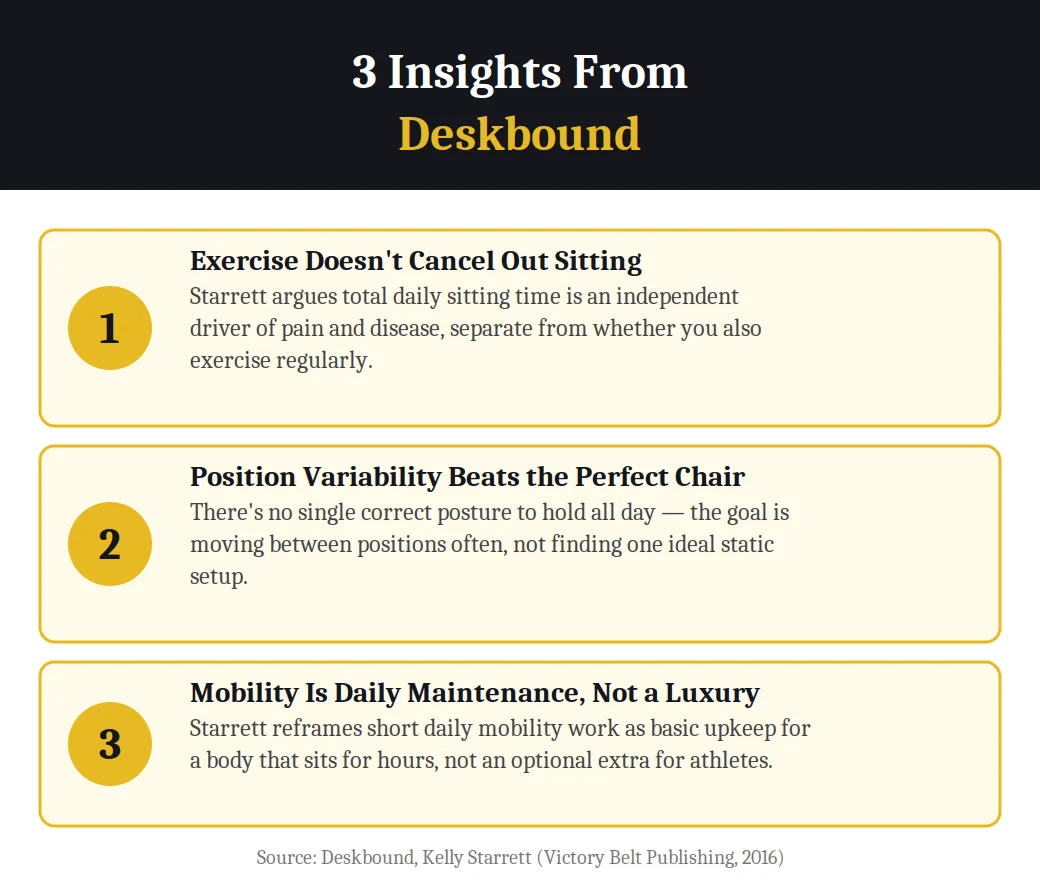
- Exercise doesn’t cancel out sitting: Starrett argues total daily sitting time is an independent driver of pain and disease, separate from whether you also exercise regularly.
- Position variability beats the perfect chair: there’s no single correct posture to hold all day — the goal is moving between positions often, not finding one ideal static setup.
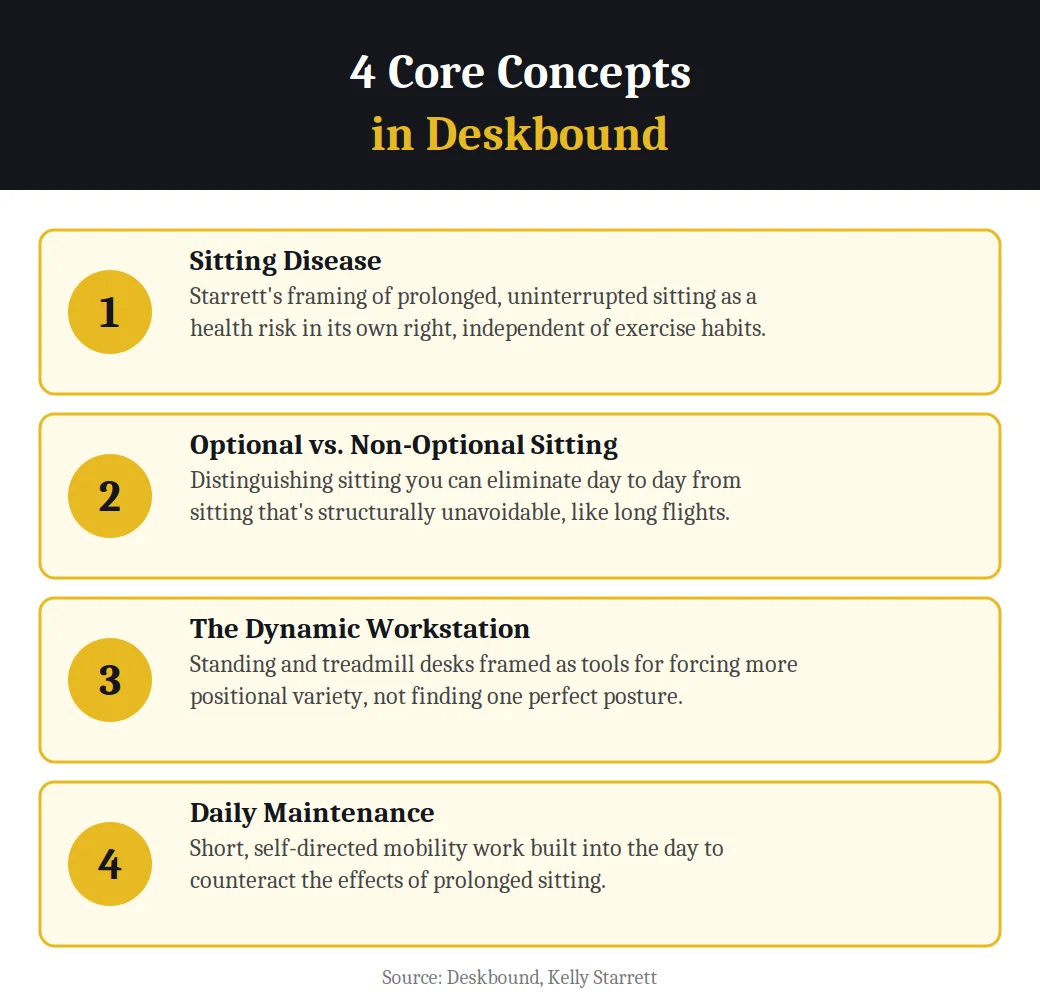
- “Sitting disease” is the framing device: prolonged, uninterrupted sitting is treated as a health risk in its own right, echoing researcher Dr. James Levine’s “sitting is the new smoking” framing.
- Optional vs. non-optional sitting is a useful distinction: separating sitting you can eliminate day to day (extra chairs, unnecessary car trips) from sitting that’s structurally unavoidable (flights).
- The dynamic workstation is a tool, not a fix: standing and treadmill desks are framed as ways to force more positional variety, not as a single correct replacement for sitting.
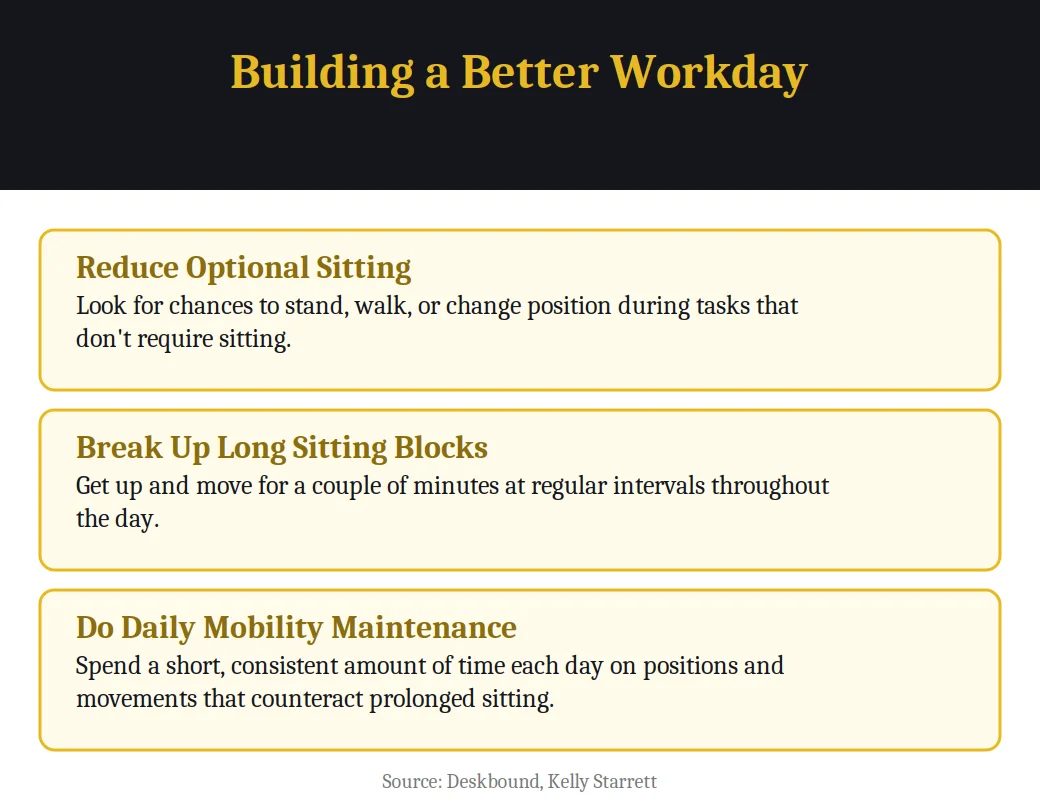
- Mobility is daily maintenance, not a luxury: Starrett reframes short, self-directed mobility work as basic upkeep for a body that sits for hours, not an optional extra for athletes.
- The book bridges Becoming a Supple Leopard to everyday life: the same biomechanical principles used to fix athletic movement faults are applied here to ordinary desk-bound posture.
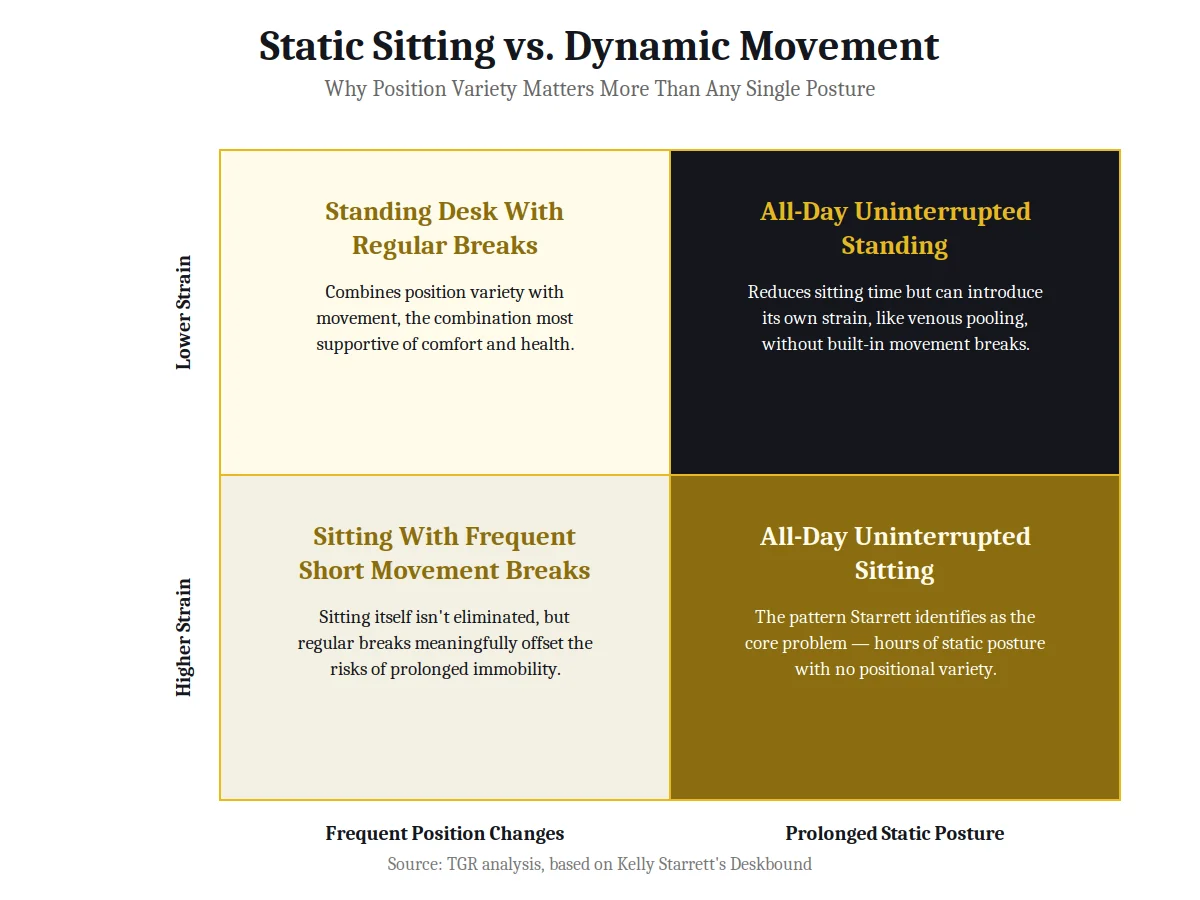
- Standing all day isn’t automatically the fix: more recent research suggests prolonged static standing carries its own strain, like venous pooling, reinforcing that variety — not simply standing instead of sitting — is the real goal.
- Small, consistent changes compound: the book’s practical framework favors frequent small movement breaks over occasional intense effort to offset a sedentary day.
What is Deskbound about?
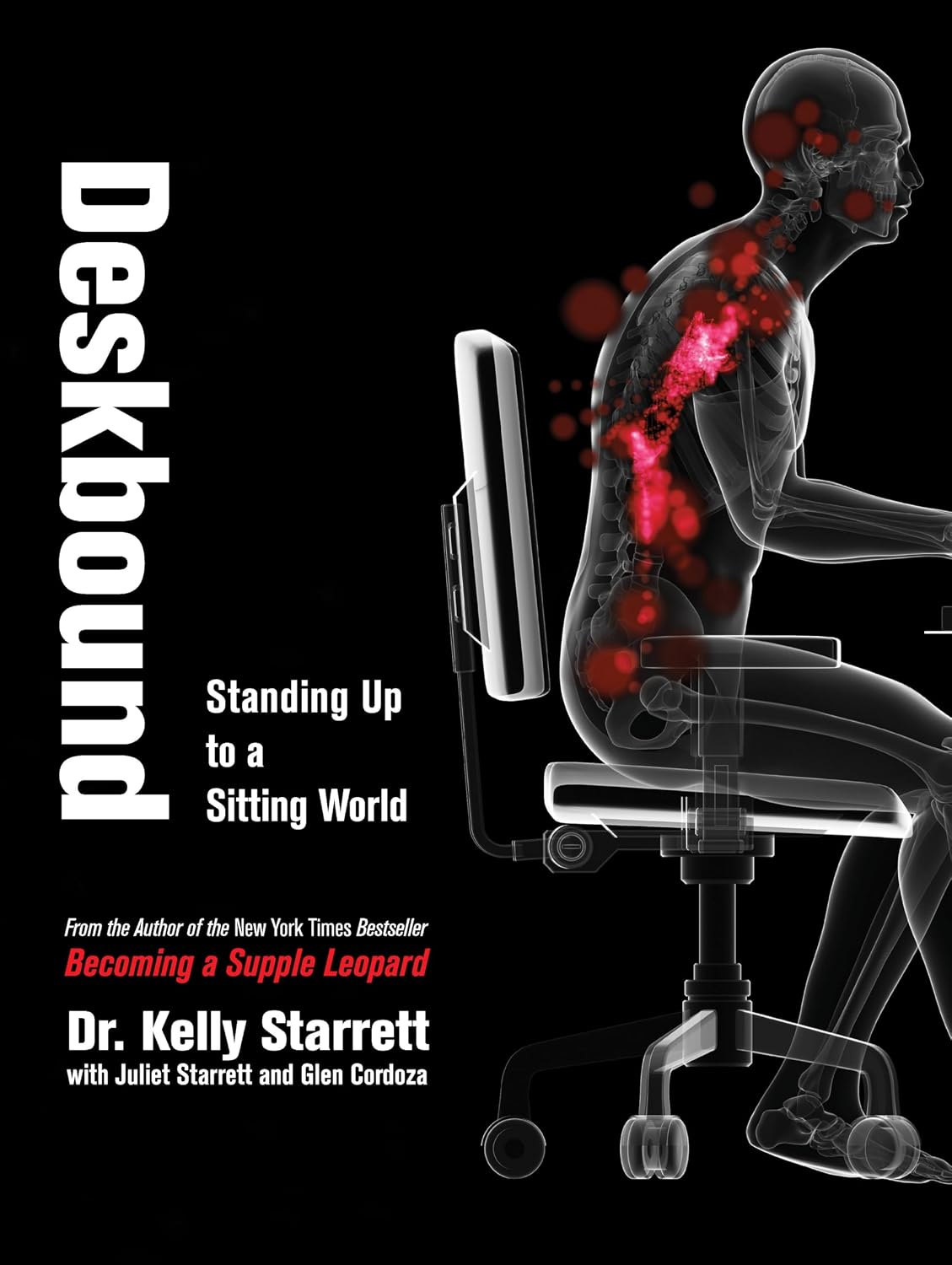
Deskbound is Kelly Starrett’s case that the amount of time spent sitting each day — independent of exercise habits — is a driver of pain and poor health, and that fixing it requires rethinking workspaces and daily habits around position variety rather than searching for one perfect posture or piece of ergonomic furniture. Extending the biomechanical framework from his earlier, athlete-focused book Becoming a Supple Leopard, Starrett walks through the mechanical consequences of poor sitting posture, principles for organizing the body well, and practical guidance on standing and dynamic workstations, before closing with a systematic approach to daily mobility maintenance. Written with his wife and business partner Juliet Starrett and co-author Glen Cordoza, and published in 2016 by Victory Belt Publishing, the book functions as much as a reference manual to dip into as a book to read cover to cover.
About the author
Kelly Starrett is an American physical therapist and mobility coach who, alongside his wife and business partner Juliet Starrett, has spent his career helping athletes and everyday people move and feel better. After founding the influential mobility resource MobilityWOD and coaching elite athletes and CrossFit competitors, Starrett wrote Deskbound (2016), extending his biomechanical approach from athletic training to the many hours ordinary people spend sitting at desks, arguing that total daily immobility — not just exercise habits — is what drives long-term pain. He later distilled a broader, more accessible version of that philosophy in Built to Move, built around ten simple physical tests and practices for assessing and improving the body’s baseline function at any age. Explore all Kelly Starrett book summaries →
Key concepts at a glance
| Concept | What it means | Use it when |
|---|---|---|
| Sitting Disease | Prolonged, uninterrupted sitting treated as a health risk in its own right, independent of exercise habits | You’re evaluating whether your workout routine is really offsetting your workday |
| Optional vs. Non-Optional Sitting | Separating sitting you can eliminate day to day from sitting that’s structurally unavoidable | You’re looking for realistic places to cut sitting time without overhauling your whole day |
| The Dynamic Workstation | Standing and treadmill desks framed as tools for forcing positional variety, not a single fix | You’re considering a standing desk and want realistic expectations for what it will and won’t do |
| Daily Maintenance | Short, self-directed mobility work built into the day to counteract prolonged sitting | You want a simple, sustainable habit rather than an occasional intense workout |
| Position Variability | Moving between multiple postures throughout the day rather than holding any single one for hours | You’re deciding what “good posture” should actually mean for your workday |
Part 1: Why sitting is its own problem
Starrett’s foundational argument is that the amount of time spent sitting each day functions as an independent variable in long-term health outcomes — separate from, and not corrected by, regular exercise. He builds on researcher Dr. James Levine’s “sitting is the new smoking” framing to argue that modern desk culture has created a form of movement deprivation that layers on top of, rather than substitutes for, general fitness. Central to this section is a distinction between “optional” sitting — time spent seated that could realistically be reduced, like extra chairs or unnecessary car trips — and “non-optional” sitting that’s structurally difficult to avoid, such as long flights, giving readers a more realistic lens than an all-or-nothing standard.
TGR Note: Starrett’s case against prolonged immobility echoes The Sleep Revolution‘s argument that recovery and rest are performance inputs, not time wasted — both push back against habits that quietly erode long-term health in the name of productivity.
Part 2: The dynamic workstation and position variability
Rather than presenting standing desks as a simple cure, Starrett frames the “dynamic workstation” — standing desks, treadmill desks, and transition strategies between them — as tools for introducing positional variety into a workday, not as a single correct replacement for sitting. His operating principle is that there’s no such thing as a perfect static posture: the value of a standing desk comes from the variability it enables, not from standing itself being inherently superior to sitting. This is a more nuanced position than the mid-2010s standing-desk wave often implied, and it’s aged reasonably well — more recent research has found that prolonged, uninterrupted standing carries its own costs, like venous pooling, reinforcing that movement variety, not a single ideal position, is what actually matters.
Part 3: Daily maintenance as basic upkeep
The book’s practical core is a systematic approach to daily mobility work, treating it not as specialized athletic training but as basic physical maintenance every desk-bound body needs. Starrett walks through mechanics for common daily movements — walking, hinging, squatting, shoulder positioning — and pairs them with short, targeted mobility routines meant to counteract the specific mechanical consequences of prolonged sitting. The underlying message is one of consistency over intensity: a short daily practice, done regularly, does more for long-term mechanical health than occasional, intense corrective effort.
Who is Deskbound best for — and who should read something else first?
This book is best for desk workers and athletes alike who want a concrete, practical framework for reducing the mechanical damage of a sedentary workday, and who don’t mind treating it more as a reference to dip into than a book to read cover to cover. Readers who already exercise regularly but still feel stiff or sore from long sitting stretches are a particularly good fit for its core argument.
If you want a broader look at recovery and rest as performance inputs beyond posture specifically, The Sleep Revolution makes a complementary case for sleep as the foundation underneath sustainable daily performance.
Questions to reflect on
- How many hours a day do you actually spend sitting, including commute, work, and leisure time combined?
- Which parts of your daily sitting are genuinely unavoidable, and which are “optional” sitting you could reduce?
- Do you rely on one “correct” posture at your desk, or do you naturally shift positions throughout the day?
- If you use or are considering a standing desk, are you actually varying your position, or just trading one static posture for another?
- What would a realistic, sustainable daily mobility routine look like for your own schedule?
🔥 Ready to stop letting your chair undo your workouts?
This guide covers the core framework — the book gives you Starrett’s full mobility templates, workstation setup guidance, and detailed movement mechanics.
How to apply Deskbound (7-day plan)
- Day 1: Track roughly how many hours you sit today, including work, commute, and leisure.
- Day 2: Identify one piece of “optional” sitting you can eliminate or reduce tomorrow.
- Day 3: Set a reminder to stand and move for two minutes every 30 minutes during work hours.
- Day 4: If you have access to a standing option, alternate between sitting and standing rather than choosing one all day.
- Day 5: Spend 10-15 minutes on basic mobility work targeting your hips, shoulders, and spine.
- Day 6: Notice which daily movements — walking, bending, reaching — feel restricted, and focus mobility work there.
- Day 7: Plan a sustainable version of this routine you can keep doing weekly, not just this one week.
Frequently asked questions
Does exercise cancel out the effects of sitting all day?
No — Starrett argues total daily sitting time is an independent driver of pain and disease, separate from exercise habits.
Is a standing desk the solution?
Not by itself — Starrett frames it as a tool for adding position variety, not a single correct replacement for sitting.
What is “optional” sitting?
Sitting you can realistically reduce or eliminate, as distinct from structurally unavoidable sitting like long flights.
How does this relate to Becoming a Supple Leopard?
It applies the same biomechanical framework from that athlete-focused book to everyday desk-bound sitting.
Is standing all day actually better than sitting?
Not necessarily — more recent research shows prolonged static standing carries its own strain, reinforcing that variety matters more than any single posture.
How much daily mobility work does the book recommend?
A short, consistent daily practice, treated as basic maintenance rather than specialized athletic training.
How is this different from The Sleep Revolution?
The Sleep Revolution focuses on sleep as a performance foundation; Deskbound focuses on movement and posture during waking hours.
Related summaries
If Deskbound resonated, these dig further into related territory: The Sleep Revolution on rest as a performance foundation, and other titles in our best health books pillar page.
How we analyze books: We work from the full book — reconstructing its core arguments in our own words, adding commentary that connects it to related research and other books in our library, and pressure-testing the advice in a practical 7-day plan. Ratings weigh usefulness, readability, and evidence quality. Read our full methodology.