
Money
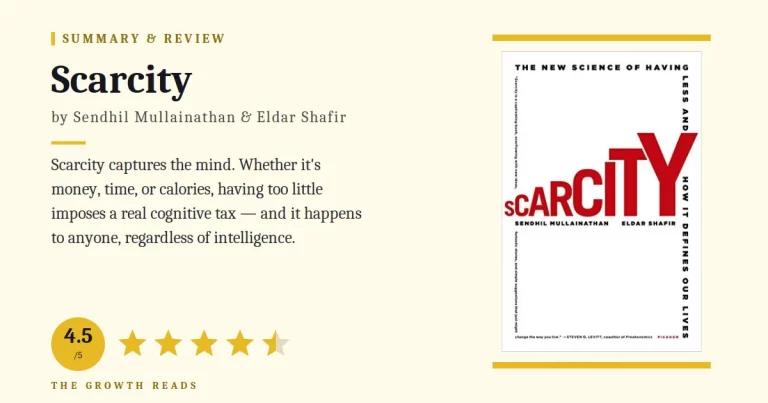
Scarcity Summary and Review
★★★★☆ 4.5/5 — A rigorous, humane case that scarcity itself — not character — imposes a real cognitive tax on anyone who…
Read Summary →"The economist and the psychologist who showed that scarcity taxes the mind the same way in poverty, busyness, and dieting alike."
Sendhil Mullainathan is an economist and MacArthur "genius grant" recipient who has held faculty positions at MIT, Harvard, and the University of Chicago Booth School of Business, and co-founded the behavioral-design nonprofit ideas42 and MIT's Poverty Action Lab (J-PAL). Eldar Shafir is the Class of 1987 Professor in Behavioral Science and Public Policy at Princeton University, where he directs the Kahneman-Treisman Center for Behavioral Science and Public Policy; his research on judgment and decision-making includes work with Amos Tversky. Their collaboration paired economics with psychology to build Scarcity's unified account of how having too little shapes the mind, drawing on field research with Indian sugarcane farmers and lab studies of shoppers under financial stress.
Our in-depth summaries and reviews of his work
★★★★☆ 4.5/5 — A rigorous, humane case that scarcity itself — not character — imposes a real cognitive tax on anyone who…
Read Summary →In "Scarcity," Mullainathan and Shafir show that having too little of any resource — money, time, or calories — imposes a real "bandwidth tax" on cognitive capacity, producing tunneling and poor decisions that look like character flaws but are actually structural effects anyone would experience.
"Scarcity captures the mind. The mind orients automatically, powerfully, toward unfulfilled needs."— Scarcity
Start with our most popular summary of their work.
Read the Summary★★★★☆ 4.5/5 — A rigorous, humane case that scarcity itself — not character — imposes a real cognitive tax on anyone who experiences it, tested across money, time, and food. Best for: readers who want a research-backed reframe of why…