
Money
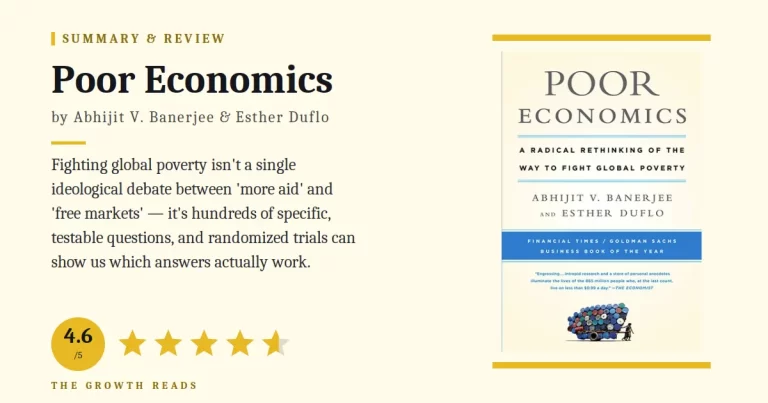
Poor Economics Summary and Review
★★★★★ 4.6/5 — A rigorous, deeply humane case that fighting global poverty isn’t one ideological debate but hundreds of testable questions —…
Read Summary →"Nobel Prize-winning economists who brought randomized trials to the fight against global poverty."
Abhijit V. Banerjee and Esther Duflo are economists at the Massachusetts Institute of Technology and co-founders of the Abdul Latif Jameel Poverty Action Lab (J-PAL), a research center that pioneered the use of randomized controlled trials to test anti-poverty interventions. In 2019, together with Michael Kremer, they were jointly awarded the Nobel Memorial Prize in Economic Sciences for their experimental approach to alleviating global poverty. Their work applies the rigor of medical drug trials to development economics, testing specific interventions — bed nets, deworming, microfinance, education programs — rather than relying on broad ideological debates about aid versus free markets. Poor Economics, published in 2011, distills years of this field research into an accessible account of what actually helps people escape poverty.
Our in-depth summaries and reviews of his work
★★★★★ 4.6/5 — A rigorous, deeply humane case that fighting global poverty isn’t one ideological debate but hundreds of testable questions —…
Read Summary →Testing interventions the way medicine tests drugs — comparing a treatment group against a control group to isolate real causal impact.
A self-reinforcing cycle where being poor makes it harder to escape poverty — real in some domains like nutrition, but not universal.
Why proven, cheap interventions still fail to reach the people who need them without deliberate delivery design.
"The poor often resist the wonderful plans we think up for them because they do not share our faith that these plans work, or work as well as we claim."— Poor Economics
"We have to abandon the habit of reducing the poor to cartoon characters and take the time to really understand their lives, in all their complexity and richness."— Poor Economics
Start with our most popular summary of their work.
Read the Summary★★★★★ 4.6/5 — A rigorous, deeply humane case that fighting global poverty isn’t one ideological debate but hundreds of testable questions — and randomized trials can show us which answers actually work. Best for: readers who want an evidence-based, on-the-ground…