

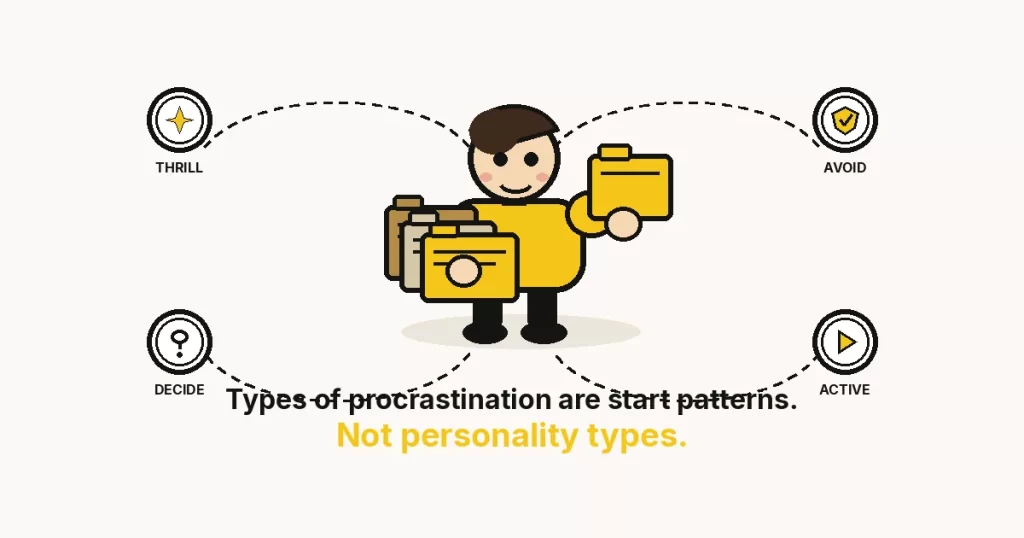
Types of procrastination are start patterns, not personality types. Ferrari’s arousal, avoidant and decisional labels name how a delayed task is entered. Chu and Choi’s active/passive split asks whether that delay was chosen. Steel’s 2007 equation sits underneath every label. Name the start, not the person.
Key takeaways
- Ferrari (1992) treated Lay’s General Procrastination Scale as arousal delay and the Adult Inventory of Procrastination as avoidant delay after the two inventories correlated only r = .07 across three samples.
- Chu and Choi (2005) surveyed 230 undergraduates and found “active” procrastinators delayed as often as “passive” ones but looked more like non-procrastinators on time control, self-efficacy, coping and academic performance.
- Steel (2007) found sensation seeking a weak predictor; task aversiveness, delay, self-efficacy, impulsiveness and conscientiousness survived the 691-correlation meta-analysis.
- Steel (2010) asked whether arousal, avoidant and decisional procrastinators exist as separate types and found the popular trichotomy does not hold as three distinct people.
- Solomon and Rothblum (1984) asked 342 students: 46% nearly always or always delayed writing a term paper; the reasons stacked on fear of failure and task aversiveness, not a third “lazy” factor.
What types of procrastination actually are
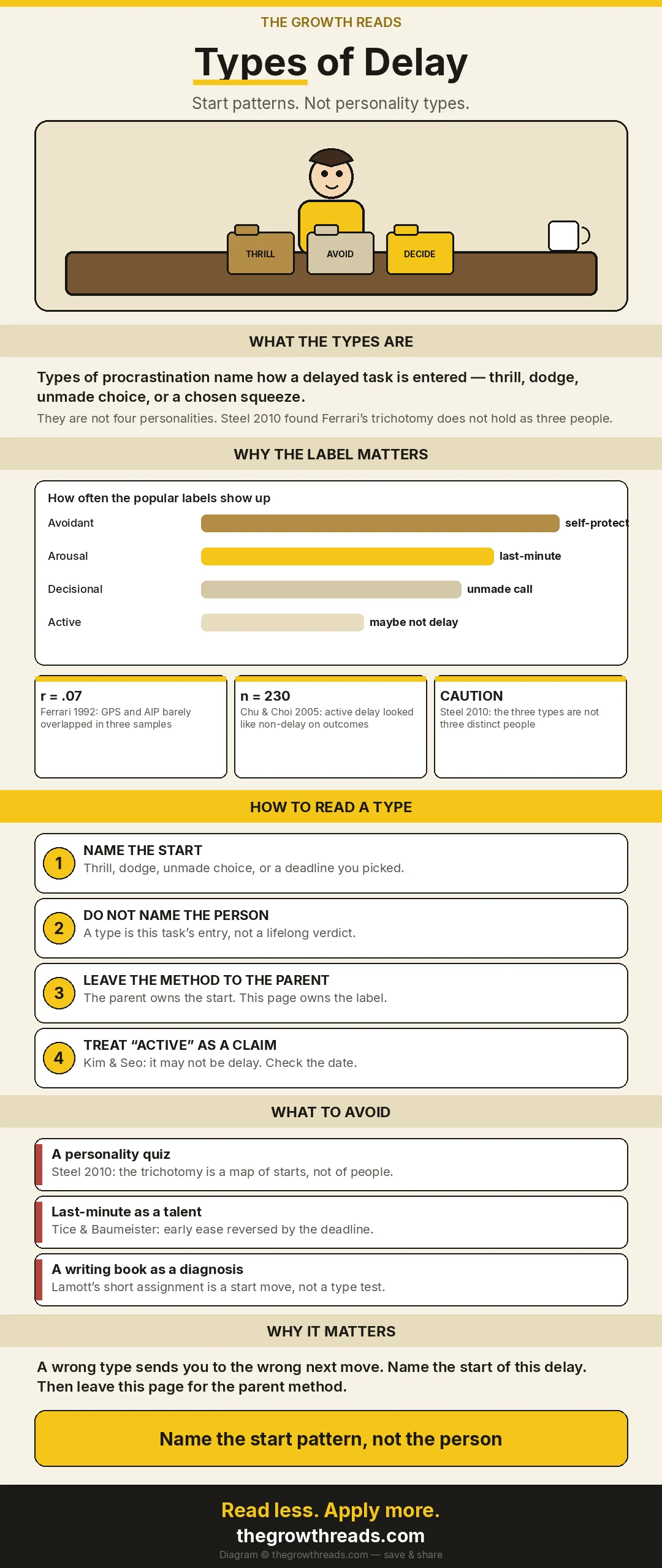
Types of procrastination are names for how a delayed task is entered — not four personalities you are stuck inside. The search phrase sounds like a quiz that will tell you which kind of person you are. The productivity read is narrower. A type is a start pattern on this task, in this room, today. The same person can run an arousal start on a slide deck and an avoidant start on a difficult email. Collapsing those into a lifelong label is how a useful map becomes a verdict.
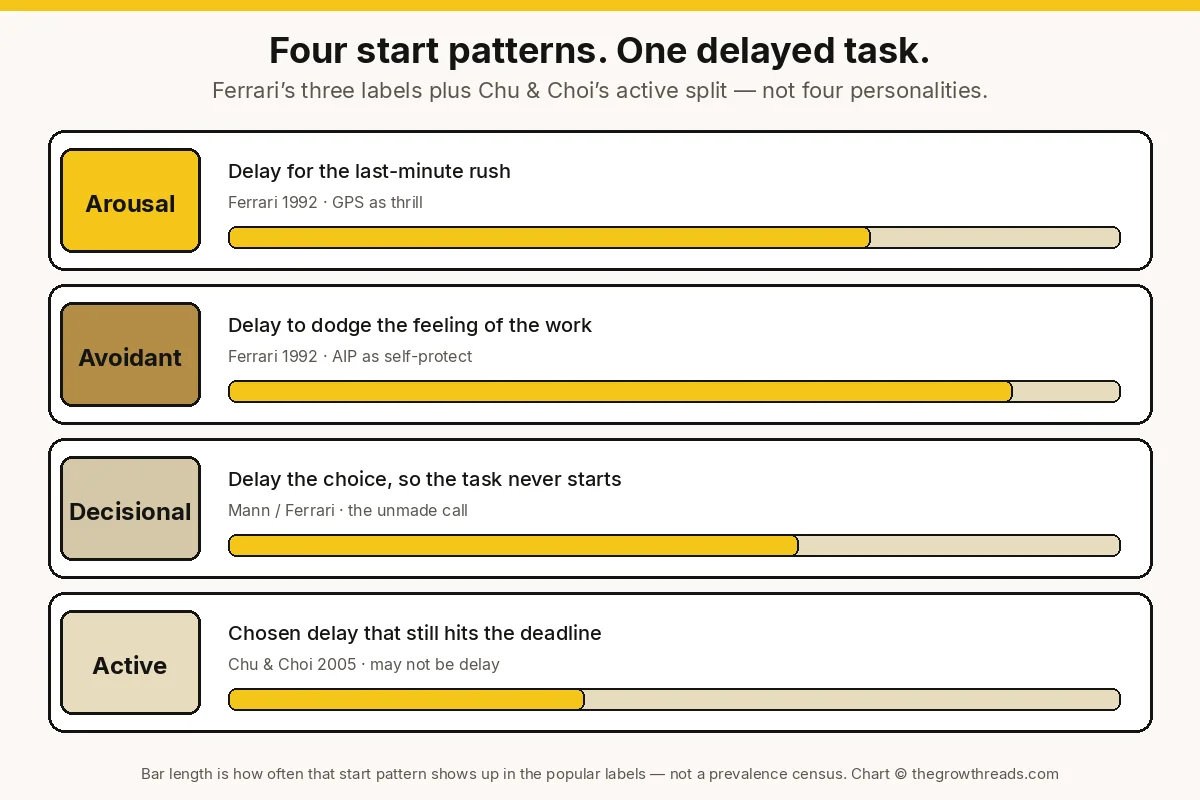
Joseph Ferrari’s 1992 paper in the Journal of Psychopathology and Behavioral Assessment is the source of the two labels most listicles still reprint. He gave adults Lay’s General Procrastination Scale (GPS) and McCown and Johnson’s Adult Inventory of Procrastination (AIP). Across three samples the two inventories barely overlapped — an average correlation of r = .07. Ferrari read that gap as two motives: GPS tracking delay that seeks a last-minute rush (arousal), AIP tracking delay that protects self-esteem or dodges evaluation (avoidant). A third label, decisional procrastination, was later folded in from Mann’s decision-making work: putting off the choice so the task never quite begins. Those three names are the popular trichotomy. They are a map of starts. They are not a census of three species.
A second split sits next to Ferrari’s and answers a different question. Angela Chu and Jin Nam Choi (2005) surveyed 230 undergraduates in The Journal of Social Psychology and separated passive procrastinators — the traditional stall, paralysed by indecision, late — from active ones, who said they preferred pressure, chose to delay, and still met the deadline. Active procrastinators delayed as often as passive ones, and still looked more like non-procrastinators on purposive time use, time control, self-efficacy, coping and academic performance. That is a claim about a chosen squeeze, not a fourth Ferrari type. Kim and Seo (2015) later warned that “active procrastination” may not be procrastination at all. This page will keep that warning attached.
The parent page how to overcome procrastination already owns the method for getting a delayed task moving. This page does not restage that method and does not emit a HowTo ladder. It owns the labels people type when they want a taxonomy. The sister page chronic procrastination owns frequent delay as a default week — how often the start loses, not which labelled door it walked through. Use that page when the question is “has this become the pattern,” and this page when the question is “which start is running.”
Anne Lamott’s Bird by Bird is the unused review this row was given, and it earns the slot for a specific reason. Her “short assignment” is a start move for the avoidant pattern: shrink the next physical action until the feeling of the whole paper is no longer the thing you are delaying. That is not a lab finding, and we will not dress a writing book as one. It is the library’s closest book-length name for “make the first unit small enough that the dodge has nothing to grip.” The productivity library already holds the parent method and the sister pages. This article names the types so those pages have a label that can survive a hostile read.
Types versus one delay equation
Under every type sits the same delay equation; the type is only the entrance. Piers Steel’s 2007 meta-analysis in Psychological Bulletin synthesised 691 correlations. The correlates that survived were task aversiveness, delay, self-efficacy, impulsiveness and conscientiousness. Sensation seeking — the trait Ferrari’s arousal story needs — was weak. Neuroticism and rebelliousness were weak. That is the first honest limit on the trichotomy: a popular name can travel further than its predictor. Steel (2010) then asked the direct question in Personality and Individual Differences: do arousal, avoidant and decisional procrastinators exist as separate types? His answer was no. The scales overlap. The people do not sort into three rooms. Keep the labels as a way to notice how this delay started. Do not promote them to a personality test.
Why the same delay splits into types
The delay splits into types because people notice different doors into the same postponement, not because three different mechanisms are running. Fuschia Sirois and Timothy Pychyl (2013) put the shared door in plain language: procrastination is a short-term mood repair. The present self puts down a task that feels bad, and the future self inherits the pile. That story does not care whether the bad feeling was boredom, evaluation fear, or an unmade choice. It cares that putting the work down felt better now. Types are the stories people tell about which feeling they were repairing. The repair is the mechanism. The story is the type.
Solomon and Rothblum (1984) already saw the split without Ferrari’s later names. They asked 342 college students how often they delayed academic work and why. Forty-six percent said they nearly always or always procrastinated on writing a term paper; 27.6% on studying for exams; 30.1% on weekly reading. A factor analysis of the reasons stacked most of the variance on two factors: fear of failure (49.4% of the variance — a smaller, more homogeneous group) and aversiveness of the task (18% — a larger, more mixed group). Those two reasons map cleanly onto avoidant and “the work itself is unpleasant.” They do not require a third personality. They also do not require a diagnosis. This is a work-and-habits page. Fear of a grade and dislike of a task are start stories, not a clinical scale.
Ferrari’s 1992 gap (r = .07) is why the two behavioural labels stuck. If two inventories barely overlap, it is tempting to treat them as two people. Ferrari et al. (2007) later took the chronic scales to 1,347 adults in six countries and reported 13.5% “pure” arousal and 14.6% “pure” avoidant after controlling for the other scale — because the two scales now correlated at r = .72. That is the second honest limit. The 1992 gap did not stay a gap. “Pure” scores in 2007 are residuals, not two rooms of people you can add into 28%. The procrastination statistics page already owns those percentages. This page owns why the same English word “type” was glued onto them.
The four start patterns people actually name
- Arousal. The start is a wait for pressure. The story is “I work better at the last minute.” Ferrari (1992) tied this to GPS and a modest sensation-seeking correlation (r = .23). Steel (2007) found sensation seeking too weak to carry a type. Treat the story as a start: the task has no cue except the deadline’s heat.
- Avoidant. The start is a dodge of how the work will feel — evaluation, a possible mess, a possible success. Ferrari read AIP as this door. Solomon and Rothblum’s fear-of-failure factor is the academic version. Lamott’s short assignment is the start move that shrinks the feeling’s surface area.
- Decisional. The start never happens because the choice is still open. Mann’s decisional items sit here. Analysis paralysis is a neighbour, not a synonym: that page owns comparing past the point of a call. This type is the unmade call that keeps the task in limbo.
- Active (claimed). The start is a chosen squeeze that still hits the date. Chu and Choi (2005), n = 230, is the paper. Choi and Moran (2009) later built a scale for it. Kim and Seo (2015) is the brake: if the work lands on time by design, you may be looking at scheduling, not procrastination. Do not use this label as a compliment for a late file.
Most weeks run two of these depending on the file. That is expected if Steel (2010) is right and the types are not three people. The useful move is to name the start of this delay, then leave this page for the parent method.
Why the wrong label costs more than it feels like
A wrong type sends you to the wrong next move, which is why a taxonomy that is treated as a personality test costs more than a late afternoon. If you read an avoidant start as arousal, you wait for pressure that will not make the evaluation feeling smaller. If you read a decisional start as laziness, you add grit to an unmade call. If you read a missed deadline as “active,” you borrow Chu and Choi’s compliment for a file that did not land. The type is cheap to name. The misread is expensive because it picks the next hour.
Dianne Tice and Roy Baumeister’s 1997 longitudinal studies in Psychological Science are the cleanest demonstration that the early story lies. Students who scored higher on procrastination reported lower stress and less illness early in the term. By the end of term the pattern reversed: more stress, more illness, lower paper and exam grades. The arousal story — “I work better under pressure” — is the first half of that curve talking. It is not a type that has been validated as a talent. It is the short-term mood repair Sirois and Pychyl named, measured across a semester.
Kim and Seo (2015) pooled 33 studies and 38,529 participants and found academic procrastination negatively correlated with academic performance, stronger when delay and grades were assessed externally. In the same paper they noted that “active procrastination” may not belong in the same pile. That is the cost of a flattering type: it can hide a late file inside a success story, or hide a planned squeeze inside a delay word. This page will not turn their caution into a pep-talk about good procrastination. It will also not ban the active label. It will keep the deadline attached. If the date was met by design, say scheduling. If it was not, do not borrow “active.”
Two honest caveats. Ferrari’s 1992 r = .07 did not survive as a clean split: Ferrari et al. (2007) found the chronic scales overlapping at r = .72. Steel (2010) is the paper that says the trichotomy does not describe three kinds of people — so a workplace “which type are you” quiz is theatre. Chu and Choi (2005) is one undergraduate sample of 230, not a career study. Observational and student samples get named as such. They still beat an unsourced “there are five types of procrastinator.”
The cost that does not need a dramatic percentage is the identity cost. Once “I am an arousal type” is read as permission, people stop distinguishing a delayed email from a chronic week. The procrastination cycle page owns the loop. This page owns the reason the loop gets a type attached to it: a sticky label is easier to repeat than “this start, this task.”
Nearby pages that are not this taxonomy
Several neighbouring pages share a delay word with this one and answer a different question. Keep them linked, not merged. This URL is the types page: how a delayed task is entered, and which popular label that entrance already has. It is not a how-to ladder, not a rewrite of the live morning-routine how-to, and not a clinical scale.
| Idea | What it actually is | What it is not |
|---|---|---|
| Types of procrastination | Start patterns: arousal, avoidant, decisional, and a claimed active split | Four personalities, or a diagnosis |
| How to overcome procrastination | The Procrastination parent: the method for starting the delayed task | A second types table |
| Chronic procrastination | Frequent delay as a default week — how often the start loses | A new type |
| Procrastination examples | What delay looks like in ordinary work | A taxonomy |
| Procrastination statistics | What was counted, in whom, in which year | A type quiz |
| What causes perfectionism | A delay driver that often feeds the avoidant start | A fifth type |
| Productive procrastination | Doing other useful work instead of the intended task | Chu and Choi’s “active” label |
| How to build a morning routine | A fixed cue-to-action sequence. Already live. Do not rewrite it here | A checklist page, and not a types page |
The live morning-routine how-to and the live morning-routine checklist are different phrases and different jobs. This article does not restage either of them. A type can describe how a morning start slips; it cannot become a new dawn stack.
Common mistakes
- Treating Ferrari’s three labels as three kinds of people. Steel (2010) is the paper that asked the question and said no. Name the start of this task.
- Adding Ferrari’s 13.5% and 14.6% as two populations. The 2007 scales overlapped (r = .72). “Pure” scores are residuals. The statistics page owns those figures.
- Calling last-minute work a talent. Tice and Baumeister’s early ease reversed by the deadline. Pressure is a cue, not a gift.
- Borrowing “active” for a late file. Chu and Choi’s active group still hit the date. Kim and Seo: the label may not be procrastination. Check the deadline.
- Restaging the parent as a HowTo ladder here. Play slots do not emit that ladder. How to overcome procrastination already owns the method.
- Rewriting the morning-routine how-to or the live checklist. Different phrases, already published. A types page is not a new dawn stack.
- Using a writing book as a diagnosis. Bird by Bird is a short-assignment start move for avoidant delay, not a type test.
The evidence behind this
The claim on this page is modest: the popular types are start patterns with named papers behind them, and they do not survive as three distinct kinds of people. The table is the working, not a highlight reel.
| Study | Design and size | Finding | What we used it for |
|---|---|---|---|
| Ferrari (1992), JPBA | Three adult samples; GPS and AIP | Inventories correlated r = .07; GPS tied to sensation seeking (r = .23); AIP tied negatively to self-esteem (r = −.28) | Where arousal vs avoidant labels come from |
| Chu & Choi (2005), J. Social Psychology | Survey, 230 undergraduates | Active procrastinators delayed as often as passive ones, but resembled non-procrastinators on time control, self-efficacy, coping and academic performance | The claimed active/passive split, with the student sample named |
| Steel (2007), Psychological Bulletin | Meta-analysis, 691 correlations | Strong: aversiveness, delay, self-efficacy, impulsiveness, conscientiousness. Weak: sensation seeking, neuroticism, rebelliousness | Why one equation sits under every type, and why arousal is a weak trait story |
| Steel (2010), PAID | Psychometric / construct test of the Ferrari trichotomy | Arousal, avoidant and decisional types do not hold as three distinct people | The hard limit on the taxonomy. Labels stay; the personality quiz goes |
| Solomon & Rothblum (1984), J. Counseling Psychology | 342 college students; PASS reasons | 46% nearly always/always delayed term papers; 27.6% exams; 30.1% weekly reading. Fear of failure 49.4% of reasons variance; task aversiveness 18% | Two start stories before Ferrari’s names, with the student room attached |
| Sirois & Pychyl (2013), SPPC | Review of mood-repair account | Procrastination as short-term priority of mood regulation by the present self | The shared door under every type |
| Ferrari et al. (2007), JCCP | 1,347 adults, six nations; two chronic scales, r = .72 | 13.5% “pure” arousal, 14.6% “pure” avoidant after controlling for the other scale | Why the 1992 gap did not stay a gap, and why the two % cannot be added |
| Kim & Seo (2015), PAID | Meta-analysis, 33 studies, 38,529 participants | Negative correlation with academic performance; “active procrastination” may not be procrastination | The brake on a flattering active label |
Frequently asked questions
What are the types of procrastination?
The popular types are start patterns, not personalities. Ferrari’s labels are arousal (wait for pressure), avoidant (dodge the feeling of the work) and decisional (delay the choice). Chu and Choi (2005) added an active/passive split: a chosen squeeze that still hits the deadline versus the traditional stall. Steel (2010) found the Ferrari trichotomy does not describe three kinds of people. Use a type to name how this task was entered. Do not use it as a lifelong verdict. The parent page owns the method for starting.
What is arousal procrastination?
Arousal procrastination is Ferrari’s name for delay that waits for the last-minute rush. In 1992 he treated Lay’s General Procrastination Scale as this door after it barely overlapped with the Adult Inventory of Procrastination (r = .07) and showed a modest link to sensation seeking (r = .23). Steel’s 2007 meta-analysis found sensation seeking too weak to carry a type. The useful remainder is a start story: the only cue is the deadline’s heat. Tice and Baumeister (1997) showed that early ease reversed by the end of term. Pressure is a cue. It is not a talent this page will certify.
What is avoidant procrastination?
Avoidant procrastination is Ferrari’s name for delay that protects self-esteem or dodges evaluation. He tied it to the Adult Inventory of Procrastination and a negative link with self-esteem (r = −.28). Solomon and Rothblum’s 1984 fear-of-failure factor is the academic version of the same door — a smaller, more homogeneous group than the “this task is unpleasant” group. Anne Lamott’s short assignment in Bird by Bird is a start move for this pattern: shrink the next physical action until the feeling of the whole file has less to grip. It is not a diagnosis and not a clinical scale.
Is active procrastination a real type?
It is a real claim in one undergraduate sample, and a disputed label after that. Chu and Choi (2005) surveyed 230 students and found people who delayed on purpose, preferred pressure, met deadlines, and looked like non-procrastinators on time control, self-efficacy, coping and grades. Choi and Moran (2009) built a scale for those dimensions. Kim and Seo (2015) said active procrastination may not be procrastination at all. This page will keep the deadline attached. If the date was met by design, say scheduling. If it was not, do not borrow the compliment.
Are the types of procrastination personality types?
No. Steel (2010) asked whether arousal, avoidant and decisional procrastinators exist as separate types and found they do not. Ferrari’s 1992 inventories barely overlapped; Ferrari et al. (2007) later found the chronic scales overlapping at r = .72. The same person can run different starts on different files. A workplace quiz that assigns you one type for life is theatre. Name the start of this delay. Then use the parent method, not a new identity.
How is this different from chronic procrastination?
Chronic procrastination asks how often the start loses — frequent delay as a default week. Types of procrastination ask which labelled door that start walked through. You can have an avoidant start once, or a chronic week that runs several starts. Harriott and Ferrari’s 15–20% adult range lives on the chronic page and the statistics page. This URL will not reprint it as a fourth type. If the question is “has this become the pattern,” leave. If the question is “which start is running,” stay.
Do I need a different fix for each type?
You need a correct name for the start, then the same parent method. Play slots do not emit a HowTo ladder, and this page will not invent a four-step system per label. An avoidant start often needs a smaller first unit (the Bird by Bird move). An arousal start needs a cue that is not the deadline. A decisional start needs a call, not more grit. Those are notices, not a second how-to. How to overcome procrastination already owns the start. This page owns the label so you do not take the wrong notice.
How should I use these types at work?
Use them as a one-word note on the delayed file, not as a personality test for your team. Write “avoidant — shrink the first unit,” or “decisional — make the call,” or “claimed active — check the date.” If someone says “I am an arousal type,” ask which task and which deadline. If the question is how to start, leave this page and use how to overcome procrastination. If the question is whether delay has become the default week, use chronic procrastination. A type that cannot name this task is not ready for a standup.
Sources
- Ferrari, J. R. (1992). Psychometric validation of two procrastination inventories for adults: Arousal and avoidance measures. Journal of Psychopathology and Behavioral Assessment, 14(2), 97–110. https://doi.org/10.1007/BF00965170
- Chu, A. H. C., & Choi, J. N. (2005). Rethinking procrastination: Positive effects of “active” procrastination behavior on attitudes and performance. The Journal of Social Psychology, 145(3), 245–264. https://doi.org/10.3200/SOCP.145.3.245-264
- Steel, P. (2007). The nature of procrastination: A meta-analytic and theoretical review of quintessential self-regulatory failure. Psychological Bulletin, 133(1), 65–94. https://doi.org/10.1037/0033-2909.133.1.65
- Steel, P. (2010). Arousal, avoidant and decisional procrastinators: Do they exist? Personality and Individual Differences, 48(8), 926–934. https://doi.org/10.1016/j.paid.2010.02.025
- Solomon, L. J., & Rothblum, E. D. (1984). Academic procrastination: Frequency and cognitive-behavioral correlates. Journal of Counseling Psychology, 31(4), 503–509. https://doi.org/10.1037/0022-0167.31.4.503
- Sirois, F. M., & Pychyl, T. (2013). Procrastination and the priority of short-term mood regulation: Consequences for future self. Social and Personality Psychology Compass, 7(2), 115–127. https://doi.org/10.1111/spc3.12011
- Ferrari, J. R., Díaz-Morales, J. F., O’Callaghan, J., Díaz, K., & Argumedo, D. (2007). Frequent behavioral delay tendencies by adults: International prevalence rates of chronic procrastination. Journal of Cross-Cultural Psychology, 38(4), 458–464. https://doi.org/10.1177/0022022107302314
- Kim, K. R., & Seo, E. H. (2015). The relationship between procrastination and academic performance: A meta-analysis. Personality and Individual Differences, 82, 26–33. https://doi.org/10.1016/j.paid.2015.02.038
Related reading on The Growth Reads
Books. Anne Lamott, Bird by Bird — the short assignment as a start move for avoidant delay. Pair it with the papers; do not replace them.
Related articles. How to overcome procrastination (parent, the method). Chronic procrastination (sister, frequent delay as a pattern). Procrastination examples. Procrastination statistics. Procrastination cycle. What causes perfectionism.
Hub. The productivity library is the silo home. Every URL on this page stays inside it.
How this article was researched
We read Ferrari 1992 as the source of the arousal/avoidant split, Chu and Choi 2005 as the source of the active/passive claim, and Steel 2007 plus Steel 2010 as the brake on treating those labels as three kinds of people. Solomon and Rothblum 1984 supplied the two academic start stories (fear of failure, task aversiveness) and the 46 / 27.6 / 30.1 term-paper, exam and reading figures. Sirois and Pychyl 2013 named the shared mood-repair door. Ferrari et al. 2007 and Kim and Seo 2015 are the later limits: overlapping chronic scales, and “active” that may not be delay. We did not invent a fifth type. We did not write a clinical page. We did not restage the live morning-routine how-to or the live morning-routine checklist.
Limits. Several papers are student samples. Chu and Choi is one class of 230. Ferrari’s 1992 gap did not hold in 2007. Steel 2010 is the construct paper that undercuts the trichotomy this URL still has to explain, because the search phrase is the trichotomy. If a later representative study replaces these labels, this page should be updated rather than defended.
Method: one play-slot article on the locked v3 template (no HowTo). Four body links: parent, sister, unused review, hub. Numbers without a dated source were left out.