


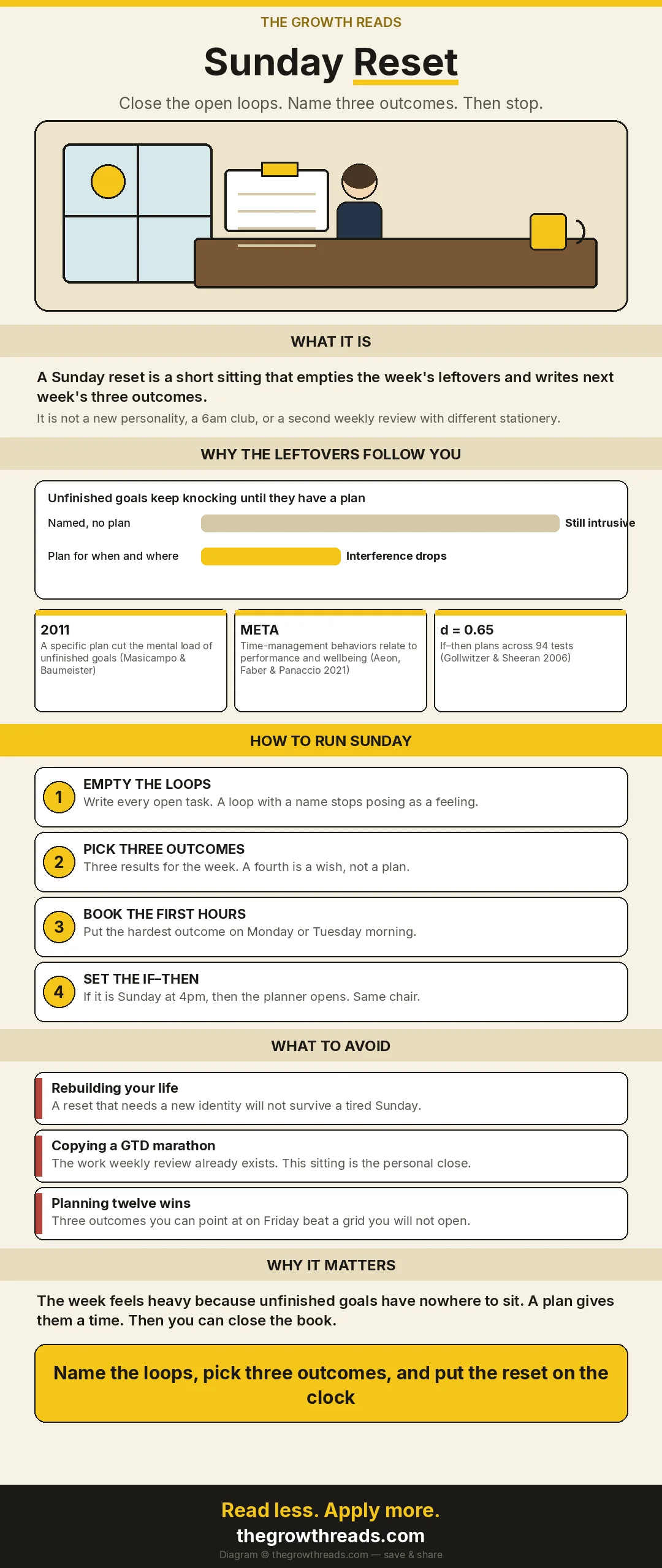
A Sunday reset is a short, repeating sitting that names the week’s unfinished tasks and writes three outcomes for the next one. It works because an unfinished goal keeps asking for attention until it has a when and a where. It is not a new morning identity, and it is not a second copy of the work weekly review.
Key takeaways
- Write every open loop down before you plan. A feeling of “so much to do” is usually a pile of unnamed tasks.
- Stop at three outcomes. A fourth item is a wish you will negotiate with on Wednesday.
- Put the hardest outcome on Monday or Tuesday morning, while the week has not spent you yet.
- Tie the sitting to a clock: if it is Sunday at 4pm, then the planner opens. Same chair.
- Keep the work weekly review for inboxes and projects. This page is the personal close of the week.
What is a Sunday reset?
A Sunday reset is a personal close of the week. You empty the small physical and mental leftovers — the bag by the door, the text you did not answer, the appointment that is still only in your head — and you write what next week is for. Then you stop. The point is a week that starts from a page, not from whatever was loudest on Sunday night.
People search “Sunday reset” and find a cleaning montage. Cleaning can be one item. It is not the practice. A spotless kitchen with twelve unnamed obligations still hands you a heavy Monday. The reset that changes the week is the one that gives each leftover a name and gives three of next week’s results a time.
Why do unfinished tasks follow you into Monday?
An unfinished goal does not sit quietly in a list you have not written. It interrupts. Masicampo and Baumeister (2011) tested that directly. People who left a task incomplete did worse on later work that needed attention, and they kept thinking about the unfinished thing. People who made a specific plan for when, where, and how they would finish it did not show that interference. The plan did not complete the task. It told the mind the task had an address.
That is the whole case for writing the loops down on Sunday instead of “being mindful” about them. Mindfulness of a vague pile is just rumination with better branding. A sentence — “email Priya Tuesday at 9, after the standup” — is a plan. “Deal with email” is another open loop wearing a verb.
Aeon, Faber and Panaccio (2021) reviewed the time-management research and found that planning behaviours are moderately related to performance and to wellbeing. Moderately. A Sunday page will not rescue a job with no control over its hours. It will stop you paying a second tax on top of the hours you do have, which is the tax of carrying the week in working memory.
How do you run the sitting without turning it into a project?
Keep it under an hour once it is a habit. The first one takes longer because you are naming a backlog, not a week. Four moves, in this order.
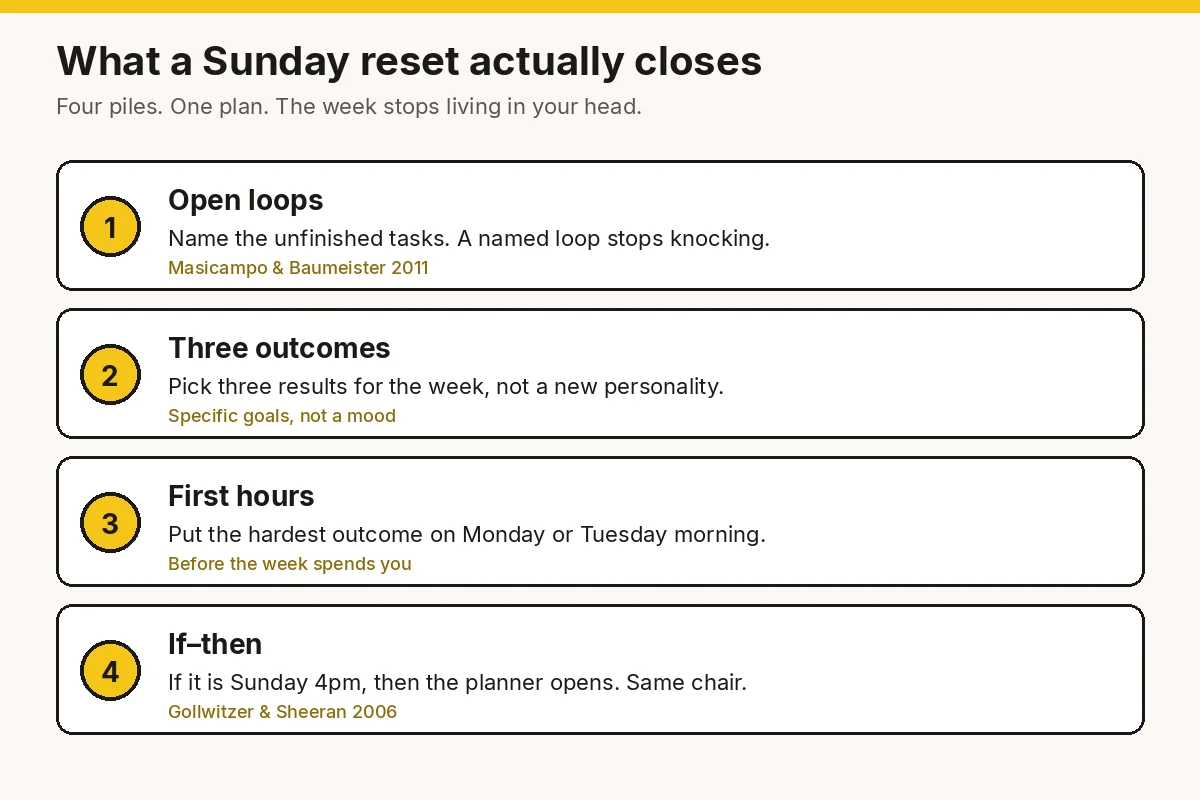
1. Name the open loops. One page. Work tasks, home tasks, messages, things you are waiting on. If it has been tapping you on the shoulder, it goes on the page. Do not sort yet. Sorting too early is how a reset becomes a colour-coded afternoon.
2. Pick three outcomes for the coming week. An outcome is something you could point at on Friday. “Draft sent.” “Appointment booked.” “The spare room has a clear floor.” Not “be consistent.” If you cannot tell whether it happened, it is a mood.
3. Book the first hours. Put the hardest of the three on Monday or Tuesday morning. The rest of the week will invent urgent work. Morning is the only slot that does not have to win an argument with that invention. This is the same reason a morning routine is a cue, not a personality: the clock does the deciding.
4. Set the if–then for next Sunday. Gollwitzer and Sheeran’s 2006 review found a medium-to-large effect for implementation intentions across 94 tests (d = 0.65). The form is dull on purpose. “If it is Sunday at 4pm, then I sit at the kitchen table and open the planner.” A reset that depends on feeling ready will meet a tired Sunday and lose.
What should a Sunday reset refuse to become?
It should refuse to become your weekly review. That page is the work system: inboxes, projects, calendars, the GTD close. Doing both in one sitting is how both get skipped. The Sunday reset is the personal layer. If your job already has a Friday review, do not rebuild it on Sunday with a different notebook.
It should also refuse the montage. A three-hour clean, a new wardrobe plan, a 5am promise and a rewritten identity is a content format. It is a poor plan. Burnett and Evans, in Designing Your Life, treat a week as a prototype you can look at, not a self you have to earn. Look at the week you just had. Keep what you would repeat. Drop what you resented. That is a design note, not a confession.
And it should refuse twelve priorities. Three outcomes you can see on Friday beat a grid you will not open on Tuesday. If a fourth item matters, it can replace one of the three. It does not get a quiet fourth line “just in case.”
What does the research actually support?
| Claim | Source | What it does not say |
|---|---|---|
| Unfinished goals interfere with later attention. A specific plan reduces that interference. | Masicampo & Baumeister, 2011, Journal of Personality and Social Psychology | It does not say a Sunday ritual outperforms any other day. The active piece is the plan, not the weekday. |
| Time-management behaviours are moderately related to performance and wellbeing. | Aeon, Faber & Panaccio, 2021, PLOS ONE meta-analysis | It does not say a planner fixes a badly designed job. The relationship is moderate. |
| If–then plans improve follow-through across many goal studies (d = 0.65). | Gollwitzer & Sheeran, 2006, Advances in Experimental Social Psychology | It does not say writing “I will reset” without a time and a place will do it. |
There is no trial called “the Sunday reset.” Treat anyone who quotes a success rate for it as someone who invented the number. The honest stack is: name the unfinished goal, give it a when and a where, and put the sitting itself on a cue you do not renegotiate.
Frequently asked questions
What is a Sunday reset in simple terms?
It is a short Sunday sitting where you write down unfinished tasks and choose three outcomes for the week ahead. Cleaning can be part of it. The part that changes Monday is the list with times on it.
How long should a Sunday reset take?
Plan 30 to 60 minutes once the backlog is named. The first sitting is longer because you are emptying a month, not a week. A 20-minute version that still names the loops and picks three outcomes is a real reset. A three-hour clean with no plan is a chore.
Is a Sunday reset the same as a weekly review?
No. The weekly review is the work close: inboxes, projects, calendars. The Sunday reset is the personal close: leftovers at home and the three outcomes for the week you are about to live. Doing both jobs in one sitting is how people skip both.
What if I miss Sunday?
Run it on Monday morning before you open mail, and keep it short. The research is about giving unfinished goals a plan, not about the name of the day. Then put next week’s sitting back on Sunday at the same time so one miss does not become the new habit.
How many goals should next week have?
Three outcomes you could point at on Friday. More than that and you are writing a wishlist. If everything feels urgent, the fourth item replaces one of the three. It does not join them.
Does a Sunday reset help if my week is controlled by other people?
It helps with the part you still choose, and it will not invent control you do not have. Aeon and colleagues found a moderate link between time-management behaviours and wellbeing, not a cure for an overloaded role. Use the sitting to protect the few hours that are actually yours, and to see clearly which hours are not.
Related reading
- How to build a morning routine — the parent page. A reset that books Monday morning needs a morning that already has a cue.
- The weekly review — the work close. Keep it separate from this personal sitting.
- Designing Your Life summary — Burnett and Evans on treating a week as a prototype you can revise.
How this article was researched
The Growth Reads editorial team checked Masicampo and Baumeister (2011), the Aeon, Faber and Panaccio (2021) meta-analysis, and Gollwitzer and Sheeran (2006) against the papers, not against a recap. We did not invent a success rate for “Sunday reset.” The phrase is a search, not a trial. Designing Your Life is used as a design frame, and it is labelled as a book.
This article contains no medical advice. A Sunday reset is a planning sitting, not a treatment for low mood or exhaustion.
How we work: every article on The Growth Reads is built from the books in our library plus the research they rest on, and is reviewed and date-stamped when the evidence changes. Read our full methodology.
Sources
- Masicampo, E. J., & Baumeister, R. F. (2011). Consider it done! Plan making can eliminate the cognitive effects of unfulfilled goals. Journal of Personality and Social Psychology, 101(4), 667–683.
- Aeon, B., Faber, A., & Panaccio, A. (2021). Does time management work? A meta-analysis. PLOS ONE, 16(1), e0245066.
- Gollwitzer, P. M., & Sheeran, P. (2006). Implementation intentions and goal achievement: A meta-analysis of effects and processes. Advances in Experimental Social Psychology, 38, 69–119.
- Burnett, B., & Evans, D. (2016). Designing Your Life. Knopf.
- Allen, D. (2001/2015). Getting Things Done. The work weekly review this page deliberately does not copy. See our weekly review article.