

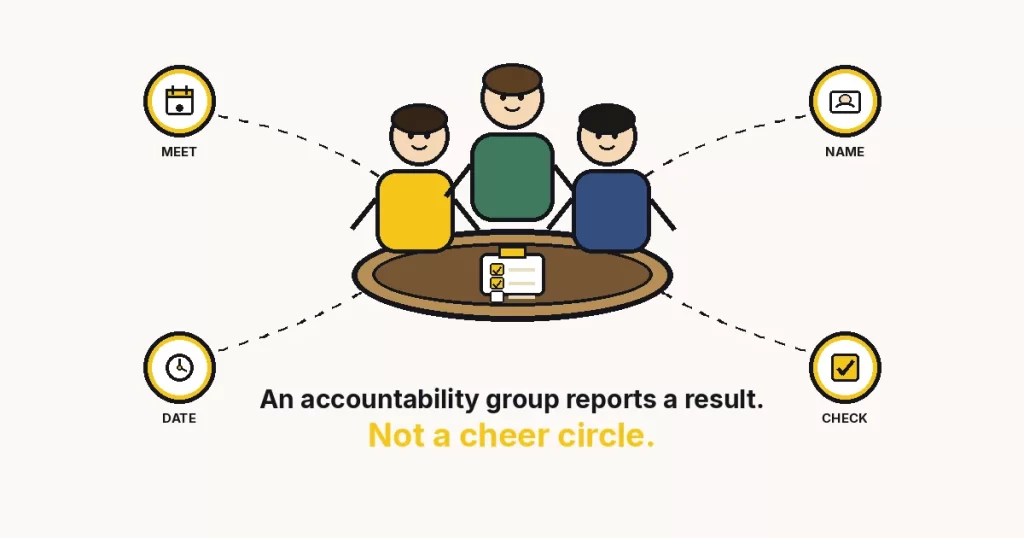
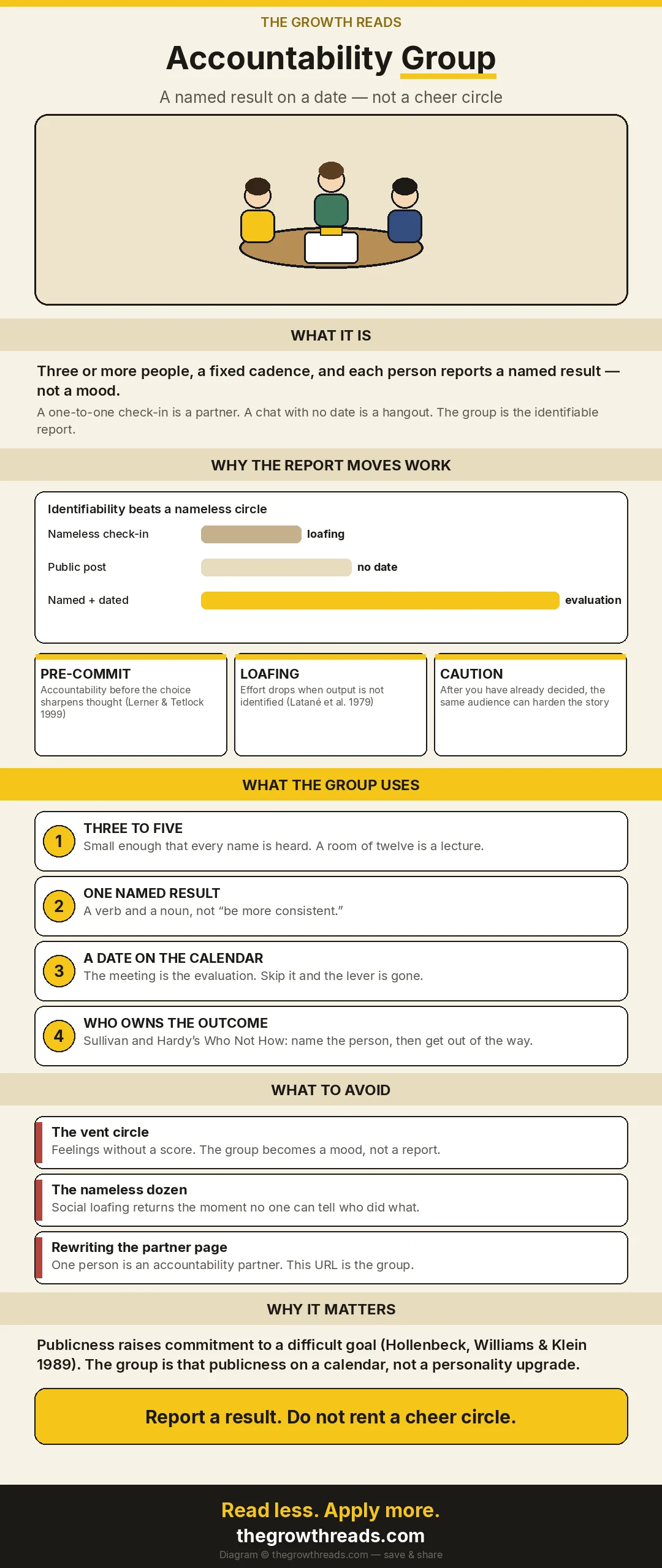
An accountability group is three or more people who meet on a fixed cadence so each person reports a named result, not a mood. Lerner and Tetlock (1999) named the lever: expected evaluation of an identifiable output. A cheer circle with no date is not a group.
Key takeaways
- Lerner and Tetlock (1999) found that expecting to justify a view to an unknown audience before a choice produces more self-critical, integratively complex thought — and that the same audience, after the choice is already made, can harden the prior story instead.
- Latané, Williams and Harkins (1979) showed people expend less effort in groups when individual output is not identified; a nameless round-robin is that finding wearing a calendar invite.
- Karau and Williams (1993) meta-analysed social loafing across 78 studies and found the drop in effort shrinks when contributions are identifiable and valued.
- Hollenbeck, Williams and Klein (1989) found that making a difficult goal public raised commitment to that goal among 190 undergraduates.
- Wing and Jeffery (1999) assigned 166 adults to treated-alone versus treated-with-friends conditions and found the friends-plus-support arm kept more of the loss at 10 months — a group effect on maintenance, not a personality upgrade.
What an accountability group actually is
An accountability group is a small set of people who meet on a known date so each name reports a result that the others can check. Three parts do the work: more than one other person, a cadence that exists before the week gets busy, and an output that can be identified as yours. Drop any one of those and you still have a gathering. You no longer have the lever this page is about.
Jennifer Lerner and Philip Tetlock’s 1999 review in Psychological Bulletin is the cleanest name for that lever. They treated accountability as the expectation that you will be called on to justify your beliefs, feelings or actions to others. Across the studies they synthesised, the useful case was predecisional accountability to an audience whose views you did not already know: people then thought in a more self-critical, integratively complex way. The same audience, once a person had already committed, often produced the opposite — defensive bolstering of the choice already made. A group that only hears the victory lap after the work is done is running the second case. A group that hears the named result on a date that was set before the work started is running the first.
This is a Discipline child. The parent how to build discipline already owns staying with a chosen task when a more comfortable option is available. The group is one social form of that staying-put: other people, on a calendar, holding a score you named. It is not a rewrite of the live morning-routine how-to, and it is not a rewrite of the live morning-routine checklist. Those pages own a dawn sequence. This URL owns a meeting that can sit at 7 a.m. or 7 p.m. without becoming a new dawn stack.
The closest sister is the live accountability partner page. One other person, on a schedule, hearing a goal, is already taken. Two other people change the math: there is now a small public, not a confidant. Dan Sullivan and Benjamin Hardy’s Who Not How is the unused review this row was given, and it earns the slot for a specific reason. Their move is to stop asking “how do I do this” and name the person who already can. A group that cannot name who owns the outcome is running a how-circle. The productivity library already holds the partner page, the parent method, and the scorecard page. This article names the group so those pages have a third person in the room.
Group versus partner versus audience
A partner is one name; a group is a small public; an audience is a crowd that cannot score you. Confusing those three is how a useful meeting becomes a performance or a hangout. The partner page already owns the 1:1 check. This page owns three-to-five people who can still tell whose line item slipped. A LinkedIn post is an audience: many eyes, no date, no named next result. Keep the words apart.
Why a group changes the work
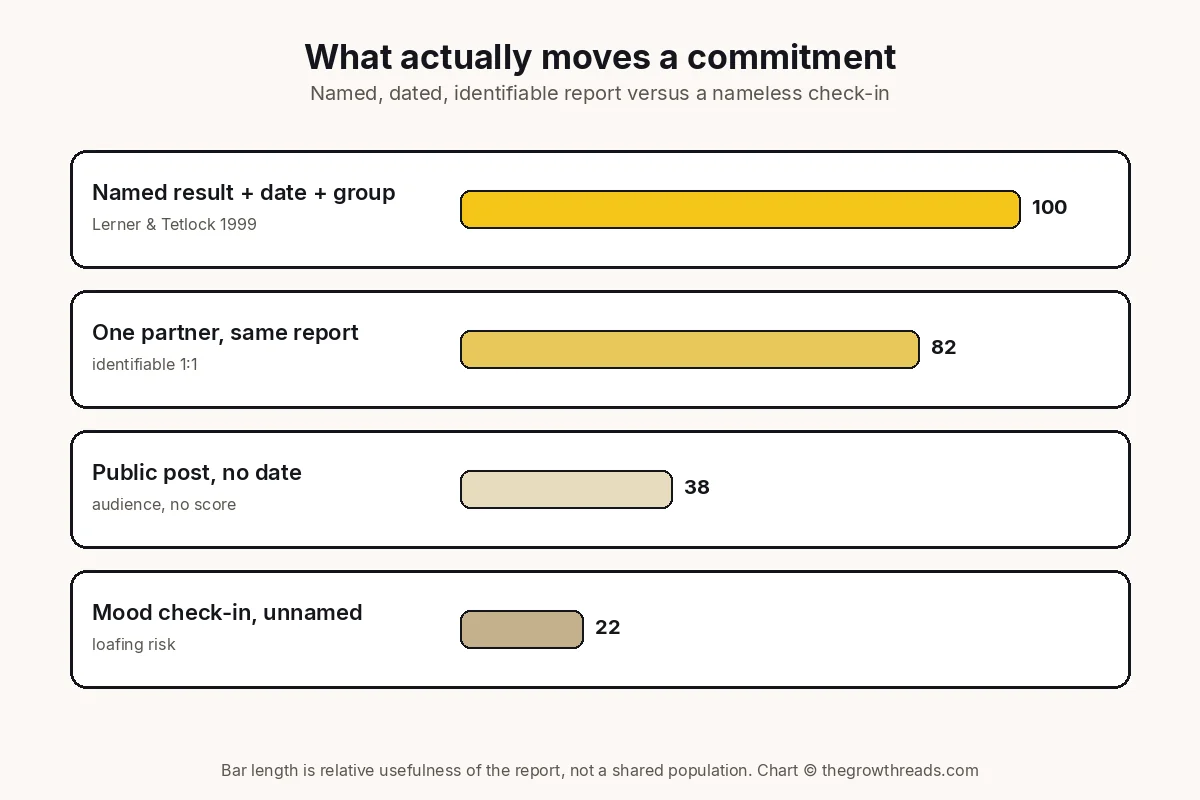
A group changes the work because a named result becomes evaluable, and evaluable work is harder to quietly drop. Bibb Latané, Kipling Williams and Stephen Harkins (1979) put the opposite case in a lab: people clapped and shouted less loudly in groups than alone, once they believed their individual sound could not be picked out. They called it social loafing. The finding is not “groups are lazy.” The finding is that effort falls when the output is no longer identifiable as yours. An accountability group is the reverse design: every name still has a line.
Stephen Harkins and Jeffrey Jackson (1985) then showed the other side of the same coin. When people believed their individual output could be evaluated, the loafing disappeared even though they were still in a group. Evaluation, not the mere presence of other bodies, was the active ingredient. Karau and Williams (1993) later meta-analysed 78 studies and 4,755 additional participants on top of earlier work and found the loafing effect robust — and smaller when contributions were identifiable, unique, or valued by the person doing them. That is the mechanism this page will keep repeating: identifiability plus expected evaluation. Warmth is optional. A date on a named result is not.
John Hollenbeck, Charles Williams and Howard Klein (1989) gave 190 undergraduates a difficult grade goal and varied how public that goal was. Publicness raised commitment. Edwin Locke and Gary Latham’s 2002 review in American Psychologist is the wider goal-setting frame those commitment findings sit inside: specific, difficult goals plus feedback beat vague “do your best” intentions. A group that asks “how was your week” is running a vague intention. A group that asks “did the draft leave the folder by Thursday” is running a specific goal with a feedback date. The meeting is the feedback.
Philip Tetlock’s 1983 paper in the Journal of Personality and Social Psychology is the earlier, cleaner demonstration of the thought-quality piece. Students who expected to justify their views to others produced more integratively complex essays than students who did not. Lerner and Tetlock (1999) later warned that this gift is conditional. Know the audience’s views in advance and people often match those views. Commit first and then meet the group, and people often defend the commitment. The useful group is therefore slightly uncomfortable: you do not already know what they will say, and you have not already published the victory post.
The four ingredients a working group actually uses
- A small room. Three to five names. Past that, individual output gets hard to hear and loafing returns. A twelve-person “mastermind” that cannot finish a round of reports is a lecture with coffee.
- A named result. A verb and a noun — “send the brief,” “run the 40-minute block,” “close the invoice.” “Be more consistent” is a mood. The partner page already warned that a goal without a score is a conversation. The group version is the same warning with more chairs.
- A date that exists before the work. Lerner and Tetlock’s predecisional case needs the evaluation to be expected, not improvised after a good week. The calendar invite is the expectation.
- A who, not a how-circle. Sullivan and Hardy’s book is not a lab paper, and this page will not dress it as one. It is the library’s closest book-length name for “stop collecting methods and name the person who owns the outcome.” If the group cannot say who is on the line, it is collecting hows.
Most weeks the group is doing two jobs at once: making the result identifiable (Latané, Williams and Harkins; Harkins and Jackson; Karau and Williams) and making the goal public enough that commitment rises (Hollenbeck, Williams and Klein). Those are social-design jobs. They are not a personality transplant and not a diagnosis.
Why a weak group costs more than it feels like
A weak group costs more than a skipped Tuesday because it spends the evaluation slot on a story that cannot be checked. The hour still happened. The loafing condition was still met. People leave feeling supported and the named result is no closer to done. That is not free. It is a standing meeting that trained everyone to treat the report as optional.
Rena Wing and Robert Jeffery’s 1999 trial in the Journal of Consulting and Clinical Psychology is the honest group-support finding, and also the limit. They assigned 166 adults to four arms: recruited alone and treated alone; recruited alone and given a social-support intervention; recruited with friends and treated with standard behaviour therapy; recruited with friends and given both. At month 4 the friends-recruited arms had lost more; at month 10 the friends-plus-support arm had maintained more (66% kept the full loss versus 24% in the three comparison arms combined). That is a real group effect on a maintenance task. It is also a weight-loss clinic, not a knowledge-work standup. It does not prove that any Slack huddle will move a slide deck. It does prove that “add friends, add structured contact” is a tested lever — and that the lever was structured, not a vent.
Two honest caveats. Lerner and Tetlock (1999) is a narrative review, not a new randomised trial of Tuesday masterminds. The predecisional gift fails when the audience’s views are already known or the choice is already made. Latané, Williams and Harkins (1979) used clapping and shouting, not quarterly OKRs; Karau and Williams (1993) found loafing smaller on tasks people already found meaningful. Wing and Jeffery (1999) is one clinic sample. Observational and analogue tasks get named as such. They still beat an unsourced “find your people and the work will happen.”
The cost that does not need a dramatic percentage is the identity cost. Once “I have an accountability group” is read as progress, people stop distinguishing a scored meeting from a cheer circle. Personal accountability already owns owning the result after the work. How to take accountability already owns the scorecard: one metric, one date, one review. This page will not restage those methods. It will say the group is those methods with extra chairs — or it is a social hour wearing their name.
Nearby pages that are not this group
Several neighbouring pages share an accountability word with this one and answer a different question. Keep them linked, not merged. This URL is the group page: three or more people, a cadence, a named result. Play slots do not emit a HowTo ladder, and this page will not invent one.
| Idea | What it actually is | What it is not |
|---|---|---|
| Accountability group | Three or more people, a fixed date, each name reports a checkable result | A cheer circle, a Slack hangout, or a personality type |
| Accountability partner | One other person on a schedule who hears the goal | A group. One chair is not three |
| How to build discipline | The Discipline parent: staying with the chosen task | A second group recipe |
| Personal accountability | Owning the result after the work, without needing an audience | A meeting |
| How to take accountability | The scorecard: one metric, one date, one review | A group roster |
| Accountability vs responsibility | Who answers for the result versus who does the work | A meeting format |
| How to build a morning routine | A fixed cue-to-action sequence. Already live. Do not rewrite it here | A checklist page, and not a group page |
The live morning-routine how-to and the live morning-routine checklist are different phrases and different jobs. This article does not restage either of them. A group can hear whether a morning sequence ran. It cannot become a new dawn stack on this URL.
Common mistakes
- Calling a chat an accountability group. If no name reported a result, Latané, Williams and Harkins’s loafing condition is still on. The invite is not the lever.
- Growing past the point where every output is identifiable. Harkins and Jackson (1985) needed evaluation of the individual line. A room of twelve that skips half the names is a lecture.
- Reporting the story after the choice is already published. Lerner and Tetlock (1999): postdecisional audiences harden the prior story. Set the date before the work, not after the win.
- Using the group as a second partner page. One person is already live at accountability partner. This URL is the small public.
- Collecting hows instead of naming a who. Who Not How is the book-length version of that mistake. A method pile is not a report.
- Rewriting the morning-routine how-to or the live checklist. Different phrases, already published. A group page is not a new dawn stack.
- Treating Wing and Jeffery as a knowledge-work guarantee. Their 1999 trial was a weight-loss clinic with structured contact. Borrow the structure. Do not borrow a 66% as a slide-deck promise.
The evidence behind this
The claim on this page is modest: a group works when a named result is expected to be evaluated, and fails when the output is no longer identifiable. The table is the working, not a highlight reel.
| Study | Design & size | What it found | Used here for |
|---|---|---|---|
| Lerner & Tetlock (1999), Psychological Bulletin | Narrative review of accountability experiments | Predecisional accountability to an unknown audience raises self-critical, complex thought; postdecisional accountability often hardens the prior choice | The lever, and why a victory-lap meeting is the wrong case |
| Tetlock (1983), Journal of Personality and Social Psychology | Lab study of students expecting to justify views | Expected justification produced more integratively complex thought than no audience | The thought-quality piece under the review |
| Latané, Williams & Harkins (1979), Journal of Personality and Social Psychology | Lab experiments on clapping and shouting in groups | People produced less noise in groups once individual output could not be identified | Why a nameless round-robin is not a group |
| Harkins & Jackson (1985), Personality and Social Psychology Bulletin | Lab study of group effort with and without evaluation | Loafing disappeared when people believed their individual output could be evaluated | Identifiability as the active ingredient |
| Karau & Williams (1993), Journal of Personality and Social Psychology | Meta-analysis, 78 studies | Social loafing is robust; smaller when contributions are identifiable, unique or valued | The boundary: meaningful, named work loafs less |
| Hollenbeck, Williams & Klein (1989), Journal of Applied Psychology | 190 undergraduates, difficult grade goal | Publicness of the goal raised commitment | Why a small public is not theatre |
| Locke & Latham (2002), American Psychologist | Review of the goal-setting programme | Specific, difficult goals plus feedback outperform vague “do your best” | Why “how was your week” is the wrong prompt |
| Wing & Jeffery (1999), Journal of Consulting and Clinical Psychology | 166 adults, four-arm weight-loss trial | Friends-plus-support maintained more loss at 10 months (66% vs 24% in the other arms combined) | A real group-support effect — and its clinic limit |
Frequently asked questions
What is an accountability group?
An accountability group is three or more people who meet on a fixed cadence so each person reports a named, checkable result. The lever is expected evaluation of an identifiable output — Lerner and Tetlock’s 1999 name for accountability — not warmth and not a shared playlist. A one-to-one check is an accountability partner. A chat with no date and no score is a hangout. If the room cannot say whose line item slipped, Latané, Williams and Harkins’s loafing condition is still on. This page owns the small public. It does not own the 1:1, and it does not emit a HowTo ladder.
How is an accountability group different from an accountability partner?
A partner is one other person on a schedule. A group is a small public — usually three to five names — that can still tell whose result slipped. The live accountability partner page already owns the 1:1. Adding a second listener changes the math: there is now an audience you did not pick as a confidant, which is closer to Tetlock’s 1983 justification condition. It also raises the loafing risk if names stop being heard. Use the partner page when one person is the whole design. Use this page when the design is a room.
How many people should be in an accountability group?
Three to five is the working range on this page, because that is still small enough for every output to stay identifiable. Harkins and Jackson (1985) needed people to believe their own line could be evaluated. Karau and Williams (1993) found loafing larger when contributions were not unique. A dozen-person mastermind that cannot finish a round of reports is a lecture. Two people is a partner, and that URL is already live. Do not grow the room to feel serious. Grow the specificity of the result.
Does an accountability group actually work?
It works when a named result is expected to be evaluated before the work is finished, and it fails when the output is no longer identifiable as yours. Lerner and Tetlock (1999) mapped the useful case — predecisional accountability to an audience whose views you do not already know. Hollenbeck, Williams and Klein (1989) found publicness raised commitment to a difficult goal. Wing and Jeffery (1999) found a structured friends-plus-support arm kept more of a weight loss at 10 months. None of those papers bless a vent circle. A group that cannot name the result is not a test of the lever. It is a social hour.
What should we report in an accountability group?
Report a verb and a noun that someone else can check: sent, closed, ran, drafted, shipped. Locke and Latham (2002) is the frame — specific, difficult goals plus feedback beat “do your best.” “Be more consistent” is a mood. “How was your week” is a prompt that cannot fail and therefore cannot inform. The how-to-take-accountability page already owns the scorecard of one metric, one date, one review. Borrow that unit. Do not turn this play page into a second scorecard HowTo. The group’s job is to hear the unit on a date that already existed.
Why do people slack off in groups?
Because individual output often stops being identifiable. Latané, Williams and Harkins (1979) measured less clapping and shouting once people believed their sound could not be picked out. Harkins and Jackson (1985) then showed that believing your own output would be evaluated removed the drop. Karau and Williams (1993) found the same pattern across 78 studies, and a smaller effect when the work already felt unique or valued. A nameless check-in recreates the original loafing design. A named line item on a date is the opposite design. The people are not the defect. The missing name is.
Is a mastermind the same thing as an accountability group?
Only if the mastermind still hears a named result from each person on a date. Napoleon Hill popularised “mastermind” as a thinking alliance; Sullivan and Hardy’s Who Not How is the modern “name the who” version in this library. Neither book is a loafing trial. A mastermind that spends the hour on ideas and never scores a line item is a seminar. A mastermind that keeps every output identifiable is this page under an older label. Keep the report. Do not keep the mystique.
Should I join an accountability group or get a partner?
Join a group when you need a small public — more than one other name, a cadence, and a result that would be embarrassing to skip in front of a room. Get a partner when one person is enough and a room would become a performance. The accountability partner page already owns that 1:1. Personal accountability owns the case where you do not need an audience at all. If the question is how to stay with the task, leave for how to build discipline. If the question is “who else hears this result,” stay. Play slots do not emit a setup ladder either way.
Sources
- Lerner, J. S., & Tetlock, P. E. (1999). Accounting for the effects of accountability. Psychological Bulletin, 125(2), 255–275. doi:10.1037/0033-2909.125.2.255
- Tetlock, P. E. (1983). Accountability and complexity of thought. Journal of Personality and Social Psychology, 45(1), 74–83. doi:10.1037/0022-3514.45.1.74
- Latané, B., Williams, K., & Harkins, S. (1979). Many hands make light the work: The causes and consequences of social loafing. Journal of Personality and Social Psychology, 37(6), 822–832. doi:10.1037/0022-3514.37.6.822
- Harkins, S. G., & Jackson, J. M. (1985). The role of evaluation in eliminating social loafing. Personality and Social Psychology Bulletin, 11(4), 457–465. doi:10.1177/0146167285114011
- Karau, S. J., & Williams, K. D. (1993). Social loafing: A meta-analytic review and theoretical integration. Journal of Personality and Social Psychology, 65(4), 681–706. doi:10.1037/0022-3514.65.4.681
- Hollenbeck, J. R., Williams, C. R., & Klein, H. J. (1989). An empirical examination of the antecedents of commitment to difficult goals. Journal of Applied Psychology, 74(1), 18–23. doi:10.1037/0021-9010.74.1.18
- Locke, E. A., & Latham, G. P. (2002). Building a practically useful theory of goal setting and task motivation: A 35-year odyssey. American Psychologist, 57(9), 705–717. doi:10.1037/0003-066X.57.9.705
- Wing, R. R., & Jeffery, R. W. (1999). Benefits of recruiting participants with friends and increasing social support for weight loss and maintenance. Journal of Consulting and Clinical Psychology, 67(1), 132–138. doi:10.1037/0022-006X.67.1.132
Related reading on The Growth Reads
The book this page draws on
- Who Not How summary & review — name the person who owns the outcome, then stop collecting methods
Related articles
- Accountability partner — the 1:1 sister; one other person on a schedule
- How to build discipline — the Discipline parent this group sits under
- Personal accountability — owning the result without needing a room
- How to take accountability — the scorecard the group is supposed to hear
- Accountability vs responsibility — who answers versus who does the work
Go deeper
How this article was researched
The Growth Reads editorial team writes from primary sources: the books themselves, the authors’ published essays and interviews, and the peer-reviewed literature behind the claims. Every study cited above was read in the original publication or its published abstract, and every figure is quoted with its design, sample and effect so you can judge its weight rather than take ours. Where a finding is a narrative review, an analogue lab task, or a clinic sample rather than a randomised trial of Tuesday standups, we say so directly in the text rather than in a footnote.
This article contains no medical advice. Wing and Jeffery (1999) is cited as a structured-support finding, not as weight-loss or mental-health guidance. Persistent difficulty starting or finishing work across contexts is worth discussing with a qualified professional rather than treated as a missing group.
How we work: every article on The Growth Reads is built from the books in our library plus the research they rest on, and is reviewed and date-stamped when the evidence changes. Read our full methodology.