

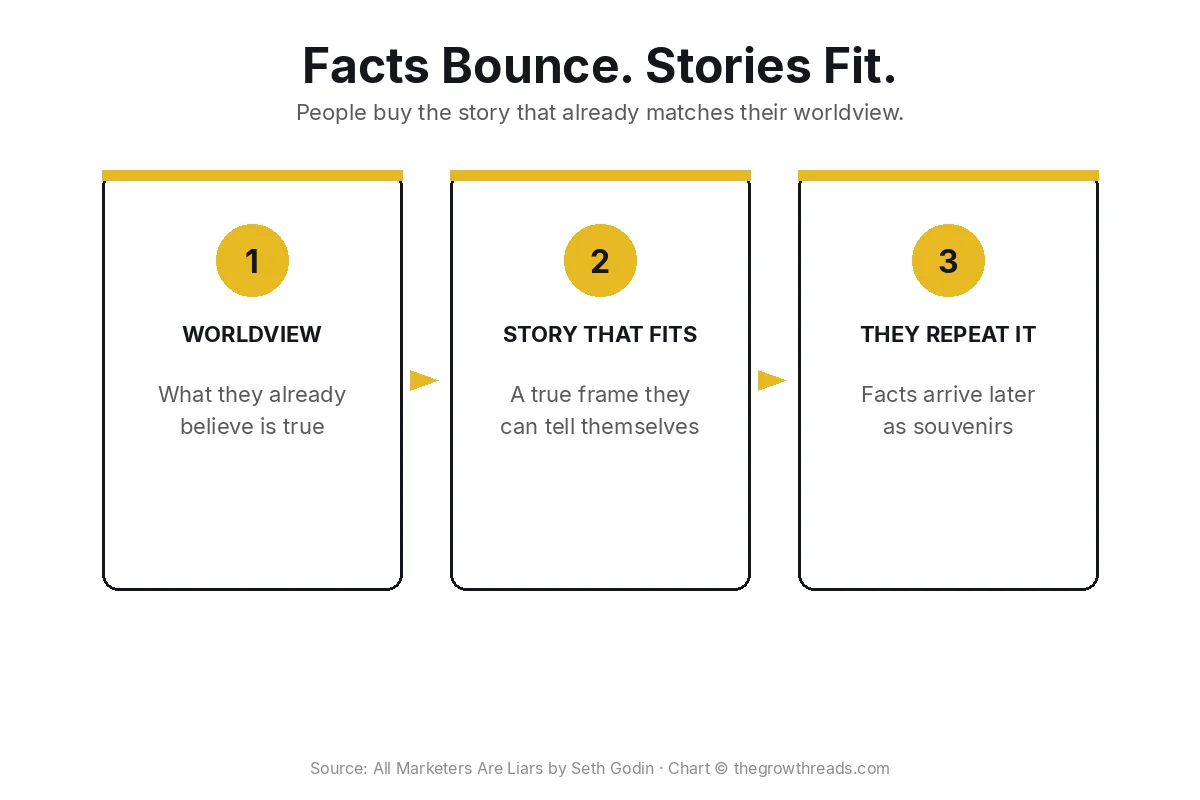
★★★★½ 4.5/5 — People do not buy the facts. They buy the story that already fits.
Best for: Founders, marketers, and makers whose deck is true and still ignored.
Reading time: ~6 hrs (Portfolio paperback, 2005/2009, ~240 pp) · this guide ~13 min
Difficulty to apply: Easy to name the story. Hard to live it when the next slide wants more proof.
All Marketers Are Liars in one minute
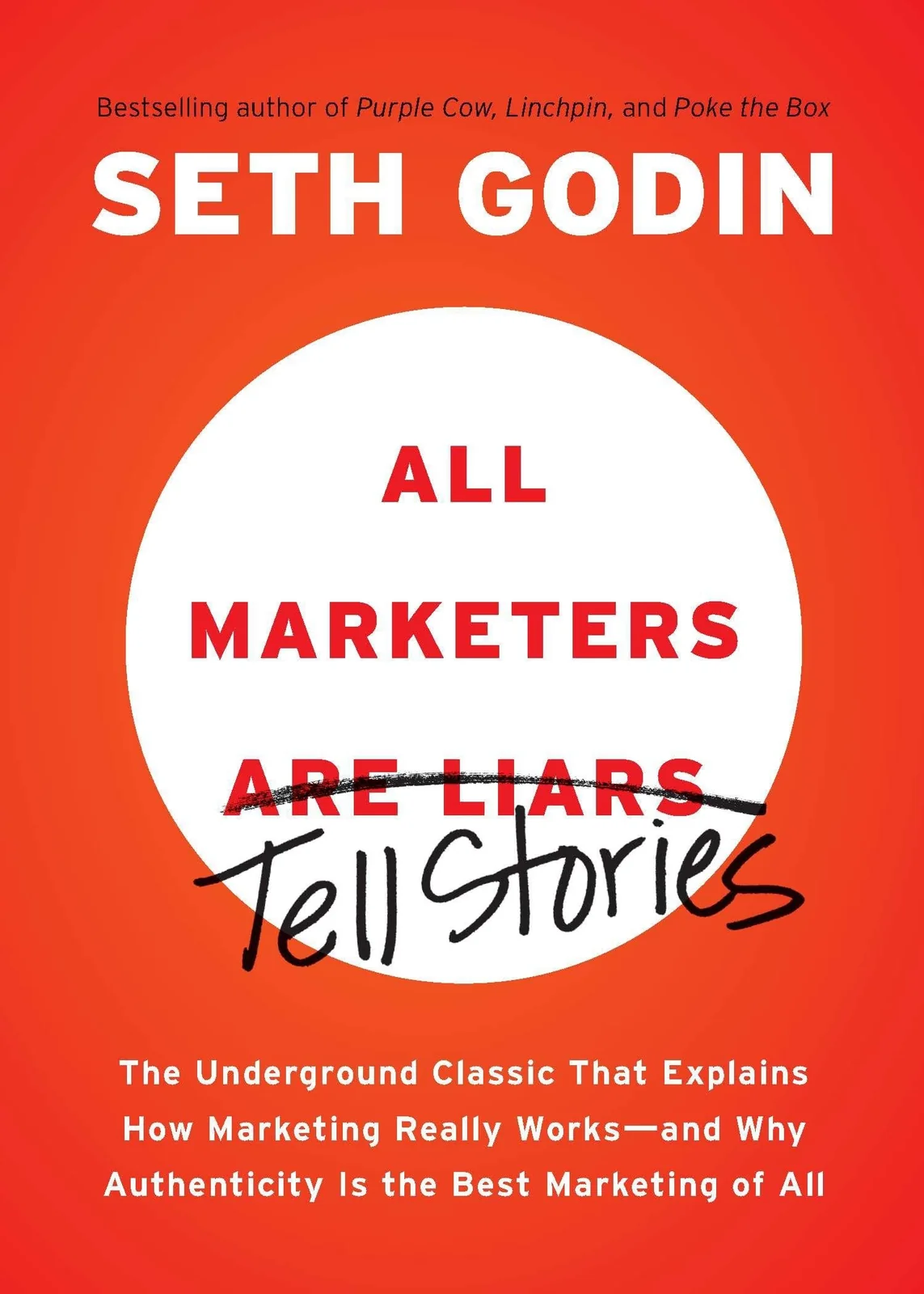
People believe what they tell themselves. Seth Godin’s 2005 book is a dare with a working rule inside it. Every useful pitch is a story. The stories that last match a worldview the listener already holds, and they are authentic enough that you actually live them. Facts arrive later, as souvenirs, to justify a snap that already happened. You do not convert a worldview with a better spec sheet. You frame a true story for people who already want to believe it, then let the first ten spread it to people like them. Later covers cross out “Are Liars” and write “Tell Stories.” That is the job. If your week is another fact dump to a room that was never going to care, this is the reset. Pick a story you can keep living on a Tuesday.
Key takeaways
- Stories beat facts: People buy a frame they can repeat, not a spreadsheet they can audit.
- Worldviews come first: Notice the beliefs already in the room. Do not try to replace them with ads.
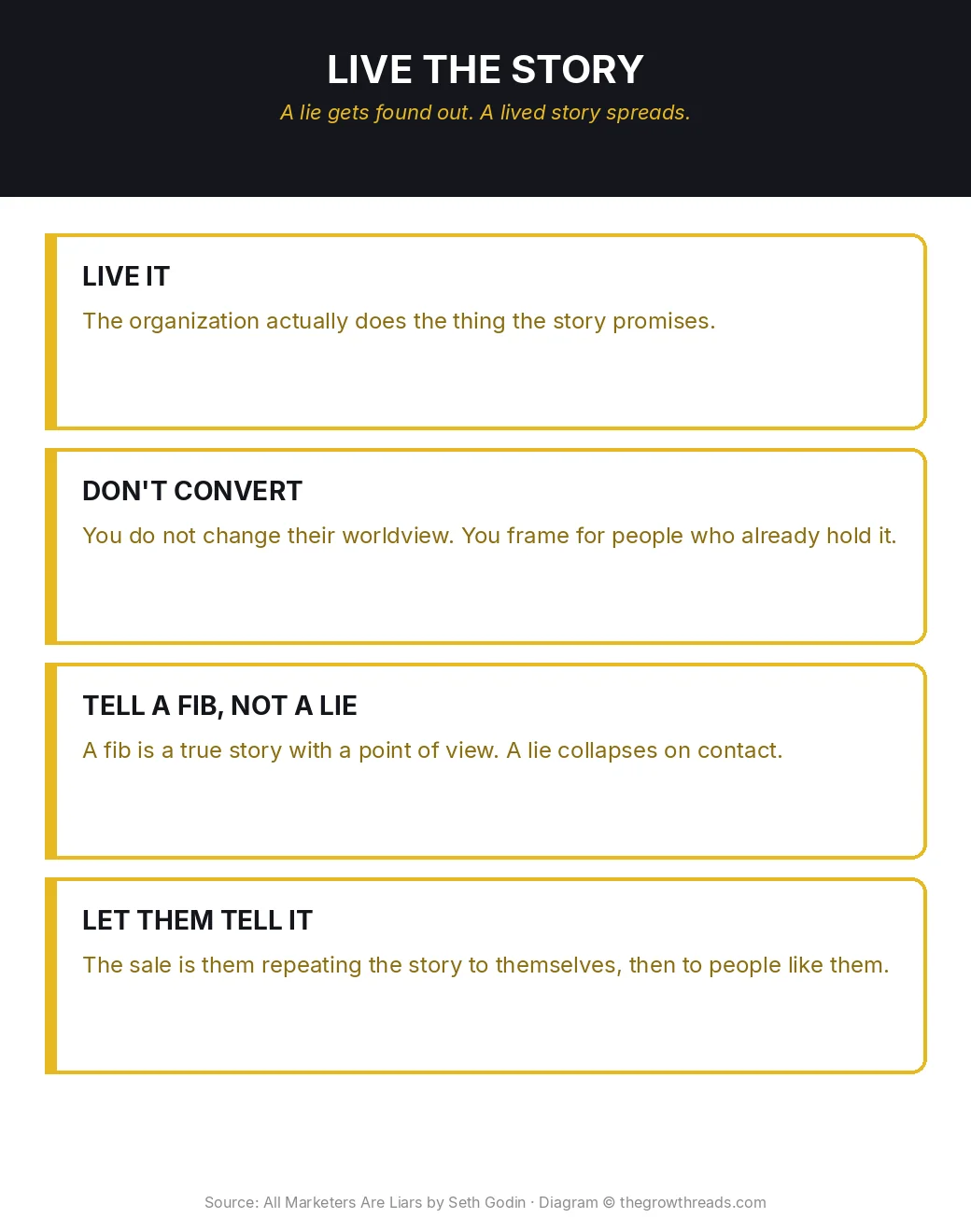
- Authenticity is the test: A lived story spreads. A lie gets found out and ends the conversation.
- Fib, not lie: A fib is a true story with a point of view. A lie collapses on contact with the product.
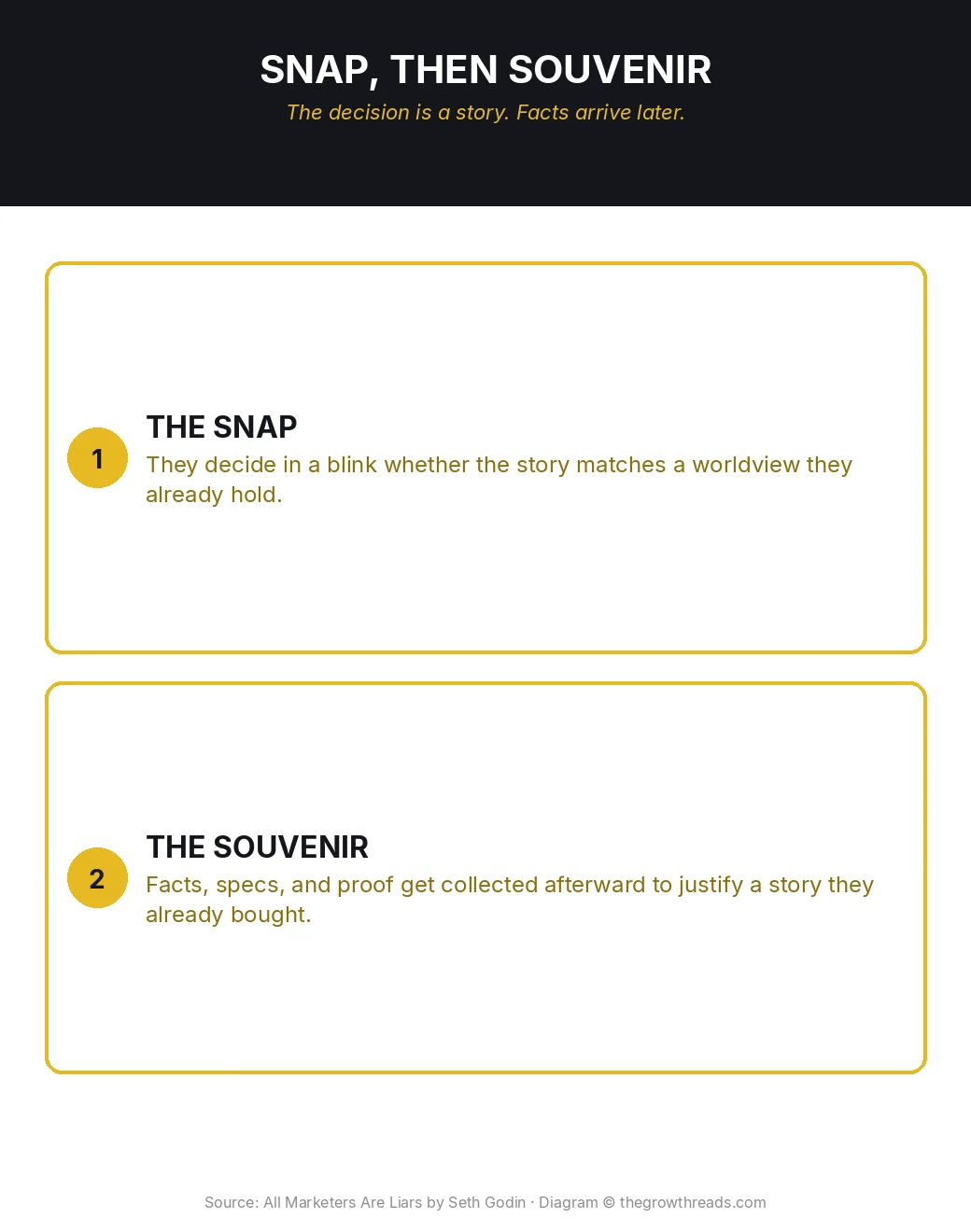
- Snap, then souvenir: The decision is fast. Proof is collected afterward to defend it.
- Frame, don’t convert: Find people who already hold the worldview. Stop shouting at the rest.
- The first ten: Stories travel inside a group. Mass reach is a lagging trophy.
- Live it on Tuesday: The product, the room, and the follow-through have to match the sentence.
- Let them tell it: The sale is them repeating the story to themselves, then to people like them.
What is All Marketers Are Liars about?
All Marketers Are Liars is Seth Godin’s 2005 argument that people buy stories, not facts. The stories that work match a worldview they already hold, and they are authentic enough that you live them. You do not convert the room. You frame a true story for people who already want to believe it.
About the author
Seth Godin is a writer, marketer, and teacher whose daily blog has run since 2002. Before the books he founded Yoyodyne, an early internet permission-marketing firm later sold to Yahoo, where he worked as a vice president of direct marketing. All Marketers Are Liars (Portfolio, 2005; later stamped Tell Stories) is the book that named the story layer under Purple Cow and This Is Marketing: people do not buy the facts, they buy a frame that already fits. He later wrote Linchpin, The Dip, Tribes, The Practice, and Permission Marketing’s descendants, and founded the altMBA and Akimbo workshops. The through-line is the same. Ship work for people who already want the change, tell a story you can keep living, and stop paying to convert everyone else. Explore all Seth Godin book summaries →
Key concepts at a glance
| Concept | What it means | Use it when |
|---|---|---|
| Story, not facts | People buy a frame they can tell themselves. | The deck is true and still ignored. |
| Worldview | Beliefs already in place before your message arrives. | You are trying to persuade everyone. |
| Snap, then souvenir | The yes is fast. Proof is collected afterward. | You lead with a spec sheet. |
| Fib vs lie | A true point of view vs a claim the product cannot keep. | The slogan would fail a month later. |
| Authenticity | You actually live the story in the product and the room. | The site says one thing and the inbox another. |
| Frame, don’t convert | Tell it for people who already hold the worldview. | The plan is a bigger audience, not a tighter story. |
| First ten | A handful of believers spread it to people like them. | You cannot name ten people who already want this. |
| They tell it | The sale is them repeating the story, not you closing harder. | Every touch is another proof point they did not ask for. |
Part 1 — People buy stories, not facts
Godin opens with a claim that still offends people who live in decks. Consumers do not walk around with a scorecard. They walk around with a story about who they are, and they buy the things that let them keep telling it. A bottle of wine is not a chemistry set. It is a weekend, a status, a “people like us drink this.” The facts on the back label get read after the story has already landed. That is the souvenir. The snap happened at the shelf.
The practical insult is that more proof often makes the story worse. A page of features asks them to assemble a narrative from parts. Most people will not. They bounce, then you add another page. Godin’s 2005 exhibits were brands and restaurants that won on a lived frame, not a denser handout. Today it is the landing page that explains everything and moves no one — technically correct, and still dead in the room.
If they cannot tell a friend what you are in one sentence that still feels true a month later, you do not have a story. You have a catalog. Catalogs are for people who already decided. Stories are how the undecided decide.
TGR Note: If the product itself is invisible, start with Purple Cow — a story cannot carry a thing nobody notices. If you need the mechanics of a sticky message, Made to Stick is the SUCCESs checklist. This book is the older rule for the frame: did they already want to believe it?
Part 2 — You don’t change the worldview
A worldview, in Godin’s use, is not a personality quiz. It is the filter already running: safe vs bold, cheap vs luxurious, homemade vs industrial. People notice stories that sit inside that filter. They ignore stories that ask them to swap it. Advertising does not convert a religion. It gets a nod from the congregation you already had, or it spends a fortune trying to baptize strangers.
That is why “educate the market” is so often a stall. Education is a gift when they asked for it. As a go-to-market plan it usually means you have not named the people who already agree. Pick a worldview you can actually serve, then tell a story that fits. The first ten live there. Trying to be reasonable to every worldview is how you become invisible to all of them.
Framing is the craft. You do not lie about the product. You choose which true thing to put in the doorway. A $40 bottle can be a steal or a splurge depending on who is holding it. Both can be accurate. Only one fits the room you are in. The failure mode is the opposite: you argue. You bring more facts to people whose story already says you are wrong. You win the footnote and lose the week.
TGR Note: Naming a tiny room is the 2018 language in This Is Marketing — people like us do things like this. If you need a script the customer can walk through, Building a StoryBrand is the seven-part map. This book is why that map only works when the worldview is already theirs.
Part 3 — Authenticity is the only story that lasts
The title is a trap if you stop at the joke. Godin is not coaching you to cheat. He splits a fib from a lie. A fib is a true story with a point of view — the hotel that actually is a hiding place, the tool that actually ships on Friday. A lie is a claim the first week of use will unsay. Lies get found out. The teller does not get a second story. They get a reputation.
Authenticity here is not a vibe on the about page. It is whether the organization lives the sentence when no one is watching. If you say you are the calm one and the onboarding is a panic, the story dies in private, then in public. If you say you are for beginners and the UI assumes a specialist, the first ten will warn the next ten. Tell a story you are willing to keep telling after the invoice clears.
The later cover stamp matters. “Tell Stories” is the job. “Are Liars” was the flinch that got you to open the book. Teams that keep the flinch write clever lines they cannot live. Teams that keep the stamp pick one story and make Tuesday match the homepage. Would a customer repeating your sentence still be right in thirty days? If not, you are already writing the apology.
TGR Note: A story you will not ship is still a slogan. The Practice is the habit of showing up so the story stays true. Permission Marketing is the cadence after they say yes — anticipated, personal, relevant. Live it, then earn the next message. Do not spend the privilege on a fact dump.
Part 4 — The first ten spread it
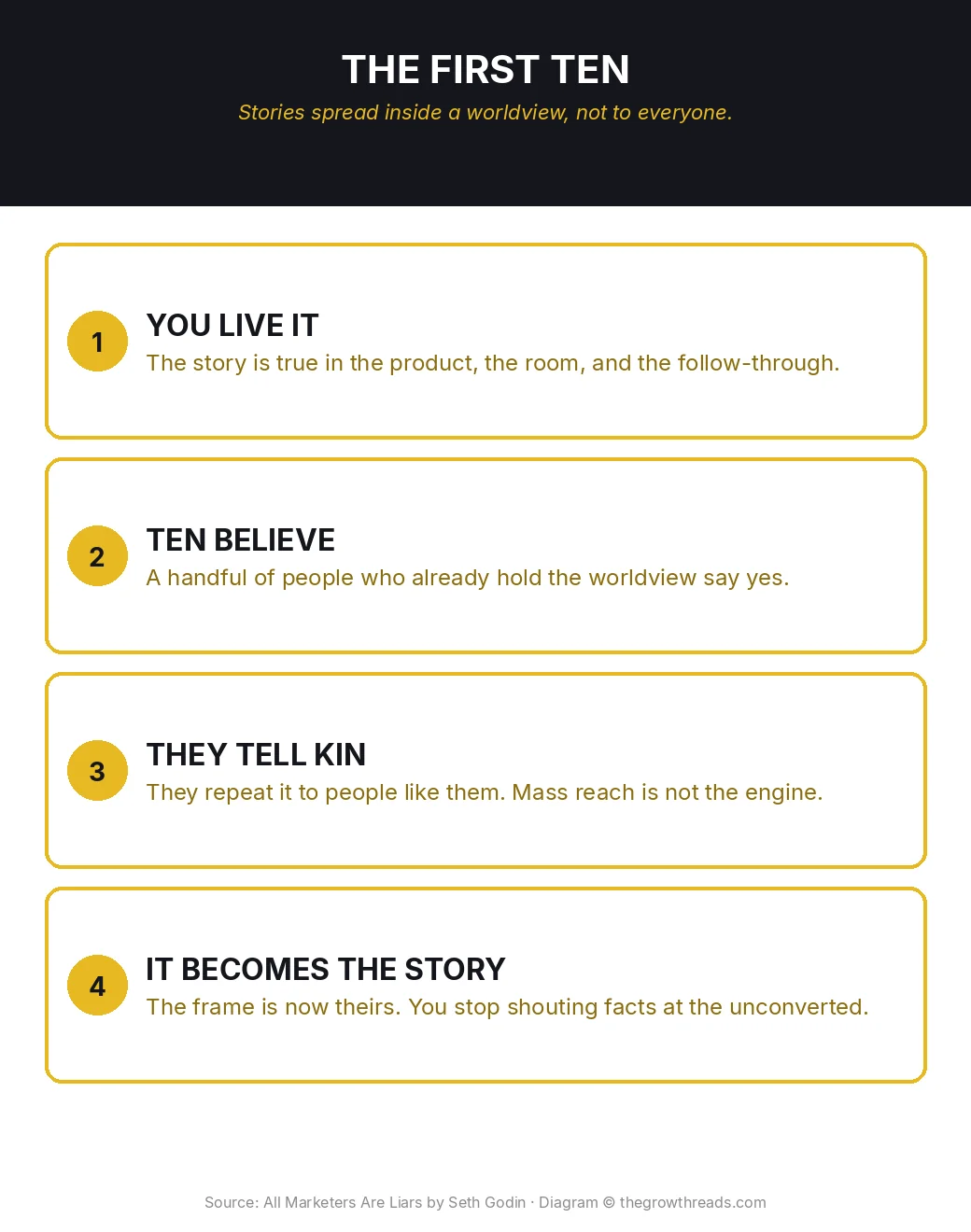
Once the story is true, the distribution engine is not a bigger list. It is a handful of people who already hold the worldview. Godin calls the pattern the first ten: they believe you, they live with the thing, and they tell people like them. Stories travel inside a tribe. Mass reach is what it looks like after a thousand of those conversations, not a switch you buy on Monday.
Hunting “awareness” often feels busy and changes nothing. You paid to interrupt people who do not share the filter. They forgot you before the next ad. The first ten did not need the ad. They needed a story they could repeat without wincing. Serve them so well that the sentence becomes theirs. Then stop spending to baptize the unconverted.
The failure mode is famous because everyone has done it. You get one believer, then you write the next campaign for the people who said no. You dilute the story so it will “scale.” The first ten no longer recognize it. The cold crowd still does not care. Keep the story tight. Name the ten. Give them something worth repeating. Let the souvenir facts exist for people who already snapped yes.
Who is All Marketers Are Liars best for — and who should read something else first?
Best for founders, marketers, consultants, and makers whose facts are fine and whose week is still a shrug. If you can paste last month’s landing page into a doc and feel the flinch, start here. The book is short. The filter is sharp. You will kill a spec dump before you buy another ad.
Read something else first if the product itself is invisible — that is Purple Cow. If you already have a story and still cannot name the smallest market, that is This Is Marketing. If you need a brand script a customer can walk, that is Building a StoryBrand. If the real problem is the cadence of the list, start with Permission Marketing. If you will not ship the thing the story promises, that is The Practice. This book will not fix a product nobody wants, and it will not earn the next email. It will stop you shouting facts at people who were never going to believe you.
Questions to reflect on
- What story do customers already tell themselves about people like them — and does your sentence sit inside it?
- If a stranger repeated your pitch in thirty days, would they still be right?
- Where does Tuesday fail to live the homepage?
- Who are the first ten, by name, and who have you been shouting at instead?
- Which fact sheet from last month was a souvenir pretending to be the decision?
🔥 Ready to tell a story they already want?
Stop pitching facts. Frame a story you actually live.
How to apply All Marketers Are Liars (7-day plan)
- Day 1 — Write the story they already tell: One sentence, in their words, about people like them. If it needs a feature list to make sense, it is not a story yet.
- Day 2 — Name the worldview: Three beliefs the first ten already hold. Cross out any line that asks them to swap a belief.
- Day 3 — Kill one fact dump: Delete one spec-led page, slide, or email. Leave the story. Feel the empty space. That is the point.
- Day 4 — Audit Tuesday: Walk the product, the inbox, and the room. Mark every place that unsays the sentence. Fix one.
- Day 5 — Tell it to ten: Send the story, once, to ten people who already hold the worldview. No brochure. Ask what they repeated back.
- Day 6 — Collect souvenirs last: Move proof below the story on one live page. If the story cannot stand alone, rewrite the story, not the appendix.
- Day 7 — Stop shouting at the unconverted: Pause one campaign aimed at people who do not share the filter. Put the hours into the ten who already said yes.
Frequently asked questions
What is All Marketers Are Liars about?
All Marketers Are Liars is Seth Godin's 2005 book about why people buy stories, not facts. The title is a provocation, not a license to cheat. Marketers tell stories. The ones that last match a worldview the listener already holds, and they are authentic enough that the teller actually lives them. People decide in a snap, then collect facts as souvenirs. You do not convert a worldview with a better deck. You frame a true story for people who already want to believe it, then let the first ten spread it to people like them. Portfolio later restamped the cover Tell Stories. Same book. Same filter. About 240 pages.
Why did Godin later stamp the cover "Tell Stories"?
The original title was a dare. Godin wanted you to flinch, then notice that every useful pitch is a story someone tells themselves. Later Portfolio editions cross out "Are Liars" and write "Tell Stories" because that is the actual job: a true frame, lived in public, aimed at people who already hold the worldview. The chapters did not change. Authenticity is still the test. If you only remember the joke on the jacket, you will write copy that sounds clever and fails on contact. If you remember the stamp, you will pick a story you can keep living on a Tuesday.
What does Godin mean by a "worldview"?
A worldview is the set of beliefs a person already uses to sort the world before your message arrives. Conservative or liberal, cheap or luxurious, safe or adventurous — the labels are less important than the fact that they are already in place. Godin's point is practical. Ads do not convert a worldview. They get noticed when they fit one. The work is to name the worldview of the people you can actually serve, then tell a story that sits inside it. Trying to persuade everyone is how you end up shouting facts at people who were never going to buy.
Is All Marketers Are Liars telling me to lie?
No. The book is an argument for authenticity. Godin splits a fib from a lie. A fib is a true story with a point of view — the wine tastes like a weekend in Tuscany because you actually made it that way. A lie is a claim that collapses the first time someone lives with the product. Lies get found out, and the teller loses the right to be heard. The practical test is rude and useful: would a customer repeating your story still be right a month later? If not, you do not have a story. You have a slogan you will have to unsay.
How is this different from Purple Cow or This Is Marketing?
Purple Cow is about making the product itself worth remarking on so you are not stuck buying attention. This Is Marketing is the 2018 language for seeing a tiny market, naming status and affiliation, and creating tension so they enroll. All Marketers Are Liars is the story layer in between. Even a remarkable product still needs a frame people can tell themselves, and even a tiny market still buys a story that fits. Permission Marketing is the cadence after they say yes. Start here if your facts are fine and nobody cares. Read the later books if the offer or the list is the problem.
How long does it take to apply All Marketers Are Liars?
You can name the worldview and the one-sentence story in an afternoon. Living it takes longer, because the product, the room, and the follow-through have to match the sentence. The 7-day plan is one week of that work: write the story they already tell, kill one fact-sheet pitch, pick ten people who already hold the worldview, tell the story once without a spec dump, and check whether a stranger could repeat it and still be right. The paperback is a short read. The practice is refusing to shout at people who were never going to believe you.
What is the first ten in All Marketers Are Liars?
The first ten are the handful of people who already hold the worldview and will say yes without a conversion campaign. Godin argues that stories spread inside a group, not across the whole market. Those ten tell people like them. Mass reach is a lagging trophy, not the engine. If you cannot name ten, you do not have a story yet — you have a broadcast. The practical move is to serve those ten so well that the story becomes theirs. Then stop spending to interrupt the unconverted. Purple Cow is what makes those ten talk. This book is why they talk to people like themselves.
Related summaries
- This Is Marketing Summary & Review — see the tiny market, then tell the story
- Purple Cow Summary & Review — make the product worth remarking on
- Permission Marketing Summary & Review — earn the next message after they say yes
- Building a StoryBrand Summary & Review — a script the customer can walk
- Best productivity books — the full Productivity silo
How we analyze books: we paraphrase arguments, add original application notes, and skip chapter-by-chapter reproduction. Read our full methodology.