

★★★★★ 4.6/5 — If a stranger cannot use it, the design failed, not the stranger.
Best for: Designers, engineers, PMs, and anyone who keeps apologizing to a door, a stove, or a settings screen
Reading time: ~8 hrs for the full book · ~14 min for this guide
Difficulty to apply: Spotting a Norman door is easy; changing one object this week is the work
The Design of Everyday Things in one minute
If you cannot use it, the object failed — not you. Don Norman’s 1988 classic, expanded in 2013, is a field guide for human-centered design. Affordances say what a thing can do. Signifiers advertise the move. Mapping puts controls where results sit. Feedback tells you it worked. Two gulfs hide the next step: you know the goal but not the action, or you acted and cannot tell whether it landed. Steal this week’s habit: pick one confusing object, add one clue, and watch someone who did not design it.
Key takeaways
- Blame the design, not the person: Confusion is information. A lecture at the door is a failed object.
- Affordances vs signifiers: What it can do is not the same as the clue that says so.
- Natural mapping: Stove knobs should follow burners. Spatial layout beats a legend.
- Feedback you can perceive: A silent save is a gulf of evaluation you left open.
- Conceptual models: Users invent a story of how it works. A lying story is still the one they will use.
- Gulf of execution: The goal is clear; the action is not. Make the move visible.
- Gulf of evaluation: The action happened; the result is not readable. Show state.
- Knowledge in the world: Labels, constraints, and layout remember so the person does not have to.
- Human error is usually design error: Slips and mistakes cluster where the object hid the next step.
What is The Design of Everyday Things about?
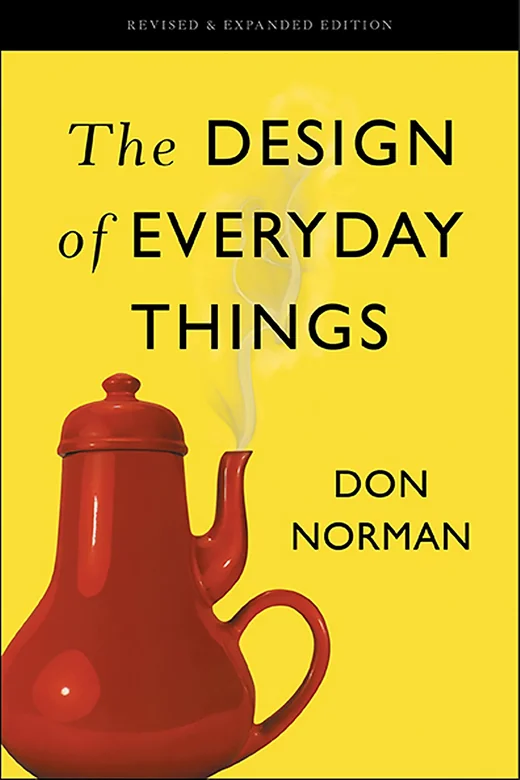
The Design of Everyday Things is Don Norman’s human-centered design handbook: why doors, stoves, and screens confuse capable people, and how affordances, signifiers, mapping, and feedback make the next action obvious. Two gulfs — execution and evaluation — explain why a goal can be clear while the move, or the result, stays hidden.
About the author
Donald Arthur Norman (born 1935) is an American cognitive scientist who made usability a public argument instead of a lab note. He directed the Design Lab at UC San Diego, taught at Northwestern, and spent time inside Apple as a user-experience fellow — then co-founded the Nielsen Norman Group with Jakob Nielsen so product teams could steal the same tests. The Psychology of Everyday Things (1988) was retitled The Design of Everyday Things; the 2013 Basic Books revision adds signifiers, updated error stories, and a sharper split between what an object can do and the clue that advertises it. Later books (Emotional Design, Living with Complexity, Design for a Better World) widen the lens. He is writing so a designer can change one confusing object this week, not so a committee can rename the problem “user error.” Explore all Don Norman book summaries →
Key concepts at a glance
| Concept | What it means | Use it when |
|---|---|---|
| Affordance | What the object can actually do in relation to you | You are decorating a control that cannot perform the advertised move |
| Signifier | The clue that advertises the move — plate, handle, underline, chevron | A first-time user hesitates with a hand in the air |
| Mapping | Controls sit where results sit; layout is the legend | Stove knobs, dashboard toggles, or a grid of identical buttons |
| Feedback | The object talks back so you know the action landed | A save, lock, or send with no visible or audible change |
| Conceptual model | The story users invent about how it works | People keep doing the “wrong” thing that the story predicts |
| Gulf of execution | Goal is clear; the accepted action is not | A door, form, or settings page needs a spoken demo |
| Gulf of evaluation | You acted; you cannot tell if it worked | State is hidden, delayed, or written only in a log |
| Forcing function | A constraint that will not let you skip a safety step | A lid, a confirm, or a cable that must seat before the next move |
Part 1: Norman doors, affordances, signifiers, and mapping
Norman opens with everyday psychopathology: doors that need a sign, refrigerator controls that look like a cockpit, switches that do not map to the lamps you can see. The joke is never that people are clumsy. A flat plate signifies push. A handle affords grasp and usually pull. When the hardware lies, people hesitate, then apologize to the building. That apology is the data. Designers have a conceptual model. Users invent one from the surface. If those stories diverge, the surface won.
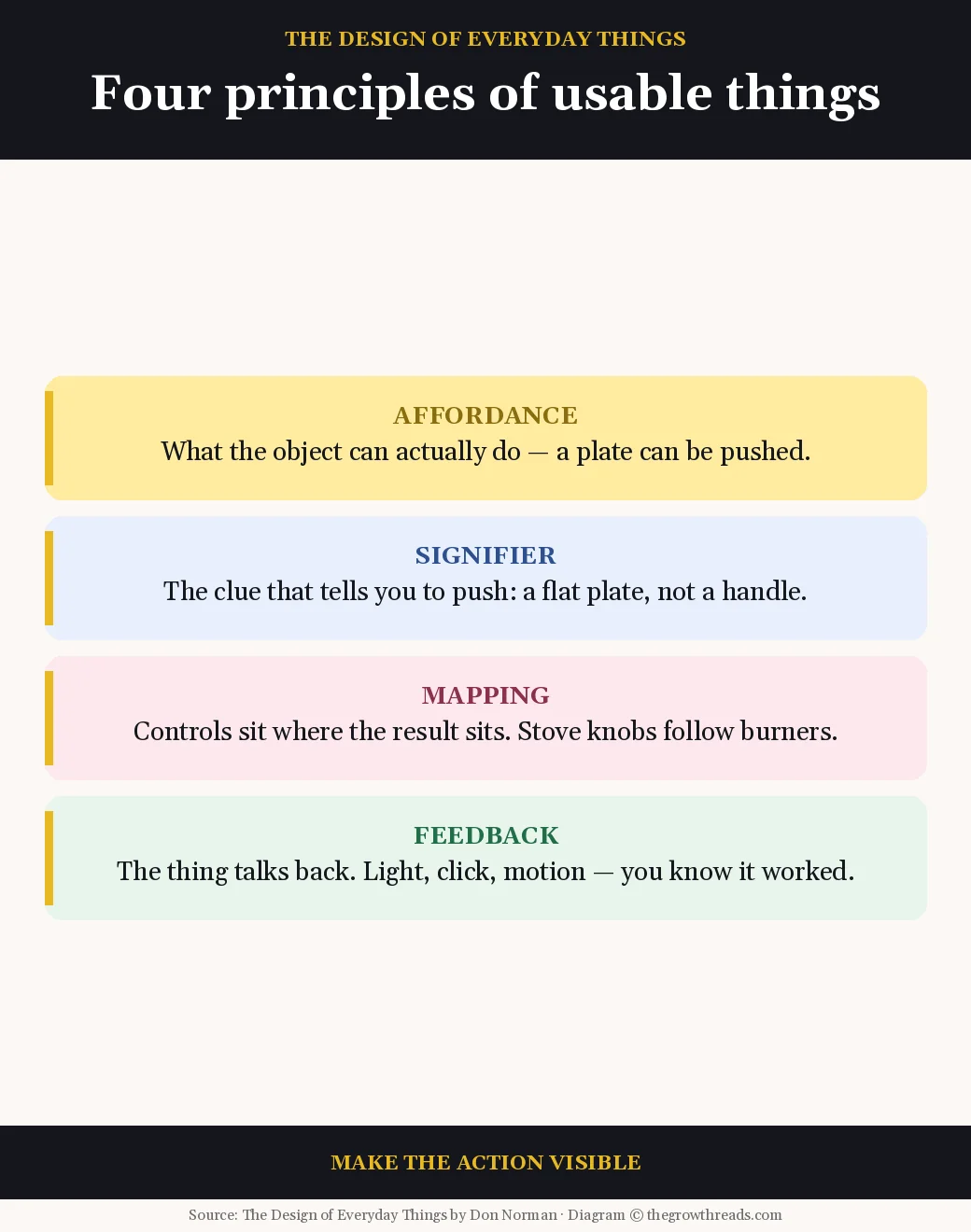
The 2013 revision is careful about words. An affordance is a relationship: what this object can do with this person. A signifier is the mark that advertises the move. Mapping is the quiet cousin: stove knobs arranged like the burners need no legend. Feedback closes the loop — a click, a light, a motion you can perceive. Pretty is allowed. Pretty that hides the move is a costume.
The steal is a hallway audit. Photograph one object this week that still needs a sentence of explanation. Label the affordance, the signifier, the mapping, and the feedback — or the missing one. If you cannot fill a row, that is the row to fix. Do not add a poster. Change the hardware or the layout until a stranger’s hand is already correct.
TGR Note: Nir Eyal’s Hooked is the other half of a product week. Eyal: build a habit loop once the action is findable. Norman: if the first tap is a mystery, you do not have a habit — you have a lecture. Make the move visible before you ask it to repeat. Jake Knapp’s Sprint is the five-day version of watching a stranger, not a teammate, touch the object.
Part 2: Seven stages of action and the two gulfs
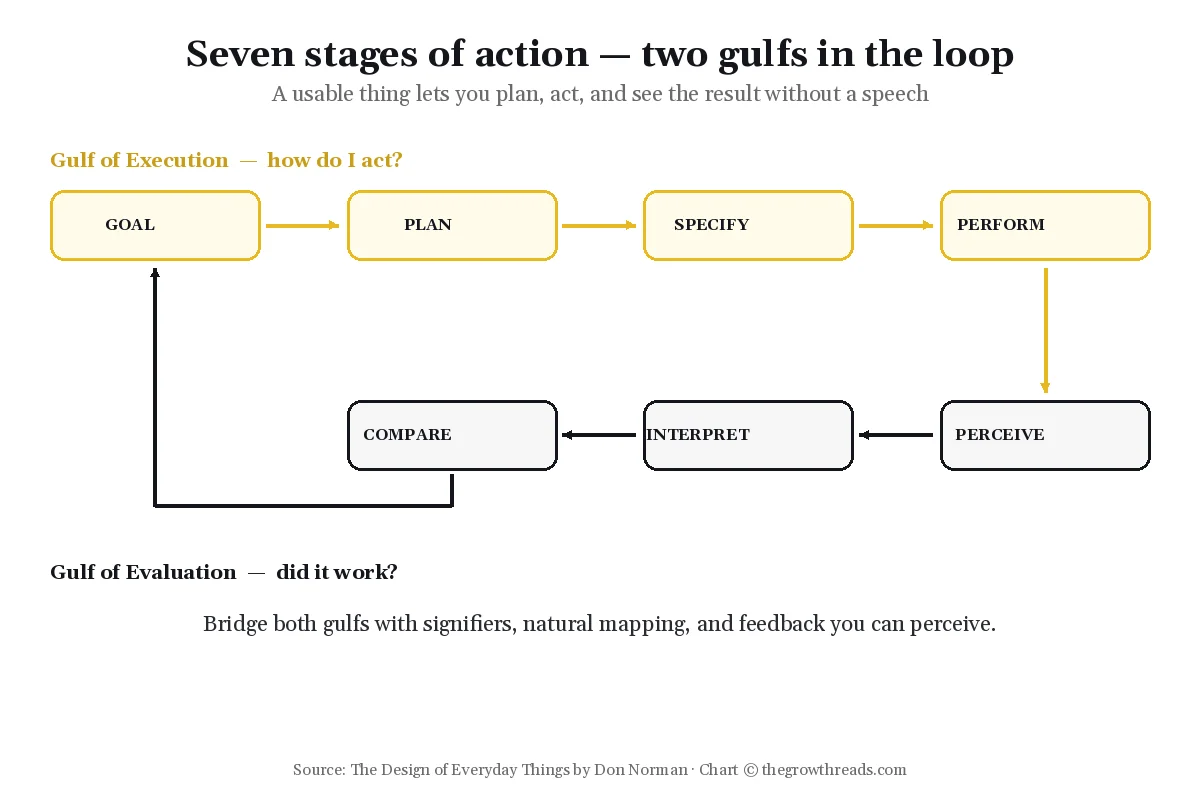
Once the door is named, Norman zooms into the mind that meets it. Action is not a single shove. You form a goal, plan, specify the move, and perform it — then you perceive the world, interpret what happened, and compare it with what you wanted. Seven stages, two directions. The gulf of execution sits on the way down: I know I want the room dark; I cannot see which switch, which scene, which tap. The gulf of evaluation sits on the way up: I tapped; the lamp might have changed in a room I cannot see. Both gulfs are design work. Neither is a personality test.
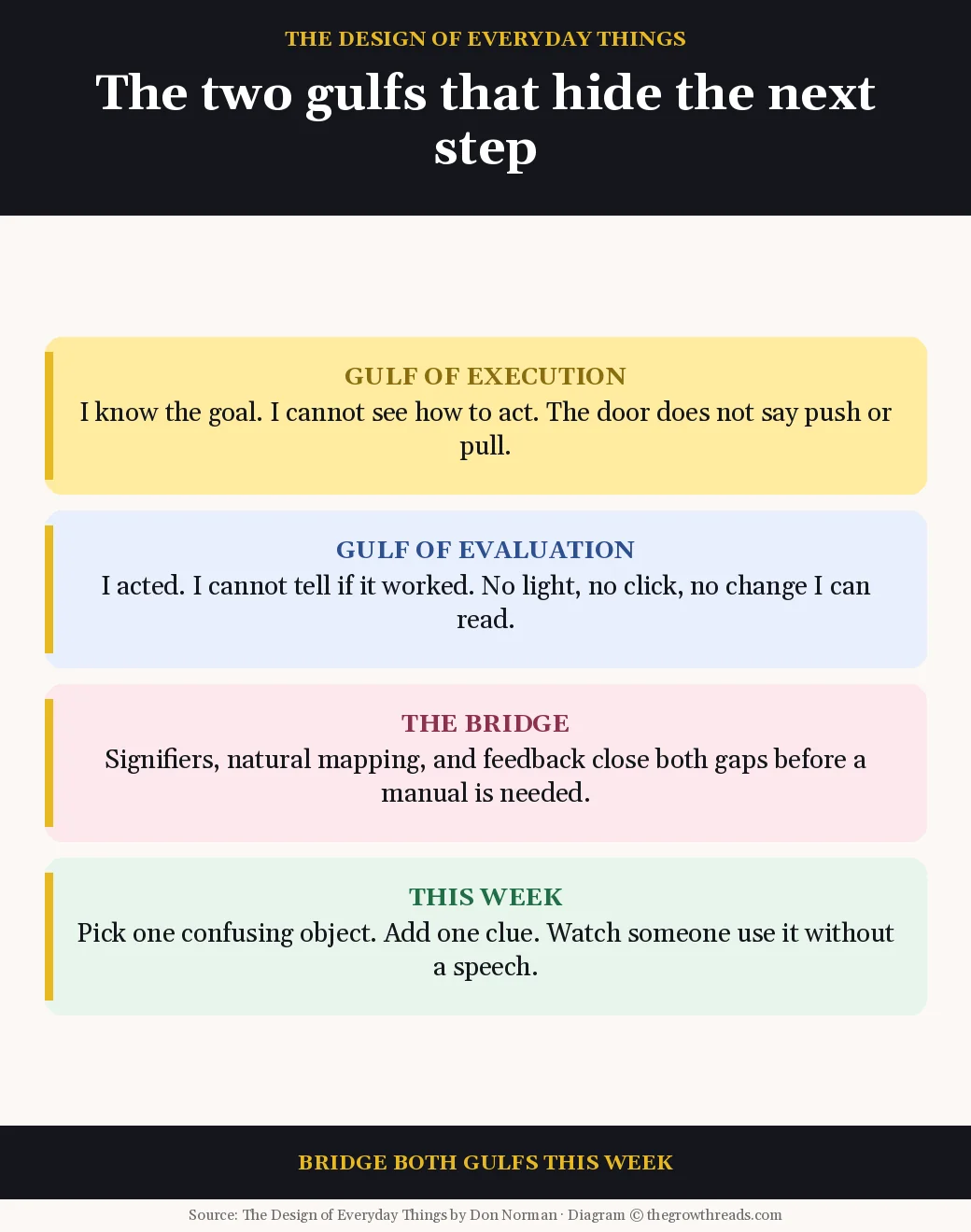
A usable thing shrinks those gaps before a manual is written. Signifiers and natural mapping shrink execution. Feedback you can perceive shrinks evaluation. Software’s favorite failure is a control that accepts an action and then goes quiet. If the person cannot tell it saved, locked, or started, they will press again or invent a ritual. That ritual is a conceptual model grown in the gulf — locally rational, globally wrong.
The steal is a two-column note on one live flow. Column A: what the person intends. Column B: what the interface will actually accept, and what state it will show. If A and B need a translator, you still have a gulf. Close one gulf this week — a label, a mapped control, a confirmation that is visible in the same glance as the button. Then watch someone who did not write the flow. Silence while they work is the grade, not a compliment after you narrate.
TGR Note: Donella Meadows’s Thinking in Systems is the cousin of Norman’s conceptual model: the structure behind the stumble is usually a missing feedback loop, not a missing pep talk. If the live problem is attention rather than a hidden action, Nicholas Carr’s The Shallows is the corrective. Do not confuse a noisy screen with feedback the user can actually read.
Part 3: Knowledge in the world, constraints, and forcing functions
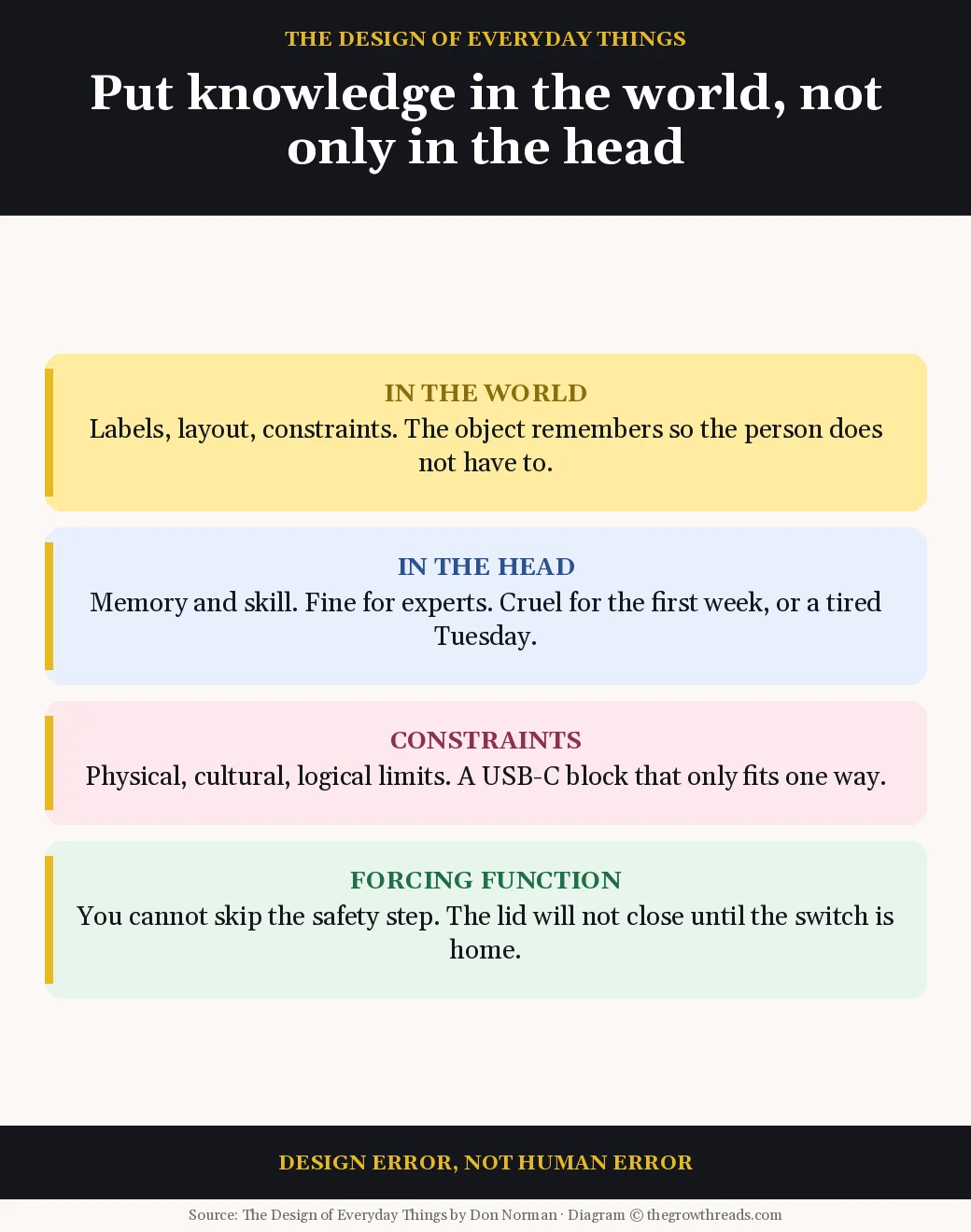
Norman splits knowledge into two places. Knowledge in the head is memory and skill — the barista’s sequence, the pianist’s hands, the engineer who can drive a CLI without looking. Knowledge in the world lives on the object: labels, layout, the shape that only fits one way, the lid that will not close until the switch is home. Everyday things should not require a rehearsal. Experts can keep knowledge in the head. Visitors, substitutes, and tired Tuesdays cannot. If only the designer can use the tool without notes, the knowledge is trapped in the wrong skull.
Constraints do the remembering — physical (a cable that will not seat upside down), cultural, logical. A forcing function is the stern cousin: you cannot skip the safety step because the next action is blocked. A safety step that depends on perfect memory fails on the day memory is busy. Put the block in the object. Leave working memory for the goal, not for which way the plug faces.
The steal is a knowledge map. For one tool you own, list what the user must remember versus what the object already shows. Move one item from head to world this week: a label on the right control, a constraint on the wrong cable, a forcing function on a skippable confirm. Then try it at 11 p.m. If it only works when you are fresh and narrating, it is still in the head.
Part 4: Human error is design error — and a 2026 steal
The last movement of the book is a mercy and a standard. People slip (the action was not the one they meant) and they mistake (the goal or the interpretation was wrong). Both cluster where the object hid a step. Norman’s line is the one worth keeping on a sticky note: don’t blame yourself; blame the designer. That is not a license to be careless. It is a method. Count the slips. They will point at the gulf you left open — a mapping that lies, a confirm that looks like a cancel, a mode the screen forgot to announce. Root-cause theater that ends in “user error” is how the same slip ships again next quarter.
Design thinking, in Norman’s use, is iteration with real people on real tasks: observe, ideate, prototype, test. A beautiful object that cannot be maintained is a showroom, not human-centered. Some systems are complex because the world is. The failure is accidental complexity — extra modes, contradicting signifiers, settings that bury the one state that matters.
Read from this year and the accidental layer has new names: gesture-only controls, dark patterns that pretend to be signifiers, generated interfaces that rearrange themselves overnight. The essential split has not moved. Either a person can see the next action and tell whether it worked, or they cannot. A model that drafts copy faster is not feedback. A settings dump is not a conceptual model. The week’s steal: pick one internal tool or one household object, close one gulf, and accept the characterization a stranger gives you without rewriting it into the story you already had.
TGR Note: Ben Shneiderman’s Human-Centered AI is Norman’s argument at machine scale: raise automation and keep human control visible. If the delay is a private vault of code, Eric S. Raymond’s The Cathedral and the Bazaar is the collaboration design. Norman is the object in the hand. Pair them when the “door” is a model-written screen that still needs a priest.
Who is The Design of Everyday Things best for — and who should read something else first?
Read it if you ship interfaces, appliances, or internal tools, or you keep apologizing to objects that should have explained themselves. You do not need a design degree. You need one confusing thing and a person who did not build it.
Read something else first if you need a five-day prototype ritual — start with Sprint. If the live problem is a habit loop rather than a hidden action, use Hooked. If the question is stocks, flows, and delayed feedback in a system, use Thinking in Systems. This book is a superb first read if you were about to add another tooltip instead of changing the control.
Questions to reflect on
- Which object in your week still needs a spoken demo — and which gulf is it, execution or evaluation?
- Where are you storing knowledge in the head that could live on the object as a label, a layout, or a constraint?
- What conceptual model are users inventing, and how does it differ from the one in the spec?
- When did you last watch a stranger use the thing in silence, without narrating the “right” path?
- Which recent “user error” would disappear if the signifier, mapping, or feedback changed?
🔥 Ready to stop blaming the user?
Get The Design of Everyday Things and start reading.
How to apply The Design of Everyday Things (7-day plan)
- Day 1: Photograph one confusing object at home or work. Write the goal in one sentence.
- Day 2: Label affordance, signifier, mapping, and feedback. Circle the empty cell.
- Day 3: Write the user’s conceptual model in one sentence, then the designer’s. Note the mismatch.
- Day 4: Name the gulf of execution — which action is unclear? Add one signifier or remap one control.
- Day 5: Name the gulf of evaluation — which result is unreadable? Add one piece of feedback you can perceive.
- Day 6: Move one piece of knowledge from the head onto the object (label, constraint, or forcing function).
- Day 7: Watch someone who did not design it. Do not speak. Write what their hands did, then ship that change.
Frequently asked questions
What is The Design of Everyday Things about?
The Design of Everyday Things is Don Norman’s field guide to human-centered design. First published in 1988 as The Psychology of Everyday Things and expanded in 2013, it argues that confusing doors, stoves, and screens are design failures, not user failures. Affordances, signifiers, mapping, and feedback should make the next action obvious. Two gulfs — execution and evaluation — explain why a goal can be clear while the move, or the result, stays hidden. Steal one object this week: add a clue, then watch someone use it without a speech from you.
What is a “Norman door”?
A “Norman door” is a door that needs a sign to tell you whether to push or pull — or a handle that invites the wrong move. Don Norman did not set out to name a meme. He used doors because they are simple, public, and still go wrong. A flat plate signifies push. A handle affords grasp and usually pull. When the hardware lies, people hesitate, then blame themselves. The same mismatch shows up on settings screens and app buttons. If a first-time user needs a lecture to open it, the object failed the week’s test.
What is the difference between an affordance and a signifier?
An affordance is what the object can actually do in relation to you: a plate can be pushed; a handle can be grasped. A signifier is the clue that advertises the move — the flat plate, the pull bar, the underlined link, the chevron. Norman’s later editions stress the split because designers kept calling every label an affordance. The steal is practical. First ask what action is possible. Then ask whether a stranger can see that action without a manual. Pretty surfaces that hide the move are signifiers that never arrived, not a personality flaw in the user.
What are the gulfs of execution and evaluation?
The gulf of execution is the gap between the goal in your head and the action the object will accept. You want the door open; you cannot tell whether to push or pull. The gulf of evaluation is the gap after you act: did it work? No click, no light, no change you can read. Norman’s seven stages of action — goal, plan, specify, perform, then perceive, interpret, compare — name the steps across both gulfs. Close them with signifiers, natural mapping, and feedback. A settings toggle with no visible state still leaves the second gulf wide open.
Is The Design of Everyday Things still relevant in 2026?
Yes, because the delay Norman named was never about analog doors. It was about whether a person can see the next move and tell whether it worked. Phones, dashboards, and model-written interfaces changed the accidental layer. They did not make a mystery toggle cheaper to learn, and they did not make a confirmation buried three screens down equal to a click you can hear. Read the teapot and the stove as case studies, not as a museum of 1988 kitchens. The 2013 chapters on signifiers and human error are the bridge into the apps you ship this quarter.
What does Norman mean by knowledge in the world versus knowledge in the head?
Knowledge in the world lives on the object: labels, layout, constraints, a USB-C block that only fits one way. Knowledge in the head lives in memory and skill — fine for experts, cruel on a tired Tuesday or a first week. Norman’s point is not that memory is bad. It is that everyday things should not require a rehearsal. Put the map on the stove knobs. Put the safety step in a forcing function the lid cannot skip. If only the designer can use the tool without notes, the knowledge is trapped in the wrong place.
How long is The Design of Everyday Things and who should read it?
The 2013 Basic Books revised paperback is about 368 pages. Most product people can finish it in a handful of evenings and steal one principle per chapter. It is best for designers, engineers, and anyone who keeps blaming themselves for a confusing tool. Skip it as a first book if you need a five-day prototype ritual — use Sprint first — or if the live problem is a habit loop rather than a hidden action. Pair it with one object in your own kitchen or product the same week you finish, and watch a person who did not design it.
Related summaries
- Hooked — habit loops once the first action is actually findable.
- Human-Centered AI — keep control visible while automation rises.
- The Cathedral and the Bazaar — let the people who hit the bug see the increment.
- The Shallows — when the problem is attention, not a hidden door.
Browse every title in our Best AI Books pillar page.
How we analyze books: summaries come from a full read of the source text, cross-referenced against the author’s published interviews where relevant, and structured around practical application rather than critique. We disclose our editorial process in full. Read our full methodology.