

★★★★☆ 4.5/5 — coach the team; give problems, not roadmaps.
Best for: product leaders, CPOs, and founders whose teams are stuck shipping other people’s solutions
Reading time: ~8.5 hours (Wiley hardcover, 2020, 432 pp) · this guide ~14 min
Difficulty to apply: Medium-hard — you cannot run it alone if leadership still assigns solutions on a date
Empowered in one minute
Give teams problems, then coach for outcomes. That is the whole argument of Empowered. Marty Cagan and Chris Jones wrote it for the people who run product, design, and engineering — the ones who currently fill a roadmap with other people’s solutions and then wonder why the product feels ordinary. Inspired taught the product trio how to discover. This book asks why so few companies let that trio actually work.
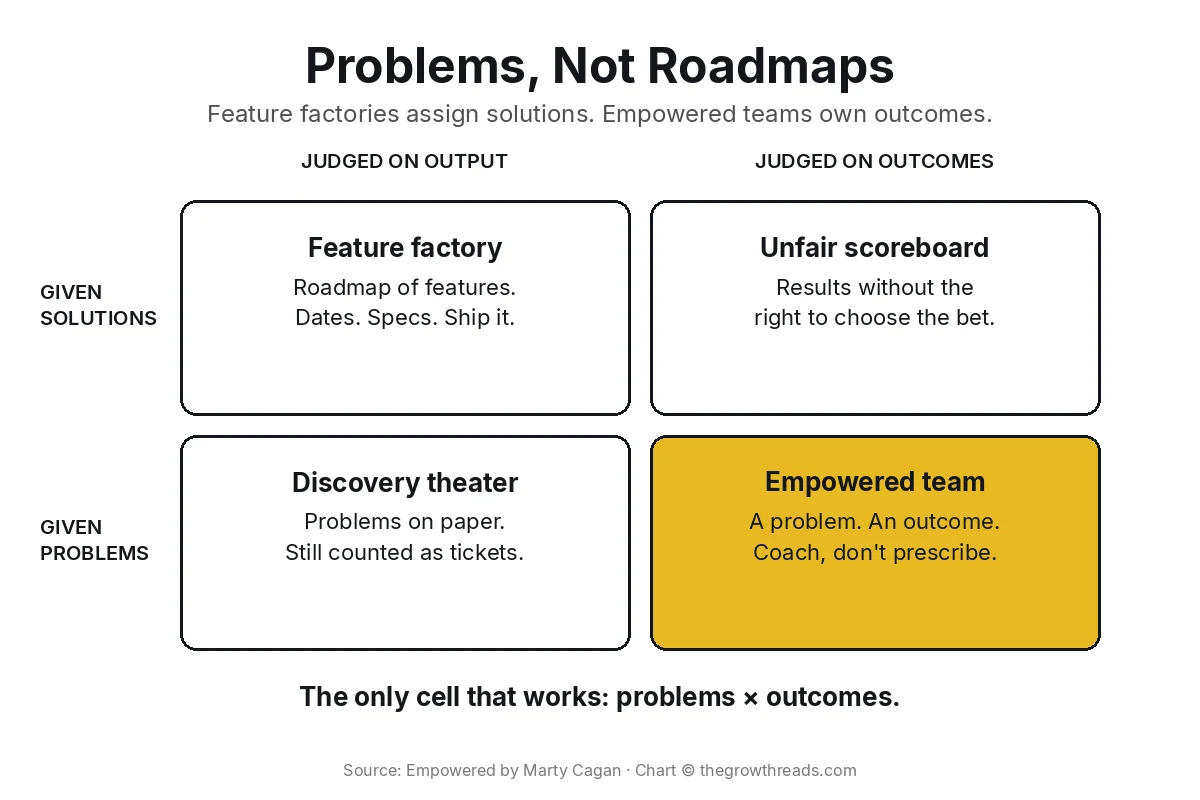
Most technology groups are feature teams: a stakeholder names a feature, it lands on a date, and success is shipped. Empowered teams get a problem and an outcome, plus the right to kill a weak idea. The leader’s real work is coaching, staffing, vision, and strategy. If you only remember one move, take one solution off this quarter’s roadmap and replace it with a problem the team is allowed to own.
Key takeaways
- Ordinary people, extraordinary products. The advantage is the environment, not a mythical hiring bar.
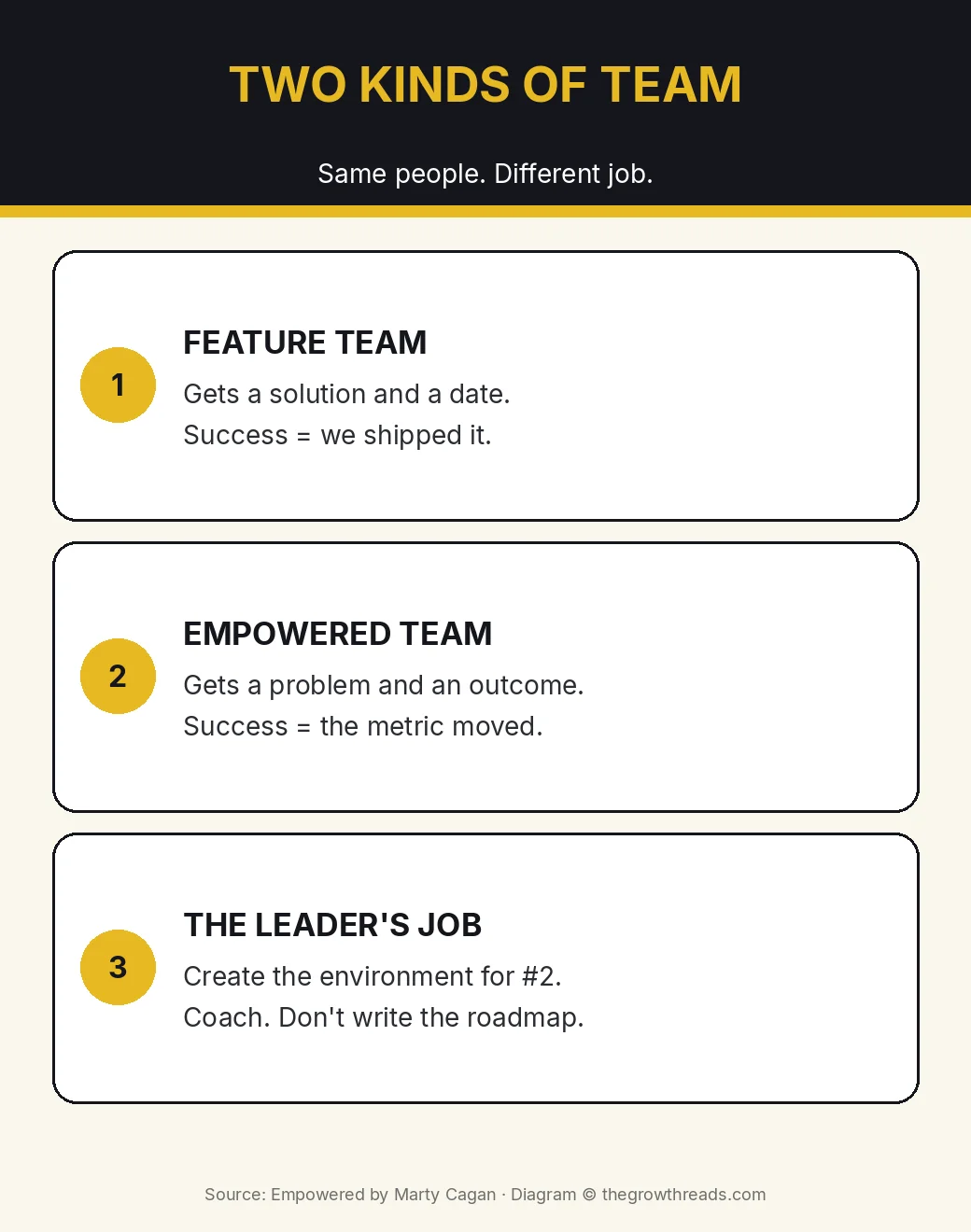
- Feature teams get solutions. Empowered teams get problems and outcomes.
- Coaching is the job. Status reviews and roadmap edits are not leadership.
- Staff for character, then skill. You can teach discovery. You cannot teach care.
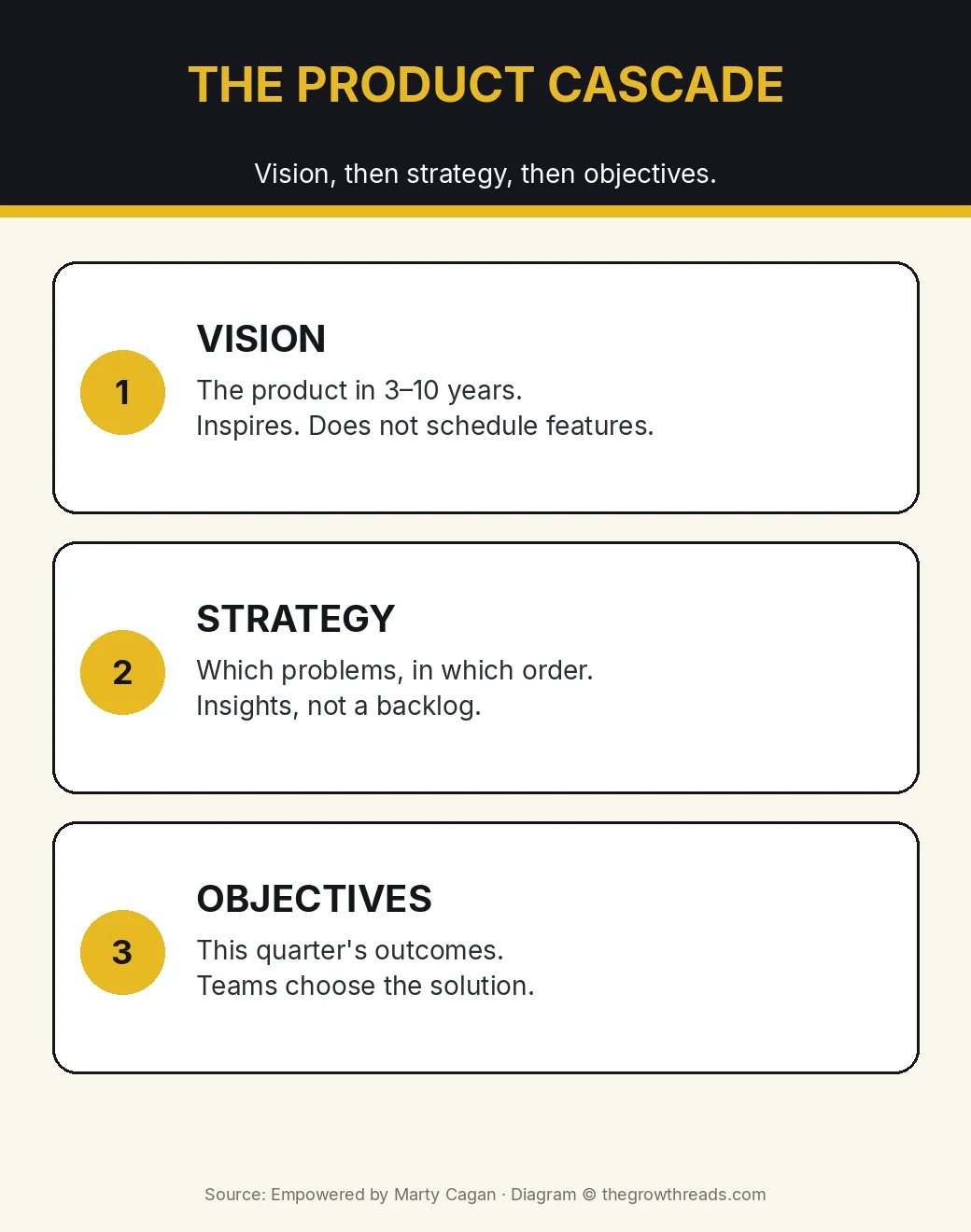
- Vision is years, not a backlog. It inspires. It does not schedule features.
- Strategy sequences problems. Insights decide which customer pain comes first.
- Objectives are outcomes. This quarter’s number, not this quarter’s feature list.
- The trio still holds. PM, designer, and engineer share the bet — leaders do not replace them.
- Collaboration is a redesign. Sales, marketing, and execs partner; they do not submit tickets.
What is Empowered about?
Empowered is Marty Cagan and Chris Jones’s manual for product leaders who want ordinary people to ship extraordinary products. Feature teams get solutions and dates. Empowered teams get problems and outcomes. The leader’s real work is coaching, staffing, vision, and strategy — not filling a roadmap.
About the author
Marty Cagan is the founder of Silicon Valley Product Group, where he coaches product leaders on how the best technology teams actually work. He was vice president of product at eBay and held senior product roles at Hewlett-Packard and Netscape Communications. Chris Jones is a partner at SVPG and a long-time product leader; Empowered is their joint field guide for the people who run product, design, and engineering. Inspired (2017) is the manual for the product trio. Empowered (2020) is the manual for the leaders of those trios. Transformed (2024) covers the company change that follows. The through-line is blunt: most organizations are staffed to ship output. The work that matters is creating the conditions where a team can discover something valuable, usable, feasible, and viable — and then be judged on the result. Explore all Chris Jones book summaries →
Key concepts at a glance
| Concept | What it means | Use it when |
|---|---|---|
| Feature team | Given a solution and a date | The roadmap is a list of other people’s ideas |
| Empowered team | Given a problem and an outcome | People are smart and still wait to be told what to build |
| Coaching | Develop the PM, designer, and tech lead in the work | Your week is status, not skill |
| Character first | Hire people who will kill a bad idea | You keep adding process because care is missing |
| Product vision | A 3–10 year picture of the product | The north star is this quarter’s epic |
| Product strategy | Which problems, in which order, on what insight | Everything is a priority |
| Objectives | Outcomes for this period, not features | OKRs secretly contain solutions |
| Team topology | Who owns which problem space | Every bet requires four handoffs |
Part 1: Feature teams vs empowered teams
Cagan and Jones open with a diagnosis most product people already feel. The companies customers love do not win because they hired superheroes. They win because ordinary, strong people are allowed to solve hard problems in ways customers love and the business can fund. The contrasting model is the feature team. A stakeholder already decided the solution. The team is staffed to implement it. Design arrives to make the decided thing usable. Engineering is asked for a date. The roadmap is a delivery schedule wearing a strategy costume.
An empowered product team is a small, durable group — a product manager, a designer, and engineers who stay together — handed a problem and an outcome. Raise activation. Cut time-to-value. Make a workflow trustworthy. The team chooses the solution, including the right to say this bet is wrong. Output (we shipped the spec) and outcome (the customer changed) are not the same number. Mixing them is how smart people spend a year on a product nobody loves. If your calendar is full of solution reviews, you are the factory’s editor. The rest of the book replaces that editor: coach, staff, set vision and strategy, and stop assigning the answers.
TGR Note: If the team does not yet know how to discover, send them to Cagan’s Inspired first — the product trio, the four risks, prototypes instead of a PRD. Empowered will not land if nobody in the room has seen discovery up close. If delivery itself is the constraint, pair with The Phoenix Project.
Part 2: Coaching is the real job
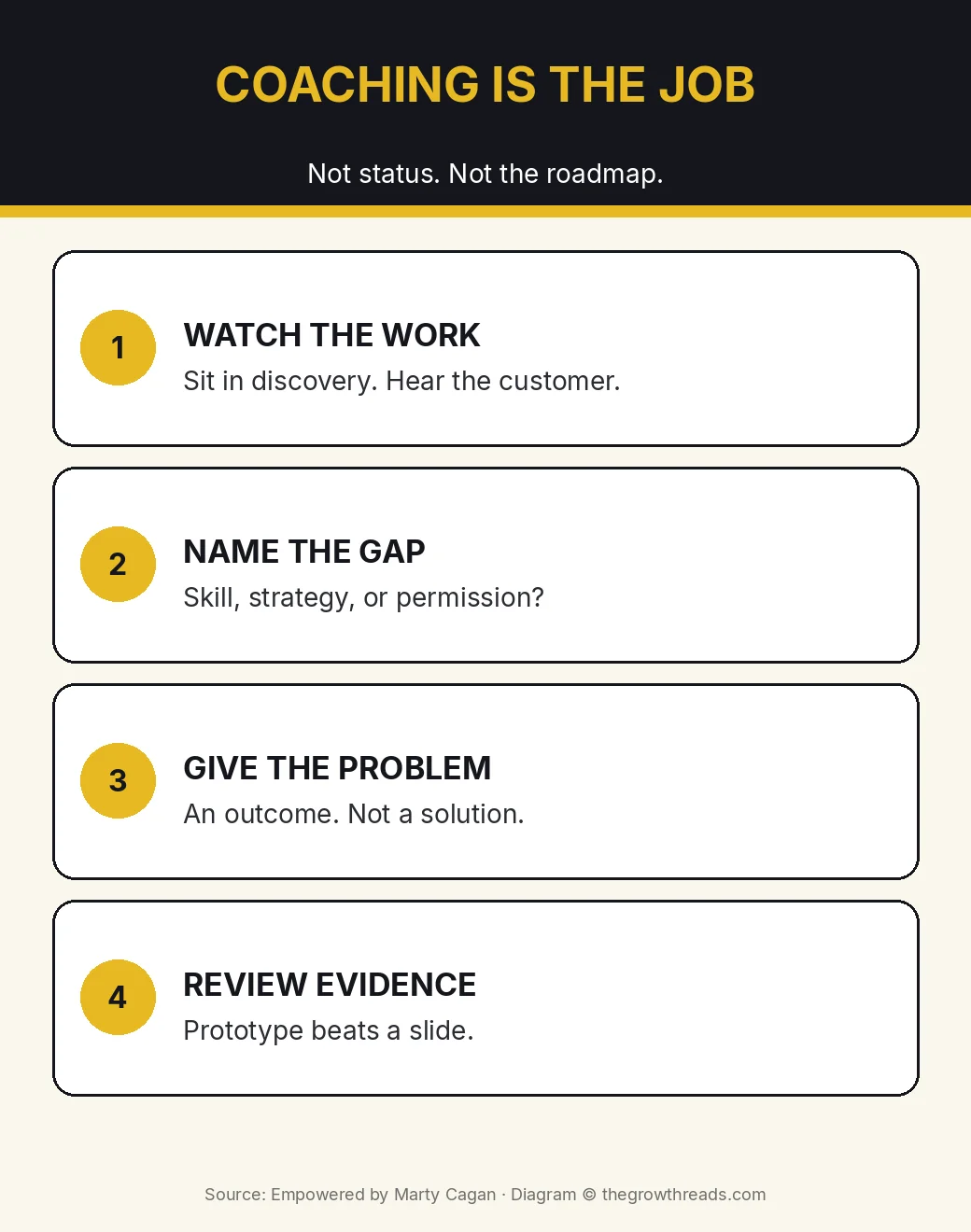
The most useful stretch of Empowered is the coaching argument. Most product leaders were promoted for being strong individual PMs, designers, or engineers, then dropped into a calendar of status and roadmap negotiation. None of that develops the team. Coaching does: sit with a PM before a customer conversation, review a prototype while it is still cheap, ask which risk is still a guess, and give notes on judgment rather than rewriting the spec yourself.
A coaching week is smaller than a transformation deck. Watch the work once. Name the gap — skill, strategy, or permission. Give a problem, not a solution. Review evidence, not slides. The one-on-one is for development, not a preview of the staff meeting. If you leave every 1:1 with a longer personal todo list, you are still doing the work instead of teaching it. After three months, is this PM more able to discover a product without you in the room? That is the test. Coaching also has a hard edge: people who will not own an outcome are a staffing problem, not a workshop problem. Hold the outcome. Help with the craft. Do not take the pen back the moment a stakeholder frowns.
TGR Note: If you are new to people-management itself, Camille Fournier’s The Making of a Manager and Andy Grove’s High Output Management cover the 1:1, the leverage of teaching, and the meeting cadence. Empowered then specializes that craft for product discovery. Do not skip the general management book if you have never run a 1:1 that was not a status pre-read.
Part 3: Staffing for character, then skill
Staffing is inseparable from coaching. You cannot coach a roster you would not have hired. The book is stubborn about character: missionaries over mercenaries, people who will kill their own idea when the evidence turns. Skill — a research session, enough of the stack to pair — can be taught if the person cares. Process cannot substitute for care. When leaders pile on intake forms, they are often regulating a staffing miss.
Hire so the trio can share one problem from week one. A PM who has never sat with a customer is not ready to own an outcome. A designer who joins after the spec is frozen is decoration. An engineer invited only to estimate is half-used. Keep teams together long enough that coaching compounds; shuffling every quarter resets the environment. Empty is more honest than a feature-factory hire with an empowered title. Development plans live in the work: the PM weak on data sits in the instrumentation review; the tech lead who avoids customers joins the next interviews. Competence is the floor. Potential is the job after that, including for the people who are already strong.
TGR Note: Jason Fried and David Heinemeier Hansson’s Rework is the permission to hire fewer people and still ship. Empowered is the permission to make those fewer people responsible for a problem. If your instinct after this chapter is to add headcount, try giving the current trio an outcome first.
Part 4: Vision, strategy, and objectives
Once people can be coached, they still need a place to aim. Cagan splits that aim into three altitudes that feature factories collapse into one backlog. Vision is the multi-year product — a picture vivid enough that design, engineering, and sales tell the same story. It does not contain this quarter’s epics. Strategy is the sequenced problems, each tied to an insight. If you cannot name the insight, you have a wish list. Objectives are this period’s outcomes: a scoreboard without a pre-written solution.
This is where most “empowered” programs quietly fail. The vision deck exists. The OKRs still say “launch X by date Y.” Launching X is a solution. The empowered version names the customer change and lets the trio find X, or neither. You will also need a topology: which team owns which problem space, so two trios are not discovering the same pain and a bet does not require four handoffs. Sales, marketing, and execs do not vanish. They stop submitting tickets and start bringing constraints and customer access. Reviews look at prototypes and results. Cancel first the meeting where leaders edit solutions they have not tested.
TGR Note: Working backwards from a customer narrative is the same altitude as Cagan’s vision-then-objectives cascade — see Working Backwards. If you need a time-boxed first prototype so the new objective is not theater, use Knapp’s Sprint inside the quarter rather than waiting for a perfect strategy offsite.
Who is Empowered best for — and who should read something else first?
Best for heads of product, design, and engineering; founders who still sit in solution reviews; and directors who manage other PMs. If that is you, this book names the job you are actually in.
Read something else first if you are an individual contributor without a team to coach — start with Inspired. If the gap is customer conversations, read The Mom Test. If the gap is focus rather than org design, Deep Work will move this week more. If you have never run a 1:1, The Making of a Manager is the on-ramp. Come back when you can change what a team is assigned.
Questions to reflect on
- Look at the last five items you shipped. How many were solutions assigned by someone outside the team?
- What would change this quarter if one objective named a customer outcome and forbade a feature name?
- When did you last sit in a customer conversation or prototype review as a coach, not as the editor?
- Which person on the trio would you not rehire, and are you coaching around a character gap?
- If you cancelled the steering meeting that edits solutions, what evidence would you look at instead?
🔥 Ready to stop assigning the answers?
Get Empowered, then use the 7-day plan to coach one team onto an outcome.
How to apply Empowered (7-day plan)
- Day 1 — Audit the last five ships. Mark each as output (a feature, a date) or outcome (a change in customer or business behavior). If fewer than two are outcomes, you have the book’s diagnosis.
- Day 2 — Rewrite one objective. Take one roadmap item. Remove the solution. Write the customer or business problem and the metric that would move. Share it with the trio before you share it upstairs.
- Day 3 — Sit in discovery. Attend one customer conversation or prototype test as a silent coach. Afterward, name one judgment call the PM made well and one risk that is still a guess.
- Day 4 — Give the problem back. If you currently own the spec, hand the rewritten objective to the team and delete your draft solution from the doc. Stay available. Do not stay in the paragraph.
- Day 5 — A 1:1 that is not status. Ask the PM (or designer, or tech lead) what skill they want to be better at in discovery this month. Pick one piece of work this week that trains it.
- Day 6 — Kill one solution review. Cancel or recast the meeting where leaders edit features. Replace the agenda with evidence: prototype, clip, metric. If there is no evidence, the item is not ready for that room.
- Day 7 — Write the coaching note. One page: what you observed, the gap (skill, strategy, or permission), the problem the team owns next week, and the evidence you will look at. That page is the job. Keep it.
Frequently asked questions
What is Empowered about in one paragraph?
Empowered is Marty Cagan and Chris Jones’s field guide for product leaders. Inspired taught individual product managers how to discover a product customers love. This book asks why so few companies let those people actually work that way. Most technology groups run as feature teams: a stakeholder names a solution, it lands on a roadmap, and success is shipped-on-the-date. Empowered teams get a problem and an outcome instead. The leader’s work is coaching, staffing, vision, and strategy — creating the environment where ordinary people produce extraordinary products, not writing the next quarter’s feature list.
Is Empowered still relevant in 2026?
Yes. Tooling got faster. The failure mode did not. Teams still confuse a board of tickets with product work, and leaders still fill roadmaps because a date feels safer than an outcome. Cagan and Jones wrote for that habit. Coaching one product manager, replacing one feature objective with a customer problem, and sitting in discovery once a week still change the week you are in. The 2020 hardcover is the edition people search for as an Empowered summary: a working manual for leaders, not a tour of one famous company’s org chart.
Should I read Inspired or Empowered first?
If you are an individual product manager, designer, or tech lead, start with Inspired. It is the job description: the product trio, the four risks, discovery beside delivery. Empowered assumes you already want that model and asks why your company will not let it run. Read Empowered first only if you already manage PMs, design, or engineering, or you are a founder whose calendar is full of solution reviews. Pair them. Inspired without Empowered leaves the PM stranded. Empowered without Inspired leaves the leader coaching a job they have not seen up close.
What is the difference between a “feature team” and an empowered team?
A feature team is given a solution and a date. A stakeholder already decided the bet. The team’s job is to build it well and hit the calendar. Success is output. An empowered team is given a problem and an outcome — raise activation, cut churn, make a workflow trustworthy — and the authority to choose the solution, including the right to kill a weak idea. Same people can sit in either model. The difference is the assignment and the scoreboard. Cagan’s claim is that extraordinary products come from the second model, which is why coaching and strategy are leadership work, not extras.
How long does it take to apply Empowered?
You can run the first coaching loop this week: sit in one discovery session, write one objective as a customer problem, and remove one pre-decided solution from the roadmap. Changing the company takes longer. Staffing for character, a multi-year vision, and a strategy that sequences problems are months of work, not a slide. The 7-day plan at the end of this Empowered summary is deliberately small so a director or founder can start without a re-org. Use it to prove the model on one team, then widen. Do not wait for a transformation program to practice coaching.
Is Empowered only for tech companies?
The case studies are technology-powered companies — the ones where software is the product, not a side system. The mechanics travel. Any group that currently assigns solutions on a date can give a problem and an outcome instead, coach the people closest to the customer, and judge the week on evidence rather than tickets closed. If your constraint is factory physics rather than product discovery, read The Phoenix Project first and come back. If your constraint is how you talk to customers, read The Mom Test. Empowered is for the moment the team could discover, and leadership will not let them.
Who should skip Empowered for now?
Skip it if you do not lead or strongly influence how product work is assigned. An individual contributor will get more from Inspired, Sprint, or The Mom Test this month. Skip it if the real pain is personal focus or calendar design — Deep Work and Essentialism are better first reads. Skip a cover-to-cover pass if you needed a two-page checklist; the book is a leadership manual with many short chapters, not a manifesto. Keep it on the desk if you run PMs, design, or engineering and your roadmap is still a list of other people’s solutions.
Related summaries
- Inspired — the field guide for the trio this book asks you to coach.
- Sprint — five days to put evidence under a new outcome.
- The Mom Test — customer conversations that do not compliment your solution.
- Working Backwards — vision written as a customer narrative before the roadmap.
More in this silo: best productivity books.
How we analyze books: every book on The Growth Reads is read cover to cover, summarized in thousands of words of original analysis, and rated against our five-criteria rubric (lasting impact, evidence quality, practical application, writing & originality, external consensus). Read our full methodology.