

★★★★★ 4.6/5 — Drop the diet war. Keep the health habits that do not wait on the scale.
Best for: People exhausted by rebound cycles, anyone who treats a number as a moral score, and readers who want weight-neutral habits they can use this week
Reading time: ~8 hrs for the BenBella 400-page revised edition · ~40 min for this guide
Difficulty to apply: Easy to understand. The work is retiring the scale as the boss of the day — not reading another manifesto.
Health at Every Size in one minute
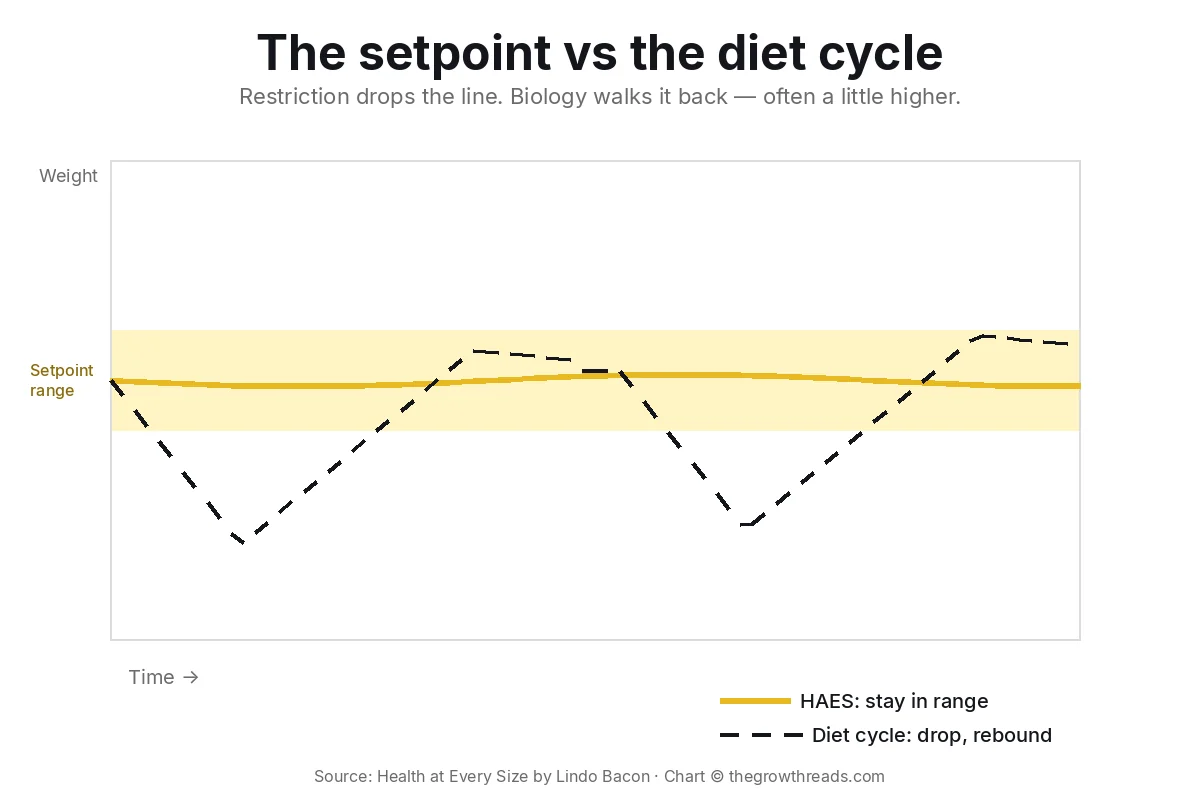
Lindo Bacon’s Health at Every Size (2008; revised 2010) is a physiologist’s case that well-being is a set of habits, not a dress size. The body defends a setpoint range. Crash diets drop the line; hunger, metabolism, and mood walk it back — often a little higher. The usable move is to stop waiting for a smaller number to grant permission: eat when you are hungry, stop when you are satisfied, move because it feels better today, and drop the shame that turns a meal into a revenge session. Diagnostic: last “blown” day — did you tighten the rule, or take care of the body you have? If the scale is still the boss of breakfast, that is the curriculum. Educational, not medical advice.
Key takeaways
- Setpoint is a band, not a verdict: The body works to keep a range. Fighting the band is a fight with biology.
- Diets rebound because they are supposed to: Restriction turns up hunger and turns down burn. Regain is data, not a character flaw.
- Health habits do not wait on the scale: Sleep, food you can live with, movement, labs you already have — start them in this body.
- Hunger is a signal, not a moral event: Eat when hungry. Stop when satisfied. Pleasure counts as information.
- Movement is for feeling better today: A walk that you will repeat beats a punishment session you will dread.
- Food politics is not your willpower: The aisle was designed. Shame is a weak tool against a market.
- Fat politics is not a lab result: Stigma is a health exposure. Kindness is not a consolation prize.
- Respect is the first practice: Stop treating the body as a project to shrink before it is allowed care.
- The test is a marker the scale cannot see: Energy, mood, bloodwork you already have, a day you can live in.
- Give up the fight to keep the habits: The program is not “never change.” It is “stop making weight the gate.”
What is Health at Every Size about?
Health at Every Size is Lindo Bacon’s weight-neutral health book: why crash diets rebound against a biological setpoint, and how to keep hunger cues, joyful movement, and health habits without waiting for the scale to grant permission. A map for care you can start this week — not a substitute for a clinician.
About the author
Lindo Bacon (published the book as Linda Bacon; they/them) is a physiologist and nutritionist with a Ph.D. from the University of California, Davis, plus master’s degrees in exercise science and psychotherapy. They taught and researched at UC Davis and City College of San Francisco, and they wrote Health at Every Size after years of watching weight-loss cycles fail the people who followed them most faithfully — including, in the book’s origin story, Bacon’s own earlier war with the scale. A government-funded trial they helped run tested a HAES-style program against a traditional diet approach; the HAES group improved health behaviors and some labs without a weight-loss mandate. Later came Body Respect (with Lucy Aphramor) and Radical Belonging. The stance is scientific and practical: well-being is a practice in the body you have. Explore all Lindo Bacon book summaries →
Key concepts at a glance
| Concept | What it means | Use it when |
|---|---|---|
| Setpoint | A weight range the body defends with hunger and burn | A crash “worked” for six weeks, then walked back |
| Diet rebound | Restriction is a biological threat. Regain is the response | You are about to blame willpower for a predictable loop |
| Health habits first | Care does not wait for a smaller number | You postponed sleep, walking, or labs until the diet “starts Monday” |
| Hunger care | Eat when hungry, stop when satisfied, include pleasure | A meal is being treated as a test you can fail |
| Life-enhancing movement | Move to feel better today, not to punish last night | Exercise only happens as a debt payment |
| Food politics | The aisle and the ad were designed. Shame is a weak tool | You think a snack is purely a character issue |
| Weight stigma | Bias is a health exposure, not a motivational speech | A comment about size is running the day |
| Respect | The body gets care before it gets a project plan | You are withholding basics until the scale moves |
Part 1: Setpoint — why the body walks the diet back
Bacon’s first gift is a different villain. The usual story says you lacked discipline. The book says you had a hypothalamus. Weight sits in a range the body treats like temperature: drop it hard and the system turns up hunger, turns down resting burn, and makes the forbidden food louder. That range is the setpoint. You will not get a lab that prints the exact band. You will feel it. A crash is a threat signal, and threat signals get answered.
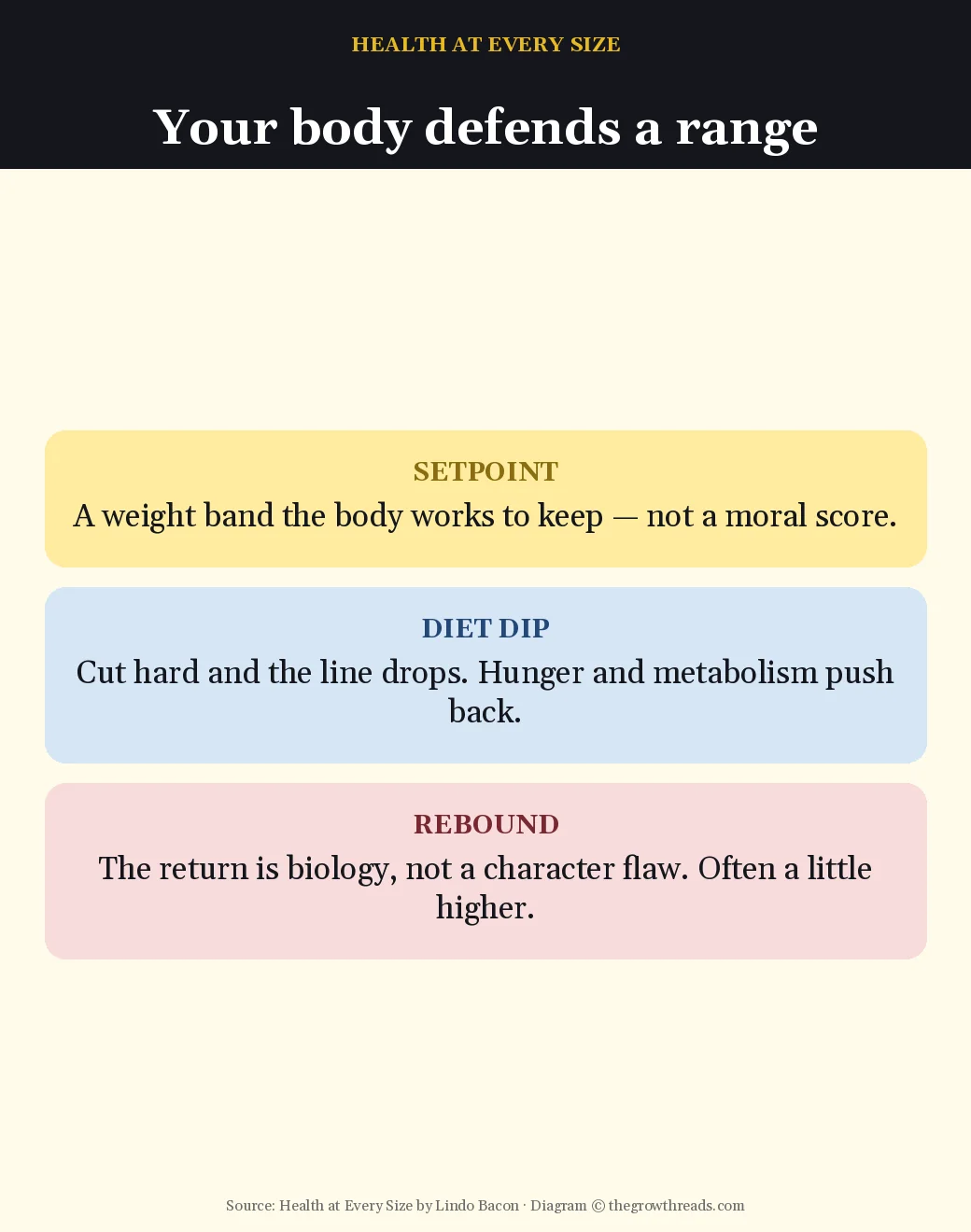
Chapter one is the wiring: leptin as a fat meter, homeostasis, the studies where people who were starved or stuffed drifted back. Chapter two is the part diets skip — we are emotionally starved, so food is asked to do jobs it cannot do. Chapter three is Sisyphus: we resist weight loss because the body is supposed to. A deficit that looks clean on a spreadsheet is a loud alarm in a mammal. If you have ever “been good” for a month and then watched the line return, Bacon wants that story taken off your character and put on physiology. Stop using a six-week drop as proof that the next, tighter rule will hold.
TGR Note: If the brain’s hunger math is the adjacent door — not stigma, but the circuitry that makes a cue louder than a plan — read The Hungry Brain. Stephan Guyenet is the neuroscience cousin. Bacon is the permission to stop treating rebound as a moral event. For the chronic-stress physiology that sits under “I eat when I am loaded,” Why Zebras Don’t Get Ulcers is the other map. None of them is a dare to skip a clinician.
Part 2: Hunger, the aisle, and the politics around fat
The middle third is why “just eat less” keeps losing to the room you actually live in. We are eternally hungry in an environment built to sell the next bite. Bacon walks food politics without a conspiracy novel: palatability, portions, marketing, a “diet” aisle that still sells restriction as a personality. Then fat politics: treating size as a proxy for virtue. The claim is not that every body has the same labs. The claim is that stigma is a health exposure of its own — delay of care, worse care — and that chasing thinness as a moral project keeps people off the habits that would have helped this week. If you see an aisle designed to override fullness, you design a hunger practice instead of a tighter rule. The next chapters stop arguing with the internet and install a program.
TGR Note: If dinner is the whole argument and you want seven words without a setpoint lecture, In Defense of Food is the philosophy (eat food, not too much, mostly plants). For the industrial recipe behind the aisle, Salt Sugar Fat and Ultra-Processed People are the reporting cousins. Bacon will not replace Pollan. Pollan will not talk you off a rebound-shame loop. Stack them.
Part 3: The HAES program — respect, hungers, a life you can live
Chapter seven is the origin of the program Bacon tested: not a slogan, a curriculum. Then the practices. Respect yourself — stop withholding care until the body is a different size. Take care of your hungers, including the ones that are not a sandwich (rest, company). Live well — movement, sleep, the appointment you are avoiding. The HAES loop is boring on purpose: cue, eat or move, feel, adjust. No revenge session. The diet loop is restrict, rebound, shame, a tighter rule. You already know that loop. Pick the one you can still be in on a Thursday.
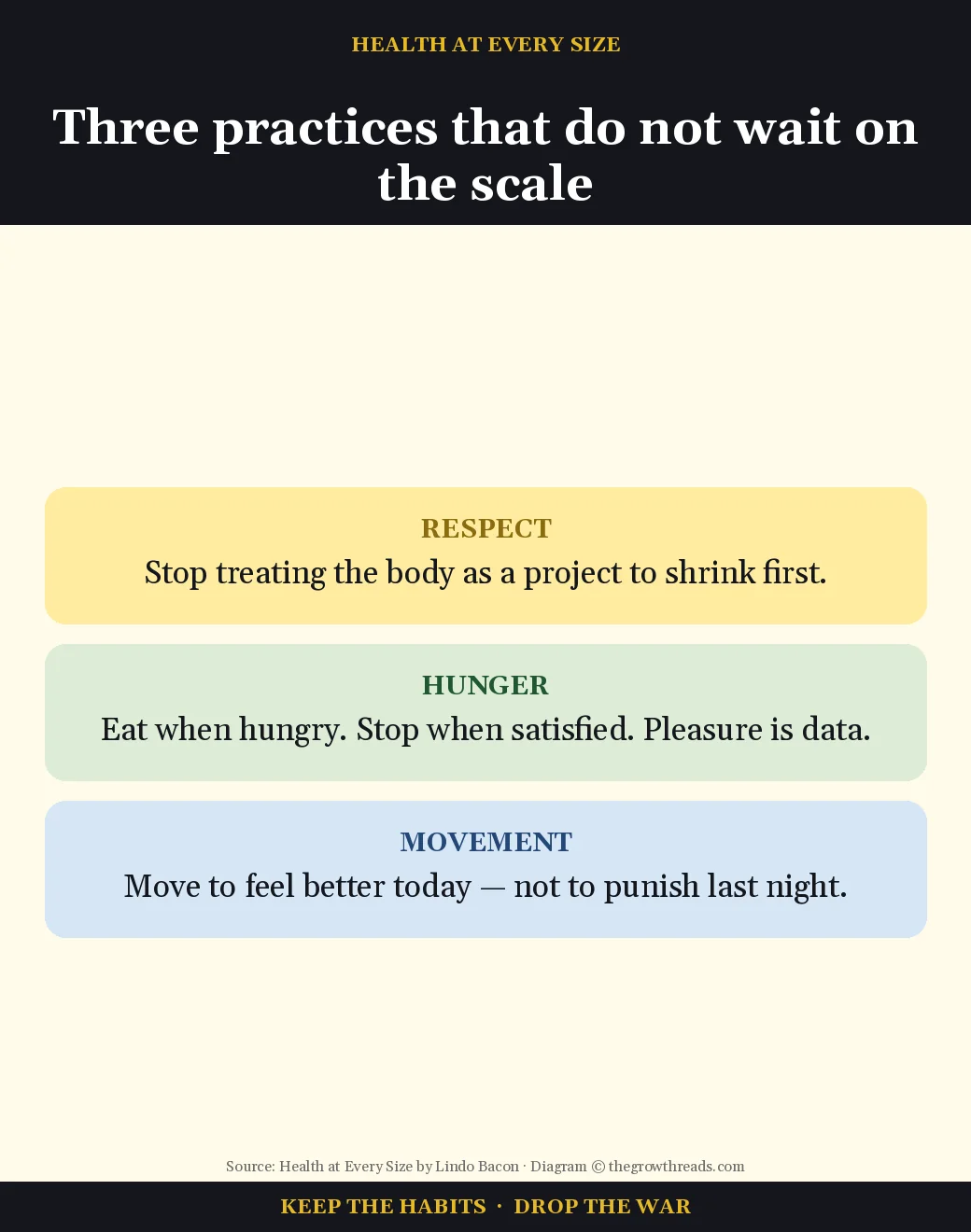
Respect is operational: buy food you enjoy, go to the appointment, wear clothes that fit, stop narrating every meal as a test. Hunger care is closer to Intuitive Eating than to a macro app: eat when hungry, pause when satisfied, include foods you were not allowed. Pleasure is data. Movement is the third leg. Bacon is not anti-exercise. They are anti-punishment-as-exercise. A twenty-minute walk you will repeat is the HAES version of training. If you steal one object from the second half, steal that distinction and a hunger scale you can actually use at lunch.
TGR Note: If the eating rules themselves are the war, start with Intuitive Eating — Tribole and Resch’s ten principles are the sister curriculum. Bacon is why the last diet rebounded; they are the permission structure. For attention under load when the day is loud, Full Catastrophe Living is the ten-minute floor practice this book will not teach. For trauma stored as physiology, The Body Keeps the Score and a clinician — not a new food rule.
Part 4: Change your tastes, then retire the weight “problem”
The last movement is taste and the so-called problem. Change your tastes is not a cleanse. It is what happens when you eat without a war long enough for preference to shift. Solving the weight “problem” is Bacon’s punchline: the problem was the war. Health markers you can influence — movement, sleep, food you can live with, care you actually attend — do not require a smaller number as a ticket. Weight may move as a side effect. It may not. The program is still the program. That sentence lets a reader start on Tuesday.
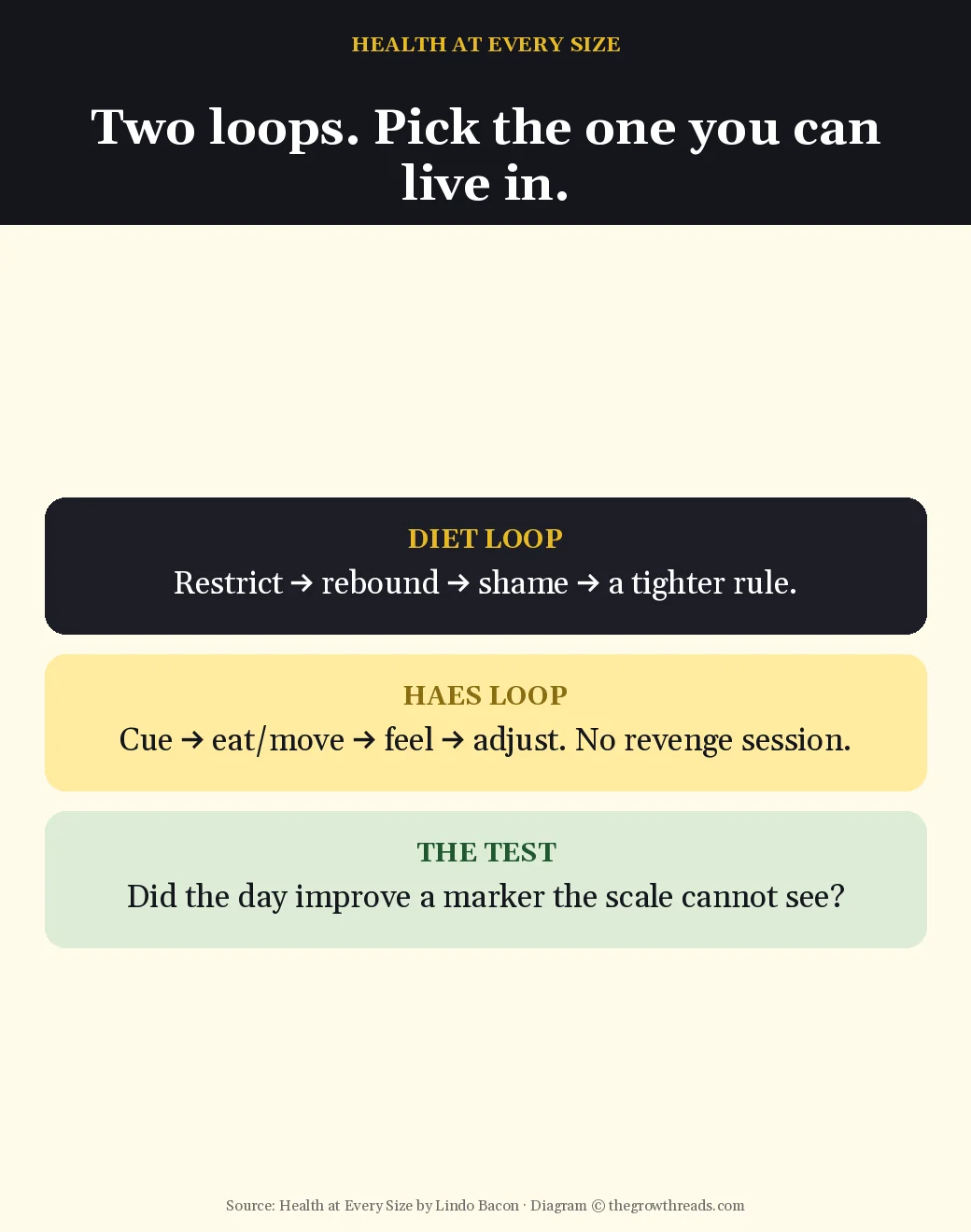
The test is not a before photo. Did energy change. Did a lab you already had move. Did a day become livable. The 7-day plan below is our application layer, not a treatment protocol. If an eating disorder is in the room, this book is not a solo project — stay with the person who already knows your history. For everyone else, the last chapter is permission to keep the habits and drop the war.
TGR Note: If you specifically want an insulin-and-fasting frame, The Obesity Code is the other door — not a HAES book, and not a reason to skip hunger cues. For a pregnancy clock rather than a setpoint lecture, What to Expect When You’re Expecting is the week-by-week map; do not import Bacon’s “eat what you want” into prenatal guidance. For longevity training, Outlive is the 90-year plan. Stack after the loop you are in, not instead of care.
Who is Health at Every Size best for — and who should read something else first?
Read it if diets keep walking themselves back, you treat the scale as a moral score, or you want a weight-neutral habit layer you can start without a new identity. It is a physiology-plus-practice book, not a meal plan you perform for 21 days.
Read something else first if eating itself is the war and you want ten principles — start with Intuitive Eating. If you want seven words about dinner, start with In Defense of Food. If you want insulin-first fasting, start with The Obesity Code. If trauma is the door, start with The Body Keeps the Score and a clinician. This is not medical advice and not a substitute for care.
Questions to reflect on
- Last rebound — did you treat it as biology, or as a character verdict?
- What care have you been postponing until the scale “starts Monday”?
- At the last meal, were you hungry, satisfied, or taking a test?
- What movement would you still do if it burned zero?
- If the scale were not allowed to boss the next seven days, what would you actually keep?
🔥 Ready to drop the diet and keep the habits?
Retire the scale as boss for a week, eat one meal by hunger, and move because it feels better today.
How to apply Health at Every Size (7-day plan)
- Day 1: Put the scale in a closet (or skip it). Write one sentence: “The number is not the boss this week.”
- Day 2: Before and after one meal, rate hunger 1–10. Eat at 3–4. Stop around 7. No makeup restriction.
- Day 3: Eat one previously forbidden food slowly, plated, sitting down. Notice taste. Do not “earn” it.
- Day 4: Twenty minutes of movement you would still do if it burned zero. A walk counts. A punishment session does not.
- Day 5: Write the diet story on one page: when it started, what it cost, what it never held. No audience.
- Day 6: One health action that is not weight — sleep window, already-ordered labs, a walk, a visit you have been delaying.
- Day 7: Review markers the scale cannot see: energy, mood, a meal you did not turn into a test. Keep one habit. Leave the war.
Frequently asked questions
What is Health at Every Size about?
It is Lindo Bacon’s 2008 weight-neutral health book, revised in 2010, about why crash diets rebound and what to do instead. The usable move is to treat well-being as a set of habits — hunger cues, food you can live with, movement that feels better today — without waiting for a smaller number to grant permission. Bacon, a physiologist, argues the body defends a setpoint range, so the war on weight is a fight with biology. The 7-day plan in this guide is our application layer, not a protocol. It is not medical advice.
Does HAES mean “healthy at any size” with no work?
No. Bacon’s premise is that well-being and healthy habits matter more than the number on the scale — not that every body is automatically well. The program is behavioral: eat when you are hungry, stop when you are satisfied, move because it helps you feel better, and drop the shame loop that follows a “blown” day. Some clinicians still treat weight loss as a primary goal; that debate belongs in a visit with your chart, not in a forum. Use the habits. Bring labs to a person who has your history. Do not treat a book as a diagnosis.
How is Health at Every Size different from Intuitive Eating?
Intuitive Eating (Tribole and Resch) is a ten-principle anti-diet eating framework. Health at Every Size is the physiology-and-politics cousin: setpoint, why restriction rebounds, food marketing, and fat stigma, then a practice of respect, hunger care, and life-enhancing movement. If you want the eating rules without the weight-science lecture, start with Intuitive Eating. If you want to understand why the last diet walked itself back, start here. They stack. Neither is a dare to ignore a clinician, and neither is a meal plan you perform for a week and abandon.
Is this medical advice — and should I ignore my clinician?
No, and no. This summary and the book are educational. Bacon is not your doctor. Do not stop prescribed care, skip indicated screening, or treat a chapter as a veto of labs. If you have an eating disorder, a condition that requires a therapeutic meal plan, or a clinician already managing weight as part of a specific treatment, stay in that relationship. The practical layer you can use this week — dropping a crash diet, noticing hunger, walking because it feels better — is the uncontroversial part. Personal questions go to the person who has your chart.
Which edition should I buy, and how long is it?
The BenBella revised paperback we link is ISBN-13 9781935618256, ASIN 1935618253, about 400 pages, published 4 May 2010 (the work first appeared in 2008). Most readers use it as a two-part book: the science of why diets rebound, then the HAES practices. That is roughly an eight-hour sit, or a week of chapters. Buy the edition you will actually mark up. Commerce here is the US listing Open Library title-checks as “Health at every size : the surprising truth about your weight.” The 7-day plan below is ours, not a substitute for the worksheets in the second half.
Is Health at Every Size still relevant in 2026?
Yes. The diet market got louder; the rebound pattern did not get kinder. GLP-1 drugs and new obesity guidelines changed the clinic conversation, which makes a weight-neutral habit layer more useful as a complement, not a slogan. Bacon’s later books (Body Respect, Radical Belonging) extend the argument; this is still the practical door. If you want insulin-first fasting, that is The Obesity Code. If you want seven words about dinner, that is In Defense of Food. If you want to stop waiting on the scale to start taking care of yourself, this is still the book people mean by HAES.
Health at Every Size vs Intuitive Eating vs The Obesity Code — which first?
Read Health at Every Size first if diets keep walking themselves back and you want the physiology of a setpoint plus a habit layer that does not wait on the scale. Read Intuitive Eating first if eating itself is the war and you want ten principles without a long science-and-politics middle. Read The Obesity Code first if you specifically want an insulin-and-fasting frame. They do not cancel each other. Bacon will not write your fasting window. Fung will not teach you to stop treating a rebound as a character flaw. Tribole will not explain leptin. Start with the loop you are actually in this month.
Related summaries
- Intuitive Eating — the ten-principle sister curriculum for the eating war.
- In Defense of Food — eat food, not too much, mostly plants.
- The Hungry Brain — why a cue gets louder than a plan.
- Why Zebras Don’t Get Ulcers — the stress physiology under “I eat when I am loaded.”
Browse titles on our Best Health Books pillar page.
How we analyze books: our summaries are built from a full read of the source text, cross-referenced against the author’s published interviews and research where relevant, and structured around practical application rather than critique. Read our full methodology.