

★★★★½ 4.5/5 — Hits spike. Classics keep selling because the work was built to last.
Best for: Makers, writers, founders, and operators who treat launch week as the whole career — then wonder why the catalog goes quiet.
Reading time: ~5 hrs (guide: 12 min)
Difficulty to apply: Easy to name a hit; honest on years of positioning and a list you actually own.
Perennial Seller in one minute
Most people spend the year chasing a spike, then call the silence “the market.” Ryan Holiday’s Perennial Seller (Portfolio, 2017) is the field manual for work that still sells after launch week dies: make something you would keep, name who it is for, tell people on purpose, and own the relationship so the backlist can compound. Shawshank missed the box office and became a classic. Iron Maiden still fills rooms without waiting for radio. If you take one move from this Perennial Seller summary, pick one piece this week, write who it is not for, and spend an hour keeping an old piece alive.
Key takeaways
- The work is the first ad: Marketing cannot rescue a thing you would not keep. Greatness is the strategy.
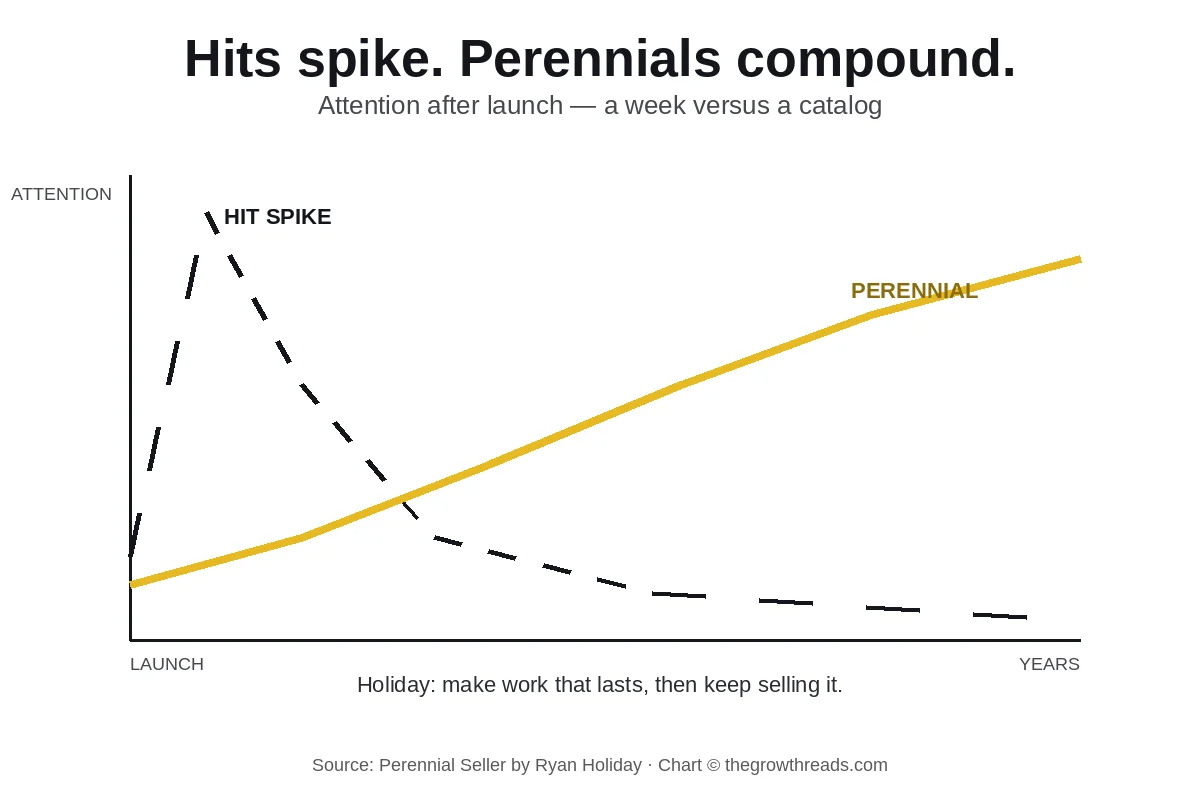
- Perennial beats hit: A spike is a week. A catalog is a career. Design for years, not a trending slot.
- Positioning is a cut: Who it is for, who it is not, one sentence. A crowd that is “everyone” hears nothing.
- Making and marketing are one job: Audience is in the room from page one, not a department you hire after.
- Launch is a process: Opening day is a door, not a verdict. Keep telling the people who already care.
- Word of mouth is the engine: Ten real conversations beat a blast to a rented feed.
- Own the platform: An email list, a room, a relationship you can reach without an algorithm’s mood.
- The backlist pays: Old work is not finished. Classics are kept alive on purpose.
- Test with humans: Ferriss-style checks beat a private masterpiece. Feedback is a tool, not a vibe.
- Luck still needs a plant: You cannot schedule a classic. You can refuse to only plant annuals.
What is Perennial Seller about?
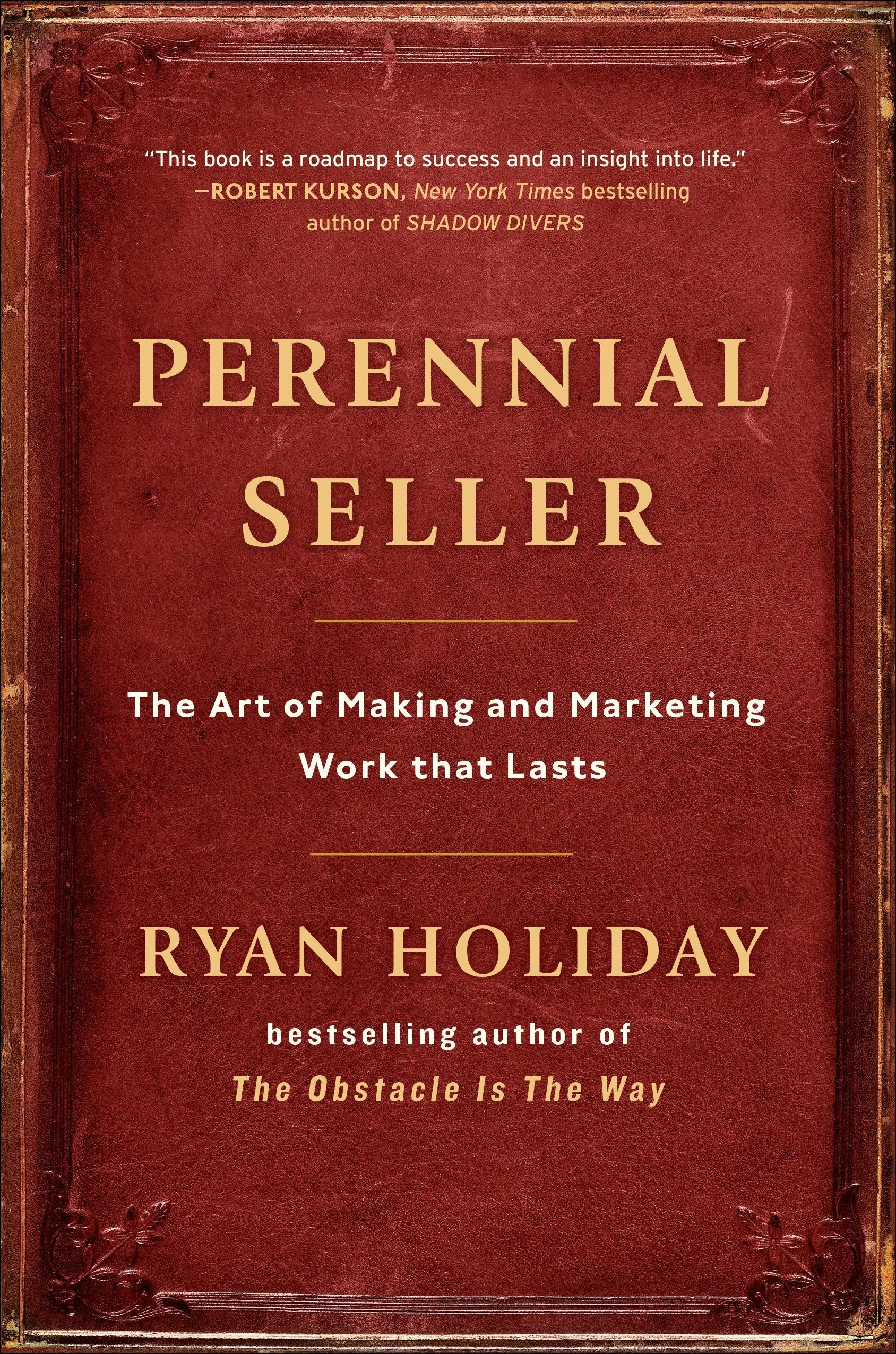
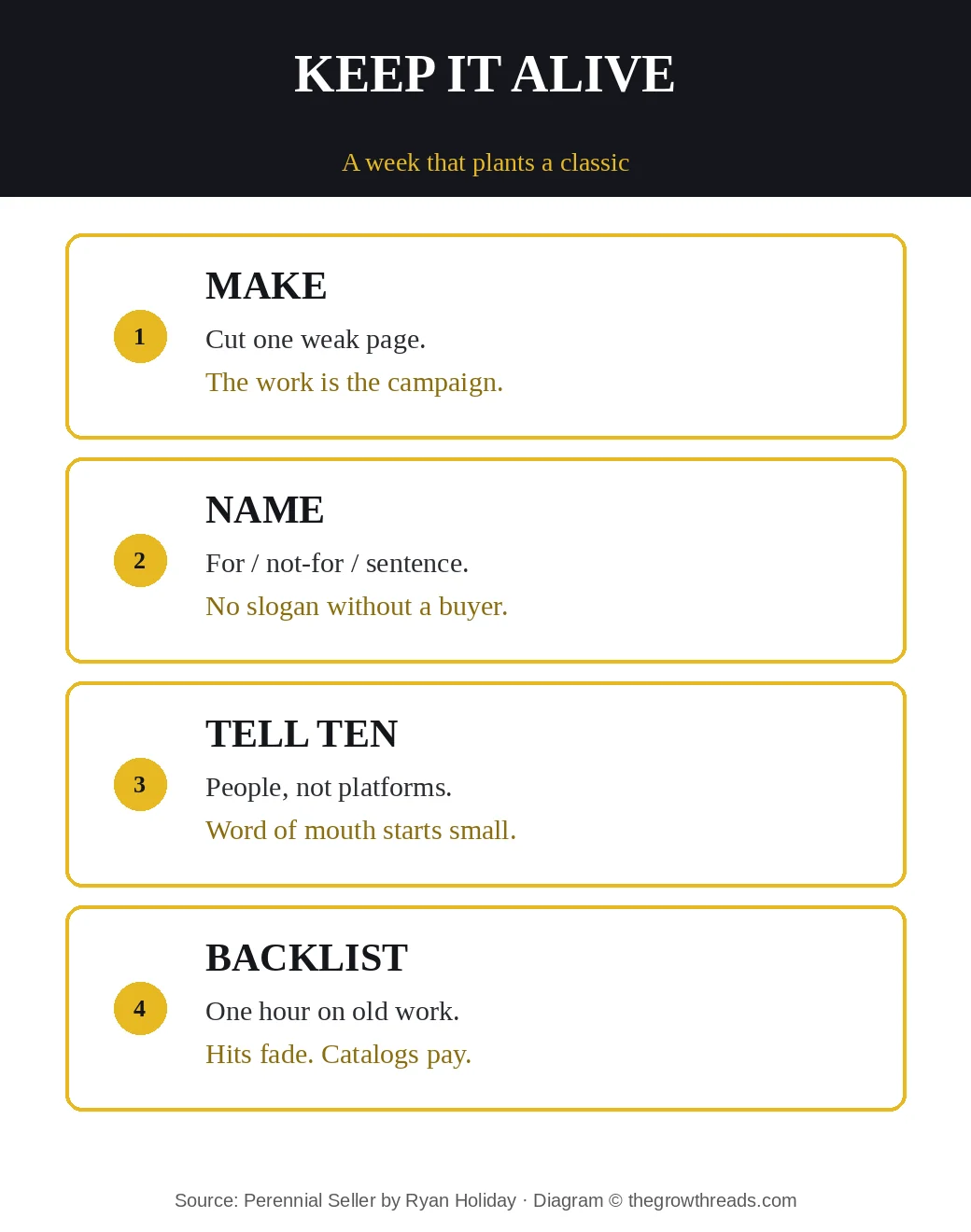
Perennial Seller is Ryan Holiday’s playbook for creating and marketing work that lasts — books, products, shows, catalogs — by treating quality, positioning, word of mouth, and an owned audience as one job instead of a launch-week stunt that is supposed to save weak work.
About the author
Ryan Holiday is an American writer and marketer who turned a career in publicity into a shelf of books on focus, ego, and Stoic practice. He ran marketing at American Apparel, advised authors and brands, and then wrote The Obstacle Is the Way, which became the on-ramp for a generation of readers. Perennial Seller is the craft book underneath that career: how Shawshank, Iron Maiden, and slow-burn titles keep finding people after the first weekend. He is not asking you to become a marketer as a personality. He is asking you to stop treating the making and the selling as two lives, then wondering why the work disappears when the ads stop. Explore all Ryan Holiday book summaries →
Key concepts at a glance
| Concept | What it means | Use it when |
|---|---|---|
| Perennial seller | Work that keeps finding people after the spike | You only plan for launch week |
| The work first | Quality is the campaign you cannot skip | You want a funnel to save a draft |
| Positioning | Who it is for, who it is not, one sentence | The pitch is “for everyone” |
| Package | Title, price, form as signals | The outside does not match the inside |
| Launch as process | Opening day starts the telling | You treat silence after week one as failure |
| Word of mouth | People telling people, on purpose | You only post to a feed |
| Platform | An audience you can reach without rent | The algorithm owns your Tuesday |
| Backlist | Old work kept alive as inventory | You only love the next new thing |
Part 1 — Make something you would keep
Holiday opens where most marketing books refuse to stay: the creative process. A perennial seller begins as work you would still want if nobody clapped. Shawshank did not win the weekend and then became a classic because the story was built to last. The 48 Laws of Power missed early lists and kept finding readers because the pages were doing a job people still needed years later. Iron Maiden did not wait for a playlist to decide they were allowed to tour. The pattern is rude and useful. If you would not keep the thing, neither will a stranger.
That is not a vibe. It is a cut. Holiday walks the mindset (long-term over trendy), the making (reps, taste, editors), and the small magic that only shows up after the boring hours. Rick Rubin pushing artists past the short-term; Harper Lee turning a muddled manuscript into To Kill a Mockingbird with an editor who would not flatter. You do not get the magic by collecting launch checklists. You get it by surviving the part where the work is still ugly and you stay anyway.
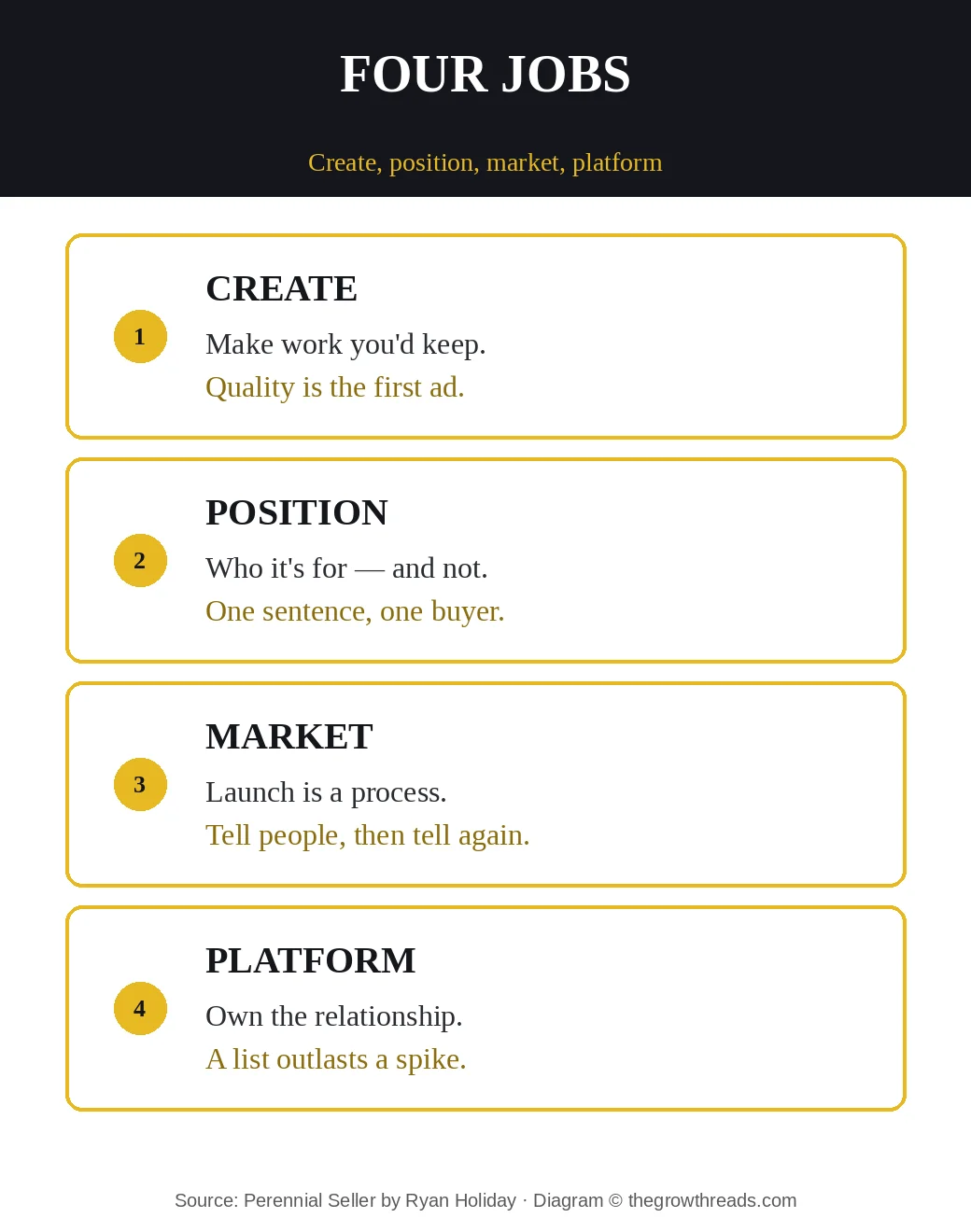
Knowledge work disguises the same stall as “I need a bigger campaign.” The inbox looks like progress. The draft stays safe. Holiday’s first job is Create: make work you would keep. If the piece cannot survive a quiet month, a louder month will not save it. Cut the weak page. Put it in front of one honest reader before you rent a crowd.
TGR Note: The Practice is Seth Godin’s companion on showing up to ship art. Making Ideas Happen is Belsky’s execution spine for people who collect more than they finish. Use Godin when the stall is identity. Use Belsky when the stall is a pile of half-starts. Use Holiday when the stall is a launch that is supposed to rescue work you would not keep — you have a campaign, and you still do not have a classic.
Part 2 — Position it so the right person can find it
Part two is positioning: polishing, perfecting, packaging. Holiday is blunt that “for everyone” is a way to be for no one. A perennial seller knows who it is for and, just as useful, who it is not for. The cut is kindness. It lets the right person hear themselves in the sentence. Title, price, format, and the one-line promise are not decoration. They are how a tired buyer decides in three seconds whether this is their problem.
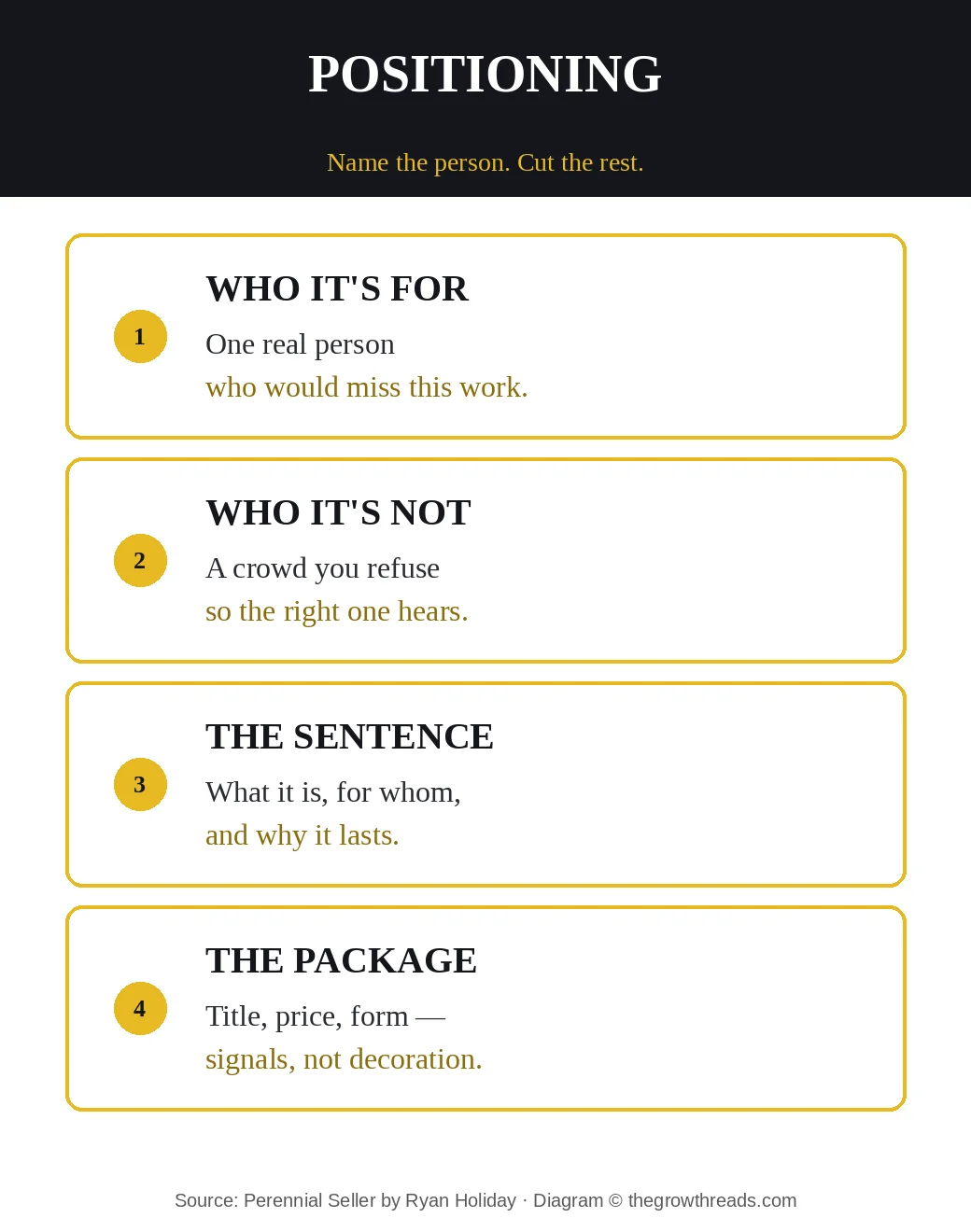
Tim Ferriss appears here as a tester, not a guru: try the elements, watch what generates a response, keep what works. That is the opposite of a private masterpiece. Put the sentence in front of a human. If they cannot repeat who it is for, the work is still hidden inside your head. Price sends a signal. Packaging tells the truth or it lies. Holiday’s useful cruelty is that you cannot position a mush. You have to choose a person, a job, and a no.
For a knowledge worker the drill is small. Write three lines: who this is for, who this is not for, and the sentence a colleague could repeat without you in the room. Then change the title or the first paragraph until those three lines match the object. If you cannot say no, you do not have a position. You have a mood. Moods do not compound. Positions do.
TGR Note: This Is Marketing is Godin’s later reminder to see the customer first. Purple Cow is the remarkability test. Use those when the work is already specific and nobody can see it. Use Holiday’s positioning chapter when the work is still trying to please a room that does not exist — you have remarks, and you still have not named a buyer.
Part 3 — Marketing is telling, then telling again
The marketing section is where launch-week mythology dies. Courting, coverage, pushing, promotion — Holiday treats them as a process, not a firework. Opening day is a door. If you walk away after the first weekend, you taught the work to be annual. Word of mouth is the engine that still runs when the ads stop, and it starts as ten conversations, not a blast. Seinfeld captured a decade and also captured themes that outlived the decade. That is work people could recommend without a discount code.
The practical stack is human. Make a list of people who already care. Tell them what it is for. Ask for a forward, a reply, a room. Do it again next month. Coverage is useful; it is not the job. If your only channel is a rented feed, you are leasing attention by the hour. Holiday’s perennial creators keep talking after the spike because the spike was never the product.
A quiet month after launch feels like a verdict. It is usually the start of the process you skipped. Ego Is the Enemy is Holiday’s earlier warning not to need a hit to stay in the chair. This book is the chair: keep telling the same person, keep the catalog warm.
TGR Note: Show Your Work is Austin Kleon’s generous version of telling — share the process so people can join it. The Dip is Godin’s quit-or-stay curve. Use Kleon when you are hiding the making. Use The Dip when you are grinding a dead path. Use Holiday when you launched, went quiet, and called the silence the market — the work still has a person, and you stopped talking to them.
Part 4 — Own the platform, keep the backlist
The last job is platform: from fans to friends to a career. Churchill, Zweig, Lady Gaga in Holiday’s telling are not just famous. They built a way to reach people without asking a gatekeeper every Tuesday. For a writer or a maker in 2026 that is still an email list, a room, a small group, a catalog page you control. Rented attention is a tool. Owned attention is an asset. If the algorithm sulks, a perennial seller still has someone to tell.
The backlist is the unfashionable gold. Hits fade because they were designed as hits. Catalogs pay because someone kept the old work findable, in print, in conversation, in a bundle, in a sentence a new reader can use. Holiday’s conclusion asks what luck has to do with it and then refuses to let luck be the plan. You cannot schedule a classic. You can plant for years: better work, a clearer person, a process of telling, a list you own, an hour this week on something you already made.
Make it physical. One card: the piece, the person, the sentence, the ten names, the backlist hour. Once this week, tell ten humans instead of a feed. Atomic Habits can keep the telling alive. Holiday would put the work first, then the list.
TGR Note: Wisdom Takes Work is Holiday’s later reminder that information is not wisdom until you train. Discipline Is Destiny is the virtue of staying in the chair. Use those when the stall is character. Use Perennial Seller when the stall is a catalog you abandoned — you have the chair, and you still only water the new plant.
Who is Perennial Seller best for — and who should read something else first?
Best for makers whose work is supposed to outlive a campaign: writers, course-builders, product people, studio owners, and operators sitting on a quiet backlist. Especially if you already know how to launch and still treat week two as a funeral.
Read something else first if you cannot yet finish a small piece — The Practice or Making Ideas Happen, then come back. If the stall is ego around a hit, start with Ego Is the Enemy. If you need a customer-first marketing lens without the catalog frame, start with This Is Marketing. Come to this book when the bottleneck is work that should last, not a louder week-one stunt.
Questions to reflect on
- What did you ship that you would not actually keep — and what would “keep” require this week?
- Who is this piece for, in one name, and who is it honestly not for?
- Where did you treat launch week as the whole career?
- Which channel do you own if the feed goes quiet tomorrow?
- What old piece will you spend one hour keeping alive instead of announcing something new?
🔥 Ready to plant a classic this week?
Make the work worth keeping, name the person, tell ten humans, and spend one hour on the backlist.
How to apply Perennial Seller (7-day plan)
- Day 1 — Name the piece. Pick one work that is supposed to last. Write why you would keep it, or what you will cut so you would.
- Day 2 — For and not-for. One name it is for. One crowd you refuse. If you cannot refuse, you do not have a position yet.
- Day 3 — The sentence. What it is, for whom, why it lasts. Read it to one person. Change it until they can repeat it.
- Day 4 — Tell ten. Ten humans, not a blast. A note, a call, a forward. Count replies, not impressions.
- Day 5 — Own a door. Add or clean one channel you control — a list, a page, a room. Put the sentence at the top.
- Day 6 — Backlist hour. Sixty minutes on old work: a better title, a bundle, a link, a reminder. Do not start a new draft.
- Day 7 — Draw the curve. Did this week look like a spike or a plant. Keep the telling. Repeat the backlist hour Monday.
Frequently asked questions
What is Perennial Seller about?
Perennial Seller is Ryan Holiday’s 2017 playbook for creating and marketing work that lasts after the launch week dies. He uses Shawshank, Iron Maiden, slow-burn books, and his own years in publicity to argue that quality, positioning, word of mouth, and an audience you own are one job — not a campaign you hire to rescue weak work. The usable residue is four moves: make something you would keep, name who it is for and not for, tell people on purpose, and keep the backlist alive. It is a craft manual for catalogs, not a growth-hack list and not a memoir of going viral.
What is a perennial seller?
A perennial seller is a piece of work that keeps finding people after the first spike: a book, show, product, or catalog that still does a job years later. Holiday’s examples include films that missed the box office and became classics, titles that missed early lists and kept selling, and artists who fill rooms without waiting for a playlist. The opposite is the annual: a launch that is supposed to be the whole career. You cannot order a classic on a calendar. You can refuse to only plant things designed to die in a week, and you can keep talking to the people who already care.
Is Perennial Seller worth reading if I already read The Practice or This Is Marketing?
Yes if you want the catalog frame, not another sermon on showing up or seeing the customer. The Practice is Godin on shipping as identity. This Is Marketing is Godin on empathy and the smallest viable audience. Perennial Seller sits beside them as the years-long version: how work is positioned, told, and kept alive so it can still sell when the feed is quiet. If Godin already got you to ship, this one changes what you do in week two, month six, and year five. Skip it as a first book if you cannot yet finish a small piece — go to The Practice, then return for the backlist.
How is Perennial Seller different from Purple Cow or Making Ideas Happen?
Purple Cow is remarkability: be worth talking about. Making Ideas Happen is Belsky’s execution system for turning piles into shipped work. Perennial Seller is what happens after the thing exists and the first weekend is over — positioning so the right person can find it, a process of telling instead of a firework, a platform you own, and a backlist you treat as inventory. Use Belsky when you are still collecting. Use Purple Cow when nobody can see you. Use Holiday when you can ship and still treat every quiet month as proof the work is dead.
Who should read Perennial Seller?
Writers, course-builders, product people, studio owners, and operators whose work is supposed to outlive a campaign — especially people sitting on a quiet catalog who only know how to announce something new. It is useful if you already know how to launch and still disappear in week two. Skip it as a first book if you cannot yet finish. Go to a shipping practice, then come back when the bottleneck is lasting, not starting. Come here when you have a piece that should still be working, and you abandoned it because the spike ended.
How long is Perennial Seller and how should I read it?
The Portfolio hardcover runs about 256 pages; most readers finish it in four to six hours. Do not study it like a marketing textbook and do not highlight every celebrity example as a plan. Read for the four jobs: create, position, market, platform. Then run one of them the same day — a cut, a for/not-for sentence, ten humans told, or an hour on old work. One job, one object, same afternoon. If you collect every case study and never pick a piece, you have bought a poster of a classic. If you land a clearer sentence and a backlist hour by Friday, you have used the book.
Does Perennial Seller say marketing does not matter?
No. Holiday’s point is the opposite of “just make it and they will come.” Marketing matters so much that it has to start inside the work: who it is for, why it lasts, how a person will tell a friend. A campaign cannot rescue a thing you would not keep, and a masterpiece you never position will sit in a drawer. The TGR application is both halves on a Tuesday: improve the object, then tell ten people, then own a door so you can tell them again. If a chapter is only a famous name, keep the principle and spend the hour. Classics are made and kept, not merely announced.
Related summaries
- The Practice — ship the art before you brand the career
- Making Ideas Happen — execution for people who collect more than they finish
- Ego Is the Enemy — do not need a hit to stay in the chair
- This Is Marketing — see the customer first, then tell them
- More on the best productivity books pillar
How we analyze books: we read for application, not for a takedown — then we add a plan you can run this week. Read our full methodology.