

★★★★☆ 4.5/5 — if they cannot finish your story, they will not buy the offer.
Best for: founders and marketers whose product is fine and whose homepage still sounds like a committee
Reading time: ~6 hours (HarperCollins Leadership hardcover, 2017, 228 pp) · this guide ~12 min
Difficulty to apply: Medium — filling the BrandScript is easy; cutting the clever copy is the work
Building a StoryBrand in one minute
Customers do not ignore you because they are busy. They ignore you because they cannot see themselves in the sentence. Donald Miller’s Building a StoryBrand is a filter for that sentence. Most brands talk like the hero of their own origin story. The customer’s brain, built to survive, treats that as noise and moves on. Put the customer in the hero’s seat and the brand in the guide’s seat. Tell a seven-part story the brain already knows how to finish.
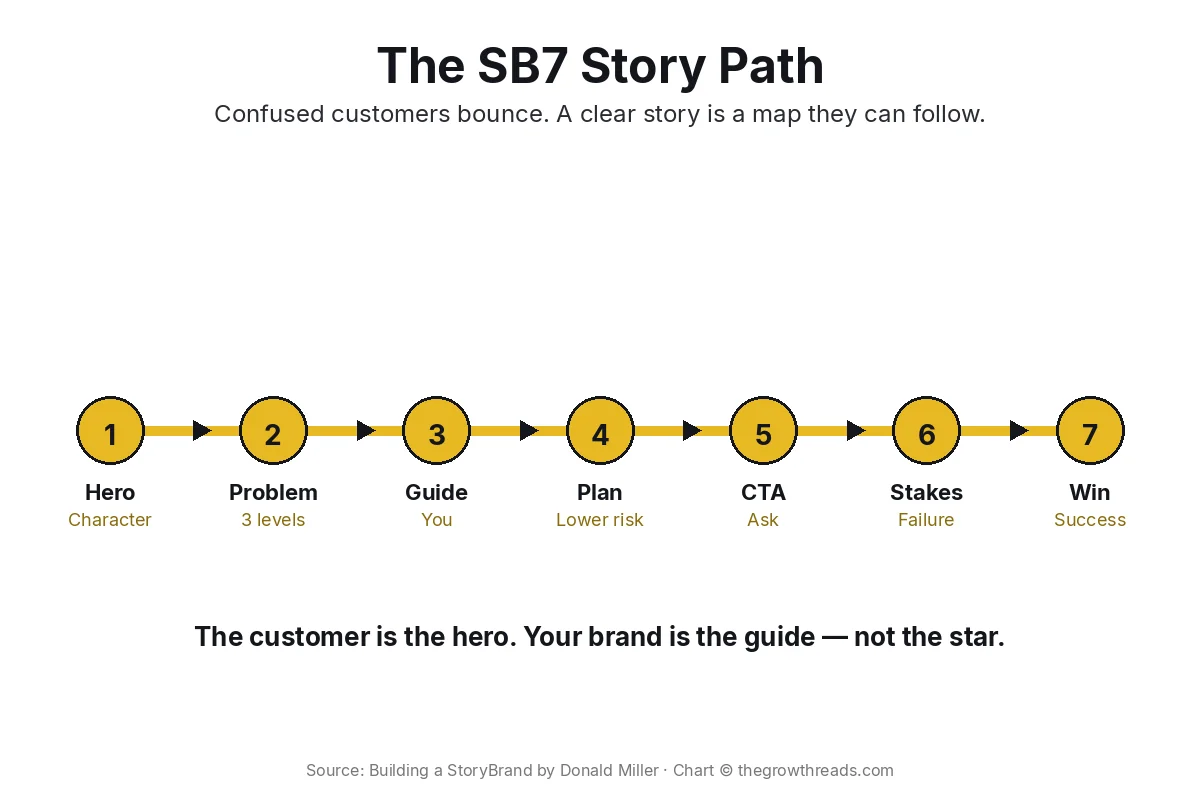
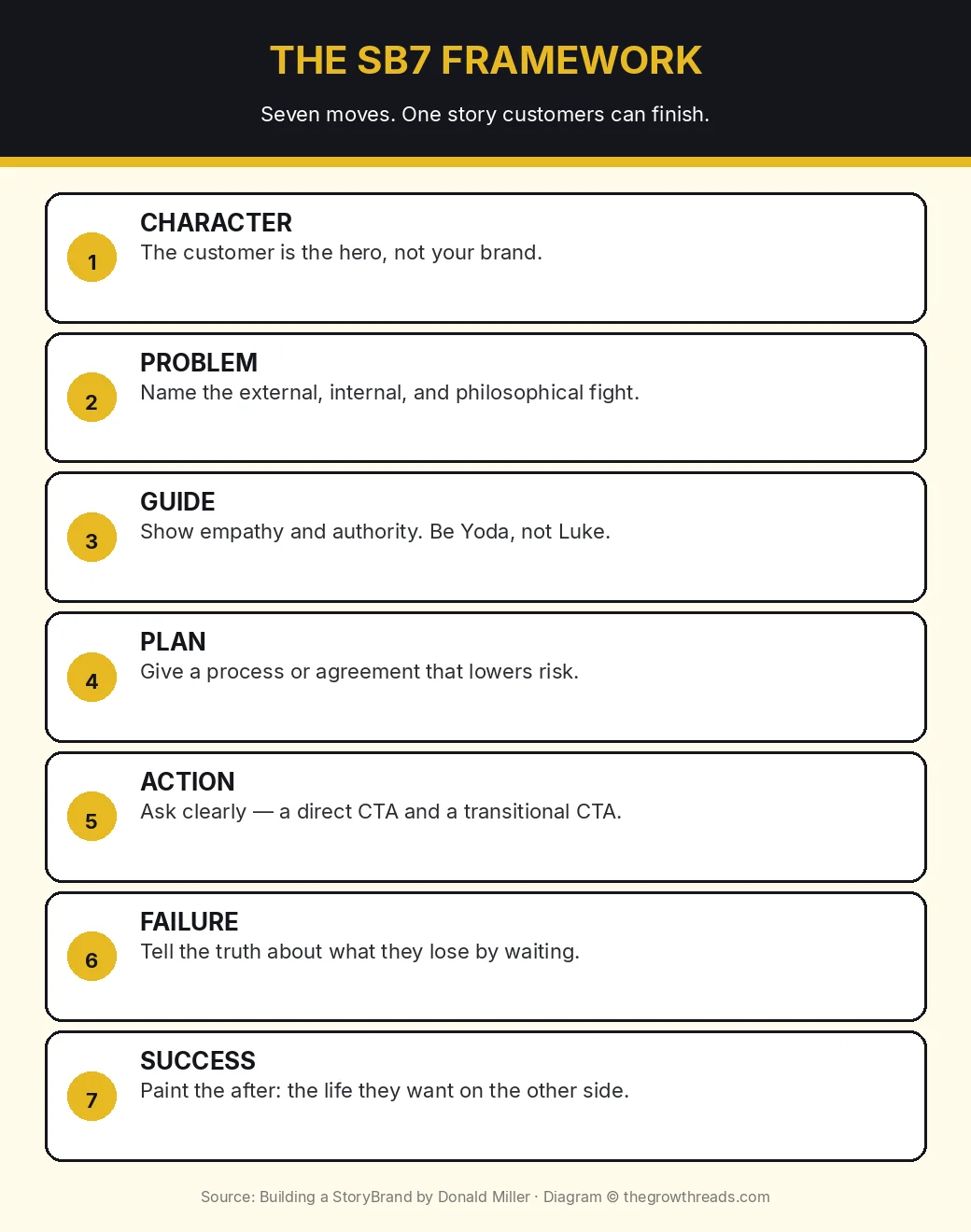
That story is the SB7 framework: a character, a problem, a guide, a plan, a call to action, a failure to avoid, and a success to want. Fill it on one page. Drop it on the homepage, the one-liner, the email. Repeat until a stranger can say what you do and what they should do next.
Key takeaways
- If you confuse, you lose. Survival brains skip complexity. A foggy offer is a silent no.
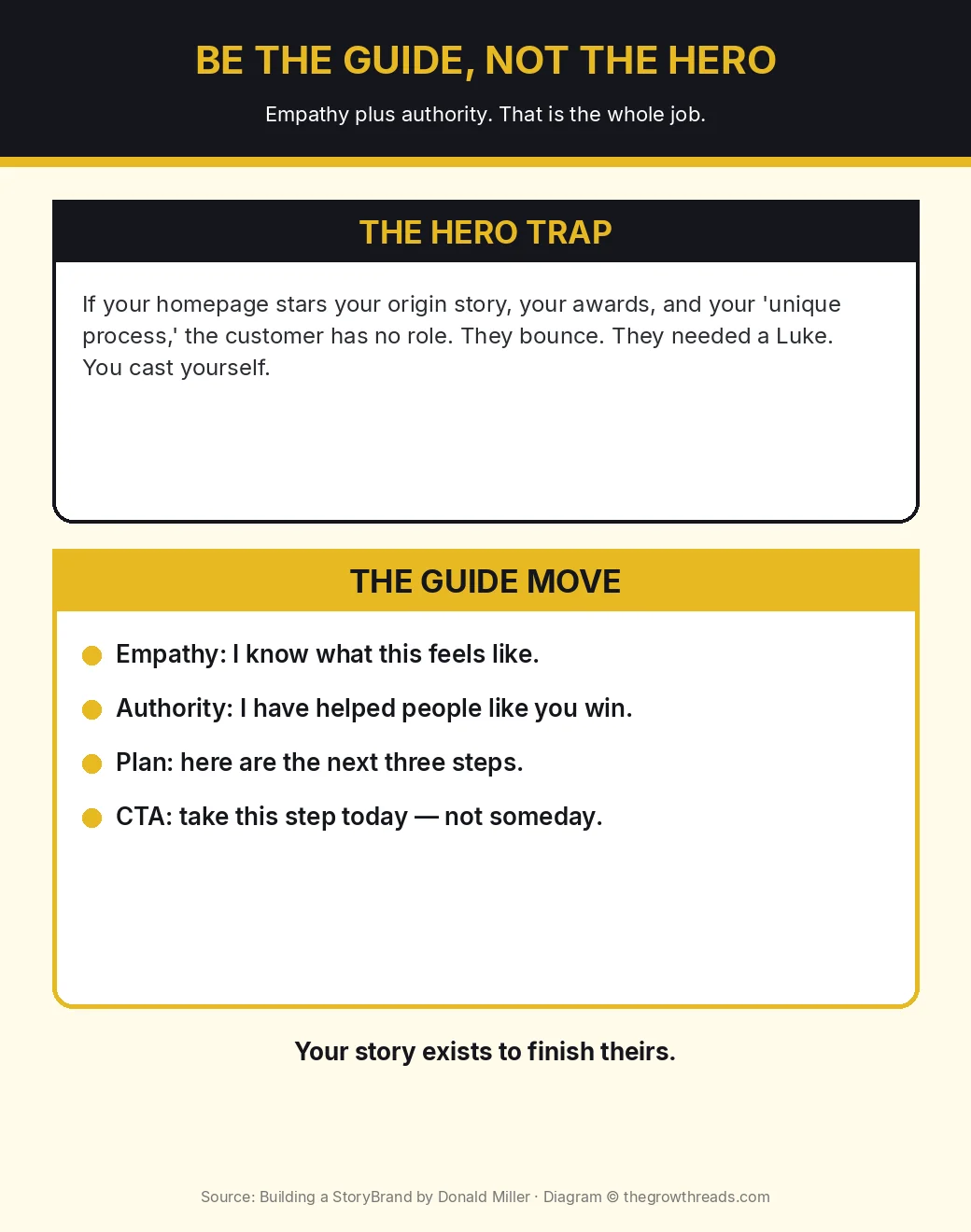
- The customer is the hero. Your brand is Yoda, not Luke. Star them or they bounce.
- They want one thing. Name a single desire on the page, not a buffet of features.
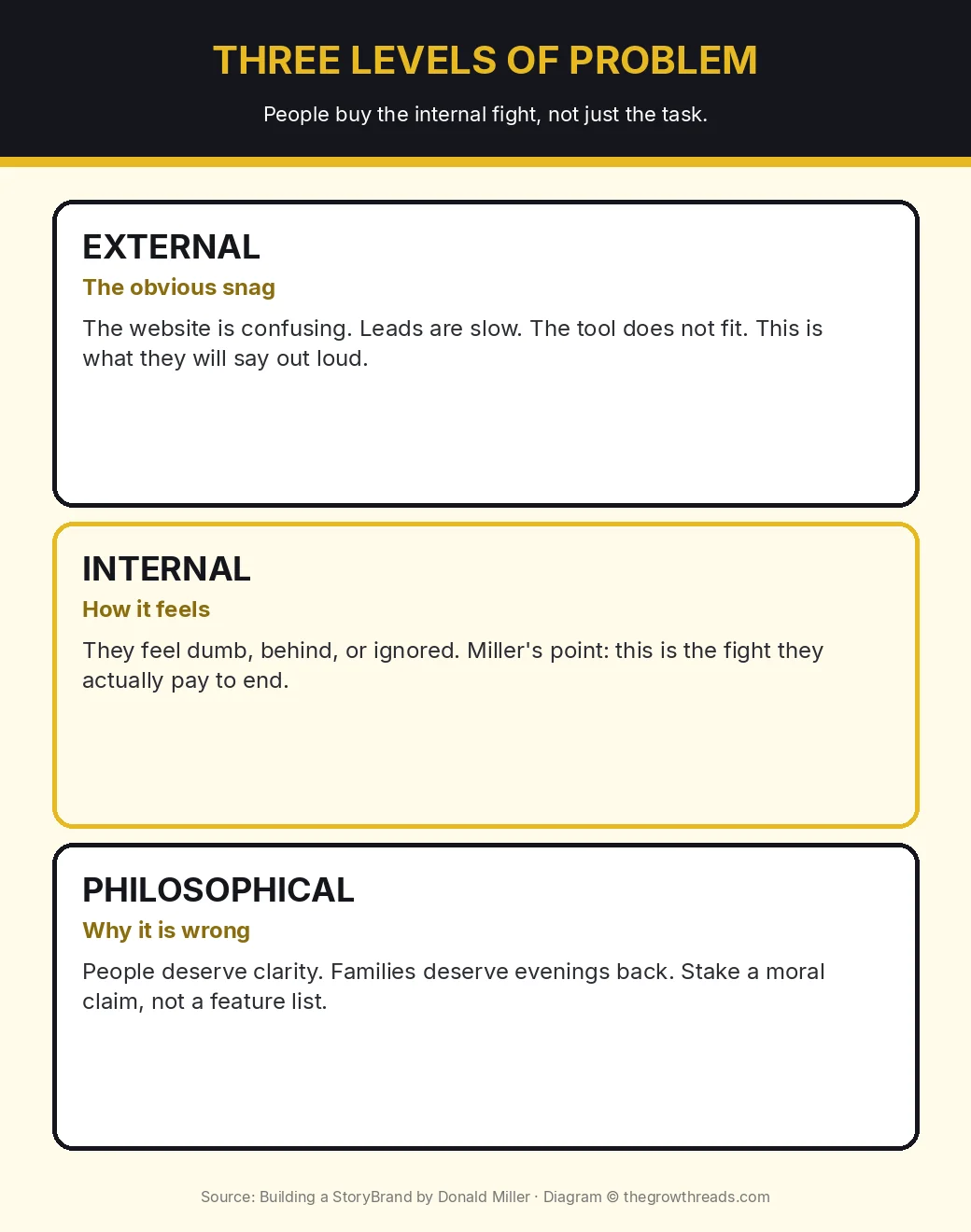
- Problems have three levels. External is the task. Internal is the feeling. Philosophical is why the fight is wrong.
- People buy the internal fight. Features do not close. Relief and respect do.
- A guide needs empathy and authority. I know how this feels, and I have helped people like you win.
- A plan lowers risk. Three steps, or a short agreement, beats a clever slogan.
- Ask twice. A direct CTA for buyers. A transitional CTA for people who are not ready.
- Paint the after, and the cost of delay. Success and failure are the stakes that make the ask honest.
What is Building a StoryBrand about?
Building a StoryBrand is Donald Miller’s practical framework for clarifying a brand so customers can understand it fast. It recasts the business as a guide in a seven-part story, then turns that story into a one-page BrandScript you can put on a website, a one-liner, and a clear next step.
About the author
Donald Miller is a writer and the CEO of StoryBrand, a company that teaches businesses to clarify their message. He first became widely known for Blue Like Jazz, a memoir about faith and self-discovery, then spent years watching companies with good products fail to explain themselves. That gap became the StoryBrand framework and this 2017 book. He later wrote Marketing Made Simple, Business Made Simple, and Hero on a Mission, and runs workshops that walk teams through a BrandScript in a day. You listen because he turned a story structure everyone already feels — hero, problem, guide — into a page a small team can fill on a Tuesday. Wikipedia: Donald Miller. Explore all Donald Miller book summaries →
Key concepts at a glance
| Concept | What it means | Use it when |
|---|---|---|
| SB7 | Seven-part story: character, problem, guide, plan, CTA, failure, success | The offer is good and the page still ramble |
| Customer as hero | They are Luke. You are the guide. | The homepage stars your origin story |
| Curse of knowledge | You speak insider. They hear fog. | Sales says “they just don’t get it” |
| Three-level problem | External task, internal feeling, philosophical wrong | Copy lists features and nobody leans in |
| Guide formula | Empathy plus authority | You sound either needy or arrogant |
| Plan | Process steps or a short agreement that lowers risk | They like you and still will not click |
| Direct + transitional CTA | Buy now, and a smaller step for the unready | The only button is “Contact sales” |
| BrandScript | One-page story you reuse everywhere | The site, ads, and sales deck disagree |
Part 1: Noise, the curse of knowledge, and the customer as hero
Miller opens on a feeling every founder already has and rarely names. You can talk about the product for an hour. A stranger lasts eight seconds on the homepage and leaves. The usual diagnosis is more traffic. Miller’s diagnosis is older. The customer’s brain is a survival tool scanning for a simple story: what is this, is it for me, what do I do next. Anything that fails that test is noise. You did not lose a debate. You never started one.
The curse of knowledge makes this worse. Once you live inside the category, you cannot hear how it sounds. Words like platform, solution, and ecosystem feel precise in the stand-up and land as sludge in a browser. Miller’s line is the one people remember: if you confuse, you lose. Not because customers are lazy. Because a confused customer cannot say yes.
The fix is not a louder origin story. It is a role swap. In the stories people already know how to finish, a character wants something, hits a problem, meets a guide, gets a plan, is asked to act, avoids a failure, and reaches a success. Brands keep casting themselves as the character. The customer then has no job in the scene, so they exit. Miller’s first rule is the whole book in one move: the customer is the hero. Your brand exists to help them win.
TGR Note: Heath and Heath’s Made to Stick is the science of why some messages survive. Miller is the homepage implementation. If the message is already sticky and the thing is still beige, Godin’s Purple Cow is the product problem, not the copy problem.
Part 2: Character, problem, and the brand as guide
Once the customer is the hero, they still need a want you can say in a line. Miller is strict. Not five wants. One desire the page can hold: save time, make money, get fit, stop looking foolish. If you cannot name it, the rest of SB7 has nothing to aim at. Teams fight this because the product does many things. The customer came with one itch.
Then the problem, where the book earns its keep. Most copy names only the external snag: the slow site, the messy books, the extra pounds. Miller splits the fight into three. External is the obvious task. Internal is how it feels — dumb, behind, ignored. Philosophical is the moral: people deserve clarity; families deserve evenings. He argues that people buy the internal fight. The tool is a means. The feeling is the job. If your page never says the feeling, you are pitching a wrench to someone who wanted their afternoon back.
The brand enters as the guide, not a second hero. Guides do two things. They say, I know what this feels like. Then they say, I can help you win. Empathy plus authority. Skip empathy and you sound like a brochure. Skip authority and you sound like a friend who cannot actually help. You need both on the same screen, in that order, before you ask for money.
TGR Note: Sinek’s Start With Why is the leadership-silo cousin: lead with purpose, not features. Why still needs a hero, a problem, and an ask. Cialdini’s Influence is for after someone understands you. Do not stack scarcity on a sentence nobody can parse.
Part 3: Plan, the ask, stakes, and success
Even a trusted guide gets a frozen yes if the next step feels like a cliff. Miller’s plan is a risk reducer, not a 40-page PDF. A process plan is three or four steps: schedule a call, get a blueprint, launch. An agreement plan is a short list of promises: we will not spam you, you will know the price, we will say if this is not a fit. Either one tells the nervous system this is a path, not a trap. If your current plan is “work with us,” you have given a shrug.
Then you have to ask. Brands hide behind “learn more” because asking feels rude. Miller splits the call to action so you can be direct without being only direct. The direct CTA is the buy, the book, the call. The transitional CTA is a smaller yes for people who are not ready: a PDF, a short video, a quiz. Direct without transitional leaves the curious in the hallway. Transitional without direct leaves money there. Put both on the page.
Failure and success are the stakes. Miller does not want cartoon fear. He wants honesty about the cost of delay: another year of looking interchangeable, another Friday where the good work still did not get found. Success is the after: a calendar with a gap, a customer who forwards the page, the shift from “I hope this works” to “I know how this goes.” People are buying a transformation, not a SKU. The BrandScript has a line for who they want to become. Fill it.
TGR Note: Berger’s Contagious is what happens after the story is clear enough to share. Godin’s The Practice is the shipping habit that keeps you from polishing the BrandScript forever. Write the page. Then make it contagious.
Part 4: The BrandScript, the one-liner, and the website
The working document is the BrandScript: one page, the seven parts, plus the transformation. Fill it in a sitting. Then stop opening a new doc every time someone asks what you do. The one-liner is the BrandScript compressed for a room: what you help a kind of person do, so they can get a result and avoid a pain. Miller’s versions are almost boring on purpose. Boring is a feature when the alternative is a paragraph nobody can repeat.
The website is where most teams leak the work. Header: hero, problem, a direct CTA, a transitional CTA. Then a guide section, the plan, success, and a last ask. Awards and the company timeline can live further down. They are not the open. Email and lead generators follow the same spine. If an asset cannot map onto the BrandScript, it is a side quest. Cut it or rewrite it.
He closes on culture. A clarified story is how a team decides what to build next, what to say on a call, and what to refuse. When the story is fuzzy, every new idea sounds urgent. When it is sharp, a lot of clever ideas become easy nos. That is the productivity claim hiding inside a marketing book. Clarity is a filter for the week, not just the homepage.
TGR Note: If you have not shipped anything worth describing, Godin’s Poke the Box and Linchpin are the prior books. StoryBrand cannot clarify a product that does not exist.
Who is Building a StoryBrand best for — and who should read something else first?
Best for people who already have an offer and cannot explain it in a sentence a stranger would repeat. Consultants, small SaaS, agencies, local services, authors — anyone whose week includes “wait, so what do you do?”
Read something else first if you do not have a product yet — Rework or Anything You Want will get you to an offer. If the work is not shipping, Poke the Box beats a BrandScript. If the ideas are clear and still do not spread, Made to Stick and Contagious are the next layer. This book is a filter for a message you already have, not a substitute for the work.
Questions to reflect on
- If a stranger read only your header, who is the hero of that sentence — you, or them?
- What is the one want you are willing to name, and which extra wants are fog?
- Which level of the problem does your copy actually speak — external, internal, or none?
- Where are you asking people to buy with no plan and no smaller yes?
- What identity are you inviting them into if the offer works?
🔥 Ready to stop sounding like noise?
Get Building a StoryBrand, then use the 7-day plan to put the customer in the hero’s seat.
How to apply Building a StoryBrand (7-day plan)
- Day 1 — Name the hero and the want. One customer. One desire. Write them on a card. Everything else waits.
- Day 2 — Write the three problems. External, internal, philosophical. One sentence each. Circle the internal. That is the one the page must say.
- Day 3 — Become the guide. Two lines: empathy, then authority. Put them under the header. Cut any sentence that stars you.
- Day 4 — Give a plan. Three steps, or four promises. If a nervous person cannot see the path, rewrite until they can.
- Day 5 — Add two asks. One direct CTA. One transitional CTA with a real asset attached, not a fake “learn more.”
- Day 6 — Stakes and success. One honest cost of delay. One after-picture. One identity they get to join.
- Day 7 — Ship the header. Replace the current homepage open with the BrandScript. Send it to someone outside the company. If they cannot repeat what you do, cut more words, not fewer.
Frequently asked questions
What is Building a StoryBrand about in one paragraph?
Building a StoryBrand is Donald Miller’s 2017 playbook for making a business easy to understand. He argues that customers ignore brands that talk about themselves in insider language. The brain already knows how to finish a story: a character, a problem, a guide, a plan, an ask, a failure to avoid, and a success to want. Put the customer in the hero’s seat and the brand in the guide’s seat, and the offer finally makes sense. The working tool is a one-page BrandScript you reuse on a homepage, a one-liner, and a clear next step. Clarity is how people decide, not a lesser version of the work.
What is the SB7 framework in Building a StoryBrand?
SB7 is Miller’s seven-part story. A character (your customer) wants something, has a problem, meets a guide (your brand), receives a plan, is called to action, avoids a failure, and moves toward a success. You fill each part in plain language on one page. The order matters. Skip the problem and the guide has no job. Skip the plan and the ask feels like a cliff. Skip success and failure and there are no stakes. If a sentence on the site does not serve one of the seven, it is probably noise. Keep it simple so a tired stranger can finish it.
What are the three levels of the customer’s problem?
Miller splits the problem into external, internal, and philosophical. External is the obvious snag: the messy books, the slow site, the extra pounds. Internal is how that snag feels — dumb, behind, ignored, tired of explaining yourself. Philosophical is the moral claim: people deserve clarity, families deserve evenings, work should not require a decoder ring. He argues that people buy the internal fight. Features are a means. Relief and respect are the job. If your copy only names the external task, you are pitching a tool. If you also name the feeling and the wrong, you are inviting someone into a story they already want to finish.
Why is the customer the hero and the brand the guide?
In the stories people already know how to finish, the hero has the want and the problem. The guide has empathy and a map. Brands keep reversing that. They star the founder’s journey, the awards, the unique process, and leave the customer with no role, so the customer leaves. Miller’s rule is a role swap: the customer is Luke, the brand is Yoda. Empathy says I know what this feels like. Authority says I have helped people like you win. Together they make the ask feel safe instead of selfish. Your origin story can still exist. It just cannot open the page. The open belongs to them.
What is a StoryBrand BrandScript?
A BrandScript is the one-page version of SB7 plus the transformation the customer gets to join. You fill the seven parts in a sitting, then stop opening a new document every time someone asks what you do. The one-liner is the BrandScript compressed for a room. The website is the BrandScript stretched into a header, a guide section, a plan, success, and a last ask. Emails and lead generators reuse the same spine. The point is not a prettier workshop canvas. The point is one story the site, the ads, and the sales call can finally agree on, so a stranger can repeat it.
Who is Donald Miller, and why listen to him?
Donald Miller is a writer and the CEO of StoryBrand. He became widely known for Blue Like Jazz, then spent years watching companies with good products fail to explain themselves. That gap became the StoryBrand framework and this book. He later wrote Marketing Made Simple, Business Made Simple, and Hero on a Mission, and runs workshops that walk a team through a BrandScript in a day. You listen because he turned a story structure everyone already feels into a page you can fill on a Tuesday. He is not offering a new personality. He is offering a filter for the sentences you already ship.
How should I apply Building a StoryBrand this week?
Do not rebuild the whole site. Open a page and write the hero, the one want, and the three-level problem. Add two guide lines — empathy, then authority — and a three-step plan. Put a direct CTA and a transitional CTA on the current header. Send that header to someone outside the company. If they cannot repeat what you do and what they should do next, cut words until they can. The 7-day plan in this summary is the method, scaled to a week. Repeat it on the about page and one email after the header is clear. Clarity is a practice, not a rebrand campaign.
Related summaries
- Made to Stick — why simple, concrete messages survive, before you put them in SB7 order.
- Purple Cow — the product has to be worth talking about once the story is clear.
- Contagious — how a clear story actually gets shared.
- The Practice — the shipping habit so the BrandScript leaves the workshop.
More in this silo: best productivity books.
How we analyze books: every book on The Growth Reads is read cover to cover, summarized in thousands of words of original analysis, and rated against our five-criteria rubric (lasting impact, evidence quality, practical application, writing & originality, external consensus). Read our full methodology.