

★★★★½ 4.6/5 — Don’t fight the barrier. Design around it.
Best for: people who know the goal and still stall on a namable obstacle.
Reading time: ~5 hrs (guide: 45 min)
Difficulty to apply: Medium — diagnosing the barrier is the work; the tools are small.
How to Change in one minute
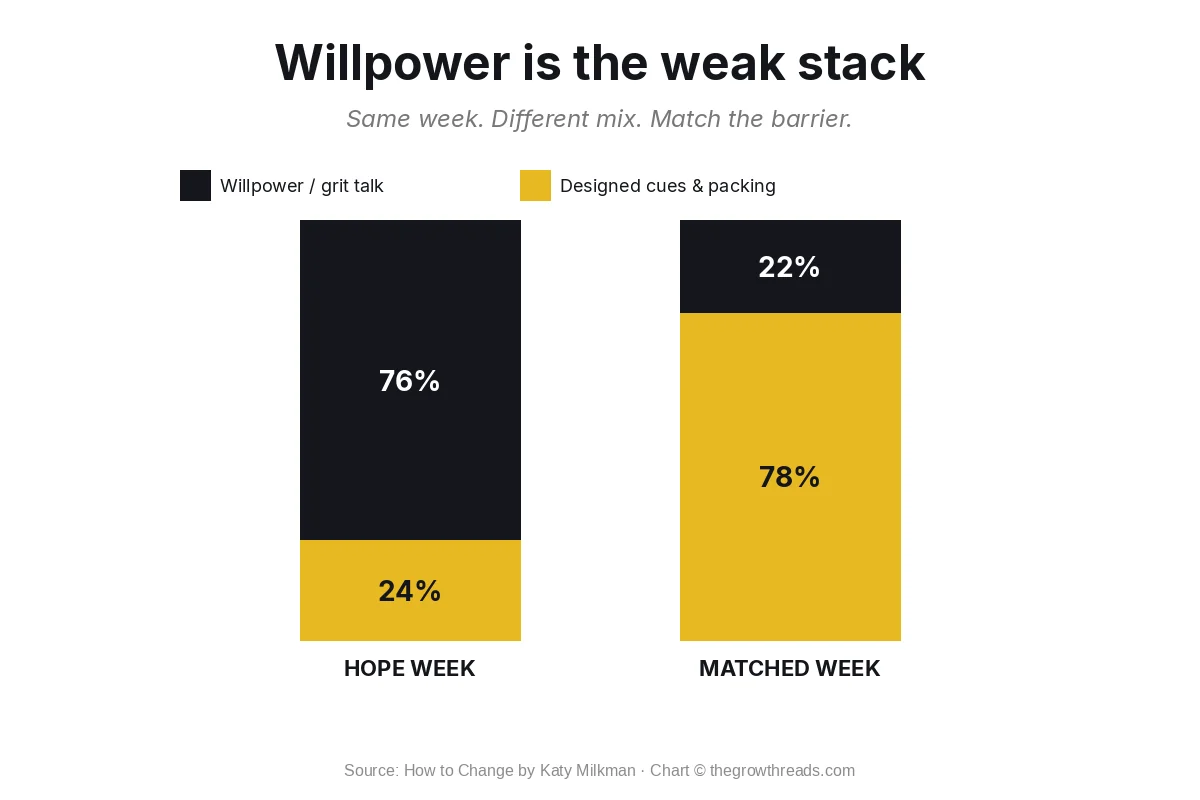
Willpower is a weak strategy for a mismatched problem. Katy Milkman, a Wharton professor and host of Choiceology, watched good people fail at goals they already believed in. The usual advice — try harder, set a bigger target, download another streak app — treats every stall as a character gap. How to Change treats it as a design gap. Name the barrier. Match the tool. A Monday is a free door. A boring gym hour works when the audiobook only plays there. Future you can be bound by a cash lock. Forgetting needs a cue in the path. Laziness needs a packed default. Confidence copies a working sequence. You need the chapter that describes this week’s stall — then one hour that happens without a negotiation.
Key takeaways
- Match the barrier: a goal-setting app will not fix a boring workout or a forgotten cue.
- Cash the fresh start: Mondays, birthdays, new jobs, and New Year already feel like a blank page — start then, install a cue before the glow fades.
- Bundle temptation: pair a should with a want, and restrict the want so it only happens with the should.
- Bind future you: commitment devices make flaking expensive while present you still wants the goal.
- Cue the path, not the phone: memory is a bad system. Put the trigger where the action lives.
- Pack the default: lay out the kit so the easy move is the right one.
- Copy and paste a sequence: borrow the exact steps from someone who already does it.
- Give the advice: teaching the plan to someone else locks your own week.
- Stay flexible: rigid streaks snap. A missed day is data, not a personality verdict.
- One tool this week: unused science is still a pep talk in hardcover.
What is How to Change about?
How to Change is Katy Milkman’s science-backed playbook for getting from where you are to where you want to be by matching the tactic to the barrier in the way — impulsivity, delay, forgetting, laziness, shaky confidence, or other people — instead of asking willpower to do a job it was never built for.
About the author
Katy Milkman is the James G. Dinan Professor at The Wharton School of the University of Pennsylvania, where she studies decision-making and behavior change. She hosts Choiceology and co-directs the Behavior Change for Good Initiative with Angela Duckworth, who wrote the foreword. Milkman trained as an engineer and as a behavioral scientist; the book reads like a lab notebook for people with jobs. Her research on the fresh start effect and temptation bundling is the spine of several chapters. She is not a guru of grit. She is a professor of design: change the path so the wanted action is the downhill one. Explore all Katy Milkman book summaries →
Key concepts at a glance
| Concept | What it means | Use it when |
|---|---|---|
| Barrier matching | Pick the tool that fits the actual stall, not a generic pep talk. | You keep buying apps and the week does not move. |
| Fresh start effect | Landmarks make beginning cheaper because the story already reset. | You need a door, not more motivation. |
| Temptation bundling | A want is allowed only with a should. | The work is useful and boring. |
| Commitment device | Make flaking costly while you still mean it. | Future you always negotiates. |
| Cues | A trigger in the path so memory is not the system. | You agree in the morning and forget by 4 p.m. |
| Packing / defaults | Set the easy move to be the right move. | Inertia wins every unstructured hour. |
| Copy and paste | Steal a working sequence, not a vibe. | You know the goal and not the steps. |
| Advice giving | Teaching the plan binds you to it. | Private streaks keep dying quietly. |
| Flexible persistence | Misses are data. Brittle all-or-nothing streaks snap. | One skipped day becomes a lost month. |
Part 1: Start when the slate already feels new
The getting-started problem is not a mystery of character. It is a timing problem. Milkman’s work on the fresh start effect shows that people try harder at temporal landmarks: the start of a week, a month, a year, a birthday, a new job, even the first day back from a trip. The calendar already told a new chapter. Beginning costs less identity because the old streak is on the other side of a line you did not have to draw. That is why gyms fill in January and empty in February. The landmark opened the door. Nothing in the path held it open.
The practical use is smaller than a New Year’s resolution. Pick the next cheap landmark — this Monday, the first of the month, the day after a trip — and attach a cue before the glow fades. A fresh start without a packed bag is a speech. Spend the free Monday on the first awkward rep, not on a new notebook. Readiness is what happens after the landmark, not before it.
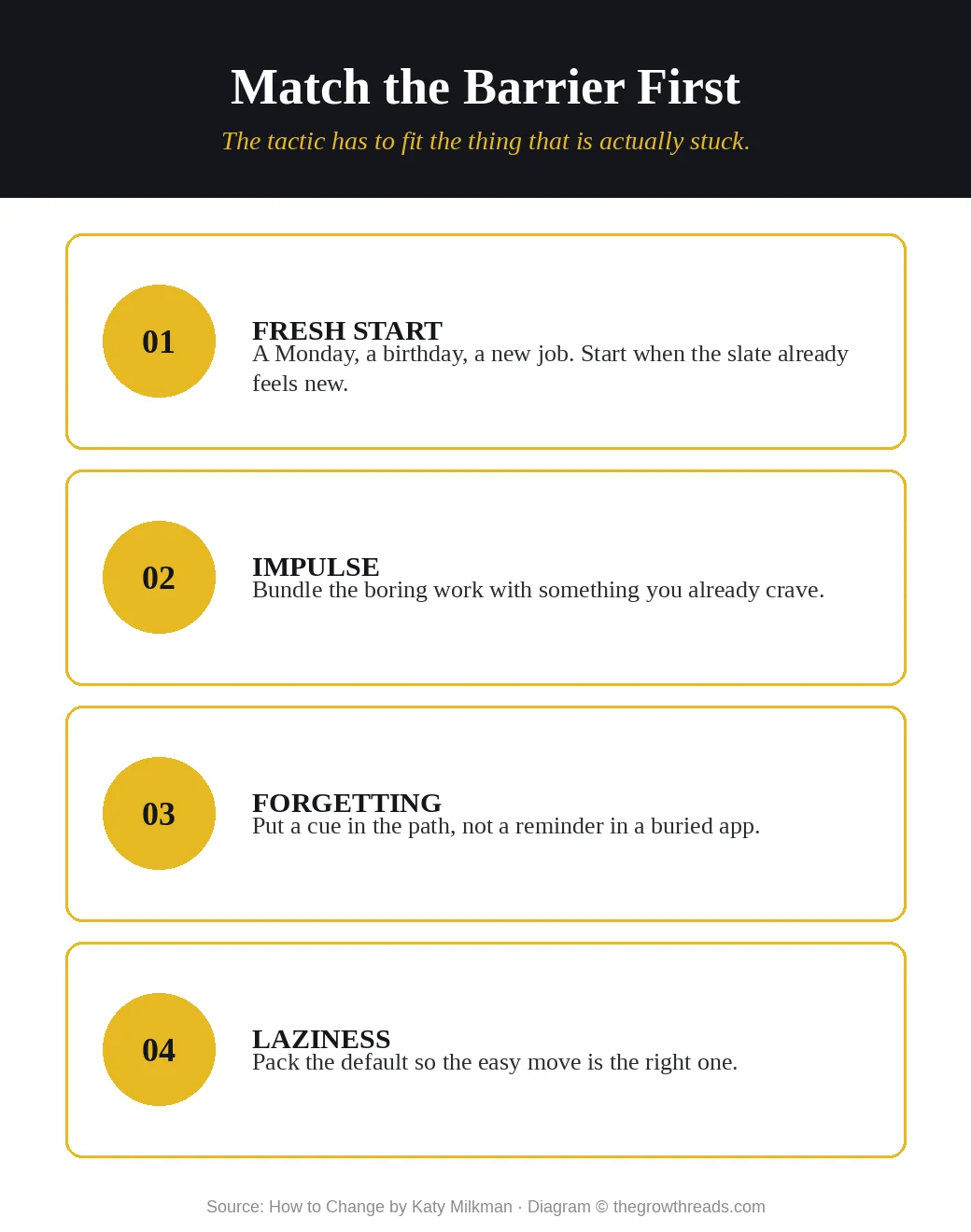
If you miss the landmark, the following Monday still counts. A fresh start can also become a stall — always about to begin on an even date. Cash this week’s door. Install one cue. Stop collecting beginnings.
TGR Note. James Clear’s Atomic Habits summary is the loop after the door opens. Milkman gets you through the door. Clear keeps the loop alive. If the first rep is still too big, Tiny Habits shrinks it so Tuesday does not need another speech.
Part 2: Impulse and delay — make the hard thing tempting, then bind it
When the work is useful and boring, grit talks are a mismatch. Milkman’s temptation bundling studies paired exercise with page-turner audiobooks that people were only allowed to hear at the gym. The workout stopped being a moral test and became the only door to the story. The restriction is the design. If the treat also plays on the couch, you will pick the couch. Office versions are easy to steal: a favourite podcast only on the walking loop, a show only on the treadmill, a fancy coffee only in the deep-work chair. You are not bribing yourself forever. You are making the wanted action the downhill path for a season until identity catches up.
Delay is a different barrier. Present you wants the goal. Future you will flake. Commitment devices make flaking expensive while you still mean it: a cash lock, a public deadline, a prepaid class. You do not need more inspiration at 9 p.m. You need a 9 a.m. decision that 9 p.m. cannot reopen. A bind that is too harsh snaps. Lock the one hour that matters. Leave the rest of the day human.
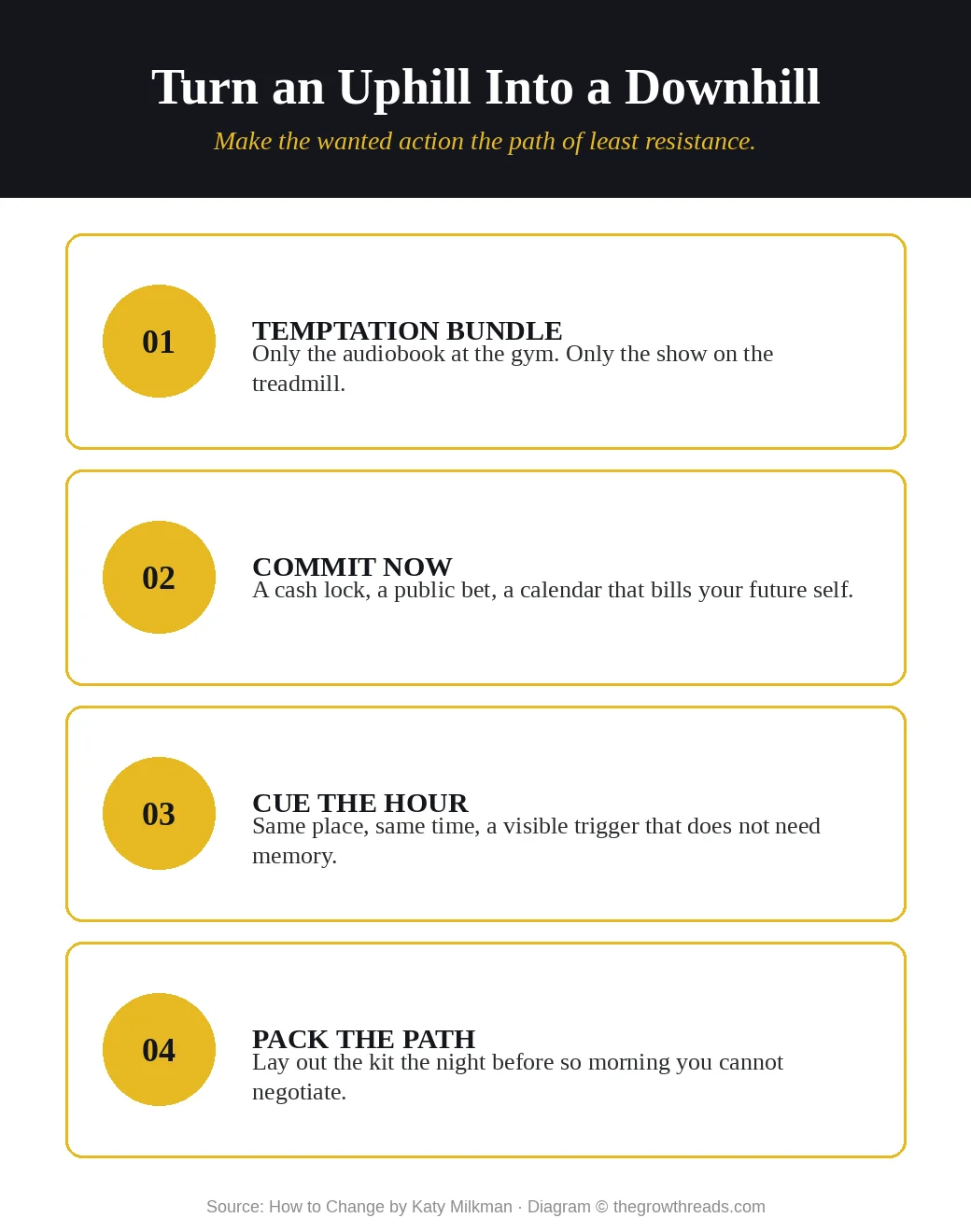
Put bundling and binding on the same week and the stall looks different. The gym is “finish the chapter,” not “be disciplined.” If you do not even remember the task at 4 p.m., skip ahead to cues. Matching still wins.
TGR Note. If delay is the whole story, Piers Steel’s The Procrastination Equation is the formula. Milkman is the kit you bolt onto it. For the blunt first-task version, Eat That Frog is shorter.
Part 3: Forgetting and laziness — cue the path, pack the default
Plenty of “undisciplined” weeks are just forgotten weeks. You meant to take the pill, send the invoice, open the document. Then 4 p.m. arrived and the intention was gone. Milkman’s answer is not a louder alarm buried in a phone. It is a cue in the path: the pill next to the kettle, the invoice template as the browser homepage for that hour, the running shoes in front of the door. Memory is a terrible operating system. The environment is a better one. If you have to remember to be the kind of person who does the thing, you will lose on busy days. If the thing is already in the way of the kettle, busy days still fire.
Laziness, in this book, is not a slur. It is the brain’s preference for the default. Packing uses that preference. Lay out the clothes, the bag, the one tab, the water bottle the night before so morning you cannot open a negotiation. Make the wanted action the path of least resistance and the unwanted action slightly annoying: the junk-food drawer on a high shelf, the social app off the home screen, the TV remote in another room. Wendy Wood’s habit research sits in the background here even when Milkman does not lecture it: repetition in a stable context beats a heroic mood. You are not becoming a new person overnight. You are making the old person trip over the right object.
A cue without packing still asks you to assemble the kit. Packing without a cue still asks you to remember the hour. Same place, same time, kit already out. If you remember and still sit down, go back to Part 2 instead of buying another reminder app.
TGR Note. Wendy Wood’s Good Habits, Bad Habits is the deeper friction book. Charles Duhigg’s The Power of Habit is the cue-routine-reward story. Milkman is the diagnostic on top. If the phone is the default, Indistractable is the companion for the same hour.
Part 4: Confidence, other people, and a change that lasts
Some stalls are not impulse or memory. You do not believe you can do it, or you do not know the steps, or you are trying to be a lone hero. Milkman’s copy-and-paste move is almost insultingly practical: find someone who already does the thing and steal the sequence, not the vibe. What time. Which bag. Which first five minutes. Which exit when it rains. Advice from a peer who is one step ahead often beats advice from a distant expert, because the sequence is actually copyable. Confidence grows from a working script, not from a mirror affirmation.
A second confidence tool is backwards: give the advice. When you explain the plan to a friend, you hear the holes and you bind yourself. Teaching is a commitment device that does not need cash. Other people also solve the conformity problem. If the people around you skip the hour, you will skip. If they walk at 7 a.m., you will find shoes. You do not need a new personality. You need a different default group for that one behavior.
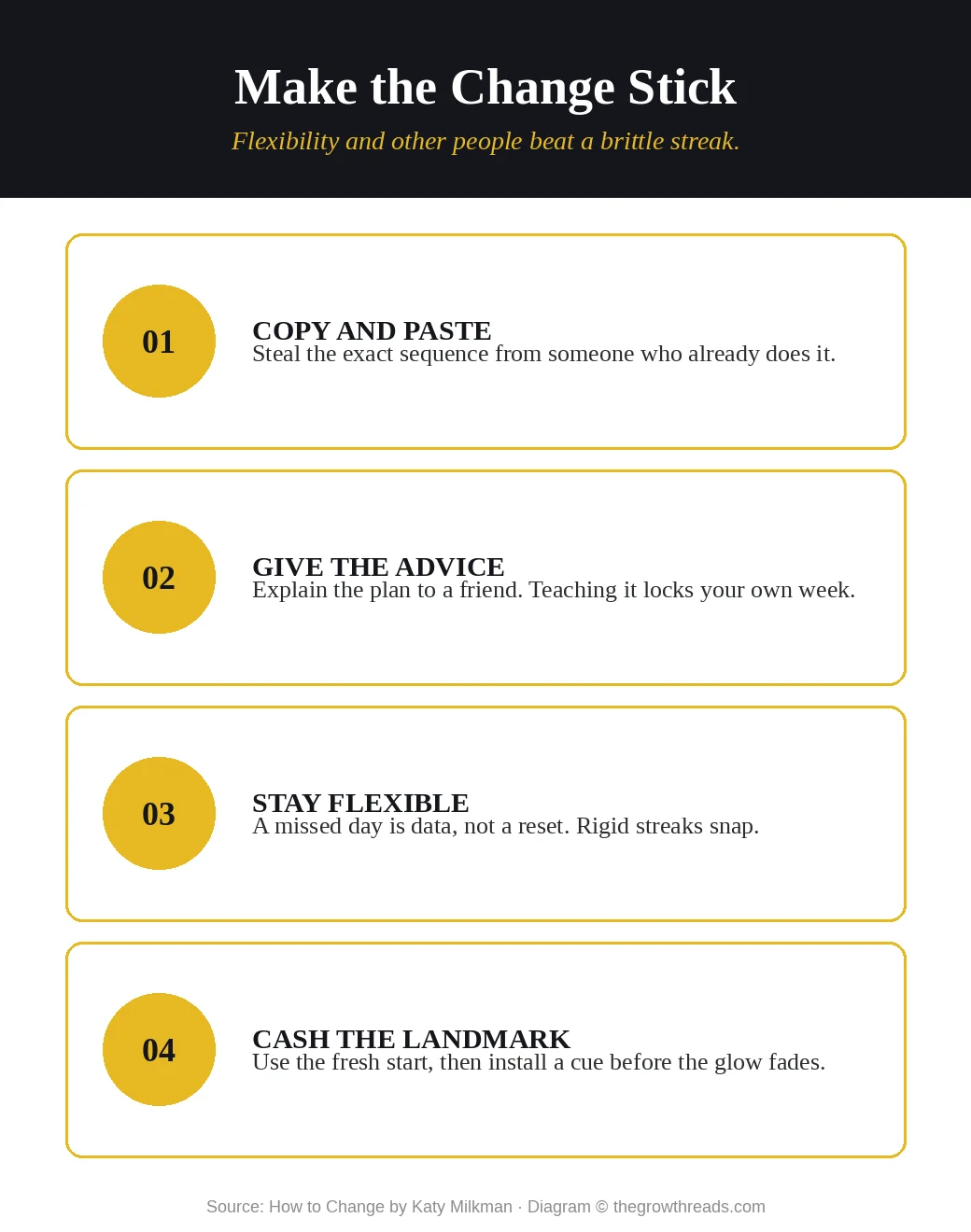
The last trap is a brittle streak. All-or-nothing plans feel clean and then shatter on a sick day. Milkman argues for flexibility: a missed day is data, not a verdict. The people who last are the people who have a rule for getting back on the path, not a fantasy of never falling. Use the fresh start when you need a door. Do not use it as an excuse to wait. Install the cue. Keep the bundle. Tell one person. That is a change that can survive next month, when the landmark is just another Thursday.
TGR Note. If the inner voice is the barrier, The Champion’s Mind trains the coach instead of the critic. Mini Habits keeps the floor so low a bad week still counts. Milkman matches the path; those books keep identity from overreacting.
Who is How to Change best for — and who should read something else first?
Best for people who can name the goal and still stall for a specific reason — the workout is boring, the invoice is forgotten, the writing hour always loses to the phone, the streak dies after one miss. Also for managers who keep giving the team another motivational offsite instead of changing the default path.
Read something else first if you do not have a loop at all: start with Atomic Habits or Tiny Habits. If delay is the only issue and you want the formula, The Procrastination Equation. If the environment is chaos, Good Habits, Bad Habits. If the phone is the default, Indistractable. If you want the original cue-routine-reward story, The Power of Habit. Come to Milkman when the goal is clear and the week still fails in a way you can point at.
Questions to reflect on
- What is the one-word barrier for the goal you keep missing — start, impulse, delay, forgetting, laziness, confidence, or other people?
- Which cheap landmark is already on the calendar this month, and what first rep will you cash it on?
- What treat are you willing to restrict so it only happens with the should?
- Where does the action fail because the kit is not packed, not because you “lack discipline”?
- Whose exact sequence can you copy this week, and who will you teach the plan to by Friday?
🔥 Ready to stop asking willpower to do a design job?
Get How to Change and match one tool to this week’s actual barrier.
How to apply How to Change (7-day plan)
- Day 1 — Name the barrier: Pick one live goal. Write one word: start, impulse, delay, forgetting, laziness, confidence, or other people. Do not pick two.
- Day 2 — Cash a landmark: Use the next Monday (or the first of the month). Do the first awkward rep that day. Do not wait for a prettier date.
- Day 3 — Bundle or bind: If the work is boring, restrict a treat to that hour. If future you flakes, add a small cash or public lock.
- Day 4 — Cue the path: Put the trigger where the action lives — shoes at the door, template as the homepage, pill by the kettle.
- Day 5 — Pack the default: Lay out tomorrow’s kit tonight. Make the wrong move slightly annoying.
- Day 6 — Copy and tell: Steal a sequence from someone who already does it. Explain your plan to one person.
- Day 7 — Review flexibility: If you missed a day, write the rule for getting back on the path. Keep the one tool that actually moved an hour. Drop the rest.
Frequently asked questions
What is How to Change about?
How to Change is Katy Milkman’s field guide to getting from where you are to where you want to be by matching the tactic to the actual barrier. Fresh starts help you begin. Temptation bundling and commitment devices handle impulse and delay. Cues and packing handle forgetting and laziness. Copy-and-paste, advice-giving, and flexible streaks help the change last. It is a behavior-science book for ordinary weeks, not a memoir and not a 30-day challenge. You diagnose the stuck point, then pick one tool that fits it.
Who should read How to Change?
Read it if you already know what to do and still stall — gym, deep work, outreach, a writing hour. It is for operators, students, and managers who keep buying another habit app instead of naming the barrier. Skip it as a first book if you have no cue at all; start with Atomic Habits or Tiny Habits. If delay is the only problem, The Procrastination Equation is tighter. Come here when the goal is clear and the week still slips for a specific, namable reason.
What is the fresh start effect?
The fresh start effect is Milkman’s finding that people try harder at temporal landmarks: Mondays, the first of the month, a birthday, a new job, a new year. The calendar already feels like a new chapter, so the first step costs less identity. The glow fades unless you install a cue or a bundle while it lasts. A fresh start is a door, not a personality upgrade. Cash it this Monday, then pack Tuesday so you are not waiting for next January.
What is temptation bundling?
Temptation bundling pairs a should with a want so the wanted action becomes the price of admission for the treat. Milkman’s gym study let people listen to page-turner audiobooks only while exercising. The workout stopped being a character test and became the only door to the story. You can bundle a walking loop with a podcast, inbox with a favourite playlist, or language drills with a show. The rule is restriction: the treat does not travel. If it plays on the couch, the bundle is dead.
How is How to Change different from Atomic Habits?
Atomic Habits is the loop: cue, craving, response, reward, and identity. How to Change is the diagnostic: which barrier is actually in the way, then which tool fits. Clear is unmatched for building a tiny repeating action. Milkman is unmatched when the tiny action is already obvious and still fails because of impulse, delay, forgetting, or a brittle streak. They stack. Use Atomic Habits to set the loop. Use How to Change when the loop keeps dying for a specific reason. Do not treat them as rivals.
How long does How to Change take to read?
The Portfolio hardcover is 272 pages — about four to five hours, or an evening if you skip the notes. Applying it is the longer job. A useful test is seven days: name the barrier on day one, install one matching tool, then review whether a real hour moved. If nothing in the calendar changed, you summarized the book. You did not install it. Reread the chapter that matches this week’s stall before you reread the whole set. Twenty minutes before Monday is enough.
What is the fastest way to apply How to Change this week?
Pick one live goal, not a hypothetical. Write the barrier in one word: start, impulse, delay, forgetting, laziness, confidence, or other people. Match one tool. Fresh start plus a packed cue. A bundle that restricts a treat. A commitment that costs you money. Copy the exact sequence from someone who already does it. Tell one person the plan so advice-giving locks it. Do that before you buy another tracker. The book starts when Tuesday happens without a negotiation on the hour.
Related summaries
- Atomic Habits Summary — the cue-craving-response-reward loop to install after the door opens.
- Tiny Habits Summary — shrink the first rep so Tuesday does not need a speech.
- Good Habits, Bad Habits Summary — friction and context, not more grit.
- The Procrastination Equation Summary — the formula behind delay.
- 20 Best Productivity Books of All Time (2026) — the full Productivity pillar.
How we analyze books: we read for the operating system, test the parts you can use in a week, and write the plan we would hand a friend. Read our full methodology.