

★★★★★ 4.7/5 — Leave the replay. Return once. Begin the thing in front of you.
Best for: People whose mind lives in yesterday’s argument and tomorrow’s rehearsal, and anyone with a stack of spiritual books and no Tuesday practice
Reading time: ~8 hrs for the Harmony square paperback · ~10 min for this guide
Difficulty to apply: The return is small; dropping the story you keep defending is the hard part
Be Here Now in one minute
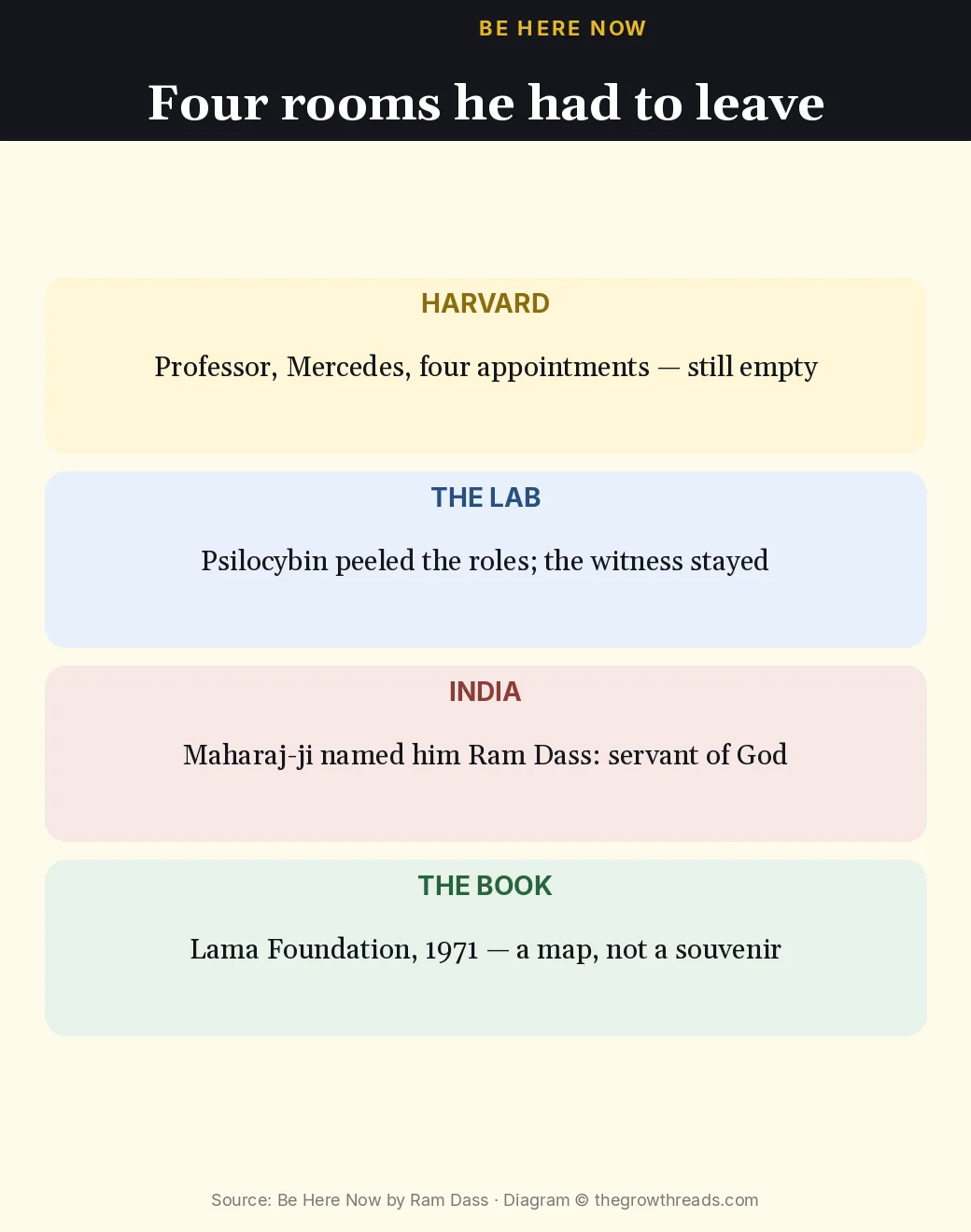
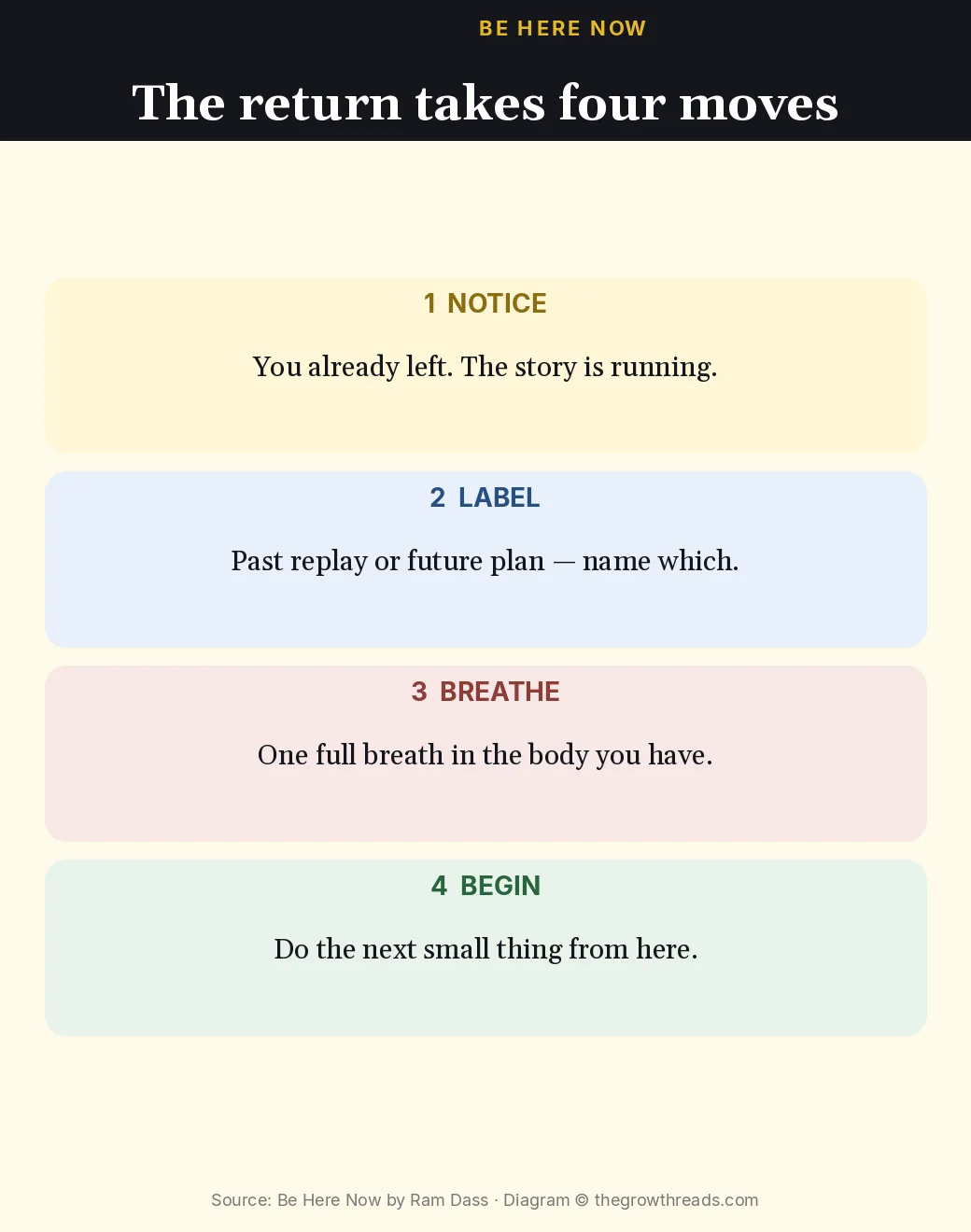
The mind leaves. Presence is a return, not a personality. Ram Dass’s 1971 book — square, illustrated, still strange on a subway — is a conversion story plus a kitchen. Richard Alpert had Harvard appointments, a Mercedes, and a hole he could not think his way out of. Psychedelics peeled the roles. India gave him Neem Karoli Baba, who would not let him stay clever, and a name: Ram Dass, servant of God. The middle, first printed as From Bindu to Ojas, is a visual teaching: you are not the story in your head. The third section is a cookbook — breath, body, word, service — because descriptions of food do not feed you. The last is a reading list with a warning: painted cakes do not satisfy hunger. Notice you left. Label past or future. Take one breath. Begin the next small thing.
Key takeaways
- The hole was not a worse résumé: Alpert had status. The emptiness was under the role, not a missing credential.
- The witness is not another character: Roles peel. Something remains that can watch the peeling without a speech.
- A name can be a job: Ram Dass means servant of God. It is work, not a brand.
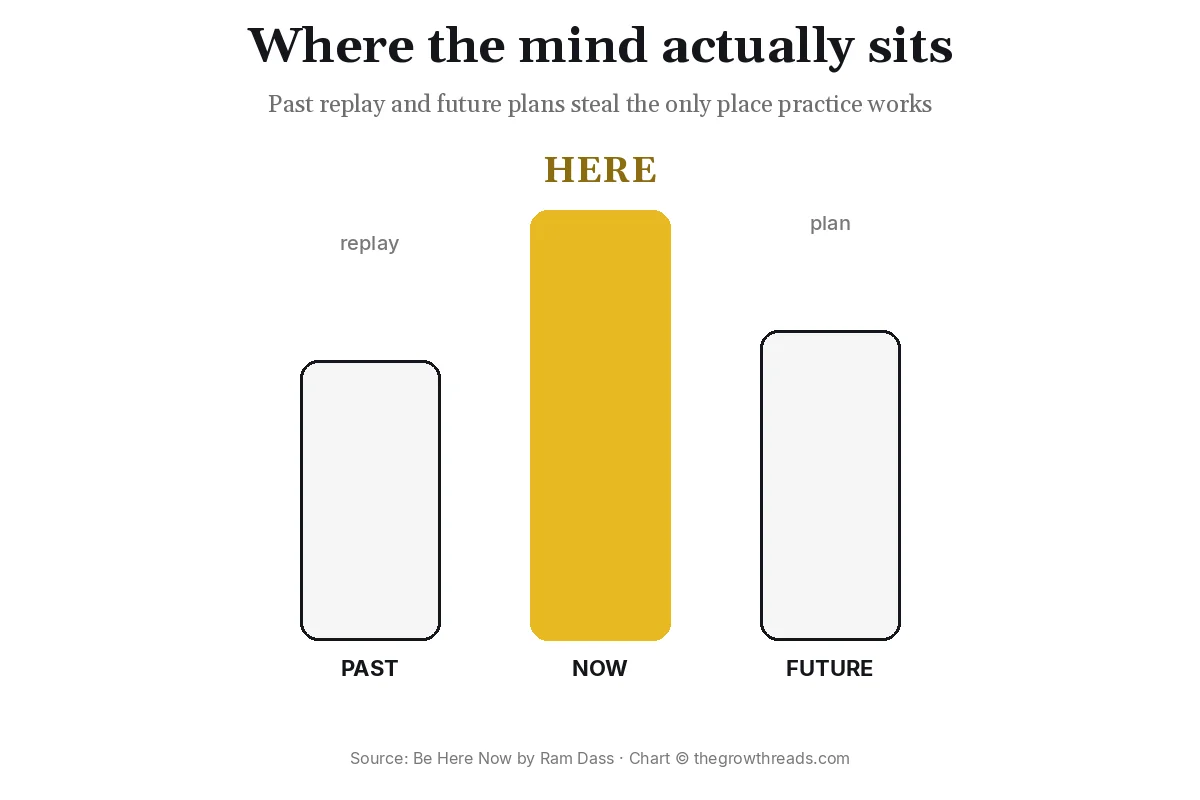
- Be here now is an instruction: If you are remembering, you left. If you are planning, you left. Return.
- Four trails, one mountain: Work, devotion, method, and insight are not rival clubs. They are ways back.
- The cookbook is the point: Asana, breath, mantra, diet, company, service. Pick one recipe this week.
- Painted cakes do not feed you: Collecting spiritual descriptions is still collecting. Practice is the meal.
- The guru is a mirror: You do not have to copy 1967. You do have to stop performing cleverness.
- The usable close is a return: One breath, one stretch, one meal without a screen, one act of help with no credit.
What is Be Here Now about?
Be Here Now is Ram Dass’s 1971 method for leaving the story of who you think you are and returning to this moment. A Harvard psychologist follows psychedelics to India, takes a new name, and hands you a cookbook of breath, body, word, and service so the teaching does not stay a souvenir.
About the author
Ram Dass (born Richard Alpert; 6 April 1931 – 22 December 2019) was an American psychologist, writer, and spiritual teacher. He taught at Harvard with Timothy Leary, ran early psilocybin studies, and was dismissed in 1963. In 1967 he went to India, met Bhagavan Das, and was taken to Neem Karoli Baba — Maharaj-ji — who named him Ram Dass. Be Here Now, produced at the Lama Foundation in New Mexico and published by Harmony in 1971, made that path public and helped bring yoga and Hindu vocabulary into Western living rooms. He later wrote Grist for the Mill, How Can I Help?, and Polishing the Mirror, taught, and kept serving after a 1997 stroke. The usable thread is not the costume. It is the return. Explore all Ram Dass book summaries →
Key concepts at a glance
| Concept | What it means | Use it when |
|---|---|---|
| Be here now | Leave the replay and the plan; return to this moment | You are in a meeting in your body and an argument in your head |
| The witness | That which watches roles peel without becoming a new role | You are performing a spiritual identity |
| Ego story | The résumé, wound, and future self you keep defending | A slight hijacks the next hour |
| Guru as mirror | A teacher who will not let you stay clever | You keep collecting methods and skipping the one in front of you |
| Four yogas | Work, devotion, method, insight — trails on one mountain | You think you picked the wrong path |
| Cookbook | Breath, body, word, service as recipes, not a shrine | You finished a spiritual book and did not change Tuesday |
| Painted cakes | Descriptions of practice that never get cooked | Your shelf is growing and your mornings are not |
| Sadhana | The day’s actual practice, however small | You are waiting for a retreat to begin |
Part 1: The professor who could not stay in his own life
The first section is prose, and it is a setup, not a celebrity tour. Richard Alpert has the Western scoreboard: Harvard appointments, a Mercedes, a calendar that looks like success. He is not pretending it was fake. He is reporting that it did not close the hole. If your emptiness is a missing credential, you will keep adding credentials. If the hole is under the role, more role will not fill it. Be Here Now starts there so you do not skip to the mandala pages as décor.
Psychedelics enter as a solvent, not as the destination. With Timothy Leary he runs the early Harvard psilocybin work. Roles peel. A witness remains. Then the solvent stops being enough — states fade, the role grows back — and Harvard dismisses him in 1963. The book does not treat that as a martyr story. It treats it as the moment the old game would not employ him. You do not need his lab. You need the question: which of your roles, if it were taken, would you still know how to be here?
India is the next room. In 1967 he follows a thread to Bhagavan Das and then to Neem Karoli Baba. Maharaj-ji feeds him, names him Ram Dass — servant of God — and points him at the present when the mind runs to yesterday or to a plan. The instruction that becomes the title is a correction, not a mug slogan. If he reminisced, he was gone. If he planned, he was gone. Be here now. The rest of the volume is how to live it when the teacher is not in the room.
TGR Note: The Power of Now is the cleaner manual for the same return. Be Here Now is the conversion story that still has dust on it — useful when a sleek teaching feels like another role. Autobiography of a Yogi is the older guru-memoir cousin, not a substitute for Tuesday’s breath.
Part 2: From Bindu to Ojas — you are not the story
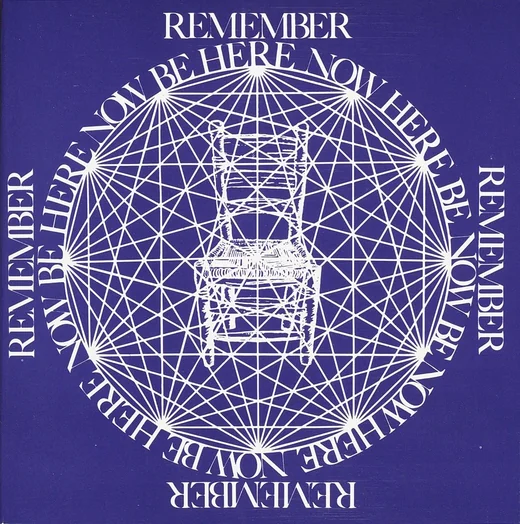
The middle of the book was first a separate object, From Bindu to Ojas, printed at the Lama Foundation before Harmony wrapped the four sections into the 1971 square paperback. It is a visual teaching, not a chapter you outline. Under the art the argument is simple enough to steal. You identify with a story — child, achiever, wounded one, spiritual one. The story runs. Something in you can watch the running. That watcher is closer to what you are than the plot.
Ram Dass is not asking you to annihilate personality as a weekend project. He is asking you to stop taking the thought-stream as the whole of you. The mind will go to the past. It will build a future self who has finally arrived. The work is not to win an argument with the stream. The work is to notice you left, and to come back without a new identity: the person who is very present now, thank you. The moment you advertise presence, you have a costume again.
Four classical trails show up as one mountain, not rival clubs: work without collecting the trophy, devotion, method (posture, breath, concentration), and insight. Western readers often pick one and despise the others. The gift is permission to use the trail in front of you. If you can serve, serve. If you can sit, sit. The mountain does not need your brand. It needs your feet. When you are in your inbox and also in last night’s slight, you have left. Remembering. Planning. Here. Practice has one address.
TGR Note: The Untethered Soul names the same split: the voice in your head is not you. Ram Dass gives you the conversion story behind that split. A New Earth is Tolle on the ego as a pain-body — a later, cleaner language for the story this book asks you to drop.
Part 3: Cookbook for a Sacred Life
Then the book changes temperature. After the illustrated teaching comes a kitchen. Cookbook for a Sacred Life is lists and methods: asana, pranayama, diet, mantra, meditation, study, the company you keep, service. It is easy to skip because it looks less holy than the mandala pages. Skip it and you have a souvenir. Ram Dass knows Western readers will collect descriptions. He writes a cookbook so you will cook.
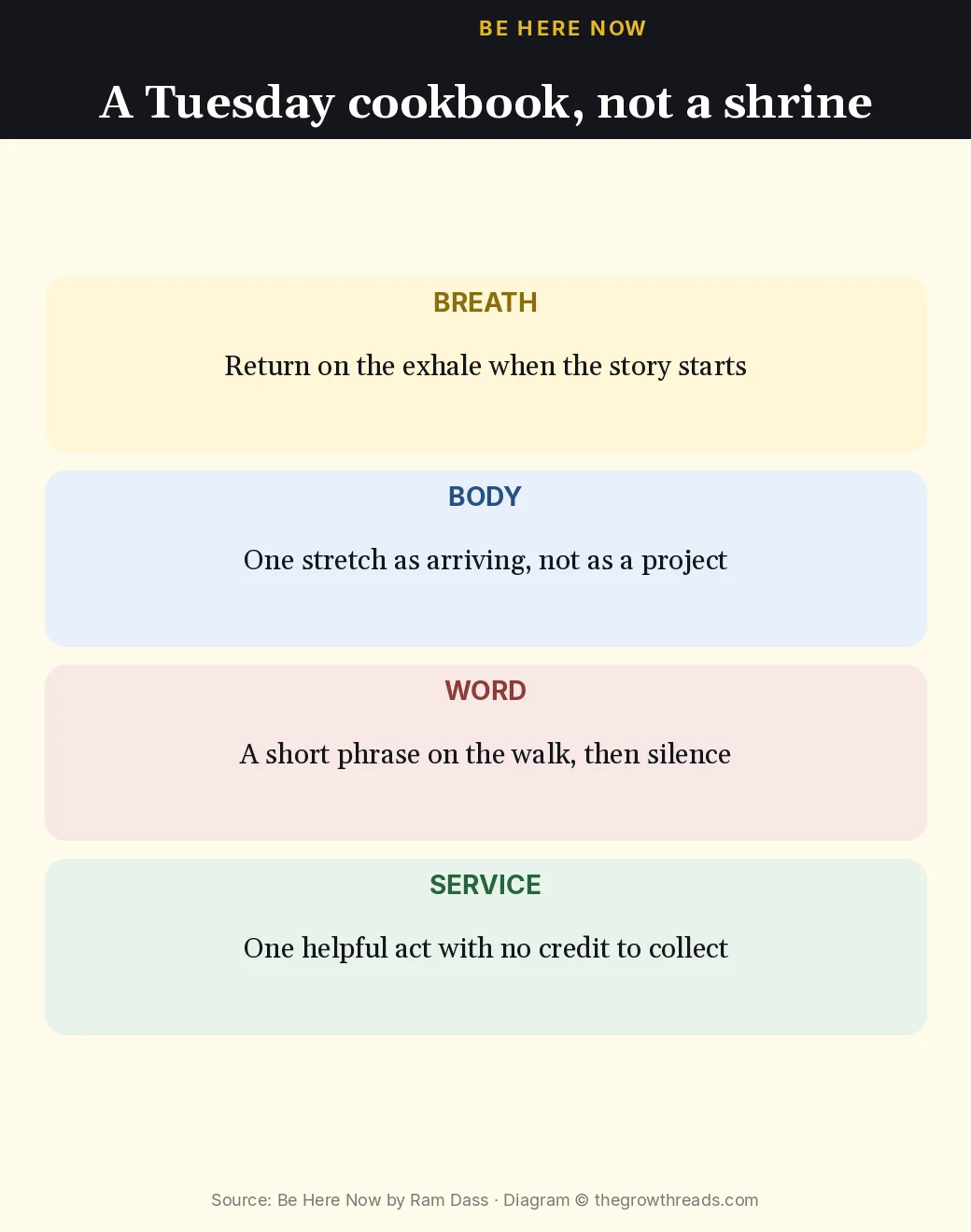
You do not need the whole menu. A cookbook is not a syllabus. Pick one recipe this week. Breath: return on the exhale when the story starts. Body: one stretch as arriving, not as a project. Word: a short phrase on the walk — the title will do — then silence. Service: one helpful act with no credit. If you post the act, you ate a painted cake. The company you keep is also a method. One friend who will not help you rehearse the slight is enough. Read a page and do the page. Sleep, food, and a walk are the ground the witness stands on — not a taxi for a special mind.
TGR Note: The Happiness Trap is a clinical cousin: notice the thought, return to the valued act. Ram Dass is not ACT, but the Tuesday shape rhymes. Full Catastrophe Living is the hospital-tested version of coming back to breath when the story is loud — Health silo, same return.
Part 4: Painted cakes do not feed Tuesday
The last section is a bibliography dressed as a warning. Painted cakes do not satisfy hunger. You can hang out with books, visit them, or have merely met them — Ram Dass even sorts the lists that way — and still starve. The 1971 reader who stacked Hesse and a yoga manual without sitting is the 2026 reader who stacks tabs and a notes app called “practice.” The food is the practice. The picture of the food is not.
This summary refuses to turn Be Here Now into a personality. The hair, the beads, the square purple object — costumes. Maharaj-ji’s correction still fits a phone year: if you are in the replay, you have left; if you are in the plan, you have left; the only place you can love someone or wash the cup is here. Ram Dass recounts the instruction as “Be here now.” Three words. If you need a longer handle, use notice, label, breathe, begin. If the shelf grew this month and the mornings did not, you have been eating paint.
Who is Be Here Now best for — and who should read something else first?
Best for readers whose mind lives in yesterday’s argument and tomorrow’s rehearsal; people who already own spiritual books and cannot point to a weekday practice; anyone who needs to see a credentialed Western psychologist drop the role without turning into a mascot. It is also for readers who bounce off sleek manuals and need a story with dust on it before they will sit.
Read something else first if you want the shortest presence manual — start with The Power of Now. If the problem is specifically the narrator in your head, The Untethered Soul is tighter. If you want a guru memoir with a different India, Autobiography of a Yogi. If you want a clinical return-to-now, The Happiness Trap. If you came for a fable about following a dream, The Alchemist is that book; this one is a kitchen.
Questions to reflect on
- Which role, if it were taken from you this week, would you not know how to be here without?
- When you left in the last hour, was it a replay or a plan? Write the label. Not the essay.
- What is one painted cake on your shelf — a book, a tab, a course — that has never been cooked?
- Who in your actual life makes the return easier, and who helps you rehearse the slight?
- What is the smallest recipe you will cook tomorrow: breath, stretch, phrase, or one act of help with no credit?
🔥 Ready to leave the story and return once?
Get Be Here Now and steal a Tuesday cookbook you can start without a new identity.
How to apply Be Here Now (7-day plan)
- Day 1 — Catch one leave. When you notice you are in a replay or a plan, say the label out loud or on paper. No essay. Then take one full breath and return to the thing in the room.
- Day 2 — Three labels. Three times today: remembering, planning, or here. Put a tick in a notebook. You are counting leaves, not becoming a person who journals.
- Day 3 — Arrive in the body. One stretch or a two-minute walk without a phone. Treat it as arriving, not as training.
- Day 4 — A phrase, then silence. On one walk, use “be here now” for a minute. Then drop it. Do not perform it at anyone.
- Day 5 — Service without credit. One helpful act nobody has to know about. If you want to post it, you found a painted cake.
- Day 6 — One meal without a screen. Taste the food you actually have. When the story starts, label it and return to the next bite.
- Day 7 — Name the identity you defend. One sentence: “The story I keep leaving into is ___.” Then do the next small thing from here for an hour. No new personality required.
Frequently asked questions
What is Be Here Now about?
Be Here Now is Ram Dass’s 1971 book on waking up from the story of who you think you are. The first section is the conversion: Richard Alpert, Harvard psychologist, follows a thread through psychedelics to India and to Neem Karoli Baba, who names him Ram Dass. The middle is a visual teaching on presence. The third is a cookbook of yoga, breath, mantra, and service. The last warns that reading about food does not feed you. This summary steals a weekday method: notice you left, return once, and do the next small thing from here.
What does “be here now” actually ask you to do?
It asks you to stop living in the replay and the plan for one breath, then begin the thing in front of you. Ram Dass is not selling a mood. The mind leaves. That is normal. The work is noticing the leave and coming back without a speech about what a spiritual person you are. Label the trip: remembering or planning. Feel the body you actually have. Then send the email, wash the cup, take the walk. The phrase is a handle, not a personality. If you turn it into an identity, you have left again.
Is Be Here Now a religion or a method?
It is a method with a Hindu vocabulary. Ram Dass does not ask you to join a church. He points at karma yoga, bhakti, raja, and jnana as four trails on one mountain, then hands you practices you can do in an apartment. You can use the return without chanting a single Sanskrit word. The guru in the book is a mirror, not a membership card. If a lineage helps you, the cookbook will meet you. If it does not, keep the four moves: notice, label, breathe, begin. The usable steal is presence, not a new costume.
How is Be Here Now different from The Power of Now?
The Power of Now is a clean manual. Be Here Now is a conversion story that still has dust on it. Tolle starts from the present. Ram Dass starts from a Mercedes, a firing, a plane to India, and a teacher who would not let him stay clever. If you want the shortest path to a practice, start with Tolle. If you need to see a successful Western psychologist drop the role and still sound like a human, start here. They rhyme. Both say the thought-stream is not the whole of you. This book adds a cookbook and a warning about painted cakes.
Do you need a guru to use this book?
No. Ram Dass had Maharaj-ji, and he is honest that the relationship melted his cleverness. You do not have to replicate 1967. The cookbook treats teachers, books, and friends as scaffolding. The actual work is returning when the story starts. A live teacher can shorten the delay between noticing and returning. A book can do the same if you open it on a schedule. If you collect gurus the way some people collect notebooks, you are eating painted cakes. One practice, done today, beats a perfect lineage you have not started.
What is the “cookbook” section for?
Cookbook for a Sacred Life is the Tuesday section. After the illustrated teaching, Ram Dass lists methods: asana, pranayama, diet, mantra, meditation, service, study, and the company you keep. It is not a syllabus you must finish. It is a kitchen. You pick one recipe this week. The point of a cookbook is that descriptions of food do not feed you; cooking does. If you only read the middle mandala pages and skip the practices, you have a souvenir. The 7-day plan below is one small menu from that kitchen.
Is Be Here Now still useful in 2026?
Yes, because the mind still leaves. Phones made the leave faster. The 1971 square book is not a productivity system and not a clinic. It is a reminder that the only place you can practice is the moment you are in. You do not need to copy the clothes, the drugs, or the ashram calendar. You need a return you will actually do: one breath, one stretch, one meal without a screen, one act of help with no post about it. The dated parts are costume. The instruction is not. Be here now is still the shortest sentence that names the work.
Related summaries
- The Power of Now — the cleaner manual for the same return.
- The Untethered Soul — the voice in your head is not you.
- Autobiography of a Yogi — another India, another kitchen.
- A New Earth — ego as a pain-body you can drop on a Tuesday.
Browse the full list on our Best Psychology Books pillar.
How we analyze books: our summaries are built from a full read of the source text, cross-referenced against the author’s published interviews and research where relevant, and structured around practical application rather than critique. We disclose our editorial process and affiliate relationships in full. Read our full methodology.