

★★★★☆ 4.4/5 — Stop waiting for the room to pick you.
Best for: people stuck in “please hire me, publish me, fund me.”
Reading time: ~4.5 hrs (guide: 45 min)
Difficulty to apply: Medium — the Daily Practice is simple; doing it daily is the work.
Choose Yourself in one minute
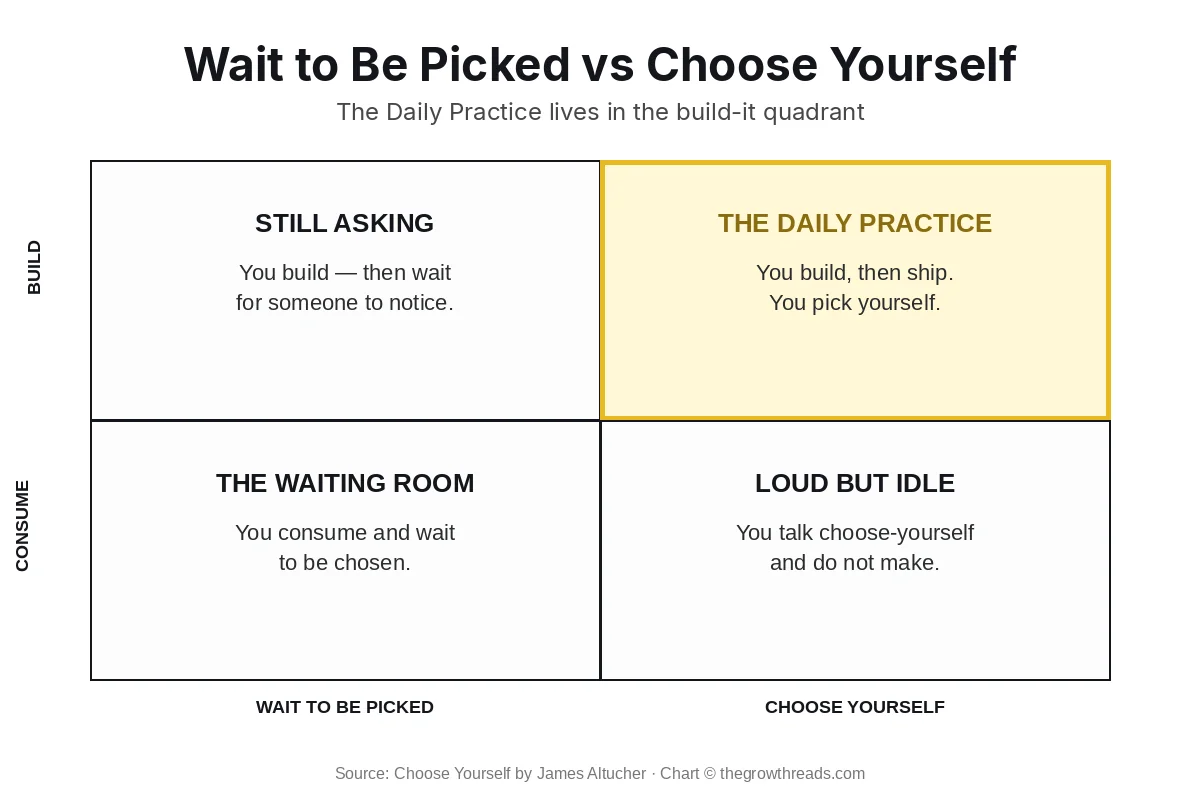
The safest career move left is to stop waiting for a gate to open. James Altucher wrote Choose Yourself after a public boom-and-bust: companies, a hedge-fund chapter, then a stretch where the money and the identity both emptied out. The rebuild was not a vision board. It was a daily practice — body, people, ideas, and a quiet hour that is not a scoreboard — plus the habit of writing ten ideas a day until ideas felt cheap. Then he sold something small instead of asking a room to elect him. That is the whole book. Permission is a lagging indicator. The Daily Practice is the leading one.
Key takeaways
- The “pick me” economy is thinning: fewer jobs, publishers, and investors can carry a whole life. Build the skill of picking yourself.
- Fill four tanks every day: physical, emotional, mental, spiritual. Skip one and the other three get noisy.
- Become an idea machine: ten ideas a day. Quantity first. Miss a day, restart the streak.
- Sell something small: a $20 offer teaches more than a private manifesto.
- Honesty is distribution: say the real thing. People forward the real thing.
- Only compare you vs yesterday: highlight reels are a tax on the Daily Practice.
- Help, don’t “network”: one useful intro beats a week of coffee chats.
- Failure is data, not identity: a miss is a closed experiment, not a verdict on the next one.
- A job can fund the practice: quitting is optional. Waiting for permission is the actual trap.
- The Daily Practice comes before the pitch: empty tanks make desperate offers.
What is Choose Yourself about?
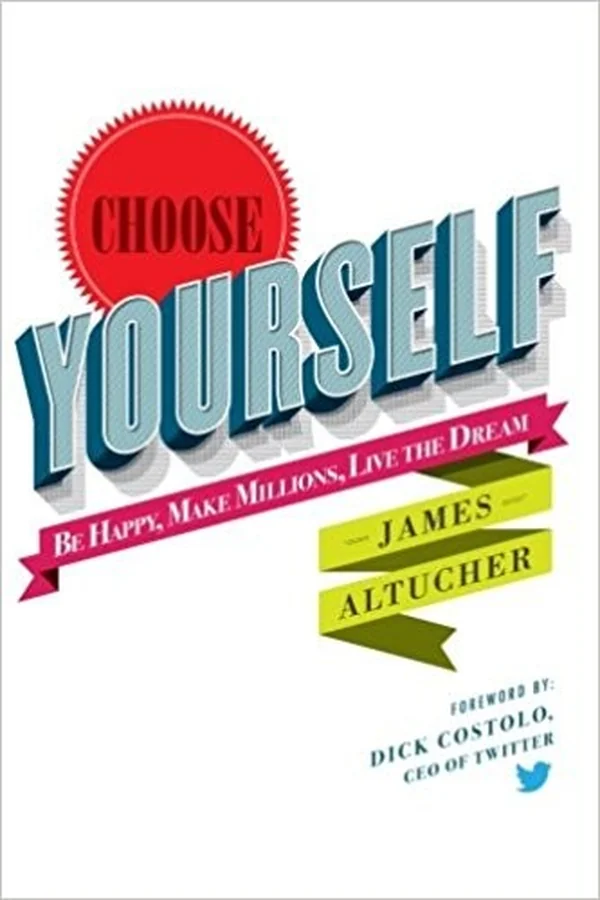
Choose Yourself is a 2013 guide to building work and a life that do not wait on a boss, publisher, or investor to say yes. Altucher’s method is the Daily Practice — physical, emotional, mental, and spiritual tanks refilled every day — plus ten ideas a day and a tiny offer you actually sell. The stories are personal; the operating system is the point.
About the author
James Altucher (born January 22, 1968) is an American writer, investor, and podcaster. He has started or co-founded more than twenty companies, written twenty-plus books, and hosted The James Altucher Show. After a public rise-and-crash in the late 1990s and early 2000s — including hedge-fund work and a stretch where the money ran out — he rebuilt around a daily practice of body, relationships, ideas, and something larger than the scoreboard. Choose Yourself (2013) is the book that named that turn. He has also written The Choose Yourself Guide to Wealth and Reinvent Yourself, and has contributed essays to the Financial Times, the Wall Street Journal, and the Huffington Post. Explore all James Altucher book summaries →
Key concepts at a glance
| Concept | What it means | Use it when |
|---|---|---|
| Choose yourself | Stop waiting for a gatekeeper to make the work real. | You keep refreshing inboxes for a yes that never comes. |
| Daily Practice | Four tanks: physical, emotional, mental, spiritual. | You feel “unlucky” and the week has no walk, no ideas, no quiet. |
| Idea machine | Ten ideas a day until options feel cheap. | You are stuck on one precious plan. |
| Tiny offer | Sell something small this week. | The notebook is full and the calendar is empty. |
| Honesty as distribution | The real sentence is the one people forward. | Your posts sound like a press release. |
| Help, don’t network | One useful intro beats ten coffees. | You are collecting cards instead of customers. |
| You vs yesterday | Compare to last week, not a highlight reel. | Envy is eating the practice. |
| Failure as data | A miss closes an experiment, not the person. | One flop has frozen the next attempt. |
Part 1: The “pick me” economy is ending
Altucher’s opening claim is economic, not motivational. For a long stretch, a competent person could wait: a college, a firm, a publisher. Someone else ran the press and the payroll. That stack still picks a few people. It no longer picks enough people to be a plan. Media unbundled. A “safe job” can vanish in a quarter. Waiting to be chosen is a strategy with a shrinking denominator.
He is not asking you to hate institutions. He is asking you to stop using them as the only proof that your work counts. A publisher can still help. A manager can still pay you well. Those are channels, not permission slips. The person who can write, sell, and recover from a miss will use a gate when it opens and keep walking when it does not.
The personal proof is his own crash. He had been picked — titles, money, a seat at the table — and then he was not. The security that survived was the ability to try a new thing on Monday. That is why the book belongs in Productivity: it is a production system for a world that will not reserve you a chair. The “pick me” habit also hides in successful people. It sounds like “once this client says yes, I’ll start the real project.”
TGR Note. Ferriss designed the muse so the calendar opens; Altucher designs the person who can use an open calendar. Pair this chapter with our 4-Hour Workweek summary if you need leverage, and with our $100 Startup summary if you already have a skill and need one customer. Freedom without a Daily Practice becomes another waiting room.
Part 2: The Daily Practice — four tanks, not a mood
The Daily Practice is the book’s actual method. Four tanks, refilled on purpose, every day.
Physical. Sleep. Walk. Eat like someone who plans to stay. He is selling a nervous system that can sit down and make ten ideas. When the body is wrecked, every email feels like a verdict. A thirty-minute walk is how you keep the other three tanks from leaking.
Emotional. Spend time with people who do not drain the day; cut the ones who do. A calendar of draining calls will eat the idea machine before lunch. You need one honest no this week and one meal with someone who leaves you sharper.
Mental. Write ten ideas a day. Lists, not essays. Ten customers, ten titles, ten things to delete. Volume is the point. A brain that can produce options on demand is harder to fire. Miss a day and restart the streak. No app. You know if you wrote them.
Spiritual. Ten quiet minutes — gratitude or a silent walk. A release valve so the other three tanks do not become a grind you secretly hate. He is not installing a religion. He is keeping the scoreboard from becoming the whole story.
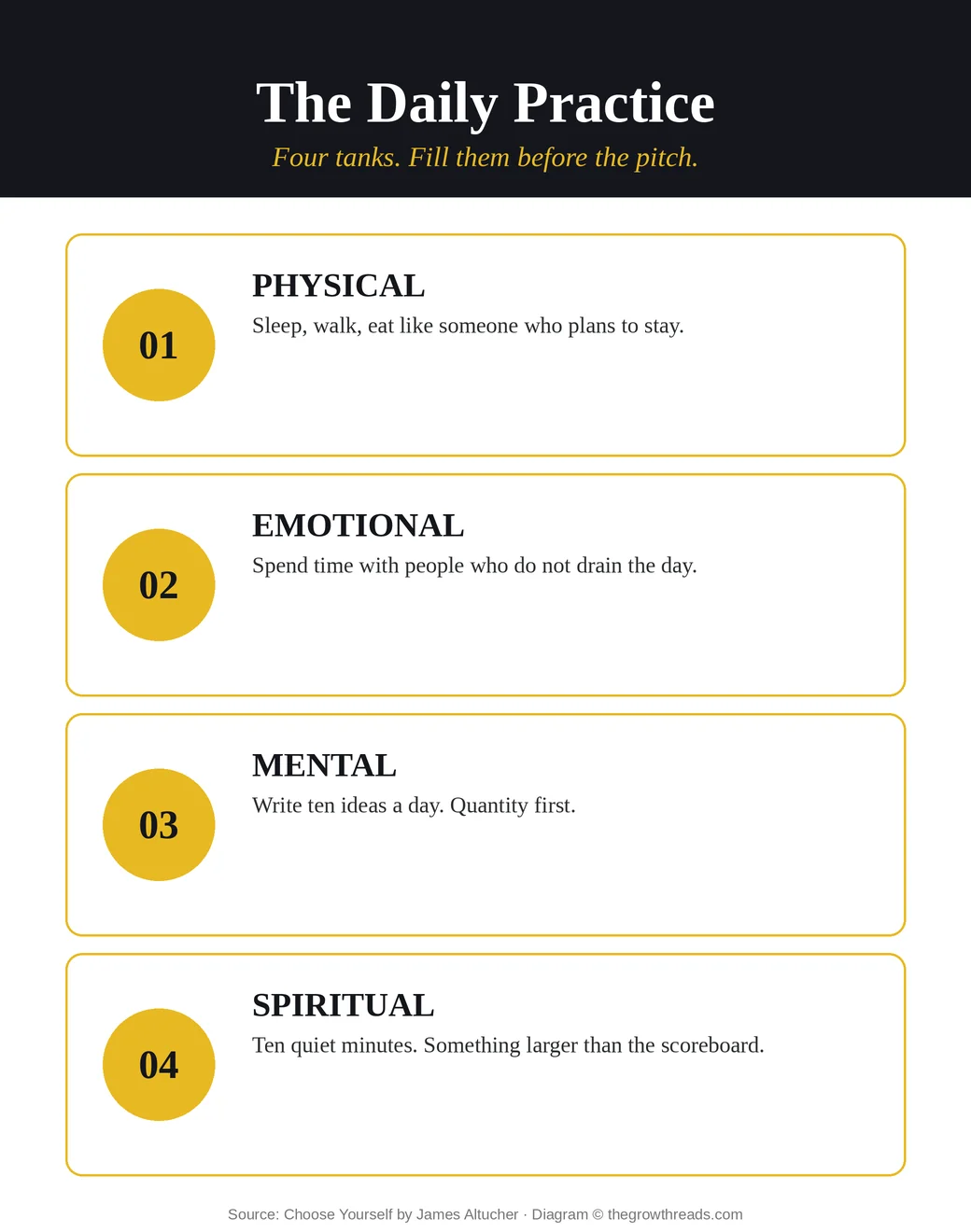
The four tanks are a unit. People love the idea list and skip sleep, or keep the gym and the draining friend. A half-practice does not compound. Fill the four, then make the offer. Empty tanks make desperate pitches — the email that sounds like “please pick me” even when the subject line says “partnership.” If you are on the floor, you do not start with a company. You start with a walk and a list.
TGR Note. The Daily Practice is identity-by-reps, the same mechanism James Clear later popularized. If you need a tighter loop than “four tanks,” use our Atomic Habits summary for cues and environment. If you need the creative version of “show up daily,” Seth Godin’s The Practice summary is the calmer sibling. Altucher’s twist is that the habit stack includes people and quiet, not just a desk.
Part 3: Become an idea machine — then sell
Ten ideas a day is how you stop treating the next idea as precious. Precious ideas get hidden. Cheap ideas get tested. He wants you fluent enough that a dead end is boring instead of fatal. The list can be ugly. Ugly is the point. You are training a reflex, not auditioning for a prize.
Then you pick one and sell. A $20 note, a one-page offer, a post that asks for a reply and a price. The sale is the feedback the notebook cannot give you. You may not love the first offer. You will love proof that strangers will pay.
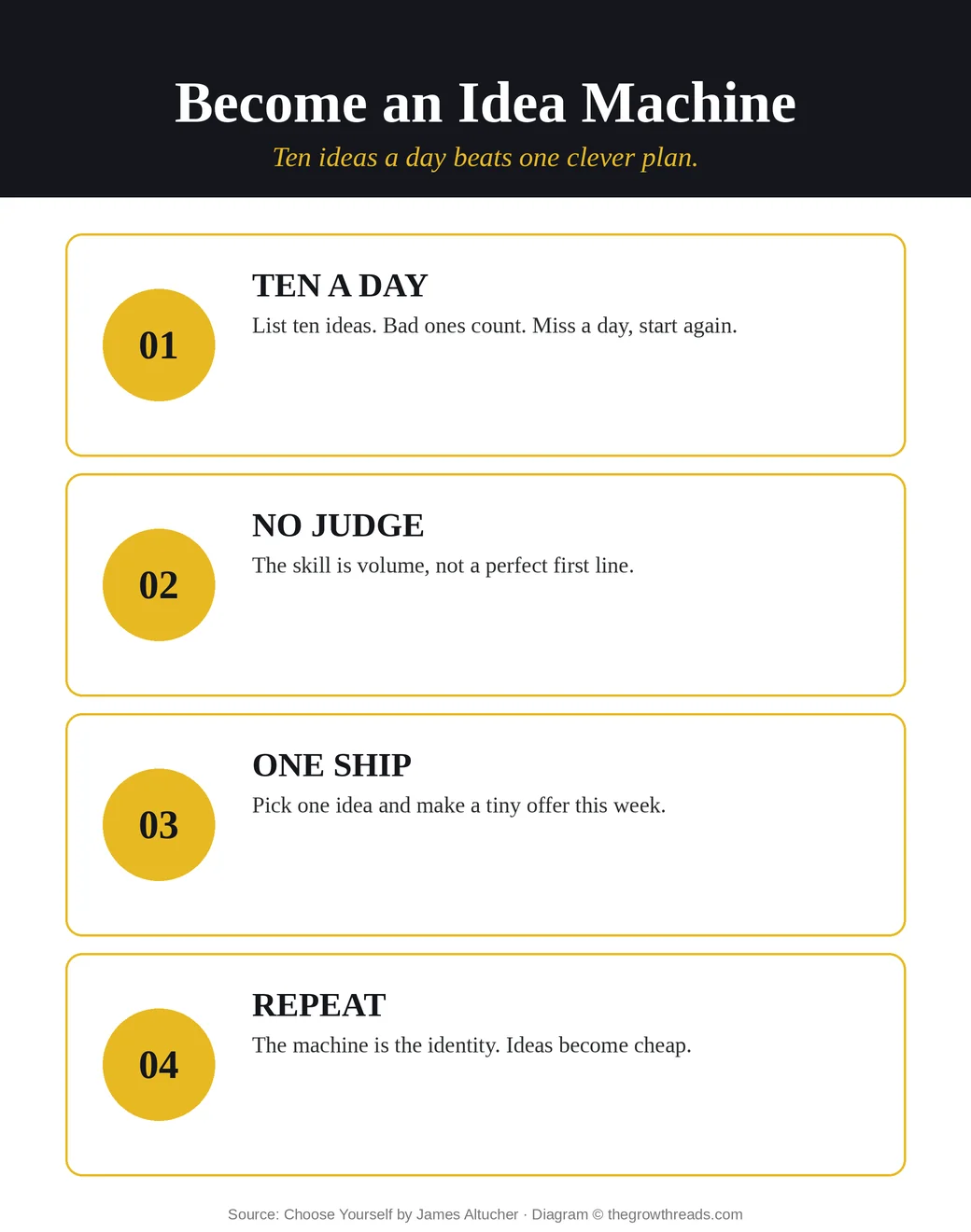
Honesty is the distribution layer. Write the real sentence — I lost the money, I was scared, here is the walk — and people forward it. The press-release version gets a nod and no movement. That is a ban on fake certainty, not a license to overshare. Help instead of networking sits next to it: one useful intro beats a week of “let’s stay in touch.” Failure is a closed experiment. Do not let one miss become your name. Sleep, walk, ten new ideas, one small sale.
TGR Note. If you want a calmer “just ship” voice after this chapter, read our Anything You Want summary. If you have been flying too low — staying average on purpose — Seth Godin’s Icarus Deception summary is the myth version of choose-yourself. For the artist’s daily fight with Resistance, keep The War of Art on the desk. Altucher adds the sale. Pressfield names the flinch.
Part 4: Meaning, from zero, without a highlight reel
When the tanks are empty and the résumé looks like a wreck, you do not rebuild a company from a crater. You rebuild a Tuesday: a walk, one person who does not drain you, ten private ideas, ten quiet minutes, then a tiny offer that would not impress a conference. “I fill the tanks” has to exist before “I am a founder again.”
Comparison is the tax. The only legal dashboard is you vs yesterday: sleep, the ten ideas, the offer. Everyone else’s highlight reel is a novel you are not in. Meaning is not a five-year plan you announce. It is the surplus that appears when the four tanks are full — enough energy to help, enough quiet to notice what you actually like. Purpose is downstream of practice.
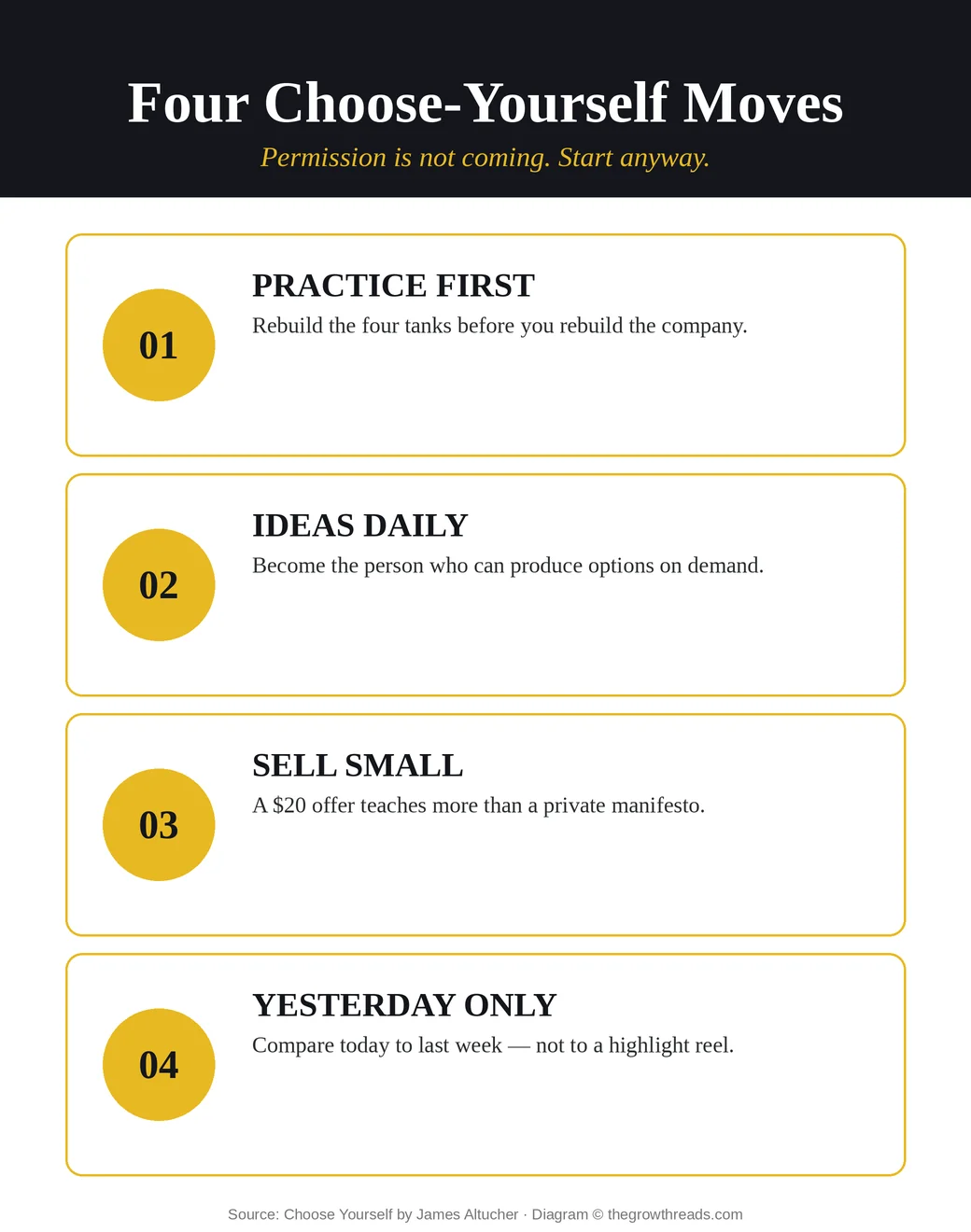
From zero, the sequence is the same as from a good year. You do not need a better origin story. You need a walk and a list. Keep the job while the practice comes online. Sell to the twelve people you have. Choosing yourself is not a rebrand. It is a refusal to outsource the next hour. One line worth a card: the only real security is the ability to try something new — so a single gate closing does not close you.
Who is Choose Yourself best for — and who should read something else first?
Best for people who already know what they would make if someone would just say yes — the side project in the drawer, the service they give away, the book they will write “once a publisher bites.” Also for anyone after a public miss who is waiting for a rescue instead of a Tuesday.
Read something else first if you need a tighter habit system before you can keep four tanks: start with Atomic Habits. If your gap is career capital, not permission, read So Good They Can’t Ignore You. If the real problem is attention, use Deep Work. If you want a 27-day hustle recipe with a first-dollar deadline, Side Hustle is more linear. If you need a pep talk that is less about selling, You Are a Badass is the warmer on-ramp.
Questions to reflect on
- Where, this month, are you waiting for a person or a platform to pick you before you start?
- Which of the four tanks is empty most often — and what is the smallest refill you will actually do tomorrow?
- If you wrote ten ideas today, which one could become a $20 offer by Friday?
- Who drains the day, and what is one honest boundary you can set this week?
- What would “you vs yesterday” look like as three numbers you can count without an app?
🔥 Ready to stop waiting to be picked?
Get Choose Yourself and start the Daily Practice this week — four tanks, ten ideas, one tiny offer.
How to apply Choose Yourself (7-day plan)
- Day 1 — Physical: Protect a full night of sleep and take a thirty-minute walk without a podcast. Write what changed in your mood after.
- Day 2 — Emotional: List the three people who drain you and the three who leave you sharper. Schedule one meal or call with a sharper name. Decline one draining ask.
- Day 3 — Mental: Write ten ideas for a problem you already understand. Do not edit. Circle one.
- Day 4 — Mental again: Ten more ideas on that circled problem. Turn the best one into a one-paragraph offer with a price.
- Day 5 — Sell small: Send the offer to three people who might need it. Not a blast. Three names. Ask for a yes, a no, or a forward.
- Day 6 — Spiritual: Ten quiet minutes. No inbox. Write one sentence about what you actually like that is not a scoreboard.
- Day 7 — Review: Score the four tanks 1–5. Keep the lowest-tank habit. Keep the idea streak. If nobody bought, rewrite the offer — do not wait for a bigger audience.
Frequently asked questions
What is Choose Yourself about?
Choose Yourself is James Altucher’s 2013 field guide for a life that does not wait on a boss, publisher, or investor to say yes. The method is the Daily Practice — physical, emotional, mental, and spiritual tanks every day — then ten ideas and a tiny offer you actually sell. The stories are personal. The operating system is the point: pick yourself and ship. Read it as a practice, not a memoir to copy.
What is the Daily Practice in Choose Yourself?
Four tanks you refill on purpose. Physical: sleep, walk, eat like someone who plans to stay. Emotional: people who do not drain the day. Mental: ten ideas a day so the brain stays a factory. Spiritual: ten quiet minutes that are not a scoreboard. Altucher treats the four as a unit. Skip one for a week and the other three get noisy. Fill them first, then make the offer.
Do I need to quit my job to apply Choose Yourself?
No. The book is not a dare to resign on Monday. A job can fund the tanks while you learn to sell. What it pushes against is the identity that says only a title or a round of funding can make the work real. Keep the paycheck if it buys sleep and groceries. Use the evenings for ten ideas and one small sale. Quit later, if ever, when the practice is already producing options.
How is Choose Yourself different from The 4-Hour Workweek?
The 4-Hour Workweek buys back time with automation and a muse. Choose Yourself rebuilds the person who can use that time. Ferriss designs the business; Altucher designs the four tanks and the idea muscle. If your calendar is already open and you still feel picked-last, start here. If you have energy and no leverage, read our 4-Hour Workweek summary first, then come back so the extra hours do not become another waiting room.
What does “become an idea machine” mean?
Write ten ideas every day — customers, titles, walks, fixes — until ideas feel cheap. Altucher is training a reflex, not hunting one genius line. Bad ideas count. Miss a day and restart the streak. Then pick one idea and make a tiny offer: a $20 note, a one-page service, a post that asks for a reply. The machine is the identity. The sale is the proof. Lists without a ship stay a hobby.
Who should read Choose Yourself?
Read it if you are waiting for a manager, agent, or investor to tap you on the shoulder — especially after a layoff or a failed launch. Skip it as a first book if you need a tighter habit loop; start with Atomic Habits. If the gap is career capital, read So Good They Can’t Ignore You. If the problem is attention, not permission, use Deep Work. This book is for the person who already knows what they would make if someone would just say yes.
How long does it take to apply Choose Yourself?
You can start today in under an hour: a walk, one honest conversation, ten ideas, ten quiet minutes. Seven days shows which tank you skip when you get busy. Thirty days of ten ideas plus one tiny offer a week is a real test. The book will not replace a career in a weekend. If the tanks are full and you still have not shipped, the next move is a small sale, not another chapter.
Related summaries
- The $100 Startup Summary — a skill, an offer, one customer.
- The 4-Hour Workweek Summary — buy back time once the offer works.
- The Practice Summary — ship creative work daily without waiting to feel ready.
- You Are a Badass Summary — stop playing small while you build the tanks.
- 20 Best Productivity Books of All Time (2026) — the full Productivity pillar.
How we analyze books: we read for the operating system, test the parts you can use in a week, and write the plan we would hand a friend. Read our full methodology.