

★★★★☆ 4.4/5 — A philosophical counter-punch to hustle culture that reframes productivity as choosing what to neglect.
Best for: Overachievers, chronic optimizers, and anyone exhausted by the never-ending quest to get everything done.
Reading time: ~5 hrs (guide: 19 min)
Difficulty to apply: Moderate — the ideas are simple but emotionally challenging to accept.
Four Thousand Weeks in one minute
You will never get everything done, and that is not a problem to solve — it is the human condition to embrace. Oliver Burkeman calculates that the average human lifespan is roughly four thousand weeks. Against that backdrop, every productivity system that promises you can “do it all” is not just unrealistic but actively harmful — it keeps you sprinting on a treadmill instead of choosing what genuinely matters. Burkeman draws on philosophy, psychology, and his own recovery from productivity obsession to argue that the path to a meaningful life runs through accepting your limitations, not transcending them. The result is a book that feels less like a time-management guide and more like permission to exhale.
Key takeaways
- Time is not a resource to manage: Treating time as a container to be filled with maximum output is a modern invention that distorts our relationship with life itself.
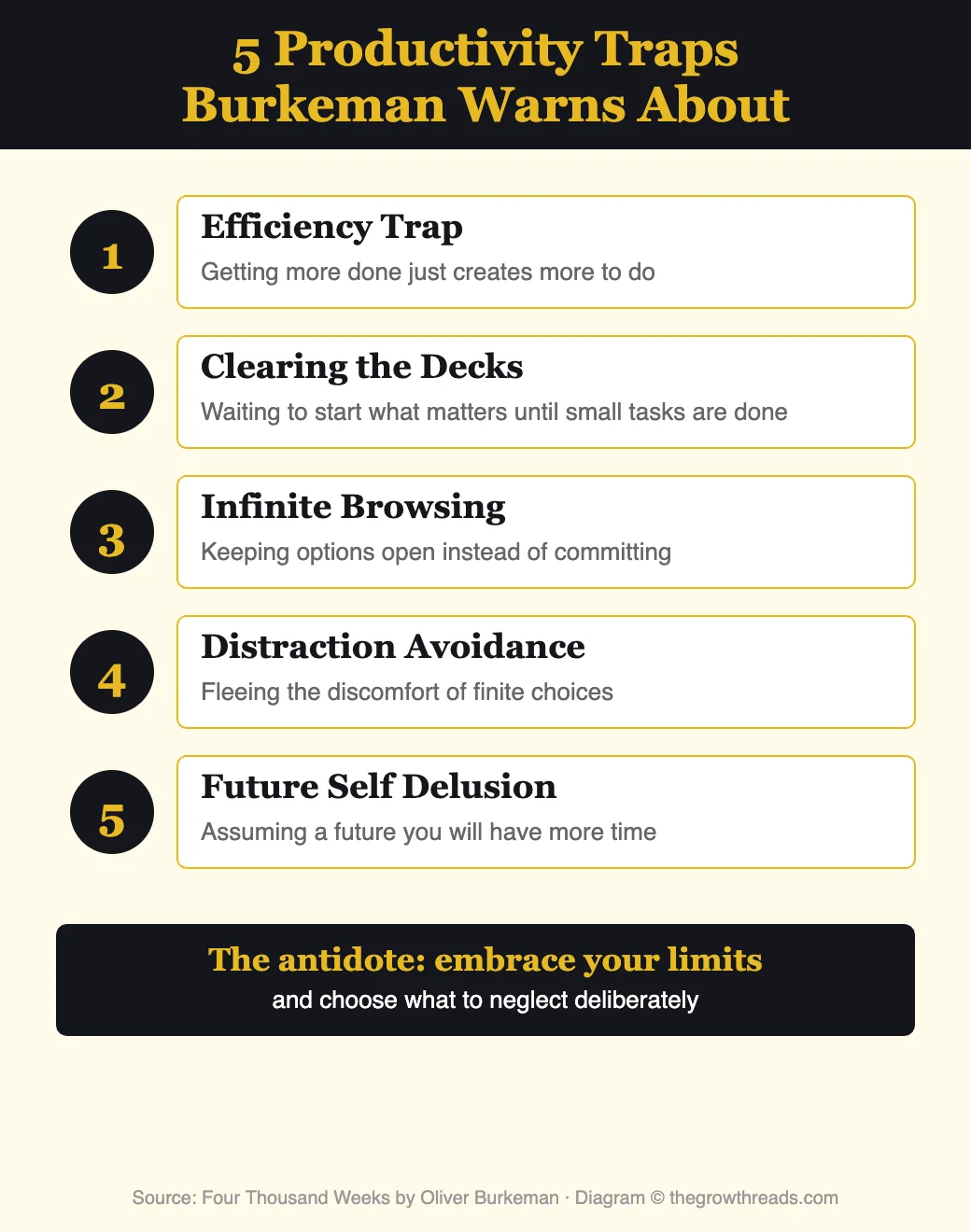
- The efficiency trap is real: Getting faster at clearing your to-do list only generates more tasks — email, for example, breeds more email the faster you reply.
- Embrace radical finitude: You will only read a fraction of the books, visit a fraction of the places, and pursue a fraction of the projects that interest you. Accepting this frees you to commit fully to what you choose.
- Patience is a competitive advantage: In a world optimized for speed, the willingness to let things take the time they take produces deeper, more original work.
- Choose what to neglect deliberately: Since you cannot do everything, the only honest question is what you are willing to not do — and own that choice consciously.
- Distraction is avoidance of finitude: We reach for our phones not because notifications are irresistible, but because focusing on one thing means accepting that countless other things will not get done.
- Cosmic insignificance therapy: Recognizing how small your life is against the scale of the universe is not depressing — it is liberating, because it removes the impossible pressure to make your time count in some grand way.
- Attention is the substance of life: Where you place your attention is, in a very real sense, where you place your life. Protect it accordingly.
What is Four Thousand Weeks about?
Four Thousand Weeks is a time-management book that inverts conventional productivity advice by arguing that the path to a meaningful life requires accepting — not overcoming — our radical limitations, embracing the discomfort of choosing, and surrendering the fantasy that we will ever have enough time to do everything.
About the author
Oliver Burkeman is a British journalist and author who spent years writing a popular psychology column for The Guardian called “This Column Will Change Your Life.” His previous book, The Antidote: Happiness for People Who Can’t Stand Positive Thinking, challenged the self-help industry’s relentless optimism. Burkeman has described himself as a recovering productivity addict — someone who spent a decade testing every system, app, and framework for getting more done, only to realize that the quest itself was the problem. He holds a degree from Cambridge University, lives in New York, and frequently speaks on the philosophy of time, attention, and what it means to live a finite life well. Explore all Oliver Burkeman book summaries →
Key concepts at a glance
| Concept | What it means | Use it when |
|---|---|---|
| Finitude | Accepting you have ~4,000 weeks and cannot do it all | You feel overwhelmed by possibilities |
| The Efficiency Trap | Doing more faster only creates more to do | Your inbox never empties despite working harder |
| Cosmic Insignificance Therapy | Your smallness against the universe is freeing, not crushing | You feel paralyzed by the pressure to be productive |
| Attention as Life Substance | Where your attention goes, your life goes | You want to be more present in daily life |
| Settling (Positively) | Committing fully to a choice rather than keeping options open | Decision paralysis prevents you from starting |
| Patience as Power | Letting things take the time they take produces deeper results | You rush through work and feel unsatisfied |
| Fixed-Volume Productivity | Set hard limits on in-progress projects and daily tasks | You juggle too many projects at once |
Part 1: The disease of busyness — why time feels so scarce
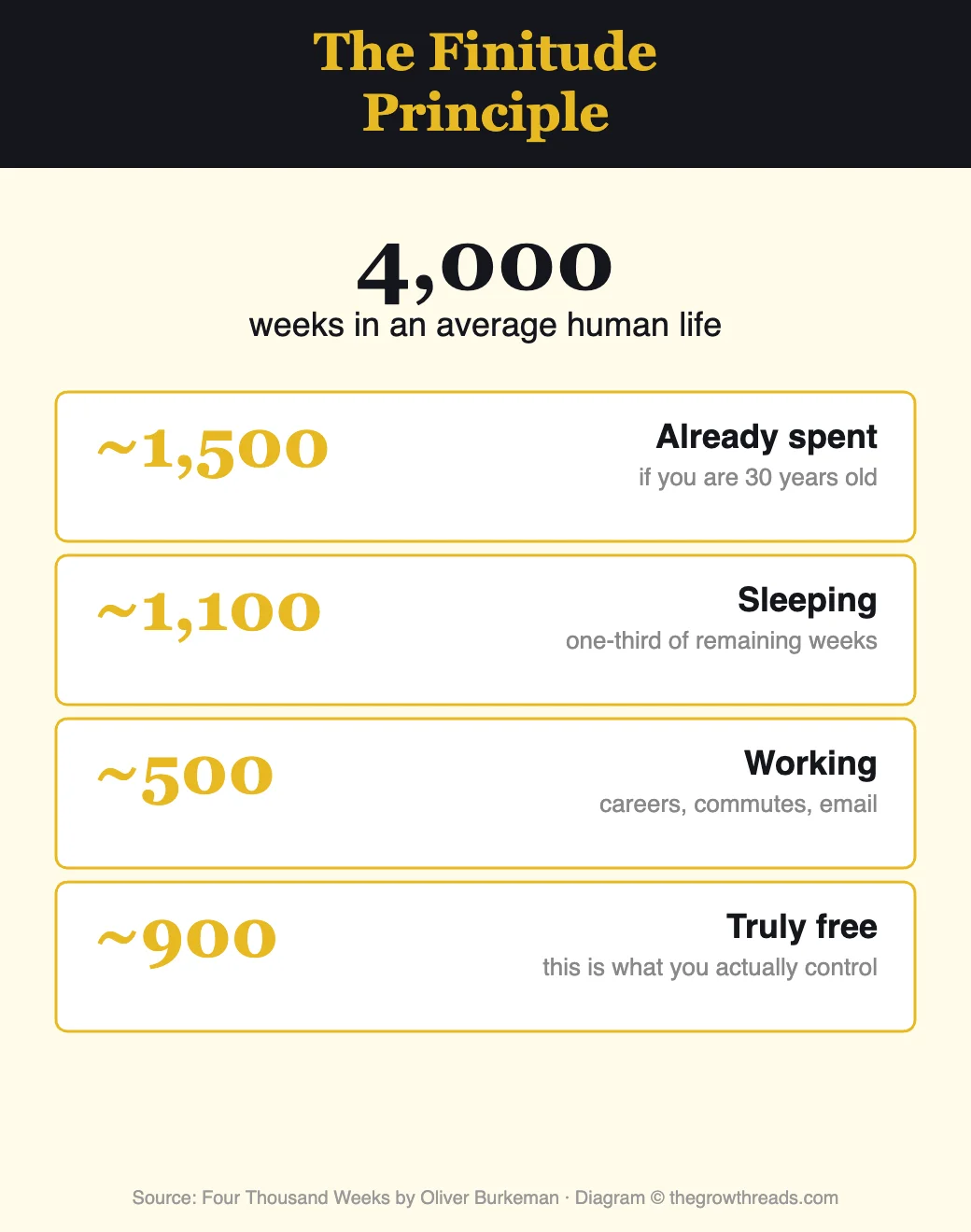
Burkeman opens with a deceptively simple calculation. If you live to 80, you get roughly four thousand weeks. That number is small enough to be disturbing — and Burkeman argues that this disturbance is precisely where clarity begins. The modern productivity movement, he contends, is built on an unspoken promise: that with the right system, you can cram enough achievement into those weeks to make them feel infinite. But that promise is a lie.
The historical context is revealing. Before the Industrial Revolution, people did not experience time as a resource to be managed. Medieval farmers worked when there was work to do and rested when there was not. The clock, the schedule, and the concept of “wasting time” are inventions of capitalism — tools designed to extract maximum labor from finite human lives. Burkeman traces how this mindset evolved into the modern productivity cult, where every minute spent not optimizing feels like a moral failure.
The efficiency trap is his central warning. When you get faster at answering email, you do not free up time — you simply receive more email. When you clear your to-do list, new items rush in to fill the space. The system is designed to be bottomless. Every gain in efficiency is absorbed by rising expectations, leaving you running faster but arriving nowhere new.
Part 2: The art of choosing — why limitations are liberating
The second movement of the book tackles the paradox of choice. In a world of infinite options — careers to pursue, hobbies to try, causes to support, people to connect with — the act of choosing one path means permanently closing others. Most people respond to this discomfort by refusing to choose at all: they keep their options open, browse endlessly, dabble without committing. Burkeman calls this the “open option” trap, and he argues it is one of the primary sources of modern anxiety.
His counter-intuitive prescription is to “settle” — a word he deliberately reclaims from its negative connotations. Settling does not mean accepting mediocrity. It means choosing a specific life, a specific partner, a specific career, and committing to it fully, knowing that the unchosen alternatives will remain forever unchosen. This is not resignation; it is liberation. The person who commits to one relationship, one city, one craft, can go deeper than the person who keeps scanning for something better.
Burkeman extends this to daily work. He advocates what he calls “fixed-volume productivity” — setting a hard limit on the number of projects you pursue simultaneously (he suggests three active and seven queued) and refusing to add new items until old ones are complete. The psychological effect is immediate: instead of feeling behind on everything, you feel focused on something.
Part 3: Patience, presence, and the power of doing nothing
Burkeman devotes his third section to a quality that modern culture has almost entirely abandoned: patience. He argues that impatience is not merely an annoyance — it is a philosophical stance that says the present moment is merely a means to some future end. When you are impatient, you are essentially refusing to be here now, treating the current moment as an obstacle rather than the substance of your life.
He draws on the work of psychologist Mihaly Csikszentmihalyi (flow states), philosopher Martin Heidegger (being-toward-death), and Buddhist teacher Pema Chodron (sitting with discomfort) to build a case for what he calls “radical incrementalism” — doing important creative work in small, consistent sessions rather than waiting for the mythical uninterrupted block of time. The great novels, scientific breakthroughs, and social movements were not produced by people who had unlimited time; they were produced by people who showed up daily despite having limited time.
The chapter on “cosmic insignificance therapy” is perhaps the book’s emotional climax. Burkeman points out that in the vast sweep of cosmic time, your life is incomprehensibly brief. Rather than finding this depressing, he argues it should be profoundly relieving: if nothing you do will matter in a billion years, then you are free to do what matters to you right now without the crushing weight of having to make it count in some grand, permanent way.
Part 4: Ten tools for embracing finitude
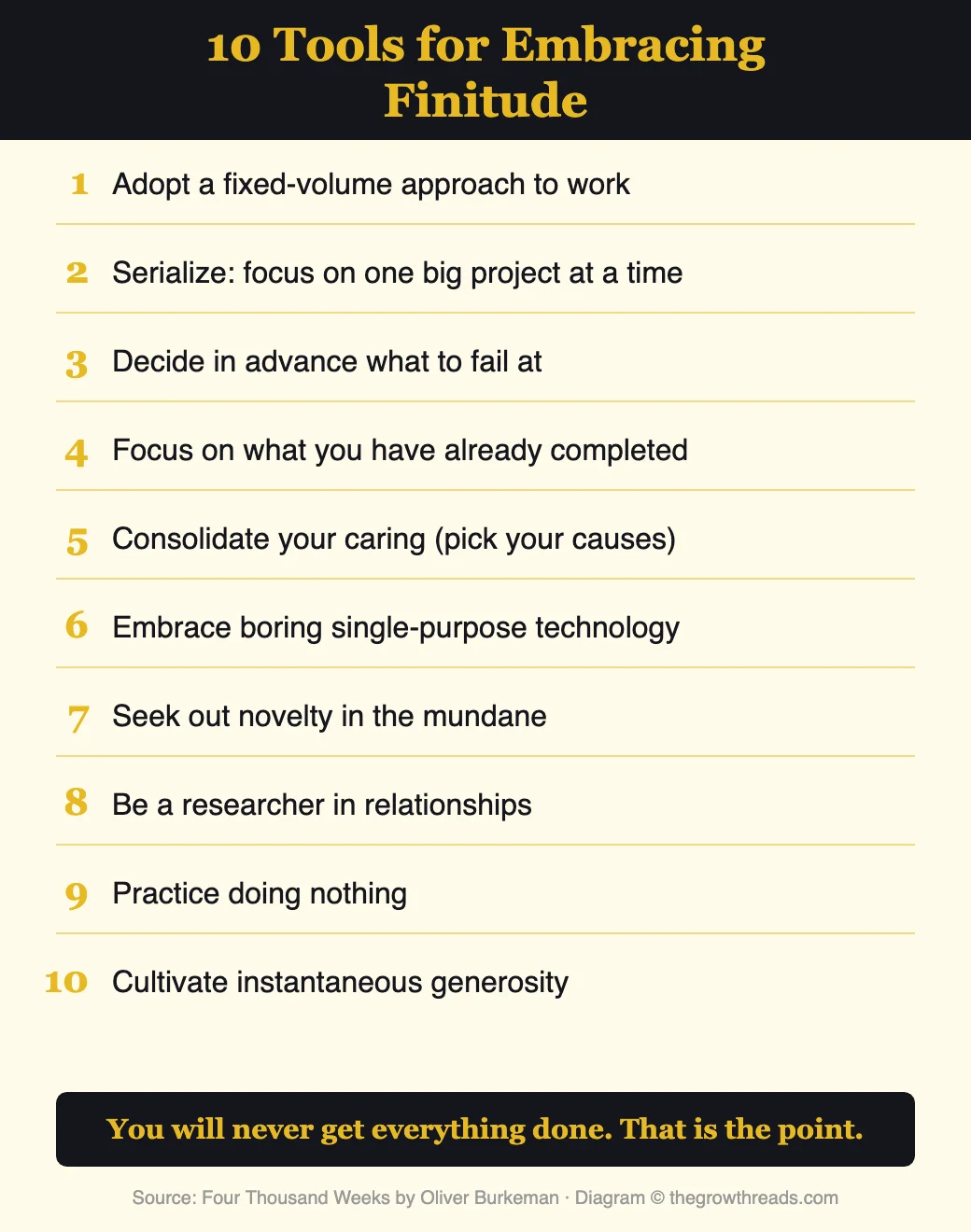
The final section translates philosophy into action with ten practical tools. Burkeman advocates adopting a fixed-volume approach to productivity, serializing your projects instead of parallelizing them, deciding in advance what you will fail at, and cultivating a practice of doing nothing. He also suggests what he calls “instantaneous generosity” — acting on generous impulses the moment they arise, because postponing them means they evaporate.
Several of these tools involve deliberately lowering your standards in areas that do not matter to you — a concept he calls “strategic mediocrity.” If you are not willing to be bad at housekeeping, average at cooking, and mediocre at social media, you will never have time to be excellent at the one or two things that genuinely define your contribution. The tools are not a system; they are a collection of attitudes designed to loosen the grip of the productivity mindset and create space for a richer, more present way of living.
Burkeman closes with a meditation on shared finitude: the recognition that everyone around you is also navigating a four-thousand-week life. This awareness, he suggests, is the foundation of compassion, community, and love — all of which require the willingness to spend your limited time on something that cannot be optimized.
Who is Four Thousand Weeks best for — and who should read something else first?
Four Thousand Weeks is best for people who already know how to be productive but cannot seem to stop. If you have read multiple time-management books, optimized your systems, and still feel overwhelmed, this book provides the philosophical reset you need. It is also excellent for anyone experiencing a midlife recalibration or quarter-life crisis — moments when the question shifts from “how do I get more done?” to “what am I doing all this for?”
If you are just starting your productivity journey and need practical frameworks, begin with Atomic Habits or Getting Things Done. If your issue is less existential and more about eliminating distractions during deep cognitive work, Deep Work is a more targeted resource.
Questions to reflect on
- If you only had 2,000 weeks remaining (about 38 years), which three commitments would you protect above all others?
- Where in your life are you keeping your options open instead of committing fully — and what is that costing you?
- What are you willing to be mediocre at so that you can be excellent at what matters most?
- When was the last time you did nothing for 15 minutes — no phone, no book, no plan — and how did it feel?
- Which of your daily productivity habits might actually be feeding the efficiency trap rather than freeing you from it?
🔥 Ready to reclaim your four thousand weeks?
Stop optimizing and start living with intention, presence, and peace.
How to apply Four Thousand Weeks (7-day plan)
- Day 1: Calculate your personal week count. Subtract your current age from 80, multiply by 52. Write the number down and sit with it for five minutes.
- Day 2: List every active project, commitment, and hobby you are currently juggling. Circle the three that matter most. Star the ones you are willing to pause or drop entirely.
- Day 3: Implement fixed-volume productivity. Set a hard cap: no more than three active projects at work, and three personal projects. Queue everything else on a “someday” list.
- Day 4: Practice doing nothing for 15 minutes. No phone, no book, no music. Just sit and observe what arises — boredom, anxiety, relief. Notice without acting.
- Day 5: Identify one area of life where you will embrace strategic mediocrity. Give yourself explicit permission to be “good enough” at it and redirect that energy toward something that matters.
- Day 6: Practice instantaneous generosity. Every time a generous impulse arises today — texting a friend, buying someone coffee, complimenting a colleague — act on it immediately instead of postponing.
- Day 7: Write a “done” list. Instead of listing what you still need to do, write down everything meaningful you have already accomplished in the past year. Let the list settle in before planning anything new.
Frequently asked questions
Is Four Thousand Weeks anti-productivity?
Not exactly. Burkeman does not argue against getting things done — he argues against the belief that you can or should get everything done. The distinction matters. He still advocates focused work, clear priorities, and disciplined execution. What he rejects is the myth that the right system will somehow allow you to transcend your human limitations. The book is anti-hustle-culture, not anti-effort.
How is this different from other time management books?
Most time management books start with the assumption that time is a resource to be optimized and then offer systems for doing so. Four Thousand Weeks starts with the assumption that optimization is part of the problem. Where Getting Things Done gives you a better inbox, and Deep Work gives you a better focus protocol, Burkeman gives you a philosophical framework for deciding what deserves your time in the first place. It operates at a different level of the stack. We explore Burkeman’s critique — and the methods he argues against — in our time blocking guide.
What is the efficiency trap?
The efficiency trap is Burkeman’s term for the paradox where becoming more efficient at a task generates more of that task. The classic example is email: studies show that the faster you reply to emails, the more emails you receive, because quick replies train correspondents to expect immediate responses. The trap applies to almost any domain — clearing your calendar creates space that fills instantly, finishing tasks faster raises expectations for speed. Efficiency alone cannot solve the problem of having more to do than you can ever complete.
What does Burkeman mean by cosmic insignificance therapy?
Cosmic insignificance therapy is the practice of zooming out to the scale of the universe — billions of years, billions of galaxies — and recognizing that your individual life, in that context, is vanishingly brief and small. Rather than finding this nihilistic, Burkeman argues it is liberating: if nothing you do will echo through eternity, you are free to pursue what feels meaningful to you without the crushing pressure of making your life count in some grand, permanent way.
What is fixed-volume productivity?
Fixed-volume productivity is Burkeman’s practical system for managing workload. You set a hard upper limit on the number of projects you will pursue simultaneously — he suggests three active projects plus a queue of seven waiting. When a new opportunity arises, it goes to the back of the queue. You only start it when one of your active three is complete. This prevents the common pattern of juggling dozens of half-finished initiatives and ensures that each project receives genuine focus.
Can I apply Four Thousand Weeks if I am early in my career?
Absolutely. Young professionals often benefit most from this book because it prevents the burnout spiral before it starts. The key insight for early-career readers is that saying yes to everything is not ambition — it is avoidance of the discomfort of choosing. Starting your career with a clear sense of what you will deliberately neglect gives you a significant advantage over peers who spread themselves thin across every opportunity. The book does not tell you to work less; it tells you to choose better.
Is the four thousand weeks calculation accurate?
Roughly, yes. Eighty years multiplied by 52 weeks per year equals 4,160 weeks. Burkeman rounds down to four thousand for rhetorical impact, and the exact number varies by country, gender, and health factors. The precision is not the point — the emotional impact of translating a lifespan into a countable number is the point. Most people find the number shockingly small, which is exactly Burkeman’s intention: to make finitude feel visceral rather than abstract.
Related summaries
- Essentialism Summary & Review — Greg McKeown on the disciplined pursuit of less.
- Deep Work Summary & Review — Cal Newport on focused work in a distracted world.
- The Miracle Morning Summary & Review — Hal Elrod on building a morning routine that compounds.
- Best Productivity Books — Our complete guide to the top books on focus, habits, and getting things done.
How we analyze books: Every summary on The Growth Reads is built from a close reading of the full text, cross-referenced with the author’s published interviews, peer-reviewed research where applicable, and reader feedback from multiple platforms. We focus on extracting actionable frameworks rather than abstract theory. Read our full methodology.
Related Productivity Summaries
Limitless Summary & Review: Unlock Your Brain’s Full Potential
Make Your Bed Summary & Review: 10 Lessons That Can Change Your Life
The 4 Disciplines of Execution Summary & Review: Achieving Your Wildly Important Goals
The Pomodoro Technique Summary & Review: 25 Minutes to Real Focus
The Talent Code Summary & Review: Greatness Is Grown, Not Born