

★★★★½ 4.5/5 — the clearest packing list for a truth most of us already nod at: growth does not arrive as a mood.
Best for: capable people whose calendar is full and whose skill is quietly stalled
Reading time: ~5 hours (288 pages) · this guide ~12 min
Difficulty to apply: Easy — Day 1 is one written growth plan for one area
The 15 Invaluable Laws of Growth in one minute
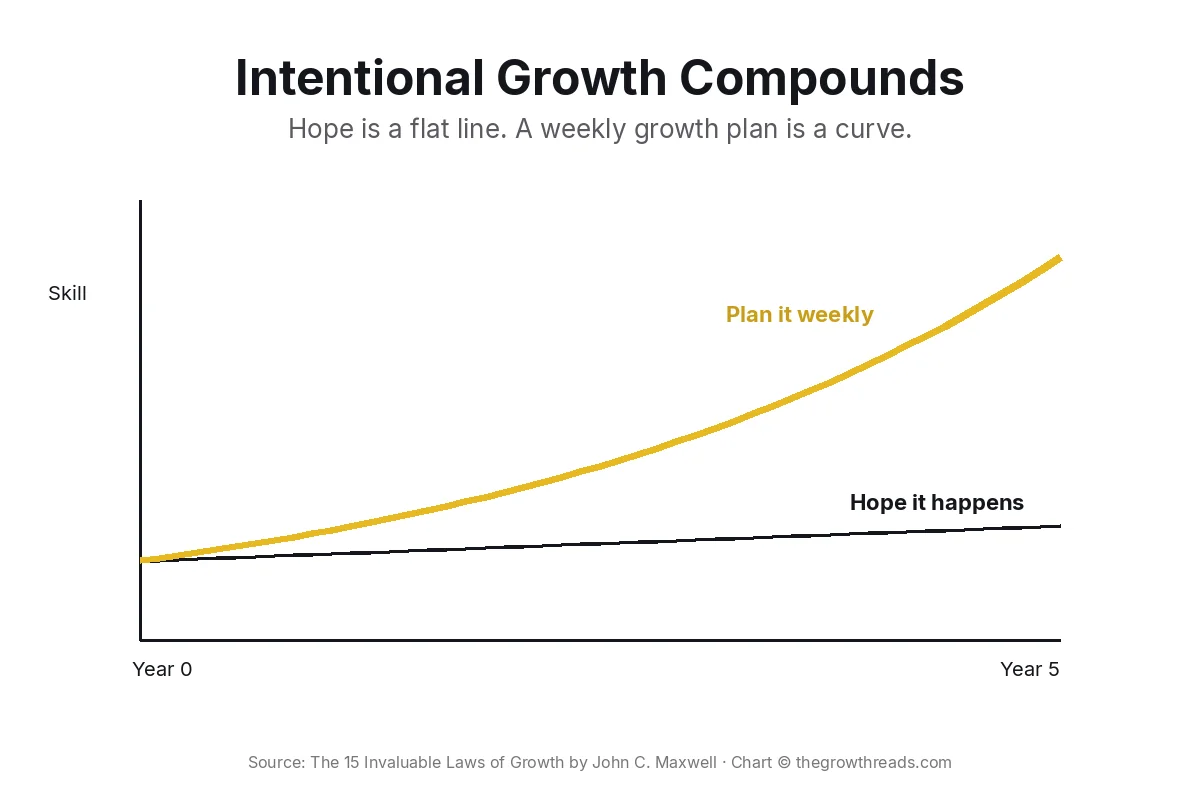
Hope is not a growth strategy. John C. Maxwell wrote The 15 Invaluable Laws of Growth for the person who is busy, decent at their job, and still the same operator they were three years ago. The book’s spine is the Law of Intentionality: personal development does not happen because you meant well. You pick an area, write a plan, put it on the calendar, and review it. The other fourteen laws are how that plan survives contact with a normal week — knowing yourself, valuing yourself enough to invest, pausing to learn, showing up when motivation leaves, choosing rooms that pull you forward, designing the how, extracting lessons from pain, growing character with skill, staying in tension with a higher standard, giving something up, staying curious, following a model, expanding capacity, and turning growth into contribution. If you take one move from this The 15 Invaluable Laws of Growth summary, write a one-page plan for a single skill this week and protect thirty minutes a day for it.
Key takeaways
- Intentionality first: If it is not on a plan and a clock, it is a wish. Growth does not hitchhike on a packed calendar.
- Know the real you: Strengths, gaps, and the story you tell about both. You cannot grow a self you refuse to see.
- Value yourself enough to invest: The Law of the Mirror. Cheap input is how stalled years happen.
- Pause on purpose: Reflection is not laziness. It is how the week becomes a teacher instead of a blur.
- Discipline outlasts mood: Motivation books the appointment. Consistency keeps it.
- Change the room: People, media, and physical space either pull you up or quietly freeze you.
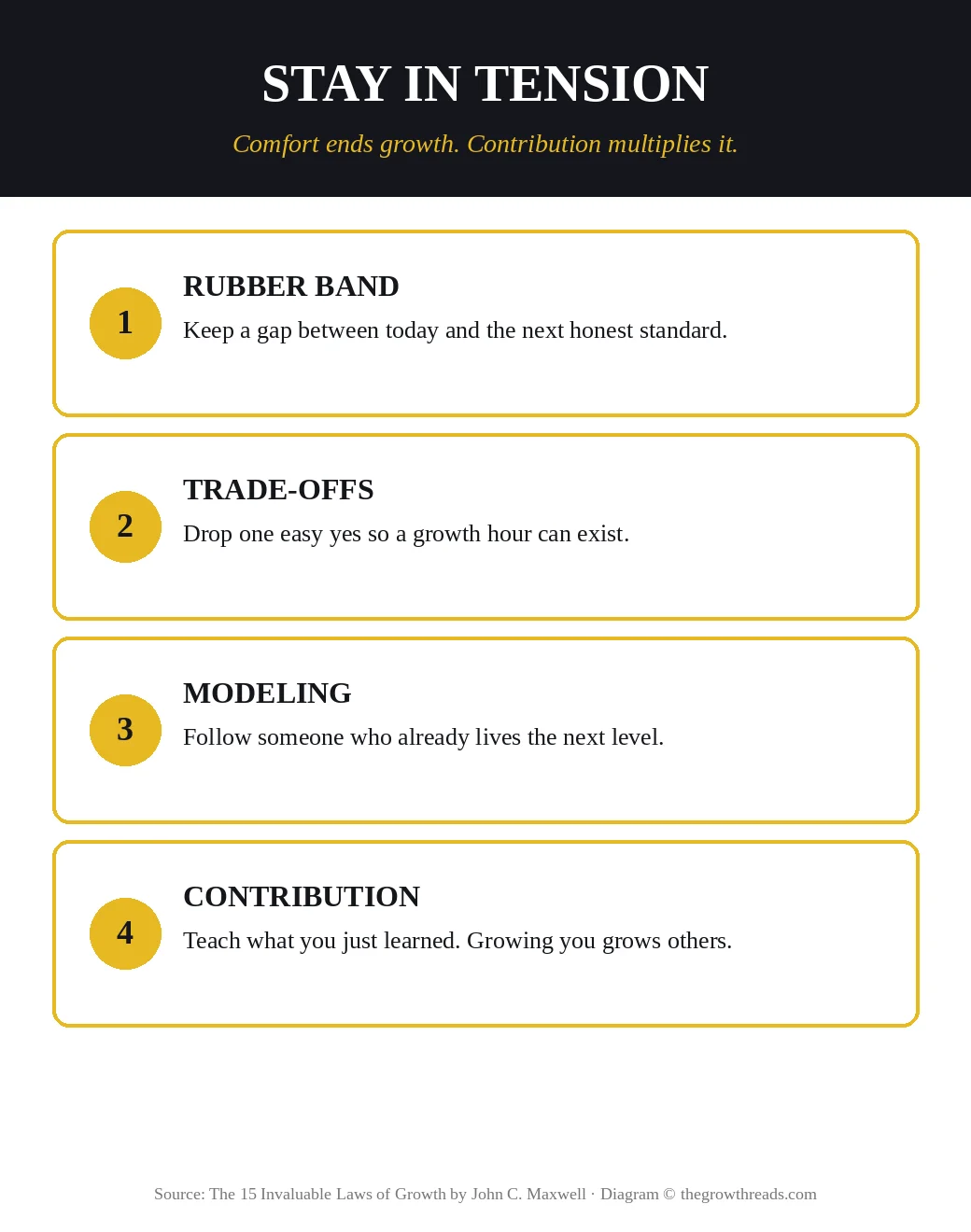
- Stay in tension: The rubber band between today and the next honest standard is the work. Comfort ends the stretch.
- Trade up: You cannot add a growth hour without dropping an easy yes.
- Grow to give: Modeling and contribution close the loop. What you teach, you keep.
What is The 15 Invaluable Laws of Growth about?
The 15 Invaluable Laws of Growth is John C. Maxwell’s 2012 field manual for personal development: fifteen named laws that turn “I should grow” into a written plan, a weekly review, a stretching environment, and a habit of contributing what you learn.
About the author
John C. Maxwell is an American pastor-turned-leadership teacher whose 21 Irrefutable Laws of Leadership made him one of the most widely read authors in the field. He founded EQUIP and the John Maxwell Company to train leaders in churches, companies, and governments, and his catalog has sold tens of millions of copies. This book is the personal-growth companion to that leadership work. Instead of lids on organizations, he writes about lids on you: the unexamined week, the room you sit in, the trade-off you will not make. He is a teacher of named laws more than a researcher. The value is the packing — a vocabulary you can put on a one-page plan and run on an ordinary Tuesday. Explore all John C. Maxwell book summaries →
Key concepts at a glance
| Concept | What it means | Use it when |
|---|---|---|
| Law of Intentionality | Growth is planned, not hoped | Your calendar is full and your skill is unchanged |
| Law of Awareness | You must know yourself to grow yourself | You copy other people’s goals and stall |
| Law of the Mirror | You invest in what you value | You buy courses and skip the hour |
| Law of Reflection | Pause so learning can catch up | Weeks blur and nothing compounds |
| Law of Consistency | Discipline keeps the plan alive | You sprint in January and vanish in March |
| Law of Environment | Rooms raise or freeze you | Your inputs are comfortable and dated |
| Law of the Rubber Band | Tension between now and next is required | You feel “fine” and slightly bored |
| Law of Contribution | Growing you lets you grow others | The plan has become a private hobby |
Part 1: Growth doesn’t just happen — the Law of Intentionality
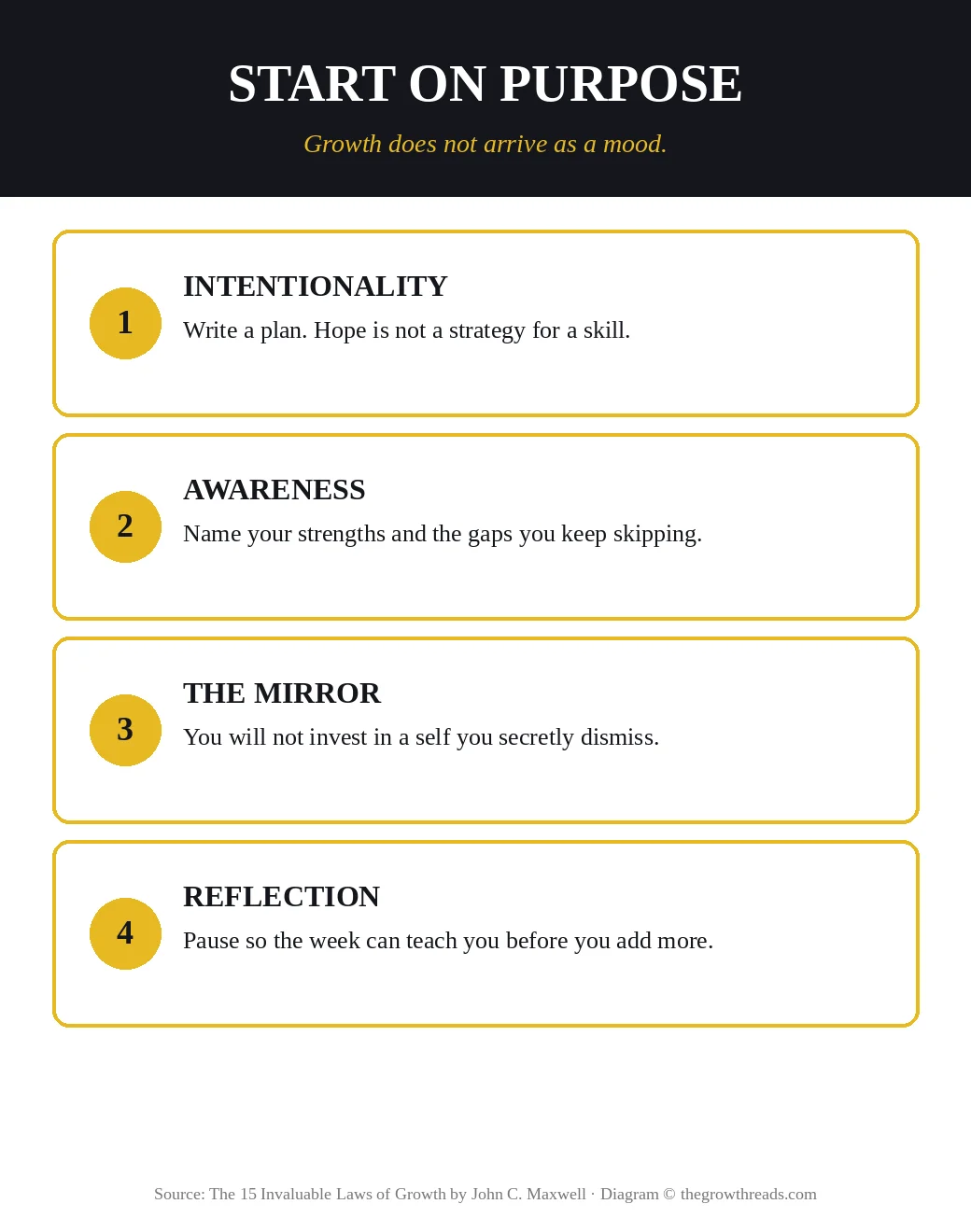
Maxwell opens with the line the rest of the book exists to defend: growth doesn’t just happen. People assume that years on the job equal development. Time is not a coach. A decade of repeating the same meetings can leave you more tired, not more capable. Intentionality is the decision to treat personal development like a project with a name, a next action, and a slot on the calendar. If you cannot point to the plan, you do not have one.
The practical move is smaller than a five-year vision board. Pick one area — a craft, a body of knowledge, a relationship skill, a health baseline — and write what “better” would look like in ninety days. Then attach time. Maxwell’s readers who stall usually skip this unglamorous page. They collect quotes. They do not protect a half hour. The Law of Intentionality is rude in a useful way: if it is not scheduled, you have already chosen not to grow it.
He is not arguing that talent is fake. He is arguing that talent without a plan still loses to a smaller talent that shows up. That is why this book belongs next to habit titles without copying them. Habits need a cue. Growth needs a destination and a review. Write the destination first. Then the cue has somewhere to take you.
TGR Note: If you already believe small daily actions compound, pair this law with our Compound Effect summary and the cue work in Atomic Habits. Maxwell supplies the plan. Clear and Hardy supply the loop. Do not use a second book as a delay. One area. One page. This week.
Part 2: Know yourself, then design the week
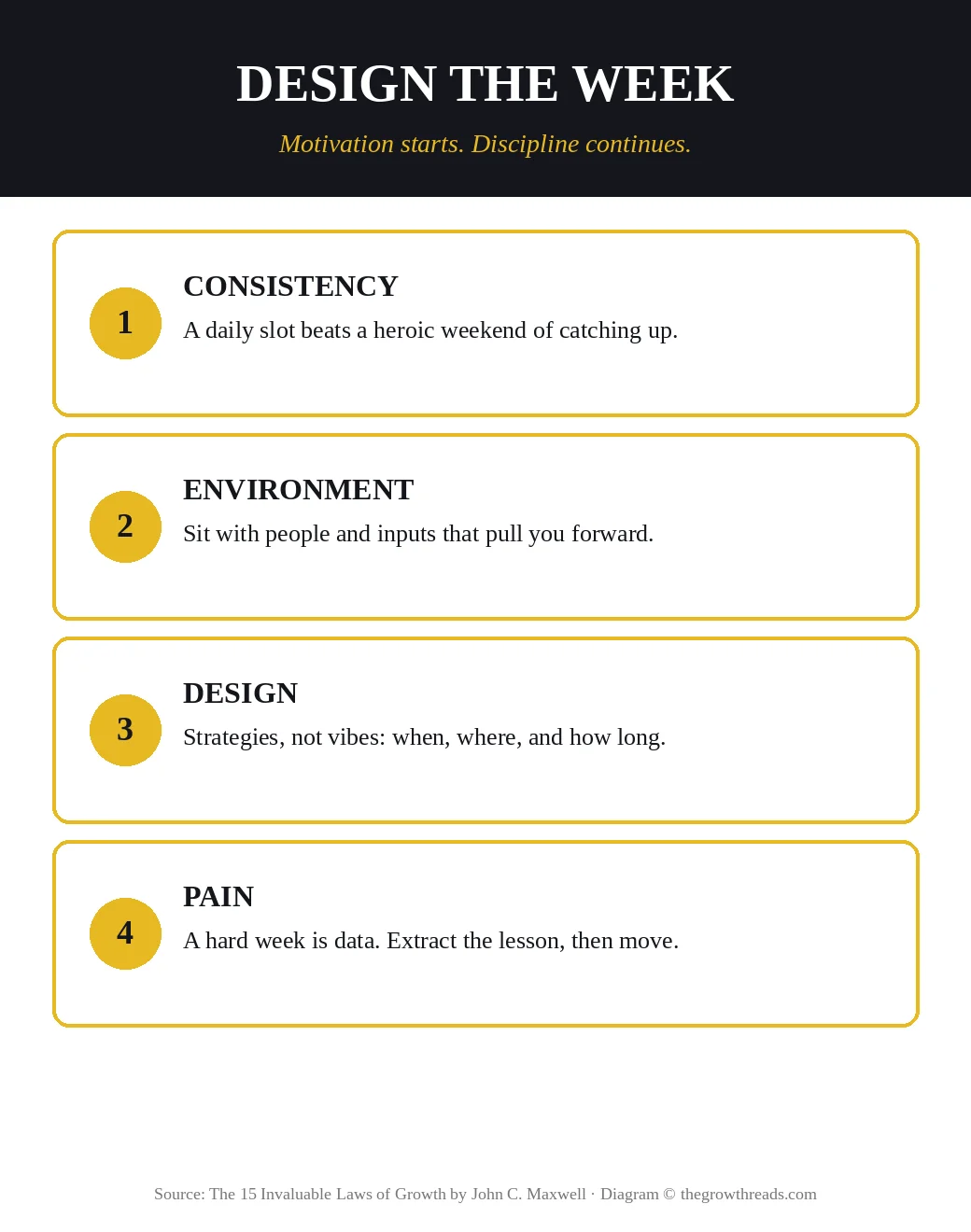
Laws two through four are the self-work most productivity systems skip. Awareness: you must know yourself to grow yourself. Strengths you refuse to name stay unused. Gaps you romanticize stay untrained. Maxwell wants a blunt inventory — what you do easily, what you avoid, what people already come to you for. The Mirror follows: you will not spend money, time, or attention on a self you secretly discount. Reflection is the pause that lets those two lists update. Without it, you just accelerate in the wrong direction.
Then he turns to the week. Consistency is the unfashionable law. Motivation books the first session. Discipline books the twentieth. Environment is the room: who you sit with, what you read, whether your phone is in the same chair as the work. Design is the how — a strategy with a time, a place, and a length, not a vibe. Pain is the unused teacher. A hard week is data if you extract the lesson. If you only recover, you paid the cost and skipped the receipt.
Put together, this is a Tuesday system. Know the gap. Value the person enough to invest. Review. Show up in a room that helps. Time-box the work. After a miss, write one sentence about what broke. That sentence is the next design change. The people who bounce off Maxwell want a personality transplant. He is offering a weekly operating loop.
TGR Note: For a career prototype instead of a growth law list, start with Designing Your Life. For written goals that move daily, Goals! is the tighter companion. Come back to Maxwell when you need the self-inventory and the environment test, not another target number.
Part 3: Stay in tension — rubber bands, trade-offs, character
The Law of the Rubber Band is the image people remember. A rubber band does useful work only when it is stretched. Too little tension and nothing moves. Too much and it snaps. Maxwell’s point is that comfort is not rest — rest is scheduled. Comfort is the week with no gap between who you are and who you could be. You keep a next honest standard in view: a harder piece, a public deadline, a coach who will not flatter you. The stretch is the job.
Trade-offs make the stretch possible. You have to give up to grow up. The calendar is already full of other people’s priorities. A growth hour is not found. It is swapped. Name the easy yes you will drop this month — a meeting, a scroll block, a favor that only exists because you will not say no. The Law of the Ladder sits under this: character growth sets the height of skill growth. If you cheat the review, pad the hours, or hide the miss, the ladder does not go higher no matter how many courses you buy.
Curiosity keeps the rubber band from becoming grim. Ask why. Ask what else. A plan that cannot be questioned becomes a cage. Maxwell’s useful version is not endless exploration. It is one curious question at the weekly review: what would make this easier or more honest next week? Then change one line. Not fifteen.
TGR Note: If the stall is a habit that used to work, read What Got You Here Won’t Get You There before you add another growth law. If you want a six-habit performance loop after Maxwell’s plan exists, High Performance Habits is the next operational book. Do not collect all three as a way to postpone the trade-off.
Part 4: Model, expand, and contribute
The closing laws prevent the plan from becoming a private hobby. Modeling: it is hard to improve when you have only yourself to follow. Find someone a few steps ahead in the specific area — not a celebrity, a practitioner. Watch how they review, who they sit with, what they refuse. Expansion: growth increases capacity. The point of the hour is not to stay busy at the same size. It is to handle a harder problem with less drama. You should feel slightly more able in ninety days, not just more informed.
Contribution is the last law and the one Maxwell cares about most. Growing yourself enables you to grow others. Teach the idea you just used. Hand a checklist to a colleague. Run a short debrief. Contribution is not a personality type. It is how the learning sticks. What you explain, you keep. What you hoard, you forget. The 15 laws are a loop, not a mountain: plan, know, show up, stretch, give.
Skip the urge to live all fifteen this month. Maxwell’s failure mode is the reader who highlights every law and changes none. Pick intentionality plus two others that match the stall — environment if your inputs are stale, trade-offs if the calendar is the enemy, contribution if the work has become self-absorbed. Run those for a quarter. Then add a fourth.
Who is The 15 Invaluable Laws of Growth best for — and who should read something else first?
Best for the capable person whose weeks are full and whose craft has plateaued. Also good if you already like Maxwell’s leadership laws and need the personal-growth companion. Not first if you still need a tiny daily action that feels safe — start with Mini Habits or Tiny Habits. Not first if you want the science of loops before a plan — The Power of Habit or Atomic Habits. Not first if the problem is career shape rather than daily growth — Designing Your Life. Maxwell is the named-laws plan after you have picked a door.
Questions to reflect on
- Which skill is the same as it was three years ago despite a full calendar?
- If growth had to fit in thirty minutes a day, which area would you choose?
- Who in your actual week pulls you forward — and who quietly freezes you?
- What easy yes will you drop so a growth hour can exist?
- Who could you teach this week’s lesson to, so the learning has to leave your notes?
🔥 Ready to put growth on the calendar?
Get The 15 Invaluable Laws of Growth, then use the 7-day plan to write one page and protect thirty minutes a day.
How to apply The 15 Invaluable Laws of Growth (7-day plan)
- Day 1 — Name the area. One skill. Write a one-page plan: what better looks like in ninety days, and a thirty-minute daily slot.
- Day 2 — Awareness list. Five strengths. Five gaps. Circle the gap this plan will touch. Do not add a second area.
- Day 3 — Change one input. Swap a feed, a lunch, or a room for something that pulls the plan forward.
- Day 4 — Run the slot. Thirty minutes. Same time. No extras. If you miss, write why in one sentence.
- Day 5 — Reflection. Twenty minutes: what worked, what was theatre, what to change. This is the Law of Reflection, not a rest day from the work.
- Day 6 — One trade-off. Drop an easy yes this month so the slot can survive next week.
- Day 7 — Contribute. Teach one idea from the week to a real person. Then keep the same slot for the next seven days.
Frequently asked questions
What is The 15 Invaluable Laws of Growth about in one paragraph?
The 15 Invaluable Laws of Growth is John C. Maxwell’s 2012 personal-development manual. He argues that growth does not arrive with time on the job: you pick an area, write a plan, put it on the calendar, and review it. Fifteen named laws cover that loop — intentionality, self-awareness, valuing yourself, reflection, consistency, environment, design, pain, character, healthy tension, trade-offs, curiosity, modeling, expanded capacity, and contribution. This The 15 Invaluable Laws of Growth summary turns the list into one ninety-day page and a thirty-minute daily slot you can run this week.
Is The 15 Invaluable Laws of Growth still worth reading in 2026?
Yes, if your problem is a full calendar and a stalled craft. Newer habit books are tighter on cues and environment science. Maxwell is still the plainest vocabulary for a written growth plan plus the social laws — modeling, environment, contribution — that a private streak tracker misses. Skip the urge to live all fifteen laws this month. Use intentionality, one stretch law, and contribution. The 7-day plan in this guide is the 2026 use case: one area, one page, one protected slot, one person you teach.
How is this book different from The 21 Irrefutable Laws of Leadership?
The 21 laws are about leading other people: influence, lids, buy-in. The 15 Invaluable Laws of Growth are about leading yourself. Same teacher, different object. If your team is the problem, start with the leadership book. If you are the bottleneck — busy, decent, unchanged — start here. Many readers use both: the growth book for the personal plan, the leadership book for the organizational lid. Do not treat this title as a lighter 21 laws. It is the self-development companion, and it earns a slot only if you will write the page.
What is the Law of Intentionality?
The Law of Intentionality says growth doesn’t just happen. Time in a role is not development. You choose an area, define better, and attach a repeating block of time. Without that, the week fills with other people’s priorities and you call it experience. Maxwell’s useful test is rude: can you point to the plan and the slot? If not, you have already decided. This is why Day 1 in the 7-day plan is a one-page plan for a single skill, not a tour of all fifteen laws.
What is the Law of the Rubber Band?
A rubber band does useful work only when stretched. Maxwell uses that image for the gap between who you are and the next honest standard — a harder piece, a public deadline, a coach who will not flatter you. Comfort is not rest. Rest is scheduled. Comfort is a week with no stretch. Too little tension and nothing moves; too much and you snap. Pair the rubber band with trade-offs: drop an easy yes so the stretch has a calendar. Keep the standard visible. Review weekly so the band does not go slack.
Who should read something else first?
If even a thirty-minute slot feels like an accusation, start with Mini Habits or Tiny Habits and come back when a tiny action already feels safe. If you want cue-craving-response science before a named-laws list, read The Power of Habit or Atomic Habits. If the problem is career shape — which job, which prototype — Designing Your Life is the better first map. The 15 Invaluable Laws of Growth is for the person who already agrees they should grow and needs a written plan, a stretching room, and a contribution loop, not another pep talk.
How do I apply the 15 laws this week?
Do not install fifteen laws. Pick one area. Write a ninety-day picture of better and a thirty-minute daily slot. Make a five-and-five list of strengths and gaps. Change one input in your environment. Run the slot four days. Write a short review. Drop one easy yes. Teach one idea to a real person. That sequence is intentionality, awareness, environment, consistency, reflection, trade-offs, and contribution — enough to prove the book. The 7-day plan in this The 15 Invaluable Laws of Growth summary is that sequence with names for each day.
Related summaries
- The Compound Effect by Darren Hardy
- Goals! by Brian Tracy
- High Performance Habits by Brendon Burchard
- Designing Your Life by Bill Burnett & Dave Evans
- Best productivity books
How we analyze books: every book on The Growth Reads is read cover to cover, summarized in thousands of words of original analysis, and rated against our five-criteria rubric (lasting impact, evidence quality, practical application, writing & originality, external consensus). Read our full methodology.