

★★★★½ 4.6/5 — a short dojo manual for staying when the graph goes flat.
Best for: people who keep starting skills and leaving at the first stall
Reading time: ~4 hrs (176 pages) · this guide ~12 min
Difficulty to apply: Medium — the work is showing up on days that feel dead
Mastery in one minute
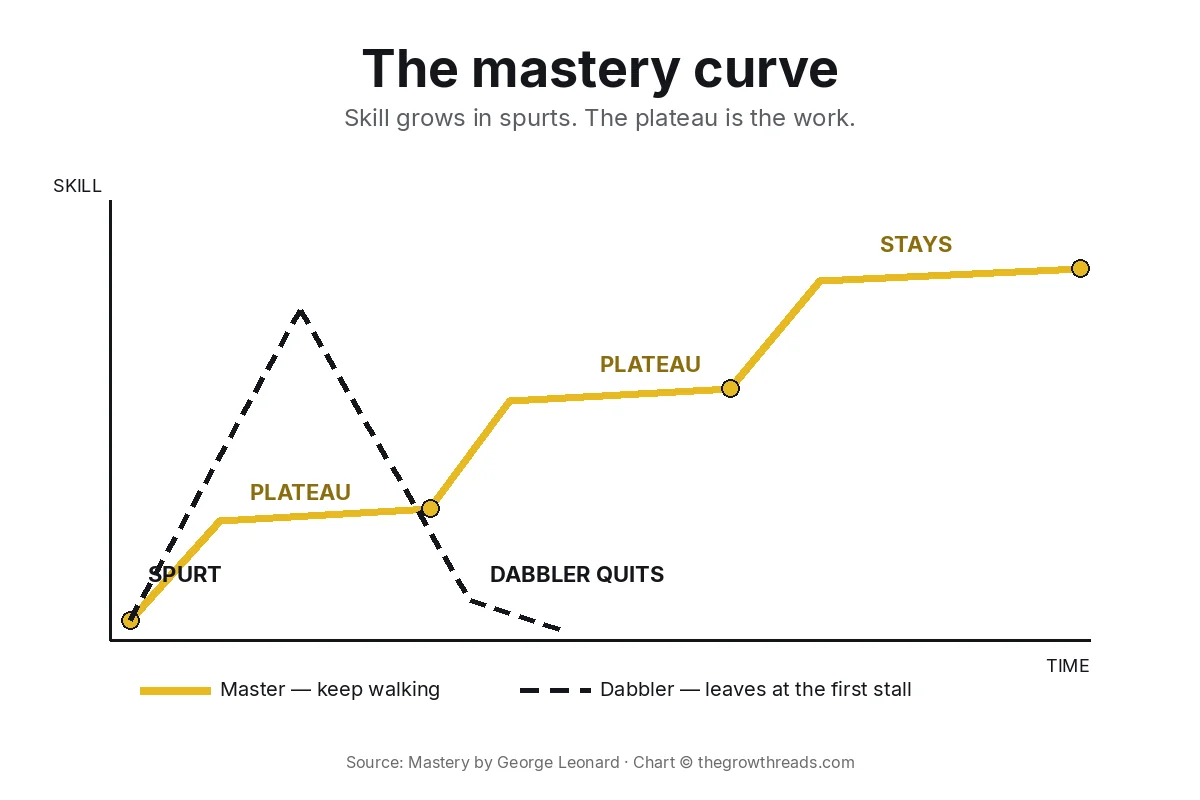
The boring stretch is the point. George Leonard’s Mastery: The Keys to Success and Long-Term Fulfillment is a 176-page dojo manual, not a museum of geniuses. Progress does not look like a staircase. It looks like a brief spurt, then a long plateau, then another spurt. Most people leave at the first flat week. Leonard names the three exits — dabbler, obsessive, hacker — and five keys for staying: instruction, practice, surrender, intentionality, and the edge. This Mastery George Leonard summary is for the person who keeps collecting beginnings. Stay on the path after the thrill drops.
Leonard earned the right to say it. He started aikido in midlife, took a fifth-degree black belt, and spent the rest of his teaching life watching talented beginners disappear the moment praise stopped arriving daily. The book is short on tactics and long on a feeling you already know: the Tuesday when nothing clicks and you want a new hobby. That Tuesday is the curriculum.
Key takeaways
- The curve is not a staircase: skill rises in spurts, then sits still. The sitting still is not a bug.
- Love the plateau: that is where the nervous system lays the skill down. Chasing only highs makes you a tourist.
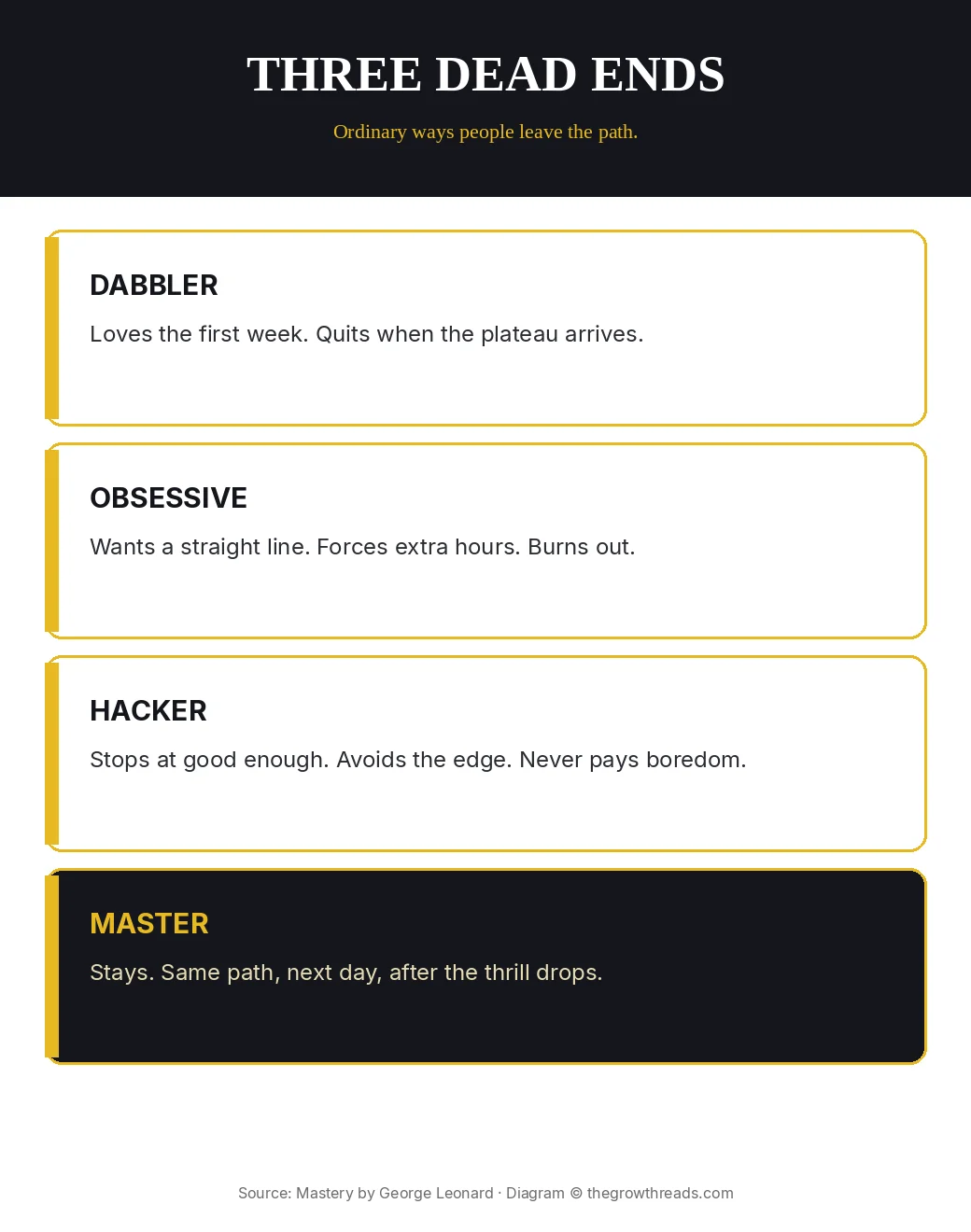
- The dabbler: adores first lessons and first praise, then quits when the graph flattens.
- The obsessive: demands a straight line, piles on hours, and burns out when the body will not spike on command.
- The hacker: stops at “good enough,” avoids the edge, and never pays the boredom tax.
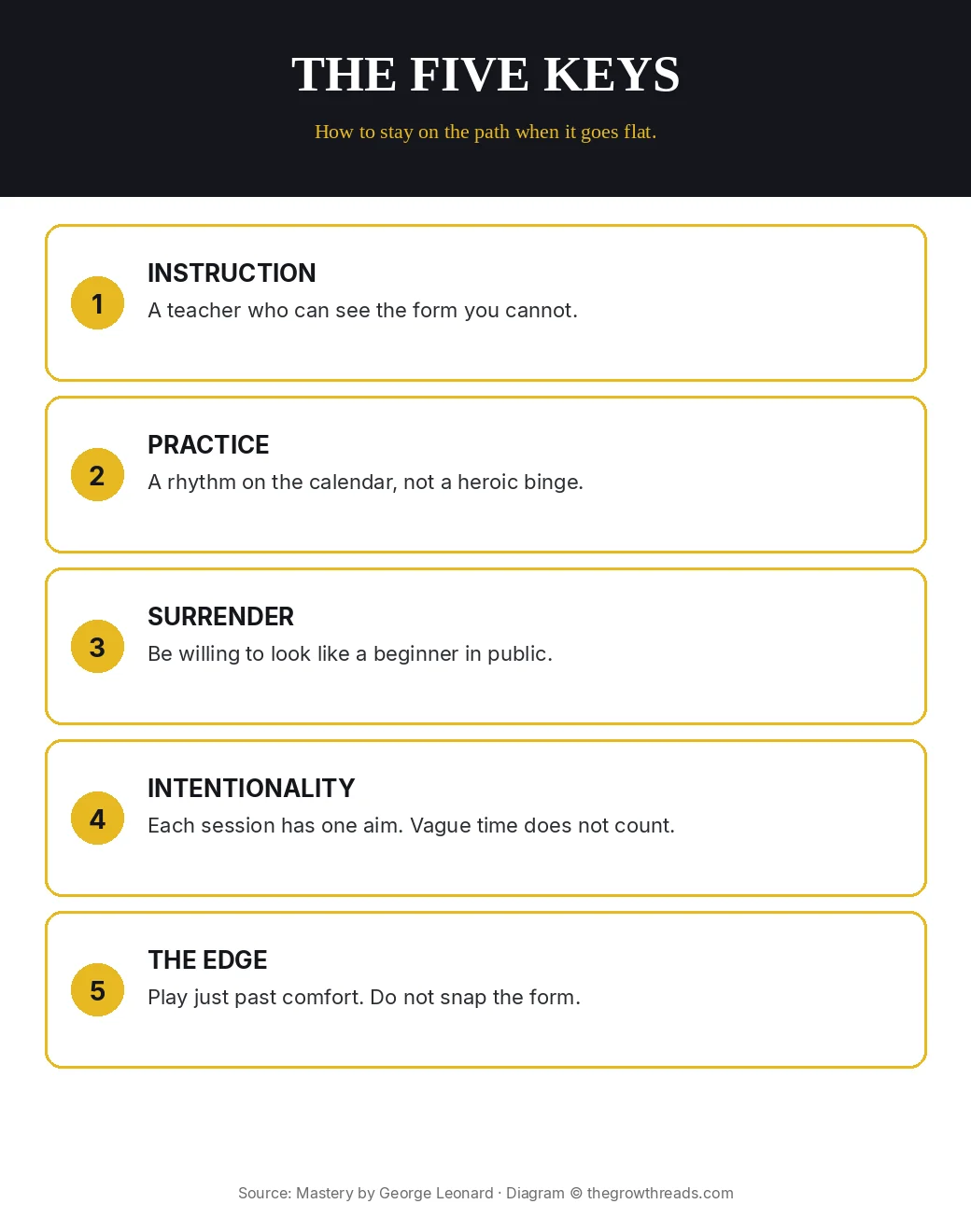
- Five keys: instruction, practice, surrender, intentionality, the edge. Use them on one path, not ten.
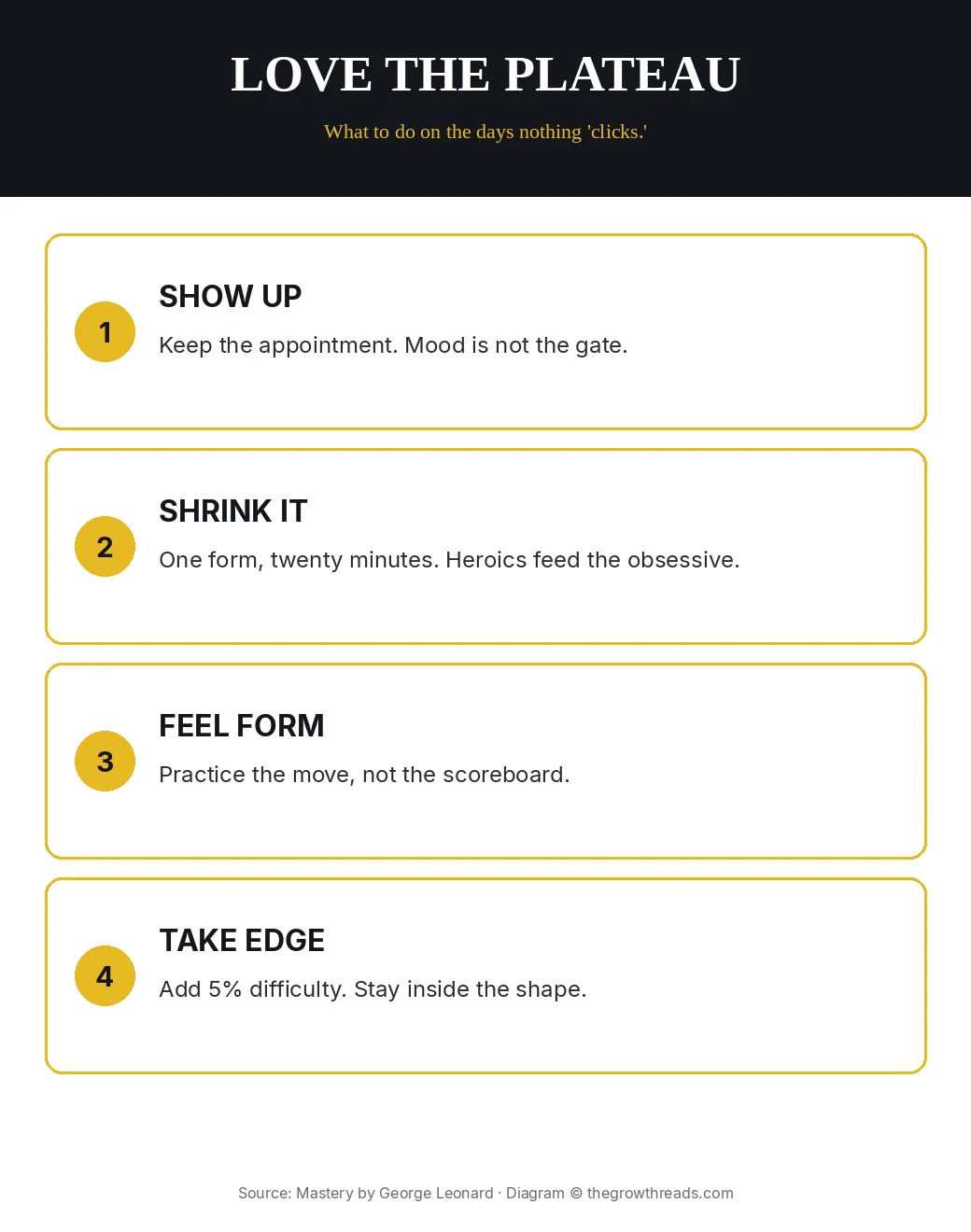
- Practice is a rhythm: a modest session on the calendar beats a heroic binge after a guilt spiral.
- Surrender: you cannot learn what you refuse to look foolish doing in public.
- The edge: add a little difficulty. Stay inside the form. Injury and ego spikes both knock you off the path.
- Homeostasis fights change: your system will pull you back to the old identity. Expect the pull; keep the appointment.
What is Mastery about?
Mastery is George Leonard’s short guide to long-term skill. It argues that fulfillment comes from staying with a practice through long plateaus, not from collecting beginnings. The book maps three ways people leave the path and five keys for remaining until the next spurt arrives.
About the author
George Burr Leonard (1923–2010) was an American writer, editor, and aikido teacher. He flew for the Army Air Corps, then spent 1953–1970 at Look magazine writing about education and human potential. He became president emeritus of the Esalen Institute, past president of the Association for Humanistic Psychology, and a co-founder of Integral Transformative Practice. He held a fifth-degree black belt in aikido and co-founded Aikido of Tamalpais in Northern California. He started the art in midlife, which is the lived proof inside this book: you can begin late and still walk the path for decades. He also wrote Education and Ecstasy and The Ultimate Athlete. He died at his home in Mill Valley in 2010. Explore all George Leonard book summaries →
Key concepts at a glance
| Concept | What it means | Use it when |
|---|---|---|
| Mastery curve | Brief spurts of gain, then long plateaus. The plateau is the work. | You treat a flat week as proof you picked the wrong skill. |
| Love the plateau | Stay with the practice while nothing “clicks.” Skill is laid down off-camera. | You only train on days that feel like a breakthrough. |
| Dabbler | Loves beginnings and first praise; leaves at the first stall. | Your hobby shelf is a graveyard of week-two equipment. |
| Obsessive | Demands a straight line. Forces extra hours. Burns out. | You double the load the moment the graph pauses. |
| Hacker | Stops at good enough. Avoids the edge. Never pays boredom. | You are competent and slightly bored, and you call that done. |
| Five keys | Instruction, practice, surrender, intentionality, the edge. | You have time on the clock and no teacher, no aim, and no stretch. |
| Homeostasis | The system pulls you back to the old identity when you change. | Friends, sleep, and mood all lobby for the person you were last month. |
Part 1: The curve — spurts, then the plateau
Leonard opens with a picture you can feel in your shoulders. A beginner makes fast gains. The first chords, the first phrases, the first clean throw. Friends notice. Then the line flattens. The same hour produces nothing you can post. This, he says, is not a malfunction. It is how a nervous system encodes a skill. The plateau is where the move becomes yours instead of a trick you can still forget overnight.
He learned it on the mat. Starting aikido in midlife, he watched younger, more flexible students arrive in a rush of talent and leave when the rank tests stopped feeling like fireworks. The people who remained were not always the most gifted. They were the ones who kept bowing in on the weeks the body felt ordinary. The book’s central drawing is that mastery curve: a short rise, a long flat, a short rise, another long flat. Western culture, he argues, is an anti-mastery machine. It sells the spurt — the transformation montage — and treats the plateau as a personal failure you should shop your way out of.
The practical move is a reframe, not a new app. When the graph goes sideways, you do not hunt a different identity. You keep the appointment. Leonard’s line is short enough to tape on a desk: to be a learner, you have got to be willing to be a fool. The fool is not a brand. The fool is the person still in the room after the easy praise ends.
TGR Note. Later research put numbers on the same shape. Peak and Talent Is Overrated call the plateau the place you put purposeful reps, not leftover time. Bounce names the iceberg: the visible spurt sits on hours nobody clapped for. Leonard’s gift is the feeling of those hours. If you already know the science and still leave on Tuesday, this is the manual for the feeling.
Part 2: Dabbler, obsessive, hacker
Leonard’s three characters are not insults. They are exits. The dabbler loves the smell of a new studio. The first week is a montage: new shoes, a teacher who smiles, a story you can tell at dinner. At the first plateau the dabbler decides the art “wasn’t for me,” and the cycle restarts with a different logo. The cost is not the unused gear. The cost is never staying long enough to meet yourself without the beginner high.
The obsessive treats the curve as a contract the universe has breached. If yesterday’s session was a spurt, today’s must be steeper. Extra hours. Extra drills. A body that cannot recover. Leonard is not against intensity. He is against using intensity to skip the plateau. The obsessive’s crash looks like discipline from the outside and like panic from the inside. When the line will not move, they either injure the practice or abandon it in disgust.
The hacker is the quietest exit. Competence arrives. People say you are good. The hacker parks there — never quite at the edge, never quite a fool again. Leonard’s point is not that “good enough” is immoral. It is that calling yourself a master while avoiding the next awkward layer is a story, not a path. The master is simply the person who remains after all three exits have been offered.
TGR Note. Need a crash “useful in twenty hours” version of a tool? That is The First 20 Hours, not this book. Leonard is the opposite medicine: stay after competence. If the question is whether this plateau is even the right mountain, The Dip is the companion — quit the wrong curve, stay on the one you chose on purpose.
Part 3: The five master keys
Instruction means a teacher who can see the form you cannot. Books help. Videos help. They cannot tap your elbow. Leonard is blunt about this because aikido made it obvious: without a live correction, you engrave your own error. Find someone who will slow you down. Hurry makes the lesson longer.
Practice is a rhythm, not a purge. A modest session that exists on days you do not feel like a protagonist will outrun the weekend binge. The calendar is the instrument. Mood is not the gate.
Surrender is the willingness to look like a beginner in public. Leonard’s aikido stories are full of black belts taking ukemi, falling on purpose, letting a white belt throw them cleanly. Ego wants to protect last month’s identity. Learning requires you to set it down for an hour.
Intentionality means this session has one aim. “Put in time” is how the hacker hides. Name the form. Name the bar. Then stop when the hour is honest.
The edge is a 5 percent stretch that stays inside the shape. Too little and you coast. Too much and you snap the form — or the tendon. Play at the boundary. Do not make a documentary of your own suffering.
TGR Note. If the missing piece is identity rather than a teacher, Atomic Habits is the cast-vote version of Leonard’s rhythm. If the missing piece is attention inside the session, The Practicing Mind and The Inner Game of Tennis quiet the voice that grades every rep. Leonard tells you to stay. Those books tell you how to stay without turning the hour into a courtroom.
Part 4: Energy, homeostasis, and the edge
The second half of the book is less a new theory than a set of body-level warnings. Mastery is not a mindset poster. It lives in sleep, food, breath, and the way you walk into the room. Leonard spent years at Esalen and on the mat watching people try to think their way into a skill their nervous system had not encoded. A tired body will sell you a story that the plateau means you should quit. Often it means you should sleep, then return.
Homeostasis is the quiet antagonist. Change a practice and the rest of your life will lobby for the person you were. Friends joke. Your calendar fills. The old identity is comfortable because it is known. Leonard’s counsel is not to smash your life. It is to expect the pull, shrink the session if you must, and keep the thread. A twenty-minute appointment kept is a vote. A two-hour heroic make-up session after a week off is often the obsessive in a new jacket.
The edge, revisited at the end, is how you avoid the hacker’s parking spot. Stay long enough to be competent, then add a little difficulty while the form still holds. That is the whole game, repeated for years. Leonard’s fifth-degree black belt was not a personality. It was a calendar.
Who is Mastery best for — and who should read something else first?
Best for people who already know they should practice and still leave when the graph goes flat: instruments, languages, writing, training, a craft at work. If your hobby shelf is a museum of week-two equipment, this is the book.
Read something else first if you need a weekend of competence — start with The First 20 Hours. If you want the lab studies behind deliberate practice, start with Peak or The Talent Code. If you want historical masters and social strategy, start with Mastery by Robert Greene — a different book with the same one-word title. If resistance is the only problem, The War of Art names the enemy; Leonard names what to do after you sit down.
Questions to reflect on
- Which skill did you abandon at the first plateau in the last two years, and what did the dabbler say it “meant”?
- Where are you the obsessive right now — adding load because the line will not move?
- Where are you the hacker — competent, slightly bored, and calling that mastery?
- Who can see your form this month? If the answer is “YouTube,” what would a live correction change?
- What twenty-minute appointment could you keep on a dead Tuesday without turning it into a personality reboot?
🔥 Ready to stay on the plateau this week?
Pick one practice. Twenty minutes. No new hobby until Friday.
How to apply Mastery (7-day plan)
- Day 1 — Pick one path. Name a single practice you will not replace this week. Write it on paper. If you cannot name it in six words, you are still shopping.
- Day 2 — Find instruction. Book one live correction: a class, a teacher, a colleague who can watch. A video queue does not count.
- Day 3 — Install the rhythm. Put a twenty-minute session on tomorrow’s calendar at a boring time. Protect it like a meeting with someone you respect.
- Day 4 — Name your exit. After the session, write dabbler, obsessive, or hacker in one sentence. No third person. What did you almost do instead of staying?
- Day 5 — Surrender one layer. Do the beginner drill in public, or ask for a correction you think you are past. Stay in the room for the whole hour.
- Day 6 — Intentionality. Walk in with one aim (“this throw,” “this bar,” “this paragraph”). Stop when the aim is honest. Do not add a second mountain.
- Day 7 — Take the edge. Add about 5 percent difficulty and keep the form. Then stop. Review the week: three kept appointments beat one cinematic Saturday.
Frequently asked questions
What is Mastery by George Leonard about?
Mastery: The Keys to Success and Long-Term Fulfillment is George Leonard’s short 1992 guide to staying with a skill long enough for it to change you. Progress does not look like a staircase. It looks like a brief spurt, then a long plateau, then another spurt. Most people leave at the first flat stretch. Leonard names three exits — the dabbler, the obsessive, and the hacker — then offers five keys for staying: instruction, practice, surrender, intentionality, and the edge. The point is fulfillment over time, not a weekend of novelty.
How is this different from Robert Greene’s Mastery?
Greene’s Mastery, already on The Growth Reads, studies historical masters and the social path to rare skill. Leonard’s Mastery is a dojo manual. It is 176 pages, written by an aikido teacher who began in midlife, and it spends its energy on how a plateau feels in your body this week. Read Greene when you want the biographies. Read Leonard when the work has gone quiet and you are tempted to start a new hobby instead of showing up. They share a title. They do not share a method. This page is only Leonard.
What are the dabbler, the obsessive, and the hacker?
The dabbler loves beginnings and first praise, then quits when the plateau arrives. The obsessive demands a straight line of improvement, forces extra hours, and burns out when the skill refuses to spike on command. The hacker stays at “good enough,” avoids the edge, and never pays the boredom tax that real skill requires. None of these people are villains. They are ordinary responses to a curve that is not a staircase. The master is simply the person who keeps walking the same path after the thrill drops.
What are Leonard’s five master keys?
Instruction means a live teacher who can see what you cannot. Practice means a regular rhythm, not a heroic binge. Surrender means being willing to look like a beginner in public. Intentionality means each session has a specific aim, not vague time on the clock. The edge means playing just past comfort without snapping the form. Together they keep you on the plateau long enough for the next spurt to arrive. Skip any one and the curve flattens into dabbling, grinding, or coasting. Use all five on one practice this week.
How long does it take to apply Mastery?
You can start the same day: pick one practice, put it on the calendar, and stay for a short session even if nothing clicks. Leonard’s own aikido path took years; the book is 176 pages and a few hours to read. The application is not a thirty-day challenge. It is a decision to remain when the graph goes sideways. Use the seven-day plan in this review to install the rhythm. Judge the experiment after a month of plateaus, not after one exciting Saturday. The plateau is the curriculum, not a delay before the curriculum starts.
Who should read Mastery — and who should start elsewhere?
Read it if you keep abandoning skills at the first stall: language apps, instruments, training, writing. If you need crash competence in a weekend, start with The First 20 Hours. If you want the laboratory of deliberate practice, start with Peak. If you want historical case studies of masters, start with Robert Greene’s Mastery. Leonard is the emotional operating system for people who already know they should practice and still leave when it feels dead. Bring one skill, not a shopping list of new identities.
Is there an audiobook, and which edition should I buy?
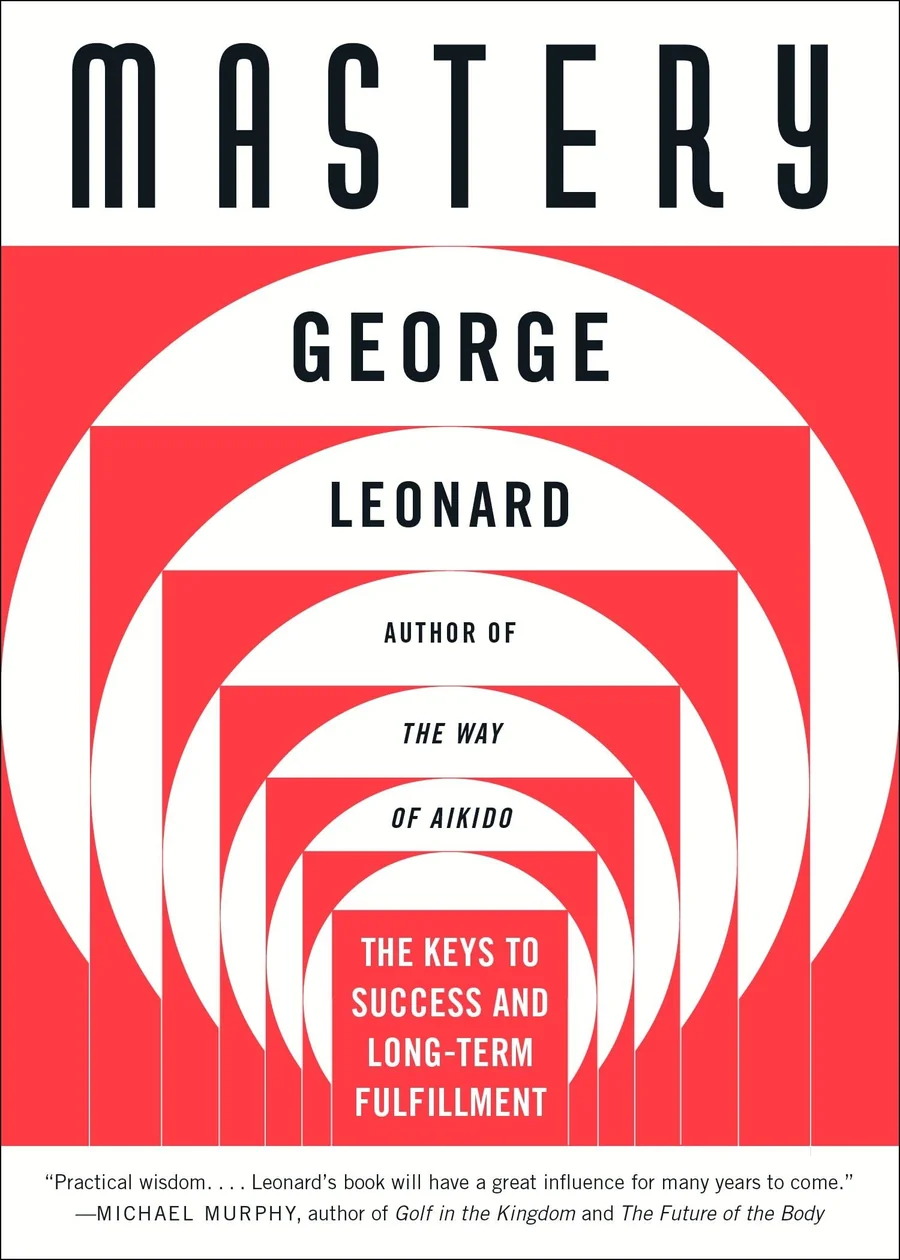
The Plume paperback (ISBN 9780452267565, Amazon 0452267560) is the working edition: 176 pages, the red concentric-square jacket. That is the copy this review cites. Search Audible for “Mastery George Leonard audiobook” and confirm the author before you tap buy. Skip Robert Greene’s Mastery in the store results; the covers and subtitles differ. If a bookseller 404s the ISBN, use the Bookshop.org shop page for The Growth Reads rather than a guessed deep link. Either format works if you practice the same day you finish a chapter.
Related summaries
- Peak — purposeful practice on the plateau
- The Practicing Mind — stay with the process
- Talent Is Overrated — practice beats the myth
- Mastery (Robert Greene) — a different book with the same title
- Best productivity books — the full TGR pillar
How we analyze books: we reconstruct the argument, add original application notes, and skip chapter-by-chapter reproduction. Read our full methodology.