

★★★★½ 4.5/5 — the same learning science as the famous course, in a book you can finish in a weekend and use on Tuesday’s hard page.
Best for: students, career-switchers, and anyone who still believes they are “not a math person”
Reading time: ~5 hours (256 pages) · this guide ~12 min
Difficulty to apply: Easy — the first drill is a 25-minute timer and a closed book
Learning How to Learn in one minute
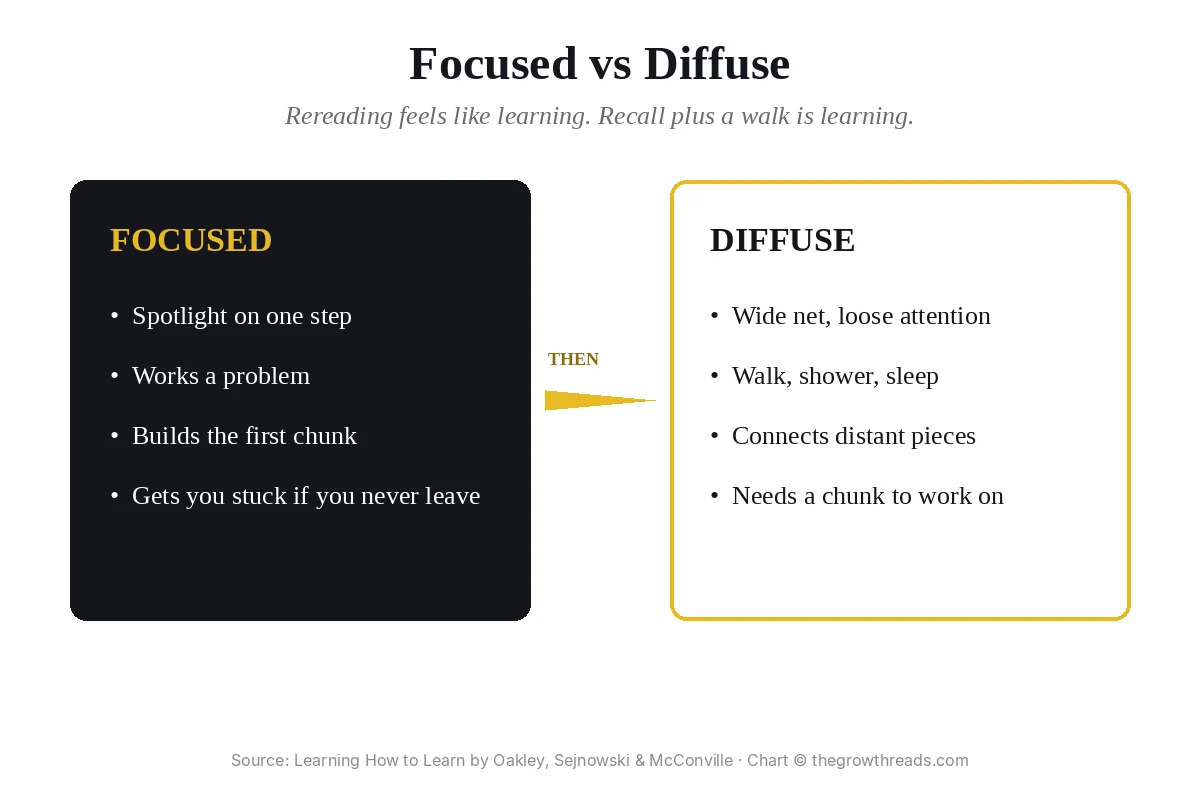
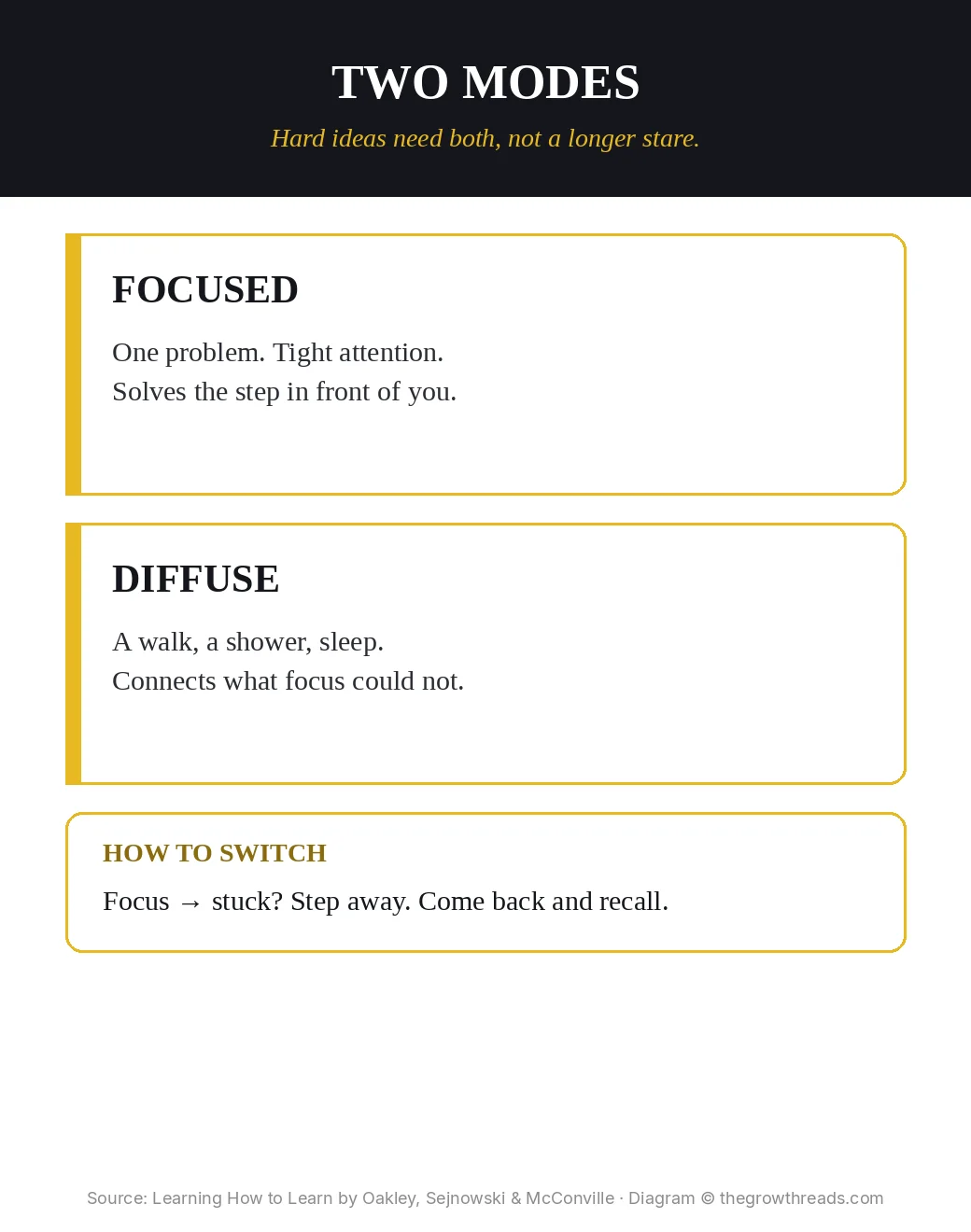
Hard subjects do not require a different brain. They require two modes, then a recall test you cannot fake. Barbara Oakley, Terrence Sejnowski, and Alistair McConville wrote it as the student-facing sibling of A Mind for Numbers and of Coursera’s giant course of the same name. Focused mode is a spotlight: one problem, tight attention. Diffuse mode is a walk, a shower, or sleep: the network that connects what the spotlight could not. You build a “chunk” by working a small piece, closing the notes, and saying it back. Rereading and highlighting feel like study and mostly measure familiarity. Procrastination is a cue, not a character flaw — start a 25-minute process instead of waiting to feel ready for the finished product. If you only take one move from this Learning How to Learn summary, pick one hard page, set a timer, then retrieve it with the book shut.
Key takeaways
- Two modes, not one longer stare: focused attention solves; diffuse attention connects. Alternate them on purpose.
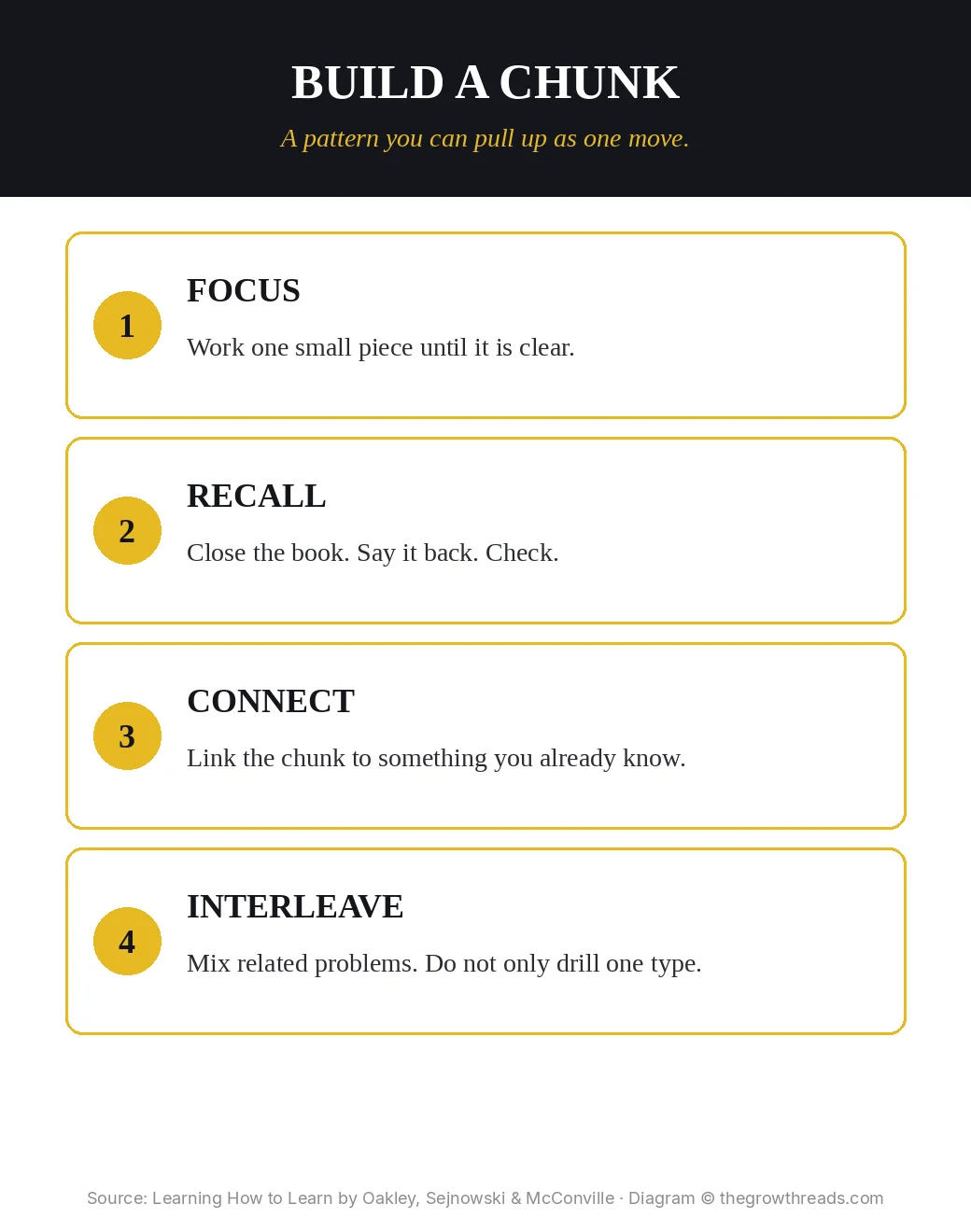
- A chunk is a pattern you can pull up as one move: focus, recall, then connect it to something you already know.
- Recall beats rereading: if you cannot say it with the page closed, you do not have it yet.
- Illusions of competence are cheap: highlighting, nodding along, and “I remember seeing that” are not memory.
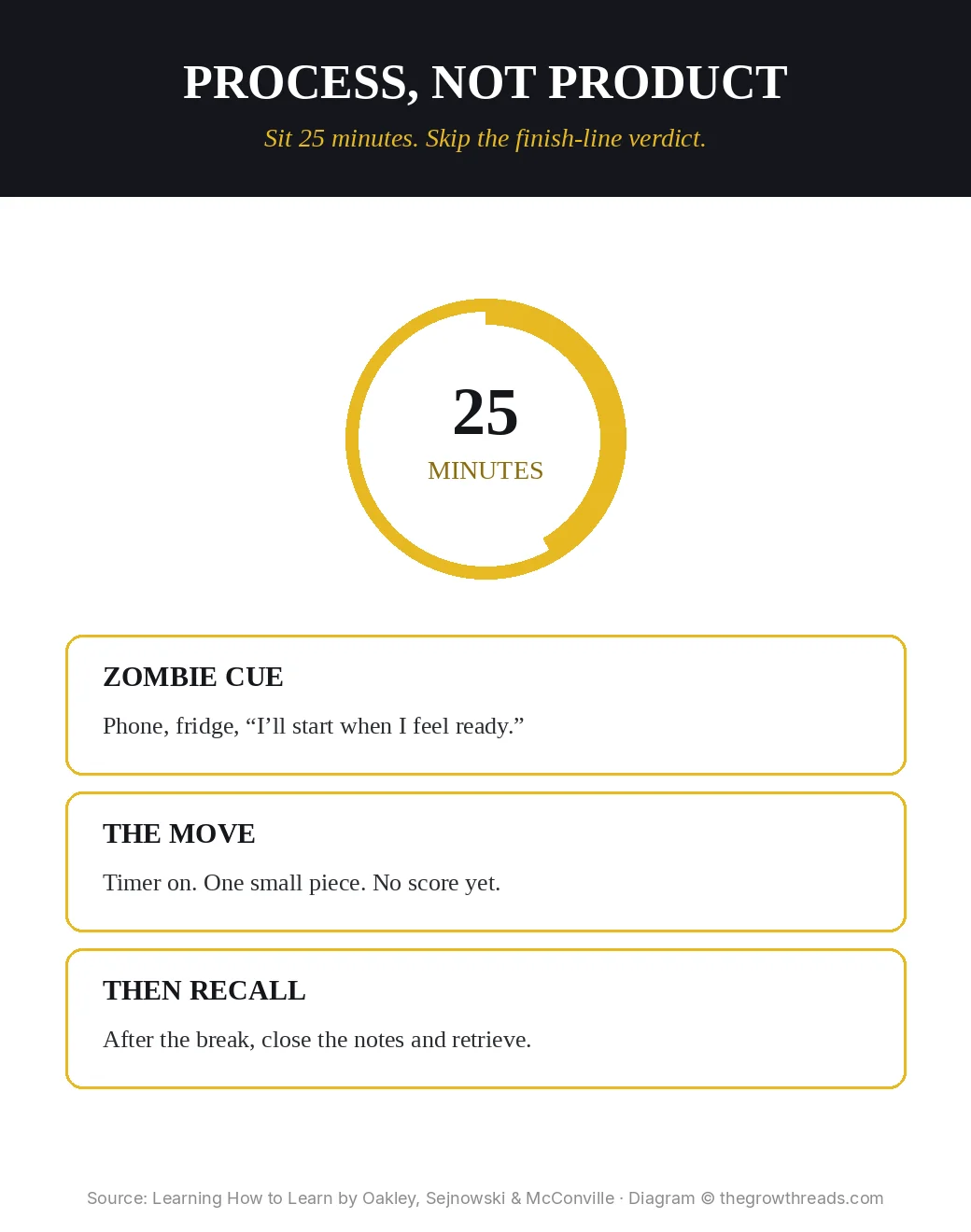
- Process, not product: sit 25 minutes. Skip the finish-line verdict until the timer ends.
- Zombie cues run the delay: phone, fridge, “I’ll start when I feel ready.” Name the cue. Start the timer anyway.
- Sleep and exercise are study: they are how the brain consolidates, not rewards you earn after a heroic night.
- Interleave: mix related problem types. Drilling only one pattern trains a trick, not a skill.
- Metaphors and picture walks stick: a vivid image beats a third pass of the same paragraph.
- Tests are retrieval practice: use them to find holes while there is still time to fill them.
What is Learning How to Learn about?
Learning How to Learn is a short field manual for making hard subjects stick: focused versus diffuse thinking, how to build a chunk you can recall with the book closed, a 25-minute Pomodoro against procrastination, plus sleep, exercise, interleaving, and tests that measure memory instead of rereading.
About the author
Barbara Oakley grew up sure she was not a math person. She enlisted in the U.S. Army, became a Russian translator, then retrained as an engineer in her mid-twenties — the origin story she uses to prove a “bad at this” identity is often just an untrained mode. She teaches engineering at Oakland University. With Salk Institute neuroscientist Terrence Sejnowski she built Learning How to Learn, one of Coursera’s most-taken courses. Educator Alistair McConville helps translate the lab into a voice that talks to a student who already decided the hard class is not for them. A Mind for Numbers (2014) is the adult depth. This 2018 TarcherPerigee book is the same science in shorter chapters you can apply the same week, whether you are fifteen or forty and stuck on a certification. Explore all Alistair McConville book summaries →
Key concepts at a glance
| Concept | What it means | Use it when |
|---|---|---|
| Focused mode | Tight, one-problem attention that works the next step | You can name the small piece in front of you |
| Diffuse mode | Loose attention — walk, shower, sleep — that connects distant pieces | You have stared and the step still will not move |
| Chunk | A pattern packed so you can pull it up as one move | You “understand it now” but cannot start from a blank page |
| Recall | Retrieve with the notes closed, then check | Your study session has been rereading and highlighting |
| Illusion of competence | Familiarity mistaken for knowledge | The page looks easy until the quiz |
| Process vs product | Sit for 25 minutes; do not wait to feel ready for the finished thing | You keep delaying until the mood is right |
| Zombie cues | Automatic detours that start the delay | The phone or the fridge appears whenever the hard file opens |
| Interleaving | Mix related problem types instead of one drill forever | Homework is all one pattern and the test is mixed |
Part 1: Focused and diffuse — why “I’m not a math person” fails
Oakley’s own story is the opening argument. She was a language person who later forced a second career through engineering school. The point is not grit theater. It is that the brain has more than one way to work a hard idea, and most people only train the first. Focused mode is the spotlight: sit down, push the next step. Stay there too long and you pinball inside the same wrong groove. You feel busy. You are looping.
Diffuse mode is the other operating system. You walk, shower, or sleep. The network is looser, and pieces that would not touch under a spotlight start to touch. Sejnowski’s neuroscience is not “breaks are nice.” Insight shows up after you have given focused mode something to chew and then allowed the other network to run. People who call themselves not a numbers person often treat a failed stare as proof they lack the gift. The book’s refusal is practical. You do not need a different soul. You need a planned switch: work until you are honestly stuck, leave on purpose, come back and recall before you reopen the explanation.
TGR Note: The adult depth of this same science is our A Mind for Numbers summary. Read that when you want the engineering-school version and more on Einstellung (getting stuck in a familiar path). This book is the on-ramp. Do not collect both as a way to delay a 25-minute recall session. If attention itself is the bottleneck more than memory, pair the switch with our Focus summary.
Part 2: Chunking — how mastery actually forms
A chunk here is not a highlight color. It is a packed pattern: a chess setup you recognize as one thing, a physics move you can start without rereading the chapter title. Novices see parts. People with chunks see a move. The recipe is short. Focus on one small piece until it is clear. Recall it with the book closed. Connect it to something you already know. Skip recall and you have sticky tabs. Skip the connection and you have a trick that dies on a mixed test.
Rereading is soothing. Highlighting is a motor skill. Neither is the exam. The “illusion of competence” is the gap: the page looks familiar, so you conclude you could reproduce it. You could not. Recall shows the hole while there is still a week to fill it. A picture walk — skim headings and diagrams before you dive — gives the first focused pass a map. Memory palaces are optional. Closed-book retrieval is not. Interleaving belongs with chunking even though it feels slower: mix related problem types so you learn the idea, not the homework’s pattern. Fluency during a highlight marathon was the illusion.
TGR Note: If you want the lab-heavy version of “retrieval beats rereading,” use our Make It Stick summary. Brown, Roediger, and McDaniel are the classroom research cousin. Oakley’s book is how to do it tonight without a methods chapter. For a student calendar that already assumes closed-book work, How to Become a Straight-A Student is the scheduling layer.
Part 3: Procrastination, zombies, and the 25-minute start
Procrastination here is a cue-and-habit loop, not a pep talk. A hard file appears. A zombie cue offers relief: the phone, the fridge, “I’ll start when I feel ready.” The product — the finished set, the clean essay — is too large to sit down with, so you never sit down. Oakley’s move is process, not product. You are sitting to work for twenty-five minutes. The Pomodoro is small enough that “feeling ready” is no longer a prerequisite. Honest minutes count even if the page is unfinished. After the timer, take a real break so diffuse mode can run — not a second screen. Then recall before you reread. The timer without retrieval is only a clock.
Name the zombie. Phone leaves the room for one pomodoro. “I need to understand the whole chapter first” is product-thinking in costume: picture-walk the headings, pick one small piece, start the clock. The authors write for a kid with a parent in the doorway and an adult with a Slack channel. The loop is the same. The relief cue is just better funded when you are thirty.
TGR Note: The timer has its own short manual in our Pomodoro Technique summary. If twenty-five minutes still feels like a cliff, steal the even smaller start from Mini Habits — one page, one problem — then use Oakley’s recall check so the tiny start actually builds a chunk. Delay that is really dread of the finished thing is also the plot of The Now Habit; come back here for the learning-science overlay.
Part 4: Sleep, exercise, tests, and a brain that can change
Sleep here is not a wellness bonus. It is when a lot of the packing happens. An all-nighter steals the phase that would have consolidated last night’s focused work. Protect sleep and lose a reread rather than the reverse. A walk is the other unglamorous multiplier — a diffuse-mode window, not a reward you earn when the chapter is done. The walk is part of the chapter.
A quiz is retrieval with a timestamp. Use practice tests to find holes while you can still fill them. Waiting to “feel ready” for a practice exam is product-thinking again. Take a small test ugly; the score is information. A metaphor can hook a dry chunk — then recall the real terms, not only the story. The closing stance matches Oakley’s biography: brains change with designed practice. “I’m not a math person” describes past training, not a life sentence. If you already know the Coursera lectures, sleep, a walk, and a closed-book page are still how inspiration becomes a chunk.
Who is Learning How to Learn best for — and who should read something else first?
Read this if you are a student, a career-switcher, or an adult who still flinches at a hard technical page. The tone is written for kids and teens. The drills are age-agnostic. You want a weekend-length book that tells you what to do in the next hour: timer, recall, walk, sleep. Parents who want language for a teenager who “studies” by rereading get a script kinder than “try harder.”
Read something else first if you already want the adult engineering manual — start with our A Mind for Numbers summary. If your problem is a study calendar more than memory, How to Become a Straight-A Student. If you want aggressive skill sprints, Ultralearning or The First 20 Hours. If the science of retrieval is the itch, Make It Stick. This book is the on-ramp, not the whole library.
Questions to reflect on
- Where did you last reread a page that felt easy — and could you have reproduced it with the book shut?
- What is the zombie cue that appears in the first two minutes of a hard task?
- When you get stuck, do you stare longer, or do you have a planned diffuse switch?
- Which chunk can you actually start from a blank page, and which only looks familiar?
- Did last week’s late night steal the sleep that would have packed the work you already did?
🔥 Ready to make a hard page stick?
Get Learning How to Learn, then use the 7-day plan to switch modes and recall with the book closed.
How to apply Learning How to Learn (7-day plan)
- Day 1 — Pick one hard page. Not the whole course. One chapter, one problem set, one certification module. Picture-walk the headings. Write the one piece you will work first.
- Day 2 — One focused pomodoro. Phone out of the room. Twenty-five minutes on that piece. No finish-line verdict. When the timer ends, stand up.
- Day 3 — Recall before reread. Close the notes. Say or write the piece from yesterday. Check. Highlight only what you missed, not what looked pretty.
- Day 4 — Planned diffuse. After a focused sit, take a ten-minute walk with no podcast about the topic. Come back and try one related problem from memory.
- Day 5 — Build the chunk’s hook. Invent one metaphor or tiny diagram that connects the piece to something you already know. Then recall the real terms, not only the story.
- Day 6 — Interleave. Mix two related problem types in one sitting. It will feel slower. That is the point.
- Day 7 — Ugly quiz plus sleep. Give yourself a short closed-book test. Score it. Protect sleep the night after instead of a reread binge. Write tomorrow’s first 25-minute piece on a card.
Frequently asked questions
What is Learning How to Learn about in one paragraph?
Learning How to Learn is the 2018 TarcherPerigee field manual — the book people mean when they search for a Learning How to Learn summary — by Barbara Oakley, Terrence Sejnowski, and Alistair McConville. It is the student-facing version of their Coursera course and of Oakley’s A Mind for Numbers: focused versus diffuse thinking, how to build a chunk through recall, a 25-minute process against procrastination, plus sleep, exercise, interleaving, and tests that measure memory. This TGR guide turns those ideas into a closed-book drill you can run this week without waiting to feel like a “math person.”
Is Learning How to Learn still worth reading in 2026?
Yes, if your study session is still rereading, highlighting, and waiting to feel ready. The neuroscience labels have not retired the laptop test: can you reproduce the idea with the notes shut? Phones got better at offering zombie cues, which makes the 25-minute process more useful, not less. If you already run retrieval, interleaving, and sleep as a system, skim the two-mode chapter and spend the hours on a harder book. If you cannot point to a closed-book page from this week, the short book is still a field manual. The cartoons are for speed, not because the advice expired.
Is this the same as A Mind for Numbers or the Coursera course?
Same science, different clothes. The Coursera course Learning How to Learn is the video on-ramp millions already took. A Mind for Numbers is Oakley’s adult, denser book from 2014. Learning How to Learn the 2018 book is the student-facing sibling: shorter chapters, McConville’s classroom voice, the same focused/diffuse switch, chunks, recall, and Pomodoro. Read the 2018 book if you want something you can finish in a weekend and hand to a teenager. Read A Mind for Numbers if you want more on Einstellung, memory, and the engineering-school version. Do not use “which edition?” as a way to delay one recall session.
What is focused vs diffuse mode in Learning How to Learn?
Focused mode is a spotlight: one problem, tight attention, the next step. Diffuse mode is a wider net: a walk, a shower, sleep, a chore that does not eat the problem. Insight often shows up after you have given focused mode something to chew and then switched. Staring longer is not always more science. The book’s practical test is rude and useful. Work until you are stuck. Leave on purpose. Come back and recall before you reopen the explanation. If you only ever use focused mode, you will loop. If you only ever wander, you will never pack a chunk. You need both, in a sequence you can name.
How do I use the Pomodoro from this book?
Set a 25-minute timer. The goal is process, not a finished problem set. Phone out of the room. Work one small piece. When the timer ends, take a real break — walk, water, stretch — so diffuse mode can run. Then close the notes and retrieve before you reread. The gadget without recall is only a clock. Honest minutes count even if the page is incomplete. If 25 still feels like a cliff, shrink the piece, not the standard of sitting down. Name the zombie cue that usually steals the first two minutes and remove it for one timer.
Is Learning How to Learn only for kids and teens?
No. The voice is written for students, and that is a feature if you want speed. The drills — timer, closed-book recall, a walk, sleep, mixed practice — are the same ones adults need for a certification, a new stack, or a class they postponed for a decade. If the cartoons annoy you, skip them and keep the sequence. If you want more theory and fewer drawings, A Mind for Numbers is sitting on the same shelf. Plenty of working adults use this as the shorter book they will actually finish. The identity it attacks — “I’m not a numbers person” — is not a teenage-only story.
Where should I start if I only have two hours?
Skip the origin story and run the drill. Pick one hard page. Picture-walk the headings. Set a 25-minute timer. Work. Walk ten minutes. Close the book and write what you remember. Check. That is the book in working clothes. If you have time left, read the focused/diffuse chapter so the walk does not feel like cheating, and name one zombie cue you will remove tomorrow. Two hours will not make you a mathematician. It will show you whether your current “studying” survives a closed page. That result is the whole argument.
Related summaries
- A Mind for Numbers by Barbara Oakley
- Make It Stick by Peter C. Brown, Henry L. Roediger III & Mark A. McDaniel
- How to Become a Straight-A Student by Cal Newport
- Ultralearning by Scott H. Young
- Best productivity books
How we analyze books: every book on The Growth Reads is read cover to cover, summarized in thousands of words of original analysis, and rated against our five-criteria rubric (lasting impact, evidence quality, practical application, writing & originality, external consensus). Read our full methodology.