

★★★★★ 4.7/5 — A builder’s biography you can spend on a factory floor this week: first principles, then the line.
Best for: Operators, PMs, and founders who keep inheriting requirements they never questioned
Reading time: ~16 hrs for the full book · ~14 min for this guide
Difficulty to apply: Easy to quote first principles; harder to stand on the line and delete a step
Elon Musk in one minute
The useful question is not “what would Elon do?” It is “which of my rules is a person, not physics?” Walter Isaacson spent two years in factories, on pads, and in late design reviews for this authorized biography. The life is oversized on purpose. The working kit is small enough to steal: reason from first principles instead of the industry’s going rate, go stand where the atoms actually move, run a five-step Algorithm that deletes before it automates, and name the surge so intensity has a start and a stop.
Pretoria, PayPal, three fallen Falcons, Fremont at night, Starlink, the Twitter purchase, xAI — Isaacson keeps returning to the same loop. Boil the problem. Walk the line. Shorten the feedback. Do not polish a step you have not earned. This summary is a working pass through that loop, not a personality to copy hour for hour.
Key takeaways
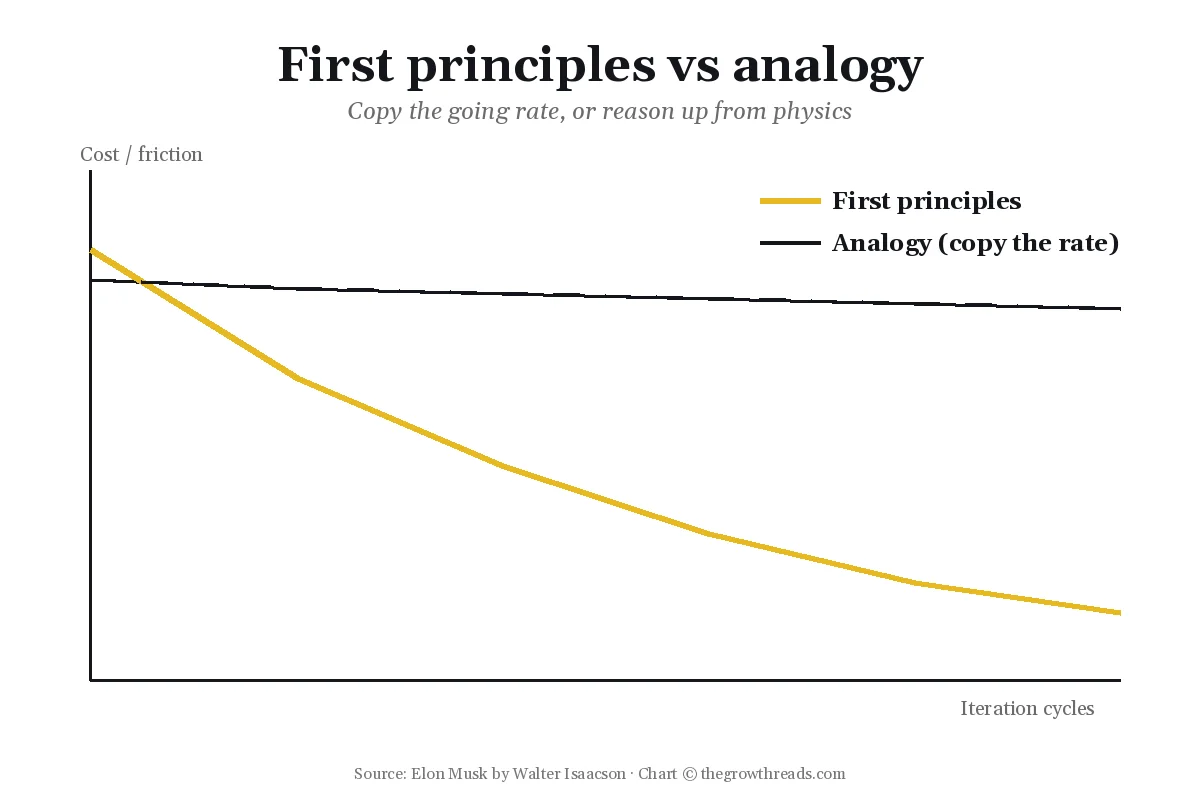
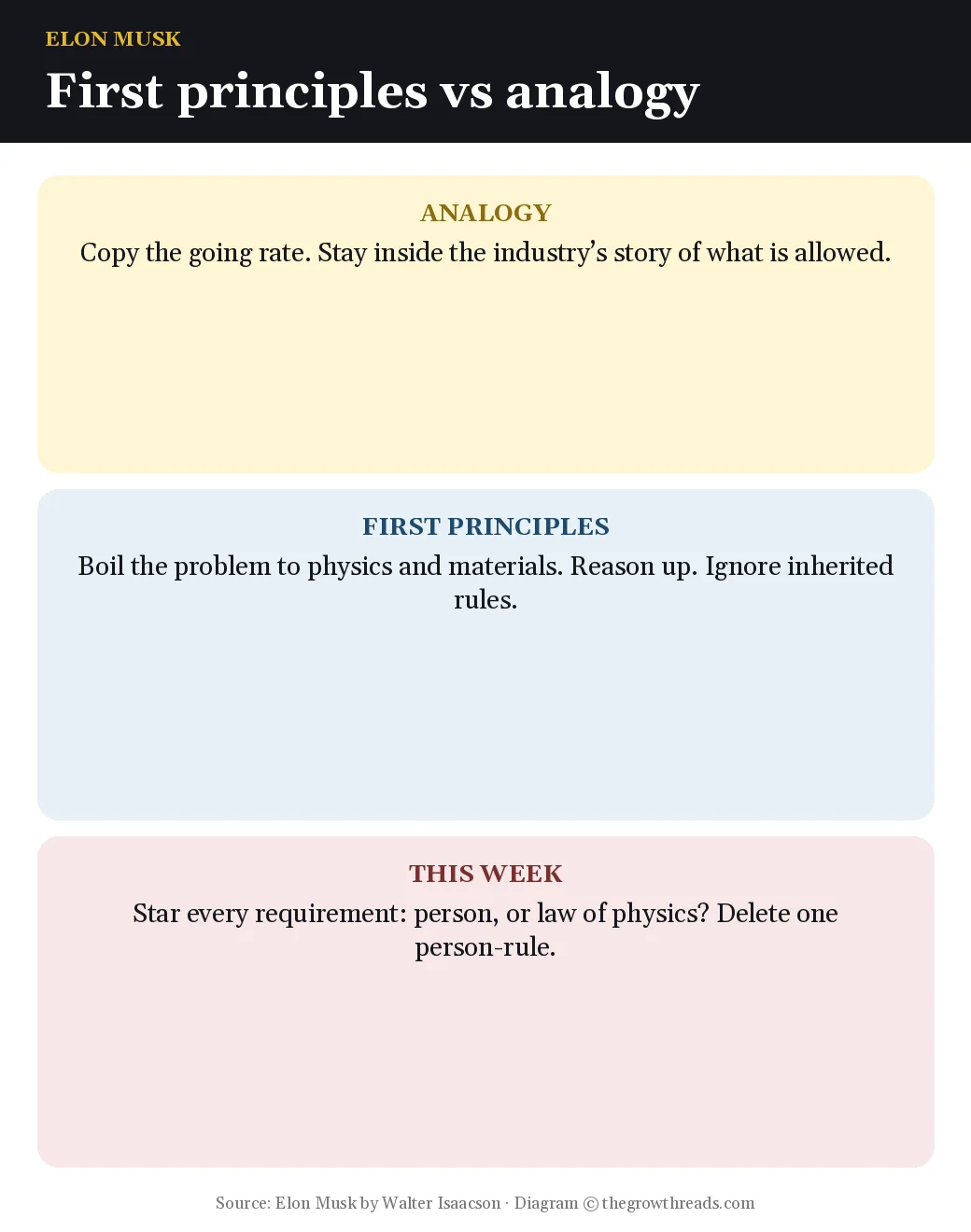
- First principles beat analogy: copy the going rate and you inherit the industry’s ceiling. Boil to physics and materials, then reason up.
- Person-rules are optional: a department’s tradition is not a law. Keep it only if physics or a regulator that can shut you down wrote it.
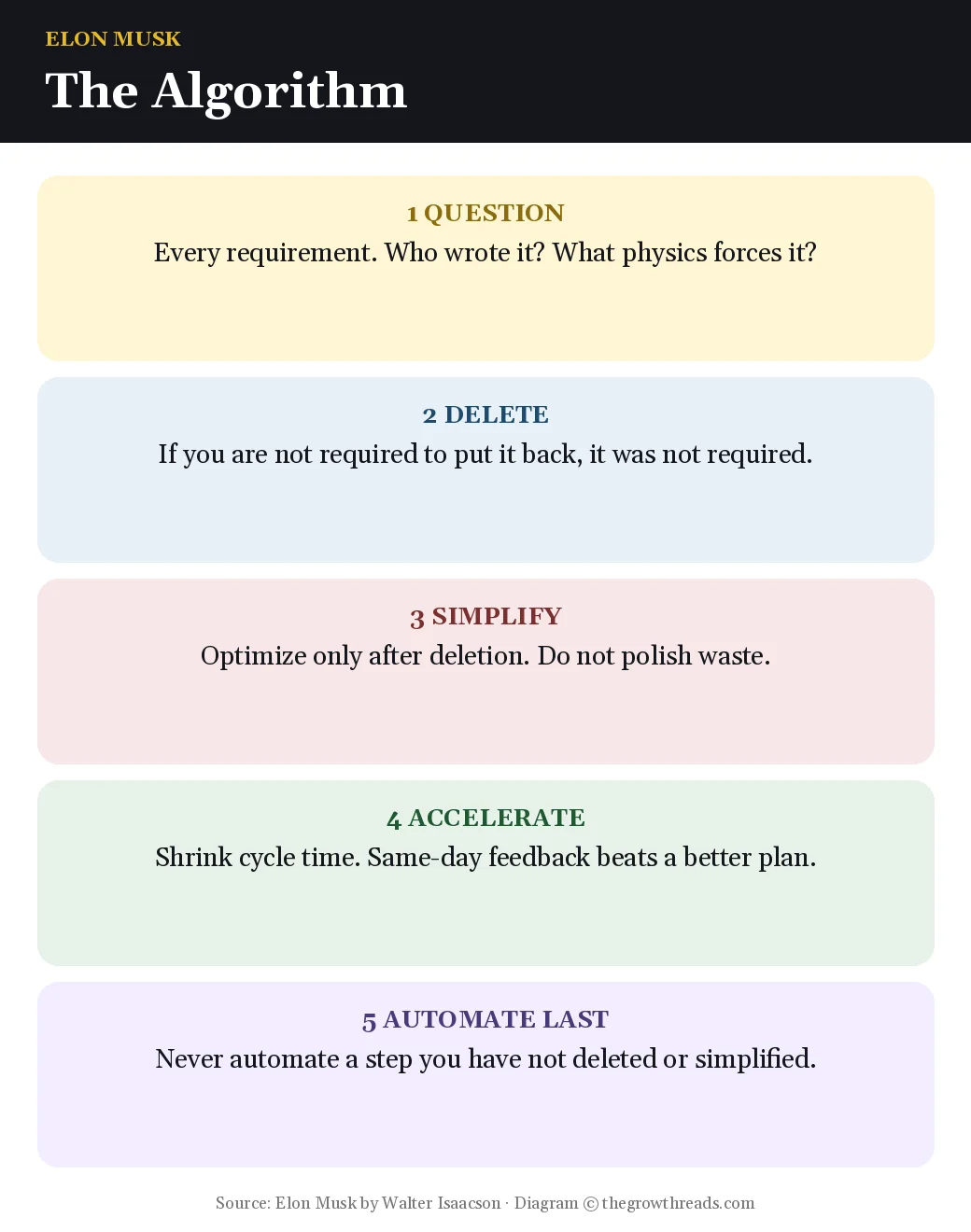
- The Algorithm has an order: question, delete, simplify, accelerate, automate last. Reversing the order polishes waste, then speeds it, then hires a robot to babysit it.
- The delete test: if you are not forced to put the step back, it was never required.
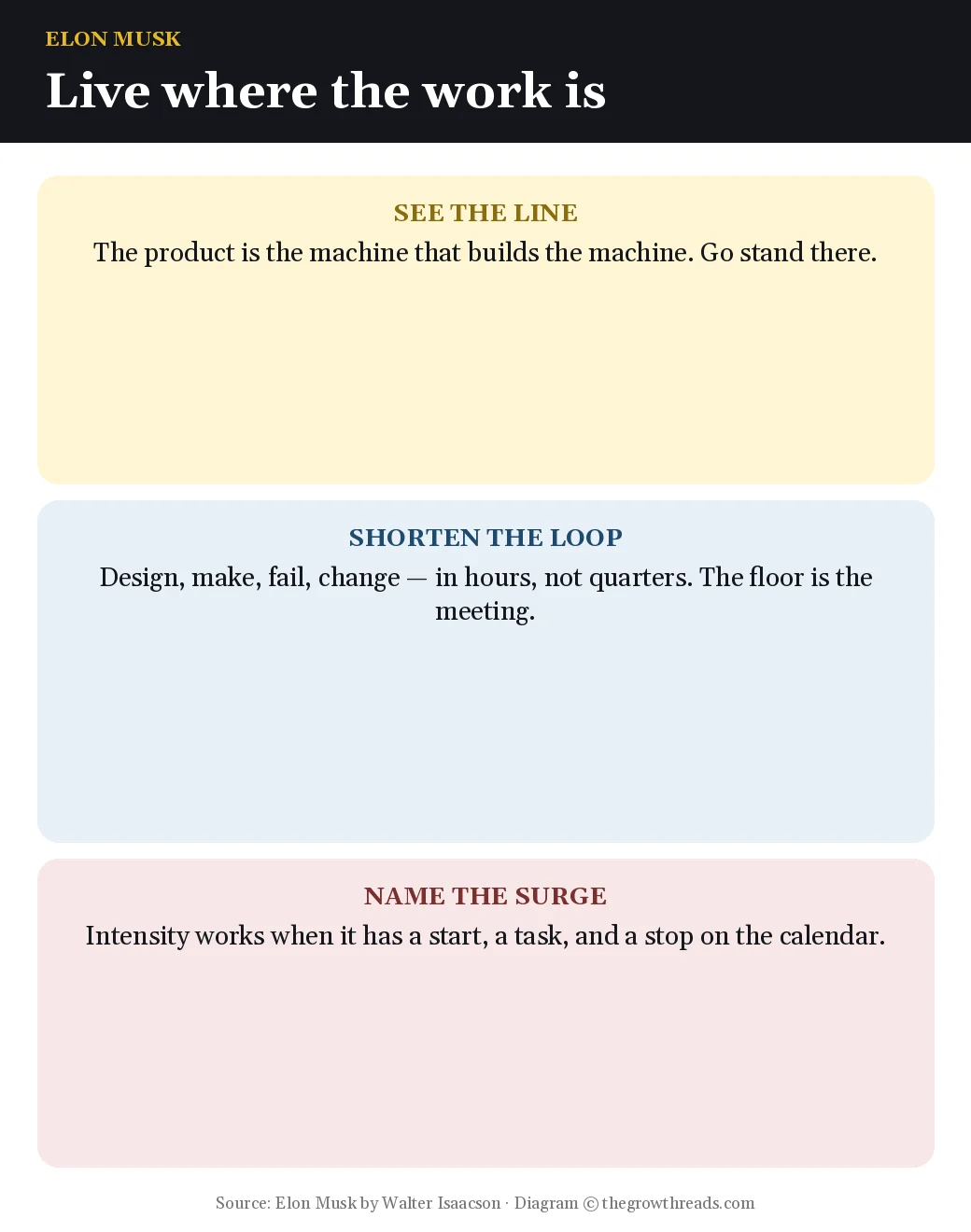
- The product is the line: “the machine that builds the machine” is the real object. The unit you photograph is a lagging indicator.
- Go to the problem: design reviews that never visit the floor are decorating a brochure. Information lives where the work breaks.
- Cycle time is a strategy: same-day feedback beats a prettier quarterly plan. Shrink the loop before you add people.
- Hardware still sets the bill: software helps; atoms, cells, steel, and methane decide whether the physics works.
- Name the surge: intensity is a tool when it has a task, a start, and a stop on the calendar.
- Steal the sequence, not the hours: a 688-page life is a case study. Your week needs one requirement questioned and one loop shortened.
What is Elon Musk about?
Elon Musk is Walter Isaacson’s 2023 authorized biography of the engineer-operator behind PayPal, SpaceX, Tesla, Neuralink, and xAI. It tracks how first principles, factory-floor presence, and a five-step Algorithm — question, delete, simplify, accelerate, automate last — were applied under real constraints, from Pretoria to production hell to orbit.
About the author
Walter Isaacson (born 1952) is an American journalist and biographer who has run CNN, edited TIME, and led the Aspen Institute. He now teaches history at Tulane. His previous lives-on-the-page — Benjamin Franklin, Albert Einstein, Steve Jobs, Leonardo da Vinci, Jennifer Doudna — all ask the same practical question: how does a mind actually work when the materials talk back? Elon Musk (Simon & Schuster, 12 September 2023, 688 pages) is the hardware chapter of that series. Isaacson was given two years of rooms most reporters never see. He writes in scenes, not slogans, so a working adult can lift a sequence off the page and try it on a smaller object the same week. Explore all Walter Isaacson book summaries →
Key concepts at a glance
| Concept | What it means | Use it when |
|---|---|---|
| First principles | Boil the problem to physics and materials, then reason up | The going rate feels like a law |
| Reasoning by analogy | Copying the industry’s story of what things cost and how they must be done | A vendor quote is doing your thinking |
| The Algorithm | Question, delete, simplify, accelerate, automate last | You are about to buy a tool for a sloppy step |
| Delete test | If you need not put it back, it was not required | A process has too many owners |
| Machine that builds the machine | The line is the product; the unit is a lagging photo | Reviews never leave the slide deck |
| Go to the problem | Stand where the work breaks | Status is green and output is not |
| Cycle time | Hours-to-feedback as strategy | The plan is prettier than the loop |
| Named surge | Intensity with a start, a task, and a stop | Urgency has become weather, not a tool |
Part 1: Pretoria to PayPal — first principles as a habit
Isaacson does not start on a launch pad. He starts with a boy in Pretoria who reads, codes, and gets hit — then Canada, Penn, Zip2, and PayPal. The opening is not trauma tourism. It is a mind that already treats inherited rules as optional. If a custom cannot be derived from physics, it can be questioned. That is first principles before it has a slogan.
Zip2 and PayPal are the first public tests. Software still has atoms underneath it — servers, money, fraud, banks that move like glaciers — but the loop is visible. Find the constraint that is a person pretending to be a law. Delete a step the customer does not feel. Shorten the time from idea to a thing in the world. A meeting is not work. A title is not a requirement.
Read the childhood chapters for the habit: when the room says “this is how it is done,” ask who wrote the rule. If the answer is a department, the rule is a candidate for the delete test. If the answer is gravity, voltage, or a regulator who can close the door, keep it and design around it.
TGR Note: Peter Thiel’s Zero to One is the PayPal-era sibling: a contrarian truth you can defend is first principles in company form. Isaacson shows the same move with factories attached. If your problem is still “what do we believe that others treat as impossible?”, start with Thiel, then come back here when the belief has to touch steel.
Part 2: SpaceX — go to the physics, then go to the pad
Aerospace, when Musk enters it, is an analogy business. Rockets cost what the incumbents say they cost. Isaacson shows the rewrite: what do the materials cost, what does the physics require, which heritage rules are just committees? The early Falcon 1 flights fail in public. The useful scene is not the explosion. It is the walk afterward — wreck, weld, supplier — because the information is on the pad, not in the narrative.
Three failures would have ended most analogical firms. The first-principles firm treats a crash as expensive telemetry: fly, fail, change, fly. You cannot do that from an office that receives a PDF. Isaacson keeps putting Musk in the room where the part is made. That is the transferable move. Your “pad” might be a warehouse, a ward, a kitchen, or a staging environment — wherever the object can still say no.
Starlink is the same physics with a different payload: a factory for satellites. The sky is the brochure. The line is the product. Remember the walk to the production problem, not only the launches.
TGR Note: Chris Miller’s Chip War is the atoms-and-nations half of this story: fabs, lithography, and the bill that physics sends to geopolitics. Isaacson’s factories still buy those chips. Read Miller when your bottleneck is the supply of the universe’s hardest parts; read Isaacson when your bottleneck is a requirement nobody can derive from those parts.
Part 3: Tesla — the machine that builds the machine
The Tesla chapters are where the slogan becomes a floor. A car is a photograph. A line that can make the next car cheaper, with fewer touches, is the product. Isaacson spends pages in Fremont during production hell: tents, bottlenecks, a part that looks fine in CAD and fails in a wrist’s worth of motion. “The machine that builds the machine” is a demand to watch one cycle and delete a motion.
This is where the Algorithm gets its scars. Teams automate a mess, speed a step that should have been removed, or simplify a requirement they never questioned. The order — question, delete, simplify, accelerate, automate last — is a sequence, not a poster. Take one process. Ask who wrote each requirement. Delete two. Only then make the remainder faster. Only then, if it is still needed, automate it.
Sleeping in the factory is the scene everyone remembers. The transferable version is smaller: a protected block labelled with the place, not the meeting. Thirty minutes where the ticket breaks. The dashboard is a lagging photo. The line is the news.
TGR Note: Cade Metz’s Genius Makers is the people-and-labs half of the AI boom; Mustafa Suleyman’s The Coming Wave is the containment half. Isaacson’s later chapters walk into that same future through factories and a social network. If you need the research-lab story, start with Metz. If you need what happens when the kit scales past one firm, add Suleyman. Keep Isaacson for the operator’s sequence inside the building.
Part 4: The Algorithm, surge, and the next stack
The last movement stacks Neuralink, the Boring Company, the Twitter purchase, xAI, and Mars. The objects differ. The kit does not. Question the requirement the incumbent treated as sacred. Delete until the remainder is physics plus a promise you can keep. Shorten the loop. Do not automate the feed, the implant, or the tunnel before the step has survived deletion.
Intensity is part of the method. The useful translation is to name it. A surge with a start, a task, and a stop is a tool. Urgency with no stop is weather, and weather cannot be scheduled. Put the stop on the calendar when you put the start.
The closing gift is not a Mars prediction. It is a diagnostic. When a project stalls: What is the physics? Which rule is a person? What can we delete before Friday? Where is the line we have not stood on? Answer those, and the next stack is another factory with a more interesting brochure.
TGR Note: Nick Bostrom’s Superintelligence is the control-problem book you want if the last chapters of Isaacson made you ask what happens when the kit is no longer a car or a rocket. Keep the Algorithm for this week’s line. Add Bostrom when the line is an intelligence you cannot walk over to and unplug with a wrench.
Who is Elon Musk best for — and who should read something else first?
Best for operators, product leads, hardware people, and founders tired of shipping other people’s requirements — and for anyone whose work still touches atoms, or software people who have a “line” they have not visited this month. It is a long book. It pays you if you read it as a case study for a sequence, not as a costume.
Read something else first if you wanted a short media-ecology argument: Amusing Ourselves to Death. If you wanted a startup method with no Pretoria chapter, Zero to One or The Lean Startup. For chip geopolitics, Chip War. For AI containment rather than a builder’s life, Superintelligence or The Coming Wave. Come back to Isaacson when you need to watch the kit fail in public and still run the next loop.
Questions to reflect on
- Which of my current rules was written by a person, and which by physics or a regulator who can shut the door?
- Where is my factory floor this week — the place the work actually breaks — and how many minutes was I there?
- What would I delete by Friday if I had to put it back only when the object forced me to?
- Am I about to automate a step I have not simplified, or speed a step I have not questioned?
- If I run a surge, what is the task, the start, and the stop on the calendar?
🔥 Ready to reason from physics this week?
Get Elon Musk and start reading.
How to apply Elon Musk (7-day plan)
- Day 1 — Star the rules. Pick one live project. List every requirement. Mark P for person, L for physics or a regulator. Do not argue yet. Just label.
- Day 2 — Delete two P-rules. Remove them in a copy of the process, not in a speech. Note what still works. If nothing breaks, they were never required.
- Day 3 — Stand on the line. Thirty protected minutes where the work happens: floor, ward, kitchen, staging, packing table. No status meeting. Write one break you saw.
- Day 4 — First-principles cost. Take one expensive input. Boil it to materials, time, and physics. Write the going rate beside it. Circle the gap.
- Day 5 — Shrink the loop. Take the break from Day 3. Design a same-day feedback path — a photo, a test, a walk. Run it once before sunset.
- Day 6 — Automate nothing. If a tool is on the shopping list, it waits until the step has survived Days 2 and 5. Write “not yet” on the requisition.
- Day 7 — Name a surge. One page: the Algorithm for this project, plus a surge with a start, a task, and a stop. Put the stop on the calendar when you put the start.
Frequently asked questions
What does Isaacson mean by “the Algorithm”?
It is a five-step working order Musk drilled into Tesla and SpaceX, not a software routine. Question every requirement. Delete any part or process you can. Simplify and optimize only after the deletion. Accelerate cycle time. Automate last. Isaacson shows teams getting the order backwards — polishing, then speeding, then automating a step that should have been removed. The practical test is blunt: if you are not forced to put the step back, it was never required. Run the five steps on one process this week before you hire a tool to babysit it.
Is Elon Musk a business book or a biography?
It is a biography you can spend like a working manual. Isaacson follows a life: Pretoria, Zip2, PayPal, SpaceX, Tesla, Neuralink, Starlink, the Twitter purchase, xAI. The application layer is the same kit in every chapter — first principles, the factory floor, the Algorithm, a named surge. If you wanted a 200-page method book with no childhood, this is the wrong object. If you wanted to watch those tools under real constraints, the life is the case study. Read it for the kit, not as a personality to copy hour for hour.
What are first principles in the book?
Reasoning by analogy copies the going rate: batteries cost what batteries cost; rockets cost what aerospace says they cost. First principles boil the thing to physics and materials, then reason up. Carbon fibre, cells, methane, software loops — what does the universe actually charge? Isaacson shows the move in factories and on pads, not only in slogans. For a working week the move is smaller: take one inherited rule, ask who wrote it, and keep it only if physics or a regulator that can shut you down wrote it. Person-rules get a delete trial.
How long is Elon Musk, and is there an audiobook?
The Simon & Schuster hardcover is 688 pages, published 12 September 2023. Most readers need about sixteen hours; this guide is a fourteen-minute working pass. Isaacson reads an Audible edition — useful on walks, weaker for the Algorithm tables you will want to copy onto a page. If you start in audio, pause after each company chapter and write the first-principles move in one sentence before you press play. Keep a pen. The book is long because the factories are long; the kit still fits on one card.
Who should read Elon Musk first?
Builders, operators, and product leads who keep shipping other people’s requirements. Also useful if you work in hardware, energy, or any place where atoms still set the bill. If you wanted media ecology rather than factories, start with Amusing Ourselves to Death. If you wanted AI control theory rather than a builder’s life, start with Superintelligence. If you wanted a short startup method with no Pretoria chapter, Zero to One or The Lean Startup will move faster. Come back to Isaacson when you need to watch the kit under load.
What is “the machine that builds the machine”?
Musk’s phrase, reported throughout the Tesla chapters, for the real product: not the car you photograph, but the line that can make the next one cheaper, faster, and with fewer people touching it. Design reviews that never visit the line are decorating a brochure. Isaacson’s practical translation is attendance. Go stand where the work happens. Watch one cycle. Delete a motion. Shorten the loop until feedback is same-day. Automate only after the motion has earned the right to exist. Software teams have a line too: the place the ticket actually breaks, not the slide that describes it.
How do I apply this without copying someone else’s hours?
Do not copy a 100-hour week. Copy the order of operations. Question the requirement. Delete. Simplify. Accelerate. Automate last. Spend one protected block on the actual line — factory, clinic, codebase, kitchen. Name a surge with a start, a task, and a stop on the calendar so intensity remains a tool. Isaacson is useful here because he shows the kit working when the constraints are ugly: money gone, rocket down, line stopped. You do not need the same constraints. You need the same sequence on a smaller object this week.
Related summaries
- Chip War — the atoms, fabs, and nations underneath every hardware loop.
- The Coming Wave — what happens when the kit scales past one factory.
- Genius Makers — the lab-and-people story of the AI boom Isaacson walks into.
- Superintelligence — the control problem after the line is no longer a car.
Browse every title in our Best AI Books pillar page.
How we analyze books: our summaries are built from a full read of the source text, cross-referenced against the author’s published interviews and research where relevant, and structured around practical application rather than critique. We disclose our editorial process and affiliate relationships in full. Read our full methodology.